Korean Four Character Idioms Flashcards: Study the 26 Cards
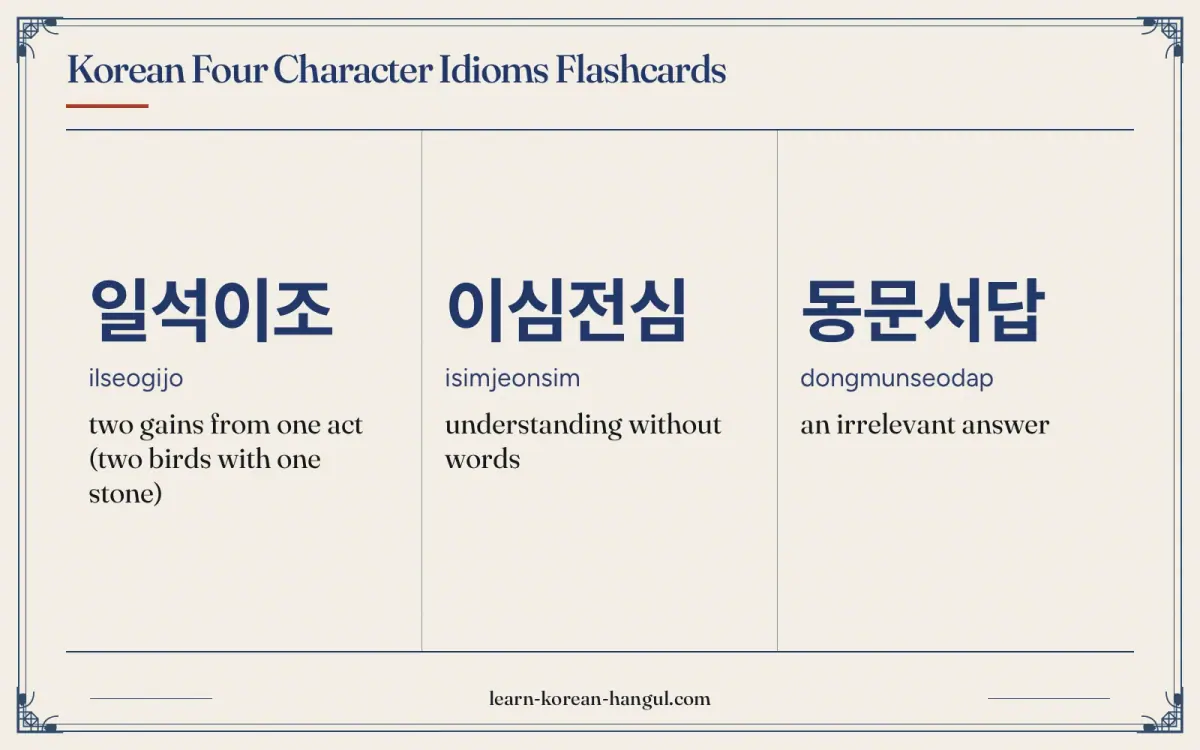
The cards start with everyday phrases such as 일석이조 and 십중팔구 (cards 1 to 5), then phrases about confusion, shared hardship and results (6 to 10), luck, trouble and unity (11 to 15), people and growth (16 to 20), and finish with phrases for describing a person or a situation, from 우유부단 to 이열치열 (21 to 26).
How Do I Use These Flashcards?
Use the deck above in four steps. It works with tap, click or keyboard, and nothing plays until you press an audio button.
- Choose a mode. Start with recognition (Hangul to meaning). Switch to recall (meaning to Hangul) or listening (audio to meaning) once recognition feels easy.
- Show the answer. Say the phrase aloud one syllable at a time, then guess the meaning from the hanja gloss in the Note column. Each syllable is one character, so 일석이조 breaks down as one, stone, two, bird. Then press Show answer (or Space). Turn on the romanization toggle only if you need it; the table below always shows it.
- Grade yourself. Press Got it if you answered correctly without help, or Not yet if you hesitated or guessed.
- Finish the session. A session holds up to 20 cards (you can set 10, 20 or 40). With 26 cards, a first-time learner should expect about 3 days at the default limit of 10 new cards a day, with review sessions on top.
What Do the Three Modes Do?
Recognition shows the Hangul and asks for the meaning, so with the first card it shows 일석이조 and you answer "two gains from one act". Recall reverses this: it shows the meaning and asks for the Hangul, and you may type the answer with your Hangul keyboard or just say it in your head. Listening plays a clip and hides the letters, which trains the sound changes inside four short syllables, such as 작심삼일 sounding like 작씸사밀.
What Do Got It and Not yet Do?
Got it moves a card up one Leitner box, so it comes back later. Not yet sends the card back to box 1, so it returns in the same session or within 10 minutes. The grades are your own judgement; the deck does not score you or claim fluency.
Deck Scope: What Is and Is Not Covered
The deck covers 26 four-character idioms, each written with four Hangul syllables and shown with its hanja. Because every syllable stands for a Chinese character, the phrases are compact and formal. They come up in reading passages, news and speeches. The deck does not try to list the hundreds of 사자성어 in Korean dictionaries, and it leaves out phrases that are mainly found in classical writing.
What Is Left out of This Deck?
Whole sayings in plain Korean words, such as 시작이 반이다, are in the Korean proverbs flashcards. Short phrases you fit into your own sentence, such as 발이 넓다, are in the Korean idioms flashcards. The background and 40 phrases with full examples are in the korean four character idioms lesson.
All 26 Cards in One Table
All 26 cards appear below in deck order. The table is plain HTML, so you can use it as a drill without the deck: cover the Meaning column, say each item aloud, then uncover it.
| # | Hangul | Hanja | Revised Romanization | Meaning | Note | Audio assetId |
|---|---|---|---|---|---|---|
| 1 | 일석이조 | 一石二鳥 | ilseogijo | two gains from one act (two birds with one stone) | [일써기조] Literally: one stone, two birds. 운동하면서 영어 팟캐스트를 들어요. 일석이조예요. (I listen to English podcasts while I work out. Two birds with one stone.) | au-pg-flashcards-four-character-idioms-flashcards-1; slow: au-pg-flashcards-four-character-idioms-flashcards-27 |
| 2 | 이심전심 | 以心傳心 | isimjeonsim | understanding without words | Literally: passing heart to heart. 엄마는 제 마음을 금방 알아요. 이심전심이에요. (Mum knows how I feel straight away. We understand each other without words.) | au-pg-flashcards-four-character-idioms-flashcards-2 |
| 3 | 동문서답 | 東問西答 | dongmunseodap | an irrelevant answer | Literally: asked about the east, answers about the west. 제 질문에 동생이 동문서답을 했어요. (My younger sibling gave an answer that had nothing to do with my question.) | au-pg-flashcards-four-character-idioms-flashcards-3 |
| 4 | 십중팔구 | 十中八九 | sipjungpalgu | most likely; almost certainly | [십쭝팔구] Literally: eight or nine out of ten. 이렇게 구름이 많으면 십중팔구 비가 와요. (With this many clouds, it'll almost certainly rain.) | au-pg-flashcards-four-character-idioms-flashcards-4; slow: au-pg-flashcards-four-character-idioms-flashcards-28 |
| 5 | 작심삼일 | 作心三日 | jaksimsamil | a resolution that does not last | [작씸사밀] Literally: a firm resolve lasts three days. 올해도 다이어트가 작심삼일이었어요. (My diet resolution fizzled out again this year.) | au-pg-flashcards-four-character-idioms-flashcards-5; slow: au-pg-flashcards-four-character-idioms-flashcards-29 |
| 6 | 우왕좌왕 | 右往左往 | uwangjwawang | to run around in confusion | Literally: going right, going left. 갑자기 불이 났어요. 사람들이 우왕좌왕했어요. (A fire suddenly broke out. People ran around in confusion.) | au-pg-flashcards-four-character-idioms-flashcards-6 |
| 7 | 동고동락 | 同苦同樂 | donggodongnak | to go through thick and thin together | [동고동낙] Literally: the same pains, the same joys. 우리는 십 년 동안 동고동락했어요. (We've been through thick and thin together for ten years.) | au-pg-flashcards-four-character-idioms-flashcards-7 |
| 8 | 고진감래 | 苦盡甘來 | gojingamnae | after hardship comes happiness | [고진감내] Literally: bitterness ends, sweetness comes. 삼 년 동안 고생했어요. 드디어 합격했어요. 고진감래예요. (I struggled for three years. I've finally passed. After hardship comes happiness.) | au-pg-flashcards-four-character-idioms-flashcards-8; slow: au-pg-flashcards-four-character-idioms-flashcards-30 |
| 9 | 다다익선 | 多多益善 | dadaikseon | the more, the better | [다다익썬] Literally: the more there are, the better. 친구는 다다익선이에요. (With friends, the more the better.) | au-pg-flashcards-four-character-idioms-flashcards-9 |
| 10 | 자업자득 | 自業自得 | jaeopjadeuk | you reap what you sow | [자업짜득] Literally: your own deeds, your own result. 밤새 게임을 해서 시험을 망쳤어요. 자업자득이에요. (I gamed all night and ruined my exam. I only have myself to blame.) | au-pg-flashcards-four-character-idioms-flashcards-10 |
| 11 | 새옹지마 | 塞翁之馬 | saeongjima | good and bad luck can turn into each other | Literally: the old frontier man's horse. 회사를 그만뒀어요. 그 덕분에 더 좋은 일을 찾았어요. 인생은 새옹지마예요. (I quit my company. Thanks to that, I found a better job. Life's ups and downs are hard to predict.) | au-pg-flashcards-four-character-idioms-flashcards-11 |
| 12 | 설상가상 | 雪上加霜 | seolsanggasang | to make matters worse | [설쌍가상] Literally: frost on top of snow. 길을 잃었어요. 설상가상으로 비까지 왔어요. (I got lost. To make matters worse, it started to rain.) | au-pg-flashcards-four-character-idioms-flashcards-12 |
| 13 | 유비무환 | 有備無患 | yubimuhwan | better safe than sorry (being prepared means no trouble) | Literally: be prepared and there is no trouble. 유비무환이에요. 우산을 챙기세요. (Better safe than sorry. Take an umbrella.) | au-pg-flashcards-four-character-idioms-flashcards-13 |
| 14 | 전화위복 | 轉禍爲福 | jeonhwawibok | a blessing in disguise | Literally: turning misfortune into fortune. 그 실패가 전화위복이 됐어요. (That failure turned out to be a blessing in disguise.) | au-pg-flashcards-four-character-idioms-flashcards-14 |
| 15 | 이구동성 | 異口同聲 | igudongseong | with one voice; unanimously | Literally: different mouths, the same voice. 학생들이 이구동성으로 대답했어요. (The students answered with one voice.) | au-pg-flashcards-four-character-idioms-flashcards-15 |
| 16 | 죽마고우 | 竹馬故友 | jungmagou | a childhood friend | [중마고우] Literally: an old friend from bamboo-horse days. 민호와 저는 죽마고우예요. (Minho and I are childhood friends.) | au-pg-flashcards-four-character-idioms-flashcards-16 |
| 17 | 대기만성 | 大器晩成 | daegimanseong | a late bloomer | Literally: a great vessel is finished late. 그 배우는 마흔 살에 유명해졌어요. 대기만성이에요. (That actor became famous at forty. A true late bloomer.) | au-pg-flashcards-four-character-idioms-flashcards-17 |
| 18 | 일취월장 | 日就月將 | ilchwiwoljang | rapid progress | [일취월짱] Literally: progress by day, advance by month. 한국어 실력이 일취월장했어요. (Your Korean has come on in leaps and bounds.) | au-pg-flashcards-four-character-idioms-flashcards-18; slow: au-pg-flashcards-four-character-idioms-flashcards-31 |
| 19 | 칠전팔기 | 七顚八起 | chiljeonpalgi | never giving up | [칠쩐팔기] Literally: fall seven times, rise eight. 그는 칠전팔기 끝에 꿈을 이뤘어요. (After falling and rising again and again, he achieved his dream.) | au-pg-flashcards-four-character-idioms-flashcards-19 |
| 20 | 외유내강 | 外柔內剛 | oeyunaegang | gentle outside, strong inside | Literally: soft outside, strong inside. 선생님은 조용하지만 외유내강이에요. (My teacher is quiet, but gentle outside and strong inside.) | au-pg-flashcards-four-character-idioms-flashcards-20 |
| 21 | 우유부단 | 優柔不斷 | uyubudan | indecisive | Literally: soft and gentle, not cutting. 저는 우유부단해서 메뉴를 못 골라요. (I'm so indecisive that I can't choose from the menu.) | au-pg-flashcards-four-character-idioms-flashcards-21 |
| 22 | 팔방미인 | 八方美人 | palbangmiin | an all-rounder; good at everything | Literally: a beauty from all eight directions. 제 친구는 노래도 잘하고 요리도 잘해요. 정말 팔방미인이에요. (My friend sings well and cooks well too. A real all-rounder.) | au-pg-flashcards-four-character-idioms-flashcards-22 |
| 23 | 금시초문 | 今始初聞 | geumsichomun | news to me (the first I have heard of it) | Literally: hearing it now for the first time. 그 이야기는 금시초문이에요. (That's the first I've heard of it.) | au-pg-flashcards-four-character-idioms-flashcards-23 |
| 24 | 시행착오 | 試行錯誤 | sihaengchago | trial and error | Literally: trying and making errors. 처음에는 많은 시행착오를 겪었어요. (At first I went through a lot of trial and error.) | au-pg-flashcards-four-character-idioms-flashcards-24 |
| 25 | 과유불급 | 過猶不及 | gwayubulgeup | too much is as bad as too little | Literally: too much is like too little. 운동도 과유불급이에요. 너무 많이 하면 다쳐요. (Exercise too: too much is as bad as too little. Overdo it and you'll get hurt.) | au-pg-flashcards-four-character-idioms-flashcards-25 |
| 26 | 이열치열 | 以熱治熱 | iyeolchiyeol | fight heat with heat | Literally: treat heat with heat. 여름에 삼계탕을 먹어요. 이열치열이에요. (In summer we eat hot ginseng chicken soup. Fighting heat with heat.) | au-pg-flashcards-four-character-idioms-flashcards-26 |
How Do I Read the Table?
Hangul is the expression itself. Revised Romanization (RR) is a learning aid, so try to read the Hangul first. The Hanja column shows the characters as a memory aid. The Meaning column gives the usual meaning, and the Note column starts with the literal picture and then gives an example sentence. Where the spoken sound differs from the spelling, the sound is shown in brackets. The last column lists the audio assetId, and a second ID marks a slow clip (0.8x).
Usage Notes for These Cards
Each syllable is one hanja. 일석이조 is 一石二鳥, literally one stone, two birds. Once you see the pieces, the phrase is easier to remember: 一 (일, one), 石 (석, stone), 二 (이, two), 鳥 (조, bird). Learning the hanja is optional, but the pieces turn four random syllables into a picture.
They work as nouns with 이다. After the phrase you can add 이다: 그건 일석이조예요 (That is two gains in one) and 이심전심이에요 (We understand each other without words). After a vowel the ending is 예요, as in 일석이조예요, and after a consonant it is 이에요, as in 이심전심이에요.
Some become adverbs. 십중팔구 비가 올 거예요 (It will most likely rain) uses the phrase before the sentence. 설상가상으로 비까지 와요 adds the particle 으로 to turn the phrase into an adverb meaning to make matters worse.
Some take 하다 to become verbs or adjectives. 우왕좌왕하다 (to be flustered), 동고동락하다 (to share joys and hardships) and 우유부단하다 (to be indecisive) all add 하다. Not every phrase can do this, so learn each one with the way it is used.
Use them to describe a situation neatly. 작심삼일로 끝났어요 (My resolution ended in three days) says in one word what would take a sentence. They sound formal or literary, so they suit writing, speeches and news more than casual talk.
Which Sounds Do Not Match the Spelling?
Four-syllable phrases hide sound changes at every join, so the spoken form often differs from the spelling. Play the clips and say each phrase after the audio.
일석이조 is said [일써기조]. Two changes happen. The ㅅ of 석 after the final ㄹ of 일 is tensed (일써), and the final ㄱ of 석 moves to the vowel of 이 (기). RR writes ilseogijo and does not show the tensing.
고진감래 is said [고진감내]. The ㄹ of 래 follows the final ㅁ of 감, so it is read as ㄴ. That gives 감내, and RR writes the sound it hears: gojingamnae.
십중팔구 is said [십쭝팔구]. The ㅈ of 중 after the final ㅂ of 십 becomes tense, giving 십쭝. In 팔구, the ㄹ of 팔 does not tense a following ㄱ in Sino-Korean words, so it stays 팔구 and not 팔꾸. RR writes sipjungpalgu.
What Mistakes Do Learners Make with Four-Character Idioms?
- Using them in casual chat with friends, where they can sound stiff. Save phrases such as 과유불급 and 이구동성 for writing, speeches or a serious tone; 일석이조 and 작심삼일 are the friendliest ones.
- Mixing up 동문서답 (an off-topic answer) with 이심전심 (silent understanding). One is about answers that miss the point, the other is about two people who understand each other without talking.
- Writing the hanja wrongly when quoting. Korean text normally uses Hangul alone, so unless you are certain of the characters, write the Hangul and leave the hanja to the dictionary.
- Mixing up phrases that point in opposite directions. 설상가상 means things get worse, while 전화위복 means a disaster turns into a blessing.
- Pronouncing every syllable as it is spelled. 십중팔구 is said [십쭝팔구] and 일취월장 is said [일취월짱]; the audio helps you hear it.
If two cards keep trading places in your head, add a short sentence of your own to each in recall mode.
How Does the Review Schedule Work?
The deck uses a simplified Leitner system with five boxes. A new card starts in box 1. Each Got it moves it up one box, and each Not yet returns it to box 1. The box sets how long the card waits before it is due again.
| Box | Wait until the next review |
|---|---|
| 1 | same session or 10 minutes |
| 2 | 1 day |
| 3 | 3 days |
| 4 | 7 days |
| 5 | 21 days |
Each session shows due cards first, oldest due first, then up to 10 new cards a day by default. A deck of 26 cards is introduced over 3 days at 10 new cards a day, and the later boxes bring every card back at longer gaps. Progress is saved only in this browser, so clearing site data deletes it. Use the export button to save a small file with card IDs, boxes and due dates, and import it on another device. No account is needed.
Cultural and Practical Context
Many four-character idioms come from Chinese classics and history, and many Koreans learn them at school and for exams. Many phrases have an old story behind them, but you do not need the story to use the phrase. They appear in speeches, newspaper columns and everyday advice, and elders often reach for them to sum up a lesson. Using the right phrase at the right moment sounds educated, and over-using them can sound lecturing.
Limits of This Deck
The deck holds 26 phrases and one example for each, so it shows the main sense and not every shade of meaning. The story behind each phrase is not told here. The hanja are shown as a learning aid and are generated text, so they need a Korean-teacher check before publication. The Korean text is AI-assisted and goes through Korean-teacher review before publication, and each audio clip is checked by a Korean teacher before publication.
Next Steps after This Deck
After these korean four character idioms flashcards, return to the Korean proverbs flashcards if a plain-Korean saying still feels shaky, or review the Korean idioms flashcards. The Korean vocabulary flashcards page lists every vocabulary deck, and the Korean flashcards hub lists all topics. The Korean idioms lesson also explains how idioms, proverbs and four-character idioms differ.
Frequently Asked Questions
Do I Need to Know the Hanja?
Not to use the idiom. Korean text normally writes these phrases in Hangul alone, and you can use all 26 cards without reading a single Chinese character. The hanja help you understand why the phrase means what it does, so the table shows them as a memory aid: 一石二鳥 is one stone, two birds.
What Is 사자성어?
A 사자성어 (sajaseongeo) is a set phrase of four syllables, each one matched to a Chinese character (hanja) and read in Korean. Many come from Chinese classics and history, and the meaning is usually not clear from the four syllables alone, so you learn each phrase as a unit.
How Do I Choose between 일석이조 and 일거양득?
Both mean getting two benefits from one action, and Korean speakers use either. 일석이조 (one stone, two birds) is the one most learners meet first, so it is on card 1. 일거양득 (一擧兩得, ilgeoyangdeuk) is the slightly more formal alternative.
Are They Common in Speech?
They appear in formal speech, news, essays and exams more than in casual chat. Some are everyday, such as 일석이조 and 작심삼일, which friends use with a joke. Using a stiff phrase like 이심전심 in a casual chat is possible, but it can sound a bit bookish.
Is My Progress Saved If I Close the Page?
Yes, in the same browser on the same device. Card boxes and due dates are stored locally and nothing is sent to a server. Clearing site data, using a private window or switching browsers removes them, so use the export button to keep a backup file. No account is needed.