
Korean Proverbs at a Glance
A proverb is a complete saying with a lesson inside it. 'The early bird catches the worm' is an English proverb. Korean proverbs work the same way, but their pictures come from village life: rice fields, oxen, tigers, rice cakes and oil lamps. Once you know the picture, the lesson is easy to guess. 소 잃고 외양간 고친다 means 'fixing the cowshed after losing the cow'. You can guess the lesson: acting too late.
Koreans use proverbs to comment on a situation. Someone tells a story, and a listener sums it up with a proverb. Because of that, a proverb usually stands on its own at the end of what you say, in its plain dictionary form. Short proverbs ending in a noun or 이다 often take the polite ending instead: 시작이 반이에요, 티끌 모아 태산이에요.
| Group | Proverbs | What it covers |
|---|---|---|
| Short everyday proverbs | 8 | The sayings you hear most often |
| Proverbs about effort and time | 8 | Persistence, habits and patience |
| Proverbs about speech | 8 | Kind words, rumours and secrets |
| Proverbs about people | 8 | Envy, humility, boasting and teamwork |
| Proverbs with animals | 8 | Cows, whales, monkeys, frogs and dragons |
How a Korean Proverb Is Built
Many proverbs have two halves joined by a connecting ending. The first half sets a condition and the second gives the result.
| Link | Meaning | Example |
|---|---|---|
| -아야/-어야 | only if | 가는 말이 고와야 / 오는 말이 곱다 |
| -(으)면 | if, when | 사촌이 땅을 사면 / 배가 아프다 |
| -고 | and | 낮말은 새가 듣고 / 밤말은 쥐가 듣는다 |
| -아도/-어도 | even if | 열 길 물속은 알아도 / 한 길 사람 속은 모른다 |
Other proverbs are a short noun phrase with no verb at all, such as 티끌 모아 태산 and 제 눈에 안경. The verb is simply understood.
This page belongs to Korean Word Types. Idioms, which describe rather than teach, are on Korean idioms. Two deeper lists go further: Famous Korean proverbs (30 well-known sayings) and Korean proverbs and English equivalents (30 Korean proverbs paired with English sayings, with a note on how close each match is).
Which Korean Proverbs Should You Learn First?
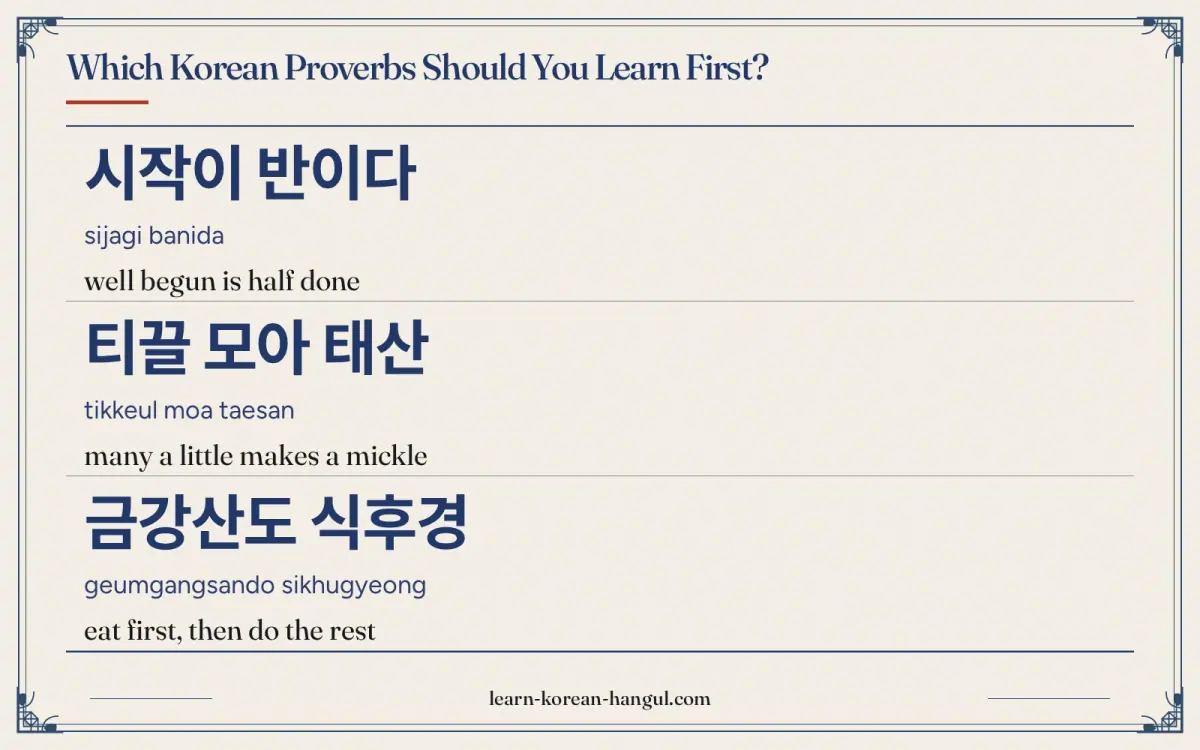
Learn the proverbs you will hear before the ones you will read. Short proverbs come up in conversation, dramas and variety shows almost every day. Longer, bookish proverbs show up in essays, speeches and reading tests, so learn to recognise them first.
- Heard daily. 시작이 반이다, 티끌 모아 태산, 금강산도 식후경, 하늘의 별 따기, 호랑이도 제 말 하면 온다, 세 살 버릇 여든까지 간다.
- Common in speech and writing. 가는 말이 고와야 오는 말이 곱다, 소 잃고 외양간 고친다, 원숭이도 나무에서 떨어진다, 벼는 익을수록 고개를 숙인다.
- Recognise first, mostly in books. 구슬이 서 말이라도 꿰어야 보배, 서당 개 삼 년이면 풍월을 읊는다, 열 길 물속은 알아도 한 길 사람 속은 모른다.
The scene below is a village where each numbered object shows one proverb. Tap a number to hear it.
Word · 10
- 1
시작이 반이다
sijagi banida
well begun is half done
- 2
티끌 모아 태산
tikkeul moa taesan
many a little makes a mickle
- 3
금강산도 식후경
geumgangsando sikhugyeong
eat first, then do the rest
- 4
등잔 밑이 어둡다
deungjan michi eodupda
the thing you seek is often right under your nose
- 5
낮말은 새가 듣고 밤말은 쥐가 듣는다
nanmareun saega deutgo bammareun jwiga deunneunda
walls have ears
- 6
소 잃고 외양간 고친다
so ilko oeyanggan gochinda
to lock the stable door after the horse has bolted
- 7
고래 싸움에 새우 등 터진다
gorae ssaume saeu deung teojinda
the small get hurt when the powerful fight
- 8
원숭이도 나무에서 떨어진다
wonsungido namueseo tteoreojinda
even experts make mistakes
- 9
벼는 익을수록 고개를 숙인다
byeoneun igeulsurok gogaereul suginda
the wiser you are, the humbler you are
- 10
개천에서 용 난다
gaecheoneseo yong nanda
a great person can come from humble beginnings
Short Everyday Proverbs
These eight proverbs are short, so they fit easily into a conversation. Several end in a noun, such as 태산 (a great mountain) or 식후경 (sightseeing after a meal). That lets speakers add the polite ending 이에요 or 예요 straight onto them.
| No. | Hangul | Revised Romanization | Literally | Meaning and note | Example sentence | Audio assetId |
|---|---|---|---|---|---|---|
| 1 | 시작이 반이다 | sijagi banida [시자기 바니다] | the start is half | well begun is half done. Heard daily. Said to encourage someone who has just started something. | 오늘 처음 운동했어요. 시작이 반이에요! (I worked out for the first time today. Well begun is half done!) | au-pg-vocabulary-word-types-proverbs-1; example: au-pg-vocabulary-word-types-proverbs-41 |
| 2 | 티끌 모아 태산 | tikkeul moa taesan | gather dust and make a great mountain | many a little makes a mickle. Heard daily, especially about saving money. | 티끌 모아 태산이에요. 매일 조금씩 저축해요. (Many a little makes a mickle. I save a little every day.) | au-pg-vocabulary-word-types-proverbs-2; example: au-pg-vocabulary-word-types-proverbs-42 |
| 3 | 금강산도 식후경 | geumgangsando sikhugyeong [금강산도 시쿠경] | even Mount Geumgang is sightseeing after a meal | eat first, then do the rest. Heard daily, often as a joke when people are hungry. 식후경 is Sino-Korean for 'view after eating'. | 구경은 나중에 해요. 금강산도 식후경이에요. (Let's look around later. Food comes first.) | au-pg-vocabulary-word-types-proverbs-3; example: au-pg-vocabulary-word-types-proverbs-43 |
| 4 | 백문이 불여일견 | baengmuni buryeoilgyeon [뱅무니 부려일견] | a hundred hearings are not as good as one seeing | seeing is believing. Common in speech and writing. A Sino-Korean saying borrowed from Classical Chinese. | 백문이 불여일견이에요. 직접 가서 보세요. (Seeing is believing. Go and see it yourself.) | au-pg-vocabulary-word-types-proverbs-4; example: au-pg-vocabulary-word-types-proverbs-44 |
| 5 | 하늘의 별 따기 | haneurui byeol ttagi [하느릐 별 따기], also [하느레 별 따기] | picking a star from the sky | next to impossible. Heard daily. Used for jobs, tickets and flats that are hard to get. | 요즘 서울에서 집 사기는 하늘의 별 따기예요. (Buying a home in Seoul these days is next to impossible.) | au-pg-vocabulary-word-types-proverbs-5; example: au-pg-vocabulary-word-types-proverbs-45 |
| 6 | 등잔 밑이 어둡다 | deungjan michi eodupda [등잔 미치 어둡따] | it is dark under the oil lamp | the thing you seek is often right under your nose. Heard daily when something lost turns up close by. | 한참 안경을 찾았어요. 그런데 머리 위에 있었어요. 등잔 밑이 어두워요. (I looked for my glasses for ages. They were on my head. It's always right under your nose.) | au-pg-vocabulary-word-types-proverbs-6; example: au-pg-vocabulary-word-types-proverbs-46 |
| 7 | 아니 땐 굴뚝에 연기 날까 | ani ttaen gulttuge yeongi nalkka [아니 땐 굴뚜게 연기 날까] | would smoke rise from a chimney with no fire lit? | there's no smoke without fire. Common. Said when a rumour seems to have some truth in it. | 소문이 계속 나요. 아니 땐 굴뚝에 연기 날까. (The rumours keep coming. There's no smoke without fire.) | au-pg-vocabulary-word-types-proverbs-7; example: au-pg-vocabulary-word-types-proverbs-47 |
| 8 | 누워서 침 뱉기 | nuwoseo chim baetgi [누워서 침 밷끼] | spitting while lying down | harming yourself by attacking others. Common. Spit thrown upward lands on your own face. | 회사 욕을 하는 건 누워서 침 뱉기예요. (Badmouthing your own company only hurts you.) | au-pg-vocabulary-word-types-proverbs-8; example: au-pg-vocabulary-word-types-proverbs-48 |
Example Sentences
In each sentence the proverb sums up the situation, either before or after it. Play each one, say it aloud, then use the proverb to comment on something in your own week.
오늘 처음 운동했어요. 시작이 반이에요!
oneul cheoeum undonghaesseoyo. sijagi banieyo!
I worked out for the first time today. Well begun is half done!
티끌 모아 태산이에요. 매일 조금씩 저축해요.
tikkeul moa taesanieyo. maeil jogeumssik jeochukaeyo.
Many a little makes a mickle. I save a little every day.
Two of these are Sino-Korean sayings: 금강산도 식후경 ends in a Sino-Korean word, and 백문이 불여일견 is borrowed whole from Classical Chinese. You will find more sayings like these in Korean four character idioms.
How Do You Say Proverbs about Effort and Time in Korean?
Effort proverbs are the ones teachers and parents quote most. They praise patience, focus and hard work, and they warn that habits stick. Several use old units: 리 for distance, 말 for volume. You don't need to know the exact size. Just know that 천 리 is a very long way.
| No. | Hangul | Revised Romanization | Literally | Meaning and note | Example sentence | Audio assetId |
|---|---|---|---|---|---|---|
| 9 | 천 리 길도 한 걸음부터 | cheon ri gildo han georeumbuteo [철리 길도 한 거름부터] | even a thousand-li road starts with one step | a journey of a thousand miles begins with a single step. Common. A 리 (li) is an old unit of distance. | 한국어가 어려워요? 천 리 길도 한 걸음부터예요. (Is Korean hard? A journey of a thousand miles begins with one step.) | au-pg-vocabulary-word-types-proverbs-9; example: au-pg-vocabulary-word-types-proverbs-49 |
| 10 | 고생 끝에 낙이 온다 | gosaeng kkeute nagi onda [고생 끄테 나기 온다] | at the end of hardship, joy comes | after hardship comes happiness. Common. Used to comfort someone going through a hard time. | 고생 끝에 낙이 온다. 조금만 더 힘내요. (After hardship comes happiness. Hang in there a little longer.) | au-pg-vocabulary-word-types-proverbs-10; example: au-pg-vocabulary-word-types-proverbs-50 |
| 11 | 열 번 찍어 안 넘어가는 나무 없다 | yeol beon jjigeo an neomeoganeun namu eopda [열뻔 찌거 안 너머가는 나무 업따] | no tree fails to fall after ten chops | persistence always wins. Common. Also used, jokingly, about winning someone's heart. | 열 번 찍어 안 넘어가는 나무 없다. 계속 도전하세요. (Persistence always wins. Keep trying.) | au-pg-vocabulary-word-types-proverbs-11; example: au-pg-vocabulary-word-types-proverbs-51 |
| 12 | 우물을 파도 한 우물을 파라 | umureul pado han umureul para [우무를 파도 한 우무를 파라] | if you dig a well, dig one well | stick to one thing and master it. Common, slightly bookish. Advice against jumping between goals. | 우물을 파도 한 우물을 파라. 저는 십 년 동안 피아노만 쳤어요. (Stick to one thing. I played only the piano for ten years.) | au-pg-vocabulary-word-types-proverbs-12; example: au-pg-vocabulary-word-types-proverbs-52 |
| 13 | 공든 탑이 무너지랴 | gongdeun tabi muneojirya [공든 타비 무너지랴] | would a carefully built tower collapse? | hard work never goes to waste. Common in encouragement before exams. The ending -랴 is an old rhetorical question. | 삼 년 동안 열심히 준비했어요. 공든 탑이 무너지랴! (I prepared hard for three years. Hard work never goes to waste!) | au-pg-vocabulary-word-types-proverbs-13; example: au-pg-vocabulary-word-types-proverbs-53 |
| 14 | 구슬이 서 말이라도 꿰어야 보배 | guseuri seo marirado kkweeoya bobae [구스리 서 마리라도 꿰어야 보배] | three mal of beads are only treasure once strung | talent is worth nothing until you use it. Common, slightly bookish. A 말 (mal) is an old measure of volume. | 좋은 계획이 많아요? 구슬이 서 말이라도 꿰어야 보배예요. (Lots of good plans? They're worth nothing until you act on them.) | au-pg-vocabulary-word-types-proverbs-14; example: au-pg-vocabulary-word-types-proverbs-54 |
| 15 | 쇠뿔도 단김에 빼라 | soeppuldo dangime ppaera [쇠뿔도 단기메 빼라] | pull out the ox horn while it is hot | strike while the iron is hot. Common, slightly old-fashioned. 단김 is the heat of the moment. | 쇠뿔도 단김에 빼라. 오늘 바로 신청해요. (Strike while the iron is hot. Let's apply today.) | au-pg-vocabulary-word-types-proverbs-15; example: au-pg-vocabulary-word-types-proverbs-55 |
| 16 | 세 살 버릇 여든까지 간다 | se sal beoreut yeodeunkkaji ganda | a habit at three lasts until eighty | old habits die hard. Heard daily, often by parents. | 세 살 버릇 여든까지 간다. 어릴 때 좋은 습관을 만들어요. (Old habits die hard. Build good habits when you're young.) | au-pg-vocabulary-word-types-proverbs-16; example: au-pg-vocabulary-word-types-proverbs-56 |
Proverbs about Speech
Korean culture puts a lot of weight on how you speak, and so do its proverbs. They warn that rumours spread (발 없는 말이 천 리 간다), that secrets leak (낮말은 새가 듣고 밤말은 쥐가 듣는다) and that tone matters as much as content (아 다르고 어 다르다).
| No. | Hangul | Revised Romanization | Literally | Meaning and note | Example sentence | Audio assetId |
|---|---|---|---|---|---|---|
| 17 | 가는 말이 고와야 오는 말이 곱다 | ganeun mari gowaya oneun mari gopda [가는 마리 고와야 오는 마리 곱따] | words that go must be kind for words that come to be kind | kind words get kind words back. Heard daily. The most quoted proverb about speech. | 가는 말이 고와야 오는 말이 곱다. 친구에게 먼저 친절하게 말해요. (Kind words get kind words. Speak kindly to your friends first.) | au-pg-vocabulary-word-types-proverbs-17; example: au-pg-vocabulary-word-types-proverbs-57 |
| 18 | 낮말은 새가 듣고 밤말은 쥐가 듣는다 | nanmareun saega deutgo bammareun jwiga deunneunda [난마른 새가 듣꼬 밤마른 쥐가 든는다] | birds hear day talk and mice hear night talk | walls have ears. Common. A reminder that secrets spread. | 낮말은 새가 듣고 밤말은 쥐가 듣는다. 비밀은 조용히 말해요. (Walls have ears. Tell secrets quietly.) | au-pg-vocabulary-word-types-proverbs-18; example: au-pg-vocabulary-word-types-proverbs-58 |
| 19 | 말 한마디로 천 냥 빚을 갚는다 | mal hanmadiro cheon nyang bijeul gamneunda [말 한마디로 천 냥 비즐 감는다] | one word pays off a debt of a thousand nyang | a kind word can work wonders. Common. A 냥 (nyang) is an old coin. | 사과 한마디가 중요해요. 말 한마디로 천 냥 빚을 갚는다. (One word of apology matters. A kind word can work wonders.) | au-pg-vocabulary-word-types-proverbs-19; example: au-pg-vocabulary-word-types-proverbs-59 |
| 20 | 발 없는 말이 천 리 간다 | bal eomneun mari cheon ri ganda [발 엄는 마리 철리 간다] | words without feet travel a thousand li | word travels fast. Heard daily. It plays on 말, which means both 'words' and 'horse'. | 벌써 모두 알아요? 발 없는 말이 천 리 간다. (Everyone knows already? Word travels fast.) | au-pg-vocabulary-word-types-proverbs-20; example: au-pg-vocabulary-word-types-proverbs-60 |
| 21 | 웃는 얼굴에 침 못 뱉는다 | unneun eolgure chim mot baenneunda [운는 얼구레 침 몯 밴는다] | you can't spit on a smiling face | it's hard to be angry with someone who is friendly. Common. Advice to stay pleasant in a conflict. | 그 사람이 웃으면서 사과했어요. 웃는 얼굴에 침 못 뱉는다. (He apologised with a smile. You can't stay angry at a smiling face.) | au-pg-vocabulary-word-types-proverbs-21; example: au-pg-vocabulary-word-types-proverbs-61 |
| 22 | 호랑이도 제 말 하면 온다 | horangido je mal hamyeon onda | even a tiger comes when you talk about it | speak of the devil. Heard daily. Often quoted as 호랑이도 제 말 하면 온다더니 (speak of the devil, as they say). | 방금 민수 씨 이야기를 했어요. 그런데 민수 씨가 왔어요! 호랑이도 제 말 하면 온다. (We were just talking about Minsu. Then Minsu walked in! Speak of the devil.) | au-pg-vocabulary-word-types-proverbs-22; example: au-pg-vocabulary-word-types-proverbs-62 |
| 23 | 말이 씨가 된다 | mari ssiga doenda [마리 씨가 된다] | words become seeds | be careful what you say; words can come true. Heard daily, often when someone says something unlucky. | 나쁜 말은 조심해요. 말이 씨가 된다. (Watch out for bad words. Words can come true.) | au-pg-vocabulary-word-types-proverbs-23; example: au-pg-vocabulary-word-types-proverbs-63 |
| 24 | 아 다르고 어 다르다 | a dareugo eo dareuda | 아 is different and 어 is different | it's not what you say but how you say it. Common. Two vowels that look alike change the feel of a word. | 같은 내용도 부드럽게 말해요. 아 다르고 어 다르다. (Say even the same thing gently. How you say it matters.) | au-pg-vocabulary-word-types-proverbs-24; example: au-pg-vocabulary-word-types-proverbs-64 |
가는 말이 고와야 오는 말이 곱다. 친구에게 먼저 친절하게 말해요.
ganeun mari gowaya oneun mari gopda. chinguege meonjeo chinjeolhage malhaeyo.
Kind words get kind words. Speak kindly to your friends first.
The pun in 발 없는 말이 천 리 간다 is worth knowing. 말 means both 'words' and 'horse'. A horse needs feet to travel, but words have no feet and still travel a thousand li.
How Do You Say Proverbs about People in Korean?
People proverbs describe character: the boaster, the humble expert, the envious cousin and the friend you never really knew. They are useful for talking about others without naming a fault directly. The proverb carries the criticism, so it sounds softer.
| No. | Hangul | Revised Romanization | Literally | Meaning and note | Example sentence | Audio assetId |
|---|---|---|---|---|---|---|
| 25 | 빈 수레가 요란하다 | bin surega yoranhada | an empty cart is noisy | empty vessels make the most noise. Common. Said about people who boast but know little. | 그 사람은 말만 많아요. 빈 수레가 요란해요. (He's all talk. Empty vessels make the most noise.) | au-pg-vocabulary-word-types-proverbs-25; example: au-pg-vocabulary-word-types-proverbs-65 |
| 26 | 낫 놓고 기역 자도 모른다 | nat noko giyeok jado moreunda [낟 노코 기역 짜도 모른다] | putting down a sickle yet not knowing the letter ㄱ | to know nothing at all about something. Heard daily. A sickle (낫) is shaped like the letter ㄱ, whose name is 기역. | 저는 컴퓨터는 낫 놓고 기역 자도 몰라요. (I know absolutely nothing about computers.) | au-pg-vocabulary-word-types-proverbs-26; example: au-pg-vocabulary-word-types-proverbs-66 |
| 27 | 사촌이 땅을 사면 배가 아프다 | sachoni ttangeul samyeon baega apeuda [사초니 땅을 사면 배가 아프다] | when your cousin buys land, your stomach hurts | people envy others' success. Heard daily. The source of the idiom 배가 아프다 (to be jealous). | 사촌이 땅을 사면 배가 아프다. 그래도 친구의 성공을 축하해요. (People envy others' success. Still, congratulate your friend.) | au-pg-vocabulary-word-types-proverbs-27; example: au-pg-vocabulary-word-types-proverbs-67 |
| 28 | 벼는 익을수록 고개를 숙인다 | byeoneun igeulsurok gogaereul suginda [벼는 이글쑤록 고개를 수긴다] | the riper the rice, the lower it bows its head | the wiser you are, the humbler you are. Common in speech and writing. Used as praise. | 그 교수님은 정말 겸손해요. 벼는 익을수록 고개를 숙인다. (That professor is truly humble. The wise bow lowest.) | au-pg-vocabulary-word-types-proverbs-28; example: au-pg-vocabulary-word-types-proverbs-68 |
| 29 | 제 눈에 안경 | je nune angyeong [제 누네 안경] | glasses for my own eyes | beauty is in the eye of the beholder. Heard daily. Said about personal taste. | 저는 이 그림이 정말 좋아요. 제 눈에 안경이에요. (I really like this painting. Beauty is in the eye of the beholder.) | au-pg-vocabulary-word-types-proverbs-29; example: au-pg-vocabulary-word-types-proverbs-69 |
| 30 | 남의 떡이 더 커 보인다 | namui tteogi deo keo boinda [나믜 떠기 더 커 보인다], also [나메] | someone else's rice cake looks bigger | the grass is always greener on the other side. Heard daily. | 남의 떡이 더 커 보인다. 제 직장도 사실 좋아요. (The grass is always greener. My own job is actually good.) | au-pg-vocabulary-word-types-proverbs-30; example: au-pg-vocabulary-word-types-proverbs-70 |
| 31 | 백지장도 맞들면 낫다 | baekjijangdo matdeulmyeon natda [백찌장도 맏뜰면 낟따] | even a sheet of paper is easier lifted together | many hands make light work. Common. 백지장 is one sheet of blank paper. | 같이 하면 금방 끝나요. 백지장도 맞들면 낫다. (If we do it together it'll be done soon. Many hands make light work.) | au-pg-vocabulary-word-types-proverbs-31; example: au-pg-vocabulary-word-types-proverbs-71 |
| 32 | 열 길 물속은 알아도 한 길 사람 속은 모른다 | yeol gil mulsogeun arado han gil saram sogeun moreunda [열 길 물쏘근 아라도 한 길 사람 소근 모른다] | you can know water ten fathoms deep, but not a person one fathom deep | you can never truly know another person's mind. Common, slightly bookish. A 길 is an old measure of depth. | 그 친구를 십 년 알았어요. 그런데 그 마음은 몰랐어요. (I knew that friend for ten years. But I never knew her heart.) | au-pg-vocabulary-word-types-proverbs-32; example: au-pg-vocabulary-word-types-proverbs-72 |
Proverbs with Animals
Animals in Korean proverbs come from the farm and the sea: cows, pheasants, frogs, crayfish, whales and shrimp. The dragon (용) in 개천에서 용 난다 stands for greatness, and the tiger (호랑이) from the speech group is the classic animal of Korean folk tales.
| No. | Hangul | Revised Romanization | Literally | Meaning and note | Example sentence | Audio assetId |
|---|---|---|---|---|---|---|
| 33 | 소 잃고 외양간 고친다 | so ilko oeyanggan gochinda [소 일코 외양간 고친다] | fixing the cowshed after losing the cow | to lock the stable door after the horse has bolted. Heard daily, often in the news after a preventable accident. | 집에 도둑이 들었어요. 그 다음에 문을 고쳤어요. 소 잃고 외양간 고친다. (A burglar got into our house. Only then did we fix the door. Too little, too late.) | au-pg-vocabulary-word-types-proverbs-33; example: au-pg-vocabulary-word-types-proverbs-73 |
| 34 | 고래 싸움에 새우 등 터진다 | gorae ssaume saeu deung teojinda [고래 싸우메 새우 등 터진다] | when whales fight, the shrimp's back bursts | the small get hurt when the powerful fight. Common. Used about family quarrels and about large countries or companies. | 부모님이 싸우면 아이들이 힘들어요. 고래 싸움에 새우 등 터진다. (When parents fight, the children suffer. The small get hurt in big fights.) | au-pg-vocabulary-word-types-proverbs-34; example: au-pg-vocabulary-word-types-proverbs-74 |
| 35 | 원숭이도 나무에서 떨어진다 | wonsungido namueseo tteoreojinda [원숭이도 나무에서 떠러진다] | even monkeys fall from trees | even experts make mistakes. Heard daily, kindly, after a skilled person slips up. | 요리사도 가끔 실수해요. 원숭이도 나무에서 떨어진다. (Even chefs make mistakes sometimes. Nobody's perfect.) | au-pg-vocabulary-word-types-proverbs-35; example: au-pg-vocabulary-word-types-proverbs-75 |
| 36 | 꿩 먹고 알 먹고 | kkwong meokgo al meokgo [꿩 먹꼬 알 먹꼬] | eat the pheasant and eat the eggs | to kill two birds with one stone. Heard daily. The four-character idiom 일석이조 means the same. | 자전거로 출근해요. 운동도 하고 돈도 아껴요. 꿩 먹고 알 먹고! (I cycle to work. I get exercise and save money. Two birds with one stone!) | au-pg-vocabulary-word-types-proverbs-36; example: au-pg-vocabulary-word-types-proverbs-76 |
| 37 | 개구리 올챙이 적 생각 못 한다 | gaeguri olchaengi jeok saenggak mot handa [개구리 올챙이 적 생각 모탄다] | the frog forgets it was once a tadpole | people forget their own humble beginnings. Common. Said about someone who now looks down on beginners. | 부장님도 신입 때 실수가 많았어요. 개구리 올챙이 적 생각 못 한다. (The manager made lots of mistakes as a new hire too. People forget where they started.) | au-pg-vocabulary-word-types-proverbs-37; example: au-pg-vocabulary-word-types-proverbs-77 |
| 38 | 서당 개 삼 년이면 풍월을 읊는다 | seodang gae sam nyeonimyeon pungworeul eumneunda [서당 개 삼 녀니면 풍워를 음는다] | a dog at a village school recites poems after three years | you pick up a skill just by being around it. Common, slightly bookish. A 서당 was a traditional village school. | 카페에서 삼 년 일했어요. 이제 커피 맛을 알아요. 서당 개 삼 년이면 풍월을 읊는다. (I worked in a café for three years. Now I know coffee. You learn just by being around it.) | au-pg-vocabulary-word-types-proverbs-38; example: au-pg-vocabulary-word-types-proverbs-78 |
| 39 | 가재는 게 편 | gajaeneun ge pyeon | the crayfish takes the crab's side | birds of a feather stick together. Heard daily. Said when people side with their own kind. | 형제는 서로 편을 들어요. 가재는 게 편이에요. (Brothers take each other's side. Birds of a feather stick together.) | au-pg-vocabulary-word-types-proverbs-39; example: au-pg-vocabulary-word-types-proverbs-79 |
| 40 | 개천에서 용 난다 | gaecheoneseo yong nanda [개처네서 용 난다] | a dragon rises from a small stream | a great person can come from humble beginnings. Common, often in news stories and debates about opportunity. | 작은 시골 마을에서 유명한 과학자가 나왔어요. 개천에서 용 났어요. (A famous scientist came from a small country village. A great person from humble beginnings.) | au-pg-vocabulary-word-types-proverbs-40; example: au-pg-vocabulary-word-types-proverbs-80 |
Which Proverbs Are Said Aloud and Which Are Written?
Most proverbs on this page are fine in everyday speech. A few belong more to writing, speeches and school lessons. The labels below are editorial guidance, not dictionary labels.
| Use | Proverbs | Advice |
|---|---|---|
| Heard daily | 시작이 반이다, 티끌 모아 태산, 하늘의 별 따기, 호랑이도 제 말 하면 온다, 꿩 먹고 알 먹고 | Use freely with friends and colleagues |
| Common in speech and writing | 소 잃고 외양간 고친다, 고래 싸움에 새우 등 터진다, 벼는 익을수록 고개를 숙인다, 백문이 불여일견 | Natural in conversation and in the news |
| Mostly in writing and speeches | 구슬이 서 말이라도 꿰어야 보배, 서당 개 삼 년이면 풍월을 읊는다, 열 길 물속은 알아도 한 길 사람 속은 모른다 | Recognise first; quote with care |
| Slightly old-fashioned | 쇠뿔도 단김에 빼라, 공든 탑이 무너지랴 | Understood by all; heard more from older speakers |
Cutting a Proverb Short
Speakers often say only the first half of a long proverb. 호랑이도 제 말 하면… or 가는 말이 고와야… is enough, because everyone knows the ending. Learners should still learn the whole proverb, since you need it to understand the half. A common way to quote one is to add -더니 or -다고 to the plain form, as in 호랑이도 제 말 하면 온다더니 (Speak of the devil, they say). These quoting endings are a grammar topic of their own, so this page sticks to the plain proverb.
How Do You Pronounce These Proverbs?
Proverbs are full sentences, so they collect many sound changes. The Standard Pronunciation Rules (표준 발음법) of the National Institute of Korean Language (국립국어원) are the reference. The romanization follows the Revised Romanization of Korean. It writes each spaced word separately and does not show tensing caused by a neighbouring sound.
- Linking. A final consonant moves to a following vowel: 시작이 [시자기], 말이 [마리], 낙이 [나기].
- Nasal assimilation. Before ㄴ or ㅁ, a final stop becomes a nasal: 백문 [뱅문], 듣는다 [든는다], 갚는다 [감는다], 읊는다 [음는다]. The romanization shows this: baengmun, deunneunda, gamneunda, eumneunda.
- ㄹ and ㄴ together. ㄴ next to ㄹ becomes ㄹ: 천 리 is said [철리]. Because the two words are spaced, the romanization still writes cheon ri.
- Aspiration. ㅎ joins a following ㄱ or ㄷ: 잃고 [일코], 놓고 [노코]. Revised Romanization shows this in verbs: ilko, noko.
- Tensing. After a stop, a plain consonant becomes tense: 뱉기 [밷끼], 듣고 [듣꼬], 먹고 [먹꼬]. The romanization does not show this.
Audio and Slow Playback
Each proverb and sentence has its own clip. The clips below replay five long proverbs slowly. Play one, repeat each half, then say the whole saying.
What Mistakes Do Learners Make with Korean Proverbs?
Five mistakes come up often.
- Turning the proverb into a report. 소 잃고 외양간 고쳐요 is grammatical, but it sounds like you are telling someone you are literally repairing a cowshed. To comment on a situation, quote the proverb in its plain form: 소 잃고 외양간 고친다.
- Using a proverb as a sentence about yourself. 원숭이도 나무에서 떨어진다 comforts someone else. Saying it about your own mistake can sound like an excuse.
- Changing words. 티끌 모아 태산 must keep 태산. Swapping in 산 (mountain) breaks the fixed saying.
- Overusing them. One proverb in a conversation sounds clever. Three in a row sounds like a textbook.
- Taking English equivalents as exact. 개천에서 용 난다 is close to 'rags to riches', but it is about a person rising from a humble background, not about sudden wealth.
Tip: Learn each proverb with the situation it comments on. When that situation comes up again, the proverb will come back to you.
Practice: Flashcards and Worksheet
Run the deck below in recognition mode until each proverb brings up its meaning, then switch to listening mode. The deck holds all 40 proverbs with audio, and your progress stays in your browser. Other topic decks are listed on the vocabulary flashcard decks page.
Practice · 40
- 01시작이 반이다
Show answer
sijagi banida
well begun is half done
- 02티끌 모아 태산
Show answer
tikkeul moa taesan
many a little makes a mickle
- 03금강산도 식후경
Show answer
geumgangsando sikhugyeong
eat first, then do the rest
- 04백문이 불여일견
Show answer
baengmuni buryeoilgyeon
seeing is believing
- 05하늘의 별 따기
Show answer
haneurui byeol ttagi
next to impossible
- 06등잔 밑이 어둡다
Show answer
deungjan michi eodupda
the thing you seek is often right under your nose
- 07아니 땐 굴뚝에 연기 날까
Show answer
ani ttaen gulttuge yeongi nalkka
there's no smoke without fire
- 08누워서 침 뱉기
Show answer
nuwoseo chim baetgi
harming yourself by attacking others
- 09천 리 길도 한 걸음부터
Show answer
cheon ri gildo han georeumbuteo
a journey of a thousand miles begins with a single step
- 10고생 끝에 낙이 온다
Show answer
gosaeng kkeute nagi onda
after hardship comes happiness
- 11열 번 찍어 안 넘어가는 나무 없다
Show answer
yeol beon jjigeo an neomeoganeun namu eopda
persistence always wins
- 12우물을 파도 한 우물을 파라
Show answer
umureul pado han umureul para
stick to one thing and master it
- 13공든 탑이 무너지랴
Show answer
gongdeun tabi muneojirya
hard work never goes to waste
- 14구슬이 서 말이라도 꿰어야 보배
Show answer
guseuri seo marirado kkweeoya bobae
talent is worth nothing until you use it
- 15쇠뿔도 단김에 빼라
Show answer
soeppuldo dangime ppaera
strike while the iron is hot
- 16세 살 버릇 여든까지 간다
Show answer
se sal beoreut yeodeunkkaji ganda
old habits die hard
- 17가는 말이 고와야 오는 말이 곱다
Show answer
ganeun mari gowaya oneun mari gopda
kind words get kind words back
- 18낮말은 새가 듣고 밤말은 쥐가 듣는다
Show answer
nanmareun saega deutgo bammareun jwiga deunneunda
walls have ears
- 19말 한마디로 천 냥 빚을 갚는다
Show answer
mal hanmadiro cheon nyang bijeul gamneunda
a kind word can work wonders
- 20발 없는 말이 천 리 간다
Show answer
bal eomneun mari cheon ri ganda
word travels fast
- 21웃는 얼굴에 침 못 뱉는다
Show answer
unneun eolgure chim mot baenneunda
it's hard to be angry with someone who is friendly
- 22호랑이도 제 말 하면 온다
Show answer
horangido je mal hamyeon onda
speak of the devil
- 23말이 씨가 된다
Show answer
mari ssiga doenda
be careful what you say; words can come true
- 24아 다르고 어 다르다
Show answer
a dareugo eo dareuda
it's not what you say but how you say it
- 25빈 수레가 요란하다
Show answer
bin surega yoranhada
empty vessels make the most noise
- 26낫 놓고 기역 자도 모른다
Show answer
nat noko giyeok jado moreunda
to know nothing at all about something
- 27사촌이 땅을 사면 배가 아프다
Show answer
sachoni ttangeul samyeon baega apeuda
people envy others' success
- 28벼는 익을수록 고개를 숙인다
Show answer
byeoneun igeulsurok gogaereul suginda
the wiser you are, the humbler you are
- 29제 눈에 안경
Show answer
je nune angyeong
beauty is in the eye of the beholder
- 30남의 떡이 더 커 보인다
Show answer
namui tteogi deo keo boinda
the grass is always greener on the other side
- 31백지장도 맞들면 낫다
Show answer
baekjijangdo matdeulmyeon natda
many hands make light work
- 32열 길 물속은 알아도 한 길 사람 속은 모른다
Show answer
yeol gil mulsogeun arado han gil saram sogeun moreunda
you can never truly know another person's mind
- 33소 잃고 외양간 고친다
Show answer
so ilko oeyanggan gochinda
to lock the stable door after the horse has bolted
- 34고래 싸움에 새우 등 터진다
Show answer
gorae ssaume saeu deung teojinda
the small get hurt when the powerful fight
- 35원숭이도 나무에서 떨어진다
Show answer
wonsungido namueseo tteoreojinda
even experts make mistakes
- 36꿩 먹고 알 먹고
Show answer
kkwong meokgo al meokgo
to kill two birds with one stone
- 37개구리 올챙이 적 생각 못 한다
Show answer
gaeguri olchaengi jeok saenggak mot handa
people forget their own humble beginnings
- 38서당 개 삼 년이면 풍월을 읊는다
Show answer
seodang gae sam nyeonimyeon pungworeul eumneunda
you pick up a skill just by being around it
- 39가재는 게 편
Show answer
gajaeneun ge pyeon
birds of a feather stick together
- 40개천에서 용 난다
Show answer
gaecheoneseo yong nanda
a great person can come from humble beginnings
Practice · 5
What does 시작이 반이다 (sijagi banida) mean?
Show answer
Well begun is half done.
시작이 반이다 means that starting is the hardest part, like 'well begun is half done'.
Which proverb means 'walls have ears'?
Show answer
낮말은 새가 듣고 밤말은 쥐가 듣는다
낮말은 새가 듣고 밤말은 쥐가 듣는다: birds hear day talk and mice hear night talk.
Your friend just mentioned Minsu, and Minsu walks in. What do you say?
Show answer
호랑이도 제 말 하면 온다
호랑이도 제 말 하면 온다 is the Korean 'speak of the devil'.
Which proverb matches 'lock the stable door after the horse has bolted'?
Show answer
소 잃고 외양간 고친다
소 잃고 외양간 고친다: fixing the cowshed after the cow is gone.
In 낫 놓고 기역 자도 모른다, why a sickle (낫)?
Show answer
Its shape looks like the letter ㄱ.
A sickle is shaped like ㄱ (기역), so not knowing ㄱ while holding one means knowing nothing.
Korean Proverbs Worksheet (PDF)
A printable worksheet for these words (word list, matching, writing practice, fill-in-the-blank exercises and answer key) is available in A4 and US Letter from the download card on this page. For practice, write one short story from your own life for five proverbs on this page, and end each story with the proverb.
Where to Go Next
Proverbs pair well with the two other kinds of fixed expressions. Korean idioms are shorter phrases you build into your own sentences, such as 손이 크다 (generous). Korean four character idioms pack a whole proverb into four syllables, such as 일석이조, which means the same as 꿩 먹고 알 먹고. To see every kind of Korean vocabulary, return to Korean Word Types. For 30 well-known sayings with usage notes, open Famous Korean proverbs; to compare Korean sayings with English ones, open Korean proverbs and English equivalents.
Frequently Asked Questions
What Is the Korean Word for Proverb?
A proverb is 속담 (sokdam). It is a traditional saying that gives advice or a lesson, such as 시작이 반이다 (well begun is half done). It differs from an idiom, 관용어 (gwanyongeo), which only describes, and from a four-character idiom, 사자성어 (sajaseongeo), which is four Sino-Korean syllables.
How Do You Say Well Begun Is Half Done in Korean?
Say 시작이 반이다 (sijagi banida), literally 'the start is half'. In polite conversation people often say 시작이 반이에요. It encourages someone who has just begun a diet, a course or a project.
How Do You Pronounce 티끌 모아 태산 (tikkeul moa taesan)?
Say it as written: [티끌 모아 태산]. 티 has the aspirated ㅌ with a puff of air, and 끌 has the tense ㄲ with no puff. 태산 also starts with an aspirated ㅌ. Use the audio on this page to hear the contrast between ㅌ and ㄲ.
Which Korean Proverbs Should I Learn First?
Start with the eight short everyday proverbs, which you will hear most: 시작이 반이다, 티끌 모아 태산, 금강산도 식후경, 백문이 불여일견, 하늘의 별 따기, 등잔 밑이 어둡다, 아니 땐 굴뚝에 연기 날까 and 누워서 침 뱉기. Then add 가는 말이 고와야 오는 말이 곱다 and 호랑이도 제 말 하면 온다.
Do Korean People Use Proverbs in Everyday Conversation?
Yes, but usually in short pieces. Speakers often say only the first half of a long proverb and let the listener finish it, as in 호랑이도 제 말 하면… The short proverbs on this page are heard daily. A few, marked as bookish, appear more in writing, speeches and school lessons.
Is the Romanization on This Page Official?
It follows the Revised Romanization of Korean, which South Korea adopted on 7 July 2000 and whose rules the National Institute of Korean Language (국립국어원) publishes. Each spaced word is romanized on its own, so sound changes across a space are not shown. The bracketed spoken forms and the audio show how each proverb really sounds.