Korean Idioms Flashcards: Study the 26 Cards
The cards start with people and character idioms (cards 1 to 7), then easy and hard tasks and food idioms (8 to 13), feelings (14 to 19), work (20 to 23), and finish with three idioms built on animals and everyday images (24 to 26).
How Do I Use These Flashcards?
Use the deck above in four steps. It works with tap, click or keyboard, and nothing plays until you press an audio button.
- Choose a mode. Start with recognition (Hangul to meaning). Switch to recall (meaning to Hangul) or listening (audio to meaning) once recognition feels easy.
- Show the answer. Say the idiom aloud, then guess the figurative meaning before you look. Ask what the literal picture might suggest, such as a wide foot walking to many places. Then press Show answer (or Space). Turn on the romanization toggle only if you need it; the table below always shows it.
- Grade yourself. Press Got it if you answered correctly without help, or Not yet if you hesitated or guessed.
- Finish the session. A session holds up to 20 cards (you can set 10, 20 or 40). With 26 cards, a first-time learner should expect about 3 days at the default limit of 10 new cards a day, with review sessions on top.
What Do the Three Modes Do?
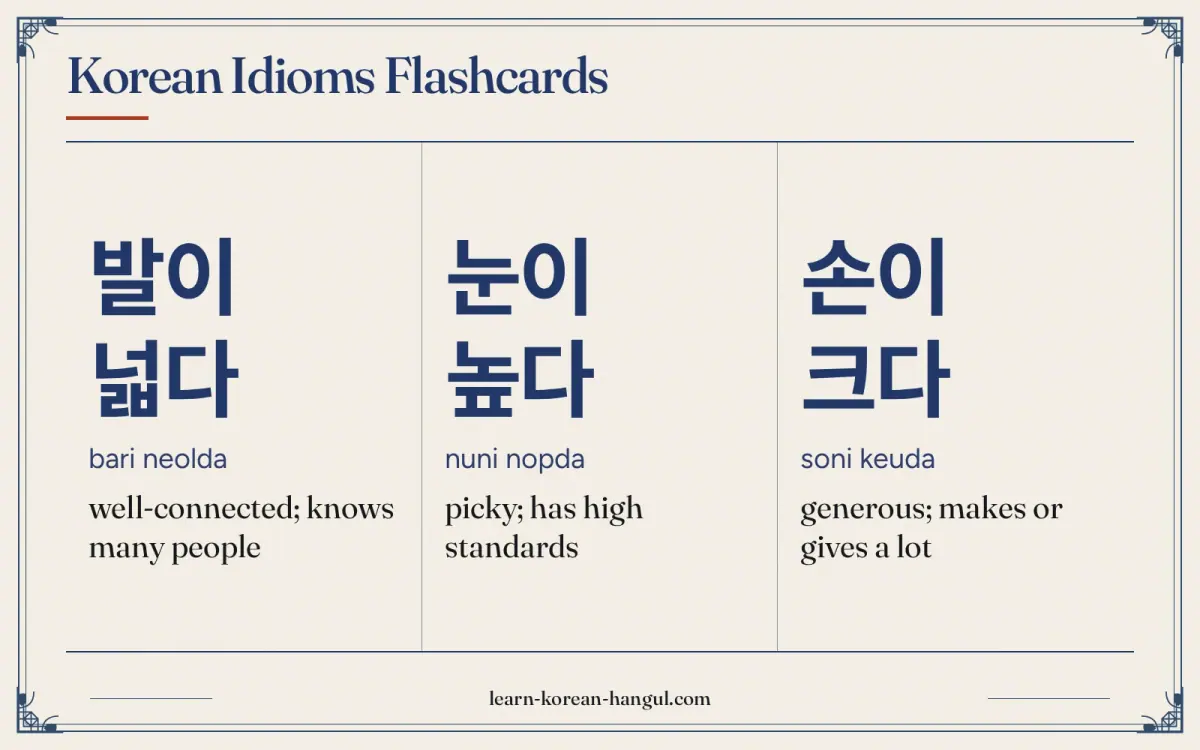
Recognition shows the Hangul and asks for the meaning, so with the first card it shows 발이 넓다 and you answer "well-connected; knows many people". Recall reverses this: it shows the meaning and asks for the Hangul, and you may type the answer with your Hangul keyboard or just say it in your head. Listening plays a clip and hides the letters, which trains your ear for the sound changes inside each phrase, such as 입이 무겁다 sounding like 이비 무겁따.
What Do Got It and Not yet Do?
Got it moves a card up one Leitner box, so it comes back later. Not yet sends the card back to box 1, so it returns in the same session or within 10 minutes. The grades are your own judgement; the deck does not score you or claim fluency.
Deck Scope: What Is and Is Not Covered
The deck covers 26 idioms. Seven describe people and character (cards 1 to 7), six are about food or ease (8 to 13), six are about feelings (14 to 19), four are about work (20 to 23) and three come from animals and everyday scenes (24 to 26). Each one is a phrase with a verb or adjective at the end, so it changes its ending like any other predicate. The deck does not try to list every Korean idiom, and it leaves out phrases that are mainly written or very old-fashioned.
What Is Left out of This Deck?
Whole sayings with a lesson, such as 시작이 반이다, are in the Korean proverbs flashcards. Four-syllable phrases from Chinese characters, such as 일석이조, are in the Korean four character idioms flashcards. Sound words such as 반짝반짝 are in the Korean onomatopoeia flashcards. The wider background is in the korean idioms lesson, which teaches 40 idioms with example sentences.
All 26 Cards in One Table
All 26 cards appear below in deck order. The table is plain HTML, so you can use it as a drill without the deck: cover the Meaning column, say each item aloud, then uncover it.
| # | Hangul | Revised Romanization | Meaning | Note | Audio assetId |
|---|---|---|---|---|---|
| 1 | 발이 넓다 | bari neolda | well-connected; knows many people | [바리 널따] Literally: the foot is wide. 민수 씨는 발이 넓어서 아는 사람이 많아요. (Minsu is well-connected, so he knows lots of people.) | au-pg-flashcards-idiom-flashcards-1; slow: au-pg-flashcards-idiom-flashcards-27 |
| 2 | 눈이 높다 | nuni nopda | picky; has high standards | [누니 놉따] Literally: the eyes are high. 언니는 눈이 높아서 아직 남자 친구가 없어요. (My older sister is picky, so she still has no boyfriend.) | au-pg-flashcards-idiom-flashcards-2 |
| 3 | 손이 크다 | soni keuda | generous; makes or gives a lot | [소니 크다] Literally: the hand is big. 어머니는 손이 커서 음식을 많이 하세요. (My mother is generous and cooks a lot.) | au-pg-flashcards-idiom-flashcards-3 |
| 4 | 입이 무겁다 | ibi mugeopda | keeps secrets; discreet | [이비 무겁따] Literally: the mouth is heavy. 지수 씨는 입이 무거워요. 비밀을 꼭 지켜요. (Jisu is discreet. She always keeps secrets.) | au-pg-flashcards-idiom-flashcards-4; slow: au-pg-flashcards-idiom-flashcards-28 |
| 5 | 입이 가볍다 | ibi gabyeopda | cannot keep a secret; talks too much | [이비 가볍따] Literally: the mouth is light. 동생은 입이 가벼워서 비밀을 금방 말해요. (My younger sibling cannot keep a secret and tells it right away.) The opposite of card 4. | au-pg-flashcards-idiom-flashcards-5 |
| 6 | 귀가 얇다 | gwiga yalda | easily persuaded; gullible | [귀가 얄따] Literally: the ears are thin. 저는 귀가 얇아서 광고를 보면 다 사고 싶어요. (I am easily persuaded, so when I see an ad I want to buy everything.) | au-pg-flashcards-idiom-flashcards-6; slow: au-pg-flashcards-idiom-flashcards-29 |
| 7 | 간이 크다 | gani keuda | bold; daring | [가니 크다] Literally: the liver is big. 혼자 세계 여행을 가요? 간이 정말 커요! (You are travelling the world alone? You are really bold!) | au-pg-flashcards-idiom-flashcards-7 |
| 8 | 식은 죽 먹기 | sigeun juk meokgi | a piece of cake; very easy | [시근 죽 먹끼] Literally: eating cold porridge. 이 문제는 저한테 식은 죽 먹기예요. (This problem is a piece of cake for me.) | au-pg-flashcards-idiom-flashcards-8 |
| 9 | 누워서 떡 먹기 | nuwoseo tteok meokgi | very easy (same meaning as card 8) | [누워서 떡 먹끼] Literally: eating rice cake lying down. 한국어 인사는 이제 누워서 떡 먹기예요. (Korean greetings are a breeze for me now.) | au-pg-flashcards-idiom-flashcards-9 |
| 10 | 그림의 떡 | geurimui tteok | something you want but cannot have | [그리믜 떡], also [그리메 떡] Literally: a rice cake in a picture. 비싼 차는 저한테 그림의 떡이에요. (An expensive car is out of my reach.) | au-pg-flashcards-idiom-flashcards-10 |
| 11 | 미역국을 먹다 | miyeokgugeul meokda | to fail an exam | [미역꾸글 먹따] Literally: to eat seaweed soup. 형은 운전면허 시험에서 미역국을 먹었어요. (My older brother failed his driving test.) It means failure only when an exam or test is in the sentence. | au-pg-flashcards-idiom-flashcards-11 |
| 12 | 김칫국부터 마시다 | gimchitgukbuteo masida | to count your chickens before they hatch | [김치꾹뿌터 마시다] Literally: to drink the kimchi soup first. 벌써 김칫국부터 마셔요? 결과는 아직 몰라요. (Counting your chickens already? We do not know the result yet.) | au-pg-flashcards-idiom-flashcards-12 |
| 13 | 파김치가 되다 | pagimchiga doeda | to be worn out | Literally: to become green-onion kimchi. 하루 종일 이사해서 파김치가 됐어요. (I moved house all day and I am completely worn out.) Casual. | au-pg-flashcards-idiom-flashcards-13 |
| 14 | 배가 아프다 | baega apeuda | to be jealous (also: to have a stomach ache) | Literally: the stomach hurts. 친구가 새 차를 사서 솔직히 배가 아파요. (My friend bought a new car and, honestly, I am jealous.) Context decides the meaning. | au-pg-flashcards-idiom-flashcards-14 |
| 15 | 속이 타다 | sogi tada | to be worried sick | [소기 타다] Literally: the insides burn. 아이가 아직 집에 안 와서 속이 타요. (My child is not home yet and I am worried sick.) | au-pg-flashcards-idiom-flashcards-15 |
| 16 | 마음이 무겁다 | maeumi mugeopda | to feel heavy-hearted | [마으미 무겁따] Literally: the heart is heavy. 친구에게 거짓말을 해서 마음이 무거워요. (I lied to my friend, so I feel heavy-hearted.) | au-pg-flashcards-idiom-flashcards-16 |
| 17 | 가슴이 뜨끔하다 | gaseumi tteukkeumhada | to feel a pang of guilt | [가스미 뜨끔하다] Literally: the chest stings. 거짓말을 한 게 생각나서 가슴이 뜨끔했어요. (I remembered my lie and felt a pang of guilt.) | au-pg-flashcards-idiom-flashcards-17 |
| 18 | 간이 콩알만 해지다 | gani kongalman haejida | to be scared stiff | [가니 콩알만 해지다] Literally: the liver shrinks to a bean. 천둥소리에 간이 콩알만 해졌어요. (The thunder scared me stiff.) The opposite of card 7. | au-pg-flashcards-idiom-flashcards-18 |
| 19 | 눈에 넣어도 아프지 않다 | nune neoeodo apeuji anta | to adore; to dote on | [누네 너어도 아프지 안타] Literally: it would not hurt even in your eye. 할머니는 손주가 눈에 넣어도 아프지 않아요. (Grandma absolutely dotes on her grandchild.) | au-pg-flashcards-idiom-flashcards-19 |
| 20 | 손을 떼다 | soneul tteda | to quit; to wash your hands of | [소늘 떼다] Literally: to take your hand off. 형은 작년에 그 사업에서 손을 뗐어요. (My older brother pulled out of that business last year.) | au-pg-flashcards-idiom-flashcards-20 |
| 21 | 발을 빼다 | bareul ppaeda | to back out of something | [바를 빼다] Literally: to pull your foot out. 위험해 보여서 그 투자에서 발을 뺐어요. (It looked risky, so I backed out of that investment.) | au-pg-flashcards-idiom-flashcards-21 |
| 22 | 머리를 맞대다 | meorireul matdaeda | to put your heads together | [머리를 맏때다] Literally: to put heads together. 팀원들이 머리를 맞대고 방법을 찾았어요. (The team put their heads together and found a way.) | au-pg-flashcards-idiom-flashcards-22 |
| 23 | 눈코 뜰 새 없다 | nunko tteul sae eopda | extremely busy | [눈코 뜰쌔 업따] Literally: no time to open eyes and nose. 요즘 회사 일 때문에 눈코 뜰 새 없어요. (These days I am run off my feet with work.) | au-pg-flashcards-idiom-flashcards-23 |
| 24 | 우물 안 개구리 | umul an gaeguri | someone with a narrow view of the world | Literally: a frog inside a well. 저는 우물 안 개구리였어요. 세상은 정말 넓어요. (I was a frog in a well. The world is really big.) | au-pg-flashcards-idiom-flashcards-24 |
| 25 | 파리를 날리다 | parireul nallida | business is dead; no customers | Literally: to make flies fly. 손님이 없어서 가게가 파리를 날려요. (There are no customers, so the shop is dead.) | au-pg-flashcards-idiom-flashcards-25 |
| 26 | 닭살이 돋다 | daksari dotda | to get goosebumps; to cringe | [닥싸리 돋따] Literally: chicken skin rises. 그 영화의 대사를 듣고 닭살이 돋았어요. (I cringed when I heard that line in the film.) | au-pg-flashcards-idiom-flashcards-26; slow: au-pg-flashcards-idiom-flashcards-30 |
How Do I Read the Table?
Hangul is the expression itself. Revised Romanization (RR) is a learning aid, so try to read the Hangul first. The Meaning column gives the figurative meaning in plain English, and the Note column starts with the literal picture. Examples show how the idiom sits inside a full sentence. Where the spoken sound differs from the spelling, the sound is shown in brackets. The last column lists the audio assetId, and a second ID marks a slow clip (0.8x).
Usage Notes for These Cards
Most idioms are a body part plus a predicate. The pattern is a body part, the particle 이/가 and an adjective or verb: 발이 넓다, 눈이 높다, 손이 크다, 입이 무겁다. The meaning is figurative, so 그 사람은 발이 넓어요 means he knows a lot of people, not that his feet are wide.
Food idioms show up in everyday talk. 손이 크다 describes someone who is generous, especially with food: 어머니는 손이 커서 음식을 많이 하세요 (My mother is generous and cooks a lot). 식은 죽 먹기 and 누워서 떡 먹기 both mean very easy: 이 문제는 식은 죽 먹기예요 (This problem is a piece of cake).
Learn them in pairs. 입이 무겁다 and 입이 가볍다 are opposites, for someone who keeps secrets and someone who talks too much. 간이 크다 (bold) and 간이 콩알만 해지다 (scared stiff) are another pair. Learning both cards of a pair together halves the work.
One phrase can have a literal and a figurative reading. 배가 아프다 means to be jealous as well as having a stomach ache, so the sentence around it tells you which. 눈이 높다 has no useful literal reading at all, because tall eyes make no sense, so it is always figurative.
Keep the words fixed and change only the ending. 발이 넓어요, 발이 넓었어요 and 발이 넓은 사람 all work. Swapping a word breaks the idiom: 눈이 높다 (picky) and 눈이 크다 (big eyes, literally) are different phrases.
Which Sounds Do Not Match the Spelling?
Some idioms change a sound where one word meets the next, so the spoken form differs from the spelling. Play the clips and say each one after the audio.
입이 무겁다 is said [이비 무겁따]. The final ㅂ of 입 links to the vowel of 이 (liaison), so you hear 이비. The ㄷ of 다 after ㅂ becomes a tense ㄸ, so 무겁다 sounds like 무겁따. RR writes ibi mugeopda and does not show the tensing.
귀가 얇다 is said [귀가 얄따]. The cluster ㄼ in 얇 is read as ㄹ before a consonant, and the ㄷ that follows becomes tense. The same happens in 얇다 on its own. RR writes gwiga yalda.
닭살이 돋다 is said [닥싸리 돋따]. In 닭살, the cluster ㄺ is read as ㄱ before a consonant and the ㅅ becomes tense, giving 닥쌀. When 이 follows, the ㄹ of 살 links to it, so you hear 닥싸리. The ㄷ of 다 after the final ㄷ of 돋 also becomes tense, giving 돋따. RR writes daksari dotda.
What Mistakes Do Learners Make with Korean Idioms?
- Translating word for word. 발이 넓다 does not mean wide feet, and 손이 크다 does not mean a big hand. Check the Meaning column before you use a phrase.
- Treating an idiom as a literal description of a body. 눈이 높다 does not mean tall eyes; it means picky or having high standards.
- Changing a word inside the phrase. 눈이 높다 is picky, while 눈이 크다 only means that the eyes are big.
- Using 배가 아프다 to say that you envy your boss. It can sound petty and childish, so it suits friends, not formal settings.
- Using 입이 가볍다 about someone to their face. It is a real criticism, so say it about a situation, or about yourself with a laugh.
The food and feelings idioms are easy to mix up in the early days, so give cards 8 and 9 extra passes in recall mode: they mean the same thing but use different foods.
How Does the Review Schedule Work?
The deck uses a simplified Leitner system with five boxes. A new card starts in box 1. Each Got it moves it up one box, and each Not yet returns it to box 1. The box sets how long the card waits before it is due again.
| Box | Wait until the next review |
|---|---|
| 1 | same session or 10 minutes |
| 2 | 1 day |
| 3 | 3 days |
| 4 | 7 days |
| 5 | 21 days |
Each session shows due cards first, oldest due first, then up to 10 new cards a day by default. A deck of 26 cards is introduced over 3 days at 10 new cards a day, and the later boxes bring every card back at longer gaps. Progress is saved only in this browser, so clearing site data deletes it. Use the export button to save a small file with card IDs, boxes and due dates, and import it on another device. No account is needed.
Cultural and Practical Context
Many Korean idioms rely on body parts, and each part has a job. The hand (손) is for giving and working, the foot (발) for going places, the eyes (눈) for judging, the mouth (입) for speaking and the liver (간) for courage. Being 발이 넓은 사람, someone with a wide network, is usually admired, and 손이 큰 사람 is praised for hospitality. Food idioms such as 미역국을 먹다 come from daily life: Koreans eat seaweed soup on birthdays, but the slippery soup is avoided before an exam, which is why the same dish also means failing a test.
Limits of This Deck
The deck holds 26 idioms and one example for each, so it shows the main sense and not every shade of meaning. Some idioms are colloquial, such as 파김치가 되다 and 닭살이 돋다, and some have more than one reading, such as 배가 아프다. Literal pictures in the Note column are only there to help you remember. The Korean text is AI-assisted and goes through Korean-teacher review before publication, and each audio clip is checked by a Korean teacher before publication.
Next Steps after This Deck
After these korean idioms flashcards, move on to the Korean proverbs flashcards to keep the same routine with whole sayings. For another set of expressive words, try the Korean onomatopoeia flashcards. Two lessons go deeper into single themes: Korean body part idioms and Korean animal idioms. Read the korean idioms lesson for 40 idioms with full examples. The Korean vocabulary flashcards page lists every vocabulary deck, and the Korean flashcards hub lists all topics.
Frequently Asked Questions
Are These Idioms Polite?
The idioms are neutral and take any speech level: 발이 넓어요 is polite and 발이 넓습니다 is formal. What matters is the person you describe. 입이 가볍다 and 눈이 높다 can sound critical, so say them about a situation or about yourself, not to someone's face.
Do the Idioms Conjugate?
Yes. The last word is an ordinary adjective or verb, so it changes like one: 발이 넓어요, 발이 넓었어요 and 발이 넓은 사람 (a well-connected person). Learn each idiom as a whole chunk, because the words inside stay fixed and only the ending changes.
Is 눈이 높다 Negative?
Not always. It can mean picky, which is mildly critical, or it can mean having good taste and high standards, which is a compliment. Tone and context decide: 눈이 높은 사람 about a shopper can be praise, while 언니는 눈이 높아서 남자 친구가 없어요 is gentle teasing.
What Is the Difference between an Idiom and a Proverb?
An idiom (관용구 or 관용어) is a short phrase you fit into your own sentence and conjugate, such as 손이 크다. A proverb (속담) is a whole saying with a lesson that you quote, such as 시작이 반이다. The proverbs and four-character idioms each have their own decks.
Is My Progress Saved If I Close the Page?
Yes, in the same browser on the same device. Card boxes and due dates are stored locally and nothing is sent to a server. Clearing site data, using a private window or switching browsers removes them, so use the export button to keep a backup file. No account is needed.