
Korean Cooking Vocabulary Flashcards: Study the 27 Cards
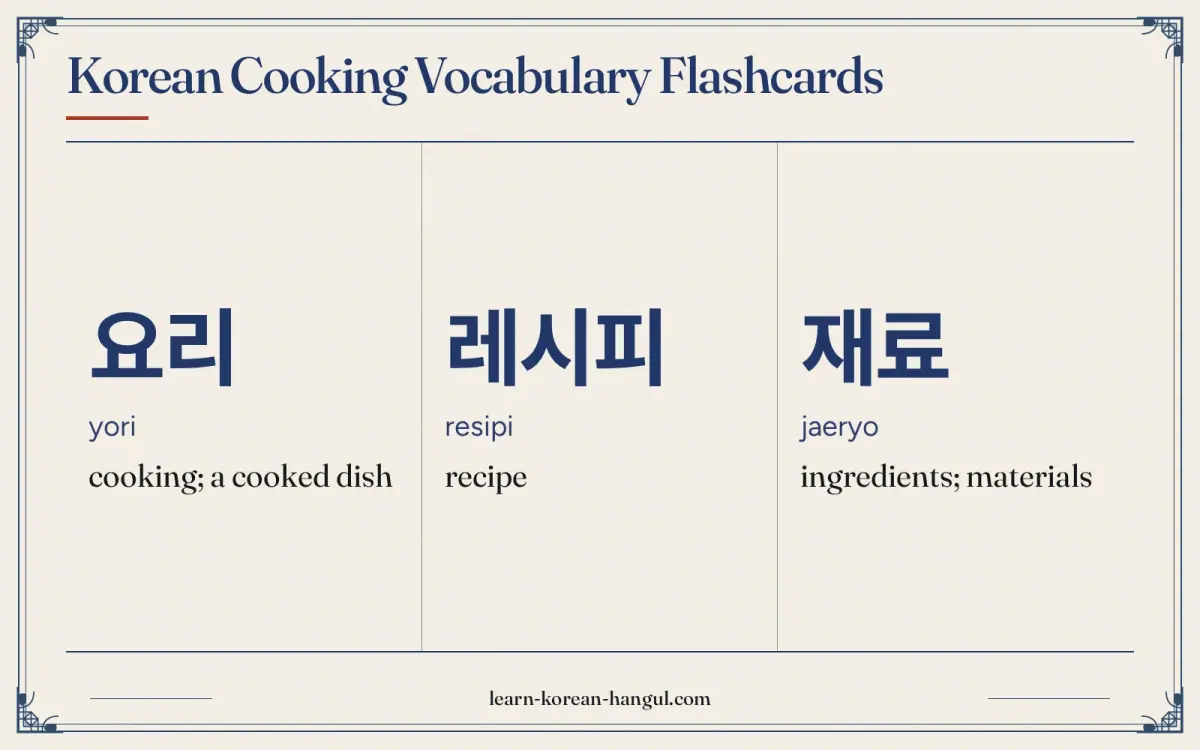
Each card shows the Hangul, the Revised Romanization (RR), the meaning and an audio button. The words come from the Korean cooking vocabulary lesson, which also has example sentences.
How Do I Use These Flashcards?
Use the deck above in four steps. It works with tap, click or keyboard, and nothing plays until you press an audio button.
- Choose a mode. Start with recognition (Hangul to meaning). Switch to recall (meaning to Hangul) or listening (audio to meaning) once recognition feels easy.
- Show the answer. Think of the answer first, then press Show answer (or Space). Say the word aloud before you reveal it. Turn on the romanization toggle only if you need it; the 27-card table below always shows it.
- Grade yourself. Press Got it if you answered correctly without help, or Not yet if you hesitated or guessed.
- Finish the session. A session holds up to 20 cards (you can set 10, 20 or 40). With 27 cards, a first-time learner can split the deck over three days, using the default limit of 10 new cards a day.
The Three Study Modes
Recognition shows the Hangul and asks for the meaning, which trains reading. Recall shows the meaning and asks for the Hangul, which trains remembering; you may type the answer with your Hangul keyboard or just recall it in your head. Listening plays a clip and hides the letters, which trains the ear. Listening mode only uses a card once its audio is approved, and cards without approved audio are skipped in that mode with a note.
Got It and Not Yet
Got it moves the card up one Leitner box, so it comes back later. Not yet sends the card back to box 1, so it returns in the same session or within 10 minutes. The grades are your own judgement; the deck does not score you or claim fluency.
Deck Scope: What Is and Is Not Covered
The deck covers 27 of the 40 words in the cooking lesson: the preparation words, eight tools of the kitchen, the taste words, the dish-type nouns that end a dish name, and a few measuring words. All are nouns.
Which Cooking Words Are Left out of This Deck?
The lesson words 준비, 설거지, 향, 단맛, 짠맛, 매운맛, 손맛, 전, 절임, 적당량, 한 줌, 한 꼬집 and 분량 are not cards here. Cooking verbs such as 굽다 and 끓이다 are in the verb lessons.
All 27 Cards in One Table
All 27 cards appear below in deck order. The table is plain HTML, so you can use it as a drill without the deck: cover the Meaning column, say each word aloud, then uncover it.
| # | Hangul | Revised Romanization | Meaning | Note | Audio assetId |
|---|---|---|---|---|---|
| 1 | 요리 | yori | cooking; a cooked dish | 요리하다 is the verb "to cook". 요리사 is a chef. | au-pg-flashcards-cooking-vocabulary-1 |
| 2 | 레시피 | resipi | recipe | A loanword. The Sino-Korean word 조리법 is used in books. | au-pg-flashcards-cooking-vocabulary-2 |
| 3 | 재료 | jaeryo | ingredients; materials | The things you need for a dish. Also used for building materials. | au-pg-flashcards-cooking-vocabulary-3 |
| 4 | 손질 | sonjil | trimming; cleaning and preparing | Cutting, washing and cleaning an ingredient before cooking, especially fish and vegetables. | au-pg-flashcards-cooking-vocabulary-4 |
| 5 | 양념 | yangnyeom | seasoning; sauce mix | The mix of soy sauce, garlic, chilli and other flavourings that goes on or in food. | au-pg-flashcards-cooking-vocabulary-5 |
| 6 | 반죽 | banjuk | dough; batter | Used for dumplings, pancakes and noodles. 반죽하다 is to knead. | au-pg-flashcards-cooking-vocabulary-6 |
| 7 | 냄비 | naembi | pot (saucepan) | A pot with a lid and two handles. Used for ramyeon, soups and stews. | au-pg-flashcards-cooking-vocabulary-7 |
| 8 | 프라이팬 | peuraipaen | frying pan | A loanword: fry + pan. Shortened to 팬 in speech. | au-pg-flashcards-cooking-vocabulary-8 |
| 9 | 칼 | kal | knife | The general word. 식칼 is a kitchen knife. | au-pg-flashcards-cooking-vocabulary-9 |
| 10 | 도마 | doma | cutting board | Used under the knife. Often made of wood. | au-pg-flashcards-cooking-vocabulary-10 |
| 11 | 가스레인지 | gaseureinji | gas stove | A loanword: gas + range. A stove with burners. | au-pg-flashcards-cooking-vocabulary-11 |
| 12 | 불 | bul | fire; heat (of a stove) | 센 불 is high heat and 약한 불 is low heat. Also the word for a light. | au-pg-flashcards-cooking-vocabulary-12 |
| 13 | 오븐 | obeun | oven | A loanword. Home ovens are less common in Korea than stoves. | au-pg-flashcards-cooking-vocabulary-13 |
| 14 | 그릇 | geureut | bowl; dish; container | The general word for tableware that holds food. Said [그륻] when it stands alone. | au-pg-flashcards-cooking-vocabulary-14 |
| 15 | 맛 | mat | taste; flavour | Said [맏] alone. 맛있다 means delicious and 맛없다 means not tasty. | au-pg-flashcards-cooking-vocabulary-15; slow: au-pg-flashcards-cooking-vocabulary-31 |
| 16 | 간 | gan | seasoning level (mainly saltiness) | 간이 맞다 means the seasoning is just right. 간을 보다 means to taste for seasoning. | au-pg-flashcards-cooking-vocabulary-16 |
| 17 | 식감 | sikgam | texture (mouthfeel) | Said [식깜]. Chewy, crispy and soft are all 식감. | au-pg-flashcards-cooking-vocabulary-17; slow: au-pg-flashcards-cooking-vocabulary-28 |
| 18 | 볶음 | bokkeum | stir-fried dish | Said [보끔]. From the verb 볶다, to stir-fry. | au-pg-flashcards-cooking-vocabulary-18; slow: au-pg-flashcards-cooking-vocabulary-30 |
| 19 | 찜 | jjim | steamed or braised dish | From 찌다 (to steam). 갈비찜 is braised short ribs and 계란찜 is steamed egg. | au-pg-flashcards-cooking-vocabulary-19 |
| 20 | 구이 | gui | grilled dish | From 굽다 (to grill). 생선구이 is grilled fish and 삼겹살구이 is grilled pork belly. | au-pg-flashcards-cooking-vocabulary-20 |
| 21 | 조림 | jorim | braised-in-sauce dish | From 조리다 (to simmer down). Salty-sweet side dishes such as 감자조림. | au-pg-flashcards-cooking-vocabulary-21 |
| 22 | 무침 | muchim | seasoned dish (mixed by hand) | From 무치다 (to toss with seasoning). A side dish of vegetables or fish. | au-pg-flashcards-cooking-vocabulary-22 |
| 23 | 튀김 | twigim | fried dish; tempura-style | From 튀기다 (to deep-fry). 새우튀김 is fried shrimp. | au-pg-flashcards-cooking-vocabulary-23 |
| 24 | 큰술 | keunsul | tablespoon | Literally "big spoon". 한 큰술, 두 큰술, 세 큰술. | au-pg-flashcards-cooking-vocabulary-24 |
| 25 | 작은술 | jageunsul | teaspoon | Literally "small spoon". Seen in recipes next to 큰술. | au-pg-flashcards-cooking-vocabulary-25 |
| 26 | 약간 | yakgan | a little; slightly | Said [약깐]. Put before the verb: 약간 넣어요. | au-pg-flashcards-cooking-vocabulary-26; slow: au-pg-flashcards-cooking-vocabulary-29 |
| 27 | 컵 | keop | cup | A loanword. In recipes, 한 컵 is about 200 ml, but check the recipe, because spoons and cups vary. | au-pg-flashcards-cooking-vocabulary-27 |
Reading the Table
Hangul is the word. Revised Romanization (RR) is a learning aid, so try to read the Hangul before you look at it. RR follows the spelling rules of the official system, not every sound change, so it can differ from what you hear. The Meaning column gives the English gloss, and the Note column gives a use or sound hint. The last column lists the audio assetId; a second ID marks a slow clip at 0.8 times the speed. Cards 18-23 are the dish-type nouns 볶음, 찜, 구이, 조림, 무침 and 튀김, which end a dish name.
Usage Notes for These Cards
요리 is the act and the dish. 요리하다 means to cook, and 요리 can also mean a cooked dish, so 중국 요리 is Chinese food. A chef is 요리사.
맛 is taste and 간 is seasoning. 맛 is the overall taste, and 맛있다 means delicious. 간 is the seasoning level, mostly saltiness, so 간이 맞다 means the seasoning is just right.
Method nouns end dish names. 볶음 (stir-fried), 찜 (steamed or braised), 구이 (grilled), 조림 (simmered in sauce), 무침 (seasoned by hand) and 튀김 (fried) attach to an ingredient: 생선구이 is grilled fish, 새우튀김 is fried shrimp.
Spoons measure recipes. 한 큰술 is one tablespoon and 한 작은술 is one teaspoon. 컵 is a cup, and 약간 means a little, so it does not take a number.
불 is fire and heat. 센 불 is high heat and 약한 불 is low heat. 불 also means a light.
Which Sounds Do Not Match the Spelling?
Some of these words are said differently from how they are written. The table follows the standard pronunciation rules (표준 발음법) of the 국립국어원 (National Institute of Korean Language).
| Spelling | Sounds like | What changes |
|---|---|---|
| 식감 | [식깜] | After a final ㄱ, ㄱ becomes tense [ㄲ]. |
| 약간 | [약깐] | After a final ㄱ, ㄱ becomes tense [ㄲ]. |
| 볶음 | [보끔] | The final ㄲ links to the next vowel and stays tense. |
| 맛 | [맏] | A final ㅅ is said as [ㄷ] at the end of a word. |
Tense sounds after a final ㄱ are the hardest here. The second syllable should sound sharp and short. For 레시피 (resipi), say re-si-pi with an even rhythm.
What Mistakes Do Learners Make with Cooking Words?
- Using 요리 only for the activity. It also names a dish.
- Confusing 간 and 맛. For a bland soup, say 간이 싱거워요.
- Treating method nouns as full dishes. 구이 alone means grilled food.
- Putting a number before 약간. Say 소금 약간 or 소금 한 꼬집.
- Translating 손맛 word for word. Use it as a compliment: 손맛이 좋아요.
How Does the Review Schedule Work?
The deck uses a simplified Leitner system with five boxes. A new card starts in box 1. Each Got it moves it up one box, and each Not yet returns it to box 1. The box sets how long the card waits before it is due again.
| Box | Wait until the next review |
|---|---|
| 1 | same session or 10 minutes |
| 2 | 1 day |
| 3 | 3 days |
| 4 | 7 days |
| 5 | 21 days |
Each session shows due cards first, oldest due first, and then up to 10 new cards a day by default. A deck of 27 cards is introduced over three days at the default of 10 new cards a day, and the later boxes bring each card back at longer gaps. Progress is saved only in this browser, so clearing site data deletes it. Use the export button to save a small JSON file with card IDs, boxes and due dates, and import it on another device. No account is needed.
Cultural and Practical Context
Korean home cooks talk about 손맛, the touch of the cook, as the thing that makes home food special. Recipes often leave amounts to taste, with words such as 약간 and 적당량, which is why measuring words matter.
Limits of This Deck
The deck holds 27 nouns and does not teach the verbs of cooking, such as 굽다 or 끓이다. A cup in a recipe is about 200 ml but the exact size depends on the recipe. All Korean text is generated and was reviewed and signed off by Min-ji Park on 15 October 2026.
Next Steps after This Deck
The words and letters on these cards are explained in the Korean cooking vocabulary lesson, so read it first if a card is new. This deck is one of the Korean vocabulary flashcards on the site, so browse the full list if you want a different topic. When these cards feel easy, move on to Korean animals flashcards to keep the same routine. If a word here still feels shaky, go back to Korean restaurant vocabulary flashcards for the earlier material. After a session, write the same words by hand with the Korean food vocabulary worksheet. All flashcard decks, including Hangul, vocabulary, phrases, grammar and TOPIK, are listed on the Korean flashcards hub.
Frequently Asked Questions
What Does 간 Mean in Cooking?
간 is the seasoning level, mainly saltiness. 간이 맞아요 means the seasoning is right, and 간이 싱거워요 means it is too weak.
How Do I Say a Little Salt?
Say 소금 약간. 약간 means a little and goes after the ingredient with no number. For a pinch, use 소금 한 꼬집.
What Is the Difference between 볶음 and 구이?
볶음 is stir-fried in a pan, and 구이 is grilled or roasted. Both end a dish name: 오징어볶음 and 생선구이.
Is 요리 a Dish or the Act of Cooking?
Both. 요리 names a cooked dish, and 요리하다 is the verb to cook.
Is My Progress Saved If I Close the Page?
Yes, in the same browser on the same device. Card boxes and due dates are stored locally and nothing is sent to a server. Clearing site data, using a private window or switching browsers removes them, so use the export button to keep a backup file. No account is needed.