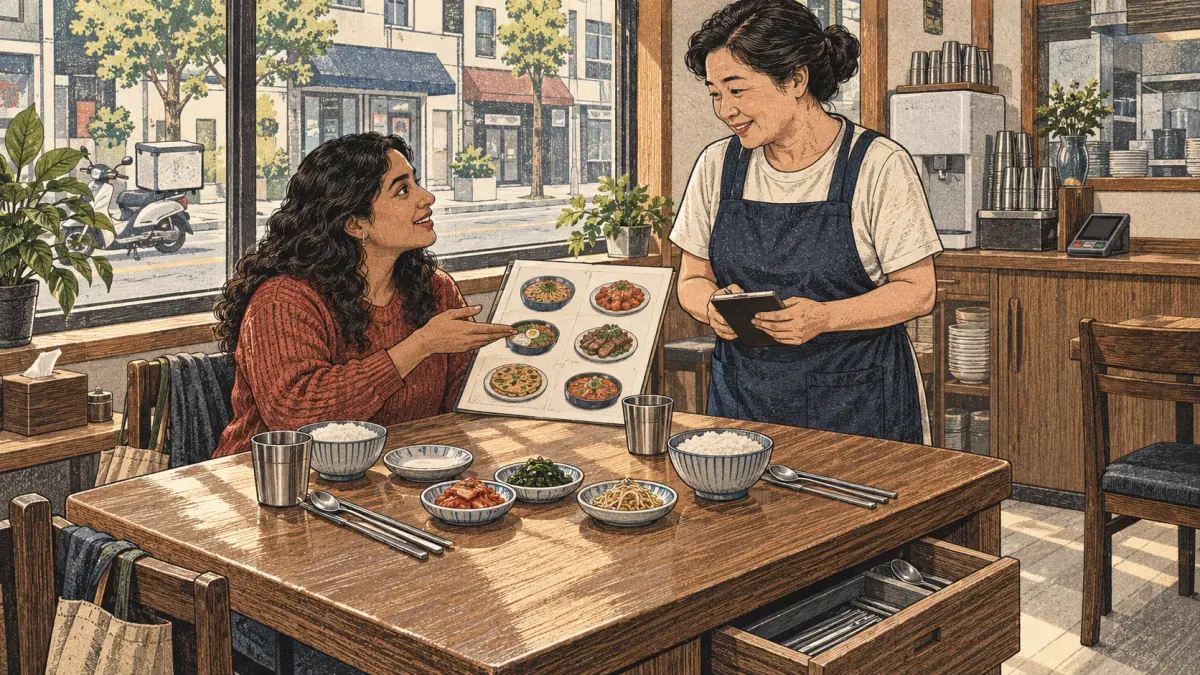
Korean Restaurant Vocabulary at a Glance
A Korean restaurant visit has its own habits, and the vocabulary reflects them. The restaurant name often tells you the food: a 고깃집 serves grilled meat, a 횟집 serves raw fish and a 분식집 serves snack food such as tteokbokki and gimbap. At the table, water and cutlery are often self-service, and many tables have a call button, so you may never need to wave at the staff. Food is ordered by the 인분 (serving), by the 그릇 (bowl) or by the 잔 (glass), and those unit words matter as much as the dish names.
The list has 45 words in five groups. It is a subhub: besides the word list, it points to the pages for drinks, cooking and taste, counters and ready-made phrases. It sits inside Food and Drink.
| Group | Words | Examples |
|---|---|---|
| Types of restaurants | 9 | 식당, 분식집, 고깃집, 횟집 |
| Table and tableware | 10 | 자리, 숟가락, 젓가락, 앞접시 |
| Menu and ordering | 11 | 메뉴, 메뉴판, 주문, 인분 |
| Paying | 7 | 계산서, 계산, 영수증, 카드 |
| Delivery and takeaway | 8 | 배달, 포장, 예약, 대기 |
By word origin, the list has 17 Sino-Korean, 11 mixed, 10 loanword and 7 native entries. Many service words, such as 주문, 계산서 and 영수증, are Sino-Korean, while most tableware words are native, and recent borrowings such as 카페 and 웨이팅 come from English and French.
Which Restaurant Words Should You Learn First?
Start with five words you will need at the first meal: 식당, 메뉴, 주문, 계산서 and 포장. Press play, then the slow button, and say each word aloud.
식당 (sikdang) means restaurant. It is the general word for a place that serves meals, and it also names the staff canteen at a school or company. A specific type is named by a word before 집, as in 고깃집, but 식당 works for all of them. Example: 이 근처에 맛있는 식당이 있어요? (Is there a tasty restaurant near here?)
메뉴 (menyu) means menu; dish on the menu. It is the English loan for menu, and it means both the printed menu and a single dish on it. The longer word 메뉴판 means the menu board or the menu sheet itself. Example: 메뉴 좀 주세요. (Please give me the menu.)
주문 (jumun) means order. It means an order for food or goods. Staff say 주문하시겠어요? to ask if you are ready, and a delivery app shows 주문 완료 when your order is placed. Example: 주문하시겠어요? (Would you like to order?)
계산서 (gyesanseo) means bill; check. It is the bill, the sheet that lists what you owe. Many restaurants ask you to pay at the counter on the way out, so you may not need to ask for it at the table. Example: 계산서 주세요. (The bill, please.)
포장 (pojang) means takeaway; packing. It means packing, and at a restaurant it means taking the food away. 포장해 주세요 is the polite request, and the same word is used for gift wrapping. Example: 포장해 주세요. (Please pack it to take away.)
Types of Restaurants
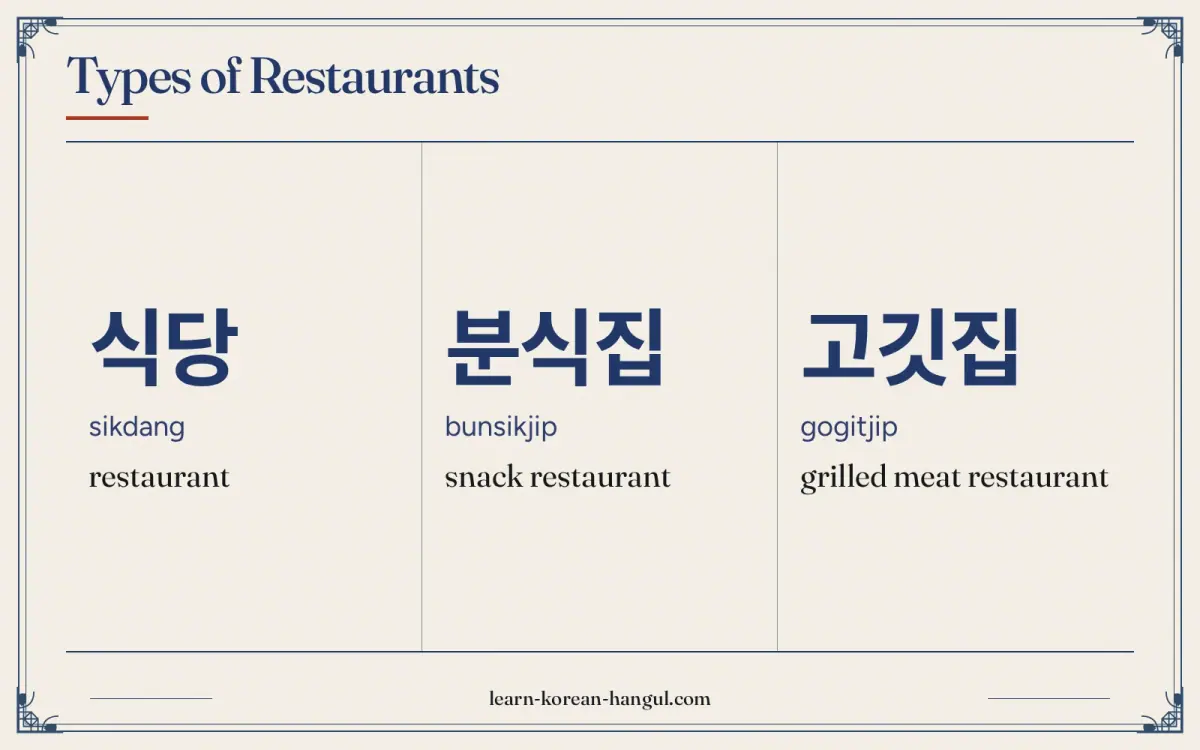
Korean restaurant names are short, and many end in 집, the native word for house, which here means a place that specialises in something. Nine words cover most of the street.
| No. | Hangul | Revised Romanization | Meaning | Origin | Example sentence | Audio assetId |
|---|---|---|---|---|---|---|
| 1 | 식당 | sikdang | restaurant | Sino-Korean | 이 근처에 맛있는 식당이 있어요? (i geuncheoe masinneun sikdangi isseoyo; Is there a tasty restaurant near here?) | au-pg-vocabulary-food-restaurant-1; example: au-pg-vocabulary-food-restaurant-101 |
| 2 | 분식집 | bunsikjip | snack restaurant | mixed | 점심에는 분식집에 가요. (jeomsimeneun bunsikjibe gayo; I go to a snack restaurant at lunch.) | au-pg-vocabulary-food-restaurant-2; example: au-pg-vocabulary-food-restaurant-102 |
| 3 | 고깃집 | gogitjip | grilled meat restaurant | native | 고깃집에서 삼겹살을 구워요. (gogitjibeseo samgyeopsareul guwoyo; We grill pork belly at a meat restaurant.) | au-pg-vocabulary-food-restaurant-3; example: au-pg-vocabulary-food-restaurant-103 |
| 4 | 횟집 | hoetjip | raw fish restaurant | mixed | 횟집에서 생선회를 먹었어요. (hoetjibeseo saengseonhoereul meogeosseoyo; We ate raw fish at a sashimi restaurant.) | au-pg-vocabulary-food-restaurant-4; example: au-pg-vocabulary-food-restaurant-104 |
| 5 | 술집 | suljip | pub; drinking place | native | 술집은 저녁에 열어요. (suljibeun jeonyeoge yeoreoyo; The pub opens in the evening.) | au-pg-vocabulary-food-restaurant-5; example: au-pg-vocabulary-food-restaurant-105 |
| 6 | 카페 | kape | cafe | loanword | 식사 후에 카페에 가요. (siksa hue kapee gayo; After the meal we go to a cafe.) | au-pg-vocabulary-food-restaurant-6; example: au-pg-vocabulary-food-restaurant-106 |
| 7 | 중국집 | junggukjip | Chinese restaurant | mixed | 중국집에서 짜장면을 시켰어요. (junggukjibeseo jjajangmyeoneul sikyeosseoyo; We ordered jjajangmyeon at the Chinese restaurant.) | au-pg-vocabulary-food-restaurant-7; example: au-pg-vocabulary-food-restaurant-107 |
| 8 | 치킨집 | chikinjip | fried chicken restaurant | mixed | 치킨집은 밤늦게까지 해요. (chikinjibeun bamneutgekkaji haeyo; The chicken place is open until late at night.) | au-pg-vocabulary-food-restaurant-8; example: au-pg-vocabulary-food-restaurant-108 |
| 9 | 뷔페 | bwipe | buffet | loanword | 뷔페에서 마음껏 먹을 수 있어요. (bwipeeseo maeumkkeot meogeul su isseoyo; You can eat as much as you like at a buffet.) | au-pg-vocabulary-food-restaurant-9; example: au-pg-vocabulary-food-restaurant-109 |
- 식당: The word joins 식 (meal) and 당 (hall). It is the plain word for a restaurant, and it often ends a restaurant's name, as in 한식당 (Korean restaurant).
- 분식집: The menu is gimbap, tteokbokki, ramyeon and fried snacks, so it is cheap and quick. The word is said [분식찝].
- 고깃집: The word is 고기 (meat) plus 집, with a linking ㅅ written in the middle. The ㅅ is the reason for the spelling 고깃집 and the tense sound [고기찝] or [고긷찝]; many signs still write 고기집.
- 횟집: The word is 회 (sliced raw fish) plus 집, and it is often near a fish market or on the coast. The same linking ㅅ appears in the spelling.
- 술집: The word is 술 (alcohol) plus 집. Many Korean pubs serve a full menu, so this is also a place for dinner.
- 카페: Coffee after a meal is a regular habit, so the cafe is often the next stop. Cafe menus have their own list on the Drinks page.
- 중국집: The word is 중국 (China) plus 집. It names the neighbourhood restaurant that serves jjajangmyeon and jjamppong and also delivers.
- 치킨집: The word is 치킨 (chicken) plus 집. Fried chicken is a late-night staple, and the place is also known for its delivery.
- 뷔페: The French loan is spelled 뷔페. The sound of 뷔 is [wi], and many learners find the spelling harder than the sound.
Example Sentences
Here is how a meal flows. At the door: 두 명이에요 (Two people), then the staff leads you to a 자리. At the table: 메뉴판 좀 주세요, then 삼겹살 이 인분 주세요 and 물 좀 주세요. At the end: 계산서 주세요 or 카드로 계산할게요. The words in the examples above fit in the blanks. For a longer set of phrases for each step, see the restaurant phrases page.
How Do You Say Table and Tableware in Korean?
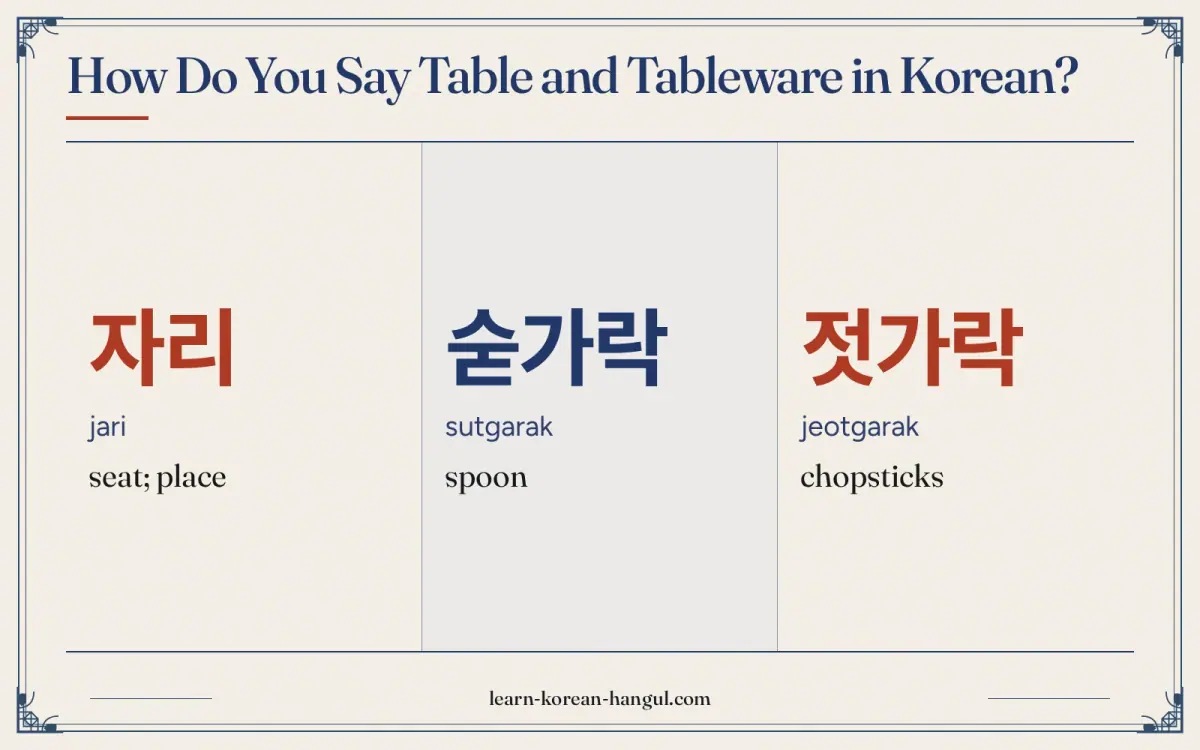
Most of the table words are native Korean and short. A few belong to the barbecue table, where staff or guests cook the meat.
| No. | Hangul | Revised Romanization | Meaning | Origin | Example sentence | Audio assetId |
|---|---|---|---|---|---|---|
| 10 | 자리 | jari | seat; place | native | 창가 자리로 주세요. (changga jariro juseyo; A window seat, please.) | au-pg-vocabulary-food-restaurant-10; example: au-pg-vocabulary-food-restaurant-110 |
| 11 | 숟가락 | sutgarak | spoon | native | 숟가락 하나 더 주세요. (sutgarak hana deo juseyo; One more spoon, please.) | au-pg-vocabulary-food-restaurant-11; example: au-pg-vocabulary-food-restaurant-111 |
| 12 | 젓가락 | jeotgarak | chopsticks | native | 젓가락은 서랍에 있어요. (jeotgarageun seorabe isseoyo; The chopsticks are in the drawer.) | au-pg-vocabulary-food-restaurant-12; example: au-pg-vocabulary-food-restaurant-112 |
| 13 | 앞접시 | apjeopsi | small individual plate | mixed | 앞접시 두 개 주세요. (apjeopsi du gae juseyo; Two small plates, please.) | au-pg-vocabulary-food-restaurant-13; example: au-pg-vocabulary-food-restaurant-113 |
| 14 | 그릇 | geureut | bowl; dish | native | 밥 한 그릇 주세요. (bap han geureut juseyo; One bowl of rice, please.) | au-pg-vocabulary-food-restaurant-14; example: au-pg-vocabulary-food-restaurant-114 |
| 15 | 컵 | keop | cup | loanword | 컵은 정수기 옆에 있어요. (keobeun jeongsugi yeope isseoyo; The cups are next to the water purifier.) | au-pg-vocabulary-food-restaurant-15; example: au-pg-vocabulary-food-restaurant-115 |
| 16 | 물티슈 | multisyu | wet wipe | mixed | 물티슈 있어요? (multisyu isseoyo; Do you have wet wipes?) | au-pg-vocabulary-food-restaurant-16; example: au-pg-vocabulary-food-restaurant-116 |
| 17 | 냅킨 | naepkin | napkin | loanword | 냅킨 좀 주세요. (naepkin jom juseyo; Please give me some napkins.) | au-pg-vocabulary-food-restaurant-17; example: au-pg-vocabulary-food-restaurant-117 |
| 18 | 불판 | bulpan | grill plate | mixed | 불판을 갈아 주세요. (bulpaneul gara juseyo; Please change the grill plate.) | au-pg-vocabulary-food-restaurant-18; example: au-pg-vocabulary-food-restaurant-118 |
| 19 | 가위 | gawi | scissors | native | 가위로 고기를 잘라요. (gawiro gogireul jallayo; We cut the meat with scissors.) | au-pg-vocabulary-food-restaurant-19; example: au-pg-vocabulary-food-restaurant-119 |
- 자리: It is the general word for a seat or a spot. The same word appears in 자리 있어요? (Is there a seat?) at the door.
- 숟가락: A Korean place setting is a spoon and metal chopsticks. The final ㄷ in 숟 is not released, and the next ㄱ turns tense: [숟까락].
- 젓가락: Many restaurants keep the spoon and chopsticks in a drawer under the tabletop, so look there first. The word is said [저까락] or [젇까락].
- 앞접시: The word is 앞 (front) plus 접시 (plate): the plate in front of you. Shared dishes go in the middle, and you take food onto your own plate.
- 그릇: It is also a counter for bowls of food: 한 그릇, 두 그릇. Rice and soup are ordered this way.
- 컵: Water is often self-service, with cups and a water purifier near the counter. The loan word ends in a consonant, and the ㅂ at the end is not released.
- 물티슈: The word is 물 (water) plus 티슈 (tissue). A wet wipe is often put on the table or in a drawer.
- 냅킨: The word 좀 softens the request and means a little. Many tables hold napkins in a dispenser.
- 불판: The word is 불 (fire) plus 판 (plate). At a barbecue table the plate becomes dirty, and staff swap it for a clean one.
- 가위: Scissors are the barbecue tool in Korea, used to cut the grilled meat into pieces at the table.
Menu and Ordering
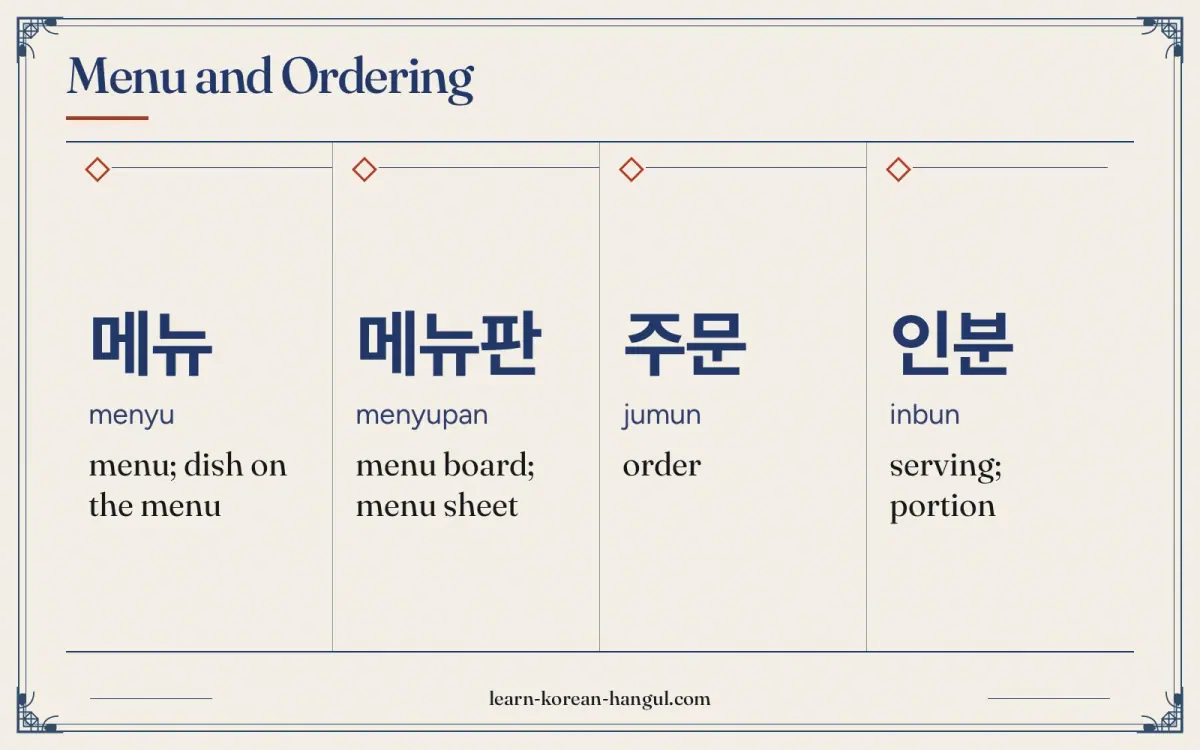
Ordering is mostly one pattern: the dish, the amount and 주세요. These eleven words give you the parts of that pattern and the people you speak to.
| No. | Hangul | Revised Romanization | Meaning | Origin | Example sentence | Audio assetId |
|---|---|---|---|---|---|---|
| 20 | 메뉴 | menyu | menu; dish on the menu | loanword | 메뉴 좀 주세요. (menyu jom juseyo; Please give me the menu.) | au-pg-vocabulary-food-restaurant-20; example: au-pg-vocabulary-food-restaurant-120 |
| 21 | 메뉴판 | menyupan | menu board; menu sheet | mixed | 메뉴판은 벽에 있어요. (menyupaneun byeoge isseoyo; The menu board is on the wall.) | au-pg-vocabulary-food-restaurant-21; example: au-pg-vocabulary-food-restaurant-121 |
| 22 | 주문 | jumun | order | Sino-Korean | 주문하시겠어요? (jumunhasigesseoyo; Would you like to order?) | au-pg-vocabulary-food-restaurant-22; example: au-pg-vocabulary-food-restaurant-122 |
| 23 | 인분 | inbun | serving; portion | Sino-Korean | 삼겹살 이 인분 주세요. (samgyeopsal i inbun juseyo; Two servings of pork belly, please.) | au-pg-vocabulary-food-restaurant-23; example: au-pg-vocabulary-food-restaurant-123 |
| 24 | 세트 | seteu | set meal | loanword | 점심 세트로 주세요. (jeomsim seteuro juseyo; I will have the lunch set.) | au-pg-vocabulary-food-restaurant-24; example: au-pg-vocabulary-food-restaurant-124 |
| 25 | 추천 | chucheon | recommendation | Sino-Korean | 추천 메뉴가 뭐예요? (chucheon menyuga mwoyeyo; What is the recommended dish?) | au-pg-vocabulary-food-restaurant-25; example: au-pg-vocabulary-food-restaurant-125 |
| 26 | 직원 | jigwon | staff member; employee | Sino-Korean | 직원에게 물어보세요. (jigwonege mureoboseyo; Ask the staff.) | au-pg-vocabulary-food-restaurant-26; example: au-pg-vocabulary-food-restaurant-126 |
| 27 | 사장님 | sajangnim | owner; boss (polite address) | mixed | 사장님, 맛있게 먹었습니다. (sajangnim masitge meogeotseumnida; Boss, I enjoyed the meal.) | au-pg-vocabulary-food-restaurant-27; example: au-pg-vocabulary-food-restaurant-127 |
| 28 | 리필 | ripil | refill | loanword | 반찬은 리필이 돼요. (banchaneun ripiri dwaeyo; Side dishes can be refilled.) | au-pg-vocabulary-food-restaurant-28; example: au-pg-vocabulary-food-restaurant-128 |
| 29 | 서비스 | seobiseu | free extra; complimentary item | loanword | 서비스로 음료수를 드릴게요. (seobiseuro eumnyosureul deurilgeyo; We will give you a drink on the house.) | au-pg-vocabulary-food-restaurant-29; example: au-pg-vocabulary-food-restaurant-129 |
| 30 | 잔 | jan | glass; cup (counter) | Sino-Korean | 맥주 두 잔 주세요. (maekju du jan juseyo; Two glasses of beer, please.) | au-pg-vocabulary-food-restaurant-30; example: au-pg-vocabulary-food-restaurant-130 |
- 메뉴: Use it for both the booklet and a single dish. 추천 메뉴 means the recommended dish.
- 메뉴판: The 판 is a board or plate, as in 불판. At a small restaurant the menu may be on the wall, not on paper.
- 주문: The -시- in the verb ending is the polite form staff use to ask you. You can answer with 네, 주문할게요 (Yes, I'll order).
- 인분: Use the Sino-Korean number before 인분: 일 인분, 이 인분. Barbecue places often have a minimum of two servings. See the food counters page for the others.
- 세트: A set is a fixed combination such as a main, a side and a drink. The 로 after the noun marks the choice.
- 추천: This is a safe question when the menu is long. The staff will often name the house special.
- 직원: It is a neutral word for the person who works there. The ending -세요 makes the request polite.
- 사장님: Customers use it to address the owner of a small restaurant, much as an English speaker would say sir or ma'am. The ending 님 adds respect.
- 리필: Banchan are usually refilled free of charge. The loan word keeps the English meaning of a refill of the same item.
- 서비스: In Korean this word means a free extra, not the quality of service. A restaurant may offer a free dish as 서비스.
- 잔: This counter is used for drinks served in a glass or cup. A bowl of food uses 그릇, and a drink uses 잔.
How Do You Say Paying in Korean?
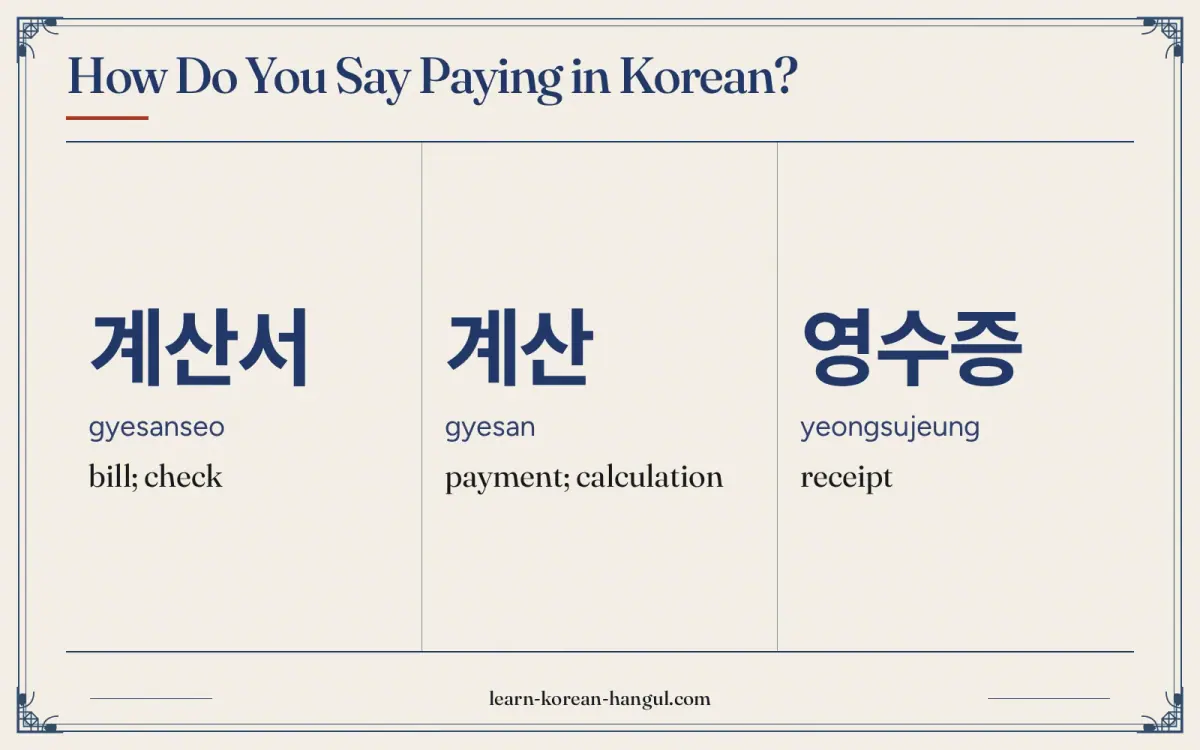
Paying uses plain Sino-Korean nouns. Seven words cover the bill, the way you pay and the receipt.
| No. | Hangul | Revised Romanization | Meaning | Origin | Example sentence | Audio assetId |
|---|---|---|---|---|---|---|
| 31 | 계산서 | gyesanseo | bill; check | Sino-Korean | 계산서 주세요. (gyesanseo juseyo; The bill, please.) | au-pg-vocabulary-food-restaurant-31; example: au-pg-vocabulary-food-restaurant-131 |
| 32 | 계산 | gyesan | payment; calculation | Sino-Korean | 계산은 카운터에서 해요. (gyesaneun kaunteoeseo haeyo; You pay at the counter.) | au-pg-vocabulary-food-restaurant-32; example: au-pg-vocabulary-food-restaurant-132 |
| 33 | 영수증 | yeongsujeung | receipt | Sino-Korean | 영수증 필요하세요? (yeongsujeung piryohaseyo; Do you need a receipt?) | au-pg-vocabulary-food-restaurant-33; example: au-pg-vocabulary-food-restaurant-133 |
| 34 | 카드 | kadeu | card | loanword | 카드로 계산할게요. (kadeuro gyesanhalgeyo; I will pay by card.) | au-pg-vocabulary-food-restaurant-34; example: au-pg-vocabulary-food-restaurant-134 |
| 35 | 현금 | hyeongeum | cash | Sino-Korean | 현금으로 낼게요. (hyeongeumeuro naelgeyo; I will pay in cash.) | au-pg-vocabulary-food-restaurant-35; example: au-pg-vocabulary-food-restaurant-135 |
| 36 | 가격 | gagyeok | price | Sino-Korean | 가격이 얼마예요? (gagyeogi eolmayeyo; What is the price?) | au-pg-vocabulary-food-restaurant-36; example: au-pg-vocabulary-food-restaurant-136 |
| 37 | 할인 | harin | discount | Sino-Korean | 할인 쿠폰이 있어요. (harin kuponi isseoyo; I have a discount coupon.) | au-pg-vocabulary-food-restaurant-37; example: au-pg-vocabulary-food-restaurant-137 |
- 계산서: The ending 서 means a written document. In some places staff only bring a bill if you ask.
- 계산: The word has two meanings: the act of paying and the act of counting. At a restaurant it means paying.
- 영수증: This is the question you hear when you pay by card. You can answer 네 (yes) or 괜찮아요 (no thanks).
- 카드: The particle 로 marks the means of payment. The same pattern gives 현금으로.
- 현금: The verb 내다 means to pay in this sentence, and -ㄹ게요 states what you will do.
- 가격: On a menu it is usually a number alone, in units of a thousand won. 가격 is the formal word for price.
- 할인: The word is common on apps and signs. A phrase such as 십 퍼센트 할인 means ten percent off.
Delivery and Takeaway
Korean delivery is fast and widespread, and a lot of ordering happens in an app. These eight words cover the app, the order and the queue at a popular place.
| No. | Hangul | Revised Romanization | Meaning | Origin | Example sentence | Audio assetId |
|---|---|---|---|---|---|---|
| 38 | 배달 | baedal | delivery | Sino-Korean | 배달은 삼십 분 걸려요. (baedareun samsip bun geollyeoyo; Delivery takes thirty minutes.) | au-pg-vocabulary-food-restaurant-38; example: au-pg-vocabulary-food-restaurant-138 |
| 39 | 포장 | pojang | takeaway; packing | Sino-Korean | 포장해 주세요. (pojanghae juseyo; Please pack it to take away.) | au-pg-vocabulary-food-restaurant-39; example: au-pg-vocabulary-food-restaurant-139 |
| 40 | 예약 | yeyak | reservation | Sino-Korean | 저녁 일곱 시에 예약했어요. (jeonyeok ilgop sie yeyakaesseoyo; I booked for seven in the evening.) | au-pg-vocabulary-food-restaurant-40; example: au-pg-vocabulary-food-restaurant-140 |
| 41 | 대기 | daegi | waiting | Sino-Korean | 대기 시간이 길어요. (daegi sigani gireoyo; The waiting time is long.) | au-pg-vocabulary-food-restaurant-41; example: au-pg-vocabulary-food-restaurant-141 |
| 42 | 웨이팅 | weiting | waiting in line (loan word) | loanword | 웨이팅 명단에 이름을 써요. (weiting myeongdane ireumeul sseoyo; I write my name on the waiting list.) | au-pg-vocabulary-food-restaurant-42; example: au-pg-vocabulary-food-restaurant-142 |
| 43 | 배달앱 | baedaraep | delivery app | mixed | 배달앱으로 주문해요. (baedaraebeuro jumunhaeyo; I order through a delivery app.) | au-pg-vocabulary-food-restaurant-43; example: au-pg-vocabulary-food-restaurant-143 |
| 44 | 배달비 | baedalbi | delivery fee | mixed | 배달비는 삼천 원이에요. (baedalbineun samcheon wonieyo; The delivery fee is 3,000 won.) | au-pg-vocabulary-food-restaurant-44; example: au-pg-vocabulary-food-restaurant-144 |
| 45 | 일회용 | ilhoeyong | disposable | Sino-Korean | 일회용 숟가락은 필요 없어요. (ilhoeyong sutgarageun piryo eopsseoyo; I do not need a disposable spoon.) | au-pg-vocabulary-food-restaurant-45; example: au-pg-vocabulary-food-restaurant-145 |
- 배달: Many restaurants deliver, even cheap dishes, and the word is the one on every app. 걸리다 means to take time.
- 포장: In a restaurant it means takeaway. The ending 해 주세요 turns a noun into a polite request.
- 예약: Clock hours use the native number: seven o'clock is 일곱 시, and minutes use the Sino-Korean numbers.
- 대기: The word appears on screens and apps next to a number of people ahead of you.
- 웨이팅: The word is an English loan used for a queue at a popular restaurant. 대기 means the same and is the formal word.
- 배달앱: The word is 배달 plus 앱 (app). The 으로 after the noun marks the means.
- 배달비: The suffix 비 means cost or fee, as in 교통비 (transport cost).
- 일회용: Apps often ask whether you need disposable cutlery. You can decline with 필요 없어요.
How Do You Pronounce These Words?
In many restaurant words a final ㄱ, ㄷ or ㅂ sound, or a linking ㅅ, makes the next consonant tense. The table follows the Standard Pronunciation rules (표준 발음법) of the 국립국어원.
| Word | Romanization | Said | Rule |
|---|---|---|---|
| 식당 | sikdang | [식땅] | ㄷ after the final ㄱ becomes tense |
| 고깃집 | gogitjip | [고기찝] or [고긷찝] | the linking ㅅ makes the ㅈ tense; the ㅅ itself may be said as a short [ㄷ] or dropped |
| 숟가락 | sutgarak | [숟까락] | ㄱ after the final ㄷ becomes tense |
| 젓가락 | jeotgarak | [저까락] or [젇까락] | the ㄱ after the ㅅ becomes tense; the ㅅ may be said as a short [ㄷ] or dropped |
| 앞접시 | apjeopsi | [압쩝씨] | ㅍ is said as ㅂ at the end of a syllable, and the following ㅈ and ㅅ become tense |
Revised Romanization is the official romanization system of South Korea, announced on 7 July 2000. It follows most sound changes, as in 음료수 eumnyosu, but it does not show tensing caused by a neighbouring sound, so 식당 is written sikdang and said [식땅]. It is only a learning aid. Always read the Hangul as well.
Audio and Slow Playback
Each headword and each example sentence has its own audio clip, and the 5 words in the first-words section also have a slow clip at 0.8 times the speed. Nothing plays until you press a button. Try 숟가락 and 젓가락 together, because they share the same sound change.
What Mistakes Do Learners Make with Restaurant Words?
- Counting a bowl of rice with 개. Say 밥 한 그릇, and use 인분 for meat and 잔 for drinks.
- Using 서비스 to mean good service. In a restaurant it means a free extra.
- Writing the linking ㅅ wrongly. The words are 고깃집 and 횟집, with a ㅅ in the middle, and a spelling without it is a mistake.
- Calling the staff 사장님 in every case. It suits the owner of a small place, and for staff you can say 저기요.
- Mixing the two number sets. A serving uses the Sino-Korean number (이 인분), but a bowl uses the native number (두 그릇).
- Treating 포장 as only takeaway. It also means wrapping or packaging, as for a gift.
Practice: Flashcards and Worksheet
Drill all 45 words with the vocabulary flashcard decks: each card shows the Hangul on one side and the meaning on the other, so you can test yourself in both directions. Consult the vocabulary worksheets page for printable sheets; for practice, write the Korean word for each numbered object in the scene above by hand. Take the groups in the order of a meal: types of restaurant on day one, tableware on day two, the menu words on day three and the rest on day four. Then play the part of a customer and say the lines in the example flow out loud.
Self-Test: 10 Sentences
Fill each blank with a word from this page. Say the whole sentence aloud when you have it. The answers follow the test.
- 이 근처에 맛있는 ___이 있어요? (Is there a tasty restaurant near here?)
- ___은 저녁에 열어요. (The pub opens in the evening.)
- 창가 ___로 주세요. (A window seat, please.)
- 밥 한 ___ 주세요. (One bowl of rice, please.)
- ___로 고기를 잘라요. (We cut the meat with scissors.)
- 삼겹살 이 ___ 주세요. (Two servings of pork belly, please.)
- 반찬은 ___이 돼요. (Side dishes can be refilled.)
- ___은 카운터에서 해요. (You pay at the counter.)
- ___ 쿠폰이 있어요. (I have a discount coupon.)
- ___ 시간이 길어요. (The waiting time is long.)
Answers: 1. 식당; 2. 술집; 3. 자리; 4. 그릇; 5. 가위; 6. 인분; 7. 리필; 8. 계산; 9. 할인; 10. 대기.
A score of 8 or more suggests the words are settling in. If you scored lower, reread the groups where you missed words.
Where to Go Next
This Korean restaurant vocabulary list sits inside Food and Drink. Continue with Drinks for the cafe and bar menu, and Cooking and Taste for words that describe flavour. For the single-word answer, see restaurant in korean.
FAQ
How Do You Say Restaurant in Korean?
Say 식당 (sikdang). It is said [식땅], and it covers any place that serves meals. For a type of restaurant, put the food before 집, as in 고깃집 (a grilled meat restaurant). For the single-word answer, see restaurant in korean.
How Do You Pronounce 분식집 (bunsikjip)?
Say boon-sik-jip, but make the last syllable tense: [분식찝]. The ㄱ at the end of 식 makes the ㅈ tight and sharp. The final ㅂ of 집 is not released, so the word ends with closed lips. Before a vowel, as in 분식집에 (to the snack restaurant), the ㅂ links forward and sounds like a light b.
How Many Restaurant Words Should I Learn First?
Learn the five words in the first-words section: 식당, 메뉴, 주문, 계산서 and 포장. Then add 인분, 그릇 and 잔, because these unit words decide how you order. The rest of the 45 words can be added a group at a time.
Where Can I Practise Restaurant Words with Flashcards?
Use the vocabulary flashcard decks. Start with the first 10 words of this page, then add 10 more each day. Review the older cards before you add new ones, so the earlier words do not fade, and say each word aloud as you flip the card.
Is the Romanization on This Page Official?
Yes, as a learning aid. It follows the Revised Romanization of Korean, the system South Korea has officially used since 7 July 2000, and the page also gives the Hangul for every word. It follows most sound changes but does not show tensing caused by a neighbouring sound: 식당 is written sikdang but said [식땅]. Treat the Hangul as the real spelling.
Is There a Printable Worksheet for Restaurant Words?
The vocabulary worksheets page lists the printable sheets. For paper practice, use the illustrated scene on this page as a labelling task and write the Korean word next to each numbered object. You can also copy the scene words by hand.