Korean Sports Flashcards: Study the 29 Cards
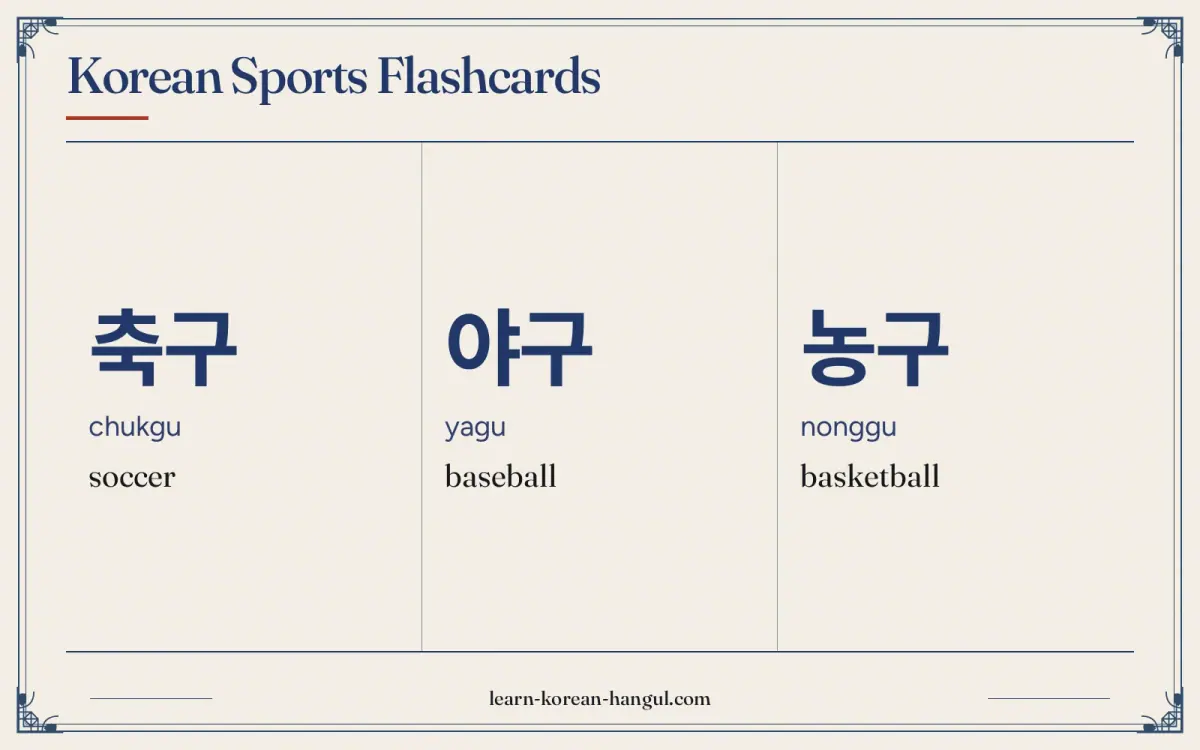
Each sport takes its own verb in Korean, so learn the verb with the sport. The notes give the verb for each card. The lesson behind the deck is sports in korean, so read it first if a card is new.
How Do I Use These Flashcards?
Use the deck above in four steps. It works with tap, click or keyboard, and nothing plays until you press an audio button.
- Choose a mode. Start with recognition (Hangul to meaning). Switch to recall (meaning to Hangul) or listening (audio to meaning) once recognition feels easy.
- Show the answer. Think of the answer first, then press Show answer (or Space). Turn on the romanization toggle only if you need it; the 29-card table below always shows it.
- Grade yourself. Press Got it if you answered correctly without help, or Not yet if you hesitated or guessed.
- Finish the session. A session holds up to 20 cards (you can set 10, 20 or 40). With 29 cards, a first-time learner can split the deck over three days, using the default limit of 10 new cards a day.
The Three Study Modes
Recognition shows the Hangul and asks for the meaning, which trains reading. Recall shows the meaning and asks for the Hangul, which trains remembering; you may type the answer with your Hangul keyboard or just recall it in your head. Listening plays a clip and hides the letters, which trains the ear. Listening mode only uses a card once its audio is approved, and cards without approved audio are skipped in that mode with a note.
Got It and Not Yet
Got it moves the card up one Leitner box, so it comes back later. Not yet sends the card back to box 1, so it returns in the same session or within 10 minutes. The grades are your own judgement; the deck does not score you or claim fluency.
Deck Scope: What Is and Is Not Covered
The deck covers ball sports (축구, 야구, 농구, 배구, 테니스, 탁구, 골프, 볼링, 배드민턴), water, winter and outdoor sports (수영, 스키, 스케이트, 달리기, 마라톤, 등산), fitness (요가, 운동, 헬스장), martial arts (태권도, 유도, 검도, 복싱, 씨름) and match words (경기, 선수, 감독, 심판, 응원, 팬). Music and games are in their own decks.
What Is Left out of This Deck?
Music words are in the korean music vocabulary flashcards, and school subjects, including 체육, are in the korean school subjects flashcards. The deck leaves out the full verb lists, because the verbs have their own lesson pages, and it does not teach sports scores or rules.
All 29 Cards in One Table
All 29 cards appear below in deck order. The table is plain HTML, so you can use it as a drill without the deck: cover the Meaning column, read each Hangul word aloud, then uncover the meaning.
| # | Hangul | Revised Romanization | Meaning | Note | Audio assetId |
|---|---|---|---|---|---|
| 1 | 축구 | chukgu | soccer | Said [축꾸]. Team ball sports take 하다: 축구를 해요. | au-pg-flashcards-sports-1; slow: au-pg-flashcards-sports-30 |
| 2 | 야구 | yagu | baseball | Team ball sports take 하다: 야구를 해요. Among the most followed spectator sports. | au-pg-flashcards-sports-2 |
| 3 | 농구 | nonggu | basketball | Team ball sports take 하다: 농구를 해요. | au-pg-flashcards-sports-3 |
| 4 | 배구 | baegu | volleyball | Team ball sports take 하다: 배구를 해요. | au-pg-flashcards-sports-4 |
| 5 | 테니스 | teniseu | tennis | A loanword. Racket and strike sports take 치다: 테니스를 쳐요. | au-pg-flashcards-sports-5 |
| 6 | 탁구 | takgu | table tennis | Said [탁꾸]. The verb is 치다: 탁구를 쳐요. | au-pg-flashcards-sports-6; slow: au-pg-flashcards-sports-31 |
| 7 | 골프 | golpeu | golf | A loanword. It takes 치다: 골프를 쳐요. | au-pg-flashcards-sports-7 |
| 8 | 볼링 | bolling | bowling | A loanword. The verb is 치다: 볼링을 쳐요. | au-pg-flashcards-sports-8 |
| 9 | 배드민턴 | baedeuminteon | badminton | A loanword. The verb is 치다: 배드민턴을 쳐요. | au-pg-flashcards-sports-9 |
| 10 | 수영 | suyeong | swimming | It becomes a verb directly: 수영해요 (I swim). | au-pg-flashcards-sports-10 |
| 11 | 스키 | seuki | ski | A loanword. Ski takes 타다: 스키를 타요. | au-pg-flashcards-sports-11 |
| 12 | 스케이트 | seukeiteu | skating | A loanword. The verb is 타다: 스케이트를 타요. | au-pg-flashcards-sports-12 |
| 13 | 달리기 | dalligi | running | From 달리다 (to run). Use it with 하다: 달리기를 해요. | au-pg-flashcards-sports-13 |
| 14 | 마라톤 | maraton | marathon | A loanword. A marathon race is 마라톤 대회. | au-pg-flashcards-sports-14 |
| 15 | 등산 | deungsan | hiking | Walking in the mountains. 등산을 가다 means to go hiking. | au-pg-flashcards-sports-15 |
| 16 | 요가 | yoga | yoga | A loanword. The verb is 하다: 요가를 해요. | au-pg-flashcards-sports-16 |
| 17 | 태권도 | taegwondo | taekwondo | Said [태꿘도]. Korea's best-known martial art. The verb is 하다: 태권도를 해요. | au-pg-flashcards-sports-17; slow: au-pg-flashcards-sports-32 |
| 18 | 유도 | yudo | judo | A martial art. The verb is 하다: 유도를 해요. | au-pg-flashcards-sports-18 |
| 19 | 검도 | geomdo | kendo | A sword-fighting martial art. The verb is 하다: 검도를 해요. | au-pg-flashcards-sports-19 |
| 20 | 복싱 | boksing | boxing | A loanword. The verb is 하다: 복싱을 해요. | au-pg-flashcards-sports-20 |
| 21 | 씨름 | ssireum | ssireum (Korean wrestling) | A traditional wrestling sport. | au-pg-flashcards-sports-21 |
| 22 | 운동 | undong | exercise; sports | Ask 무슨 운동을 좋아해요? (Which sport do you like?). 운동하다 means to exercise. | au-pg-flashcards-sports-22 |
| 23 | 헬스장 | helseujang | gym | Gym; a fitness centre. 장 means place. | au-pg-flashcards-sports-23; slow: au-pg-flashcards-sports-33 |
| 24 | 경기 | gyeonggi | match; game | A sports match. 경기를 보다 means to watch a match. | au-pg-flashcards-sports-24 |
| 25 | 선수 | seonsu | player; athlete | A person who plays a sport at a high level. | au-pg-flashcards-sports-25 |
| 26 | 감독 | gamdok | coach; manager | The head of a team. | au-pg-flashcards-sports-26 |
| 27 | 심판 | simpan | referee | The person who makes the rulings in a match. | au-pg-flashcards-sports-27 |
| 28 | 응원 | eungwon | cheering; support | 응원하다 means to cheer. Fans cheer the team. | au-pg-flashcards-sports-28 |
| 29 | 팬 | paen | fan | Fan, of a team or a player. A loanword. | au-pg-flashcards-sports-29 |
Reading the Table
Hangul is the word. Revised Romanization (RR) is a learning aid, so try to read the Hangul before you look at it. RR follows the sound of the word, which is why some spellings change. The Meaning column gives the English gloss, and the Note column gives the verb that goes with each sport, because 하다, 치다 and 타다 are not interchangeable. Sixteen cards that are not in the shared word list were added from the sports lesson plan, and their glosses are plain. The last column lists the audio assetId; a second ID marks a slow clip.
Usage Notes for These Cards
Team ball sports take 하다. 축구를 해요 (I play soccer) and 야구를 해요 (I play baseball). 농구 and 배구 follow the same pattern.
Racket and strike sports take 치다. 테니스를 쳐요, 탁구를 쳐요, 골프를 쳐요 and 볼링을 쳐요. The verb 치다 means to hit or strike.
Sports where you ride or glide take 타다. 자전거를 타요 (I ride a bike), 스키를 타요 and 스케이트를 타요.
Swimming becomes a verb directly; running takes 하다. 수영해요 (I swim) adds 하다 straight to the noun. Running uses the noun with 를 and 하다: 달리기를 해요 (I run).
Win and lose belong to the team. 우리 팀이 이겼어요 (Our team won) and 졌어요 (lost). 이기다 and 지다 are the verbs; the deck teaches the nouns around them.
Which Sounds Do Not Match the Spelling?
Several sports words change sound when they are said.
- 축구 is said [축꾸]. The ㄱ after a closed ㄱ sound is tensified.
- 탁구 is said [탁꾸]. The same tensing applies.
- 태권도 is said [태꿘도]. The ㄱ of 권 is pronounced tense, like ㄲ, in this word.
The pronunciations follow the 국립국어원 (National Institute of Korean Language) standard pronunciation rules (표준 발음법), and the romanization follows the Revised Romanization of Korean (2000).
What Mistakes Do Learners Make with Sports Words?
- Saying 축구를 치다. Team ball sports use 하다.
- Saying 자전거를 하다. Use 자전거를 타다.
- Saying 수영을 타다. Swimming is 수영하다.
- Mixing up 운동 (exercise) and 경기 (a match).
- Using 선수 for any player. It means a competitive athlete, not a casual player.
How Does the Review Schedule Work?
The deck uses a simplified Leitner system with five boxes. A new card starts in box 1. Each Got it moves it up one box, and each Not yet returns it to box 1. The box sets how long the card waits before it is due again.
| Box | Wait until the next review |
|---|---|
| 1 | same session or 10 minutes |
| 2 | 1 day |
| 3 | 3 days |
| 4 | 7 days |
| 5 | 21 days |
Each session shows due cards first, oldest due first, and then up to 10 new cards a day by default. A deck of 29 cards is introduced over three days at the default of 10 new cards a day, and the later boxes bring each card back at longer gaps. Progress is saved only in this browser, so clearing site data deletes it. Use the export button to save a small JSON file with card IDs, boxes and due dates, and import it on another device. No account is needed.
Cultural and Practical Context
Taekwondo is Korea's best-known martial art and is called the 국기 (national sport), while 씨름 is a traditional wrestling sport. Baseball and soccer are followed by many fans, and cheering (응원) is a big part of the experience at a game.
Limits of This Deck
The deck has 29 cards, so it teaches the sports and match words and leaves out the verbs. Sixteen cards come from the sports lesson rather than the site's word dictionary, which holds only a small set of sports, so their glosses are kept short and plain. Popularity statements are general. All Korean text is generated and was reviewed and signed off by Min-ji Park on 15 October 2026. The audio is generated with text-to-speech and is checked by a Korean teacher before publication, and listening mode uses only cards whose clips are approved.
Next Steps after This Deck
Continue with the korean music vocabulary flashcards, or go back to the korean school subjects flashcards if a word here still feels shaky. Write the same words by hand with the korean hobbies vocabulary worksheet. The korean vocabulary flashcards page lists every other deck, and the korean flashcards hub lists all topics.
Frequently Asked Questions
Is 야구 Popular in Korea?
It is among the most followed spectator sports in Korea, together with soccer. Fans follow professional teams and cheer for them, and 응원 is a card in this deck. The deck teaches the word 야구 and the pattern 야구를 해요, but it gives no audience numbers.
How Do I Ask What Sport You Like?
Say 무슨 운동을 좋아해요? (Which sport do you like?). The answer is 저는 축구를 좋아해요 (I like soccer). Put the sport name from any card before 를 or 을 and then 좋아해요. Use the noun that matches the sport you mean.
Do I Say 골프를 치다?
Yes. 치다 is used for golf, tennis, table tennis and bowling, because you strike a ball or pins in each of them. So you say 골프를 쳐요 and not 골프를 해요, although 하다 is also heard in speech for the activity as a whole. Team ball sports use 하다.
What Is 등산?
It is hiking in the mountains. 등산을 가요 means "I go hiking", and it is a popular weekend activity. The word is made of 등 (climb) and 산 (mountain), and a person who goes hiking is called a 등산객, which is easy to remember from the two parts.
Is My Progress Saved If I Close the Page?
Yes, in the same browser on the same device. Card boxes and due dates are stored locally and nothing is sent to a server. Clearing site data, using a private window or switching browsers removes them, so use the export button to keep a backup file. No account is needed.