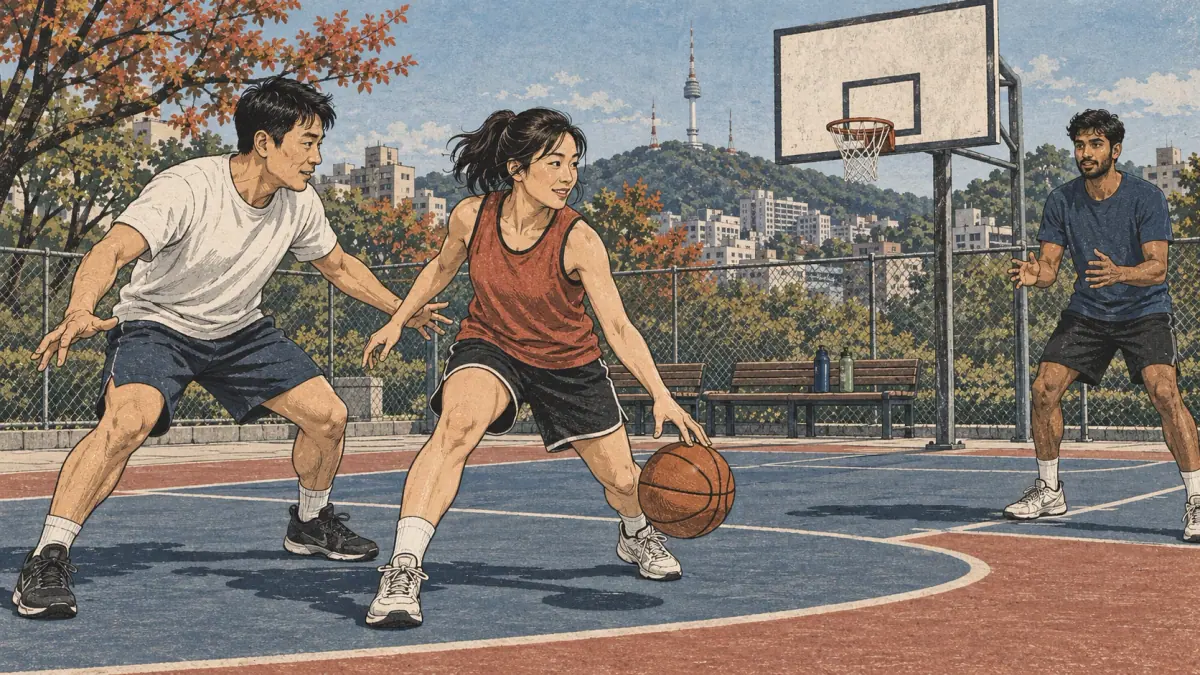
What you'll learn
- Match all 45 sports words to their English meanings.
- Choose the right verb for a sport: 하다, 치다, 타다 or 차다.
- Say five of the words aloud with the help of the Revised Romanization and the audio.
- Write two original sentences with words such as 야구 and 농구.
Prerequisites: you can read Hangul and know the polite ending -아요/-어요. Estimated time: about 60 minutes, plus short reviews on the following days.
Sports in Korean at a Glance
Most sport names in Korean come from two sources. The traditional team sports and martial arts use Sino-Korean words, which are built from Chinese-derived syllables: 야구 (野球, field-ball), 축구 (蹴球, kick-ball), 농구 (籠球, basket-ball) and 배구 (排球, volleyball). Sports that arrived later keep their English names in Hangul: 골프, 테니스, 스키 and 요가. If you can read Hangul, many entries on this list are English words you already know.
The second thing to learn is the verb. English says "play" for most sports, but Korean chooses by action. You do (하다) soccer, hit (치다) a tennis ball, and ride (타다) skis. The verb table below shows the pattern. The list sits inside Hobbies and Leisure and has three deeper pages: sports positions, gym and fitness and taekwondo and martial arts.
| Group | Words | Examples |
|---|---|---|
| Ball sports | 10 | 야구, 축구, 농구, 배구 |
| Water and winter sports | 8 | 수영, 수영장, 스키, 스키장 |
| Martial arts | 6 | 태권도, 유도, 검도, 합기도 |
| Fitness | 8 | 운동, 헬스, 요가, 달리기 |
| Watching sports | 13 | 경기, 선수, 팀, 감독 |
By origin, the list has 23 Sino-Korean words, 4 native Korean words, 17 loanwords and 1 mixed word (스키장: the loanword 스키 plus the Sino-Korean 장).
Which Sports Words Should You Learn First?
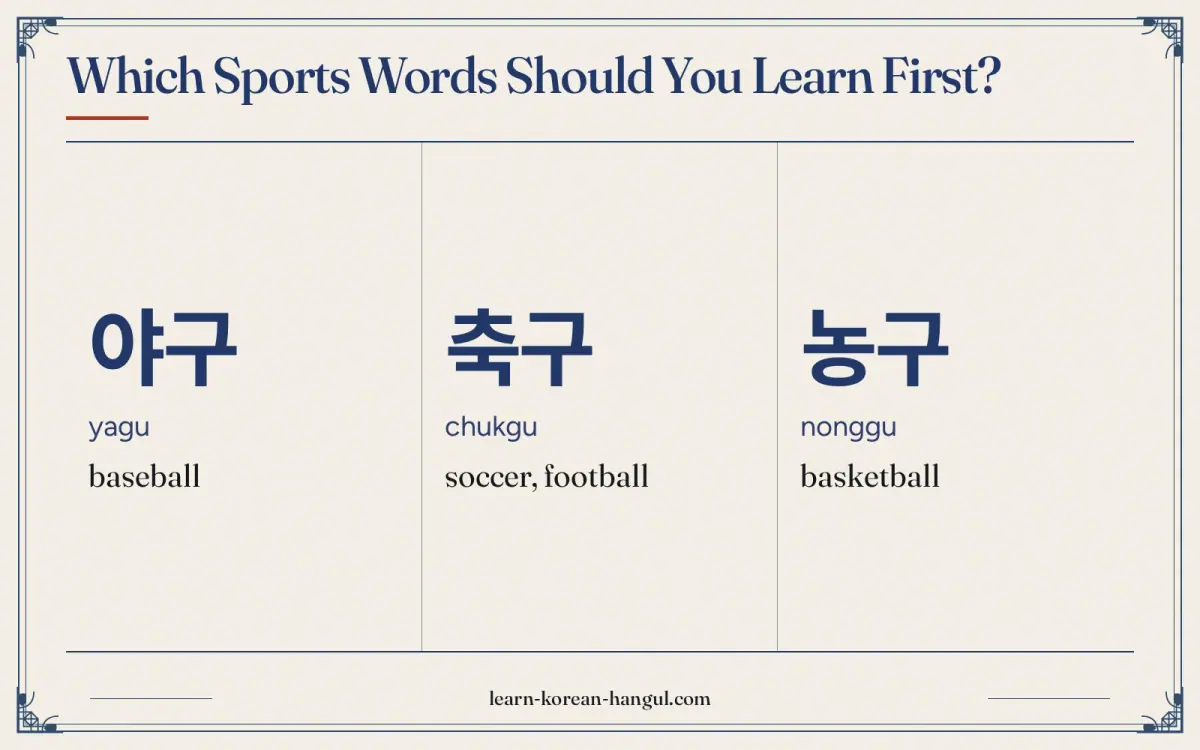
Start with five words: 야구, 축구, 수영, 운동 and 경기. They cover the most common sports, the general word for exercise, and the word for a match. Press the slow button, say each word aloud, then listen to the sentence.
The scene below shows twelve of the 45 words. Each number matches a word in the lists that follow.
Word · 12
- 1
야구
yagu
baseball
- 2
축구
chukgu
soccer, football
- 3
농구
nonggu
basketball
- 4
볼링
bolling
bowling
- 5
수영
suyeong
swimming
- 6
스키
seuki
skiing, ski
- 7
태권도
taegwondo
taekwondo
- 8
운동
undong
exercise, sport
- 9
헬스
helseu
gym workout, weight training
- 10
경기
gyeonggi
match, game
- 11
심판
simpan
referee, umpire
- 12
홈런
homneon
home run
Twelve numbered objects match twelve words from the lists. Use the list under the picture if you cannot see the numbers.
Ball Sports
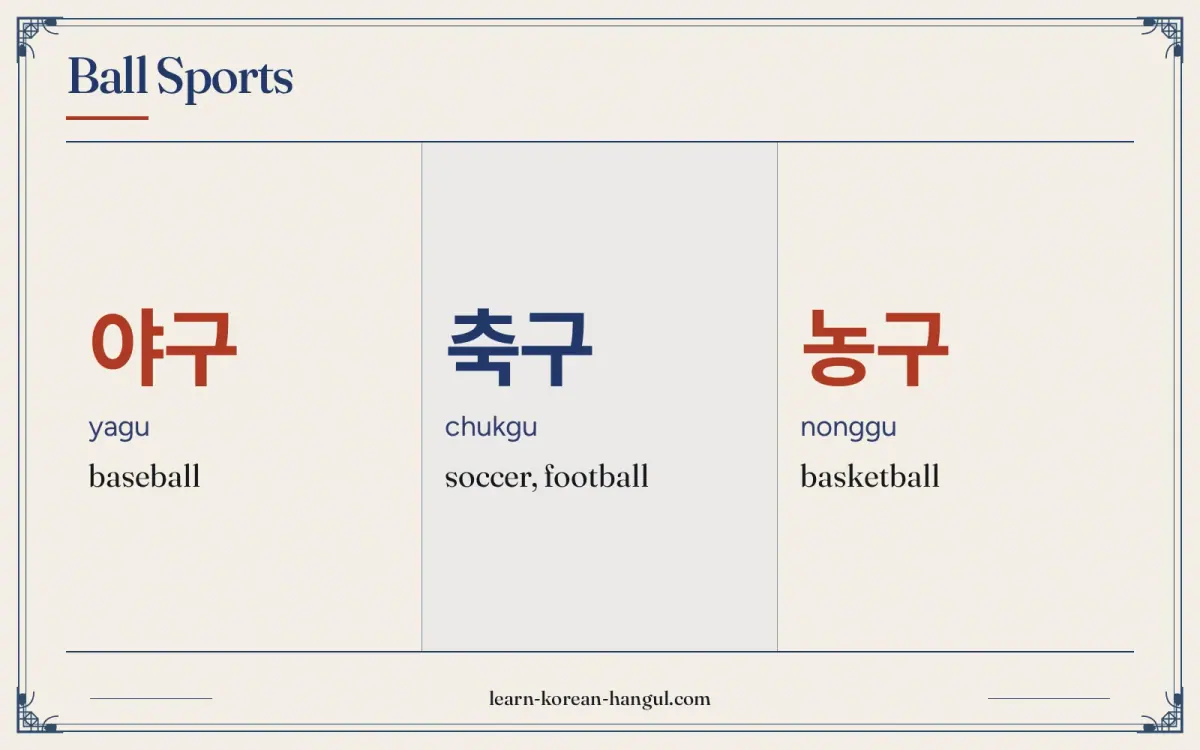
Ten words for ball games. The five Sino-Korean names end in 구 (球, ball), which is a quick way to recognise them: 야구, 축구, 농구, 배구, 탁구. Racket and club sports take 치다 (to hit).
| No. | Hangul | Revised Romanization | Meaning | Example sentence | Audio assetId |
|---|---|---|---|---|---|
| 1 | 야구 | yagu | baseball | 주말에 야구를 봐요. (jumare yagureul bwayo. I watch baseball on weekends.) | au-pg-vocabulary-hobbies-sports-1; example: au-pg-vocabulary-hobbies-sports-101 |
| 2 | 축구 | chukgu | soccer, football | 친구들과 축구를 해요. (chingudeulgwa chukgureul haeyo. I play soccer with friends.) | au-pg-vocabulary-hobbies-sports-2; example: au-pg-vocabulary-hobbies-sports-102 |
| 3 | 농구 | nonggu | basketball | 저는 농구를 좋아해요. (jeoneun nonggureul joahaeyo. I like basketball.) | au-pg-vocabulary-hobbies-sports-3; example: au-pg-vocabulary-hobbies-sports-103 |
| 4 | 배구 | baegu | volleyball | 학교에서 배구를 해요. (hakgyoeseo baegureul haeyo. I play volleyball at school.) | au-pg-vocabulary-hobbies-sports-4; example: au-pg-vocabulary-hobbies-sports-104 |
| 5 | 탁구 | takgu | table tennis | 탁구를 쳐요. (takgureul chyeoyo. I play table tennis.) | au-pg-vocabulary-hobbies-sports-5; example: au-pg-vocabulary-hobbies-sports-105 |
| 6 | 골프 | golpeu | golf | 아버지는 골프를 치세요. (abeojineun golpeureul chiseyo. My father plays golf.) | au-pg-vocabulary-hobbies-sports-6; example: au-pg-vocabulary-hobbies-sports-106 |
| 7 | 테니스 | teniseu | tennis | 테니스를 배우고 싶어요. (teniseureul baeugo sipeoyo. I want to learn tennis.) | au-pg-vocabulary-hobbies-sports-7; example: au-pg-vocabulary-hobbies-sports-107 |
| 8 | 배드민턴 | baedeuminteon | badminton | 공원에서 배드민턴을 쳐요. (gongwoneseo baedeuminteoneul chyeoyo. I play badminton in the park.) | au-pg-vocabulary-hobbies-sports-8; example: au-pg-vocabulary-hobbies-sports-108 |
| 9 | 볼링 | bolling | bowling | 주말에 볼링을 쳐요. (jumare bollingeul chyeoyo. I go bowling on weekends.) | au-pg-vocabulary-hobbies-sports-9; example: au-pg-vocabulary-hobbies-sports-109 |
| 10 | 공 | gong | ball | 공을 던져요. (gongeul deonjyeoyo. I throw the ball.) | au-pg-vocabulary-hobbies-sports-10; example: au-pg-vocabulary-hobbies-sports-110 |
- 야구: Baseball is one of the most followed spectator sports in Korea. Say 야구를 하다 for playing it and 야구를 보다 for watching a game.
- 축구: Korean uses 축구 for the game English speakers call football or soccer. It is said [축꾸], with a tense second consonant.
- 농구: The ㅇ at the end of 농 is the ng sound, so say nong-gu, not no-gu. 농구장 is a basketball court.
- 배구: Do not confuse 배구 (volleyball) with 배 (stomach, ship or pear). The short word 배 is not a sport.
- 탁구: You hit the ball, so the verb is 치다 and the polite form is 쳐요. Said [탁꾸].
- 골프: A loanword. The verb is 치다, here in the honorific form 치세요 because the subject is a parent.
- 테니스: Written 테니스 with the vowel ㅔ in the first syllable. The racket is 라켓.
- 배드민턴: A four-syllable loanword: bae-deu-min-teon. It is a popular park and gym activity for all ages.
- 볼링: Bowling takes 치다 as well. The two ㄹ sounds in 볼링 join into a long l, written bolling.
- 공: A native Korean word, short and common. The same sound is the Sino-Korean zero in phone numbers, so context matters. Its verbs are 던지다 (throw) and 차다 (kick).
Example Sentences
Press play and repeat each sentence aloud. The ball sports use three different verbs, so read the endings carefully.
친구들과 축구를 해요.
chingudeulgwa chukgureul haeyo.
I play soccer with friends.
탁구를 쳐요.
takgureul chyeoyo.
I play table tennis.
아버지는 골프를 치세요.
abeojineun golpeureul chiseyo.
My father plays golf.
공을 던져요.
gongeul deonjyeoyo.
I throw the ball.
Notice that 축구 takes 해요, 탁구 and 골프 take 쳐요 or 치세요, and 공 takes 던져요. The next section sorts the verbs.
Which Verb Goes with Which Sport?
English says play for most sports, but Korean uses a different verb for each kind of action. The verb table shows the main choices, with the polite present from the site conjugator.
| Verb | Polite present | Meaning | Used with |
|---|---|---|---|
| 하다 | 해요 | to do | 축구, 야구, 농구, 배구, 수영, 요가, 운동 |
| 치다 | 쳐요 | to hit | 탁구, 테니스, 골프, 배드민턴, 볼링 |
| 타다 | 타요 | to ride, to glide | 스키, 스케이트, 스노보드, 눈썰매, 자전거 |
| 차다 | 차요 | to kick | 공 |
To say you like a sport, put 좋아하다 after it, as in 농구를 좋아해요. To say you watch it, use 보다: 야구를 봐요. Many sports also accept 하다 informally, so 탁구를 해요 is understood, but 탁구를 쳐요 sounds more natural.
Water and Winter Sports
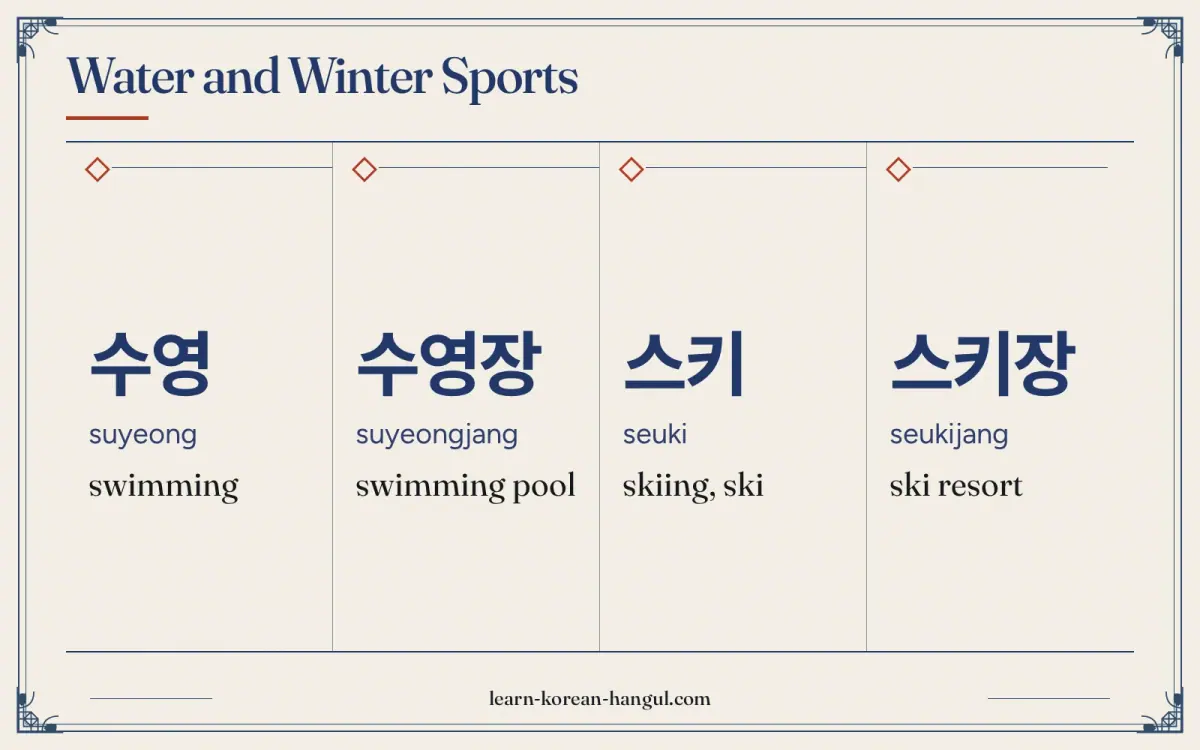
Eight words for sports done on water, snow and ice. Most of them are English loanwords, and the verb is usually 타다 (to ride) for sports where you glide.
| No. | Hangul | Revised Romanization | Meaning | Example sentence | Audio assetId |
|---|---|---|---|---|---|
| 11 | 수영 | suyeong | swimming | 매일 아침 수영을 해요. (maeil achim suyeongeul haeyo. I swim every morning.) | au-pg-vocabulary-hobbies-sports-11; example: au-pg-vocabulary-hobbies-sports-111 |
| 12 | 수영장 | suyeongjang | swimming pool | 수영장은 집 근처에 있어요. (suyeongjangeun jip geuncheoe isseoyo. The swimming pool is near my house.) | au-pg-vocabulary-hobbies-sports-12; example: au-pg-vocabulary-hobbies-sports-112 |
| 13 | 스키 | seuki | skiing, ski | 겨울에 스키를 타요. (gyeoure seukireul tayo. I ski in winter.) | au-pg-vocabulary-hobbies-sports-13; example: au-pg-vocabulary-hobbies-sports-113 |
| 14 | 스키장 | seukijang | ski resort | 이번 주말에 스키장에 가요. (ibeon jumare seukijange gayo. I am going to the ski resort this weekend.) | au-pg-vocabulary-hobbies-sports-14; example: au-pg-vocabulary-hobbies-sports-114 |
| 15 | 스케이트 | seukeiteu | ice skating, skates | 스케이트를 타요. (seukeiteureul tayo. I go ice skating.) | au-pg-vocabulary-hobbies-sports-15; example: au-pg-vocabulary-hobbies-sports-115 |
| 16 | 스노보드 | seunobodeu | snowboard | 스노보드는 스키보다 어려워요. (seunobodeuneun seukiboda eoryeowoyo. Snowboarding is harder than skiing.) | au-pg-vocabulary-hobbies-sports-16; example: au-pg-vocabulary-hobbies-sports-116 |
| 17 | 서핑 | seoping | surfing | 여름에 서핑을 배워요. (yeoreume seopingeul baewoyo. I learn surfing in summer.) | au-pg-vocabulary-hobbies-sports-17; example: au-pg-vocabulary-hobbies-sports-117 |
| 18 | 눈썰매 | nunsseolmae | snow sledding | 아이들은 눈썰매를 타요. (aideureun nunsseolmaereul tayo. The children go sledding.) | au-pg-vocabulary-hobbies-sports-18; example: au-pg-vocabulary-hobbies-sports-118 |
- 수영: Swimming is 수영하다 as one verb, or 수영을 하다 as two words. Both are correct.
- 수영장: 수영 plus 장 (place). The suffix 장 appears in many place names, as in 스키장 and 야구장.
- 스키: You ride skis, so the verb is 타다. The word is written with the vowel ㅡ in the first syllable: seu-ki.
- 스키장: 스키 plus 장 (place). Many ski resorts are in the mountains of Gangwon Province.
- 스케이트: Both the sport and the skates themselves. The loanword has four syllables: seu-ke-i-teu.
- 스노보드: The particle 보다 means than here. 어렵다 changes to 어려워요 in the polite present.
- 서핑: Said seo-ping. Surfing also uses 타다 in the phrase 파도를 타다 (to ride a wave), though 서핑을 하다 is more common.
- 눈썰매: Made from 눈 (snow) and 썰매 (sled). The double ㅆ is a tense s, written ss.
Martial Arts
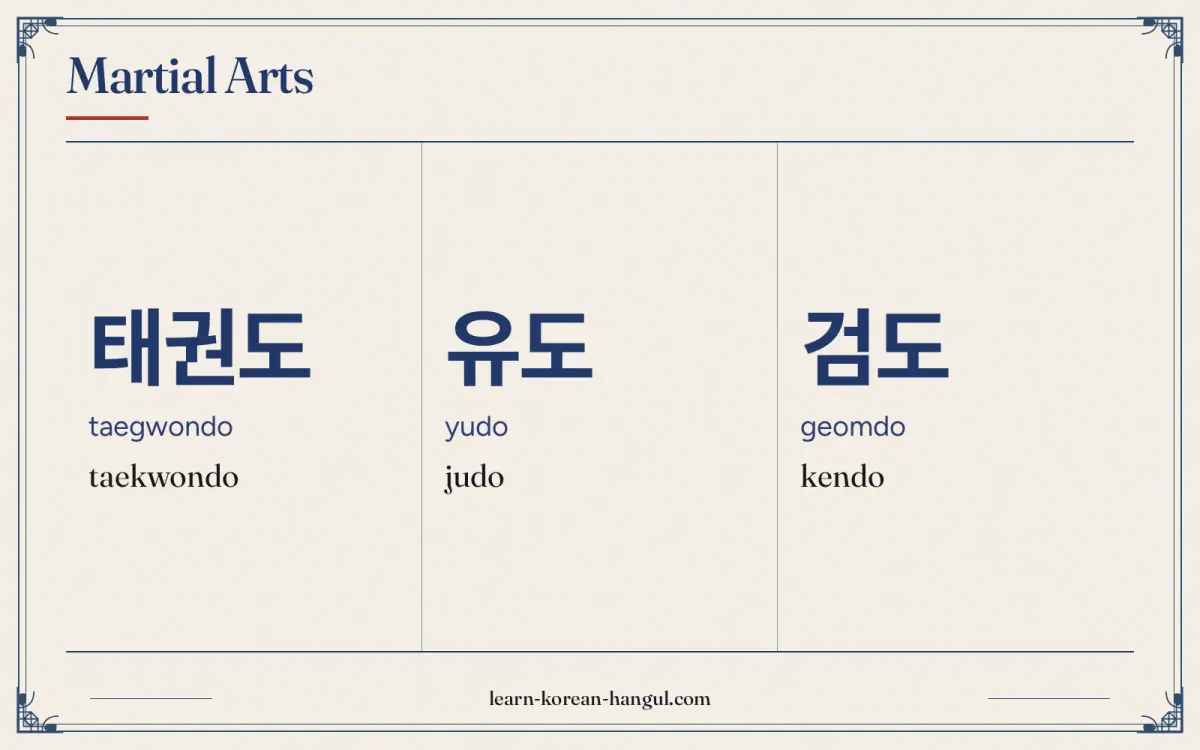
Six names for Korean and East Asian martial arts. Most end in 도 (道, way), the same word as in 태권도. Page taekwondo and martial arts goes deeper.
| No. | Hangul | Revised Romanization | Meaning | Example sentence | Audio assetId |
|---|---|---|---|---|---|
| 19 | 태권도 | taegwondo | taekwondo | 저는 태권도를 배워요. (jeoneun taegwondoreul baewoyo. I learn taekwondo.) | au-pg-vocabulary-hobbies-sports-19; example: au-pg-vocabulary-hobbies-sports-119 |
| 20 | 유도 | yudo | judo | 유도를 배우고 싶어요. (yudoreul baeugo sipeoyo. I want to learn judo.) | au-pg-vocabulary-hobbies-sports-20; example: au-pg-vocabulary-hobbies-sports-120 |
| 21 | 검도 | geomdo | kendo | 검도 도장에 다녀요. (geomdo dojange danyeoyo. I go to a kendo dojo.) | au-pg-vocabulary-hobbies-sports-21; example: au-pg-vocabulary-hobbies-sports-121 |
| 22 | 합기도 | hapgido | hapkido | 합기도는 던지기 기술이 많아요. (hapgidoneun deonjigi gisuri manayo. Hapkido has many throwing techniques.) | au-pg-vocabulary-hobbies-sports-22; example: au-pg-vocabulary-hobbies-sports-122 |
| 23 | 씨름 | ssireum | ssireum (Korean wrestling) | 추석에 씨름을 봐요. (chuseoge ssireumeul bwayo. We watch ssireum at Chuseok.) | au-pg-vocabulary-hobbies-sports-23; example: au-pg-vocabulary-hobbies-sports-123 |
| 24 | 권투 | gwontu | boxing | 권투 선수가 연습해요. (gwontu seonsuga yeonseupaeyo. The boxer is practising.) | au-pg-vocabulary-hobbies-sports-24; example: au-pg-vocabulary-hobbies-sports-124 |
- 태권도: Taekwondo is a Korean martial art, and the Korean spelling gives the Revised Romanization taegwondo. The parts are 태 (foot), 권 (fist) and 도 (way).
- 유도: A Sino-Korean word that shares its characters with Japanese judo. Ends in 도, the way.
- 검도: 검 means sword. The standard pronunciation is [검도], with a plain ㄷ, although [검또] is also heard.
- 합기도: Said [합끼도]. The final ㅂ makes the following ㄱ tense.
- 씨름: A traditional Korean folk wrestling sport, popular at holidays. The double ㅆ is tense.
- 권투: 권투 means boxing, and 권투 선수 is a boxer. Some people also say 복싱, a loanword.
Fitness
Eight words for staying active. 운동 is the general word, and the others name particular activities.
| No. | Hangul | Revised Romanization | Meaning | Example sentence | Audio assetId |
|---|---|---|---|---|---|
| 25 | 운동 | undong | exercise, sport | 저는 매일 운동해요. (jeoneun maeil undonghaeyo. I exercise every day.) | au-pg-vocabulary-hobbies-sports-25; example: au-pg-vocabulary-hobbies-sports-125 |
| 26 | 헬스 | helseu | gym workout, weight training | 퇴근 후에 헬스를 해요. (toegeun hue helseureul haeyo. I work out at the gym after work.) | au-pg-vocabulary-hobbies-sports-26; example: au-pg-vocabulary-hobbies-sports-126 |
| 27 | 요가 | yoga | yoga | 아침에 요가를 해요. (achime yogareul haeyo. I do yoga in the morning.) | au-pg-vocabulary-hobbies-sports-27; example: au-pg-vocabulary-hobbies-sports-127 |
| 28 | 달리기 | dalligi | running | 달리기는 건강에 좋아요. (dalligineun geongange joayo. Running is good for your health.) | au-pg-vocabulary-hobbies-sports-28; example: au-pg-vocabulary-hobbies-sports-128 |
| 29 | 조깅 | joging | jogging | 공원에서 조깅을 해요. (gongwoneseo jogingeul haeyo. I jog in the park.) | au-pg-vocabulary-hobbies-sports-29; example: au-pg-vocabulary-hobbies-sports-129 |
| 30 | 마라톤 | maraton | marathon | 마라톤에 참가하고 싶어요. (maratone chamgahago sipeoyo. I want to join a marathon.) | au-pg-vocabulary-hobbies-sports-30; example: au-pg-vocabulary-hobbies-sports-130 |
| 31 | 등산 | deungsan | hiking, mountain climbing | 일요일에 등산을 가요. (iryoire deungsaneul gayo. I go hiking on Sundays.) | au-pg-vocabulary-hobbies-sports-31; example: au-pg-vocabulary-hobbies-sports-131 |
| 32 | 자전거 | jajeongeo | bicycle | 주말에 자전거를 타요. (jumare jajeongeoreul tayo. I ride a bicycle on weekends.) | au-pg-vocabulary-hobbies-sports-32; example: au-pg-vocabulary-hobbies-sports-132 |
- 운동: Used for exercise in general and also for sport. 운동하다 is the verb, and 운동장 is a sports field.
- 헬스: From English health. In Korean, 헬스 means weight training, not health. Health in general is 건강.
- 요가: The same sounds as English yoga, with the vowels ㅛ and ㅏ.
- 달리기: A noun made from the verb 달리다 (to run). It means the activity, as in 달리기 시합 (a race).
- 조깅: Said jo-ging. It is gentler than 달리기 and often done for health.
- 마라톤: Three syllables, ma-ra-ton. 마라톤 대회 means a marathon event.
- 등산: Hiking is very popular in Korea. 등 (to climb) and 산 (mountain). The verb is 가다 in this phrase: 등산을 가다.
- 자전거: Riding a bicycle uses 타다. The word is Sino-Korean, from 自轉車.
Watching Sports
Thirteen words for matches, players and fans. Spectator language is a big part of sports talk, because many people follow a team without playing. The best-known professional leagues are the KBO League for baseball (프로야구, peuroyagu) and the K League for soccer (K리그), and esports (e스포츠) also draws large audiences, especially among younger fans.
| No. | Hangul | Revised Romanization | Meaning | Example sentence | Audio assetId |
|---|---|---|---|---|---|
| 33 | 경기 | gyeonggi | match, game | 오늘 저녁에 경기가 있어요. (oneul jeonyeoge gyeonggiga isseoyo. There is a match this evening.) | au-pg-vocabulary-hobbies-sports-33; example: au-pg-vocabulary-hobbies-sports-133 |
| 34 | 선수 | seonsu | player, athlete | 그 선수는 정말 빨라요. (geu seonsuneun jeongmal ppallayo. That player is really fast.) | au-pg-vocabulary-hobbies-sports-34; example: au-pg-vocabulary-hobbies-sports-134 |
| 35 | 팀 | tim | team | 우리 팀이 이겼어요. (uri timi igyeosseoyo. Our team won.) | au-pg-vocabulary-hobbies-sports-35; example: au-pg-vocabulary-hobbies-sports-135 |
| 36 | 감독 | gamdok | coach, manager, director | 감독님이 선수를 불러요. (gamdongnimi seonsureul bulleoyo. The coach calls the player.) | au-pg-vocabulary-hobbies-sports-36; example: au-pg-vocabulary-hobbies-sports-136 |
| 37 | 심판 | simpan | referee, umpire | 심판이 경기를 시작해요. (simpani gyeonggireul sijakaeyo. The referee starts the match.) | au-pg-vocabulary-hobbies-sports-37; example: au-pg-vocabulary-hobbies-sports-137 |
| 38 | 관중 | gwanjung | spectators, crowd | 관중이 정말 많아요. (gwanjungi jeongmal manayo. There are so many spectators.) | au-pg-vocabulary-hobbies-sports-38; example: au-pg-vocabulary-hobbies-sports-138 |
| 39 | 응원 | eungwon | cheering, support | 팬들이 큰 소리로 응원해요. (paendeuri keun soriro eungwonhaeyo. The fans cheer loudly.) | au-pg-vocabulary-hobbies-sports-39; example: au-pg-vocabulary-hobbies-sports-139 |
| 40 | 점수 | jeomsu | score, points | 점수가 아직 영 대 영이에요. (jeomsuga ajik yeong dae yeongieyo. The score is still zero to zero.) | au-pg-vocabulary-hobbies-sports-40; example: au-pg-vocabulary-hobbies-sports-140 |
| 41 | 골 | gol | goal (scored) | 골이 들어갔어요. (gori deureogasseoyo. The goal went in.) | au-pg-vocabulary-hobbies-sports-41; example: au-pg-vocabulary-hobbies-sports-141 |
| 42 | 홈런 | homneon | home run | 그 선수가 홈런을 쳤어요. (geu seonsuga homneoneul chyeosseoyo. That player hit a home run.) | au-pg-vocabulary-hobbies-sports-42; example: au-pg-vocabulary-hobbies-sports-142 |
| 43 | 우승 | useung | winning a title, championship | 우리 팀이 우승했어요. (uri timi useunghaesseoyo. Our team won the championship.) | au-pg-vocabulary-hobbies-sports-43; example: au-pg-vocabulary-hobbies-sports-143 |
| 44 | 올림픽 | ollimpik | Olympics | 올림픽을 텔레비전으로 봤어요. (ollimpigeul tellebijeoneuro bwasseoyo. I watched the Olympics on television.) | au-pg-vocabulary-hobbies-sports-44; example: au-pg-vocabulary-hobbies-sports-144 |
| 45 | 월드컵 | woldeukeop | World Cup | 월드컵은 사 년마다 열려요. (woldeukeobeun sa nyeonmada yeollyeoyo. The World Cup is held every four years.) | au-pg-vocabulary-hobbies-sports-45; example: au-pg-vocabulary-hobbies-sports-145 |
- 경기: General word for a match. 경기장 is a stadium and 경기 결과 is a match result.
- 선수: Used for professional or competing athletes. 축구 선수 is a soccer player. 빠르다 changes to 빨라요.
- 팀: From English team. The verb for win is 이기다, with the past form 이겼어요.
- 감독: In sports, the head coach. The same word means the director of a film. 님 makes it polite.
- 심판: Also the word for a judge in some contexts. For sports, the person who decides fouls.
- 관중: 관 (see) plus 중 (crowd). In the example, 많아요 is said [마나요], because the ㅎ is silent between the vowels.
- 응원: The verb is 응원하다, to cheer. 응원단 is a cheering squad.
- 점수: Said [점쑤]. Numbers in scores use Sino-Korean numerals, with 대 between them.
- 골: From English goal. Soccer uses 골, and the fixed phrase is 골을 넣다 (to score a goal).
- 홈런: Baseball loanword. The ㄹ after a final ㅁ is said as ㄴ: [홈넌], written homneon.
- 우승: The verb is 우승하다. 우승 is a title or a final victory, not just winning one match.
- 올림픽: The Olympic Games. Seoul hosted the Summer Olympics in 1988, and Pyeongchang hosted the Winter Olympics in 2018.
- 월드컵: The soccer tournament. Korea and Japan co-hosted the men's World Cup in 2002.
How Do You Pronounce These Words?
Most sport names are easy to read, but a few follow sound rules. The table follows the standard pronunciation rules (표준 발음법) of the 국립국어원 (National Institute of Korean Language).
| Word | Revised Romanization | Said | Rule |
|---|---|---|---|
| 축구 | chukgu | [축꾸] | ㄱ after a final ㄱ becomes tense: the second syllable is said gg |
| 탁구 | takgu | [탁꾸] | same rule as 축구 |
| 검도 | geomdo | [검도] | no change: unlike 축구, the second syllable stays plain after ㅁ (a tense [검또] is also heard) |
| 합기도 | hapgido | [합끼도] | ㄱ after a final ㅂ becomes tense |
| 홈런 | homneon | [홈넌] | ㄹ after a final ㅁ is said as ㄴ |
Revised Romanization follows the spoken sound when a consonant changes, as in 홈런 (homneon), but it does not show tensing caused by a neighbouring sound: 축구 is written chukgu even though it is said [축꾸].
Audio and Slow Playback
Each headword and each example sentence has its own audio clip, and the 5 words in the first-words section also have a slow clip at 0.8 times the speed. Nothing plays until you press a button. Listen to 축구 and 농구 one after the other and hear how only the first one gets a tense second syllable.
What Mistakes Do Learners Make with Sports Words?
- Using 하다 for every sport. 탁구를 하다 is understandable, but 탁구를 치다 is the natural phrase, and skis, skates and bikes take 타다.
- Mixing up 운동 and 스포츠. 운동 is exercise or sport, while 스포츠 usually means sport as an industry or a broadcast category, as in 스포츠 뉴스.
- Thinking 헬스 means health. In Korean it is the gym workout; health is 건강.
- Saying 축구 as chuk-gu with a soft g. Native speakers tense it to [축꾸].
- Calling American football 축구. Soccer is 축구, and American football is 미식축구.
- Confusing 배구 (volleyball) with 배 (stomach, ship, pear). Context and the 구 ending tell them apart.
Practice: Flashcards and Worksheet
Drill all 45 words with the vocabulary flashcard decks: each card shows the Hangul on one side and the meaning on the other, so you can test yourself in both directions. A printable worksheet for these words (word list, matching, writing practice, fill-in-the-blank exercises and answer key) is available in A4 and US Letter from the download card on this page. A simple plan is one group a day: ball sports on day one, water and winter sports on day two, and so on, then a review of the whole list on day six. Say the sport with its verb every time, for example 스키를 타요.
Practice · 4
- 01친구들과 축구를 해요.
Show answer
chingudeulgwa chukgureul haeyo.
I play soccer with friends.
- 02탁구를 쳐요.
Show answer
takgureul chyeoyo.
I play table tennis.
- 03아버지는 골프를 치세요.
Show answer
abeojineun golpeureul chiseyo.
My father plays golf.
- 04공을 던져요.
Show answer
gongeul deonjyeoyo.
I throw the ball.
Sports in Korean Worksheet (PDF)
Quick Quiz
Choose the best answer. The explanation after each question tells you why.
Practice · 5
Which sport do you ride with 타다?
Show answer
스키
스키 uses 타다. 탁구 takes 치다, and 축구 and 야구 take 하다.
What is soccer in Korean?
Show answer
축구
축구 means soccer. 농구 is basketball and 배구 is volleyball.
Which word means the referee?
Show answer
심판
심판 is the referee. 감독 is the coach, 선수 is the player and 관중 is the crowd.
Which verb goes with 골프?
Show answer
치다
Golf is hit, so the verb is 치다.
Which word means gym workout?
Show answer
헬스
헬스 is a gym workout. 건강 is health.
Write two sentences of your own, one about a sport you play and one about a sport you watch. Use a verb from the table above, for example 저는 수영을 해요 or 주말에 야구를 봐요.
Where to Go Next
This sports list sits inside Hobbies and Leisure. Go deeper with sports positions and teams, gym and fitness or taekwondo and martial arts. Nearby topics are Music and Movies and TV.
Pages in This Section
These three deeper pages build on the 45 words above.
| Page | What it covers | Level | Words |
|---|---|---|---|
| Korean Sports Positions Vocabulary | goalkeepers, pitchers, coaches and match terms | A2 | 35 |
| Korean Gym and Fitness Vocabulary | gym equipment, exercises, yoga and memberships | A2 | 35 |
| Korean Taekwondo Vocabulary | commands, belts, kicks and training terms | A2 | 35 |
FAQ
How Do You Say Baseball in Korean?
Say 야구 (yagu). It is a Sino-Korean word, and the verb for playing it is 하다, as in 야구를 해요 (I play baseball). To say you watch it, use 야구를 봐요.
How Do You Pronounce 농구 (nonggu)?
Say nong-gu, with the ng sound at the end of the first syllable and a plain g in the second. Revised Romanization writes it nonggu. Unlike 축구, the second syllable is not tense.
How Many Sports Words Should I Learn First?
Learn the five words in the first-words section: 야구, 축구, 수영, 운동 and 경기. Then add one group a day. Learn each sport with its verb, so 축구를 해요 and 스키를 타요 stay together as a unit.
Where Can I Practise Sports Words with Flashcards?
Use the vocabulary flashcard decks. Add the ball sports first, then the verbs, and mix the groups once you know 20 words.
Is the Romanization on This Page Official?
It follows the Revised Romanization of Korean, the system South Korea has officially used since 2000, as a learning aid. It does not show tensing caused by a neighbouring sound, so 축구 is written chukgu but said [축꾸]. Always read the Hangul as well.
Is There a Printable Worksheet for Sports Words?
A printable worksheet for these words (word list, matching, writing practice, fill-in-the-blank exercises and answer key) is available in A4 and US Letter from the download card on this page. For additional practice, write the Korean name next to each numbered object in the scene above.