
Korean Technology Vocabulary Flashcards: Study the 29 Cards
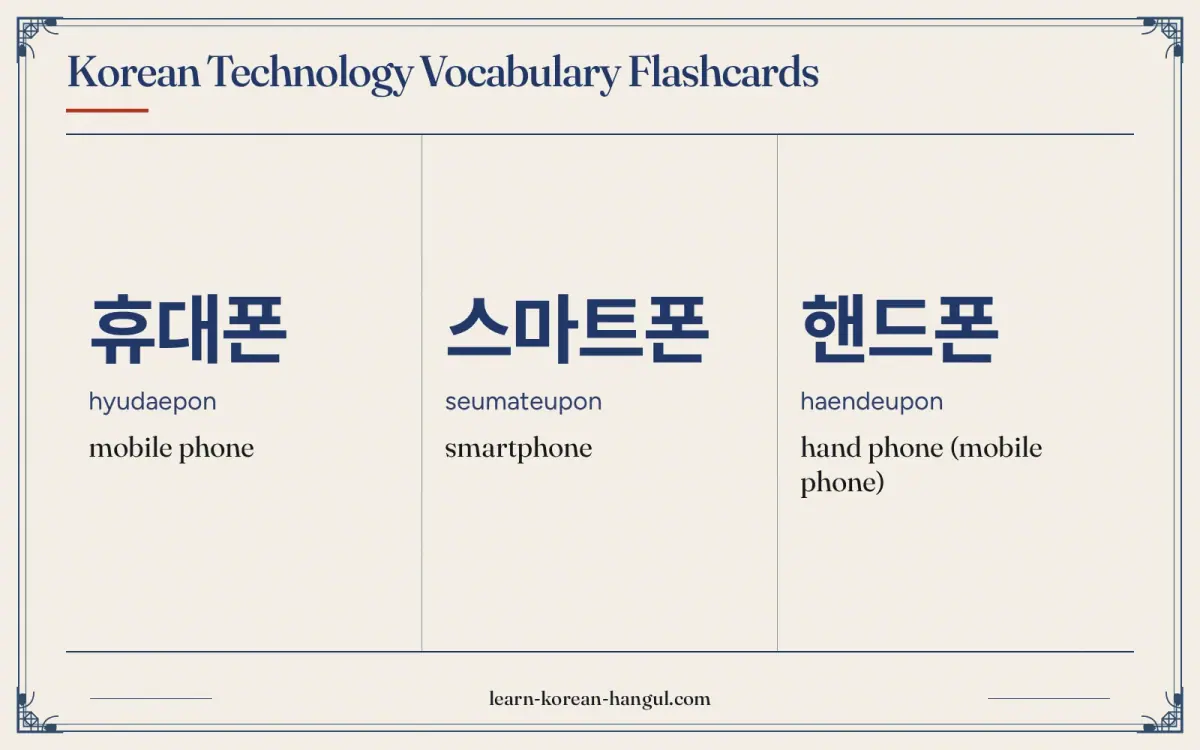
Read each card as a Korean word first, not as an English word in Hangul. The sound often differs from English, as in 컴퓨터 and 와이파이. The lesson behind the deck is korean technology vocabulary, so read it first if a card is new.
How Do I Use These Flashcards?
Use the deck above in four steps. It works with tap, click or keyboard, and nothing plays until you press an audio button.
- Choose a mode. Start with recognition (Hangul to meaning). Switch to recall (meaning to Hangul) or listening (audio to meaning) once recognition feels easy.
- Show the answer. Think of the answer first, then press Show answer (or Space). Turn on the romanization toggle only if you need it; the 29-card table below always shows it.
- Grade yourself. Press Got it if you answered correctly without help, or Not yet if you hesitated or guessed.
- Finish the session. A session holds up to 20 cards (you can set 10, 20 or 40). With 29 cards, a first-time learner can split the deck over three days, using the default limit of 10 new cards a day.
The Three Study Modes
Recognition shows the Hangul and asks for the meaning, which trains reading. Recall shows the meaning and asks for the Hangul, which trains remembering; you may type the answer with your Hangul keyboard or just recall it in your head. Listening plays a clip and hides the letters, which trains the ear. Listening mode only uses a card once its audio is approved, and cards without approved audio are skipped in that mode with a note.
Got It and Not Yet
Got it moves the card up one Leitner box, so it comes back later. Not yet sends the card back to box 1, so it returns in the same session or within 10 minutes. The grades are your own judgement; the deck does not score you or claim fluency.
Deck Scope: What Is and Is Not Covered
The deck covers phone words (휴대폰, 스마트폰, 핸드폰, 전화번호, 앱), computer words (컴퓨터, 노트북, 키보드, 마우스, 모니터, 파일, 폴더), internet words (인터넷, 와이파이, 웹사이트, 검색, 링크, 이메일) and login words (비밀번호, 로그인), plus a few accessories (충전기, 이어폰, 태블릿). Internet slang is in the internet-slang deck, and Konglish oddities are in the Konglish deck.
What Is Left out of This Deck?
Health and hospital words are in the korean hospital vocabulary flashcards, and banking and card terms are in the korean money vocabulary flashcards. The deck leaves out social-media words such as 해시태그 and 댓글, and it does not cover AI or programming terms, which have their own lesson pages.
All 29 Cards in One Table
All 29 cards appear below in deck order. The table is plain HTML, so you can use it as a drill without the deck: cover the Meaning column, read each Hangul word aloud, then uncover the meaning.
| # | Hangul | Revised Romanization | Meaning | Note | Audio assetId |
|---|---|---|---|---|---|
| 1 | 휴대폰 | hyudaepon | mobile phone | The usual written term; the full official term is 휴대 전화. 휴대 means carrying. | au-pg-flashcards-technology-vocabulary-1 |
| 2 | 스마트폰 | seumateupon | smartphone | A loanword: smart + phone. The usual word for the modern touch-screen phone. | au-pg-flashcards-technology-vocabulary-2 |
| 3 | 핸드폰 | haendeupon | hand phone (mobile phone) | A Korean-made English compound, very common in speech; in writing, 휴대폰 or 휴대 전화 is preferred. | au-pg-flashcards-technology-vocabulary-3 |
| 4 | 전화번호 | jeonhwabeonho | telephone number | 전화 means phone and 번호 means number. Said [전화번호]. | au-pg-flashcards-technology-vocabulary-4 |
| 5 | 컴퓨터 | keompyuteo | computer | The ㅍ is aspirated, with a small puff of air. The word is used for desktops and general talk of computers. | au-pg-flashcards-technology-vocabulary-5 |
| 6 | 노트북 | noteubuk | laptop | In Korean, 노트북 means a laptop computer, not a paper notebook (that is 공책). | au-pg-flashcards-technology-vocabulary-6 |
| 7 | 키보드 | kibodeu | keyboard | A loanword. The Korean layout has Hangul and Latin letters on the same keys. | au-pg-flashcards-technology-vocabulary-7 |
| 8 | 마우스 | mauseu | mouse (computer) | A loanword. The animal mouse is 쥐, a different word. | au-pg-flashcards-technology-vocabulary-8 |
| 9 | 모니터 | moniteo | monitor | A loanword. Offices often have two monitors on one desk. | au-pg-flashcards-technology-vocabulary-9 |
| 10 | 프린터 | peurinteo | printer | A loanword. The same word is used for office and home printers. | au-pg-flashcards-technology-vocabulary-10 |
| 11 | 앱 | aep | app | Short for 애플리케이션. Said [앱] with a closed p. | au-pg-flashcards-technology-vocabulary-11; slow: au-pg-flashcards-technology-vocabulary-30 |
| 12 | 화면 | hwamyeon | screen | 화 means picture and 면 means surface. Used for any screen. | au-pg-flashcards-technology-vocabulary-12 |
| 13 | 설정 | seoljeong | settings | Said [설쩡]. The gear icon on a phone is labelled 설정. | au-pg-flashcards-technology-vocabulary-13 |
| 14 | 알림 | allim | notification | Said with a long l sound. Apps send 알림 for messages and updates. | au-pg-flashcards-technology-vocabulary-14 |
| 15 | 카카오톡 | kakaotok | KakaoTalk (messenger app) | A brand name. A messenger that many people in Korea use; 카톡 for short. | au-pg-flashcards-technology-vocabulary-15 |
| 16 | 파일 | pail | file (computer) | A loanword. A paper folder or file is also called 파일 in an office. | au-pg-flashcards-technology-vocabulary-16 |
| 17 | 폴더 | poldeo | folder | A loanword. 폴더를 만들다 means to create a folder. | au-pg-flashcards-technology-vocabulary-17 |
| 18 | 프로그램 | peurogeuraem | program; software | A loanword. Also the word for a TV or radio programme. | au-pg-flashcards-technology-vocabulary-18 |
| 19 | 인터넷 | inteonet | internet | Said [인터넫] at the end of a word. The final ㅅ is said as [ㄷ]. | au-pg-flashcards-technology-vocabulary-19 |
| 20 | 와이파이 | waipai | Wi-Fi | A loanword. A café sign often says 무료 와이파이 (free Wi-Fi). | au-pg-flashcards-technology-vocabulary-20 |
| 21 | 웹사이트 | wepsaiteu | website | Usually said [웹싸이트]. Shortened to 사이트 in speech. Some official writing uses 누리집, but speech rarely does. | au-pg-flashcards-technology-vocabulary-21; slow: au-pg-flashcards-technology-vocabulary-33 |
| 22 | 검색 | geomsaek | search | 검색하다 means to search. The search bar is the 검색창. | au-pg-flashcards-technology-vocabulary-22; slow: au-pg-flashcards-technology-vocabulary-31 |
| 23 | 링크 | ringkeu | link | A loanword. A link can be sent in a chat with 링크를 보내요. | au-pg-flashcards-technology-vocabulary-23 |
| 24 | 이메일 | imeil | A loanword. Often shortened to 메일. | au-pg-flashcards-technology-vocabulary-24 | |
| 25 | 비밀번호 | bimilbeonho | password | 비밀 means secret and 번호 means number. Literally "secret number". | au-pg-flashcards-technology-vocabulary-25; slow: au-pg-flashcards-technology-vocabulary-32 |
| 26 | 로그인 | rogeuin | login | A loanword. 로그인하다 is the verb. | au-pg-flashcards-technology-vocabulary-26 |
| 27 | 충전기 | chungjeongi | charger | 충전 (charging) + 기 (machine). | au-pg-flashcards-technology-vocabulary-27 |
| 28 | 이어폰 | ieopon | earphones | A loanword: ear + phone. Plugs go in with 꽂다. | au-pg-flashcards-technology-vocabulary-28 |
| 29 | 태블릿 | taebeullit | tablet | A loanword. Often 태블릿 PC in product names. | au-pg-flashcards-technology-vocabulary-29 |
Reading the Table
Hangul is the word. Revised Romanization (RR) is a learning aid, so try to read the Hangul before you look at it. RR follows the sound of the word, which is why some spellings change. The Meaning column gives the English gloss, and the Note column explains the parts of the word or gives a usage hint. For loanwords, it shows the Korean way to say the word. The last column lists the audio assetId; a second ID marks a slow clip.
Usage Notes for These Cards
Switch devices with 켜다 and 끄다. 컴퓨터를 켜요 means "I turn on the computer" and 컴퓨터를 꺼요 means "I turn it off". Do not use 열다 (to open) for a device.
Make and receive calls. You make a phone call with 전화를 걸다 and receive one with 전화를 받다: 전화 받으세요 (Please answer the phone).
Ask for a number with 번. 전화번호가 몇 번이에요? (What is your phone number?) uses 번 for numbers. The answer is read digit by digit with Sino-Korean numbers.
문자 is a text message. 문자 is an SMS text message and 문자를 보내다 means to send one: 문자 보낼게요 (I will text you). Chat apps such as 카카오톡 use 메시지.
English words take 하다 to become verbs. 로그인하다 (to log in) and 다운로드하다 (to download) follow the same pattern: loanword plus 하다. Learn the noun first and the verb comes with it.
Which Sounds Do Not Match the Spelling?
Loanwords follow Korean sound rules, not English ones, and some written forms hide a sound change.
- 앱이 is said [애비]. The final ㅂ moves to the empty ㅇ of 이, so a single closed syllable becomes two syllables when a particle follows.
- 검색하다 is said [검새카다]. The ㄱ at the end of 색 and the ㅎ of 하 merge into an aspirated ㅋ.
- 문자 is said [문짜]. The ㅈ after ㄴ is tense in this word. 웹사이트 is usually said [웹싸이트] in speech, and 인터넷 ends in an unreleased [t] sound.
The pronunciations follow the 국립국어원 (National Institute of Korean Language) standard pronunciation rules (표준 발음법), and the romanization follows the Revised Romanization of Korean (2000).
What Mistakes Do Learners Make with Technology Words?
- Using 열다 for turning on a device. Use 켜다, and 끄다 for turning off.
- Saying 전화를 하세요 for a call made to you. The person calling does 전화하다, and the person receiving does 전화를 받다.
- Writing 컴퓨타 for 컴퓨터. These loanwords end in ㅓ, as in 컴퓨터, 프린터 and 모니터.
- Treating 노트북 as a paper notebook. In Korean it means a laptop; a paper notebook is 공책 or 노트.
- Mixing up 휴대폰 and 핸드폰. Both mean a mobile phone: 휴대폰 is the usual written form (the full official term is 휴대 전화), and 핸드폰 is more common in speech.
How Does the Review Schedule Work?
The deck uses a simplified Leitner system with five boxes. A new card starts in box 1. Each Got it moves it up one box, and each Not yet returns it to box 1. The box sets how long the card waits before it is due again.
| Box | Wait until the next review |
|---|---|
| 1 | same session or 10 minutes |
| 2 | 1 day |
| 3 | 3 days |
| 4 | 7 days |
| 5 | 21 days |
Each session shows due cards first, oldest due first, and then up to 10 new cards a day by default. A deck of 29 cards is introduced over three days at the default of 10 new cards a day, and the later boxes bring each card back at longer gaps. Progress is saved only in this browser, so clearing site data deletes it. Use the export button to save a small JSON file with card IDs, boxes and due dates, and import it on another device. No account is needed.
Cultural and Practical Context
Many technology words enter Korean directly from English and are spelled by Korean sound rules, so the Hangul form can differ from the English spelling. Shops and cafés often show a sign for free Wi-Fi, and 카카오톡 is the messenger that many people use every day.
Limits of This Deck
The deck has 29 cards and covers the core of the lesson list, not every device or app. It shows nouns, with only a few verb patterns in the notes. Technology changes fast, so new words and brand names may be missing. The claim about messaging habits is a general one, not a statistic. All Korean text is generated and was reviewed and signed off by Min-ji Park on 15 October 2026. The audio is generated with text-to-speech and is checked by a Korean teacher before publication, and listening mode uses only cards whose clips are approved.
Next Steps after This Deck
Continue with the korean hospital vocabulary flashcards, or go back to the korean money vocabulary flashcards if a word here still feels shaky. Write the same words by hand with the korean daily life vocabulary worksheet. The korean vocabulary flashcards page lists every other deck, and the korean flashcards hub lists all topics.
Frequently Asked Questions
What Is the Difference between 스마트폰 and 휴대폰?
스마트폰 is the specific type, a touch-screen smartphone. 휴대폰 means a mobile phone in general and is the usual written term. In daily speech, many people use both, and 핸드폰 is also common. For a learner, using 휴대폰 is the safest choice in any setting.
How Do I Ask for the Wi-Fi Password?
Say 와이파이 비밀번호가 뭐예요? (What is the Wi-Fi password?). 비밀번호 is the password and 뭐예요 asks what it is. A café sign often says 무료 와이파이 (free Wi-Fi), so the network name and the password are usually the two things you need to ask staff about.
Are English Words Pronounced Like English?
They follow Korean sounds, not English ones. 컴퓨터 is keompyuteo, with a vowel at the end, and 와이파이 is waipai. Korean has no sound for every English letter, so the Hangul spelling gives the closest Korean sound. Listen to the audio and repeat it.
Is 앱 a One-Syllable Word?
Yes. 앱 is one syllable. It is said with a closed ㅂ ending and no vowel after it, so it sounds close to the English word. When a particle with a vowel follows, such as 이, the ㅂ moves to the next syllable and you hear [애비].
Is My Progress Saved If I Close the Page?
Yes, in the same browser on the same device. Card boxes and due dates are stored locally and nothing is sent to a server. Clearing site data, using a private window or switching browsers removes them, so use the export button to keep a backup file. No account is needed.