
Korean Money Vocabulary Flashcards: Study the 27 Cards
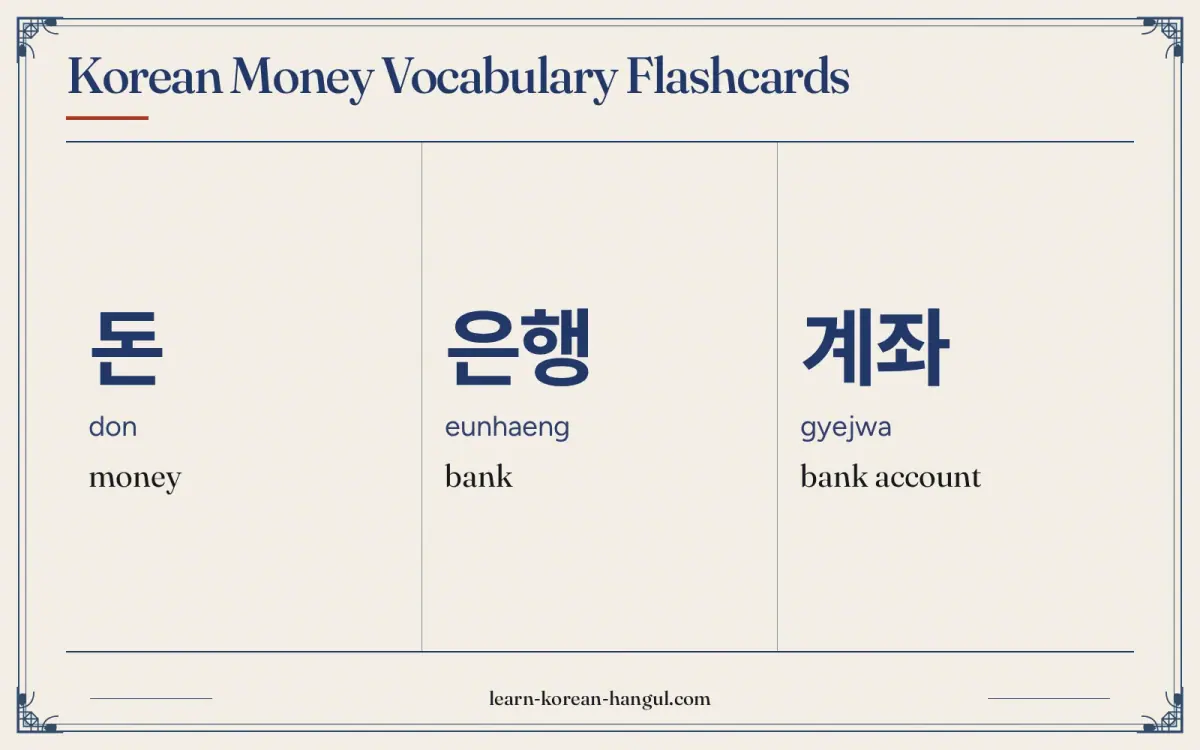
Say each word aloud before you press Show answer. Every card has a short note that explains how the word is used or why it sounds different from its spelling.
How Do I Use These Flashcards?
Use the deck above in four steps. It works with tap, click or keyboard, and nothing plays until you press an audio button.
- Choose a mode. Start with recognition (Hangul to meaning). Switch to recall (meaning to Hangul) or listening (audio to meaning) once recognition feels easy.
- Show the answer. Think of the answer first, then press Show answer (or Space). Turn on the romanization toggle only if you need it; the 27-card table below always shows it.
- Grade yourself. Press Got it if you answered correctly without help, or Not yet if you hesitated or guessed.
- Finish the session. A session holds up to 20 cards (you can set 10, 20 or 40). With 27 cards, a first-time learner can split the deck over 3 days, using the default limit of 10 new cards a day.
What Do the Three Modes Do?
Recognition shows the Hangul and asks for the meaning, which trains reading. Recall shows the meaning and asks for the Hangul, which trains remembering; you may type the answer with your Hangul keyboard or just recall it in your head. Listening plays a clip and hides the letters, which trains the ear. Listening mode only uses a card once its audio is approved, and cards without approved audio are skipped in that mode with a note.
What Do Got It and Not yet Do?
Got it moves the card up one Leitner box, so it comes back later. Not yet sends the card back to box 1, so it returns in the same session or within 10 minutes. The grades are your own judgement; the deck does not score you or claim fluency.
Deck Scope: What Is and Is Not Covered
The deck covers bank, card and cash vocabulary for everyday money tasks. Shop prices and bargaining are in the korean shopping vocabulary flashcards, and phone and app words are in the korean technology vocabulary flashcards. The topic lesson is money and banking in korean.
What Is Left out of This Deck?
The deck has 27 cards for everyday money tasks. It does not teach prices in shops, tax terms or investment words, and it is not financial advice. Bank forms and fees differ by bank, so ask the clerk. All Korean text is generated, and Min-ji Park reviewed and signed off the text and audio on 15 October 2026.
All 27 Cards in One Table
All 27 cards appear below in deck order. The table is plain HTML, so you can use it as a drill without the deck: cover the Meaning column, read each word aloud, then uncover the meaning.
| # | Hangul | Revised Romanization | Meaning | Note | Audio assetId |
|---|---|---|---|---|---|
| 1 | 돈 | don | money | The basic word for money. | au-pg-flashcards-money-vocabulary-1 |
| 2 | 은행 | eunhaeng | bank | Bank. | au-pg-flashcards-money-vocabulary-2 |
| 3 | 계좌 | gyejwa | bank account | Make one with 계좌를 만들다. | au-pg-flashcards-money-vocabulary-3 |
| 4 | 통장 | tongjang | bankbook; account | The passbook that goes with an account. | au-pg-flashcards-money-vocabulary-4 |
| 5 | 현금 | hyeongeum | cash | Cash. | au-pg-flashcards-money-vocabulary-5 |
| 6 | 카드 | kadeu | card | Pay with a card: 카드로 계산하다. | au-pg-flashcards-money-vocabulary-6 |
| 7 | 지갑 | jigap | wallet | Wallet. | au-pg-flashcards-money-vocabulary-7 |
| 8 | 원 | won | won (Korean currency) | The currency unit; it follows the number: 만 원. | au-pg-flashcards-money-vocabulary-8 |
| 9 | 지폐 | jipye | banknote | Banknote. | au-pg-flashcards-money-vocabulary-9 |
| 10 | 동전 | dongjeon | coin | Coin. | au-pg-flashcards-money-vocabulary-10 |
| 11 | 입금 | ipgeum | deposit (paying in) | Paying in. 입금하다 is said [입끔하다]. | au-pg-flashcards-money-vocabulary-11; slow: au-pg-flashcards-money-vocabulary-28 |
| 12 | 출금 | chulgeum | withdrawal | Taking out; the opposite of 입금. | au-pg-flashcards-money-vocabulary-12 |
| 13 | 송금 | songgeum | sending money | 송금하다 means to send money to an account. | au-pg-flashcards-money-vocabulary-13 |
| 14 | 이체 | iche | transfer | Transfer between accounts. | au-pg-flashcards-money-vocabulary-14 |
| 15 | 잔액 | janaek | balance | Account balance. | au-pg-flashcards-money-vocabulary-15 |
| 16 | 수수료 | susuryo | fee | A fee charged for a service. | au-pg-flashcards-money-vocabulary-16 |
| 17 | 이자 | ija | interest | Interest on savings or a loan. | au-pg-flashcards-money-vocabulary-17 |
| 18 | 대출 | daechul | loan | Loan. | au-pg-flashcards-money-vocabulary-18 |
| 19 | 저축 | jeochuk | savings | Savings. | au-pg-flashcards-money-vocabulary-19 |
| 20 | 환전 | hwanjeon | currency exchange | Changing money from one currency to another. | au-pg-flashcards-money-vocabulary-20 |
| 21 | 환율 | hwanyul | exchange rate | Said [화뉼]: the ㄴ of 환 links to the vowel of 율. | au-pg-flashcards-money-vocabulary-21; slow: au-pg-flashcards-money-vocabulary-29 |
| 22 | 달러 | dalleo | dollar | Dollar; a loanword. | au-pg-flashcards-money-vocabulary-22 |
| 23 | 월급 | wolgeup | monthly salary | Monthly pay. | au-pg-flashcards-money-vocabulary-23 |
| 24 | 결제 | gyeolje | payment | Payment; 결제하다 means to pay. | au-pg-flashcards-money-vocabulary-24 |
| 25 | 빚 | bit | debt | Debt. | au-pg-flashcards-money-vocabulary-25 |
| 26 | 갚다 | gapda | to repay | Said [갑따]: ㅍ neutralizes to ㅂ and the ㄷ is tensified. | au-pg-flashcards-money-vocabulary-26; slow: au-pg-flashcards-money-vocabulary-30 |
| 27 | 빌리다 | billida | to borrow | To borrow. To lend is 빌려 주다. | au-pg-flashcards-money-vocabulary-27 |
How Do I Read the Table?
Hangul is the word. Revised Romanization (RR) is a learning aid, so try to read the Hangul before you look at it. RR follows the sound of the word, which is why some spellings change. The Meaning column gives the English gloss, and the Note column gives a use or sound hint. The last column lists the audio assetId; a second ID marked slow is a slower clip for the 3 cards whose sound differs from their spelling.
Usage Notes for These Cards
Opening an account. Open an account with 계좌를 만들다 (to make an account); a 통장 is the passbook that goes with it.
Cash in and out. Cash is taken out with 돈을 찾다 (to find, that is, withdraw) and put in with 돈을 넣다: 돈을 찾고 싶어요 (I want to withdraw money).
Sending money. 송금하다 is the word for sending money to an account: 친구에게 송금했어요 (I sent money to a friend).
Borrow and lend. 빌리다 means to borrow and 빌려 주다 means to lend, so direction matters: 돈을 빌려 주세요 (Please lend me money).
Big amounts. Amounts of 10,000 start with 만 without 일: 만 원 (10,000 won), 십만 원 (100,000 won).
Which Sounds Do Not Match the Spelling?
환율 is said [화뉼]: 율 starts with a silent ㅇ, so the ㄴ of 환 links to its vowel. RR writes hwanyul.
갚다 is said [갑따]: ㅍ neutralizes to ㅂ and the ㄷ is tensified.
입금하다 is said [입끔하다]: the ㄱ after a ㅂ final is tensified.
These forms follow the 국립국어원 standard pronunciation rules (표준 발음법).
What Mistakes Do Learners Make with Money Vocabulary?
- Using 빌리다 for lend. Lend is 빌려 주다.
- Saying 일만 원. The normal form is 만 원.
- Saying 카드를 계산하다. Say 카드로 계산하다.
How Does the Review Schedule Work?
The deck uses a simplified Leitner system with five boxes. A new card starts in box 1. Each Got it moves it up one box, and each Not yet returns it to box 1. The box sets how long the card waits before it is due again.
| Box | Wait until the next review |
|---|---|
| 1 | same session or 10 minutes |
| 2 | 1 day |
| 3 | 3 days |
| 4 | 7 days |
| 5 | 21 days |
Each session shows due cards first, oldest due first, and then up to 10 new cards a day by default. Progress is saved only in this browser, so clearing site data deletes it. Use the export button to save a small JSON file with card IDs, boxes and due dates, and import it on another device. No account is needed.
Cultural and Practical Context
Bank transfers and card payments are everyday ways to pay in Korea, and many people also use phone-based payment apps.
Next Steps after This Deck
The words and letters on these cards are explained in the korean money vocabulary lesson, so read it first if a card is new. This deck is one of the korean vocabulary flashcards on the site, so browse the full list if you want a different topic. When these cards feel easy, move on to korean technology vocabulary flashcards to keep the same routine. If a word here still feels shaky, go back to korean shopping vocabulary flashcards for the earlier material. After a session, write the same words by hand with the korean daily life vocabulary worksheet. All flashcard decks, including Hangul, vocabulary, phrases, grammar and TOPIK, are listed on the korean flashcards hub.
Frequently Asked Questions
What Is the Difference between 신용카드 and 체크카드?
신용카드 is a credit card and 체크카드 is a debit card. The card on this deck, 카드, is the general word, and the compounds name the type.
How Do I Ask What the Exchange Rate Is?
Ask 환율이 얼마예요? It means How much is the exchange rate? The 환율 card gives you the key noun, and 환전 names the exchange itself.
Is 원 a Counter?
It is the currency unit and it follows the number: 오천 원 is 5,000 won. It works like a counter in word order, but it names money, not a thing you count.
What Is the Difference between 월급 and 연봉?
월급 is monthly pay and 연봉 is annual pay. Card 23 gives 월급, and you will see 연봉 on job adverts.
Is My Progress Saved If I Close the Page?
Yes, in the same browser on the same device. Card boxes and due dates are stored locally and nothing is sent to a server. Clearing site data, using a private window or switching browsers removes them, so use the export button to keep a backup file. No account is needed.