
Korean Time Expressions Flashcards: Study the 29 Cards
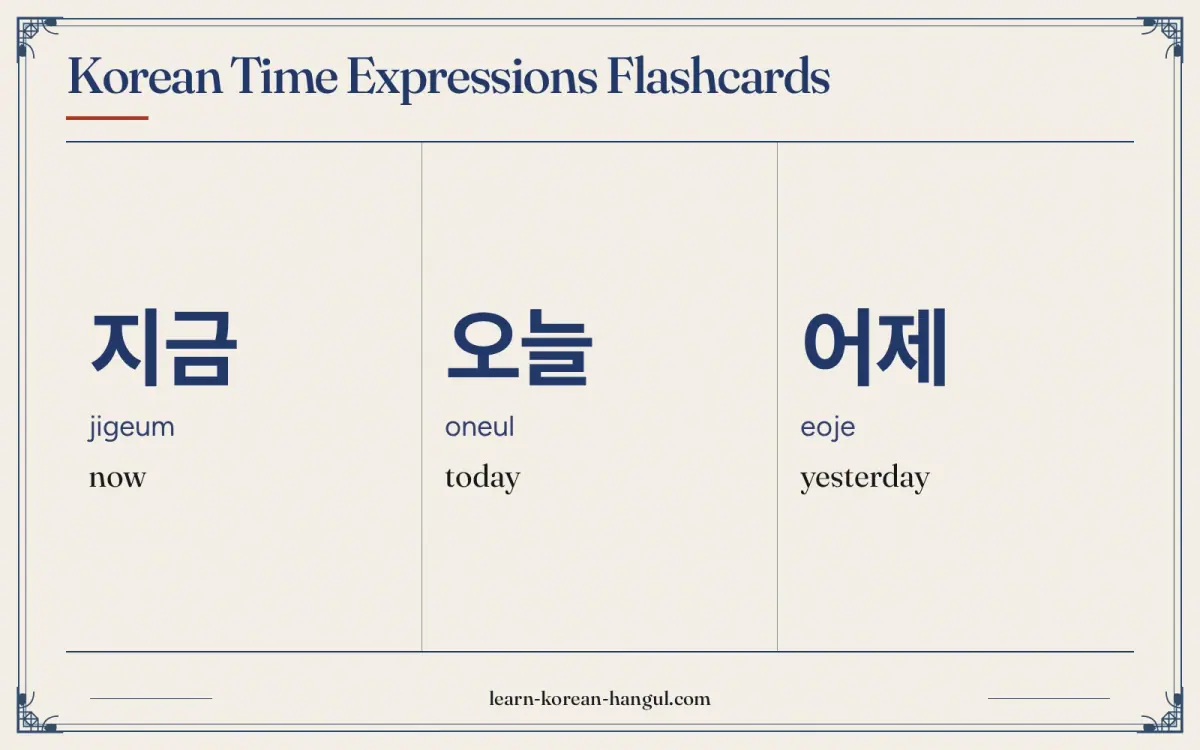
Many time words take no particle, and the notes mark which ones do. Say each card aloud before you press Show answer, because the order of the pieces, such as 오후 세 시, matters. The lesson behind the deck is korean time expressions, so read it first if a card is new.
How Do I Use These Flashcards?
Use the deck above in four steps. It works with tap, click or keyboard, and nothing plays until you press an audio button.
- Choose a mode. Start with recognition (Hangul to meaning). Switch to recall (meaning to Hangul) or listening (audio to meaning) once recognition feels easy.
- Show the answer. Think of the answer first, then press Show answer (or Space). Turn on the romanization toggle only if you need it; the 29-card table below always shows it.
- Grade yourself. Press Got it if you answered correctly without help, or Not yet if you hesitated or guessed.
- Finish the session. A session holds up to 20 cards (you can set 10, 20 or 40). With 29 cards, a first-time learner can split the deck over three days, using the default limit of 10 new cards a day.
The Three Study Modes
Recognition shows the Hangul and asks for the meaning, which trains reading. Recall shows the meaning and asks for the Hangul, which trains remembering; you may type the answer with your Hangul keyboard or just recall it in your head. Listening plays a clip and hides the letters, which trains the ear. Listening mode only uses a card once its audio is approved, and cards without approved audio are skipped in that mode with a note.
Got It and Not Yet
Got it moves the card up one Leitner box, so it comes back later. Not yet sends the card back to box 1, so it returns in the same session or within 10 minutes. The grades are your own judgement; the deck does not score you or claim fluency.
Deck Scope: What Is and Is Not Covered
The deck covers now and the days around today (지금, 오늘, 어제, 내일, 모레), weeks, months and years (이번 주, 지난주, 다음 주, 지난달, 다음 달, 올해, 작년, 내년), parts of the day (아침, 오전, 점심, 오후, 저녁, 밤), time-order words (이따가, 아직, 벌써), clock words (시, 분, 몇 시) and frequency adverbs (항상, 자주, 가끔, 매일). Days of the week and months are in their own decks.
What Is Left out of This Deck?
The months of the year are in the months in korean flashcards, and place words for a city are in the korean city vocabulary flashcards. The deck leaves out the rest of the frequency list, such as 거의 and 전혀, and it does not teach full clock times, which depend on the number systems.
All 29 Cards in One Table
All 29 cards appear below in deck order. The table is plain HTML, so you can use it as a drill without the deck: cover the Meaning column, read each Hangul word aloud, then uncover the meaning.
| # | Hangul | Revised Romanization | Meaning | Note | Audio assetId |
|---|---|---|---|---|---|
| 1 | 지금 | jigeum | now | Takes no 에. | au-pg-flashcards-time-expressions-1 |
| 2 | 오늘 | oneul | today | Takes no 에. | au-pg-flashcards-time-expressions-2 |
| 3 | 어제 | eoje | yesterday | Takes no 에; the verb is past. | au-pg-flashcards-time-expressions-3 |
| 4 | 내일 | naeil | tomorrow | Takes no 에; the verb is present or future. | au-pg-flashcards-time-expressions-4 |
| 5 | 모레 | more | the day after tomorrow | Two days ahead. | au-pg-flashcards-time-expressions-5 |
| 6 | 매일 | maeil | every day | 매 means every. Works with no particle. | au-pg-flashcards-time-expressions-6 |
| 7 | 이번 주 | ibeon ju | this week | 이번 is this time. | au-pg-flashcards-time-expressions-7 |
| 8 | 지난주 | jinanju | last week | One word. 지난 means past. | au-pg-flashcards-time-expressions-8 |
| 9 | 다음 주 | daeum ju | next week | 다음 is next. | au-pg-flashcards-time-expressions-9 |
| 10 | 지난달 | jinandal | last month | One word. | au-pg-flashcards-time-expressions-10 |
| 11 | 다음 달 | daeum dal | next month | Two words. | au-pg-flashcards-time-expressions-11 |
| 12 | 올해 | olhae | this year | Said with a clear ㄹ before 해. | au-pg-flashcards-time-expressions-12 |
| 13 | 작년 | jangnyeon | last year | The ㄱ turns into ㅇ before ㄴ. Said [장년]. | au-pg-flashcards-time-expressions-13; slow: au-pg-flashcards-time-expressions-30 |
| 14 | 내년 | naenyeon | next year | 내 is coming; 년 is year. | au-pg-flashcards-time-expressions-14 |
| 15 | 아침 | achim | morning | Also means breakfast. | au-pg-flashcards-time-expressions-15 |
| 16 | 오전 | ojeon | a.m.; morning before noon | Goes before the clock time. | au-pg-flashcards-time-expressions-16 |
| 17 | 점심 | jeomsim | lunch; midday | Both the meal and the time around noon. | au-pg-flashcards-time-expressions-17 |
| 18 | 오후 | ohu | p.m.; afternoon | Goes before the clock time. | au-pg-flashcards-time-expressions-18 |
| 19 | 저녁 | jeonyeok | evening; dinner | Also means the evening meal. | au-pg-flashcards-time-expressions-19 |
| 20 | 밤 | bam | night | Also means chestnut. | au-pg-flashcards-time-expressions-20 |
| 21 | 이따가 | ittaga | later (today) | Later the same day; also 이따. | au-pg-flashcards-time-expressions-21; slow: au-pg-flashcards-time-expressions-32 |
| 22 | 아직 | ajik | still; not yet | Pairs with a negative for not yet. | au-pg-flashcards-time-expressions-22 |
| 23 | 벌써 | beolsseo | already | Earlier than expected. Said [벌써]. | au-pg-flashcards-time-expressions-23 |
| 24 | 시 | si | o'clock | Follows native numbers, as in 세 시. | au-pg-flashcards-time-expressions-24 |
| 25 | 분 | bun | minute | Follows Sino-Korean numbers, as in 십 분. | au-pg-flashcards-time-expressions-25 |
| 26 | 몇 시 | myeot si | what time | Asks for the clock hour. Said [멷씨]. | au-pg-flashcards-time-expressions-26; slow: au-pg-flashcards-time-expressions-31 |
| 27 | 항상 | hangsang | always | The top rung. Works with a positive verb. | au-pg-flashcards-time-expressions-27 |
| 28 | 자주 | jaju | often | Frequent but not constant. | au-pg-flashcards-time-expressions-28 |
| 29 | 가끔 | gakkeum | sometimes | Occasional. The ㄲ is tense. | au-pg-flashcards-time-expressions-29; slow: au-pg-flashcards-time-expressions-33 |
Reading the Table
Hangul is the word. Revised Romanization (RR) is a learning aid, so try to read the Hangul before you look at it. RR follows the sound of the word, which is why some spellings change. The Meaning column gives the English gloss, and the Note column says whether the word takes the particle 에 and how it combines with other words. The last column lists the audio assetId; a second ID marks a slow clip.
Usage Notes for These Cards
Hours are native, minutes are Sino. Clock hours use native numbers with 시 and minutes use Sino numbers with 분: 세 시 십 분 (3:10). The cards 시 and 분 teach the counters, and the numbers decks teach the numbers.
Put 오전 or 오후 first. Put 오전 or 오후 before the time: 오후 세 시에 만나요 (Let's meet at 3 p.m.). The order is always 오후 세 시, never 세 시 오후.
Frequency adverbs go before the verb. 가끔 영화를 봐요 (I sometimes watch movies) and 자주 커피를 마셔요 (I often drink coffee). 가끔 is less often than 자주, and 항상 is the most often.
아직 and 벌써 are a pair. 아직 with a negative means not yet: 아직 안 먹었어요 (I have not eaten yet). 벌써 means already and goes with a positive verb.
Clock times take 에, relative words do not. 아침 일곱 시에 일어나요 (I get up at 7 in the morning) uses 에, but 지금 가요 (I am going now) does not. The same is true of 오늘, 어제 and 내일.
Which Sounds Do Not Match the Spelling?
A few time words change sound when they are said.
- 몇 시 is said [멷씨]. The ㅊ of 몇 is read as ㄷ, and the ㅅ of 시 becomes tense.
- 늦게 (late) is said [늗께]. The ㅈ is read as ㄷ and the ㄱ after it is tensified. It is on the lesson page and works like the cards above.
- 가끔 has a tense ㄲ in the middle, and 때때로 (at times) has tense ㄸ in both syllables. The doubled letter should sound sharp, not like an aspirated ㅋ or ㅌ.
The pronunciations follow the 국립국어원 (National Institute of Korean Language) standard pronunciation rules (표준 발음법), and the romanization follows the Revised Romanization of Korean (2000).
What Mistakes Do Learners Make with Time Expressions?
- Using Sino numbers for hours. 삼 시 is wrong; say 세 시.
- Using native numbers for minutes. Say 십 분, not 열 분.
- Adding 에 to 지금. 지금에 is wrong; say just 지금.
- Mixing up 작년 and 내년. 작년 is last year and 내년 is next year.
- Forgetting that 아침, 점심 and 저녁 also mean breakfast, lunch and dinner. Context tells you whether the time or the meal is meant.
How Does the Review Schedule Work?
The deck uses a simplified Leitner system with five boxes. A new card starts in box 1. Each Got it moves it up one box, and each Not yet returns it to box 1. The box sets how long the card waits before it is due again.
| Box | Wait until the next review |
|---|---|
| 1 | same session or 10 minutes |
| 2 | 1 day |
| 3 | 3 days |
| 4 | 7 days |
| 5 | 21 days |
Each session shows due cards first, oldest due first, and then up to 10 new cards a day by default. A deck of 29 cards is introduced over three days at the default of 10 new cards a day, and the later boxes bring each card back at longer gaps. Progress is saved only in this browser, so clearing site data deletes it. Use the export button to save a small JSON file with card IDs, boxes and due dates, and import it on another device. No account is needed.
Cultural and Practical Context
The phrase 빨리빨리 (hurry, hurry) is often cited as a symbol of the fast pace of Korean daily life. Time words like 곧 and 방금 turn up in service talk. The deck itself stays with the plain words that every learner needs on the first day.
Limits of This Deck
The deck has 29 cards, so it teaches single words and not full clock times or dates. 몇 시 is a two-word phrase that is used as one unit. The remark about 빨리빨리 is general culture. The frequency adverbs here are only four of the longer list, and the order of 가끔, 자주 and 항상 is a guide rather than a count. All Korean text is generated and was reviewed and signed off by Min-ji Park on 15 October 2026. The audio is generated with text-to-speech and is checked by a Korean teacher before publication, and listening mode uses only cards whose clips are approved.
Next Steps after This Deck
Continue with the months in korean flashcards, or go back to the korean city vocabulary flashcards if a word here still feels shaky. Write the same words by hand with the korean time words worksheet. The korean vocabulary flashcards page lists every other deck, and the korean flashcards hub lists all topics.
Frequently Asked Questions
Do I Say 오후 세 시 or 세 시 오후?
Always 오후 세 시. The part of the day comes first, then the hour. The same order is used for 오전, so 7 a.m. is 오전 일곱 시. You add 에 after the whole time when you say at that time, as in 오후 세 시에 만나요.
What Is the Difference between 아직 and 벌써?
아직 means still or not yet, and 벌써 means already. 아직 안 왔어요 means he has not come yet, and 벌써 왔어요 means he has already come. The first goes with a negative verb, and the second goes with a positive one. Both come before the verb.
Is 가끔 More or Less than 자주?
가끔 is less often than 자주. In order from most to least, the cards give 항상, 자주, 가끔. All three go before the verb, as in 자주 커피를 마셔요 (I often drink coffee). The order is a guide, since speakers do not agree on exact counts.
How Do I Ask the Time?
Say 지금 몇 시예요? (What time is it now?). The answer uses a native number with 시, such as 세 시예요 (It is three o'clock). For minutes, add a Sino-Korean number with 분. The two cards 시 and 분 give you the counters you need.
Is My Progress Saved If I Close the Page?
Yes, in the same browser on the same device. Card boxes and due dates are stored locally and nothing is sent to a server. Clearing site data, using a private window or switching browsers removes them, so use the export button to keep a backup file. No account is needed.