
Korean Time Expressions at a Glance
Most Korean time words are nouns or adverbs that sit near the start of a sentence, before the verb. Many are used with no particle at all, and others take 에 (at, on, in). Knowing which is which is the main skill on this page. Words about days of the week and months have their own pages: Days of the Week and Months. This page is the hub for three deeper lists, Korean Relative Time Words, Korean Parts of the Day and Korean Frequency Adverbs.
| Group | Words | What it covers |
|---|---|---|
| Today, yesterday, tomorrow | 8 | Days around today, day, every day |
| Weeks, months and years | 12 | This, last and next periods |
| Morning to night | 10 | Parts of the day |
| Now, soon and later | 10 | Moments relative to the speaker |
| Clock words | 10 | Hours, minutes, early and late |
The page belongs to Time Words. If you want to say the exact clock time with numbers, continue to telling time after this list.
Which Time Expressions Should You Learn First?
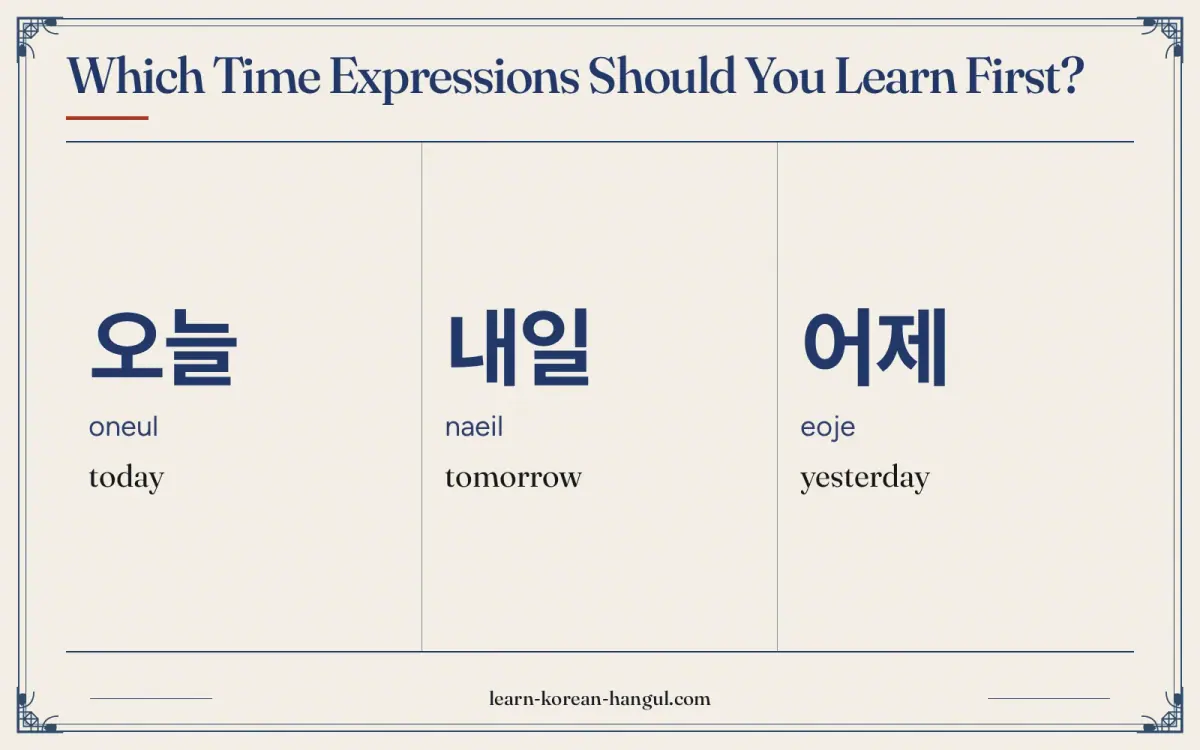
Learn 오늘, 어제, 내일, 지금 and 언제 first. They let you ask and answer when something happens with no grammar beyond the verb. Next add 아침, 점심, 저녁 and 밤, which name the parts of the day, and then the this/last/next pattern. Learn the clock words last, because they need numbers.
- Say first. 오늘, 내일, 지금, 언제, 매일, 아침, 저녁.
- Recognise. 정오, 자정, 모레, 그저께. They appear in notices and news.
- Sentence helpers. 이따가, 곧, 아직, 벌써. They are small words that change the feel of a sentence.
The scene below shows a wall clock, a calendar and a daily timeline with ten of the words as numbered items.
Word · 10
- 1
오늘
oneul
today
- 2
내일
naeil
tomorrow
- 3
어제
eoje
yesterday
- 4
아침
achim
morning
- 5
점심
jeomsim
lunch; midday
- 6
저녁
jeonyeok
evening; dinner
- 7
밤
bam
night
- 8
지금
jigeum
now
- 9
주
ju
week
- 10
시간
sigan
time; hour (duration)
Today, Yesterday, Tomorrow
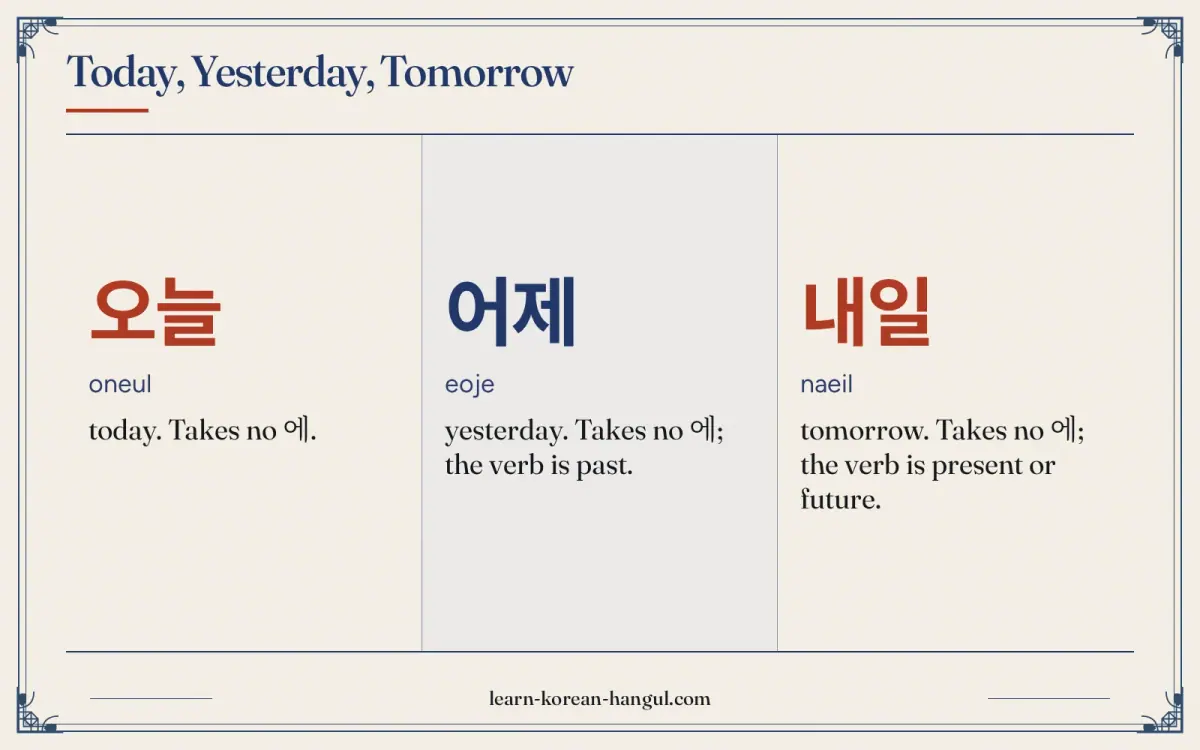
The core day words form a line: 그저께, 어제, 오늘, 내일, 모레. Each is one short noun, and none takes 에. Say 내일 가요, not 내일에 가요. Past days go with a past verb and future days with a present or future verb. 매일 and 하루 belong here because they count days: 매일 means every day, and 하루 means a span of one day.
| No. | Hangul | Revised Romanization | Meaning and note | Example sentence | Audio assetId |
|---|---|---|---|---|---|
| 1 | 오늘 | oneul | today. Takes no 에. | 오늘 날씨가 좋아요. (The weather is nice today.) | au-pg-vocabulary-time-time-expressions-1; example: au-pg-vocabulary-time-time-expressions-51 |
| 2 | 어제 | eoje | yesterday. Takes no 에; the verb is past. | 어제 영화를 봤어요. (I watched a movie yesterday.) | au-pg-vocabulary-time-time-expressions-2; example: au-pg-vocabulary-time-time-expressions-52 |
| 3 | 내일 | naeil | tomorrow. Takes no 에; the verb is present or future. | 내일 회사에 가요. (I go to work tomorrow.) | au-pg-vocabulary-time-time-expressions-3; example: au-pg-vocabulary-time-time-expressions-53 |
| 4 | 모레 | more | the day after tomorrow. Two days ahead. | 모레 시험이 있어요. (There is an exam the day after tomorrow.) | au-pg-vocabulary-time-time-expressions-4; example: au-pg-vocabulary-time-time-expressions-54 |
| 5 | 그저께 | geujeokke | the day before yesterday. Two days back. 엊그제 is a looser spoken variant. | 그저께 친구를 만났어요. (I met a friend the day before yesterday.) | au-pg-vocabulary-time-time-expressions-5; example: au-pg-vocabulary-time-time-expressions-55 |
| 6 | 날 | nal | day; a particular day. The day as a unit or occasion, not the weekday. | 오늘은 좋은 날이에요. (Today is a good day.) | au-pg-vocabulary-time-time-expressions-6; example: au-pg-vocabulary-time-time-expressions-56 |
| 7 | 하루 | haru | one day. A span of one day, with a native number built in. | 하루에 세 번 먹어요. (I eat three times a day.) | au-pg-vocabulary-time-time-expressions-7; example: au-pg-vocabulary-time-time-expressions-57 |
| 8 | 매일 | maeil | every day. 매 means every. Works with no particle. | 매일 아침에 커피를 마셔요. (I drink coffee every morning.) | au-pg-vocabulary-time-time-expressions-8; example: au-pg-vocabulary-time-time-expressions-58 |
Example Sentences
The sentences keep the same frame: time word, then the rest, then the verb. Replace 오늘 with 어제 and change the verb to the past to see how the tense follows the time word. Listen first, repeat the whole sentence, then change one word.
For the full 그저께 to 글피 line, see Korean Relative Time Words.
How Do You Say Weeks, Months and Years in Korean?
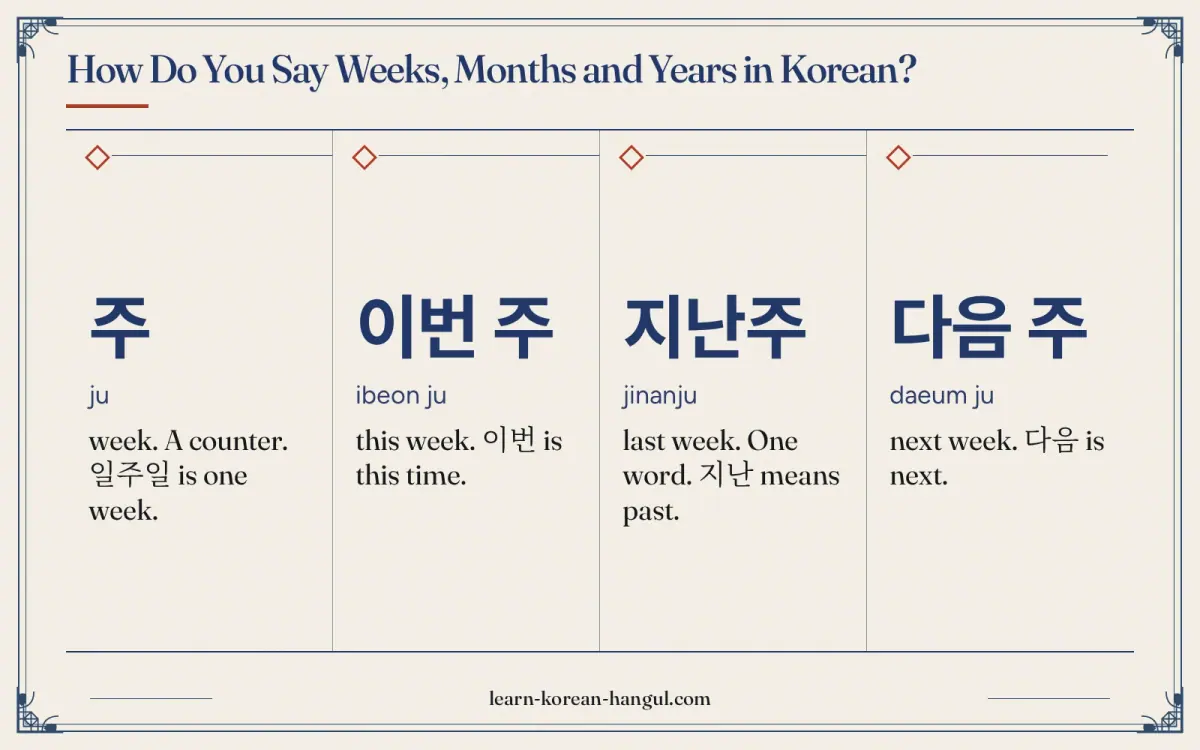
A pattern does most of the work. 지난 (past), 이번 (this) and 다음 (next) go in front of the period word: 지난주, 이번 주, 다음 주; 지난달, 이번 달, 다음 달. Years have their own words: 작년 (last year), 올해 (this year), 내년 (next year). The units 주, 달 and 년 also count: 한 주 (one week), 한 달 (one month), 삼 년 (three years).
| No. | Hangul | Revised Romanization | Meaning and note | Example sentence | Audio assetId |
|---|---|---|---|---|---|
| 9 | 주 | ju | week. A counter. 일주일 is one week. | 한 주에 한 번 청소해요. (I clean once a week.) | au-pg-vocabulary-time-time-expressions-9; example: au-pg-vocabulary-time-time-expressions-59 |
| 10 | 이번 주 | ibeon ju | this week. 이번 is this time. | 이번 주에 바빠요? (Are you busy this week?) | au-pg-vocabulary-time-time-expressions-10; example: au-pg-vocabulary-time-time-expressions-60 |
| 11 | 지난주 | jinanju | last week. One word. 지난 means past. | 지난주에 이사했어요. (I moved house last week.) | au-pg-vocabulary-time-time-expressions-11; example: au-pg-vocabulary-time-time-expressions-61 |
| 12 | 다음 주 | daeum ju | next week. 다음 is next. | 다음 주에 여행을 가요. (I am going on a trip next week.) | au-pg-vocabulary-time-time-expressions-12; example: au-pg-vocabulary-time-time-expressions-62 |
| 13 | 달 | dal | month (span); moon. Counts months with native numbers, as in 한 달. | 한 달에 두 번 가요. (I go twice a month.) | au-pg-vocabulary-time-time-expressions-13; example: au-pg-vocabulary-time-time-expressions-63 |
| 14 | 지난달 | jinandal | last month. One word. | 지난달에 시험을 봤어요. (I took an exam last month.) | au-pg-vocabulary-time-time-expressions-14; example: au-pg-vocabulary-time-time-expressions-64 |
| 15 | 이번 달 | ibeon dal | this month. Two words. | 이번 달에 책을 세 권 읽었어요. (I read three books this month.) | au-pg-vocabulary-time-time-expressions-15; example: au-pg-vocabulary-time-time-expressions-65 |
| 16 | 다음 달 | daeum dal | next month. Two words. | 다음 달에 한국에 가요. (I go to Korea next month.) | au-pg-vocabulary-time-time-expressions-16; example: au-pg-vocabulary-time-time-expressions-66 |
| 17 | 올해 | olhae | this year. Said [올해]; in fast speech the ㅎ weakens, so it often sounds like [오래]. | 올해 목표는 한국어 공부예요. (This year's goal is studying Korean.) | au-pg-vocabulary-time-time-expressions-17; example: au-pg-vocabulary-time-time-expressions-67 |
| 18 | 작년 | jangnyeon | last year. The ㄱ turns into ㅇ before ㄴ. Said [장년]. | 작년에 한국에 왔어요. (I came to Korea last year.) | au-pg-vocabulary-time-time-expressions-18; example: au-pg-vocabulary-time-time-expressions-68 |
| 19 | 내년 | naenyeon | next year. 내 is coming; 년 is year. | 내년에 졸업해요. (I graduate next year.) | au-pg-vocabulary-time-time-expressions-19; example: au-pg-vocabulary-time-time-expressions-69 |
| 20 | 년 | nyeon | year (counter). Follows Sino-Korean numbers, as in 삼 년. | 삼 년 동안 한국어를 배웠어요. (I studied Korean for three years.) | au-pg-vocabulary-time-time-expressions-20; example: au-pg-vocabulary-time-time-expressions-70 |
Note that 달 is a span of time and counts with native numbers, while 년 follows Sino-Korean numbers. This difference is also covered on Months. For the past-tense verb forms that go with 지난주 or 작년, see the past tense lesson.
How Do You Say Morning to Night in Korean?
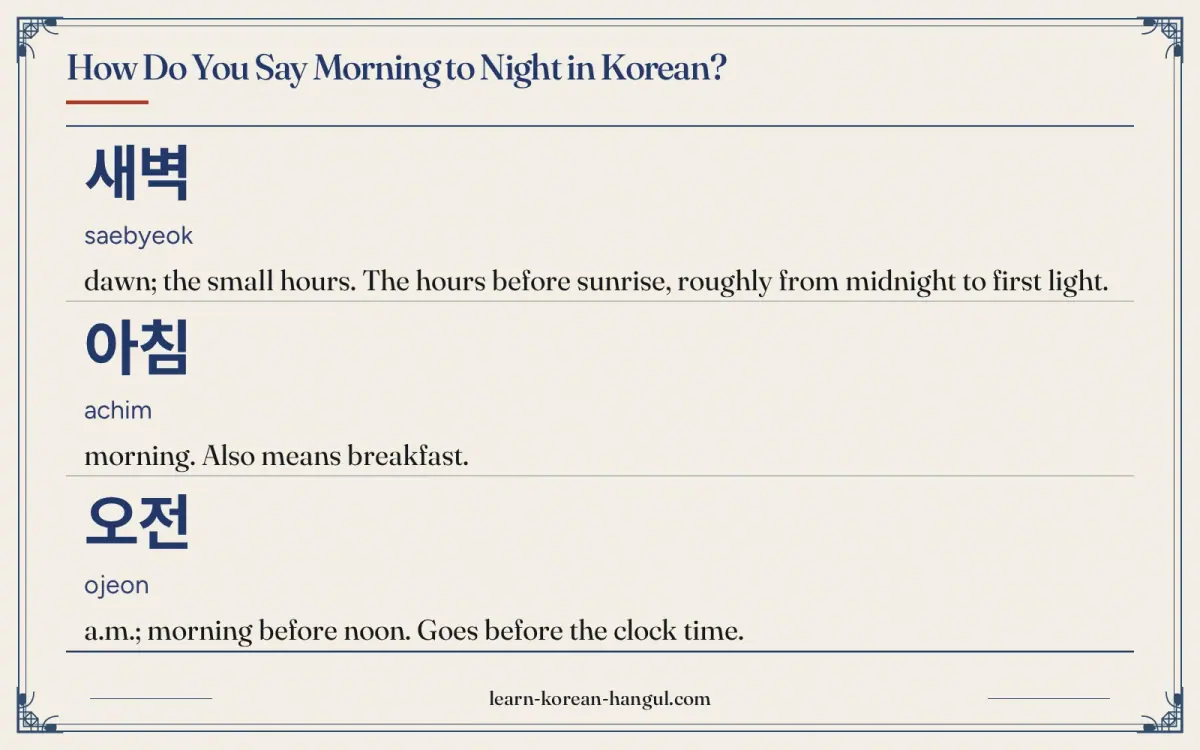
The day has several names. 새벽 is before the sun rises, 아침 is the morning, 낮 is the bright part of the day, 점심 is around noon, 저녁 is the evening and 밤 is the night. 오전 and 오후 are the clock labels for a.m. and p.m. Three of these have two meanings: 아침 is morning and breakfast, 점심 is midday and lunch, and 저녁 is evening and dinner. Context makes it clear: 아침을 먹어요 is "I eat breakfast", and 아침에 먹어요 is "I eat in the morning".
| No. | Hangul | Revised Romanization | Meaning and note | Example sentence | Audio assetId |
|---|---|---|---|---|---|
| 21 | 새벽 | saebyeok | dawn; the small hours. The hours before sunrise, roughly from midnight to first light. | 새벽에 일어났어요. (I woke up at dawn.) | au-pg-vocabulary-time-time-expressions-21; example: au-pg-vocabulary-time-time-expressions-71 |
| 22 | 아침 | achim | morning. Also means breakfast. | 아침에 운동해요. (I exercise in the morning.) | au-pg-vocabulary-time-time-expressions-22; example: au-pg-vocabulary-time-time-expressions-72 |
| 23 | 오전 | ojeon | a.m.; morning before noon. Goes before the clock time. | 오전 아홉 시에 시작해요. (It starts at nine a.m.) | au-pg-vocabulary-time-time-expressions-23; example: au-pg-vocabulary-time-time-expressions-73 |
| 24 | 낮 | nat | daytime. The bright part of the day, against 밤. Said [낟]. | 낮에는 따뜻해요. (It is warm during the day.) | au-pg-vocabulary-time-time-expressions-24; example: au-pg-vocabulary-time-time-expressions-74 |
| 25 | 점심 | jeomsim | lunch; midday. Both the meal and the time around noon. | 점심에 뭐 먹어요? (What do you eat for lunch?) | au-pg-vocabulary-time-time-expressions-25; example: au-pg-vocabulary-time-time-expressions-75 |
| 26 | 오후 | ohu | p.m.; afternoon. Goes before the clock time. | 오후에 회의가 있어요. (There is a meeting in the afternoon.) | au-pg-vocabulary-time-time-expressions-26; example: au-pg-vocabulary-time-time-expressions-76 |
| 27 | 저녁 | jeonyeok | evening; dinner. Also means the evening meal. | 저녁에 친구를 만나요. (I meet a friend in the evening.) | au-pg-vocabulary-time-time-expressions-27; example: au-pg-vocabulary-time-time-expressions-77 |
| 28 | 밤 | bam | night. Also means chestnut. | 밤에는 조용해요. (It is quiet at night.) | au-pg-vocabulary-time-time-expressions-28; example: au-pg-vocabulary-time-time-expressions-78 |
| 29 | 정오 | jeongo | noon. Exactly twelve o'clock; more formal than 낮 열두 시. | 정오에 점심을 먹어요. (I eat lunch at noon.) | au-pg-vocabulary-time-time-expressions-29; example: au-pg-vocabulary-time-time-expressions-79 |
| 30 | 자정 | jajeong | midnight. Exactly twelve at night. | 자정에 불꽃놀이가 시작돼요. (The fireworks start at midnight.) | au-pg-vocabulary-time-time-expressions-30; example: au-pg-vocabulary-time-time-expressions-80 |
Two cautions. First, 밤 also means chestnut, so check the verb: 밤을 먹어요 is likely chestnuts. Second, the boundaries between the parts of the day are loose and depend on the speaker. For a closer look, see Korean Parts of the Day.
How Do You Say Now, Soon, Later in Korean?
These ten words place an event around the moment of speaking. 지금 is now, 방금 is just now, 아까 is a while ago, 곧 is soon, and 이따가 and 나중에 are two kinds of later. 이따가 means later the same day, while 나중에 is open-ended. 먼저 means first, 요즘 means these days, 벌써 means already, and 아직 means still or not yet.
| No. | Hangul | Revised Romanization | Meaning and note | Example sentence | Audio assetId |
|---|---|---|---|---|---|
| 31 | 지금 | jigeum | now. Takes no 에. | 지금 뭐 해요? (What are you doing now?) | au-pg-vocabulary-time-time-expressions-31; example: au-pg-vocabulary-time-time-expressions-81 |
| 32 | 방금 | banggeum | just now. A moment ago; pairs with a past verb. | 방금 도착했어요. (I just arrived.) | au-pg-vocabulary-time-time-expressions-32; example: au-pg-vocabulary-time-time-expressions-82 |
| 33 | 아까 | akka | a little while ago. Earlier the same day. | 아까 전화했어요. (I called earlier.) | au-pg-vocabulary-time-time-expressions-33; example: au-pg-vocabulary-time-time-expressions-83 |
| 34 | 이따가 | ittaga | later (today). Later the same day; also 이따. | 이따가 전화할게요. (I will call you later.) | au-pg-vocabulary-time-time-expressions-34; example: au-pg-vocabulary-time-time-expressions-84 |
| 35 | 곧 | got | soon. A short wait ahead. | 곧 도착해요. (I will arrive soon.) | au-pg-vocabulary-time-time-expressions-35; example: au-pg-vocabulary-time-time-expressions-85 |
| 36 | 나중에 | najunge | later; some other time. Open-ended. The 에 is part of the word. | 나중에 이야기해요. (Let us talk later.) | au-pg-vocabulary-time-time-expressions-36; example: au-pg-vocabulary-time-time-expressions-86 |
| 37 | 먼저 | meonjeo | first; ahead. Before the others. | 먼저 갈게요. (I will go first.) | au-pg-vocabulary-time-time-expressions-37; example: au-pg-vocabulary-time-time-expressions-87 |
| 38 | 요즘 | yojeum | these days. A loose present period. | 요즘 한국어를 공부해요. (These days I study Korean.) | au-pg-vocabulary-time-time-expressions-38; example: au-pg-vocabulary-time-time-expressions-88 |
| 39 | 벌써 | beolsseo | already. Earlier than expected. Said [벌써]. | 벌써 열두 시예요. (It is already twelve o'clock.) | au-pg-vocabulary-time-time-expressions-39; example: au-pg-vocabulary-time-time-expressions-89 |
| 40 | 아직 | ajik | still; not yet. Pairs with a negative for not yet. | 아직 안 왔어요. (He has not come yet.) | au-pg-vocabulary-time-time-expressions-40; example: au-pg-vocabulary-time-time-expressions-90 |
The sentence with 아직 shows that one word covers both "still" and "not yet". With a negative verb, 아직 안 왔어요 means "has not come yet". With a positive verb, 아직 있어요 means "is still here". Frequency words like 항상 and 가끔 are on Korean Frequency Adverbs.
Time of the Day with 에
The particle 에 attaches to a point in time: 아침에, 오후에, 세 시에, 월요일에. It does not attach to the relative words 오늘, 어제, 내일, 모레, 그저께, 지금 or 언제. Compare:
- 아침에 운동해요. (I exercise in the morning.) Uses 에.
- 내일 운동해요. (I exercise tomorrow.) No 에.
- 세 시에 만나요. (We meet at three o'clock.) Uses 에.
- 언제 만나요? (When shall we meet?) No 에.
The clock words below finish the group. 시 follows a native number (세 시), 분 and 초 follow Sino-Korean numbers (십 분), and 반 means half.
| No. | Hangul | Revised Romanization | Meaning and note | Example sentence | Audio assetId |
|---|---|---|---|---|---|
| 41 | 시간 | sigan | time; hour (duration). Time in general or a length of one hour. | 시간이 없어요. (I have no time.) | au-pg-vocabulary-time-time-expressions-41; example: au-pg-vocabulary-time-time-expressions-91 |
| 42 | 시 | si | o'clock. Follows native numbers, as in 세 시. | 지금 세 시예요. (It is three o'clock now.) | au-pg-vocabulary-time-time-expressions-42; example: au-pg-vocabulary-time-time-expressions-92 |
| 43 | 분 | bun | minute. Follows Sino-Korean numbers, as in 십 분. | 십 분 걸려요. (It takes ten minutes.) | au-pg-vocabulary-time-time-expressions-43; example: au-pg-vocabulary-time-time-expressions-93 |
| 44 | 초 | cho | second. Follows Sino-Korean numbers. | 오 초만 기다려 주세요. (Please wait just five seconds.) | au-pg-vocabulary-time-time-expressions-44; example: au-pg-vocabulary-time-time-expressions-94 |
| 45 | 반 | ban | half. Half past the hour. | 두 시 반이에요. (It is half past two.) | au-pg-vocabulary-time-time-expressions-45; example: au-pg-vocabulary-time-time-expressions-95 |
| 46 | 몇 시 | myeot si | what time. Asks for the clock hour. Said [멷씨]. | 지금 몇 시예요? (What time is it now?) | au-pg-vocabulary-time-time-expressions-46; example: au-pg-vocabulary-time-time-expressions-96 |
| 47 | 언제 | eonje | when. Asks about a point in time; takes no 에. | 언제 만나요? (When shall we meet?) | au-pg-vocabulary-time-time-expressions-47; example: au-pg-vocabulary-time-time-expressions-97 |
| 48 | 일찍 | iljjik | early. Before the usual time. Said [일찍]. | 내일 일찍 일어나요. (I get up early tomorrow.) | au-pg-vocabulary-time-time-expressions-48; example: au-pg-vocabulary-time-time-expressions-98 |
| 49 | 늦게 | neutge | late. After the usual time. Said [늗께]. | 늦게 자요. (I go to bed late.) | au-pg-vocabulary-time-time-expressions-49; example: au-pg-vocabulary-time-time-expressions-99 |
| 50 | 정각 | jeonggak | on the dot. Placed after the hour: 세 시 정각. | 세 시 정각에 시작해요. (It starts at three o'clock sharp.) | au-pg-vocabulary-time-time-expressions-50; example: au-pg-vocabulary-time-time-expressions-100 |
How Do You Pronounce These Words?
Several time words change sound at the end or in the middle. Standard pronunciation follows the National Institute of Korean Language (국립국어원) rules, and the romanization follows the Revised Romanization of Korean, which does not mark every sound change.
| Spelling | Sounds like | What changes |
|---|---|---|
| 낮 | [낟] | Final ㅈ is said as [ㄷ]. |
| 몇 시 | [멷씨] | Final ㅊ is said as [ㄷ], and ㅅ after it is tense. |
| 늦게 | [늗께] | Final ㅈ is said as [ㄷ], and ㄱ after it is tense. |
| 작년 | [장년] | ㄱ before ㄴ becomes [ㅇ]. |
| 밤에 | [바메] | The final ㅁ moves to the next syllable. |
| 저녁에 | [저녀게] | The final ㄱ moves to the next syllable. |
The pair to practise is 늦게 and 일찍. Both have a tense consonant in the second syllable ([께] and [찍]), a sound English lacks: say it with a tight throat and no puff of air.
Audio and Slow Playback
Each word and sentence has its own clip. The clips below replay the trickiest words slowly. Play one, repeat it, then play it again and compare.
What Mistakes Do Learners Make with Time Expressions?
Five mistakes come up often.
- Adding 에 to 오늘, 어제 or 내일. Leave it off.
- Treating 밤 as only night. 밤 can also be a chestnut.
- Using 시 with Sino-Korean numbers. Say 세 시 (three o'clock), not 삼 시.
- Using 분 with native numbers. Say 십 분 (ten minutes), not 열 분.
- Leaving out the negative with 아직. 아직 안 왔어요 needs 안 to mean "not yet", because 아직 alone does not say "not yet".
The clock mistakes come from the two number systems, so telling time explains the pairing in full.
Practice: Flashcards and Worksheet
Run the deck in recognition mode until the day words come quickly, then switch to listening mode and take the quiz. The deck holds all 50 words with audio, and your progress stays in your browser. The vocabulary flashcard decks page lists the other decks.
Practice · 105
- 01오늘
Show answer
headword 1: today
- 02어제
Show answer
headword 2: yesterday
- 03내일
Show answer
headword 3: tomorrow
- 04모레
Show answer
headword 4: the day after tomorrow
- 05그저께
Show answer
headword 5: the day before yesterday
- 06날
Show answer
headword 6: day; a particular day
- 07하루
Show answer
headword 7: one day
- 08매일
Show answer
headword 8: every day
- 09주
Show answer
headword 9: week
- 10이번 주
Show answer
headword 10: this week
- 11지난주
Show answer
headword 11: last week
- 12다음 주
Show answer
headword 12: next week
- 13달
Show answer
headword 13: month (span); moon
- 14지난달
Show answer
headword 14: last month
- 15이번 달
Show answer
headword 15: this month
- 16다음 달
Show answer
headword 16: next month
- 17올해
Show answer
headword 17: this year
- 18작년
Show answer
headword 18: last year
- 19내년
Show answer
headword 19: next year
- 20년
Show answer
headword 20: year (counter)
- 21새벽
Show answer
headword 21: dawn; the small hours
- 22아침
Show answer
headword 22: morning
- 23오전
Show answer
headword 23: a.m.; morning before noon
- 24낮
Show answer
headword 24: daytime
- 25점심
Show answer
headword 25: lunch; midday
- 26오후
Show answer
headword 26: p.m.; afternoon
- 27저녁
Show answer
headword 27: evening; dinner
- 28밤
Show answer
headword 28: night
- 29정오
Show answer
headword 29: noon
- 30자정
Show answer
headword 30: midnight
- 31지금
Show answer
headword 31: now
- 32방금
Show answer
headword 32: just now
- 33아까
Show answer
headword 33: a little while ago
- 34이따가
Show answer
headword 34: later (today)
- 35곧
Show answer
headword 35: soon
- 36나중에
Show answer
headword 36: later; some other time
- 37먼저
Show answer
headword 37: first; ahead
- 38요즘
Show answer
headword 38: these days
- 39벌써
Show answer
headword 39: already
- 40아직
Show answer
headword 40: still; not yet
- 41시간
Show answer
headword 41: time; hour (duration)
- 42시
Show answer
headword 42: o'clock
- 43분
Show answer
headword 43: minute
- 44초
Show answer
headword 44: second
- 45반
Show answer
headword 45: half
- 46몇 시
Show answer
headword 46: what time
- 47언제
Show answer
headword 47: when
- 48일찍
Show answer
headword 48: early
- 49늦게
Show answer
headword 49: late
- 50정각
Show answer
headword 50: on the dot
- 51오늘 날씨가 좋아요.
Show answer
example sentence for 오늘
- 52어제 영화를 봤어요.
Show answer
example sentence for 어제
- 53내일 회사에 가요.
Show answer
example sentence for 내일
- 54모레 시험이 있어요.
Show answer
example sentence for 모레
- 55그저께 친구를 만났어요.
Show answer
example sentence for 그저께
- 56오늘은 좋은 날이에요.
Show answer
example sentence for 날
- 57하루에 세 번 먹어요.
Show answer
example sentence for 하루
- 58매일 아침에 커피를 마셔요.
Show answer
example sentence for 매일
- 59한 주에 한 번 청소해요.
Show answer
example sentence for 주
- 60이번 주에 바빠요?
Show answer
example sentence for 이번 주
- 61지난주에 이사했어요.
Show answer
example sentence for 지난주
- 62다음 주에 여행을 가요.
Show answer
example sentence for 다음 주
- 63한 달에 두 번 가요.
Show answer
example sentence for 달
- 64지난달에 시험을 봤어요.
Show answer
example sentence for 지난달
- 65이번 달에 책을 세 권 읽었어요.
Show answer
example sentence for 이번 달
- 66다음 달에 한국에 가요.
Show answer
example sentence for 다음 달
- 67올해 목표는 한국어 공부예요.
Show answer
example sentence for 올해
- 68작년에 한국에 왔어요.
Show answer
example sentence for 작년
- 69내년에 졸업해요.
Show answer
example sentence for 내년
- 70삼 년 동안 한국어를 배웠어요.
Show answer
example sentence for 년
- 71새벽에 일어났어요.
Show answer
example sentence for 새벽
- 72아침에 운동해요.
Show answer
example sentence for 아침
- 73오전 아홉 시에 시작해요.
Show answer
example sentence for 오전
- 74낮에는 따뜻해요.
Show answer
example sentence for 낮
- 75점심에 뭐 먹어요?
Show answer
example sentence for 점심
- 76오후에 회의가 있어요.
Show answer
example sentence for 오후
- 77저녁에 친구를 만나요.
Show answer
example sentence for 저녁
- 78밤에는 조용해요.
Show answer
example sentence for 밤
- 79정오에 점심을 먹어요.
Show answer
example sentence for 정오
- 80자정에 불꽃놀이가 시작돼요.
Show answer
example sentence for 자정
- 81지금 뭐 해요?
Show answer
example sentence for 지금
- 82방금 도착했어요.
Show answer
example sentence for 방금
- 83아까 전화했어요.
Show answer
example sentence for 아까
- 84이따가 전화할게요.
Show answer
example sentence for 이따가
- 85곧 도착해요.
Show answer
example sentence for 곧
- 86나중에 이야기해요.
Show answer
example sentence for 나중에
- 87먼저 갈게요.
Show answer
example sentence for 먼저
- 88요즘 한국어를 공부해요.
Show answer
example sentence for 요즘
- 89벌써 열두 시예요.
Show answer
example sentence for 벌써
- 90아직 안 왔어요.
Show answer
example sentence for 아직
- 91시간이 없어요.
Show answer
example sentence for 시간
- 92지금 세 시예요.
Show answer
example sentence for 시
- 93십 분 걸려요.
Show answer
example sentence for 분
- 94오 초만 기다려 주세요.
Show answer
example sentence for 초
- 95두 시 반이에요.
Show answer
example sentence for 반
- 96지금 몇 시예요?
Show answer
example sentence for 몇 시
- 97언제 만나요?
Show answer
example sentence for 언제
- 98내일 일찍 일어나요.
Show answer
example sentence for 일찍
- 99늦게 자요.
Show answer
example sentence for 늦게
- 100세 시 정각에 시작해요.
Show answer
example sentence for 정각
- 101낮
Show answer
slow playback: 낮
- 102몇 시
Show answer
slow playback: 몇 시
- 103늦게
Show answer
slow playback: 늦게
- 104작년
Show answer
slow playback: 작년
- 105벌써
Show answer
slow playback: 벌써
Practice · 6
What does 내일 (naeil) mean?
Show answer
tomorrow
내일 means tomorrow. Example: 내일 회사에 가요. (I go to work tomorrow.)
What does 지난주 (jinanju) mean?
Show answer
last week
지난주 means last week. Example: 지난주에 이사했어요. (I moved house last week.)
What does 저녁 (jeonyeok) mean?
Show answer
evening; dinner
저녁 means evening; dinner. Example: 저녁에 친구를 만나요. (I meet a friend in the evening.)
What does 아까 (akka) mean?
Show answer
a little while ago
아까 means a little while ago. Example: 아까 전화했어요. (I called earlier.)
What does 몇 시 (myeot si) mean?
Show answer
what time
몇 시 means what time. Example: 지금 몇 시예요? (What time is it now?)
What does 벌써 (beolsseo) mean?
Show answer
already
벌써 means already. Example: 벌써 열두 시예요. (It is already twelve o'clock.)
Korean Time Expressions Worksheet (PDF)
A printable worksheet for these words (word list, matching, writing practice, fill-in-the-blank exercises and answer key) is available in A4 and US Letter from the download card on this page. For practice, draw a line from morning to night, write the Hangul for each part of the day and add one sentence under each.
Where to Go Next
Continue with Korean Relative Time Words for the full past-to-future line, then Korean Parts of the Day and Korean Frequency Adverbs. Or go back to Months and Time Words.
Pages in This Section
- Korean Relative Time Words: 30 words from 그저께 to 글피, with last, this and next periods.
- Korean Parts of the Day: 25 words from dawn to midnight, with greetings by time.
- Korean Frequency Adverbs: 20 words from always to never, with every-X nouns.
Frequently Asked Questions
How Do You Say Today, Yesterday and Tomorrow in Korean?
Today is 오늘 (oneul), yesterday is 어제 (eoje) and tomorrow is 내일 (naeil). None of them takes 에. Say 내일 만나요 for "We meet tomorrow". The day before yesterday is 그저께 and the day after tomorrow is 모레.
When Do You Use 에 with a Time Word?
Use 에 with a point in time such as 아침, 오후, 세 시 or a day name: 아침에, 세 시에, 월요일에. Do not use it with 오늘, 어제, 내일, 지금 or 언제, which already work as adverbs.
How Do You Say Last Week, This Week and Next Week in Korean?
Say 지난주 for last week, 이번 주 for this week and 다음 주 for next week. The same pattern works for months: 지난달, 이번 달 and 다음 달. For years, use 작년, 올해 and 내년.
What Is the Difference between 이따가 and 나중에?
이따가 means later the same day, usually within hours: 이따가 전화할게요. 나중에 is open-ended, any time later or some other time: 나중에 이야기해요. 이따가 takes no 에, while 나중에 already contains it.
Why Does 아침 Mean Both Morning and Breakfast?
Korean often uses the time of the meal as the word for the meal. 아침 is breakfast, 점심 is lunch and 저녁 is dinner, as well as morning, midday and evening. The verb and particle show which: 아침을 먹어요 is "I eat breakfast", and 아침에 먹어요 is "I eat in the morning".
Is the Romanization on This Page Official?
It follows the Revised Romanization of Korean, which South Korea adopted on 7 July 2000 and whose rules the National Institute of Korean Language (국립국어원) publishes. It is a learning aid and does not mark every sound change, so rely on the Hangul and the audio.