Korean Holidays Flashcards: Study the 29 Cards
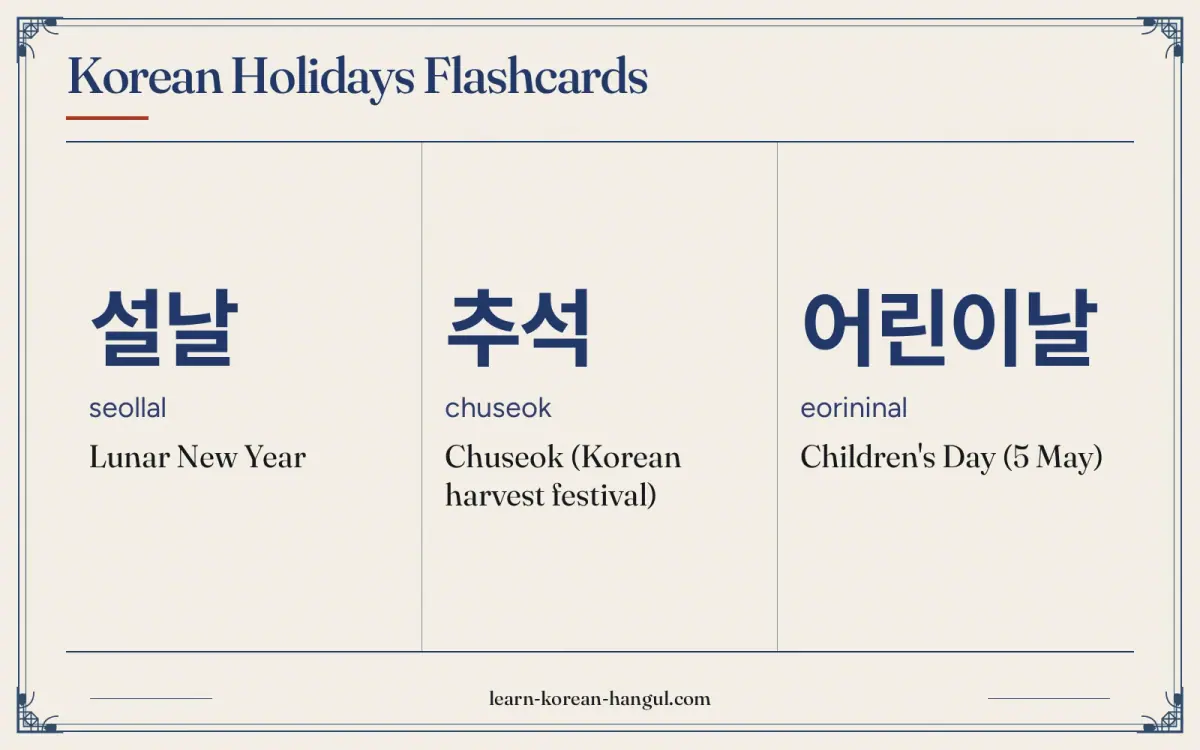
Say each word aloud before you press Show answer. Every card has a short note that explains how the word is used or why it sounds different from its spelling.
How Do I Use These Flashcards?
Use the deck above in four steps. It works with tap, click or keyboard, and nothing plays until you press an audio button.
- Choose a mode. Start with recognition (Hangul to meaning). Switch to recall (meaning to Hangul) or listening (audio to meaning) once recognition feels easy.
- Show the answer. Think of the answer first, then press Show answer (or Space). Turn on the romanization toggle only if you need it; the 29-card table below always shows it.
- Grade yourself. Press Got it if you answered correctly without help, or Not yet if you hesitated or guessed.
- Finish the session. A session holds up to 20 cards (you can set 10, 20 or 40). With 29 cards, a first-time learner can split the deck over 3 days, using the default limit of 10 new cards a day.
What Do the Three Modes Do?
Recognition shows the Hangul and asks for the meaning, which trains reading. Recall shows the meaning and asks for the Hangul, which trains remembering; you may type the answer with your Hangul keyboard or just recall it in your head. Listening plays a clip and hides the letters, which trains the ear. Listening mode only uses a card once its audio is approved, and cards without approved audio are skipped in that mode with a note.
What Do Got It and Not yet Do?
Got it moves the card up one Leitner box, so it comes back later. Not yet sends the card back to box 1, so it returns in the same session or within 10 minutes. The grades are your own judgement; the deck does not score you or claim fluency.
Deck Scope: What Is and Is Not Covered
The deck covers national holidays, traditional festivals and common celebration words, from 설날 and 추석 to 돌잔치 and 공휴일. Traditional culture words such as 한복 (hanbok) belong to the traditional Korean culture words flashcards, and fan-culture events are in the kpop korean words flashcards. The lesson behind the deck is korean holidays.
What Is Left out of This Deck?
The deck lists dates only for the fixed-date holidays, and holiday dates and customs change over time, so check the current calendar before you plan around them. It does not cover regional customs, religious holidays beyond 크리스마스 or the full list of anniversary days.
All 29 Cards in One Table
All 29 cards appear below in deck order. The table is plain HTML, so you can use it as a drill without the deck: cover the Meaning column, read each word aloud, then uncover the meaning.
| # | Hangul | Revised Romanization | Meaning | Note | Audio assetId |
|---|---|---|---|---|---|
| 1 | 설날 | seollal | Lunar New Year | One of the two big 명절. Said [설랄]. | au-pg-flashcards-holidays-1; slow: au-pg-flashcards-holidays-30 |
| 2 | 추석 | chuseok | Chuseok (Korean harvest festival) | Harvest festival on the 15th day of the 8th lunar month; a 명절. | au-pg-flashcards-holidays-2 |
| 3 | 어린이날 | eorininal | Children's Day (5 May) | Fixed date, 5 May. Said [어리니날]. | au-pg-flashcards-holidays-3; slow: au-pg-flashcards-holidays-31 |
| 4 | 한글날 | hangeullal | Hangeul Day (9 October) | Fixed date, 9 October. Said [한글랄]. | au-pg-flashcards-holidays-4; slow: au-pg-flashcards-holidays-32 |
| 5 | 명절 | myeongjeol | traditional holiday | The two main 명절 are 설날 and 추석. | au-pg-flashcards-holidays-5 |
| 6 | 음력 | eumnyeok | lunar calendar | Said [음녁]. 설날 and 추석 follow it. | au-pg-flashcards-holidays-6; slow: au-pg-flashcards-holidays-33 |
| 7 | 연휴 | yeonhyu | holiday break; consecutive days off | Several days off in a row. | au-pg-flashcards-holidays-7 |
| 8 | 세배 | sebae | New Year bow to elders | Younger people bow to elders at New Year. | au-pg-flashcards-holidays-8 |
| 9 | 세뱃돈 | sebaetdon | New Year money given after the bow | Money an elder gives after the 세배. | au-pg-flashcards-holidays-9 |
| 10 | 떡국 | tteokguk | rice-cake soup, eaten on Seollal | Rice-cake soup eaten on 설날 morning. Said [떡꾹]. | au-pg-flashcards-holidays-10; slow: au-pg-flashcards-holidays-34 |
| 11 | 송편 | songpyeon | half-moon rice cake | Half-moon rice cake, a Chuseok food. | au-pg-flashcards-holidays-11 |
| 12 | 차례 | charye | ancestral rite held on the morning of the holiday | The ancestral rite held on the holiday morning. | au-pg-flashcards-holidays-12 |
| 13 | 성묘 | seongmyo | visiting ancestors' graves | Visiting ancestors' graves. | au-pg-flashcards-holidays-13 |
| 14 | 귀성 | gwiseong | travelling to one's hometown for a holiday | Travelling to your hometown for a holiday. | au-pg-flashcards-holidays-14 |
| 15 | 고향 | gohyang | hometown | Hometown: 고향이 어디예요? | au-pg-flashcards-holidays-15 |
| 16 | 선물 | seonmul | gift | Gift. Give one with 선물을 주다, or 선물을 드리다 to an elder. | au-pg-flashcards-holidays-16 |
| 17 | 생일 | saengil | birthday | Birthday: 생일 축하해요. | au-pg-flashcards-holidays-17 |
| 18 | 생신 | saengsin | birthday (honorific, for elders) | The honorific for an elder's birthday; use it instead of 생일. | au-pg-flashcards-holidays-18 |
| 19 | 축하 | chukha | congratulation; celebration | Congratulations: 생일 축하해요. Use 축하드려요 to elders. | au-pg-flashcards-holidays-19 |
| 20 | 결혼식 | gyeolhonsik | wedding | Wedding. | au-pg-flashcards-holidays-20 |
| 21 | 돌잔치 | doljanchi | first-birthday party | First-birthday party. | au-pg-flashcards-holidays-21 |
| 22 | 공휴일 | gonghyuil | public holiday | Public holiday; 휴일 is any day off. | au-pg-flashcards-holidays-22 |
| 23 | 휴일 | hyuil | day off; holiday | Day off. | au-pg-flashcards-holidays-23 |
| 24 | 삼일절 | samiljeol | Independence Movement Day (1 March) | Fixed date, 1 March. Said [사밀쩔]. | au-pg-flashcards-holidays-24; slow: au-pg-flashcards-holidays-35 |
| 25 | 광복절 | gwangbokjeol | Liberation Day (15 August) | Fixed date, 15 August. | au-pg-flashcards-holidays-25 |
| 26 | 개천절 | gaecheonjeol | National Foundation Day (3 October) | Fixed date, 3 October. | au-pg-flashcards-holidays-26 |
| 27 | 크리스마스 | keuriseumaseu | Christmas | English loanword. | au-pg-flashcards-holidays-27 |
| 28 | 새해 | saehae | new year | New year. | au-pg-flashcards-holidays-28 |
| 29 | 새해 복 많이 받으세요 | saehae bok mani badeuseyo | Happy New Year (set greeting) | The set greeting. Do not say 새해 축하해요. | au-pg-flashcards-holidays-29 |
How Do I Read the Table?
Hangul is the word. Revised Romanization (RR) is a learning aid, so try to read the Hangul before you look at it. RR follows the spelling rules of the official system, not every sound change, so it can differ from what you hear. The Meaning column gives the English gloss, and the Note column gives a use or sound hint. The last column lists the audio assetId; a second ID marked slow is a slower clip for the 6 cards whose sound differs from their spelling.
Usage Notes for These Cards
Lunar holidays. The big traditional holidays are 설날 and 추석, which follow the lunar calendar and are called 명절.
New Year customs. At New Year younger people bow (세배) to elders and receive 세뱃돈, and the greeting is 새해 복 많이 받으세요 (Please receive many blessings in the new year).
Birthdays. The greeting is 생일 축하해요. For an elder the honorific 생신 replaces 생일: 할아버지 생신 (grandfather's birthday).
Fixed-date holidays. Several public holidays are fixed dates, such as 어린이날 on 5 May, 삼일절 on 1 March, 광복절 on 15 August, 개천절 on 3 October and 한글날 on 9 October.
Gifts and congratulations. Gifts are given with 선물을 주다. Congratulating someone uses 축하해요, or 축하드려요 for elders.
Which Sounds Do Not Match the Spelling?
설날 is said [설랄]: ㄴ after a ㄹ final is read as ㄹ. 한글날 follows the same rule and is said [한글랄].
삼일절 is said [사밀쩔]: the ㅁ of 삼 links to the vowel of 일, and in this Sino-Korean word the ㅈ after a final ㄹ becomes tense [ㅉ].
Revised Romanization shows the [ㄹ] in seollal and hangeullal, but it does not show the tense ㅉ in samiljeol.
These forms follow the standard pronunciation rules (표준 발음법) of the 국립국어원 (National Institute of Korean Language).
What Mistakes Do Learners Make with Holidays?
- Using 생일 for an elder. Use 생신.
- Saying 새해 축하해요 for Happy New Year. The set phrase is 새해 복 많이 받으세요.
- Confusing 어린이날 (5 May) and 어버이날 (8 May). The second one is a day for parents, and it is not a public holiday.
How Does the Review Schedule Work?
The deck uses a simplified Leitner system with five boxes. A new card starts in box 1. Each Got it moves it up one box, and each Not yet returns it to box 1. The box sets how long the card waits before it is due again.
| Box | Wait until the next review |
|---|---|
| 1 | same session or 10 minutes |
| 2 | 1 day |
| 3 | 3 days |
| 4 | 7 days |
| 5 | 21 days |
Each session shows due cards first, oldest due first, and then up to 10 new cards a day by default. Progress is saved only in this browser, so clearing site data deletes it. Use the export button to save a small JSON file with card IDs, boxes and due dates, and import it on another device. No account is needed.
Cultural and Practical Context
설날 and 추석 are the two major family holidays, when many people travel to their hometowns (귀성), and meals, ancestral rites and visits to family are central. The same words appear in dramas, news and shop signs every year, which is why the lunar-holiday cards come first.
Next Steps after This Deck
The words and letters on these cards are explained in the korean holidays lesson, so read it first if a card is new. This deck is one of the korean vocabulary flashcards on the site, so browse the full list if you want a different topic. When these cards feel easy, move on to kpop korean words flashcards to keep the same routine. If a word here still feels shaky, go back to korean gaming vocabulary flashcards for the earlier material. After a session, write the same words by hand with the korean culture vocabulary worksheet. All flashcard decks, including Hangul, vocabulary, phrases, grammar and TOPIK, are listed on the korean flashcards hub.
Frequently Asked Questions
Why Do 설날 and 추석 Change Dates Each Year?
They follow the lunar calendar (음력), not the solar calendar used for 5 May or 15 August. A lunar date lands on a different solar date each year, so the holiday moves, and the break around it is called 연휴.
What Is 화이트데이?
화이트데이 is 14 March, when men give gifts in return for Valentine's Day. It is a gift-giving day and not a public holiday, and it is not one of the 29 cards.
What Is 환갑?
환갑 is a traditional 60th birthday celebration. It is a milestone birthday, so the elder is honoured with the word 생신 and a family meal. It is outside this deck but links to the 생신 card.
How Do I Say Happy Birthday to an Elder?
Say 생신 축하드립니다. The honorific 생신 replaces 생일, and 축하드립니다 is the respectful form of the greeting. To a friend you can say 생일 축하해요.
Is My Progress Saved If I Close the Page?
Yes, in the same browser on the same device. Card boxes and due dates are stored locally and nothing is sent to a server. Clearing site data, using a private window or switching browsers removes them, so use the export button to keep a backup file. No account is needed.