
Kpop Korean Words at a Glance
Kpop Korean words are easy to start with, because 21 of the 45 are loanwords, mostly from English, that you can read once you know Hangul: 앨범, 콘서트, 팬 and 티켓 are English words spelled in Korean letters. The rest are Sino-Korean words (17 of 45), plus 2 native and 5 mixed words, including the slang words 덕질 and 입덕. Fans use many of these words every day, and some, such as 컴백 and 최애, have a Korean meaning that differs a little from the English one.
This list is also a hub for two deeper pages: K-Pop Industry Vocabulary and K-Pop Fandom Vocabulary. The page itself is a child of Korean Culture Words.
| Group | Words | What it covers |
|---|---|---|
| Idol industry | 9 | Idols, agencies, debuts and group roles |
| Fandom | 9 | Fans, the favourite member, lightsticks and fan slang |
| Concerts and events | 9 | Concerts, tickets, stages and music shows |
| Music and releases | 9 | Albums, songs, lyrics and charts |
| Fan-made content | 9 | Fancams, photocards, fan art and cheering |
If you want full sentences instead of single words, the K-pop fan phrases page has them. The next section says which words to learn first.
Which K-Pop Words Should You Learn First?
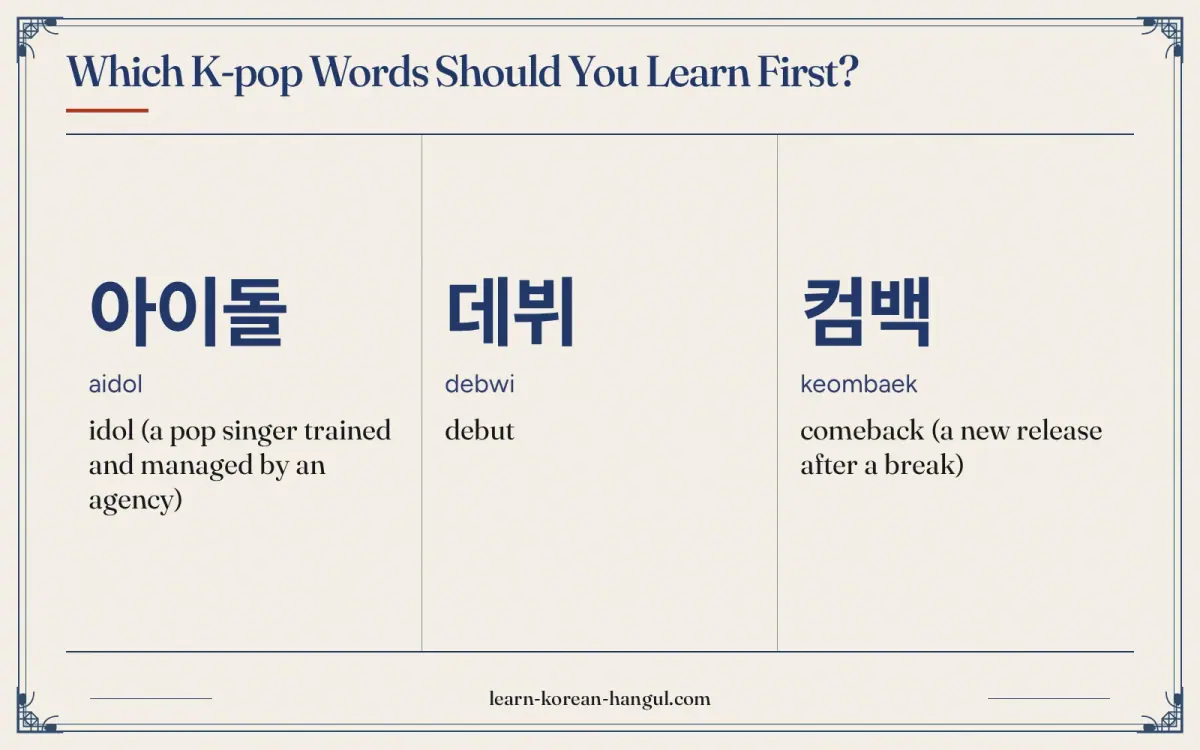
Learn 아이돌, 팬, 앨범, 컴백 and 콘서트 first. These five words appear in almost every fan post and news item, and you can already read them because they are loanwords. Then add 최애, 응원봉 and 막내, the three words that describe fan culture best.
- To read posts and headlines. 아이돌, 가수, 팬, 앨범, 컴백, 데뷔 and 신곡.
- To talk about your favourite. 최애, 멤버, 리더, 막내 and 팬클럽.
- To go to a concert. 콘서트, 공연, 티켓, 티켓팅, 응원봉 and 무대.
- To join the fan community. 덕질, 입덕, 팬카페, 직캠 and 굿즈.
At 9 words a day, the list takes five days plus review. The scene below puts eight of the words on one picture.
Word · 8
- 1
아이돌
aidol
idol (a pop singer trained and managed by an agency)
- 2
데뷔
debwi
debut
- 3
컴백
keombaek
comeback (a new release after a break)
- 4
최애
choeae
favourite (member); a fan's 'bias'
- 5
응원봉
eungwonbong
lightstick
- 6
콘서트
konseoteu
concert
- 7
앨범
aelbeom
album
- 8
타이틀곡
taiteulgok
title track (the main song of an album)
Reading loanwords is the quickest win on this list. Korean spells English words by sound, so 앨범 is album, 콘서트 is concert and 뮤직비디오 is music video. The spelling follows Korean sound patterns, not English ones, which is why 앨범 has a final ㅁ and 콘서트 ends in ㅡ. The loanwords in Hangul page explains the rules.
Idol Industry
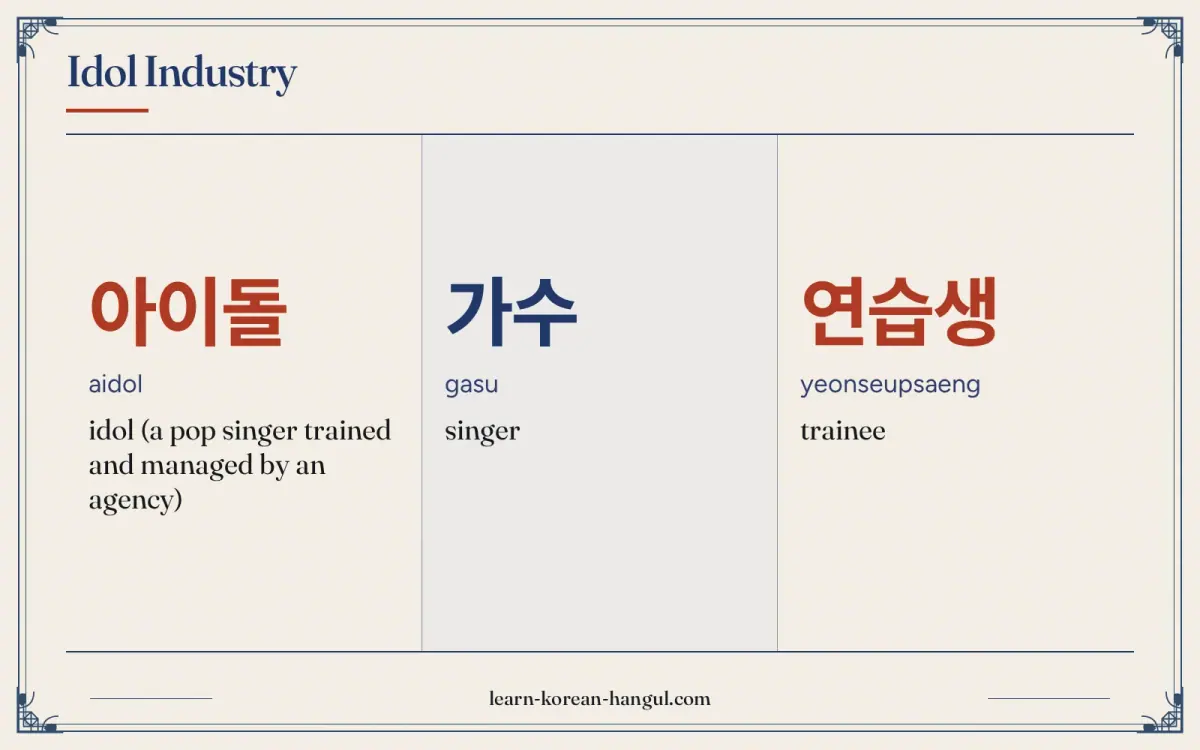
The idol industry words describe how a group is made. A 연습생 (trainee) practises at a 기획사 (agency) until the group is ready for a 데뷔 (debut). Each 멤버 (member) has a role: the 리더 (leader), the 막내 (youngest) and so on. After the first release, a new release after a break is called a 컴백.
| No. | Hangul | Revised Romanization | Origin | Meaning | Example sentence | Audio assetId |
|---|---|---|---|---|---|---|
| 1 | 아이돌 | aidol | loanword | idol (a pop singer trained and managed by an agency) | 저는 아이돌을 좋아해요. (I like idols.) | au-pg-vocabulary-culture-kpop-1; example: au-pg-vocabulary-culture-kpop-46 |
| 2 | 가수 | gasu | Sino-Korean | singer | 이 가수는 노래를 잘해요. (This singer sings well.) | au-pg-vocabulary-culture-kpop-2; example: au-pg-vocabulary-culture-kpop-47 |
| 3 | 연습생 | yeonseupsaeng | Sino-Korean | trainee | 연습생은 매일 연습해요. (Trainees practise every day.) | au-pg-vocabulary-culture-kpop-3; example: au-pg-vocabulary-culture-kpop-48 |
| 4 | 기획사 | gihoeksa | Sino-Korean | entertainment agency | 기획사가 새 그룹을 발표해요. (The agency announces a new group.) | au-pg-vocabulary-culture-kpop-4; example: au-pg-vocabulary-culture-kpop-49 |
| 5 | 데뷔 | debwi | loanword | debut | 이 그룹은 올해 데뷔해요. (This group debuts this year.) | au-pg-vocabulary-culture-kpop-5; example: au-pg-vocabulary-culture-kpop-50 |
| 6 | 컴백 | keombaek | loanword | comeback (a new release after a break) | 다음 주에 컴백해요. (They come back next week.) | au-pg-vocabulary-culture-kpop-6; example: au-pg-vocabulary-culture-kpop-51 |
| 7 | 멤버 | membeo | loanword | member | 멤버가 다섯 명이에요. (There are five members.) | au-pg-vocabulary-culture-kpop-7; example: au-pg-vocabulary-culture-kpop-52 |
| 8 | 리더 | rideo | loanword | leader (of a group) | 리더가 팀을 이끌어요. (The leader leads the team.) | au-pg-vocabulary-culture-kpop-8; example: au-pg-vocabulary-culture-kpop-53 |
| 9 | 막내 | mangnae | native | youngest member (often spelled maknae in K-pop) | 막내가 제일 귀여워요. (The youngest member is the cutest.) | au-pg-vocabulary-culture-kpop-9; example: au-pg-vocabulary-culture-kpop-54 |
In Korean, 컴백 means a new release or return to promotion, even if the group never left. In English a comeback means a return after a long absence, but in K-pop it also covers a new release by an active group. 막내 is a native word for the youngest of any family or group, and it is used for the youngest sibling too. Its Revised Romanization is mangnae, and the usual K-pop spelling is maknae.
아이돌 is a loanword with a narrower meaning than the English idol: it means a pop performer trained and managed by an agency. The K-Pop Industry Vocabulary page covers the business side in depth. The next group is the fans.
Example Sentences
Each example is a short polite sentence. Most follow the pattern noun + 을/를 + verb, as in 사진을 찍어요, or noun + 이/가 + adjective, as in 가사가 좋아요. Say each sentence aloud, then swap the noun. Replace 사진 in 사진을 찍어요 with 영상 and you get 영상을 찍어요, which is also natural.
How Do You Say Fandom in Korean?
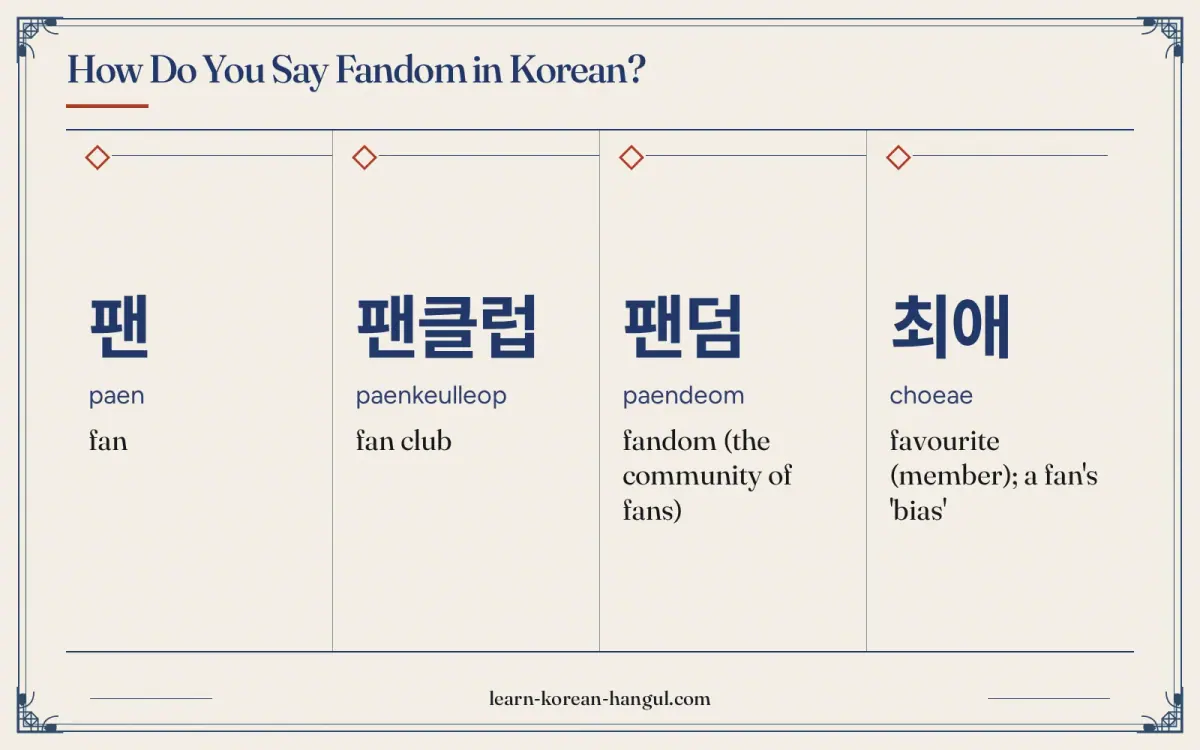
Fandom words describe the fans themselves. A 팬 follows a singer, a 팬클럽 is the official group of fans, and the 팬덤 is the whole community. Fans show support with 응원 (cheering) and carry an 응원봉 (lightstick). Your 최애 is your favourite member.
| No. | Hangul | Revised Romanization | Origin | Meaning | Example sentence | Audio assetId |
|---|---|---|---|---|---|---|
| 10 | 팬 | paen | loanword | fan | 저는 이 가수의 팬이에요. (I am a fan of this singer.) | au-pg-vocabulary-culture-kpop-10; example: au-pg-vocabulary-culture-kpop-55 |
| 11 | 팬클럽 | paenkeulleop | loanword | fan club | 팬클럽에 가입했어요. (I joined the fan club.) | au-pg-vocabulary-culture-kpop-11; example: au-pg-vocabulary-culture-kpop-56 |
| 12 | 팬덤 | paendeom | loanword | fandom (the community of fans) | 팬덤이 아주 커요. (The fandom is very big.) | au-pg-vocabulary-culture-kpop-12; example: au-pg-vocabulary-culture-kpop-57 |
| 13 | 최애 | choeae | Sino-Korean | favourite (member); a fan's 'bias' | 제 최애는 막내예요. (My favourite is the youngest member.) | au-pg-vocabulary-culture-kpop-13; example: au-pg-vocabulary-culture-kpop-58 |
| 14 | 응원 | eungwon | Sino-Korean | cheering; support | 응원이 필요해요. (I need support.) | au-pg-vocabulary-culture-kpop-14; example: au-pg-vocabulary-culture-kpop-59 |
| 15 | 응원봉 | eungwonbong | Sino-Korean | lightstick | 콘서트에서 응원봉을 흔들어요. (I wave the lightstick at the concert.) | au-pg-vocabulary-culture-kpop-15; example: au-pg-vocabulary-culture-kpop-60 |
| 16 | 팬카페 | paenkape | loanword | fan cafe (an online fan community) | 팬카페에서 소식을 봐요. (I read the news at the fan cafe.) | au-pg-vocabulary-culture-kpop-16; example: au-pg-vocabulary-culture-kpop-61 |
| 17 | 덕질 | deokjil | mixed | being a devoted fan (slang) | 덕질은 정말 재미있어요. (Being a devoted fan is really fun.) | au-pg-vocabulary-culture-kpop-17; example: au-pg-vocabulary-culture-kpop-62 |
| 18 | 입덕 | ipdeok | mixed | becoming a fan (slang) | 저는 지난달에 입덕했어요. (I became a fan last month.) | au-pg-vocabulary-culture-kpop-18; example: au-pg-vocabulary-culture-kpop-63 |
최애 is made of 최 (most) and 애 (love), so it literally means most loved. It is the Korean counterpart of the English fan word bias, but 최애 is more flexible: you can have a 최애 song, a 최애 food or a 최애 city. The two do not match exactly, so treat 최애 as favourite and not as a perfect translation of bias.
덕질 and 입덕 come from 덕후 (a devoted fan, from the Japanese otaku). 덕질 is the activity of being a devoted fan, and 입덕 is the moment you fall into fandom. Both are informal slang. The K-Pop Fandom Vocabulary page has more fan terms. The next group is about live events.
Concerts and Events
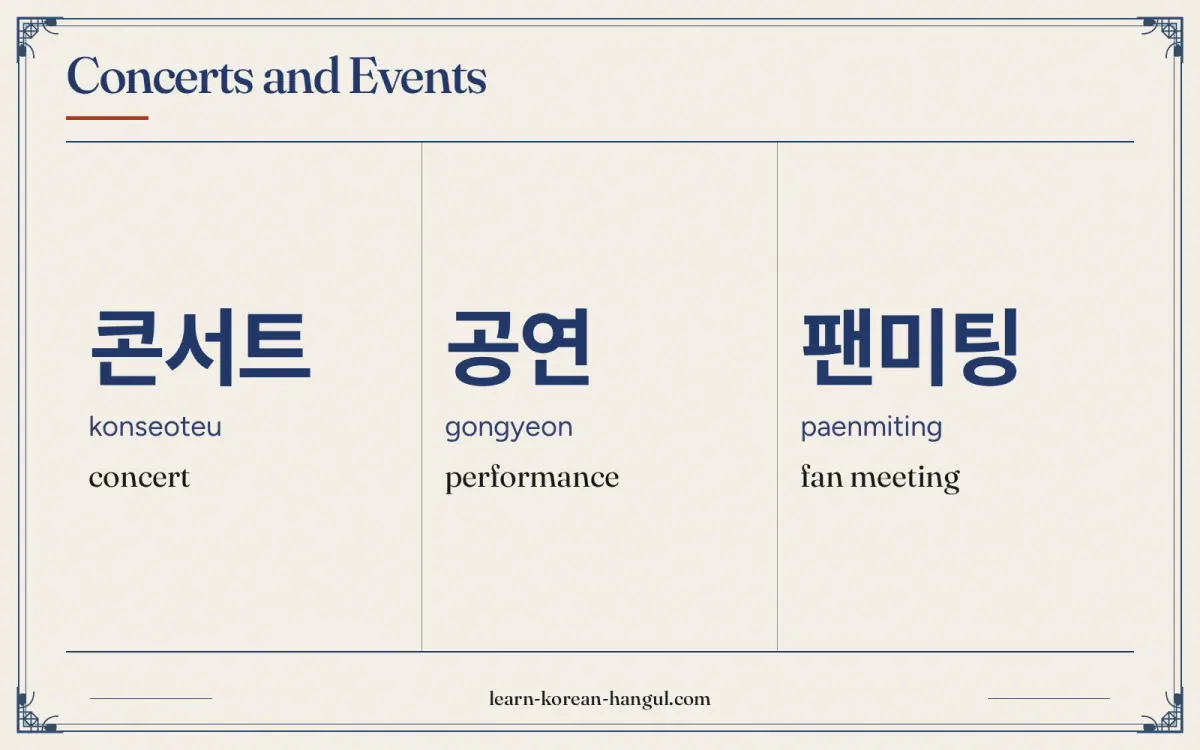
Concert and event words follow a fan from ticket to stage. 티켓팅 is the race to book tickets online, 콘서트 is the concert, and 공연 is a performance of any kind. Smaller events are the 팬미팅 (fan meeting) and the 팬사인회 (fan signing). After the show, the audience calls for an 앙코르.
| No. | Hangul | Revised Romanization | Origin | Meaning | Example sentence | Audio assetId |
|---|---|---|---|---|---|---|
| 19 | 콘서트 | konseoteu | loanword | concert | 콘서트에 가요. (I am going to a concert.) | au-pg-vocabulary-culture-kpop-19; example: au-pg-vocabulary-culture-kpop-64 |
| 20 | 공연 | gongyeon | Sino-Korean | performance | 공연이 세 시간이에요. (The performance is three hours long.) | au-pg-vocabulary-culture-kpop-20; example: au-pg-vocabulary-culture-kpop-65 |
| 21 | 팬미팅 | paenmiting | loanword | fan meeting | 팬미팅은 이번 주말에 있어요. (The fan meeting is this weekend.) | au-pg-vocabulary-culture-kpop-21; example: au-pg-vocabulary-culture-kpop-66 |
| 22 | 팬사인회 | paensainhoe | mixed | fan signing event | 팬사인회에서 사인을 받아요. (I get an autograph at the fan signing.) | au-pg-vocabulary-culture-kpop-22; example: au-pg-vocabulary-culture-kpop-67 |
| 23 | 티켓 | tiket | loanword | ticket | 티켓이 비싸요. (The ticket is expensive.) | au-pg-vocabulary-culture-kpop-23; example: au-pg-vocabulary-culture-kpop-68 |
| 24 | 티켓팅 | tiketing | loanword | online ticket booking race | 티켓팅은 정말 어려워요. (Ticket booking is really hard.) | au-pg-vocabulary-culture-kpop-24; example: au-pg-vocabulary-culture-kpop-69 |
| 25 | 무대 | mudae | Sino-Korean | stage | 무대가 정말 멋있어요. (The stage is really cool.) | au-pg-vocabulary-culture-kpop-25; example: au-pg-vocabulary-culture-kpop-70 |
| 26 | 음악방송 | eumakbangsong | Sino-Korean | TV music show | 음악방송에서 신곡을 불러요. (They sing the new song on the music show.) | au-pg-vocabulary-culture-kpop-26; example: au-pg-vocabulary-culture-kpop-71 |
| 27 | 앙코르 | angkoreu | loanword | encore | 앙코르를 외쳐요. (The audience shouts for an encore.) | au-pg-vocabulary-culture-kpop-27; example: au-pg-vocabulary-culture-kpop-72 |
공연 and 콘서트 both mean a show, but 공연 is the wider word: it covers a concert, a musical and a play. 티켓팅 comes from the English word ticketing, but in Korean fan talk it names the race to book tickets as soon as they open. It is not a general word for buying a ticket. For ordinary ticket buying, say 표를 사요.
음악방송 is a TV music show, where groups perform new songs. Notice that it is said [으막빵송], with a tense ㅂ after the ㄱ. The next group is about the music itself.
How Do You Say Music and Releases in Korean?
Music and release words describe the songs and how they are sold. A 앨범 holds several songs, and the 타이틀곡 is the main one. A 신곡 is a new song, a 가사 is its lyrics, a 뮤직비디오 is its video, and the 차트 and 순위 show how well it is doing.
| No. | Hangul | Revised Romanization | Origin | Meaning | Example sentence | Audio assetId |
|---|---|---|---|---|---|---|
| 28 | 앨범 | aelbeom | loanword | album | 새 앨범이 나왔어요. (A new album has come out.) | au-pg-vocabulary-culture-kpop-28; example: au-pg-vocabulary-culture-kpop-73 |
| 29 | 노래 | norae | native | song | 이 노래를 매일 들어요. (I listen to this song every day.) | au-pg-vocabulary-culture-kpop-29; example: au-pg-vocabulary-culture-kpop-74 |
| 30 | 가사 | gasa | Sino-Korean | lyrics | 가사가 좋아요. (The lyrics are good.) | au-pg-vocabulary-culture-kpop-30; example: au-pg-vocabulary-culture-kpop-75 |
| 31 | 신곡 | singok | Sino-Korean | new song | 신곡이 내일 나와요. (The new song comes out tomorrow.) | au-pg-vocabulary-culture-kpop-31; example: au-pg-vocabulary-culture-kpop-76 |
| 32 | 타이틀곡 | taiteulgok | mixed | title track (the main song of an album) | 타이틀곡이 인기가 많아요. (The title track is very popular.) | au-pg-vocabulary-culture-kpop-32; example: au-pg-vocabulary-culture-kpop-77 |
| 33 | 뮤직비디오 | myujikbidio | loanword | music video | 뮤직비디오를 봤어요. (I watched the music video.) | au-pg-vocabulary-culture-kpop-33; example: au-pg-vocabulary-culture-kpop-78 |
| 34 | 음원 | eumwon | Sino-Korean | digital music release (for streaming) | 음원은 자정에 나와요. (The digital release comes out at midnight.) | au-pg-vocabulary-culture-kpop-34; example: au-pg-vocabulary-culture-kpop-79 |
| 35 | 차트 | chateu | loanword | chart | 차트에서 노래를 확인해요. (I check the song on the chart.) | au-pg-vocabulary-culture-kpop-35; example: au-pg-vocabulary-culture-kpop-80 |
| 36 | 순위 | sunwi | Sino-Korean | ranking | 순위가 올라가요. (The ranking goes up.) | au-pg-vocabulary-culture-kpop-36; example: au-pg-vocabulary-culture-kpop-81 |
앨범 and 노래 are different levels: an 앨범 is the whole release, and a 노래 is one song on it. A 신곡 is a new song, and a 음원 is the digital version released on streaming services. Fans watch the 차트 and 순위 closely, and a new release is often timed to the minute. That is why a post such as 음원은 자정에 나와요 is common.
For flashcards of the album words, see the vocabulary flashcard decks. The last group covers what fans make themselves.
Fan-Made Content
Fan-made content words name what fans produce and collect. A 직캠 is a fancam, a video filmed by a fan, and 팬아트 and 팬픽 are fan art and fan fiction. Fans also collect 포토카드 (photocards) and other 굿즈 (merchandise), and they learn the 응원법 (cheering routine) before a concert.
| No. | Hangul | Revised Romanization | Origin | Meaning | Example sentence | Audio assetId |
|---|---|---|---|---|---|---|
| 37 | 직캠 | jikkaem | mixed | fancam (a fan-filmed video of one performer) | 직캠을 올려요. (I upload a fancam.) | au-pg-vocabulary-culture-kpop-37; example: au-pg-vocabulary-culture-kpop-82 |
| 38 | 영상 | yeongsang | Sino-Korean | video | 영상을 편집해요. (I edit the video.) | au-pg-vocabulary-culture-kpop-38; example: au-pg-vocabulary-culture-kpop-83 |
| 39 | 사진 | sajin | Sino-Korean | photo | 사진을 찍어요. (I take a photo.) | au-pg-vocabulary-culture-kpop-39; example: au-pg-vocabulary-culture-kpop-84 |
| 40 | 포토카드 | potokadeu | loanword | photocard (a collectable card) | 포토카드를 모아요. (I collect photocards.) | au-pg-vocabulary-culture-kpop-40; example: au-pg-vocabulary-culture-kpop-85 |
| 41 | 굿즈 | gutjeu | loanword | merchandise; goods | 굿즈를 사요. (I buy merchandise.) | au-pg-vocabulary-culture-kpop-41; example: au-pg-vocabulary-culture-kpop-86 |
| 42 | 팬아트 | paenateu | loanword | fan art | 팬아트를 그려요. (I draw fan art.) | au-pg-vocabulary-culture-kpop-42; example: au-pg-vocabulary-culture-kpop-87 |
| 43 | 팬픽 | paenpik | loanword | fan fiction | 팬픽을 써요. (I write fan fiction.) | au-pg-vocabulary-culture-kpop-43; example: au-pg-vocabulary-culture-kpop-88 |
| 44 | 자막 | jamak | Sino-Korean | subtitles | 자막이 있어요. (There are subtitles.) | au-pg-vocabulary-culture-kpop-44; example: au-pg-vocabulary-culture-kpop-89 |
| 45 | 응원법 | eungwonbeop | Sino-Korean | cheering routine; chant guide | 응원법을 배워요. (I learn the cheering routine.) | au-pg-vocabulary-culture-kpop-45; example: au-pg-vocabulary-culture-kpop-90 |
직캠 is usually explained as 직접 (directly) plus cam, and it means a video of a single performer filmed by a fan. 응원법 is the guide to the chants and lightstick moves that fans perform in time with a song. The loanword 굿즈 comes from goods, but in Korean it refers to fan merchandise, not goods in general.
자막 are subtitles, and fans share translated subtitles for videos. This is the end of the list, and the next section covers the sounds.
How Do You Pronounce These Words?
Most of these words follow the spelling, but several undergo sound changes between consonants. The table shows eight that learners often get wrong.
| Spelling | Pronunciation | What happens |
|---|---|---|
| 최애 | [최애] or [췌애] | ㅚ may be said as the diphthong we, which most speakers use |
| 연습생 | [연습쌩] | ㅅ after a final ㅂ is said as a tense sound |
| 기획사 | [기획싸] | ㅅ after a final ㄱ is said as a tense sound |
| 덕질 | [덕찔] | ㅈ after a final ㄱ is said as a tense sound |
| 입덕 | [입떡] | ㄷ after a final ㅂ is said as a tense sound |
| 순위 | [수뉘] | The final ㄴ of 순 links to the vowel of 위 |
| 막내 | [망내] | A final ㄱ before ㄴ becomes ㅇ |
| 음악방송 | [으막빵송] | The final ㄱ of 음악 links to the next syllable, and ㅂ after ㄱ is said as a tense sound |
The rules come from the Standard Pronunciation rules (표준 발음법) of the 국립국어원. Revised Romanization does not show tensing caused by a neighbouring sound, so it writes 연습생 as yeonseupsaeng even though it is said [연습쌩]. It does show the nasal change in 막내 (mangnae).
Audio and Slow Playback
Each word has a normal clip, and 5 key words also have a slow clip at 0.8 times the speed: 아이돌, 막내, 최애, 응원봉 and 음악방송. Nothing plays until you press a button.
Listen to 막내 first. You should hear the ㄱ turn into a nasal ㅇ, as if the word were spelled 망내. Then listen to 음악방송, and notice how the middle ㅂ is tense.
What Mistakes Do Learners Make with K-Pop Words?
- Reading the loanwords as English. 컴백 is keom-baek, not come-back, and 데뷔 is de-bwi. Learn the Korean sound, not the English one.
- Treating 최애 as a perfect match for bias. It means favourite, and it is used for songs and foods too.
- Using 덕질 or 입덕 in a formal setting. Both are slang between fans.
- Reading 막내 as mak-nae. It is said [망내], and the Revised Romanization is mangnae.
- Thinking 컴백 means the group has been away. It can simply mean a new release.
- Confusing 공연 and 콘서트. 콘서트 is one kind of 공연, so a musical or a play is a 공연 but not a 콘서트.
Of these, reading the loanwords with Korean sounds helps most, because it also improves your listening. The next section turns the list into practice.
Practice: Flashcards and Worksheet
Drill these words with the Kpop Korean words flashcards or browse all the vocabulary flashcard decks. A printable worksheet for these words (word list, matching, writing practice, fill-in-the-blank exercises and answer key) is available in A4 and US Letter from the download card on this page. Progress in the decks is saved only in your browser.
K-Pop Words Worksheet
Try this five-question check, then say the 45 words aloud once more.
Practice · 5
What does 데뷔 mean?
Show answer
debut
데뷔 (debwi) means debut.
What does 응원 mean?
Show answer
cheering; support
응원 (eungwon) means cheering; support.
What does 티켓 mean?
Show answer
ticket
티켓 (tiket) means ticket.
What does 타이틀곡 mean?
Show answer
title track (the main song of an album)
타이틀곡 (taiteulgok) means title track (the main song of an album).
What does 굿즈 mean?
Show answer
merchandise; goods
굿즈 (gutjeu) means merchandise; goods.
Pages in This Section
Two deeper pages expand this list. K-Pop Industry Vocabulary goes further into agencies, training, debuts and promotions, and K-Pop Fandom Vocabulary goes further into fan culture, chants and slang. Open the one that matches what you want to read next.
Where to Go Next
This list sits inside Korean Culture Words. After the K-pop words, many learners move on to Korean holidays or to K-drama words. If you want a guided path from fan to reader, the Korean for K-pop fans course sequences the lessons, and the K-pop fan phrases page turns the words into sentences.
Frequently Asked Questions
How Do You Say Album in Korean?
Album is 앨범 (aelbeom). It is an English loanword written in Hangul, and it ends in ㅁ. Say it as ael-beom, with two syllables. For a single song, use 노래 (norae). A new release is often called 새 앨범, and the title song is the 타이틀곡.
How Do You Pronounce 최애 (choeae)?
최애 is written choeae in Revised Romanization. Most speakers say the first vowel ㅚ as a diphthong, so the word sounds close to chwe-ae. The first syllable starts with an aspirated ㅊ, a ch with a puff of air. Say the two syllables smoothly and compare with the audio.
How Many K-Pop Words Should I Learn First?
Learn about 15 first: 아이돌, 가수, 팬, 앨범, 노래, 컴백, 데뷔, 콘서트, 공연, 최애, 멤버, 응원봉, 신곡, 티켓 and 무대. They are enough to read most posts. Add the slang and fan-made content words as you join a community, and review the first 15 again after two days.
Where Can I Practise K-Pop Words with Flashcards?
Use the Kpop Korean words flashcards, a 30-card deck with audio. Progress stays in your browser. For words on this page that are not in the deck, copy the tables above onto cards: Hangul on one side, English on the other, and say each word aloud as you flip the card.
Is the Romanization on This Page Official?
It follows the Revised Romanization of Korean, which South Korea officially adopted on 7 July 2000 and whose rules the National Institute of Korean Language (국립국어원) publishes. It is a learning aid that does not show tensing caused by a neighbouring sound, so learn the Hangul and use the audio.
Is There a Printable Worksheet for K-Pop Words?
A printable worksheet for these words (word list, matching, writing practice, fill-in-the-blank exercises and answer key) is available in A4 and US Letter from the download card on this page. For practice, write the Hangul from memory, cover the English column and check your answers against the tables.