
Key facts
- Topic: Sino Korean vocabulary, meaning Korean words made from Chinese-derived syllables.
- Sino-Korean words are written in Hangul. You do not need hanja to learn them.
Sino Korean Vocabulary at a Glance
Korean has three layers of words. Native Korean words are the oldest, such as 사람 (saram, person) and 하늘 (haneul, sky). Sino-Korean words, called 한자어 (hanjaeo), were built from syllables borrowed from Chinese characters over many centuries. Loanwords, called 외래어 (oeraeeo), came later and mostly from English. In the Standard Korean Dictionary (표준국어대사전), kept by the National Institute of Korean Language (국립국어원), Sino-Korean words fill a very large share of the entries, and the share depends on how you count.
What counts as a Sino-Korean word? It is any word whose syllables each come from a Chinese-derived morpheme. Take 학교. The first syllable 학 (學) means study and the second 교 (校) means school. Korean speakers read these syllables with Korean sounds, so you see only Hangul on a sign or in a text. The character form, called hanja, is optional, and most daily writing leaves it out. If you want the characters behind a word, the Hanja word families hub teaches the same syllables through one character at a time, while this page stays with the word list.
| Group | Words | What it covers |
|---|---|---|
| School and study | 10 | 학교, 학생, 공부, 시험 and the classroom |
| People and family | 10 | Family, friends, jobs and nationality |
| Places and daily life | 10 | Hospital, bank, subway, phone, food |
| Work and ideas | 10 | Company, problem, reason, experience |
| Word-building and polite choices | 10 | Not/with/without words and honorific nouns |
The page sits in Korean Word Types next to Konglish and Loanwords and Onomatopoeia and Mimetic Words. Numbers have their own lessons: see Sino-Korean numbers for 일, 이, 삼.
Which Sino-Korean Words Should You Learn First?
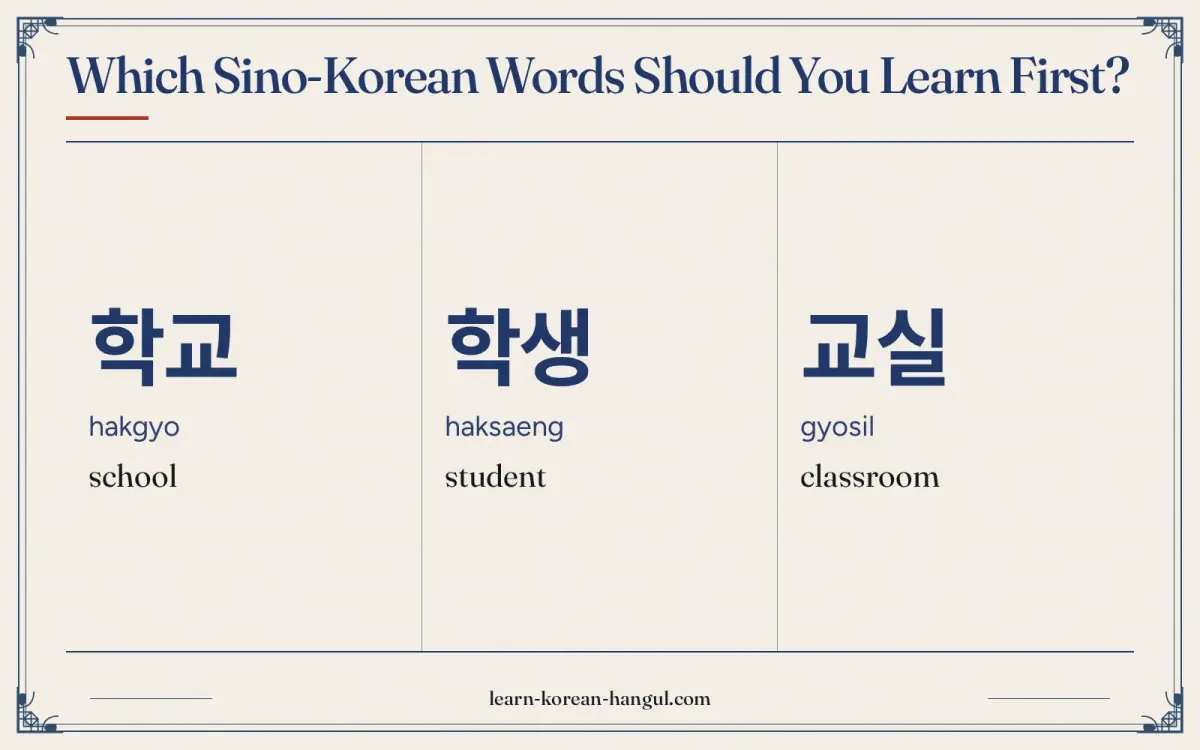
Start with the school group, because 학교, 학생, 공부 and 시험 appear in the first weeks of almost every course. Then learn the people and place words, which you need to talk about your day. Words in the last two groups are slightly more formal. They are very common in news, offices and writing, so learn them once you can read the first three groups with ease.
- Say first. 학교, 학생, 공부, 친구, 전화, 시간, 음식.
- Know soon. 병원, 은행, 회사, 약속, 여행, 운동.
- Recognise in reading. 경험, 관계, 가능, 불편, 무료, 연세.
The scene below is a classroom with ten numbered items taken from the school group. Tap a number to hear the word.
Word · 10
- 1
학교
hakgyo
school
- 2
학생
haksaeng
student
- 3
교실
gyosil
classroom
- 4
공부
gongbu
study
- 5
시험
siheom
exam; test
- 6
숙제
sukje
homework
- 7
수업
sueop
class; lesson
- 8
질문
jilmun
question
- 9
대답
daedap
answer; reply
- 10
도서관
doseogwan
library
School and Study Words
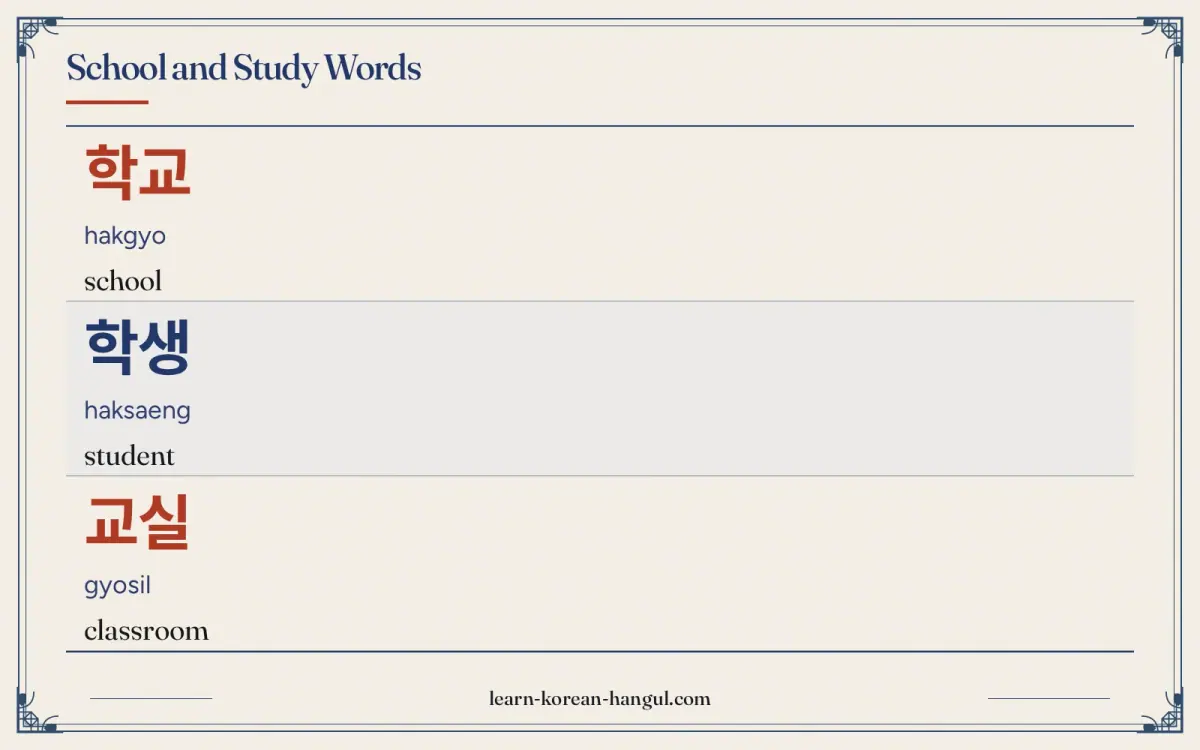
School words are the best entry point to Sino-Korean vocabulary because the same syllables repeat. 학 shows up in 학교 and 학생, and 생 shows up in 학생 and 선생님. When two words share a syllable, learning one makes the other easier to remember. The note on each row tells you how the word sounds when it differs from its spelling.
| No. | Hangul | Revised Romanization | Meaning and note | Example sentence | Audio assetId |
|---|---|---|---|---|---|
| 1 | 학교 | hakgyo | school. Say [학꾜]: the ㄱ after a final ㄱ is tense (Standard Pronunciation Rules, Article 23). | 학교에 가요. (I go to school.) | au-pg-vocabulary-word-types-sino-korean-1; example: au-pg-vocabulary-word-types-sino-korean-51 |
| 2 | 학생 | haksaeng | student. Say [학쌩]. Put 대학 in front to make 대학생 (university student). | 저는 학생이에요. (I am a student.) | au-pg-vocabulary-word-types-sino-korean-2; example: au-pg-vocabulary-word-types-sino-korean-52 |
| 3 | 교실 | gyosil | classroom. This 교 sounds like the 교 in 학교 but comes from a different character (敎, teach). | 교실에 학생이 많아요. (There are many students in the classroom.) | au-pg-vocabulary-word-types-sino-korean-3; example: au-pg-vocabulary-word-types-sino-korean-53 |
| 4 | 공부 | gongbu | study. Becomes a verb with 하다: 공부하다 (to study). | 도서관에서 공부해요. (I study at the library.) | au-pg-vocabulary-word-types-sino-korean-4; example: au-pg-vocabulary-word-types-sino-korean-54 |
| 5 | 시험 | siheom | exam; test. Used for school tests and for licence tests. | 내일 시험이 있어요. (I have an exam tomorrow.) | au-pg-vocabulary-word-types-sino-korean-5; example: au-pg-vocabulary-word-types-sino-korean-55 |
| 6 | 숙제 | sukje | homework. Say [숙쩨]. Tense ㅈ after a final ㄱ. | 숙제가 많아요. (There is a lot of homework.) | au-pg-vocabulary-word-types-sino-korean-6; example: au-pg-vocabulary-word-types-sino-korean-56 |
| 7 | 수업 | sueop | class; lesson. The class itself, not the room. The room is 교실. | 수업이 아홉 시에 시작해요. (Class starts at nine o'clock.) | au-pg-vocabulary-word-types-sino-korean-7; example: au-pg-vocabulary-word-types-sino-korean-57 |
| 8 | 질문 | jilmun | question. A question you ask. The word for a test question is 문제. | 질문이 있어요. (I have a question.) | au-pg-vocabulary-word-types-sino-korean-8; example: au-pg-vocabulary-word-types-sino-korean-58 |
| 9 | 대답 | daedap | answer; reply. A spoken or written reply to a question. | 대답을 몰라요. (I do not know the answer.) | au-pg-vocabulary-word-types-sino-korean-9; example: au-pg-vocabulary-word-types-sino-korean-59 |
| 10 | 도서관 | doseogwan | library. Built from 도서 (books) and 관 (building). | 도서관은 학교 안에 있어요. (The library is inside the school.) | au-pg-vocabulary-word-types-sino-korean-10; example: au-pg-vocabulary-word-types-sino-korean-60 |
Example Sentences
Each sentence uses a plain frame: topic or subject, then a short predicate. The particle 이 or 가 follows the noun (숙제가, 질문이), and 은 or 는 marks the topic (도서관은, 저는). A noun is followed by 이에요 after a consonant and 예요 after a vowel, as in 학생이에요 and 회사원이에요 (after a consonant) and 의사예요 (after a vowel). Play each sentence, say it aloud, then swap in another word from the table.
People and Family Words
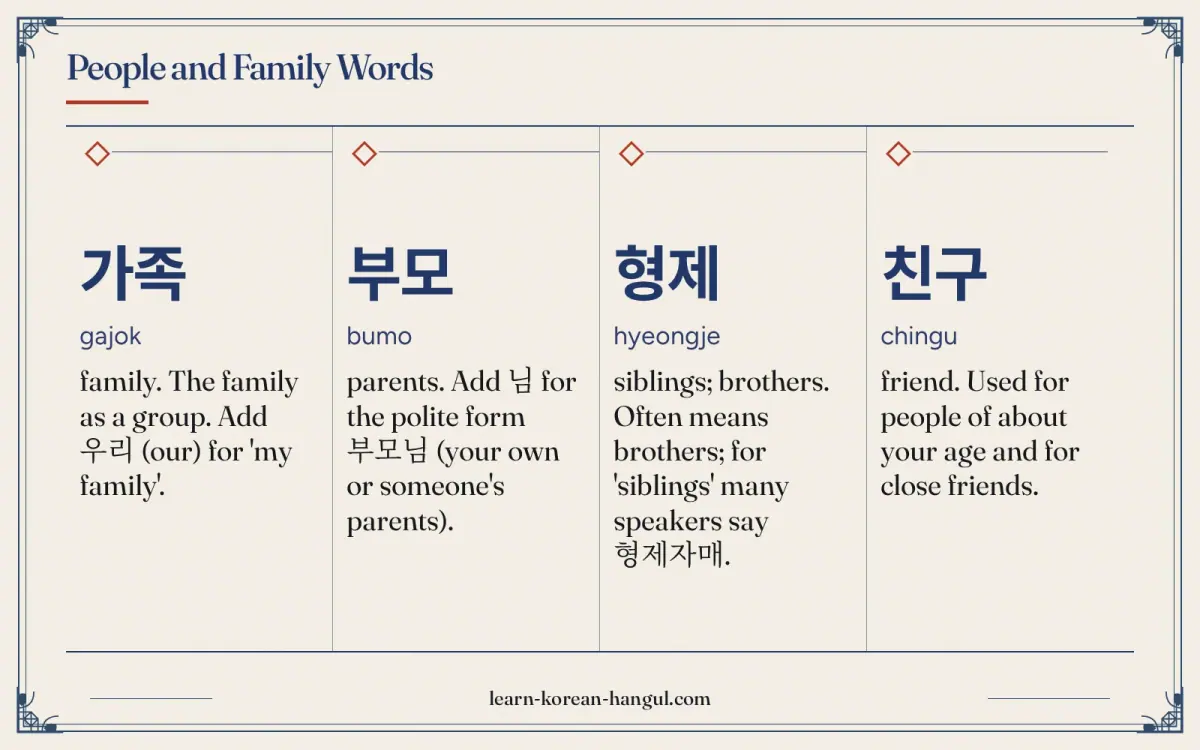
Many words for people end in a Sino-Korean syllable that means a person: 인 in 한국인 and 외국인, 원 in 회사원, 사 in 의사. Spot the ending and you can guess the meaning of new words such as 미국인 (an American) or 공무원 (a civil servant). Family words like 가족 and 부모 are Sino-Korean too, while the words for father, mother and grandmother are native Korean.
| No. | Hangul | Revised Romanization | Meaning and note | Example sentence | Audio assetId |
|---|---|---|---|---|---|
| 11 | 가족 | gajok | family. The family as a group. Add 우리 (our) for 'my family'. | 우리 가족은 네 명이에요. (My family has four people.) | au-pg-vocabulary-word-types-sino-korean-11; example: au-pg-vocabulary-word-types-sino-korean-61 |
| 12 | 부모 | bumo | parents. Add 님 for the polite form 부모님 (your own or someone's parents). | 부모님은 부산에 살아요. (My parents live in Busan.) | au-pg-vocabulary-word-types-sino-korean-12; example: au-pg-vocabulary-word-types-sino-korean-62 |
| 13 | 형제 | hyeongje | siblings; brothers. Often means brothers; for 'siblings' many speakers say 형제자매. | 형제가 없어요. (I have no siblings.) | au-pg-vocabulary-word-types-sino-korean-13; example: au-pg-vocabulary-word-types-sino-korean-63 |
| 14 | 친구 | chingu | friend. Used for people of about your age and for close friends. | 친구를 만나요. (I meet a friend.) | au-pg-vocabulary-word-types-sino-korean-14; example: au-pg-vocabulary-word-types-sino-korean-64 |
| 15 | 선생님 | seonsaengnim | teacher. 선생 (teacher) plus the respectful ending 님. Used for teachers and as a polite title. | 선생님은 한국 사람이에요. (The teacher is Korean.) | au-pg-vocabulary-word-types-sino-korean-15; example: au-pg-vocabulary-word-types-sino-korean-65 |
| 16 | 의사 | uisa | doctor. The ㅢ in the first syllable is said as [의]. | 의사는 병원에서 일해요. (The doctor works at a hospital.) | au-pg-vocabulary-word-types-sino-korean-16; example: au-pg-vocabulary-word-types-sino-korean-66 |
| 17 | 회사원 | hoesawon | office worker. 회사 (company) plus 원 (member). | 아버지는 회사원이에요. (My father is an office worker.) | au-pg-vocabulary-word-types-sino-korean-17; example: au-pg-vocabulary-word-types-sino-korean-67 |
| 18 | 외국인 | oegugin | foreigner. Say [외구긴]: the final ㄱ moves to the next syllable. | 저는 외국인이에요. (I am a foreigner.) | au-pg-vocabulary-word-types-sino-korean-18; example: au-pg-vocabulary-word-types-sino-korean-68 |
| 19 | 한국인 | hangugin | Korean person. Say [한구긴]. 한국 사람 means the same and is common in speech. | 한국인 친구가 많아요. (I have many Korean friends.) | au-pg-vocabulary-word-types-sino-korean-19; example: au-pg-vocabulary-word-types-sino-korean-69 |
| 20 | 인간 | ingan | human being. Used for humanity in general, not for a particular person. | 로봇은 인간이 아니에요. (A robot is not a human being.) | au-pg-vocabulary-word-types-sino-korean-20; example: au-pg-vocabulary-word-types-sino-korean-70 |
Note that 선생님 is the title you add to a teacher's name or use alone. The ending 님 is a respectful suffix, so do not drop it when you speak to a teacher.
Places and Daily Life Words
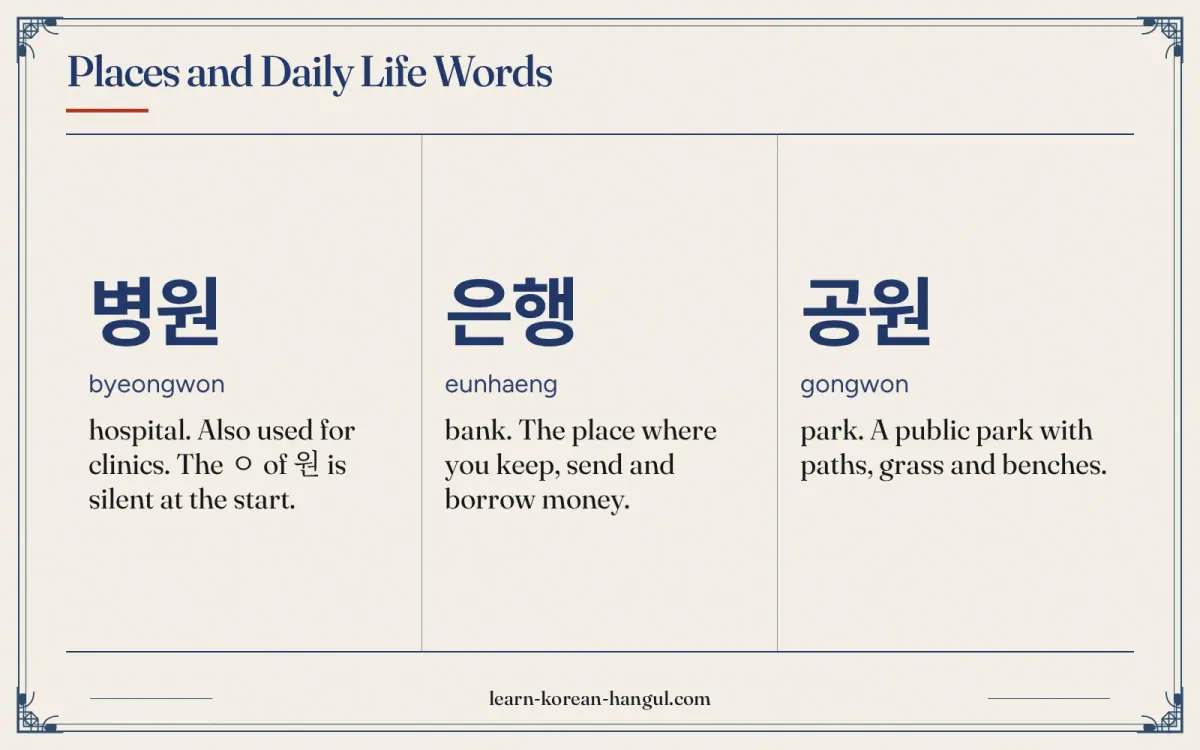
Public places are almost always Sino-Korean: 병원, 은행, 공원, 공항, 지하철. Their endings tell you what kind of place it is. 원 points to an institution in 병원 (院) and to a garden in 공원 (園), 관 means a building, 항 means port, and 철 comes from the character for iron, as in railway. Once you know 관, 도서관 (library) and 박물관 (museum) are easy to guess.
| No. | Hangul | Revised Romanization | Meaning and note | Example sentence | Audio assetId |
|---|---|---|---|---|---|
| 21 | 병원 | byeongwon | hospital. Also used for clinics. The ㅇ of 원 is silent at the start. | 병원이 어디에 있어요? (Where is the hospital?) | au-pg-vocabulary-word-types-sino-korean-21; example: au-pg-vocabulary-word-types-sino-korean-71 |
| 22 | 은행 | eunhaeng | bank. The place where you keep, send and borrow money. | 은행은 아홉 시에 열어요. (The bank opens at nine o'clock.) | au-pg-vocabulary-word-types-sino-korean-22; example: au-pg-vocabulary-word-types-sino-korean-72 |
| 23 | 공원 | gongwon | park. A public park with paths, grass and benches. | 주말에 공원에서 걸어요. (On weekends I walk in the park.) | au-pg-vocabulary-word-types-sino-korean-23; example: au-pg-vocabulary-word-types-sino-korean-73 |
| 24 | 공항 | gonghang | airport. 공 (air) plus 항 (port). | 공항은 멀어요. (The airport is far.) | au-pg-vocabulary-word-types-sino-korean-24; example: au-pg-vocabulary-word-types-sino-korean-74 |
| 25 | 지하철 | jihacheol | subway; metro. 지하 (underground) plus 철 (iron, as in railway). | 지하철로 학교에 가요. (I go to school by subway.) | au-pg-vocabulary-word-types-sino-korean-25; example: au-pg-vocabulary-word-types-sino-korean-75 |
| 26 | 전화 | jeonhwa | telephone; phone call. Verb: 전화하다 (to call). Also the phone itself. | 친구한테 전화해요. (I call a friend.) | au-pg-vocabulary-word-types-sino-korean-26; example: au-pg-vocabulary-word-types-sino-korean-76 |
| 27 | 음식 | eumsik | food; dish. Food as a general idea. Say [음식], with the final ㄱ held and not released. | 한국 음식이 맛있어요. (Korean food is delicious.) | au-pg-vocabulary-word-types-sino-korean-27; example: au-pg-vocabulary-word-types-sino-korean-77 |
| 28 | 운동 | undong | exercise; sport. Verb: 운동하다 (to exercise). | 매일 운동해요. (I exercise every day.) | au-pg-vocabulary-word-types-sino-korean-28; example: au-pg-vocabulary-word-types-sino-korean-78 |
| 29 | 약속 | yaksok | appointment; promise. Say [약쏙]. Both a plan to meet and a promise. | 오늘 약속이 있어요. (I have plans today.) | au-pg-vocabulary-word-types-sino-korean-29; example: au-pg-vocabulary-word-types-sino-korean-79 |
| 30 | 시간 | sigan | time; hour. Also a length of time: 한 시간 (one hour). | 지금 시간이 없어요. (I do not have time now.) | au-pg-vocabulary-word-types-sino-korean-30; example: au-pg-vocabulary-word-types-sino-korean-80 |
Work and Ideas
These words describe work and mental life. Many take 하다 to become verbs: 준비하다, 연습하다, 사용하다, 여행하다. Add 하다 to the noun and conjugate 하다 as usual: 준비해요, 연습해요, 사용해요, 여행해요. The noun form stays Sino-Korean, and the grammar stays native. This pattern is the main way Korean turns foreign-origin nouns into verbs.
| No. | Hangul | Revised Romanization | Meaning and note | Example sentence | Audio assetId |
|---|---|---|---|---|---|
| 31 | 회사 | hoesa | company. 회 (gathering) plus 사 (company). | 회사는 서울에 있어요. (The company is in Seoul.) | au-pg-vocabulary-word-types-sino-korean-31; example: au-pg-vocabulary-word-types-sino-korean-81 |
| 32 | 직업 | jigeop | occupation. Say [지겁]: the final ㄱ moves forward. | 직업이 뭐예요? (What is your job?) | au-pg-vocabulary-word-types-sino-korean-32; example: au-pg-vocabulary-word-types-sino-korean-82 |
| 33 | 문제 | munje | problem; exam question. Means both a problem and a question on a test. | 문제가 없어요. (There is no problem.) | au-pg-vocabulary-word-types-sino-korean-33; example: au-pg-vocabulary-word-types-sino-korean-83 |
| 34 | 경험 | gyeongheom | experience. Used for what you have lived through. | 좋은 경험이에요. (It is a good experience.) | au-pg-vocabulary-word-types-sino-korean-34; example: au-pg-vocabulary-word-types-sino-korean-84 |
| 35 | 준비 | junbi | preparation. Verb: 준비하다 (to prepare). | 시험을 준비해요. (I prepare for the exam.) | au-pg-vocabulary-word-types-sino-korean-35; example: au-pg-vocabulary-word-types-sino-korean-85 |
| 36 | 연습 | yeonseup | practice. Verb: 연습하다 (to practise). | 매일 한국어를 연습해요. (I practise Korean every day.) | au-pg-vocabulary-word-types-sino-korean-36; example: au-pg-vocabulary-word-types-sino-korean-86 |
| 37 | 이유 | iyu | reason. Often follows 무슨 (what kind of): 무슨 이유 (what reason). | 이유가 뭐예요? (What is the reason?) | au-pg-vocabulary-word-types-sino-korean-37; example: au-pg-vocabulary-word-types-sino-korean-87 |
| 38 | 사용 | sayong | use. Verb: 사용하다 (to use). A little more formal than the native 쓰다. | 이 앱을 사용해요. (I use this app.) | au-pg-vocabulary-word-types-sino-korean-38; example: au-pg-vocabulary-word-types-sino-korean-88 |
| 39 | 관계 | gwangye | relationship. Between people or between things. | 우리는 좋은 관계예요. (We have a good relationship.) | au-pg-vocabulary-word-types-sino-korean-39; example: au-pg-vocabulary-word-types-sino-korean-89 |
| 40 | 여행 | yeohaeng | trip; travel. Verb: 여행하다 (to travel). | 내일 여행을 가요. (I am going on a trip tomorrow.) | au-pg-vocabulary-word-types-sino-korean-40; example: au-pg-vocabulary-word-types-sino-korean-90 |
Common Sino-Korean Syllables
These twenty syllables appear in many common Sino-Korean words. Each syllable keeps a core meaning, although one sound can stand for more than one character, and the same syllable can sit at the start or the end of a word. 학 starts 학교 but ends 방학 (school vacation). The table lists the Hangul syllable, the hanja it comes from, its core meaning and three words that use it. The hanja are shown only to explain where a meaning comes from. You never need to write them to use the words.
| Syllable | Hanja | Core meaning | Three words that use it |
|---|---|---|---|
| 학 | 學 | study | 학교 (hakgyo, school); 학생 (haksaeng, student); 학원 (hagwon, private academy) |
| 인 | 人 | person | 한국인 (hangugin, Korean person); 외국인 (oegugin, foreigner); 인간 (ingan, human being) |
| 일 | 日 | day; sun | 일요일 (iryoil, Sunday); 생일 (saengil, birthday); 일기 (ilgi, diary) |
| 대 | 大 | big | 대학 (daehak, university); 대사관 (daesagwan, embassy); 대통령 (daetongnyeong, president) |
| 국 | 國 | country | 한국 (hanguk, Korea); 외국 (oeguk, foreign country); 국가 (gukga, nation) |
| 생 | 生 | life; birth | 생일 (saengil, birthday); 생활 (saenghwal, daily life); 인생 (insaeng, life (as a whole)) |
| 수 | 水 | water | 수요일 (suyoil, Wednesday); 수영 (suyeong, swimming); 홍수 (hongsu, flood) |
| 화 | 火 | fire | 화요일 (hwayoil, Tuesday); 화재 (hwajae, fire (disaster)); 화산 (hwasan, volcano) |
| 산 | 山 | mountain | 산 (san, mountain); 등산 (deungsan, hiking); 산불 (sanbul, wildfire) |
| 전 | 電 | electricity | 전화 (jeonhwa, phone call); 전기 (jeongi, electricity); 전자 (jeonja, electronics) |
| 차 | 車 | vehicle | 자동차 (jadongcha, car); 기차 (gicha, train); 주차 (jucha, parking) |
| 서 | 書 | book; writing | 도서관 (doseogwan, library); 서점 (seojeom, bookstore); 독서 (dokseo, reading) |
| 식 | 食 | food; eating | 음식 (eumsik, food); 식당 (sikdang, restaurant); 식사 (siksa, meal) |
| 화 | 話 | talk | 대화 (daehwa, conversation); 통화 (tonghwa, phone call); 화제 (hwaje, topic) |
| 시 | 時 | time | 시간 (sigan, time); 시계 (sigye, clock); 시대 (sidae, era) |
| 년 | 年 | year | 작년 (jangnyeon, last year); 내년 (naenyeon, next year); 학년 (hangnyeon, school year) |
| 월 | 月 | moon; month | 월요일 (woryoil, Monday); 일월 (irwol, January); 월급 (wolgeup, monthly pay) |
| 문 | 門 | gate; door | 문 (mun, door); 정문 (jeongmun, main gate); 대문 (daemun, front gate) |
| 장 | 場 | place | 시장 (sijang, market); 공장 (gongjang, factory); 주차장 (juchajang, parking lot) |
| 교 | 校 | school | 학교 (hakgyo, school); 교복 (gyobok, school uniform); 교문 (gyomun, school gate) |
Two rows share the sound 화: 火 (fire) and 話 (talk). Korean has many homophones among Sino-Korean syllables, so a single syllable can have several meanings. The words around it tell you which one is meant. 화요일 (Tuesday) uses fire, and 대화 (conversation) uses talk. This is why learners who memorise whole words, not isolated syllables, make fewer mistakes.
Word-Building Patterns
Beyond single syllables, Korean uses short Sino-Korean endings and beginnings to build words in bulk. If you know the pattern, a new word is often guessable. For example, 과학 (gwahak, science) plus 자 gives 과학자 (scientist), and 가능 (possible) with 불 in front gives 불가능 (impossible).
| Pattern | Adds this meaning | Examples |
|---|---|---|
| -학 (學) | field of study | 경제학 (gyeongjehak, economics); 언어학 (eoneohak, linguistics); 심리학 (simnihak, psychology) |
| -자 (者) | a person who | 과학자 (gwahakja, scientist); 연구자 (yeonguja, researcher); 환자 (hwanja, patient) |
| -적 (的) | -al; -ic; of that kind | 기본적 (gibonjeok, basic); 경제적 (gyeongjejeok, economic); 개인적 (gaeinjeok, personal) |
| -성 (性) | quality; likelihood | 가능성 (ganeungseong, possibility); 중요성 (jungyoseong, importance); 안전성 (anjeonseong, safety) |
| -화 (化) | becoming; -ization | 세계화 (segyehwa, globalization); 도시화 (dosihwa, urbanization); 현대화 (hyeondaehwa, modernization) |
| 불- / 부- (不) | not | 불가능 (bulganeung, impossible); 불편 (bulpyeon, inconvenient); 부정확 (bujeonghwak, inaccurate) |
| 비- (非) | non-; un- | 비공식 (bigongsik, unofficial); 비정상 (bijeongsang, abnormal) |
| 무- (無) / 유- (有) | without / with | 무료 (muryo, free); 무시 (musi, ignoring); 유료 (yuryo, paid); 유명 (yumyeong, famous) |
The prefix 불 changes in some words. It becomes 부 before ㄷ and ㅈ, as in 부정확 (bujeonghwak, inaccurate). Do not guess this one. Check each word the first time you meet it. The suffixes -적 and -성 are very productive, and they turn nouns into descriptive words: 기본적인 방법 (a basic method), 가능성이 있어요 (there is a chance). The fuller lesson is Sino-Korean prefixes and suffixes.
| No. | Hangul | Revised Romanization | Meaning and note | Example sentence | Audio assetId |
|---|---|---|---|---|---|
| 41 | 가능 | ganeung | possibility; being possible. Use 가능하다 as an adjective: 가능해요 (it is possible). | 내일도 가능해요? (Is tomorrow possible too?) | au-pg-vocabulary-word-types-sino-korean-41; example: au-pg-vocabulary-word-types-sino-korean-91 |
| 42 | 불가능 | bulganeung | impossibility. 불 (not) plus 가능. A formal-sounding 'impossible'. | 그건 불가능해요. (That is impossible.) | au-pg-vocabulary-word-types-sino-korean-42; example: au-pg-vocabulary-word-types-sino-korean-92 |
| 43 | 편리 | pyeolli | convenience. Use 편리하다 as an adjective. Say [펼리]. | 지하철은 편리해요. (The subway is convenient.) | au-pg-vocabulary-word-types-sino-korean-43; example: au-pg-vocabulary-word-types-sino-korean-93 |
| 44 | 불편 | bulpyeon | inconvenience; discomfort. 불 (not) plus 편 (comfortable). Opposite of 편리 and 편하다. | 이 의자는 불편해요. (This chair is uncomfortable.) | au-pg-vocabulary-word-types-sino-korean-44; example: au-pg-vocabulary-word-types-sino-korean-94 |
| 45 | 유료 | yuryo | paid (charge). 유 (have) plus 료 (fee). Opposite of 무료. | 주차는 유료예요. (Parking costs money.) | au-pg-vocabulary-word-types-sino-korean-45; example: au-pg-vocabulary-word-types-sino-korean-95 |
| 46 | 무료 | muryo | free of charge. 무 (none) plus 료 (fee). | 입장은 무료예요. (Admission is free.) | au-pg-vocabulary-word-types-sino-korean-46; example: au-pg-vocabulary-word-types-sino-korean-96 |
| 47 | 과학자 | gwahakja | scientist. 과학 (science) plus 자 (person). Say [과학짜]. | 그는 과학자예요. (He is a scientist.) | au-pg-vocabulary-word-types-sino-korean-47; example: au-pg-vocabulary-word-types-sino-korean-97 |
| 48 | 식사 | siksa | meal. A polite word for a meal. Say [식싸]. The native word is 밥. | 식사하세요. (Please enjoy your meal.) | au-pg-vocabulary-word-types-sino-korean-48; example: au-pg-vocabulary-word-types-sino-korean-98 |
| 49 | 연세 | yeonse | age (honorific). Polite word for another person's age. Never use it for your own age. | 할아버지 연세는 여든이세요. (Grandfather is eighty years old.) | au-pg-vocabulary-word-types-sino-korean-49; example: au-pg-vocabulary-word-types-sino-korean-99 |
| 50 | 성함 | seongham | name (honorific). Polite word for another person's name. Use 이름 for your own. | 성함이 어떻게 되세요? (May I ask your name?) | au-pg-vocabulary-word-types-sino-korean-50; example: au-pg-vocabulary-word-types-sino-korean-100 |
Sino-Korean vs Native Korean Choices
Sometimes Korean gives you two words for one idea, one native and one Sino-Korean. The Sino-Korean word is often more formal, more respectful or more technical. The table shows eight pairs you will meet early. The word you pick depends on who you are talking to and what kind of text you are writing. For a full comparison with rules of thumb and a sorting quiz, read Sino-Korean vs native Korean words.
| Native word | Sino-Korean word | Meaning | How they differ |
|---|---|---|---|
| 이름 (ireum) | 성함 (seongham) | name | The native word is neutral; 성함 is only for another person, in polite speech. |
| 나이 (nai) | 연세 (yeonse) | age | 나이 is neutral; 연세 respects an older person's age. |
| 밥 (bap) | 식사 (siksa) | meal; rice | 밥 also means cooked rice. 식사 sounds more polite and formal. |
| 집 (jip) | 댁 (daek) | house; home | 집 is neutral. 댁 is a respectful word for someone else's home. |
| 생일 (saengil) | 생신 (saengsin) | birthday | 생일 is the everyday word. 생신 is the respectful word for an elder's birthday. |
| 달 (dal) | 월 (wol) | month; moon | 달 counts months (한 달) and means moon. 월 is used in names such as 일월. |
| 사람 (saram) | 인간 (ingan) | person | 사람 is the everyday word. 인간 means a human being in general. |
| 해 (hae) | 년 (nyeon) | year | 해 is the everyday word for a year (and for the sun). 년 follows a Sino-Korean number, as in 이천이십육 년 (the year 2026). |
Numbers follow the same two-layer idea. 세 명 (three people) uses a native number with the counter, and 삼 층 (third floor) uses a Sino-Korean number. Sino Korean vs native Korean numbers sets out which counter takes which system.
How Do You Pronounce These Words?
Sino-Korean words follow the same sound rules as native ones, with a few patterns you meet again and again. The Standard Pronunciation Rules (표준 발음법) published by the National Institute of Korean Language (국립국어원) are the reference, and the romanization follows the Revised Romanization of Korean.
- Tense consonants after a final stop. A plain ㄱ, ㄷ, ㅂ, ㅅ or ㅈ becomes tense after a final ㄱ, ㄷ or ㅂ (Article 23). 학교 is [학꾜], 학생 is [학쌩], 숙제 is [숙쩨], 약속 is [약쏙] and 식사 is [식싸]. Romanization does not show tensing caused by a neighbouring sound, so hakgyo stays hakgyo in writing.
- Final consonant moving forward. A final consonant moves to a following silent ㅇ. 한국인 is [한구긴], 외국인 is [외구긴] and 직업 is [지겁].
- ㄹ before ㄷ, ㅅ or ㅈ. In Sino-Korean words, a final ㄹ makes only a following ㄷ, ㅅ or ㅈ tense (Article 26): 발달 [발딸], 일시 [일씨]. It does not tense ㄱ, so 출금 (withdrawal) stays [출금].
- ㄹ after ㄴ. A ㄹ after ㄴ is said as ㄹ, so 편리 is [펼리].
Audio and Slow Playback
Each headword and each sentence has its own clip. The clips below replay five tricky words slowly. Play one, repeat it, then play it again and compare.
What Mistakes Do Learners Make with Sino-Korean Words?
Five mistakes come up often.
- Using the honorific nouns for yourself. 성함 and 연세 are for other people. Say 제 이름은 민수예요 (My name is Minsu), not 제 성함은.
- Counting people with the wrong numbers. Say 학생 세 명 (native number plus 명), not 학생 삼 명.
- Reading 한국인 as two words. It is one word said as [한구긴], with the ㄱ moving forward.
- Treating every syllable as one fixed meaning. Syllables such as 수, 화 and 대 have several meanings, so learn whole words with their examples.
- Thinking you need hanja first. Daily Korean is written in Hangul. Learn the words in Hangul and add characters later if you want them.
The pronunciation errors are small, but they are the first thing a listener notices. Tense consonants matter most, so practise the five slow clips.
Practice: Flashcards and Worksheet
Run the deck in recognition mode until each word gives its meaning, then switch to listening mode and take the quiz. The deck holds all 50 words with audio, and your progress stays in your browser. The vocabulary flashcard decks page lists the other decks, and the Sino-Korean words flashcards deck is a separate 29-card set that shares some of these words.
Practice · 105
- 01학교
Show answer
headword 1: school
- 02학생
Show answer
headword 2: student
- 03교실
Show answer
headword 3: classroom
- 04공부
Show answer
headword 4: study
- 05시험
Show answer
headword 5: exam; test
- 06숙제
Show answer
headword 6: homework
- 07수업
Show answer
headword 7: class; lesson
- 08질문
Show answer
headword 8: question
- 09대답
Show answer
headword 9: answer; reply
- 10도서관
Show answer
headword 10: library
- 11가족
Show answer
headword 11: family
- 12부모
Show answer
headword 12: parents
- 13형제
Show answer
headword 13: siblings; brothers
- 14친구
Show answer
headword 14: friend
- 15선생님
Show answer
headword 15: teacher
- 16의사
Show answer
headword 16: doctor
- 17회사원
Show answer
headword 17: office worker
- 18외국인
Show answer
headword 18: foreigner
- 19한국인
Show answer
headword 19: Korean person
- 20인간
Show answer
headword 20: human being
- 21병원
Show answer
headword 21: hospital
- 22은행
Show answer
headword 22: bank
- 23공원
Show answer
headword 23: park
- 24공항
Show answer
headword 24: airport
- 25지하철
Show answer
headword 25: subway; metro
- 26전화
Show answer
headword 26: telephone; phone call
- 27음식
Show answer
headword 27: food; dish
- 28운동
Show answer
headword 28: exercise; sport
- 29약속
Show answer
headword 29: appointment; promise
- 30시간
Show answer
headword 30: time; hour
- 31회사
Show answer
headword 31: company
- 32직업
Show answer
headword 32: occupation
- 33문제
Show answer
headword 33: problem; exam question
- 34경험
Show answer
headword 34: experience
- 35준비
Show answer
headword 35: preparation
- 36연습
Show answer
headword 36: practice
- 37이유
Show answer
headword 37: reason
- 38사용
Show answer
headword 38: use
- 39관계
Show answer
headword 39: relationship
- 40여행
Show answer
headword 40: trip; travel
- 41가능
Show answer
headword 41: possibility; being possible
- 42불가능
Show answer
headword 42: impossibility
- 43편리
Show answer
headword 43: convenience
- 44불편
Show answer
headword 44: inconvenience; discomfort
- 45유료
Show answer
headword 45: paid (charge)
- 46무료
Show answer
headword 46: free of charge
- 47과학자
Show answer
headword 47: scientist
- 48식사
Show answer
headword 48: meal
- 49연세
Show answer
headword 49: age (honorific)
- 50성함
Show answer
headword 50: name (honorific)
- 51학교에 가요.
Show answer
example sentence for 학교
- 52저는 학생이에요.
Show answer
example sentence for 학생
- 53교실에 학생이 많아요.
Show answer
example sentence for 교실
- 54도서관에서 공부해요.
Show answer
example sentence for 공부
- 55내일 시험이 있어요.
Show answer
example sentence for 시험
- 56숙제가 많아요.
Show answer
example sentence for 숙제
- 57수업이 아홉 시에 시작해요.
Show answer
example sentence for 수업
- 58질문이 있어요.
Show answer
example sentence for 질문
- 59대답을 몰라요.
Show answer
example sentence for 대답
- 60도서관은 학교 안에 있어요.
Show answer
example sentence for 도서관
- 61우리 가족은 네 명이에요.
Show answer
example sentence for 가족
- 62부모님은 부산에 살아요.
Show answer
example sentence for 부모
- 63형제가 없어요.
Show answer
example sentence for 형제
- 64친구를 만나요.
Show answer
example sentence for 친구
- 65선생님은 한국 사람이에요.
Show answer
example sentence for 선생님
- 66의사는 병원에서 일해요.
Show answer
example sentence for 의사
- 67아버지는 회사원이에요.
Show answer
example sentence for 회사원
- 68저는 외국인이에요.
Show answer
example sentence for 외국인
- 69한국인 친구가 많아요.
Show answer
example sentence for 한국인
- 70로봇은 인간이 아니에요.
Show answer
example sentence for 인간
- 71병원이 어디에 있어요?
Show answer
example sentence for 병원
- 72은행은 아홉 시에 열어요.
Show answer
example sentence for 은행
- 73주말에 공원에서 걸어요.
Show answer
example sentence for 공원
- 74공항은 멀어요.
Show answer
example sentence for 공항
- 75지하철로 학교에 가요.
Show answer
example sentence for 지하철
- 76친구한테 전화해요.
Show answer
example sentence for 전화
- 77한국 음식이 맛있어요.
Show answer
example sentence for 음식
- 78매일 운동해요.
Show answer
example sentence for 운동
- 79오늘 약속이 있어요.
Show answer
example sentence for 약속
- 80지금 시간이 없어요.
Show answer
example sentence for 시간
- 81회사는 서울에 있어요.
Show answer
example sentence for 회사
- 82직업이 뭐예요?
Show answer
example sentence for 직업
- 83문제가 없어요.
Show answer
example sentence for 문제
- 84좋은 경험이에요.
Show answer
example sentence for 경험
- 85시험을 준비해요.
Show answer
example sentence for 준비
- 86매일 한국어를 연습해요.
Show answer
example sentence for 연습
- 87이유가 뭐예요?
Show answer
example sentence for 이유
- 88이 앱을 사용해요.
Show answer
example sentence for 사용
- 89우리는 좋은 관계예요.
Show answer
example sentence for 관계
- 90내일 여행을 가요.
Show answer
example sentence for 여행
- 91내일도 가능해요?
Show answer
example sentence for 가능
- 92그건 불가능해요.
Show answer
example sentence for 불가능
- 93지하철은 편리해요.
Show answer
example sentence for 편리
- 94이 의자는 불편해요.
Show answer
example sentence for 불편
- 95주차는 유료예요.
Show answer
example sentence for 유료
- 96입장은 무료예요.
Show answer
example sentence for 무료
- 97그는 과학자예요.
Show answer
example sentence for 과학자
- 98식사하세요.
Show answer
example sentence for 식사
- 99할아버지 연세는 여든이세요.
Show answer
example sentence for 연세
- 100성함이 어떻게 되세요?
Show answer
example sentence for 성함
- 101학교
Show answer
slow playback: 학교
- 102숙제
Show answer
slow playback: 숙제
- 103한국인
Show answer
slow playback: 한국인
- 104편리
Show answer
slow playback: 편리
- 105과학자
Show answer
slow playback: 과학자
Practice · 5
What does 학교 (hakgyo) mean?
Show answer
school
학교 means school. Example: 학교에 가요. (I go to school.)
Which word means 'free of charge'?
Show answer
무료
무료 means free of charge. 유료 is the opposite, paid. Example: 입장은 무료예요. (Admission is free.)
Which honorific noun do you use for another person's age?
Show answer
연세
연세 is the respectful word for another person's age. 나이 is the everyday word.
What does the suffix -자 add to a word like 과학?
Show answer
a person who
-자 means a person who. 과학자 is a scientist.
Which counter phrase is right for three students?
Show answer
학생 세 명
Use a native number before 명: 학생 세 명.
Sino-Korean Vocabulary Worksheet (PDF)
A printable worksheet for these words (word list, matching, writing practice, fill-in-the-blank exercises and answer key) is available in A4 and US Letter from the download card on this page. For practice, write the ten school words from memory and add one example sentence for each.
Where to Go Next
Compare the two layers directly on Sino-Korean vs native Korean words. The affixes that form new words are taught in Sino-Korean prefixes and suffixes. For the characters behind the syllables, see Hanja word families. To go up a level, return to Korean Word Types, or move on to Konglish and Loanwords.
Frequently Asked Questions
What Is Sino-Korean Vocabulary?
Sino-Korean vocabulary means Korean words built from syllables that came from Chinese characters, such as 학교 (school) and 전화 (telephone). Koreans read these syllables with Korean sounds and write them in Hangul. In the Standard Korean Dictionary they make up a very large share of entries, and the exact share depends on how the words are counted.
Do I Need to Learn Hanja to Learn Sino-Korean Words?
No. Everyday Korean is written in Hangul, and you can learn every word on this page without knowing a single character. Hanja only help you see why a word means what it does. If you are curious, the hanja word-families pages teach the same syllables one character at a time.
How Can I Tell If a Korean Word Is Sino-Korean?
Look for a word of two or more syllables that follows a known pattern, such as an ending like -자, -성 or -화, or a school, office or news word. Many one-syllable nouns such as 책 (book) and 문 (door) are also Sino-Korean. The Standard Korean Dictionary marks the origin of each entry, so check it when you are unsure.
Are Sino-Korean Words More Formal than Native Korean Words?
Often, yes, but not always. Honorific nouns such as 연세 and 성함 are Sino-Korean and respectful, and abstract and technical words are mostly Sino-Korean. Everyday words like 학교 and 시간 are Sino-Korean but perfectly casual. Choose by how respectful or technical the situation is.
Why Do Some Sino-Korean Words Sound Different from Their Spelling?
Korean sound rules apply inside words. A plain consonant becomes tense after some final consonants, so 학교 is said [학꾜], and a final consonant moves to a silent ㅇ, so 한국인 is said [한구긴]. Revised Romanization does not mark tensing caused by a neighbouring sound, so use the audio as well as the romanization.
Is the Romanization on This Page Official?
It follows the Revised Romanization of Korean, which South Korea adopted on 7 July 2000 and whose rules the National Institute of Korean Language (국립국어원) publishes. It is a learning aid and does not mark every sound change, so rely on the Hangul and the audio.