
Sino Korean Numbers Flashcards: Study the 30 Cards
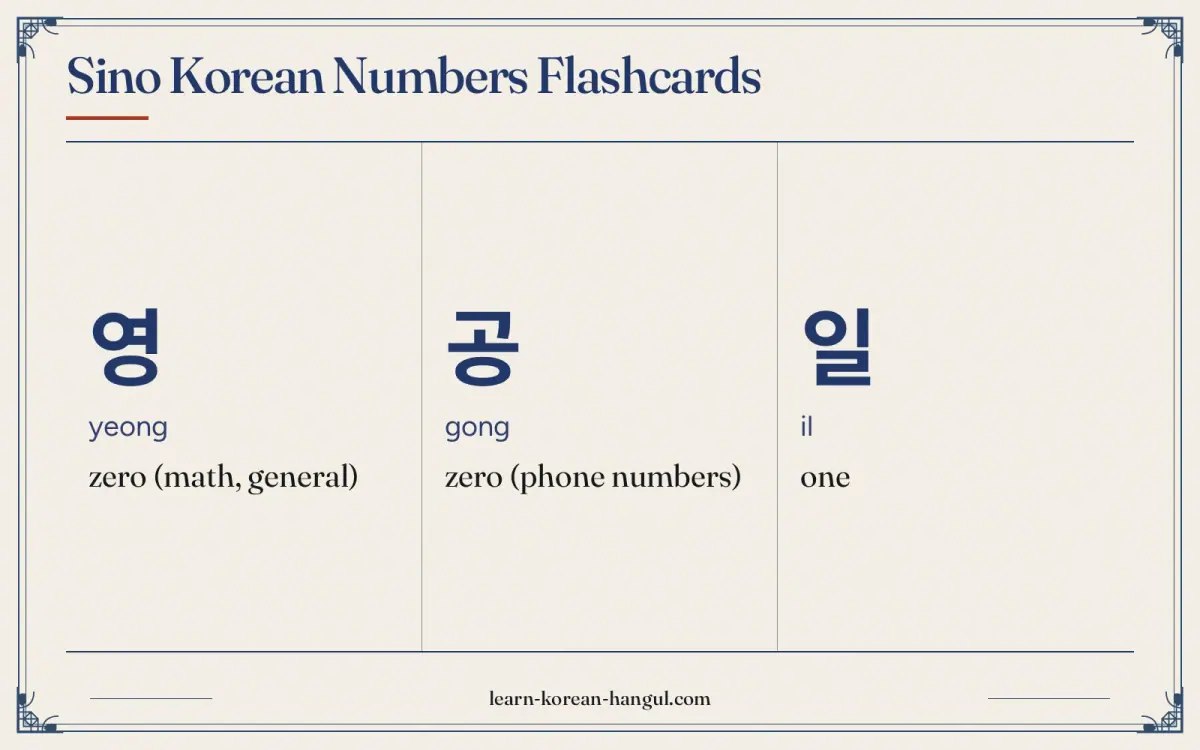
Sino-Korean numbers come from Chinese and are the numbers used to label things: dates, prices, phone numbers, floors and minutes. The lesson behind this deck is Sino Korean numbers, so read it first if a card is new.
How Do I Use These Flashcards?
Use the deck above in four steps. It works with tap, click or keyboard, and nothing plays until you press an audio button.
- Choose a mode. Start with recognition (Hangul to meaning). Switch to recall (meaning to Hangul) or listening (audio to meaning) once recognition feels easy.
- Show the answer. Think of the answer first, then press Show answer (or Space). Say the number aloud before you reveal it. Turn on the romanization toggle only if you need it; the 30-card table below always shows it.
- Grade yourself. Press Got it if you answered correctly without help, or Not yet if you hesitated or guessed.
- Finish the session. A session holds up to 20 cards (you can set 10, 20 or 40). With 30 cards, a first-time learner can split the deck over three days, using the default limit of 10 new cards a day.
The Three Study Modes
Recognition shows the Hangul and asks for the meaning, which trains reading. Recall shows the meaning and asks for the Hangul, which trains remembering; you may type the answer with your Hangul keyboard or just recall it in your head. Listening plays a clip and hides the letters, which trains the ear. Listening mode only uses a card once its audio is approved, and cards without approved audio are skipped in that mode with a note.
Got It and Not Yet
Got it moves the card up one Leitner box, so it comes back later. Not yet sends the card back to box 1, so it returns in the same session or within 10 minutes. The grades are your own judgement; the deck does not score you or claim fluency.
Deck Scope: What Is and Is Not Covered
The deck covers the Sino-Korean digits 0 to 9, the place words 십, 백, 천, 만 and 억, a few sample compounds up to a million, and the unit words used in everyday contexts: 월 in months, 분 in minutes, 원 in prices, 층 for floors and 호 for room numbers. It does not teach native Korean counting or counter words.
What Is Left out of This Deck?
Native Korean counting, such as 하나 and 둘, is in the native Korean numbers flashcards. Counter words such as 명 and 개 are in the Korean counters flashcards. For other numbers, the Korean number converter gives the Sino reading up to the trillions.
All 30 Cards in One Table
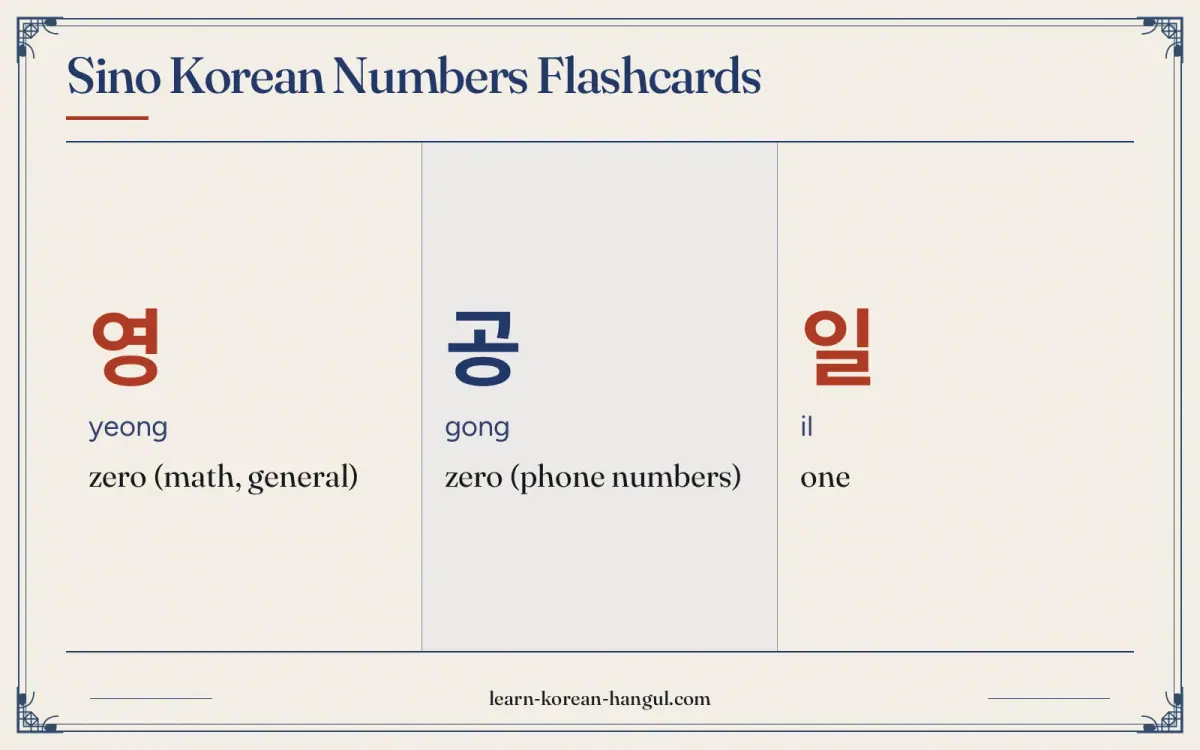
All 30 cards appear below in deck order. The table is plain HTML, so you can use it as a drill without the deck: cover the Meaning column, say each number aloud, then uncover it.
| # | Hangul | Revised Romanization | Meaning | Note | Audio assetId |
|---|---|---|---|---|---|
| 1 | 영 | yeong | zero (math, general) | The usual zero in maths and scores. | au-pg-flashcards-sino-numbers-1 |
| 2 | 공 | gong | zero (phone numbers) | Used for zero in phone numbers. | au-pg-flashcards-sino-numbers-2 |
| 3 | 일 | il | one | Also the word for day in dates. | au-pg-flashcards-sino-numbers-3 |
| 4 | 이 | i | two | One short vowel. | au-pg-flashcards-sino-numbers-4 |
| 5 | 삼 | sam | three | Ends in a nasal [m]. | au-pg-flashcards-sino-numbers-5 |
| 6 | 사 | sa | four | Some lifts label the 4th floor F; see the context section. | au-pg-flashcards-sino-numbers-6 |
| 7 | 오 | o | five | One short vowel. | au-pg-flashcards-sino-numbers-7 |
| 8 | 육 | yuk | six | Ends in a closed [k] sound. | au-pg-flashcards-sino-numbers-8 |
| 9 | 칠 | chil | seven | Ends in [l]. | au-pg-flashcards-sino-numbers-9 |
| 10 | 팔 | pal | eight | Ends in [l]. | au-pg-flashcards-sino-numbers-10 |
| 11 | 구 | gu | nine | One short vowel. | au-pg-flashcards-sino-numbers-11 |
| 12 | 십 | sip | ten | Place word: tens. | au-pg-flashcards-sino-numbers-12 |
| 13 | 백 | baek | hundred | Place word: hundreds. | au-pg-flashcards-sino-numbers-13 |
| 14 | 천 | cheon | thousand | Place word: thousands. | au-pg-flashcards-sino-numbers-14 |
| 15 | 만 | man | ten thousand | Korean groups large numbers by 만 (10,000). | au-pg-flashcards-sino-numbers-15 |
| 16 | 억 | eok | hundred million | Next group after 만 (100,000,000). | au-pg-flashcards-sino-numbers-16 |
| 17 | 십일 | sibil | eleven | 십 plus 일; said [시빌]. | au-pg-flashcards-sino-numbers-17 |
| 18 | 십육 | simnyuk | sixteen | Said [심뉵]: ㄴ is inserted and ㅂ becomes ㅁ. | au-pg-flashcards-sino-numbers-18; slow: au-pg-flashcards-sino-numbers-31 |
| 19 | 이십 | isip | twenty | Two plus ten. | au-pg-flashcards-sino-numbers-19 |
| 20 | 오십 | osip | fifty | Five plus ten. | au-pg-flashcards-sino-numbers-20 |
| 21 | 구십구 | gusipgu | ninety-nine | The highest two-digit Sino number. | au-pg-flashcards-sino-numbers-21 |
| 22 | 이백 | ibaek | two hundred | No 일 before 백, but 이 before it. | au-pg-flashcards-sino-numbers-22 |
| 23 | 십만 | simman | 100,000 | Said [심만]: ㅂ becomes ㅁ before ㅁ. Ten times 만. | au-pg-flashcards-sino-numbers-23; slow: au-pg-flashcards-sino-numbers-32 |
| 24 | 백만 | baengman | 1,000,000 | Said [뱅만]; a hundred times 만. | au-pg-flashcards-sino-numbers-24; slow: au-pg-flashcards-sino-numbers-33 |
| 25 | 시월 | siwol | October | Irregular: 십월 is written 시월. | au-pg-flashcards-sino-numbers-25 |
| 26 | 유월 | yuwol | June | Irregular: 육월 is written 유월. | au-pg-flashcards-sino-numbers-26 |
| 27 | 분 | bun | minute(s) | Minutes take Sino numbers: 십오 분. | au-pg-flashcards-sino-numbers-27 |
| 28 | 원 | won | won (Korean currency) | Prices take Sino numbers: 오천 원. | au-pg-flashcards-sino-numbers-28 |
| 29 | 층 | cheung | floor | Floors take Sino numbers: 오 층. | au-pg-flashcards-sino-numbers-29 |
| 30 | 호 | ho | number, room number | Room numbers take Sino numbers: 삼백일 호. | au-pg-flashcards-sino-numbers-30 |
Reading the Table
Hangul is the word. Revised Romanization (RR) is a learning aid, so try to read the Hangul before you look at it. RR follows the sound of the word, which is why some spellings change, as in 십육 (simnyuk). The Meaning column gives the English gloss, and the Note column gives a use or sound hint. The last column lists the audio assetId; a second ID marks a slow clip. Cards 1-16 are single words; cards 17-24 are sample compounds; cards 25-30 are the unit words used with Sino numbers.
Usage Notes for These Cards
Dates are all Sino-Korean. March 21 is said 삼월 이십일 일, with the unit words 월 (month) and 일 (day) after each number. Months are the number plus 월, so 5월 is 오월; the day is the number plus 일.
Prices use Sino numbers plus 원. In speech the leading 일 is dropped before 만, 천, 백 and 십, so 10,000 won is 만 원, not 일만 원. A price of 15,000 won is 만 오천 원.
Large numbers group by 만, not by thousands. Korean counts in groups of four digits, so 100,000 is 십만 (ten 만) and 1,000,000 is 백만 (a hundred 만). This matters when you read prices on a menu or in a shop.
Phone numbers are read digit by digit. Zero is 공, so 010 is 공일공. The hyphen between groups is either a short pause or spoken as 에 (the particle 의, said [에]).
Minutes, floors and rooms take Sino numbers. They appear as 십오 분, 오 층 and 삼백일 호. The hour in the same time expression takes a native number, as in 세 시 십오 분.
Which Sounds Do Not Match the Spelling?
십육 is written with ㅂ but said [심뉵]. A ㄴ sound is inserted before 육, and the ㅂ in 십 becomes ㅁ next to it (nasalization). Revised Romanization follows the sound, so the card shows simnyuk.
십만 is said [심만]. The final ㅂ of 십 becomes ㅁ before the nasal ㅁ of 만, which is nasalization. In the same way 백만 is said [뱅만], where the final ㄱ becomes ㅇ.
십일 is said [시빌]. The final ㅂ of 십 moves onto the empty ㅇ of 일 (liaison), the same link that turns 십이 into [시비]. Reviewers should confirm these forms against the 국립국어원 standard pronunciation rules.
What Mistakes Do Learners Make with Sino Korean Numbers?
- Saying 십월 or 육월 for October and June. The months are spelled and said 시월 and 유월.
- Using Sino numbers to count people or items, such as 삼 명 for three people. Say 세 명, which is a native number.
- Saying 일만 원 for 10,000 won. The 일 is dropped, so say 만 원.
- Reading zero as 영 in a phone number. Phone numbers normally use 공 for zero.
Each of these errors comes from applying a rule from one context to another, so test yourself in recall mode with the unit cards at the end of the deck.
How Does the Review Schedule Work?
The deck uses a simplified Leitner system with five boxes. A new card starts in box 1. Each Got it moves it up one box, and each Not yet returns it to box 1. The box sets how long the card waits before it is due again.
| Box | Wait until the next review |
|---|---|
| 1 | same session or 10 minutes |
| 2 | 1 day |
| 3 | 3 days |
| 4 | 7 days |
| 5 | 21 days |
Each session shows due cards first, oldest due first, and then up to 10 new cards a day by default. A deck of 30 cards is introduced over three days at the default of 10 new cards a day, and the later boxes bring each card back at longer gaps. Progress is saved only in this browser, so clearing site data deletes it. Use the export button to save a small JSON file with card IDs, boxes and due dates, and import it on another device. No account is needed.
Cultural and Practical Context
Korean keeps both a Chinese-derived and a native number system, and each has fixed jobs, so choosing the right one is part of sounding natural. Some lifts and buildings label the fourth floor F instead of 4, because 사 (four) sounds the same as the Sino-Korean 사 (死, death). Floor 4 still exists; only the label changes.
Limits of This Deck
The deck holds 30 cards, so it does not show every number from 1 to 100, but the digits and place words let you build them. Years such as 2026 are not on a card; the FAQ explains them. The deck also does not test reading long numbers aloud, such as 35,000 won. All Korean text is generated, and Min-ji Park reviewed and signed off the text and audio on 15 October 2026.
Next Steps after This Deck
Continue with the native Korean numbers flashcards to practise counting, then add counters. Write the numbers by hand with the Korean numbers worksheet and try other values in the Korean number converter. The Korean vocabulary flashcards page lists every other deck, and the Korean flashcards hub lists all topics.
Frequently Asked Questions
Why Does Korean Have Two Number Systems and Which One Do I Use?
Korean has a Chinese-derived Sino-Korean system and a native Korean system. Use Sino numbers for dates, money, phone numbers, floors and minutes, and native numbers for counting things, people and age. Both systems appear in a time such as 세 시 십오 분, where the hour is native and the minutes are Sino.
Should I Say 영 or 공 for Zero?
Say 영 in maths, scores and general talk, and 공 when reading digits in a phone number, such as 공일공 for 010. Temperatures also use 영, as in 영 도 (0 degrees). If you are unsure, 영 is understood everywhere, while 공 is a specialist choice for digit strings.
How Do I Read 10,000 and 100,000 Won in Korean?
Say 만 원 for 10,000 won and 십만 원 for 100,000 won. Korean groups large numbers by 만, which is 10,000, so 100,000 is ten 만. The leading 일 is dropped before 만, so avoid saying 일만 원 for 10,000.
How Do I Say a Year Such as 2026?
Read a year as a Sino-Korean number followed by 년. So 2026 is 이천이십육 년. Say the thousands, hundreds, tens and units in order, and add 년 at the end. Years are never read in pairs of digits as in English.
Is My Progress Saved If I Close the Page?
Yes, in the same browser on the same device. Card boxes and due dates are stored locally and nothing is sent to a server. Clearing site data, using a private window or switching browsers removes them, so use the export button to keep a backup file. No account is needed.