What you'll learn
- Build -아/어 하다 on feeling adjectives, including ㅂ, ㅡ and 하다 stems.
- Talk about what other people feel, like, dislike or fear.
- Switch the particle from 이/가 to 을/를 when the adjective becomes a verb.
- Spot the common mistakes, such as using the bare adjective for a third person.
Prerequisites: the lesson on -(으)ㄴ 척하다 pretend, the object particle object particle 을/를, and the idea that korean adjectives are verbs. Time: about 15 minutes.
Key facts
- The adjective stem comes first, then 아 or 어, then 하다, written as one word.
- The adjective names a feeling. The verb shows a person who has that feeling.
- The thing felt about moves from 이/가 with the adjective to 을/를 with the verb.
- The vowel rule is the same as for -아요/어요: 아 after ㅏ or ㅗ, and 어 after other vowels.
- Familiar pairs follow the same pattern: 좋다 and 좋아하다, 싫다 and 싫어하다.
Listen to the two model sentences for this lesson.
The next section defines the pattern and shows what it means.
What Does -아/어 하다 Emotion Verbs Mean?
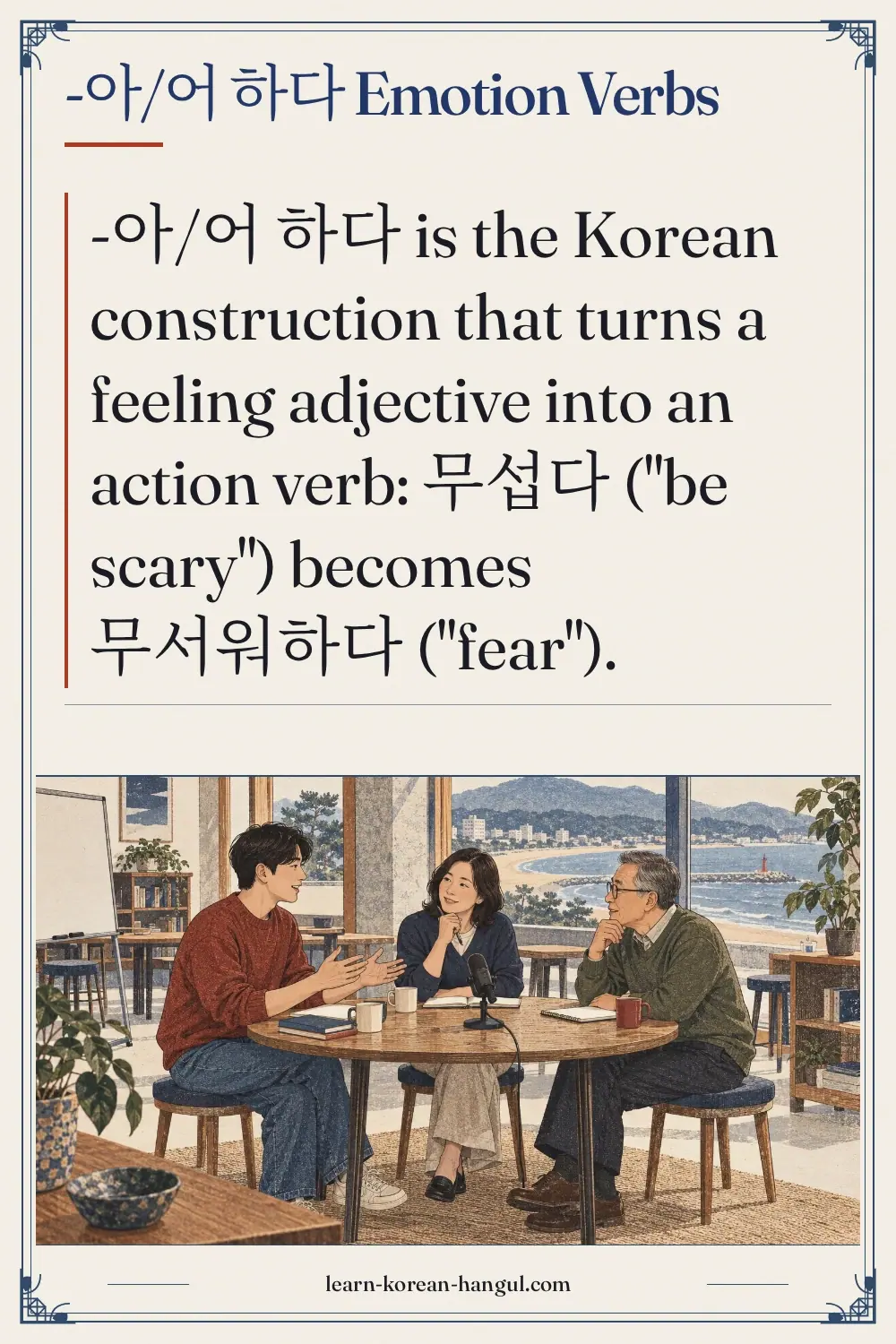
-아/어 하다 changes a word for a feeling into a word for a person who shows that feeling. An adjective in Korean describes a state or a quality, and it works like a verb without an object. 무섭다 says that something is frightening or that someone feels afraid. The auxiliary 하다 ("do") makes the feeling into an act that someone performs, so it can take an object.
The change reflects a habit in Korean. A speaker knows their own feelings directly and says them with the adjective: 저는 무서워요 ("I am scared"). A speaker cannot feel another person's mind. So when talking about a third person, Korean describes the feeling as something they do or show: 동생은 무서워해요 ("My younger sibling is afraid"). The verb form is the normal way to report what others feel.
The pattern gives a verb from nearly every feeling adjective. Here is a short list.
- Likes and dislikes. 좋아하다 (like), 싫어하다 (dislike).
- Fear and embarrassment. 무서워하다 (fear), 두려워하다 (dread), 부끄러워하다 (be shy or embarrassed).
- Joy and sadness. 기뻐하다 (be glad), 슬퍼하다 (grieve), 행복해하다 (be happy).
- Wishes and doubts. 궁금해하다 (wonder), 아쉬워하다 (feel the loss).
A First Example
Here are two sentences, one in the present and one in the past.
| Part | 동생은 벌레를 무서워해요. | 아이가 선물을 기뻐했어요. |
|---|---|---|
| Subject | 동생은 (my younger sibling) | 아이가 (the child) |
| Thing felt about | 벌레를 (bugs) | 선물을 (the gift) |
| Verb | 무서워해요 (fears) | 기뻐했어요 (was glad about) |
| Adjective behind it | 무섭다 | 기쁘다 |
| Spoken | [동생은 벌레를 무서워해요] | [아이가 선무를 기뻐해써요] |
| RR (aid) | dongsaengeun beollereul museowohaeyo | aiga seonmureul gippeohaesseoyo |
| English | My younger sibling is afraid of bugs. | The child was happy about the gift. |
Notice that both sentences have an object with 를. That is the sign of the verb form. The next section shows how the pattern is formed.
How Does -아/어 하다 Emotion Verbs Work?
The rule has two steps: attach 아 or 어 to the adjective stem, then add 하다 and conjugate it. The stem is the adjective without its dictionary ending -다. For 싫다 the stem is 싫.
- Make the -아/어 form of the adjective. Choose 아 or 어 by the last vowel of the stem, and apply any irregular change. 무섭다 gives 무서워.
- Add 하다. 무서워 + 하다 gives 무서워하다, written as one word.
- Conjugate 하다 for tense and speech level. 무서워해요 (polite present), 무서워했어요 (polite past).
Formation Table
| Adjective | Stem type | -아/어 form | Verb | Meaning |
|---|---|---|---|---|
| 좋다 (good) | regular, ㅗ gives 아 | 좋아 | 좋아하다 | like |
| 싫다 (disagreeable) | regular, ㅣ gives 어 | 싫어 | 싫어하다 | dislike |
| 무섭다 (scary) | ㅂ-irregular | 무서워 | 무서워하다 | fear |
| 부끄럽다 (shy, embarrassed) | ㅂ-irregular | 부끄러워 | 부끄러워하다 | be shy or embarrassed |
| 두렵다 (dreadful) | ㅂ-irregular | 두려워 | 두려워하다 | dread |
| 아쉽다 (regrettable) | ㅂ-irregular | 아쉬워 | 아쉬워하다 | feel the loss |
| 고맙다 (thankful) | ㅂ-irregular | 고마워 | 고마워하다 | be grateful |
| 기쁘다 (glad) | ㅡ drops | 기뻐 | 기뻐하다 | be glad |
| 슬프다 (sad) | ㅡ drops | 슬퍼 | 슬퍼하다 | grieve |
| 아프다 (painful) | ㅡ drops | 아파 | 아파하다 | feel pain |
| 궁금하다 (curious) | 하다 adjective | 궁금해 | 궁금해하다 | wonder |
| 행복하다 (happy) | 하다 adjective | 행복해 | 행복해하다 | be happy |
| 힘들다 (hard) | ㄹ stem | 힘들어 | 힘들어하다 | struggle |
| 자랑스럽다 (proud) | ㅂ-irregular | 자랑스러워 | 자랑스러워하다 | be proud |
Three points explain most of the table. First, the ㅂ-irregular adjectives change ㅂ to 우 before 어, which gives the ending 워: 무섭다 gives 무서워. Second, ㅡ-stems lose the ㅡ and take the vowel from the syllable before it. 기쁘다 gives 기뻐 and 아프다 gives 아파. Third, 하다 adjectives contract 하여 to 해: 궁금하다 gives 궁금해, so the verb 궁금해하다 has 해 twice in its polite form, 궁금해해요.
How Does the Verb Change?
Only 하다 changes with tense and speech level. The part before it stays the same. The next table shows the forms you will use most for 무서워하다.
| Meaning | Form | English |
|---|---|---|
| Polite present | 무서워해요 | fears, is afraid |
| Polite past | 무서워했어요 | feared, was afraid |
| Casual | 무서워해 | fears (to a friend) |
| Formal | 무서워합니다 | fears (formal) |
| Honorific | 무서워하세요 | fears (about a respected person) |
| Plain, in writing | 무서워한다 | fears (diary, story) |
| Modifier | 무서워하는 | who fears |
For the stem 행복해하다 the spoken form shows the aspirated sound: 행복해해요 is said [행보캐해요] and 행복해했어요 is said [행보캐해써요]. Revised Romanization writes haengbokaehaeyo and haengbokaehaesseoyo, with the k showing the aspiration.
The next section builds one sentence from scratch.
Worked Example: Building 동생은 벌레를 무서워해요
To say that your younger sibling is afraid of bugs, start from the adjective and add the pattern in five steps.
- Pick the adjective. "Scary" or "afraid" is 무섭다.
- Find the -아/어 form. 무섭다 is ㅂ-irregular, so ㅂ becomes 우 and 어 follows: 무서워.
- Add 하다. 무서워하다 is now a verb that takes an object.
- Choose the tense and level. The fear is ongoing, so use the polite present: 무서워해요.
- Add the person and the thing. The person who feels is the topic, 동생은. The thing feared takes 를: 벌레를. The result is 동생은 벌레를 무서워해요.
You'll know it worked when the sentence has 을 or 를 on the thing, the verb ends in 하다 forms, and the feeler is the subject or the topic. The same steps give 아이가 개를 무서워해요 ("The child fears dogs") and 부모님이 결과를 궁금해하세요 ("My parents are curious about the result").
In a question, the question word carries the prominence and the sentence often ends with a fall or a rise-fall. 왜 벌레를 무서워해요? means "Why is he afraid of bugs?" A yes/no question such as 벌레를 무서워해요? ends with a rise.
The next section compares the verb with the adjective that learners start from.
How Is -아/어 하다 Different from the Adjective?
The adjective and the verb describe the same feeling from different positions. The adjective speaks from inside the person who feels it. The verb speaks about a person from outside. Object particle 을/를 appears only with the verb.
| Form | Who feels | Particle on the thing | Example | English |
|---|---|---|---|---|
| Adjective | the speaker | 이/가 | 저는 벌레가 무서워요. | Bugs scare me. |
| Verb | another person | 을/를 | 동생은 벌레를 무서워해요. | My sibling is afraid of bugs. |
| Adjective | the speaker | 이/가 | 저는 고양이가 좋아요. | I like cats. |
| Verb | anyone | 을/를 | 저는 고양이를 좋아해요. | I like cats. |
Pay attention to the second pair. 좋다 and 좋아하다 are both possible for "I like". The adjective, with 가, says that cats are good to you, which is a direct feeling. The verb, with 를, says that you are a person who likes cats, which sounds like a general fact about you. The difference between the two is covered in 좋아하다 vs 좋다 particles.
Asking the Listener
A question about how the listener feels right now usually uses the adjective, because you ask about their inner feeling: 지금 무서워요? ("Are you scared now?"). The answer is in the first person, with the adjective too. Use the verb if you ask about a third person: 동생이 벌레를 무서워해요? ("Is your sibling afraid of bugs?"). To ask the listener about a lasting trait, the verb is also natural: 벌레를 무서워해요? ("Are you afraid of bugs?").
Your Own Lasting Traits
A speaker can also use the verb for a lasting trait: 저는 벌레를 무서워해요 means "I am someone who fears bugs". It states the trait as a fact, with less immediacy than 저는 벌레가 무서워요. Use the adjective for a feeling that you have right now, and the verb for a fact about your character.
The Same Idea in -고 싶어 하다
The wish form works the same way. 먹고 싶어요 is "I want to eat", and 동생은 먹고 싶어 해요 is "My sibling wants to eat". That pattern keeps a space between 싶어 and 하다 and is taught in -고 싶어 하다 third person.
The next section explains which adjectives take the pattern and how to write it.
Which Adjectives Take -아/어 하다, and How Do You Write It?
The pattern works for adjectives of feeling and of bodily sensation. It works less well for adjectives that describe qualities of things.
| Group | Adjective | Verb | Example |
|---|---|---|---|
| Sensation | 춥다 (cold) | 추워하다 | 아이가 추워해요. |
| Sensation | 덥다 (hot) | 더워하다 | 할아버지가 더워하세요. |
| Sensation | 배고프다 (hungry) | 배고파하다 | 강아지가 배고파해요. |
| Feeling | 외롭다 (lonely) | 외로워하다 | 친구가 외로워해요. |
| Fondness | 예쁘다 (pretty) | 예뻐하다 | 할머니가 손녀를 예뻐해요. |
The last row is special. 예뻐하다 does not mean "be pretty". It means "to be fond of, to dote on", and it takes an object: 할머니가 손녀를 예뻐해요 means "The grandmother dotes on her granddaughter". 귀여워하다 works in the same way. Adjectives that describe plain qualities, such as 크다 ("big") or 빠르다 ("fast"), do not make a verb with 하다 in this sense.
Spelling
A single-word adjective gives a single-word verb, so write 무서워하다 and 기뻐하다 without a space. The Standard Korean Language Dictionary (표준국어대사전) lists many of these verbs as headwords, such as 좋아하다 and 싫어하다. When the adjective is a phrase, the verb keeps a space: 먹고 싶어 하다 and 마음에 들어 하다. If you are not sure, check a dictionary.
Register
Politeness comes from the ending, not from the pattern. Use 무서워하세요 for a respected person, as in 할머니는 천둥을 무서워하세요 ("My grandmother is afraid of thunder"). Formal speech uses 무서워합니다, and writing uses 무서워한다.
What this lesson does not cover. Becoming a feeling (-아/어지다), the wish form for others (-고 싶어 하다) and the experience form (-아/어 보다) have their own lessons. The related pages are -고 싶어 하다 third person and -아/어 보다 try.
An honest limit. Spoken Korean also uses the bare adjective for a third person when an ending marks the feeling as reported or inferred, such as 동생이 무섭대요 ("My sibling says he is scared") or 동생이 무서운가 봐요 ("My sibling seems scared"). Beginners should follow the verb rule above, because it is always safe.
The next section lists the errors that appear most often.
What Mistakes Do Learners Make with -아/어 하다 Emotion Verbs?
Learners make five predictable mistakes. Each has a reason and a fix.
Learners often use the adjective for another person. Actually the adjective sounds like the speaker's view. Wrong: 동생은 벌레가 무서워요 for "My sibling is afraid of bugs". Right: 동생은 벌레를 무서워해요. Fix: for someone else's feeling, use the verb.
Learners often keep 이/가 on the thing felt about. Actually the verb takes an object. Wrong: 동생은 벌레가 무서워해요. Right: 동생은 벌레를 무서워해요. Fix: change 이/가 to 을/를 when you add 하다.
Learners often add 하다 to every adjective. Actually the pattern is for feelings, sensations and fondness. Wrong: 커해요 for "is big". Right: 커요. Fix: ask whether the adjective names something that a person feels.
Learners often write the verb with a space. Actually the verb is one word. Wrong: 무서워 해요. Right: 무서워해요. Fix: join the -아/어 form and 하다 for single-word adjectives.
Learners often use the wrong vowel or irregular form. Actually the stem decides. Wrong: 무섭어하다 or 기쁘어하다. Right: 무서워하다 and 기뻐하다. Fix: form the -아/어 form first, as you would for -아요/어요, then add 하다.
Practice puts these rules into your own sentences, as the next section shows.
Practice and Answers
Complete the four tasks, then compare your answers with the key.
Task 1: form the verb. Write the polite present of the verb.
- 싫다
- 무섭다
- 기쁘다
- 궁금하다
Task 2: fix the error. Each sentence has one mistake. Rewrite it correctly.
- 동생은 개가 무서워해요.
- 친구는 시험 결과가 궁금해요. (the meaning is "My friend is curious about the test result")
- 아이가 선물을 기뻐 해요.
Task 3: translate. Write in Korean: "My older brother dislikes spicy food." and "The child was happy about the gift."
Task 4: write your own. Write one sentence about what a family member likes, and one about what a friend is afraid of.
Practice · 4
Which sentence means "My sibling is afraid of bugs"?
Show answer
동생은 벌레를 무서워해요.
The verb 무서워하다 takes an object, so the thing takes 를.
What is the verb for 기쁘다?
Show answer
기뻐하다
The ㅡ drops, and 어 gives 뻐: 기뻐하다.
Which particle goes on 벌레 in "동생은 벌레__ 무서워해요"?
Show answer
를
The verb 무서워하다 takes an object, so the thing takes 을 or 를.
Which adjective does NOT make a normal feeling verb with 하다?
Show answer
크다
크다 describes size, not a feeling.
Answer key
- (1) 싫어해요 (2) 무서워해요 (3) 기뻐해요 (4) 궁금해해요
- (1) 동생은 개를 무서워해요. (2) 친구는 시험 결과를 궁금해해요. (3) 아이가 선물을 기뻐해요.
- 형은 매운 음식을 싫어해요. 아이가 선물을 기뻐했어요.
- Sample answers: 어머니는 꽃을 좋아하세요. ("My mother likes flowers.") 제 친구는 높은 곳을 무서워해요. ("My friend is afraid of heights.") Any feeling adjective is correct if the -아/어 form comes first and the thing takes 을 or 를.
If task 1 was correct, you have the formation. If task 2 was hard, return to the comparison table and ask who feels the emotion. The next section points you to what comes after this lesson.
What Should You Learn after -아/어 하다 Emotion Verbs?
After -아/어 하다 emotion verbs, learn -고 싶어 하다 third person, which uses the same idea for wishes. Then read 좋아하다 vs 좋다 particles to see how the particles change with the two forms of "like". If the idea of adjectives behaving like verbs is new, review korean adjectives are verbs.
For a wider view, the parent page Korean auxiliary verbs lists every lesson in learning order. To review the lesson before this one, return to -(으)ㄴ 척하다 pretend.
This lesson covers -아/어 하다 with feeling adjectives in the polite and formal forms. It does not cover every figurative use. About this page. Last updated 2026-10-09. The Korean text and spoken forms on this page were machine-generated and reviewed and signed off by Min-ji Park on 15 October 2026. Romanization follows the Revised Romanization of Korean and is shown only as a learning aid.
Frequently Asked Questions
What Does -아/어 하다 Mean?
-아/어 하다 turns a feeling adjective into an action verb, so you can say what someone else feels. 무섭다 means "be scary" or "feel afraid", and 무서워하다 means "fear". 동생은 벌레를 무서워해요 means "My younger sibling is afraid of bugs". The thing felt about takes 을 or 를.
How Do I Form -아/어 하다?
Take the adjective stem and add 아 after the vowels ㅏ and ㅗ, or 어 after other vowels, then add 하다. 싫다 becomes 싫어하다, 무섭다 becomes 무서워하다, 기쁘다 becomes 기뻐하다, and 궁금하다 becomes 궁금해하다. Write the result as one word, and conjugate 하다 as usual: 무서워해요.
What Is the Most Common Mistake with -아/어 하다?
The most common mistake is using the adjective for another person's feeling, as in 동생은 벌레가 무서워요. This sounds like a statement of how the speaker sees the sibling. Use 동생은 벌레를 무서워해요. A second mistake is keeping 가 on the thing felt about: it becomes 을 or 를 with the verb.
How Is 무서워하다 Different from 무섭다?
무섭다 is an adjective and names a feeling or a quality: 벌레가 무서워요 means "Bugs scare me". 무서워하다 is a verb that shows a person fearing something: 동생은 벌레를 무서워해요. The adjective takes 이 or 가 on the thing, and the verb takes 을 or 를. You use the verb for others, and for your own lasting traits.
Do I Use -아/어 하다 in Speech, Writing or Both?
Both. 좋아해요 and 싫어해요 are among the first verbs every learner meets, and 무서워해요 and 기뻐했어요 are common in daily talk. In writing, plain forms such as 무서워한다 and 기뻐했다 describe characters in stories and news. The grammar is the same, and only the ending changes.