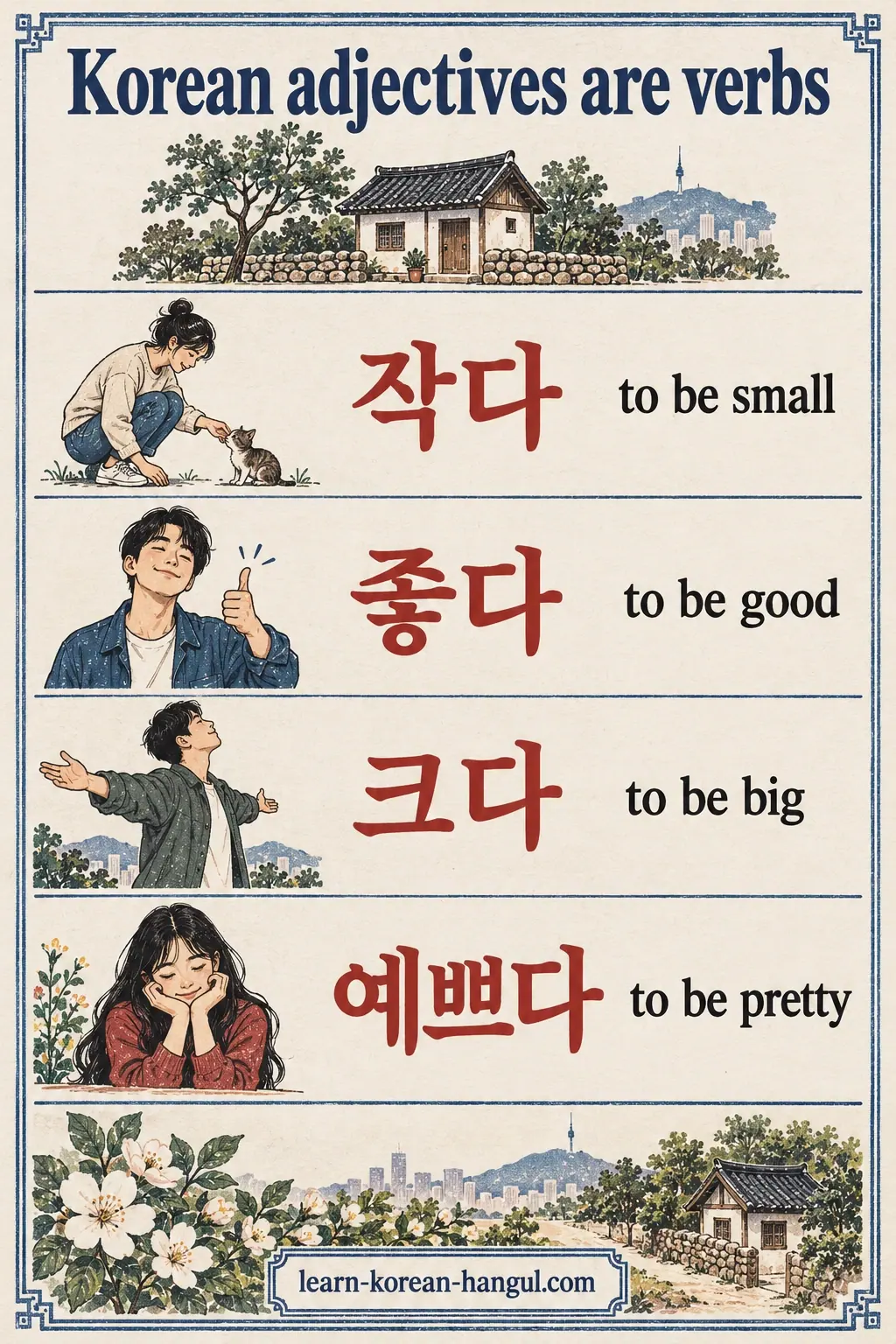
Korean adjectives are verbs: words such as 예쁘다 (to be pretty) and 크다 (to be big) end in 다, take tense endings and end a sentence by themselves, just like the action verb 먹다 (to eat). English-language textbooks often call them descriptive verbs; Korean grammar calls them 형용사. The main difference is the form they take before a noun.
What you'll learn
- Explain why a Korean word meaning "pretty" or "big" behaves like a verb.
- Conjugate a descriptive verb into the polite present and the past.
- Put an adjective before a noun with the correct modifier ending.
- Avoid the three mistakes that come from treating Korean adjectives like English ones.
Prerequisite: you know what Korean nouns are and can read Hangul. Estimated time: 25 minutes.
Why Are Korean Adjectives Verbs?

Korean adjectives are verbs because they behave exactly like verbs in every position that matters: they have a dictionary form ending in 다, they drop 다 to form a stem, they take the same tense and politeness endings, and they can end a sentence without any helper word. English needs "is" to carry tense and person with an adjective ("is pretty", "was pretty"). Korean puts that job inside the adjective itself.
Compare the two words below. Both start from a dictionary form, and both use the same ending 어요 for the polite present.
| Step | Action verb 먹다 (to eat) | Descriptive verb 예쁘다 (to be pretty) |
|---|---|---|
| Dictionary form | 먹다 | 예쁘다 |
| Stem (remove 다) | 먹 | 예쁘 |
| Polite present | 먹어요 | 예뻐요 |
| Past | 먹었어요 | 예뻤어요 |
In grammar books both words belong to one class, 용언 (yongeon), the predicate words that can change their endings. Within it, 동사 (dongsa) are action verbs and 형용사 (hyeongyongsa) are descriptive verbs. The English name "adjective" is useful when you translate, but the Korean label tells you how the word acts.
A First Example: Two Annotated Sentences
Example 1. 이 꽃은 예뻐요. (i kkocheun yeppeoyo.) means "This flower is pretty." The parts are 이 (this), 꽃 (flower), 은 (topic particle), and 예뻐요 (is pretty). There is no separate word for "is".
Example 2. 꽃이 예뻤어요. (kkochi yeppeosseoyo.) means "The flower was pretty." Only the ending changed: 예뻐요 became 예뻤어요 to show past time, the same way 먹어요 becomes 먹었어요.
The two sentences use one stem, 예쁘, and two endings. That pairing of stem plus ending is the whole system, and the next section shows how to build it.
How Do Korean Descriptive Verbs Conjugate?

Korean descriptive verbs conjugate by removing 다 from the dictionary form and adding the ending you need. The stem is the part that carries the meaning, and the ending carries tense and politeness. For the polite present, add 아요 after a stem whose last vowel is ㅏ or ㅗ, and 어요 after any other vowel.
Here is the polite present and past of five words, with the present noun modifier in the last column.
| Dictionary form | Stem | Polite present | Past | Modifier before a noun |
|---|---|---|---|---|
| 먹다 (to eat, action) | 먹 | 먹어요 | 먹었어요 | 먹는 사람 (a person who eats) |
| 작다 (to be small) | 작 | 작아요 | 작았어요 | 작은 집 (a small house) |
| 좋다 (to be good) | 좋 | 좋아요 | 좋았어요 | 좋은 날씨 (good weather) |
| 크다 (to be big) | 크 | 커요 | 컸어요 | 큰 집 (a big house) |
| 예쁘다 (to be pretty) | 예쁘 | 예뻐요 | 예뻤어요 | 예쁜 꽃 (a pretty flower) |
Two small sound changes appear in the table. First, a stem ending in ㅡ, like 크 and 예쁘, drops the ㅡ before 어요, so 크 + 어요 becomes 커요. Revised Romanization shows the results as keoyo and yeppeoyo. The rule applies to new ㅡ stems too, except stems ending in 르, such as 빠르다 (to be fast) → 빨라요, which follow their own pattern. Second, the ㅎ at the end of 좋 is silent before a vowel, so 좋아요 is said [조아요] (joayo).
The pattern table gives you the shape of every regular descriptive verb. A small group of stems changes in other ways, such as ㅂ-irregular and ㅎ-irregular stems, and those belong to the conjugation lessons in the Korean tenses section.
Worked Example: Building 이 꽃은 예뻐요

Building 이 꽃은 예뻐요 from the dictionary form takes five steps, and each step ends with a check.
- Start with the dictionary form. 예쁘다 (to be pretty). Check: it ends in 다, so it is a predicate word.
- Remove 다 to find the stem. 예쁘. Check: the stem ends in ㅡ.
- Pick the ending. Polite present means 어요, because the vowel before ㅡ is ㅖ, not ㅏ or ㅗ. Check: ㅡ drops, so 예쁘 + 어요 becomes 예뻐요.
- Choose the subject and its particle. 꽃 ends in a consonant, so the topic particle is 은: 꽃은. Check: 은 attaches without a space. Say it as [꼬츤].
- Add the pointing word. 이 (this) goes before the noun: 이 꽃은 예뻐요. Check: the predicate comes last.
You will know it worked when you can replace 예쁘다 with 크다 and get 이 꽃은 커요 (this flower is big) without looking anything up. Replacing the noun with 집 gives the audio sentence 이 집은 커요 from the table above.
The sentence needs no verb "to be", which sets up the contrast with action verbs in the next section.
How Are Descriptive Verbs Different from Action Verbs?

Descriptive verbs differ from action verbs in three places: the present noun modifier, the -고 있다 pattern, and the plain present form. Everything else matches. The easiest test is the modifier, because it appears in many sentences and can be checked in seconds.
| Feature | Action verb 먹다 | Descriptive verb 예쁘다 |
|---|---|---|
| Polite present | 먹어요 | 예뻐요 |
| Past | 먹었어요 | 예뻤어요 |
| Present modifier | 먹는 사람 | 예쁜 꽃 |
| Plain present (dictionary-style statement) | 먹는다 | 예쁘다 |
| With -고 있다 (is doing) | 먹고 있어요 (is eating) | not used for describing a state |
| Can end a sentence alone | yes | yes |
The modifier test works like this. Try to put -는 on the word and place it before a noun. If 먹는 사람 sounds natural, the word is an action verb. If you need -(으)ㄴ, as in 예쁜 꽃, the word is descriptive. The lesson on the -는 noun modifier explains the action-verb side, and the lesson on the -(으)ㄴ adjective and past modifier explains the other.
The same -(으)ㄴ ending also marks the past for action verbs: 먹은 음식 means "the food I ate". The ending shows time for action verbs and state for descriptive verbs, so check the word type before you read the meaning.
Do You Ever Need "Is" with a Korean Adjective?
No, you never add a word for "is" after a Korean adjective. The adjective carries it. The Korean word for "to be" in the sense "A is B" is 이다, and it attaches to nouns, as in 저는 학생이에요 (I am a student). Compare:
- 꽃이 예뻐요: adjective, no helper. "The flower is pretty."
- 이것은 꽃이에요: noun + 이에요. "This is a flower."
Mixing the two gives the mistake 꽃이 예쁘이에요, which Korean speakers do not say. The 이에요 pattern is taught in the lesson on 이에요/예요.
When Do Korean Adjectives Behave Differently?

Korean adjectives behave differently in a few edge cases, and knowing them prevents most surprises. The honest limit: this lesson teaches the regular core, not every exception.
- Words that feel like states in English but are action verbs in Korean. 좋아하다 (to like) is an action verb: 사과를 좋아해요 (I like apples), with the object particle 를. The descriptive verb 좋다 (to be good) is different: 날씨가 좋아요 (the weather is good), with the subject particle 가.
- 하다 words split into both types. 조용하다 (to be quiet) is descriptive, while 공부하다 (to study) is an action verb. Both end in 하다, so the ending does not tell you. See the page on Korean 하다 verbs.
- Commands and suggestions. Action verbs form commands (먹으세요, please eat) and suggestions (먹자, let's eat). Descriptive verbs do not form ordinary commands, because you cannot order someone to "be big".
- Present-time meaning. The polite present of a descriptive verb states the current quality: 예뻐요 is "is pretty" right now. Action verbs use the same polite ending for habits and the near future, which the lesson on Korean present tense uses explains. For the adjective side, see adjective present tense in Korean.
The sentence 밥을 먹고 있어요 (I am eating) shows the pattern that descriptive verbs avoid. The ending -고 있다 describes an action in progress, and a quality cannot be "in progress". With the edge cases mapped, the next section lists the mistakes they cause.
Common Mistakes with Korean Adjectives
Most mistakes come from treating Korean adjectives as English ones. Each mistake below follows the same pattern: what learners assume, what is true, and why.
Adding -고 있다 to an adjective. Learners often assume 예쁘고 있어요 means "is being pretty"; actually -고 있다 marks an action in progress, and a descriptive verb names a state, so use 예뻐요 for "is pretty".
Adding 이에요 after the adjective. Learners often assume Korean needs a word for "is" and write 예뻐이에요 or 예쁜이에요; actually the adjective already includes "is", and 이에요 only follows nouns. Write 예뻐요.
Using the action-verb modifier on an adjective. Learners often make 예쁘는 꽃 by copying 먹는 사람; actually descriptive verbs take -(으)ㄴ in the present, so the form is 예쁜 꽃.
Forgetting the ㅡ drop. Learners often say 크어요 or 예쁘어요 by attaching 어요 to the full stem; actually the ㅡ disappears, giving 커요 and 예뻐요.
Putting the modifier after the noun. Learners often write 집 큰, because they know Korean predicates come last; actually a modifier comes before its noun, as in 큰 집 (a big house). Only the predicate form goes at the end: 집이 커요 (the house is big).
All five errors have one cause: the learner looks for an English part of speech instead of checking how the Korean word is built. When in doubt, go back to the stem and the ending.
Practice: Choose, Fix, Translate and Write

Try these before reading the answers.
Exercise 1. Choose the polite present. Write the 요 form.
- 크다 (to be big)
- 작다 (to be small)
- 좋다 (to be good)
Exercise 2. Fix the error.
꽃이 예쁘고 있어요. (Meaning: The flower is pretty.)
Exercise 3. Translate into Korean. "I like small houses." Use 작은 for "small" before the noun, and 좋아해요 for "like".
Exercise 4. Write your own. Choose a noun you know and one descriptive verb. Write a sentence of the form noun + 이/가 + descriptive verb in the polite present.
Sentence
This flower is pretty.
Show answer
이 꽃은 예뻐요
Practice · 3
Which is the modifier of 예쁘다 before a noun?
Show answer
예쁜
Which sentence means 'The weather is good'?
Show answer
날씨가 좋아요
Which word is an action verb?
Show answer
먹다
Answers.
- Exercise 1: (1) 커요 (크 + 어요; the ㅡ drops). (2) 작아요 (the last vowel of 작 is ㅏ, so 아요). (3) 좋아요 (the last vowel of 좋 is ㅗ, so 아요).
- Exercise 2: 꽃이 예뻐요. The descriptive verb takes no -고 있다.
- Exercise 3: 작은 집을 좋아해요. The word 좋아하다 is an action verb, so the thing liked takes the object particle 을.
- Exercise 4: answers vary. A correct model is 날씨가 좋아요 (the weather is good).
Where to Go after Korean Adjectives Are Verbs
After this lesson, move to Korean pronouns, which covers words like 저 and 나 that replace nouns, and revisit Korean nouns if the particle choice (이/가, 은/는) still feels slow. To learn the modifier forms in full, continue to the -는 noun modifier and the -(으)ㄴ adjective and past modifier lessons. The wider set of word classes is in Korean parts of speech.
This lesson does not cover irregular stems (ㅂ, ㄷ, ㅅ, ㅎ, 르), adverbs formed with -게, or the full range of tenses. Those topics have their own lessons.
In short, Korean adjectives are verbs: they end in 다, drop it to make a stem, take the same endings as action verbs, need no word for "is", and change shape before a noun with -(으)ㄴ.
Frequently Asked Questions
Are Korean adjectives really verbs? Yes, in how they behave. Korean descriptive verbs (형용사) end in 다 in the dictionary, take the same tense and politeness endings as action verbs, and can end a sentence alone. Korean school grammar still lists 형용사 as its own word class beside action verbs (동사), and both belong to the predicate group 용언.
Do I need the word 'is' with a Korean adjective? No. The Korean adjective carries the meaning of 'is' inside its ending. 꽃이 예뻐요 means 'The flower is pretty' with no extra word. Adding 이에요 after an adjective is a mistake, because 이에요 belongs only after nouns, as in 학생이에요 (I am a student).
How do I put an adjective before a noun in Korean? Change the adjective stem with -(으)ㄴ and place it before the noun. Use -ㄴ after a vowel and -은 after a consonant: 예쁘다 becomes 예쁜 꽃 (pretty flower) and 작다 becomes 작은 집 (small house). The adjective always comes before the noun it describes.
What is the difference between 먹는 and 예쁜? Both modify a noun, but 먹는 is the present modifier of an action verb (the person who eats) and 예쁜 is the present modifier of a descriptive verb (the pretty flower). Action verbs take -는 for present time, while descriptive verbs take -(으)ㄴ, so the form shows which type the word is.
Are there Korean adjectives that behave like action verbs? Mostly no, but the dividing line is about grammar, not English meaning. 좋아하다 (to like) is an action verb in Korean even though 'like' feels like a state in English, while 좋다 (to be good) is descriptive. Test a word by asking whether it takes the -는 modifier.