What you'll learn
- Choose 을 or 를 correctly for any noun by looking at its last letter.
- Build a full sentence with an object, such as 영화를 봐요 ("I watch a movie").
- Distinguish an object (을/를) from a subject (이/가) and a topic (은/는).
- Spot verbs that look like they need 을/를 but do not.
Before you start: you should know that Korean puts the verb last (see the Korean SOV sentence pattern) and be able to read Hangul. Time: about 25 minutes.
What Does the Object Particle 을/를 Mean?

The object particle 을/를 tells the listener which noun receives the action of the verb. A particle (조사, josa) is a short word that attaches to a noun, with no space and shows its job in the sentence. A direct object is the person or thing a verb acts on. In "I drink water", the water is the direct object. A verb that takes a direct object is called a transitive verb.
English shows the direct object with word order: it comes after the verb. Korean puts the verb at the end, so word order alone cannot do the job, and the particle does it instead. That is why the same noun can move around in a Korean sentence while its role stays clear. The one you will see most is 을/를, which is part of the family of Korean object particles.
A First Example
Here are two short sentences. Listen to each at normal speed first, then slowly.
1. 저는 물을 마셔요. (jeoneun mureul masyeoyo) "I drink water."
Pronunciation: [저는 무를 마셔요]. The final ㄹ of 물 moves onto the next syllable, so 물을 sounds like 무를.
2. 영화를 봐요. (yeonghwareul bwayo) "I watch a movie."
Here 영화 ends in a vowel (ㅘ), so the particle is 를. The subject "I" is left out because the situation makes it clear.
Both sentences follow the same pattern: noun + 을/를 + verb. The next section explains how to choose between 을 and 를.
How Does the Object Particle 을/를 Work?

The object particle 을/를 has two forms, and the last letter of the noun decides which one you use. If the noun ends in a written final consonant (a 받침, batchim), add 을. If the noun ends in a vowel, add 를. The particle is written directly after the noun, with no space.
Pattern Table
| Noun | Last letter | Particle | Written | Sounds like | Meaning |
|---|---|---|---|---|---|
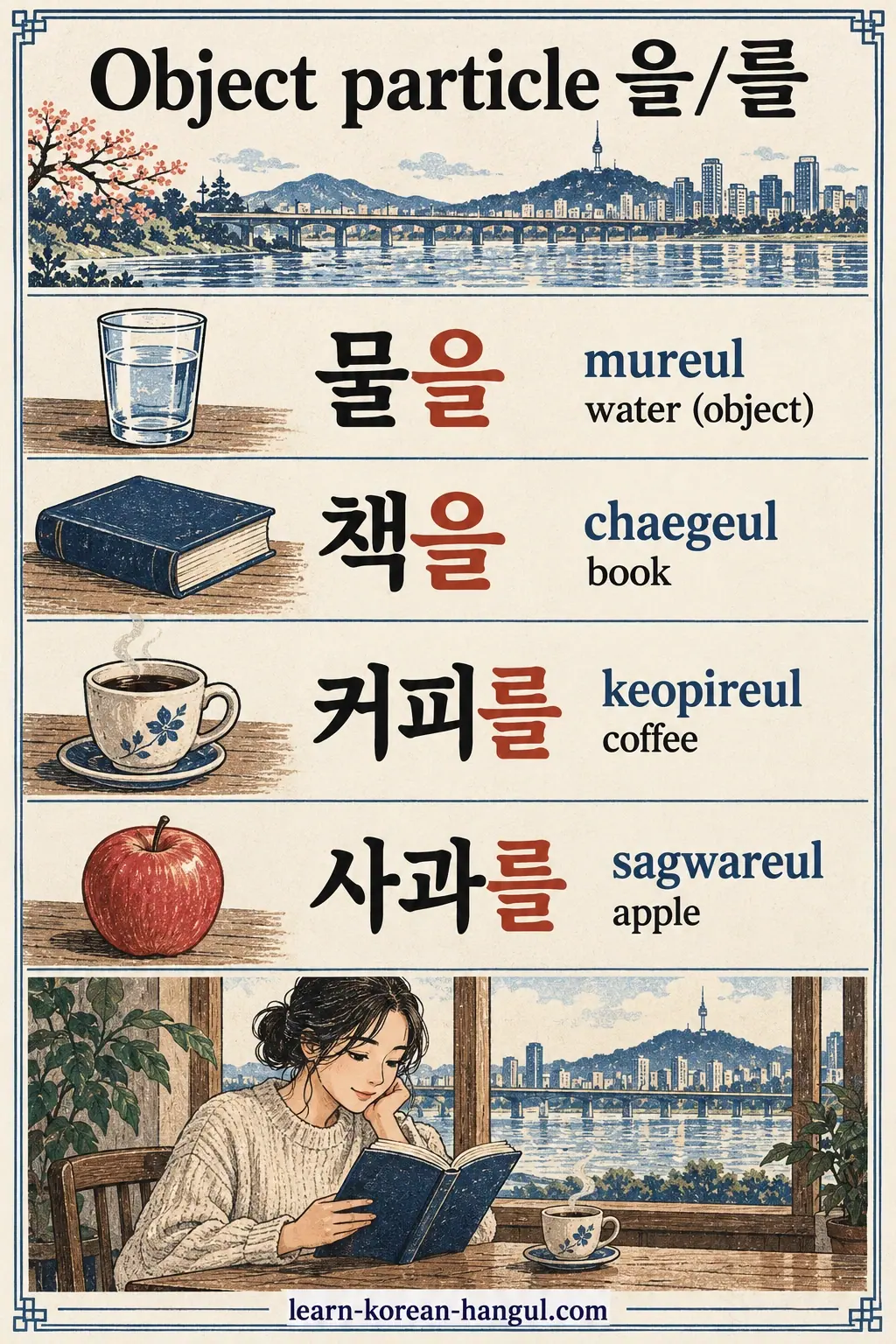
| 물 | consonant ㄹ | 을 | 물을 | [무를] mureul | water (object) |
| 책 | consonant ㄱ | 을 | 책을 | [채글] chaegeul | book |
| 밥 | consonant ㅂ | 을 | 밥을 | [바블] babeul | rice, a meal |
| 꽃 | consonant ㅊ | 을 | 꽃을 | [꼬츨] kkocheul | flower |
| 음악 | consonant ㄱ | 을 | 음악을 | [으마글] eumageul | music |
| 커피 | vowel ㅣ | 를 | 커피를 | keopireul | coffee |
| 김치 | vowel ㅣ | 를 | 김치를 | gimchireul | kimchi |
| 사과 | vowel ㅘ | 를 | 사과를 | sagwareul | apple |
| 영화 | vowel ㅘ | 를 | 영화를 | yeonghwareul | movie |
Three details make the rule easy to apply.
- Use the written letter, not the sound. 꽃 is pronounced with a final [ㄷ] sound when it stands alone, but it is written with the consonant ㅊ, so it takes 을. Always look at the spelling.
- Final ㄹ counts as a consonant. 물 ends in ㄹ, so it takes 을 (물을), not 를. Learners sometimes expect ㄹ to behave like a vowel because it does so before (으)로 (지하철로, by subway). With 을/를 it does not.
- The particle joins the next syllable when spoken. A final consonant moves onto the vowel of 을, so 책을 sounds like 채글. This is the ordinary liaison (연음) rule described in the Korean pronunciation rules.
The Spoken Shortcut: 를 Becomes ㄹ
In everyday speech, 를 often shrinks to a single ㄹ that attaches to the last syllable of the noun. This works only after a vowel, so only for 를, never for 을.
| Full form | Spoken short form | Meaning |
|---|---|---|
| 뭐를 (mworeul) | 뭘 (mwol) | what (object) |
| 나를 (nareul) | 날 (nal) | me |
| 저를 (jeoreul) | 절 (jeol) | me (polite) |
| 이거를 (igeoreul) | 이걸 (igeol) | this thing |
You will hear 뭘 먹어요? ("What are you eating?") far more often than 뭐를 먹어요?. Understand the short forms when you listen, but write the full form until you are comfortable.
Knowing the rule, you can now build a sentence from scratch.
How Do You Say "I Drink Water" with 을/를?

To say "I drink water" in Korean, put the object with its particle first and the verb last: 물을 마셔요. Follow these steps to build any object sentence.
- Find the object. Ask "what does the verb act on?" For "I drink water", the answer is water, 물.
- Check its last letter. 물 ends in the consonant ㄹ, so the particle is 을. Result: 물을.
- Choose the verb and put it last. The dictionary form is 마시다 (to drink). The polite present form is 마셔요 (masyeoyo), because 마시 + 어요 joins into 마셔요.
- Add the subject if you need it. 저는 (jeoneun, "as for me") goes first: 저는 물을 마셔요. Korean speakers usually leave it out when it is obvious.
- Say it with the liaison. Read 물을 as [무를], not as two separate words.
You'll know it worked when your sentence has three blocks in this order: noun + particle, then verb. Common mistake at this step: writing the verb before the object, as English does. In Korean the verb comes last: 물을 마셔요, not 마셔요 물을.
The same steps work for 영화를 봐요: object 영화, last letter vowel ㅘ, particle 를, verb 보다 → 봐요. Once you can build a plain object sentence, the next question is how the object particle differs from the two other particles that attach to nouns.
How Is 을/를 Different from 이/가 and 은/는?

The three particles label different jobs. 을/를 marks what the verb acts on, 이/가 marks the subject, and 은/는 marks the topic or a contrast. A single noun can take any of them, and the choice changes the meaning of the sentence.
| Particle | Job | Question it answers | Example with 책 (book) | Meaning |
|---|---|---|---|---|
| 을/를 | object | What is acted on? | 책을 읽어요. | I read a book. |
| 이/가 | subject | Who or what is it? | 책이 있어요. | There is a book. |
| 은/는 | topic or contrast | What is this about? | 책은 읽어요. | Books, I do read (but maybe not other things). |
Look at the third row. 은/는 can replace 을/를 when you want to set the object up as a topic or contrast it with something else: 책은 읽어요. 신문은 안 읽어요. ("I read books. I don't read newspapers.") It replaces the object particle; it does not stack on it. You never write 책을는. The full picture of that choice is in the lessons on subject particle 이/가 and topic particle 은/는.
An expert rule of thumb: ask "is this noun doing the action, receiving the action, or being talked about?" Doing is 이/가, receiving is 을/를, and being talked about is 은/는.
When Do You Use 을/를, and When Not?

The object particle 을/를 belongs with transitive verbs, but real sentences bend the rule in a few predictable ways.
Dropped in casual speech. When the meaning is clear, speakers often leave the particle out: 밥 먹었어요? for 밥을 먹었어요? ("Did you eat?"). The lesson on omitting particles in Korean lists when this is safe.
Replaced by 은/는 for contrast. 김치는 좋아해요 means "Kimchi, yes, I like it", and it hints that other foods may be different.
Split from 하다 verbs. Many verbs are a noun plus 하다 (to do). You can keep the noun and verb together or split them with 을/를: 공부해요 (gongbuhaeyo) and 공부를 해요 (gongbureul haeyo) both mean "I study." Splitting is common when you want to add a word, as in 한국어 공부를 해요 ("I study Korean"). The full pattern is in the guide to Korean 하다 verbs.
Verbs that surprise English speakers. Some Korean verbs take 을/를 where English uses a preposition: 버스를 타요 (beoseureul tayo) "I get on the bus" and 친구를 기다려요 (chingureul gidaryeoyo) "I wait for a friend". Others take a different particle where English has a direct object: 친구에게 전화해요 "I call a friend" uses 에게. Motion verbs such as 가다 take 에 for the destination: 학교에 가요 "I go to school". The lesson on motion verbs, particle 을/를 vs 에 covers the motion pattern.
Not for descriptions. Adjectives and 있다 (to exist, to have) describe a state, so they do not take an object. They take 이/가 on the thing: 물이 있어요 "There is water."
Honest limit of this lesson: it covers the plain direct object with common verbs. Rarer uses, such as a second 을/를 in the same sentence or objects of causative verbs, are left for later grammar lessons.
Knowing where the rule bends, you can now see where learners go wrong.
Common Mistakes with 을/를

Five mistakes cover most errors. Each one follows the pattern "learners often assume X, but actually Y, because Z."
- Choosing 를 after a consonant. Learners often write 물를 because 물 feels soft. Actually the form is 물을, because ㄹ is a final consonant and consonant endings take 을.
- Putting 을/를 on the subject. Learners often write 친구를 와요 for "My friend comes." Actually the friend does the action, so the subject particle is correct: 친구가 와요. Check who is doing the verb before you pick a particle.
- Using 을/를 after 좋다, 싫다 or 있다. Learners often write 커피를 좋아요. Actually 좋다 describes a state, so the thing takes 이/가: 커피가 좋아요. With the action verb 좋아하다 ("to like") the object particle is correct: 커피를 좋아해요. The lesson on 좋아하다 vs 좋다 particles explains this pair in full.
- Reading 을 as a separate syllable. Learners often read 물을 as "mul eul". Actually the ㄹ moves forward and the word sounds like [무를]. Say the noun and particle as one unit.
- Stacking particles. Learners often write 책을는 or 책을이. Actually only one of the three particles goes on the noun. Choose the one that fits the job.
If you want to see what each particle looks like in a coloured sentence, use the highlighter again on your own examples in the practice set below.
Practice and Answers
Try all four items before you read the answers. Each answer sentence has audio, normal and slow, in the answer key.
Practice · 8
Choose the correct form for "I eat an apple": 사과(을/를) 먹어요.
Show answer
사과를 먹어요.
사과 ends in a vowel, so it takes 를, written with no space.
Fix the error in 커피을 마셔요 ("I drink coffee").
Show answer
커피를 마셔요.
커피 ends in a vowel, so it takes 를, and the verb stays at the end.
Which object form is correct for 물 (water)?
Show answer
물을
Final ㄹ counts as a consonant, so 물 takes 을; it is pronounced [무를].
Which object form is correct for 꽃 (flower)?
Show answer
꽃을
Use the written letter, not the sound: 꽃 is written with the consonant ㅊ, so it takes 을.
Which sentence correctly says "My friend comes"?
Show answer
친구가 와요.
The friend does the action, so it takes the subject particle 이/가, not the object particle.
Which sentence correctly says "I like coffee" with the adjective 좋다?
Show answer
커피가 좋아요.
좋다 describes a state, so the thing takes 이/가; 을/를 goes with the action verb 좋아하다.
What is the spoken short form of 뭐를?
Show answer
뭘
In speech 를 can shrink to ㄹ after a vowel, so 뭐를 becomes 뭘, as in 뭘 먹어요?
Which sentence correctly says "I wait for a friend"?
Show answer
친구를 기다려요.
기다리다 takes 을/를 where English uses "for", so the friend is the object: 친구를.
- Choose the form. 사과(을/를) 먹어요. ("I eat an apple.")
- Fix the error. 커피을 마셔요. ("I drink coffee.")
- Translate. "I read a book."
- Write your own. Write one sentence about something you eat or drink, using 을 or 를.
Answer Key
- 사과를 먹어요. (sagwareul meogeoyo) 사과 ends in the vowel ㅘ, so the particle is 를.
- 커피를 마셔요. (keopireul masyeoyo) 커피 ends in the vowel ㅣ, so 를, not 을.
- 책을 읽어요. (chaegeul ilgeoyo) 책 ends in the consonant ㄱ, so 을. The sentence sounds like [채글 일거요]. Adding 저는 at the start is also correct.
- Sample answer: 밥을 먹어요. (babeul meogeoyo) "I eat rice." Any noun with the right particle and the verb at the end is correct. Check the last letter of your noun: 밥 ends in ㅂ, so 을.
If you missed an item, return to the pattern table and say each noun plus particle aloud. Then move on to the lessons that build on this one.
Next Lessons and Where to Go from Here
After the object particle 을/를, the best next step is the pair that learners confuse most: 좋아하다 vs 좋다 particles, which shows why "like" can take 을/를 or 이/가. Then read about motion verbs, particle 을/를 vs 에. The set overview, Korean object particles, lists every lesson in order.
For more practice, try the grammar quizzes. This lesson uses Revised Romanization (the official Latin-letter system) only as a learning aid; the Hangul is the reference. With the rule in hand, the object particle 을/를 is a two-step check: look at the last letter, then pick 을 or 를.
Frequently Asked Questions
What Does 을/를 Mean?
The particle 을/를 has no English translation of its own. It is a label that tells the listener which noun receives the action of the verb. In 물을 마셔요, the 을 shows that water is what gets drunk. English shows the same job with word order: the noun after the verb.
How Do I Form 을/를?
Look at the last letter of the noun as it is written. If it has a final consonant (받침), add 을: 책 becomes 책을. If it ends in a vowel, add 를: 커피 becomes 커피를. Write the particle directly after the noun with no space.
What Is the Most Common Mistake with 을/를?
Learners most often put 을/를 on things that the verb does not act on. The clearest case is 좋다 (to be good, to like), 싫다 and 있다, which take 이/가 on the thing: 커피가 좋아요, not 커피를 좋아요. Check whether the verb is an action or a description.
How Is 을/를 Different from 이/가 and 은/는?
을/를 marks what the verb acts on, 이/가 marks who or what does or is something, and 은/는 marks what the sentence is about or sets up a contrast. One noun can take any of them. 책을 읽어요 means I read a book, while 책이 있어요 means there is a book.
Do I Use 을/를 in Speech, Writing or Both?
Both. In careful speech and in all formal writing, 을/를 stays. In casual conversation Koreans often drop it when the meaning is clear, so 밥 먹었어요? is normal for 밥을 먹었어요?. As a learner, include the particle first, then learn when it can disappear.