What you'll learn
- Choose between "can" for circumstances and "know how to" for skills in one sentence.
- Build both patterns from a verb stem and spell them with the correct spacing.
- Say "cannot" and "do not know how to" with the matching negative forms.
- Recognise 줄 알았어요 as "I thought" and 줄 몰랐어요 as "I did not know".
Before you start: you should know the polite ending -아요/-어요 and verbs such as 가다, 하다 and 치다. The full rules for each pattern are in the lessons on -(으)ㄹ 수 있다/없다 and -(으)ㄹ 줄 알다/모르다. It plays only when you press a button.
What Is the Difference between -(으)ㄹ 수 있다 and -(으)ㄹ 줄 알다?
The difference is the reason you can. -(으)ㄹ 수 있다 says that nothing stops the action: you have the ability, the time, the permission or the chance. -(으)ㄹ 줄 알다 says that you know the method, because you learned it. The first is about the situation, and the second is about knowledge.
Two sentences show the contrast:
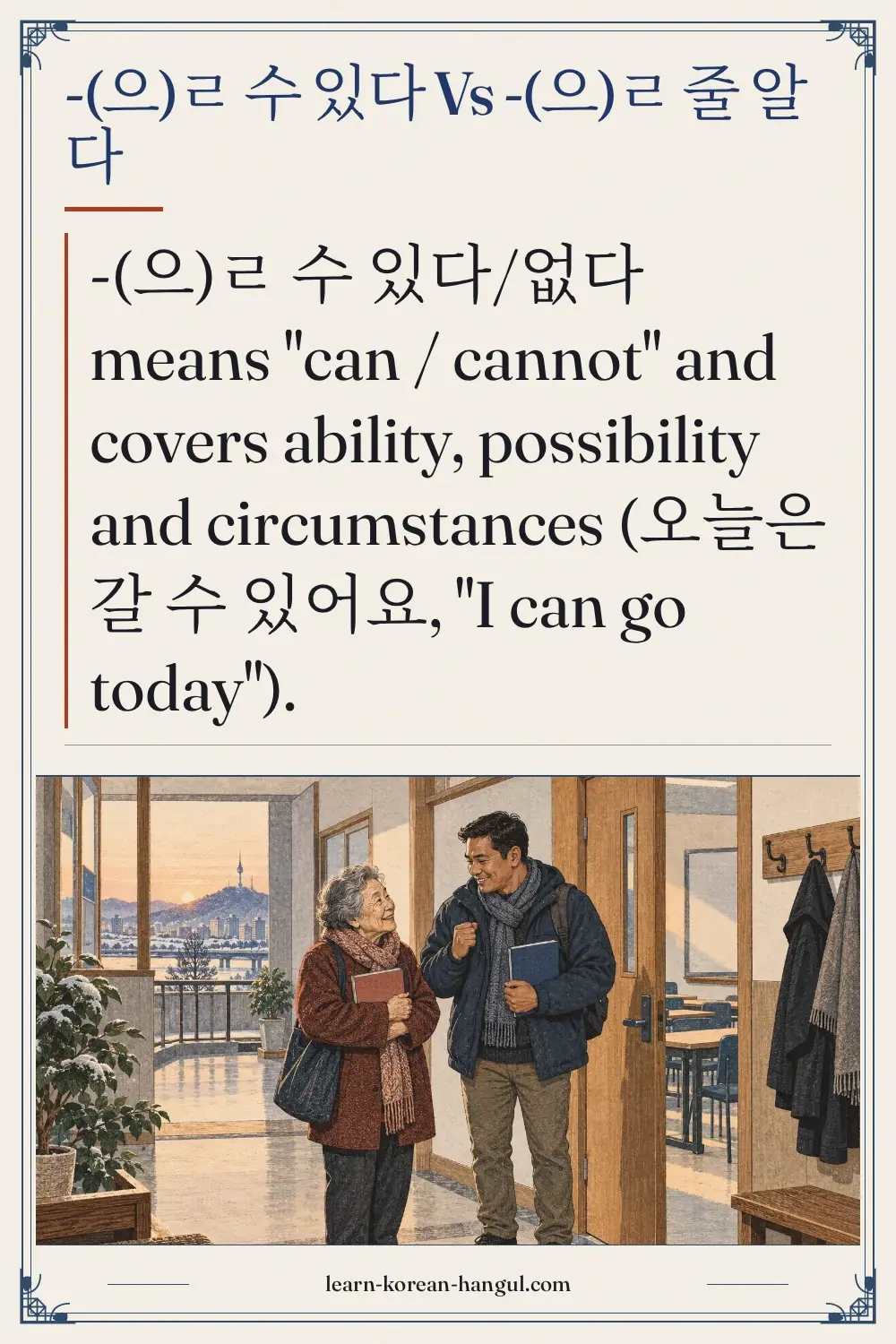
- 오늘은 갈 수 있어요. (oneureun gal su isseoyo.) [오느른 갈쑤 이써요] = "I can go today." Your schedule allows it. No skill is involved.
- 저는 운전할 줄 알아요. (jeoneun unjeonhal jul arayo.) [운전할쭐 아라요] = "I know how to drive." You learned the skill.
The word 수 means "way" or "possibility" and the word 줄 means "way of doing". Both are dependent nouns that must follow a modifier such as 갈 or 할. The next sections turn this into a rule you can apply in a few seconds.
The One-Line Rule
Use -(으)ㄹ 줄 알다 when the English is "know how to" and the skill is learned. Use -(으)ㄹ 수 있다 for every other "can": a free schedule, permission, a chance, or general ability. When you are unsure, -(으)ㄹ 수 있다 is the safer choice, because it makes no claim about how you learned the skill.
-(으)ㄹ 수 있다 vs -(으)ㄹ 줄 알다: Side-by-Side Table
The table compares the two patterns on the points learners need most. Each row has one specific answer for each pattern.
| Point | -(으)ㄹ 수 있다/없다 | -(으)ㄹ 줄 알다/모르다 |
|---|---|---|
| Core meaning | can / cannot (ability, possibility, circumstance) | know / do not know how to (learned skill) |
| English cue | "can", "be able to", "may" | "know how to", "have learned to" |
| Learned skill | yes: 수영할 수 있어요 | yes: 수영할 줄 알아요 |
| Circumstance (time, place, health) | yes: 오늘은 갈 수 있어요 | no |
| Possibility or chance | yes: 그럴 수 있어요 | no |
| Adjectives | yes: 위험할 수 있어요 ("it can be dangerous") | no |
| Negative | 수 없다: 찍을 수 없어요 | 줄 모르다: 칠 줄 몰라요 |
| Spelling | 수 is spaced: 갈 수 있다 | 줄 is spaced: 할 줄 알다 |
| Pronunciation | 수 is tense: [갈쑤] | 줄 is tense: [할쭐] |
| Past modifier + 알았다 | not used | "I thought that...": 올 줄 알았어요 |
| Example | 여기에서는 사진을 찍을 수 없어요. | 기타를 칠 줄 몰라요. |
The table shows that -(으)ㄹ 수 있다 is the wider pattern and -(으)ㄹ 줄 알다 is the narrower one. Each has a few typical situations.
When Do You Use -(으)ㄹ 수 있다?
Use -(으)ㄹ 수 있다 for four kinds of "can". Each uses the same shape: modifier + 수 + 있다 or 없다.
- General ability. 저는 한국어를 할 수 있어요. (jeoneun hangugeoreul hal su isseoyo.) = "I can speak Korean."
- Circumstance. 오늘은 갈 수 있어요. = "I can go today." Time or schedule allows it.
- Permission or rule. 여기에서는 사진을 찍을 수 없어요. (yeogieseoneun sajineul jjigeul su eopseoyo.) [찌글쑤 업써요] = "You can't take photos here."
- Possibility or chance. 그럴 수 있어요. (geureol su isseoyo.) = "That can happen." With adjectives, 위험할 수 있어요 means "It can be dangerous".
To build the pattern, take the stem and add the right modifier form. A stem that ends in a vowel adds ㄹ to the last block (가 + ㄹ = 갈). A stem that ends in a consonant adds 을 (찍 + 을 = 찍을). A stem that already ends in ㄹ keeps it (놀 stays 놀). Then add 수 있다 or 수 없다. The negative 수 없다 states "not possible" more explicitly than 못 하다 and can sound more formal.
The tense sits on the last verb: 갈 수 있었어요 ("I could go") and 갈 수 없었어요 ("I could not go"). Spelling puts spaces on both sides of 수.
When Do You Use -(으)ㄹ 줄 알다?
Use -(으)ㄹ 줄 알다 when you talk about a learned skill and the key idea is "know how". The pattern works only with action verbs. Its negative is 줄 모르다, not 줄 없다.
- Skills learned by practice. 저는 운전할 줄 알아요. (jeoneun unjeonhal jul arayo.) = "I know how to drive."
- Lack of a learned skill. 기타를 칠 줄 몰라요. (gitareul chil jul mollayo.) = "I don't know how to play the guitar."
- Languages and tools. 한국어로 말할 줄 알아요 means "I know how to speak in Korean", and 요리할 줄 몰라요 means "I don't know how to cook".
The pattern is built exactly like 수 있다: 할 줄 알다, 먹을 줄 알다, 만들 줄 알다. The pronunciation of 줄 is tense after the ㄹ of the modifier, so you hear [할쭐 아라요].
Notice what 줄 모르다 does not say. 요리할 줄 몰라요 does not claim that you are unable to cook at this moment. It claims that you never learned how. If an injured hand is the reason, say 요리할 수 없어요 instead.
Worked Example: Choosing in One Situation
Follow the steps with the idea of swimming. The same verb gives two different sentences depending on the reason.
- Find the verb. The verb is 수영하다, "to swim". The modifier form is 수영할.
- Ask: is the point know-how? You learned to swim as a child, so say 저는 수영할 줄 알아요. = "I know how to swim."
- Ask: is the point a situation? Today it is raining and the pool is closed, so say 비가 와서 수영할 수 없어요. = "I can't swim because it is raining."
- Check the pair. Both sentences use 수영할, but 줄 알아요 describes a skill, while 수 없어요 describes today's situation.
You will know it worked when the situation sentence has a cause (비가 와서) and the skill sentence has none. The usual slip at this stage is to say 비가 와서 수영할 줄 몰라요, which would mean "because it rains, I don't know how to swim". Rain does not remove knowledge.
What Do the past Forms with 줄 Mean?
When a modifier + 줄 is used in the past, the meaning is about belief, not skill. 줄 알았다 means "I thought that" and 줄 몰랐다 means "I did not know that" or "I never expected that". The tense of the modifier follows the event you believed in.
- 비가 올 줄 알았어요. (biga ol jul arasseoyo.) = "I thought it would rain." The belief was about the future.
- 이렇게 어려울 줄 몰랐어요. (ireoke eoryeoul jul mollasseoyo.) [이러케 어려울쭐 몰라써요] = "I didn't know it would be this hard."
- 시험이 쉬운 줄 알았어요. (siheomi swiun jul arasseoyo.) = "I thought the exam was easy."
An honest limit: with a time word, the same ending can report a past skill: 어릴 때는 수영할 줄 알았어요 means "I knew how to swim as a child". Without a time word, 줄 알았어요 usually reports a belief that turned out to be wrong, so test the sentence with "I thought that" first.
Can You Use Both in the Same Sentence?
Yes, for skills the two patterns overlap. 수영할 수 있어요 and 수영할 줄 알아요 are both correct. 한국어를 할 수 있어요 and 한국어를 할 줄 알아요 are both correct. Two differences remain.
- Emphasis. 줄 알다 stresses that you learned it. 수 있다 states that you can do it now.
- Questions. 운전할 수 있어요? asks whether you can drive today, and the answer may depend on a car or a licence. 운전할 줄 알아요? asks whether you ever learned.
Some limits are firm. Only -(으)ㄹ 수 있다 works for time, place, permission and chance. Only -(으)ㄹ 수 있다 works with adjectives. The short negative 못 covers both patterns in daily speech: 수영을 못 해요 means either "I can't swim (for any reason)" or "I don't know how to swim". The negation lesson 안 vs 못 explains this word.
Which Should You Pick? a Simple Rule of Thumb
Follow these four steps in order. The first step that applies gives the answer.
- Is the sentence about time, place, permission or chance? Use -(으)ㄹ 수 있다: 오늘은 갈 수 있어요.
- Is the predicate an adjective? Use -(으)ㄹ 수 있다: 위험할 수 있어요.
- Is it a skill you learned, and the point is know-how? Use -(으)ㄹ 줄 알다: 운전할 줄 알아요.
- Are you reporting a past belief? Use modifier + 줄 알았다: 올 줄 알았어요.
Checkpoint: read the sentence with "know how to" in English. If it still makes sense, -(으)ㄹ 줄 알다 is right. If "be able to" makes more sense, choose -(으)ㄹ 수 있다.
What Mistakes Do Learners Make with These Two?
Learners most often use 줄 알다 for a situation. Five mistakes appear again and again, and each has a quick repair.
- Using 줄 알다 for circumstance. Learners often assume that 줄 알다 is a second "can". Actually, 오늘은 갈 줄 알아요 means "I know how to go today", which is strange. Say 오늘은 갈 수 있어요.
- Using 줄 알다 with an adjective. 비쌀 줄 알아요 does not mean "it can be expensive". Say 비쌀 수 있어요.
- Mixing the two verbs. 운전할 수 알아요 and 운전할 줄 있어요 are wrong. The pairs are fixed: 수 + 있다/없다 and 줄 + 알다/모르다.
- Removing the space. 갈수있어요 and 할줄알아요 break the spelling rule for dependent nouns. Write 갈 수 있어요 and 할 줄 알아요.
- Reading 줄 알았어요 as a skill. 비가 올 줄 알았어요 means "I thought it would rain", not "I knew how to rain". Check whether the clause before 줄 describes a skill or an event.
An honest limit: this page treats the textbook contrast. Spoken Korean also uses -(으)ㄹ 수 있다 freely for learned skills, so you will often hear it where a textbook might expect 줄 알다. The rules above tell you what each pattern means; they do not forbid 수 있다 for a skill.
Practice: Choose the Right Pattern
Try the five items before you read the answer key. Cover the answers with your hand.
- Choose. Your schedule is free tomorrow. Complete: 내일 파티에 올 ___. (수 있어요 / 줄 알아요)
- Choose. You want to say you know how to play the guitar. Complete: 기타를 칠 ___. (수 있어요 / 줄 알아요)
- Choose. You never learned to cook. Complete: 요리할 ___. (수 없어요 / 줄 몰라요)
- Choose. You warn that a path can be dangerous. Complete: 이 길은 위험할 ___. (수 있어요 / 줄 알아요)
- Translate. "I didn't know it would be this hard." Use 어렵다.
Practice · 5
Your schedule is free tomorrow. 내일 파티에 올 ___.
Show answer
수 있어요
The reason is the schedule, so only 수 있다 fits.
You want to stress that you learned to play the guitar. 기타를 칠 ___.
Show answer
줄 알아요
줄 알다 stresses a learned skill. 칠 수 있어요 is also correct but does not stress the learning.
You never learned to cook. 요리할 ___.
Show answer
줄 몰라요
Not knowing how uses 줄 모르다.
You warn that a path can be dangerous. 이 길은 위험할 ___.
Show answer
수 있어요
위험하다 is an adjective, and only 수 있다 works with adjectives.
Which sentence means "I didn't know it would be this hard"?
Show answer
이렇게 어려울 줄 몰랐어요.
A past belief uses modifier + 줄 몰랐다.
Answer key
- 수 있어요. The reason is the schedule, so only 수 있다 fits.
- 줄 알아요. The point is a learned skill. 칠 수 있어요 is also correct, but it does not stress the skill.
- 줄 몰라요. You never learned how, so 줄 모르다 fits.
- 수 있어요. The predicate is an adjective, and only 수 있다 works with adjectives.
- 이렇게 어려울 줄 몰랐어요. The past belief pattern uses 줄 몰랐어요 after the modifier 어려울.
If you got four or five right, you can handle most daily uses. If you missed items 1 and 4, review the situation-based uses of -(으)ㄹ 수 있다.
What Should You Learn Next?
After -(으)ㄹ 수 있다 vs -(으)ㄹ 줄 알다, study each pattern on its own, then the negation words that overlap with them. This page compares the two patterns but does not teach every use of either one.
- Read the full lessons: -(으)ㄹ 수 있다/없다 and -(으)ㄹ 줄 알다/모르다.
- Compare the two negative words in 안 vs 못.
- Learn the full lesson on 못 can't in Korean.
- See every pair on Confusing Grammar Compared, or browse Beginner Grammar for the patterns around level A2.
With these steps, the choice in -(으)ㄹ 수 있다 vs -(으)ㄹ 줄 알다 becomes automatic: decide whether the point is the situation or the know-how, then add the pattern to the modifier.
Frequently Asked Questions
Can I always replace -(으)ㄹ 수 있다 with -(으)ㄹ 줄 알다?
No. 줄 알다 covers only a learned skill, so 오늘은 갈 줄 알아요 does not mean "I can go today". For skills, the two overlap: 수영할 수 있어요 and 수영할 줄 알아요 are both correct, but 줄 알다 stresses that you learned how, while 수 있다 states current ability.
Which one sounds more natural in speech?
-(으)ㄹ 수 있다 is more frequent because it covers ability, permission and possibility. For a plain question such as "Can you drive?", speakers use both 운전할 수 있어요? and 운전할 줄 알아요?. The second sounds like a question about training, and the first like a question about the present situation.
How do I say "I cannot" with each pattern?
Use 수 없다 for any "cannot" and 줄 모르다 for "do not know how". 수영할 수 없어요 can mean you are blocked today; 수영할 줄 몰라요 means you never learned. The short form 못 해요 (수영을 못 해요) is the everyday choice, and it covers both meanings.
Does -(으)ㄹ 줄 알았어요 mean "I knew how to"?
Not by default. After a verb, 비가 올 줄 알았어요 means "I thought it would rain". Use a time word to mean a past skill: 어릴 때는 수영할 줄 알았어요 means "I knew how to swim as a child". Without a context like this, 알았어요 after 줄 reports a belief that may have been wrong.
What is the quickest rule to remember?
Ask whether the key is know-how or the situation. If you learned the skill (driving, swimming, cooking), use -(으)ㄹ 줄 알다. If the reason is time, place, permission, health or chance, use -(으)ㄹ 수 있다. When both seem right, -(으)ㄹ 수 있다 is the safer default.