
What you'll learn
- Attach -(으)ㄹ 줄 알다 and -(으)ㄹ 줄 모르다 to any action verb stem.
- Say "I know how to drive" and "I don't know how to swim" in polite Korean.
- Choose between 줄 알다 (a learned skill) and 수 있다 (can, in general).
- Read -(으)ㄴ/는 줄 알았다 as "I thought that ..." and not as "I knew how to".
- Avoid the five most common mistakes.
Before you start: you should know how to find a verb stem (drop 다 from the dictionary form) and the polite ending -아요/어요. If the verb 알다 is new, note that it means "know" and has the polite form 알아요. Audio plays only when you press a button.
What Does -(으)ㄹ 줄 알다/모르다 Grammar Mean?
-(으)ㄹ 줄 알다/모르다 grammar means "know how to do" and "not know how to do". It is about a skill that you have learned or not learned. The pattern has three parts: a verb in the modifier form -(으)ㄹ, the dependent noun 줄, and the verb 알다 ("know") or 모르다 ("not know").
A dependent noun (의존 명사) is a noun that cannot stand alone. 줄 here means "the way" or "how". So 운전할 줄 알아요 says literally "I know the way of driving", which becomes "I know how to drive". The first two examples show the pattern.
- 저는 운전할 줄 알아요. (jeoneun unjeonhal jul arayo.) [저는 운전할쭐 아라요] = "I know how to drive."
- 저는 수영할 줄 몰라요. (jeoneun suyeonghal jul mollayo.) [저는 수영할쭐 몰라요] = "I don't know how to swim."
The pattern states a fact about the speaker's knowledge. It says nothing about whether the speaker can do the action today. The sound of 줄 also changes: after the ending -ㄹ, the ㅈ is pronounced tense, so you hear [쭐]. This follows the standard pronunciation rules (표준 발음법, Article 27) of the 국립국어원 (National Institute of Korean Language). Write 줄, and say [쭐]. The next section shows how to build the pattern.
How Do You Form -(으)ㄹ 줄 알다/모르다?
-(으)ㄹ 줄 알다/모르다 is formed by taking the verb stem, adding the modifier ending -(으)ㄹ and then 줄 알다 or 줄 모르다. After a vowel, add ㄹ directly to the stem. After a consonant, add 을.
| Dictionary form | Stem | Add -(으)ㄹ 줄 알다 | Polite form | Meaning |
|---|---|---|---|---|
| 운전하다 | 운전하 | 운전할 줄 알다 | 운전할 줄 알아요 | know how to drive |
| 타다 | 타 | 탈 줄 알다 | 탈 줄 알아요 | know how to ride |
| 읽다 | 읽 | 읽을 줄 알다 | 읽을 줄 알아요 | know how to read |
| 만들다 | 만들 | 만들 줄 알다 | 만들 줄 알아요 | know how to make |
| 걷다 | 걷 | 걸을 줄 알다 | 걸을 줄 알아요 | know how to walk |
| 부르다 | 부르 | 부를 줄 알다 | 부를 줄 알아요 | know how to sing |
For the negative, replace 알아요 with 몰라요: 읽을 줄 몰라요 means "I don't know how to read." The table shows one rule applied to six verbs. The next three parts look at the groups of stems.
Stems Ending in a Vowel
A vowel stem takes ㄹ directly, and the ㄹ joins the last syllable: 타다 gives 탈, 하다 gives 할, and 부르다 gives 부를. Examples:
- 자전거를 탈 줄 알아요. (jajeongeoreul tal jul arayo.) [자전거를 탈쭐 아라요] = "I know how to ride a bicycle."
- 노래를 부를 줄 알아요. (noraereul bureul jul arayo.) [노래를 부를쭐 아라요] = "I know how to sing."
Stems Ending in a Consonant
A consonant stem takes 을 as the linking syllable. 읽다 gives 읽을, and 치다 gives 칠, because 치 ends in a vowel. Examples:
- 한글을 읽을 줄 알아요. (hangeureul ilgeul jul arayo.) [한그를 일글쭐 아라요] = "I know how to read Hangul."
- 기타를 칠 줄 몰라요. (gitareul chil jul mollayo.) [기타를 칠쭐 몰라요] = "I don't know how to play the guitar."
The spelling 읽을 줄 is written in separate words, with a space before 줄. The pronunciation links them, as in [일글쭐].
Irregular Stems and Nouns
The modifier ending -(으)ㄹ is a linked ending (it uses 으 after a consonant), so ㄷ- and ㅂ-irregular stems change, ㄹ-stems keep their ㄹ and 르-verbs stay whole.
- ㄹ-stems keep their ㄹ. 만들다 gives 만들 줄 알아요, not 만들을 줄 알아요. 김밥을 만들 줄 알아요 (gimbabeul mandeul jul arayo) [김바블 만들쭐 아라요] means "I know how to make gimbap."
- ㄷ-irregular stems change ㄷ to ㄹ. 걷다 gives 걸을 줄 알아요. 아기는 아직 걸을 줄 몰라요 (agineun ajik georeul jul mollayo) [아기는 아직 거를쭐 몰라요] means "The baby doesn't know how to walk yet."
- ㅂ-irregular stems turn ㅂ into 우. 돕다 gives 도울 줄 알아요.
- 르-verbs keep 르 in this ending. 부르다 gives 부를 줄 알아요.
- Nouns do not take this pattern directly. For a noun skill, use a 하다 verb or a verb meaning "do": 요리할 줄 알아요 (from 요리하다), not 요리 줄 알아요.
With the forms clear, a full sentence can be built step by step.
Worked Example: Building a Sentence with -(으)ㄹ 줄 알다
-(으)ㄹ 줄 알다/모르다 turns a verb into a statement about skill. Follow the steps with the sentence "I know how to cook."
- Start with the plain action. 저는 요리해요. (jeoneun yorihaeyo.) = "I cook." The verb is 요리해요.
- Find the dictionary form and the stem. 요리해요 comes from 요리하다. The stem is 요리하.
- Check the last sound. The stem ends in the vowel 하, so add ㄹ: 요리할.
- Add 줄 알다. 요리할 + 줄 알다 = 요리할 줄 알다.
- Put it in the polite style. Replace 알다 with 알아요: 저는 요리할 줄 알아요. (jeoneun yorihal jul arayo.) [저는 요리할쭐 아라요] = "I know how to cook."
Sentence
You know it worked when the original subject stays in place and the last words are 줄 알아요. The usual slip at this step is to forget the space before 줄. The pattern needs three words: the modifier, 줄 and the verb. The next section shows the tenses and sentence types.
Which Tenses and Sentence Types Work with -(으)ㄹ 줄 알다/모르다?
-(으)ㄹ 줄 알다/모르다 works in the present, the past, questions and every speech level. The changes happen on 알다 or 모르다, the last word. The first verb always stays in the -(으)ㄹ form.
| Sentence type | 알다 (know how) | 모르다 (don't know how) |
|---|---|---|
| Polite present | 할 줄 알아요 | 할 줄 몰라요 |
| Polite past | 할 줄 알았어요 | 할 줄 몰랐어요 |
| Question | 할 줄 알아요? | 할 줄 몰라요? |
| Honorific | 할 줄 아세요 | 할 줄 모르세요 |
| Formal | 할 줄 압니다 | 할 줄 모릅니다 |
| Casual | 할 줄 알아 | 할 줄 몰라 |
A natural pair for a conversation is the question and answer: 한국어를 할 줄 아세요? (hangugeoreul hal jul aseyo?) [한구거를 할쭐 아세요] means "Do you speak Korean?" and 네, 조금 할 줄 알아요 (ne, jogeum hal jul arayo) means "Yes, I can speak a little." The honorific 아세요 comes from 알다, where the ㄹ drops before ㅅ.
The past form says that you knew how, not that you did it: 어릴 때는 수영할 줄 알았어요 (eoril ttaeneun suyeonghal jul arasseoyo) [어릴 때는 수영할쭐 아라써요] means "When I was young, I knew how to swim." The past tense goes on 알다. Putting it on the first verb (수영했을 줄 알아요) changes the meaning and is not used for this purpose.
The pattern is closest to another one that also means "can", so the next section compares them.
How Is -(으)ㄹ 줄 알다/모르다 Different from -(으)ㄹ 수 있다/없다?
-(으)ㄹ 줄 알다/모르다 is about knowing how, while -(으)ㄹ 수 있다/없다 is about being able to or being allowed to. The first is a skill learned over time. The second covers skill, but also situation, permission and possibility.
| Point | -(으)ㄹ 줄 알다/모르다 | -(으)ㄹ 수 있다/없다 |
|---|---|---|
| Core meaning | know how to / not know how to | can / cannot |
| What it expresses | a learned skill | ability, possibility, permission |
| Example | 운전할 줄 알아요. | 운전할 수 있어요. |
| Meaning of example | I know how to drive. | I can drive (I am able or allowed). |
| Negative | 운전할 줄 몰라요. | 운전할 수 없어요. |
| Meaning of negative | I never learned to drive. | I cannot drive (now, or at all). |
The difference matters in context. Imagine a person who drove for years but drank alcohol today. 술을 마셔서 운전할 수 없어요 (sureul masyeoseo unjeonhal su eopseoyo) [수를 마셔서 운전할쑤 업써요] means "I can't drive because I drank." Saying 운전할 줄 몰라요 would claim that the person never learned. The second sentence is about knowledge, and the first is about the situation.
Permission and possibility need 수 있다. 여기서 사진을 찍을 수 있어요? (yeogiseo sajineul jjigeul su isseoyo?) [여기서 사지늘 찌글쑤 이써요] means "May I take photos here?" and 줄 알다 cannot say this. The negation words 못 and -지 못하다 are also close: 수영을 못 해요 (suyeongeul mot haeyo) [수영을 모태요] means "I can't swim", whether because of skill or circumstance, while 수영할 줄 몰라요 points to the missing skill. See -(으)ㄹ 수 있다/없다, the side-by-side lesson -(으)ㄹ 수 있다 vs -(으)ㄹ 줄 알다, and the negation lessons 못 can't in Korean and -지 못하다 cannot. The next section covers variations.
Variations and Edge Cases of -(으)ㄹ 줄 알다/모르다
-(으)ㄹ 줄 알다/모르다 has three useful variations. Each one is short, and each one is heard in everyday Korean.
- "I thought that ...". With the forms -(으)ㄴ/는 줄 알았다, the same chunk shows a belief, usually a mistaken one. 비가 오는 줄 알았어요 (biga oneun jul arasseoyo) [비가 오는 주라라써요] means "I thought it was raining." 어려운 줄 알았어요 (eoryeoun jul arasseoyo) [어려운 주라라써요] means "I thought it was hard." Here the modifier is 는 for verbs and (으)ㄴ for adjectives, not -(으)ㄹ, and the meaning has nothing to do with skill. Even with -(으)ㄹ, 줄 알았어요 can mean "I thought ... would ..." rather than "I knew how to", so context decides.
- A person who can. Change 알다 to 아는 to describe someone: 운전할 줄 아는 사람 means "a person who knows how to drive."
- Adding emphasis words. Words like 조금 ("a little"), 잘 ("well") and 전혀 ("not at all") fit before 줄: 조금 할 줄 알아요, 잘 할 줄 알아요 and 전혀 할 줄 몰라요.
This lesson covers the skill meaning and the "I thought" pattern in brief. It does not cover the many other uses of 줄, such as 줄 몰랐다 ("I did not realise that"). The mistakes below show where the boundary causes real errors.
What Mistakes Do Learners Make with -(으)ㄹ 줄 알다/모르다?
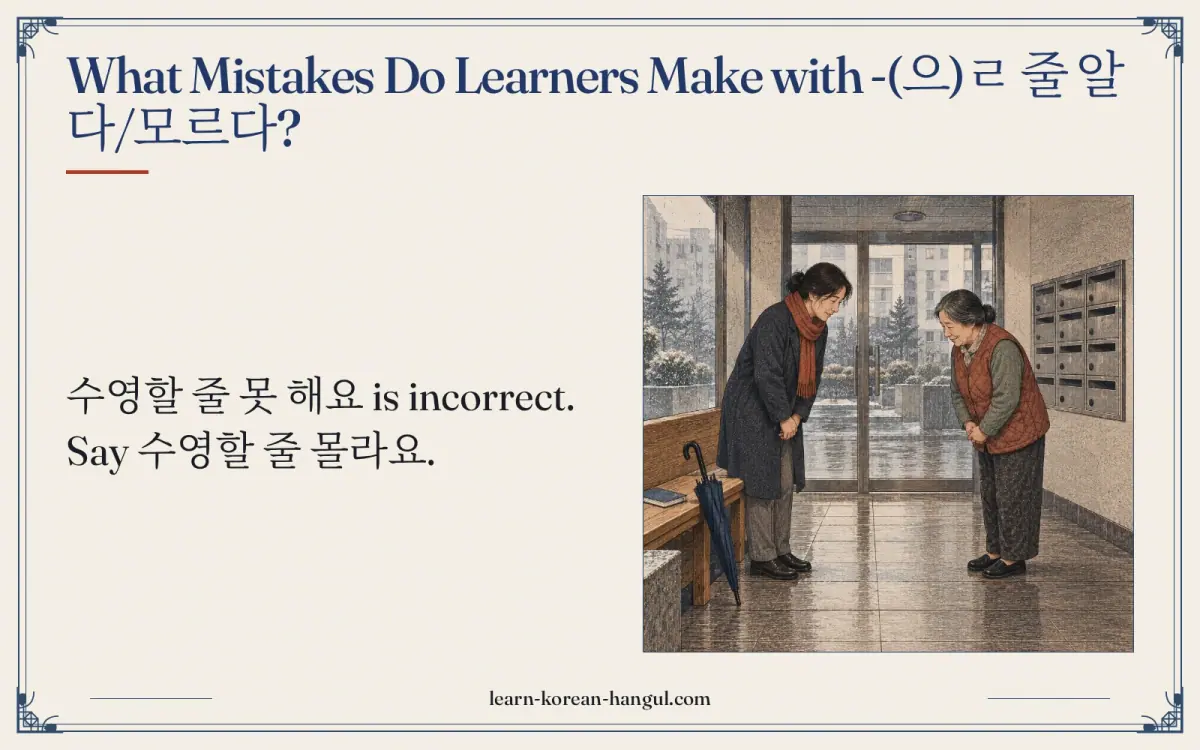
Learners most often mix up the negative, the meaning or the spacing. Five mistakes appear again and again.
- Using it for permission or possibility. 여기서 사진을 찍을 줄 알아요? is wrong for "May I take photos here?". Use 찍을 수 있어요?
- Using 못 or 안 for the negative. 수영할 줄 못 해요 and 수영할 줄 안 알아요 are wrong. The negative is the separate verb 모르다: 수영할 줄 몰라요. 알다 has its own negative verb, so 안 알아요 is not used.
- Writing it as one word. 할줄 알아요 is wrong. 줄 is a dependent noun and takes a space: 할 줄 알아요.
- Putting the past tense on the first verb. 운전했을 줄 알아요 does not mean "I knew how to drive". Put the past on 알다: 운전할 줄 알았어요.
- Using it with an adjective for a skill. 예쁠 줄 알아요 does not mean "I know how to be pretty". In the skill meaning, this pattern needs an action verb.
A quick check: Is the first word an action verb stem plus -(으)ㄹ? Is there a space before 줄? Does the sentence describe a learned skill? If all three answers are yes, the sentence is sound.
The practice set tests these points.
Practice and Answers
Try the four items before you read the answers.
- Choose the form. Complete: 저는 기타를 ___ 줄 몰라요. (칠 / 치을)
- Fix the error. A learner asks 여기서 사진을 찍을 줄 알아요? to find out if photos are allowed. Correct it.
- Translate. "I know how to cook." Use 요리하다.
- Write your own. Write one sentence about a skill you have and one about a skill you lack, using 줄 알다 and 줄 모르다.
Practice · 8
Complete: 저는 기타를 ___ 줄 몰라요.
Show answer
칠
The stem 치 ends in a vowel, so it takes ㄹ directly.
Which sentence asks "May I take photos here?"
Show answer
여기서 사진을 찍을 수 있어요?
Permission needs -(으)ㄹ 수 있다. 줄 알다 is only about a learned skill.
Which sentence correctly says "I don't know how to swim"?
Show answer
수영할 줄 몰라요.
The negative of 줄 알다 is the separate verb 모르다, not 못 or 안.
Which spelling is correct?
Show answer
할 줄 알아요
줄 is a dependent noun, so it is written with a space before it.
Which sentence says "When I was young, I knew how to swim"?
Show answer
어릴 때는 수영할 줄 알았어요.
The past tense goes on 알다, not on the first verb.
What does 비가 오는 줄 알았어요 mean?
Show answer
I thought it was raining.
-(으)ㄴ/는 줄 알았다 shows a belief, usually a mistaken one, and has nothing to do with skill.
Which form is correct for 걷다?
Show answer
걸을 줄 알아요
걷다 is ㄷ-irregular, so ㄷ changes to ㄹ before 을: 걸을.
How is 운전할 줄 알아요 pronounced?
Show answer
[운전할쭐 아라요]
After the ending -ㄹ, 줄 is said tense [쭐], and the ㄹ of 알 moves to the next syllable: [아라요].
Answer key
- 칠. The stem 치 ends in a vowel, so it takes ㄹ directly: 기타를 칠 줄 몰라요.
- 여기서 사진을 찍을 수 있어요? Permission needs 수 있다, because 줄 알다 is about skill.
- 저는 요리할 줄 알아요. (jeoneun yorihal jul arayo.) [저는 요리할쭐 아라요]
- Answers vary. Check that the first verb ends in -(으)ㄹ, the space before 줄 is present and the negative uses 몰라요. An example: 저는 피아노를 칠 줄 알아요. 하지만 바이올린은 연주할 줄 몰라요. ("I know how to play the piano. But I don't know how to play the violin.")
If you can complete items 1 to 3 without the key, you can use the pattern in conversation. The next section points to related lessons.
What Should You Learn Next after -(으)ㄹ 줄 알다/모르다 Grammar?
After -(으)ㄹ 줄 알다/모르다 grammar, learn the pattern for general ability and then the negation forms. This lesson teaches the skill meaning and does not cover permission, possibility or the other uses of 줄. Those have their own pages.
- Start with -(으)ㄹ 수 있다/없다, which covers can and cannot.
- Compare the pair in -(으)ㄹ 수 있다 vs -(으)ㄹ 줄 알다.
- Read 못 can't in Korean and -지 못하다 cannot for the negatives.
- Return to Ability and Possibility to see every lesson in this set, or to the Beginner Grammar list for other early patterns.
With these steps, the pattern becomes automatic: take the verb stem, add -(으)ㄹ 줄 알아요, and use 몰라요 for the negative.
Frequently Asked Questions
What does -(으)ㄹ 줄 알다 mean?
-(으)ㄹ 줄 알다 means "know how to" and -(으)ㄹ 줄 모르다 means "not know how to". Both describe a learned skill. 운전할 줄 알아요 means "I know how to drive", and 수영할 줄 몰라요 means "I don't know how to swim". The first verb takes the modifier ending -(으)ㄹ, and 줄 is a separate word.
How do I attach -(으)ㄹ 줄 알다 to a verb or adjective?
Take the verb stem and add ㄹ after a vowel (탈 줄) or 을 after a consonant (읽을 줄). ㄹ-stems keep ㄹ (만들 줄), and ㄷ-irregular stems change ㄷ to ㄹ (걸을 줄). In the skill meaning, use action verbs only, not adjectives or nouns.
Can -(으)ㄹ 줄 알다 be used in the past tense?
Yes, but the past marker goes on 알다: 운전할 줄 알았어요 means "I knew how to drive". Be careful with -(으)ㄴ/는 줄 알았어요, which means "I thought that ..." and is about a belief, not a skill. 비가 오는 줄 알았어요 means "I thought it was raining".
Is -(으)ㄹ 줄 알다 used in speech or only in writing?
Both. In speech, people say 할 줄 알아요 (polite) and 할 줄 알아 (casual). In notices and formal talks, they say 할 줄 압니다. A question such as 한국어를 할 줄 아세요? is common when you meet someone, and the meaning stays the same at every speech level.
What is the most common mistake with -(으)ㄹ 줄 알다?
The most common mistake is using it for permission or possibility. 여기서 사진을 찍을 줄 알아요? is wrong for "May I take photos here?", and 찍을 수 있어요 is right. A second common slip is the negative: say 몰라요, not 못 or 안.