What you'll learn
- Attach -(으)ㄹ 수 있다 and -(으)ㄹ 수 없다 to any verb stem and say both polite forms from memory.
- Say what you can and cannot do, and ask a friend the same question.
- Ask for permission and make a polite request with the same pattern.
- Handle ㄹ-stems, ㄷ-irregular verbs and 하다 verbs without errors.
- Choose between 수 없다 and the short word 못.
Before you start: you should know how to find a verb stem (drop 다 from the dictionary form) and the polite ending -아요/어요. The page explains the modifier ending -(으)ㄹ from scratch. Audio plays only when you press a button.
What Does -(으)ㄹ 수 있다/없다 Grammar Mean?
-(으)ㄹ 수 있다/없다 grammar means "to be able to" and "to be unable to." The verb in front says the action, and 수 있다 or 수 없다 says whether a way exists to do it. Literally, 갈 수 있어요 is "there is a way to go."
Here are the first two examples. The pattern is the same in both, and only the verb and the final word change.
- 저는 한국어를 읽을 수 있어요. (jeoneun hangugeoreul ilgeul su isseoyo.) [저는 한구거를 일글쑤 이써요] = "I can read Korean."
- 내일은 갈 수 없어요. (naeireun gal su eopseoyo.) [내이른 갈쑤 업써요] = "I can't go tomorrow."
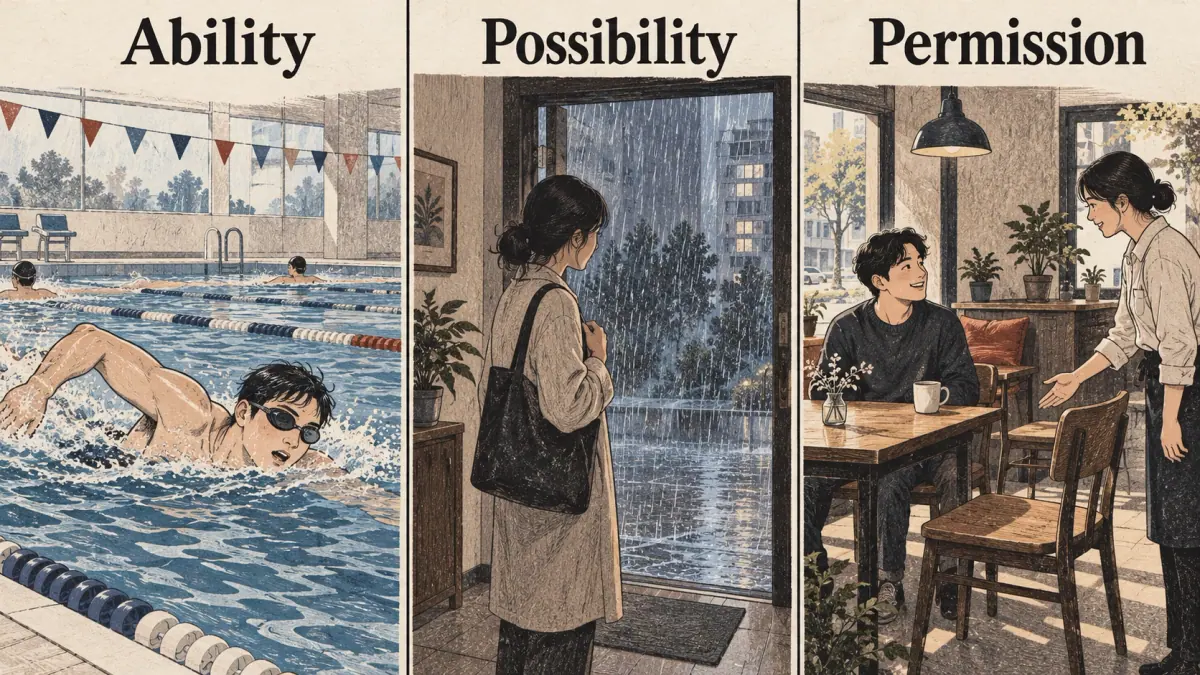
The word 수 is a dependent noun (의존 명사), a noun that cannot stand alone and always needs a modifier in front of it. Here the modifier is the verb in its -(으)ㄹ form, and 수 means "way" or "possibility." The words 있다 ("there is") and 없다 ("there is not") then say whether that way exists. This is why one pattern covers three meanings:
- Ability: the speaker has the skill or strength. 수영할 수 있어요 = "I can swim."
- Possibility: the situation allows it. 내일은 갈 수 없어요 = "I can't go tomorrow (something blocks me)."
- Permission: the rules allow it. 여기에 앉을 수 있어요? = "May I sit here?"
Context tells you which meaning is meant. First, the formation.
How Do You Form -(으)ㄹ 수 있다/없다?
-(으)ㄹ 수 있다/없다 is formed by dropping 다 from the dictionary form of a verb, adding the modifier ending -(으)ㄹ, and then adding 수 있다 or 수 없다. The ending is -ㄹ after a vowel or after a ㄹ stem, and -을 after any other consonant.
| Dictionary form | Stem | Add -(으)ㄹ 수 있다 | Polite form | Meaning |
|---|---|---|---|---|
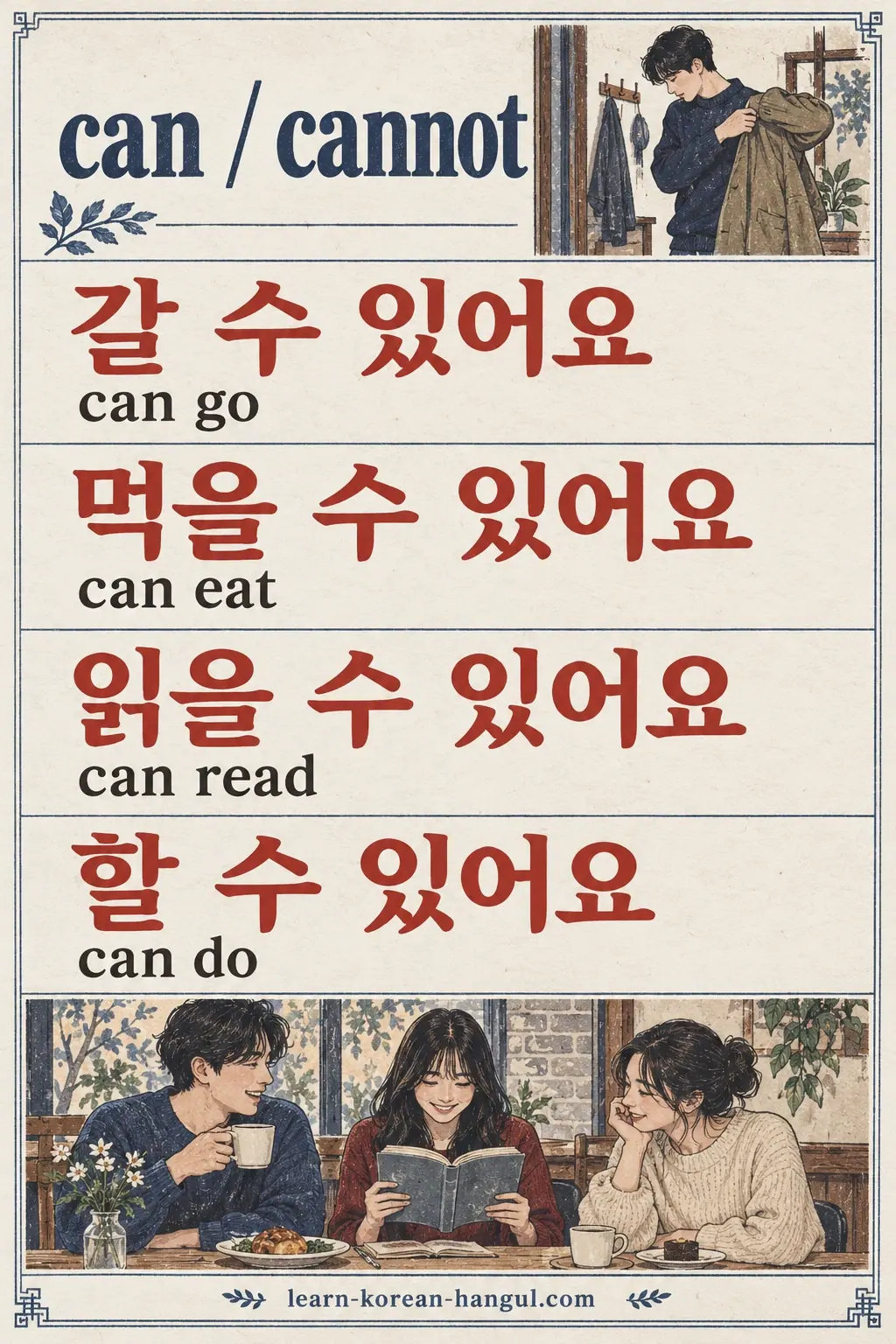
| 가다 | 가 | 갈 수 있다 | 갈 수 있어요 | can go |
| 먹다 | 먹 | 먹을 수 있다 | 먹을 수 있어요 | can eat |
| 하다 | 하 | 할 수 있다 | 할 수 있어요 | can do |
| 읽다 | 읽 | 읽을 수 있다 | 읽을 수 있어요 | can read |
| 만들다 | 만들 | 만들 수 있다 | 만들 수 있어요 | can make |
| 듣다 | 듣 | 들을 수 있다 | 들을 수 있어요 | can listen |
For "cannot," replace 있다 with 없다: 갈 수 없다, 먹을 수 없다, 할 수 없다. The table shows one rule applied to six verbs. The next three parts look at the groups of stems one at a time.
Stems Ending in a Vowel
A vowel stem takes -ㄹ on the last syllable. 가다 becomes 갈, 보다 becomes 볼, 하다 becomes 할, and 사다 becomes 살. Then add 수 있다. Because 하다 verbs are very common, 할 수 있어요 is worth memorising as a unit.
- 수영할 수 있어요. (suyeonghal su isseoyo.) [수영할쑤 이써요] = "I can swim."
- 한국어로 말할 수 있어요. (hangugeoro malhal su isseoyo.) [한구거로 말할쑤 이써요] = "I can speak in Korean."
Notice the sound. After the -ㄹ ending, the ㅅ of 수 becomes tense, so 할 수 is pronounced [할쑤] as if the two words were one. The standard pronunciation rules (표준 발음법) of the 국립국어원 (National Institute of Korean Language) describe this in Article 27: a plain consonant is tensed after a -(으)ㄹ modifier. You write 할 수 and you say [할쑤]. Vowel stems are the simplest case. A stem with a final consonant needs one extra syllable.
Stems Ending in a Consonant
A consonant stem takes -을 before 수. 먹다 becomes 먹을, 읽다 becomes 읽을, and 찍다 becomes 찍을. The same link vowel appears in -으세요 and -으면.
- 매운 음식을 먹을 수 없어요. (maeun eumsigeul meogeul su eopseoyo.) [매운 음시글 머글쑤 업써요] = "I can't eat spicy food."
- 여기에서 사진을 찍을 수 있어요? (yeogieseo sajineul jjigeul su isseoyo?) [여기에서 사지늘 찌글쑤 이써요] = "Can I take photos here?"
The final consonant moves to the next syllable in speech, so 먹을 sounds like [머글] and 찍을 like [찌글]. Two more groups need a short note, because learners expect trouble with them.
Irregular Stems and Nouns
Irregular verbs follow the changes that they show before any ending that starts with -(으)ㄹ.
- ㄷ-irregular: 듣다 becomes 들을 수 있다. 음악을 들을 수 있어요 = "I can listen to music." [으마글 드를쑤 이써요]
- ㅂ-irregular: 돕다 becomes 도울 수 있다 ("can help"). The related verb 도와주다 (to help someone) gives 도와줄 수 있어요?, "Could you help me?"
- ㄹ-stems: 만들다 and 살다 keep their ㄹ and add no second one: 만들 수 있다, 살 수 있다. 김치를 만들 수 있어요? = "Can you make kimchi?"
- 르-verbs: 부르다 becomes 부를 수 있다, and 모르다 becomes 모를 수 있다.
Nouns do not take the pattern directly. To say you can do an activity that is a noun, add 하다: 수영을 할 수 있어요 and 요리를 할 수 있어요 ("I can cook"). Adjectives rarely take the pattern, and only in the possibility sense. 어려울 수 있어요 means "It can be difficult." For that meaning, learners usually choose -(으)ㄹ 수도 있다. With the formation clear, one full sentence can be built step by step.
Worked Example: Building a Sentence with -(으)ㄹ 수 있다/없다

-(으)ㄹ 수 있다/없다 grammar turns an action into a statement about whether it is possible. Follow the steps with the idea "I can eat spicy food, but my friend cannot."
- Choose the verb. 먹다 (to eat). The stem is 먹.
- Add the modifier ending. 먹 ends in a consonant, so add -을: 먹을.
- Add 수 and the verb 있다 or 없다. For "I can": 먹을 수 있다. For "cannot": 먹을 수 없다.
- Move to the polite style. 있다 becomes 있어요, and 없다 becomes 없어요.
- Rebuild the sentence with the object. 저는 매운 음식을 먹을 수 있어요. 친구는 먹을 수 없어요. (jeoneun maeun eumsigeul meogeul su isseoyo. chinguneun meogeul su eopseoyo.) = "I can eat spicy food. My friend can't."
Sentence
You will know it worked when the verb is in the 먹을 form, 수 stands alone with a space on each side, and the object keeps 을/를. The most common slip at step 3 is skipping 수 and writing 먹을 있어요, which is not a sentence. Each sentence can also appear in several tenses and sentence types, and each has limits.
Which Tenses and Sentence Types Work with -(으)ㄹ 수 있다/없다?

-(으)ㄹ 수 있다/없다 works in the present, past, future and negative, in statements and questions. The tense always goes on 있다 or 없다, the last word. The table shows the forms for 가다 in the polite style.
| Sentence type | Form | Meaning |
|---|---|---|
| Present statement | 갈 수 있어요 | I can go. |
| Past statement | 갈 수 있었어요 | I was able to go. |
| Future | 갈 수 있을 거예요 | I will be able to go. |
| Negative | 갈 수 없어요 | I cannot go. |
| Negative past | 갈 수 없었어요 | I could not go. |
| Question | 갈 수 있어요? | Can you go? |
| Formal | 갈 수 있습니다 | I can go (formal). |
| Casual (banmal) | 갈 수 있어 | I can go (to a friend). |
| Written plain style | 갈 수 있다 | I can go (diary, essay). |
| Before a noun | 갈 수 있는 곳 | a place one can go to |
The present statement and the question have the same shape, and rising tone marks the question. In a question the subject is usually "you," and in permission questions it is "I": 여기에 앉을 수 있어요? means "May I sit here?"
- 어제는 갈 수 없었어요. (eojeneun gal su eopseosseoyo.) [어제는 갈쑤 업써써요] = "I could not go yesterday."
- 내일은 갈 수 있을 거예요. (naeireun gal su isseul geoyeyo.) [내이른 갈쑤 이쓸꺼예요] = "I will probably be able to go tomorrow."
Pay attention to where the past tense sits. 갈 수 있었어요 puts it on 있다 and means "I was able to go." Putting it on the verb gives 갔을 수 있어요, a separate pattern that means "He may have gone." A noun-modifying form uses 있는 or 없는: 먹을 수 있는 음식 (meogeul su inneun eumsik) [머글쑤 인는 음식], "food one can eat."
The compatibility pattern is simple: the verb stays in -(으)ㄹ form and only the last word changes. The most useful contrast is with patterns that look similar.
How Is -(으)ㄹ 수 있다/없다 Different from -(으)ㄹ 수도 있다?

-(으)ㄹ 수 있다 states ability or a plain possibility, while -(으)ㄹ 수도 있다 says that something might happen and the speaker is not sure. The small particle 도 changes the job of the sentence from "can" to "maybe."
| Point | -(으)ㄹ 수 있다 | -(으)ㄹ 수도 있다 |
|---|---|---|
| Core idea | can, be able to | might, may |
| Expresses ability | yes | no |
| Example | 저는 갈 수 있어요. | 저는 갈 수도 있어요. |
| Meaning of example | I can go. | I might go (I am not sure). |
그럴 수 있어요 ("That can happen") shows the possibility meaning without 도. It is a reaction: it says that something is understandable, not that someone is able. A second neighbour is -(으)ㄹ 줄 알다/모르다, which means "know how to." 수영할 줄 알아요 says that you learned to swim, while 수영할 수 있어요 says that you are able to swim at this moment, which can depend on your health or on the weather. Use 줄 for learned skills only. The side-by-side lesson is -(으)ㄹ 수 있다 vs -(으)ㄹ 줄 알다.
A third neighbour is -아/어도 되다, "may" or "it is okay to." Both ask for permission, but -아/어도 되다 is the usual way to give or request it, and -(으)ㄹ 수 있다 asks whether it is possible. A fourth, for a different judgement, is -(으)ㄹ 만하다, which says that something is worth doing. These contrasts lead to the smaller variations of the pattern itself.
Variations and Edge Cases of -(으)ㄹ 수 있다/없다

-(으)ㄹ 수 있다/없다 has four common variations: an emphatic 수가 없다, the choice between 수 없다 and 못, a modifying form and a softened question. Each one is short, and each appears in real conversation.
- Emphatic -(으)ㄹ 수가 없다. Adding the subject particle 가 to 수 stresses the impossibility. 갈 수가 없어요 means "There is just no way I can go." Speakers use it when they are frustrated or want to be firm. It is a section of this lesson, not a separate pattern.
- 수 없다 versus 못. 갈 수 없어요 and 못 가요 both mean "I can't go." 못 is shorter and the usual choice in casual speech. 수 없다 is more explicit, and it is common in rules, announcements and writing. Never use both together: 못 갈 수 없어요 is not a normal sentence. See 못 can't in Korean and -지 못하다 cannot for those forms.
- Modifying a noun. Change 있다 to 있는 or 없다 to 없는: 갈 수 있는 곳 ("a place you can go to"), 먹을 수 없는 음식 ("food you can't eat").
- Polite requests. 도와줄 수 있어요? ("Could you help me?") asks for a favour more softly than a command. Adding 혹시 ("by any chance") softens it further: 혹시 도와줄 수 있어요?
This lesson covers the common forms used in daily life. It does not cover relatives such as -(으)ㄹ 수 있도록 ("so that one can") or fixed phrases with 수. The mistakes below show where the boundaries cause real errors.
Common Mistakes with -(으)ㄹ 수 있다/없다
Learners most often get the spacing, the word class or the position of the tense wrong. Four mistakes appear again and again.
- Writing it without spaces. 갈수있어요 is wrong. 수 is a separate word, so write 갈 수 있어요, with a space before and after 수.
- Attaching it to a noun. 수영 수 있어요 is wrong. A noun needs a verb: 수영을 할 수 있어요.
- Putting the past on the verb. 갔을 수 있어요 means "He may have gone," not "I was able to go." For past ability, write 갈 수 있었어요.
- Doubling the negative. 못 갈 수 없어요 repeats the idea twice. Choose 못 가요 or 갈 수 없어요.
A quick check for any "can" sentence: Is the word before 수 a verb in the -(으)ㄹ form? Is 수 spaced? Is the tense on 있다 or 없다? If all three answers are yes, the sentence is sound.
The practice set below tests these points directly.
Practice and Answers
Try the four items before you read the answer key. Cover the answers with your hand.
- Choose the form. Complete: 저는 김치를 ___. ("I can make kimchi.") (만들 수 있어요 / 만들을 수 있어요)
- Make it negative. Change 한국어를 읽을 수 있어요 into "I cannot read Korean."
- Fix the error. A learner says 수영 수 있어요. Correct it.
- Write your own. Write one sentence about a language you can speak, using 말하다 and -(으)ㄹ 수 있어요.
Practice · 7
What does 저는 한국어를 읽을 수 있어요 mean?
Show answer
I can read Korean.
-(으)ㄹ 수 있다 means "can." 읽다 has a consonant stem, so it takes -을: 읽을 수 있어요.
Which form completes 저는 김치를 ___ ("I can make kimchi")?
Show answer
만들 수 있어요
만들다 is a ㄹ stem, so it keeps its ㄹ and takes no extra ㄹ or 을: 만들 수 있어요.
Which form of 듣다 goes before 수 있어요?
Show answer
들을
듣다 is ㄷ-irregular, so ㄷ becomes ㄹ before -을: 들을 수 있어요.
How is 갈 수 있어요 spaced correctly?
Show answer
갈 수 있어요
수 is a dependent noun, so it is its own word with a space on each side: 갈 수 있어요.
A learner says 수영 수 있어요 for "I can swim." What is the correct sentence?
Show answer
수영을 할 수 있어요.
A noun cannot take the pattern directly. Add 하다: 수영을 할 수 있어요.
How do you say "I was able to go"?
Show answer
갈 수 있었어요.
The tense goes on 있다, the last word: 갈 수 있었어요. 갔을 수 있어요 means "He may have gone."
Which sentence means "I can't go" and is correct?
Show answer
갈 수 없어요.
Use 갈 수 없어요 or 못 가요, never both together. 못 갈 수 없어요 doubles the negative.
Answer key
- 만들 수 있어요. 만들다 is a ㄹ stem, so it keeps its ㄹ and takes no extra ㄹ or 을.
- 한국어를 읽을 수 없어요. Replace 있어요 with 없어요.
- 수영을 할 수 있어요. A noun needs 하다 before the pattern.
- 한국어로 말할 수 있어요. (hangugeoro malhal su isseoyo.) = "I can speak in Korean." Answers vary. Check that 말하다 becomes 말할 and 수 stands alone.
If you can complete items 1 to 3 without the key, you can use the pattern in conversation. Next, the lesson hands off to related patterns.
What Should You Learn Next after -(으)ㄹ 수 있다/없다 Grammar?
After -(으)ㄹ 수 있다/없다 grammar, learn how to say that something might happen, then how to say you know how to do something. This lesson teaches "can" and "cannot" and does not cover probability, learned skills or permission in depth. Those live on their own pages.
- Start with -(으)ㄹ 수도 있다, which means "might" and builds on 수.
- Continue with -(으)ㄹ 줄 알다/모르다, the pattern for learned skills.
- For giving and asking permission, read -아/어도 되다.
- Return to Ability and Possibility to see every lesson in this set, or to the Beginner Grammar list for other A1 patterns.
With these steps, -(으)ㄹ 수 있다/없다 becomes automatic: take the verb stem, add -(으)ㄹ 수 있어요, and keep 수 as its own word.
Frequently Asked Questions
What does -(으)ㄹ 수 있다/없다 mean?
-(으)ㄹ 수 있다 means "can" and -(으)ㄹ 수 없다 means "cannot." It covers ability (저는 수영할 수 있어요, "I can swim"), possibility (비가 올 수 있어요, "It can rain") and permission (여기에 앉을 수 있어요?, "May I sit here?"). Context tells you which meaning is meant.
How do I attach -(으)ㄹ 수 있다/없다 to a verb or adjective?
Drop 다 from the verb and add -ㄹ 수 있다 after a vowel or ㄹ (가다 becomes 갈 수 있다) and -을 수 있다 after another consonant (먹다 becomes 먹을 수 있다). Use 없다 for "cannot." Verbs are the normal choice. An adjective appears only when you mean "it can be" something.
Can -(으)ㄹ 수 있다/없다 be used in the past tense?
Yes. Change 있다 or 없다 to the past: 갈 수 있었어요 means "I was able to go," and 갈 수 없었어요 means "I could not go." Do not put the past on the verb. 갔을 수 있어요 is a different sentence and means "He may have gone."
Is -(으)ㄹ 수 있다/없다 used in speech or only in writing?
Both, in every speech level. People say 갈 수 있어요 in daily talk, 갈 수 있어 to friends and 갈 수 있습니다 in formal speech. In writing, the plain form 갈 수 있다 appears. The short word 못 is more common in casual speech for "cannot," but 수 없다 is always correct.
What is the most common mistake with -(으)ㄹ 수 있다/없다?
The most common mistake is writing the pattern without spaces, as in 갈수있어요. A second mistake is attaching it to a noun. 수영 수 있어요 is wrong, and 수영을 할 수 있어요 is correct. A third mistake is adding 못 to a sentence that already says 수 없다.
When should I use 수 없다 instead of 못?
Both mean "cannot." 못 is shorter and sits before the verb, as in 못 가요, and it is the usual choice in casual talk. 수 없다 is more explicit, slightly more formal, and common in writing, announcements and rules. Never use both together: 못 갈 수 없어요 is not a normal sentence.