What you'll learn
- Choose between -(으)니까 and -기 때문에 by checking the second clause.
- Attach both patterns to verbs, adjectives and nouns, in the present and the past.
- Use 때문에 correctly after nouns and 이기 때문에 after predicate nouns.
- Recognise the discovery meaning of -(으)니까.
Before you start: you should know the polite ending -아요/-어요, the past tense and the command ending -(으)세요. The full rules for each pattern are in the lessons on -(으)니까 and -기 때문에. It plays only when you press a button.
What Is the Difference between -(으)니까 and -기 때문에?
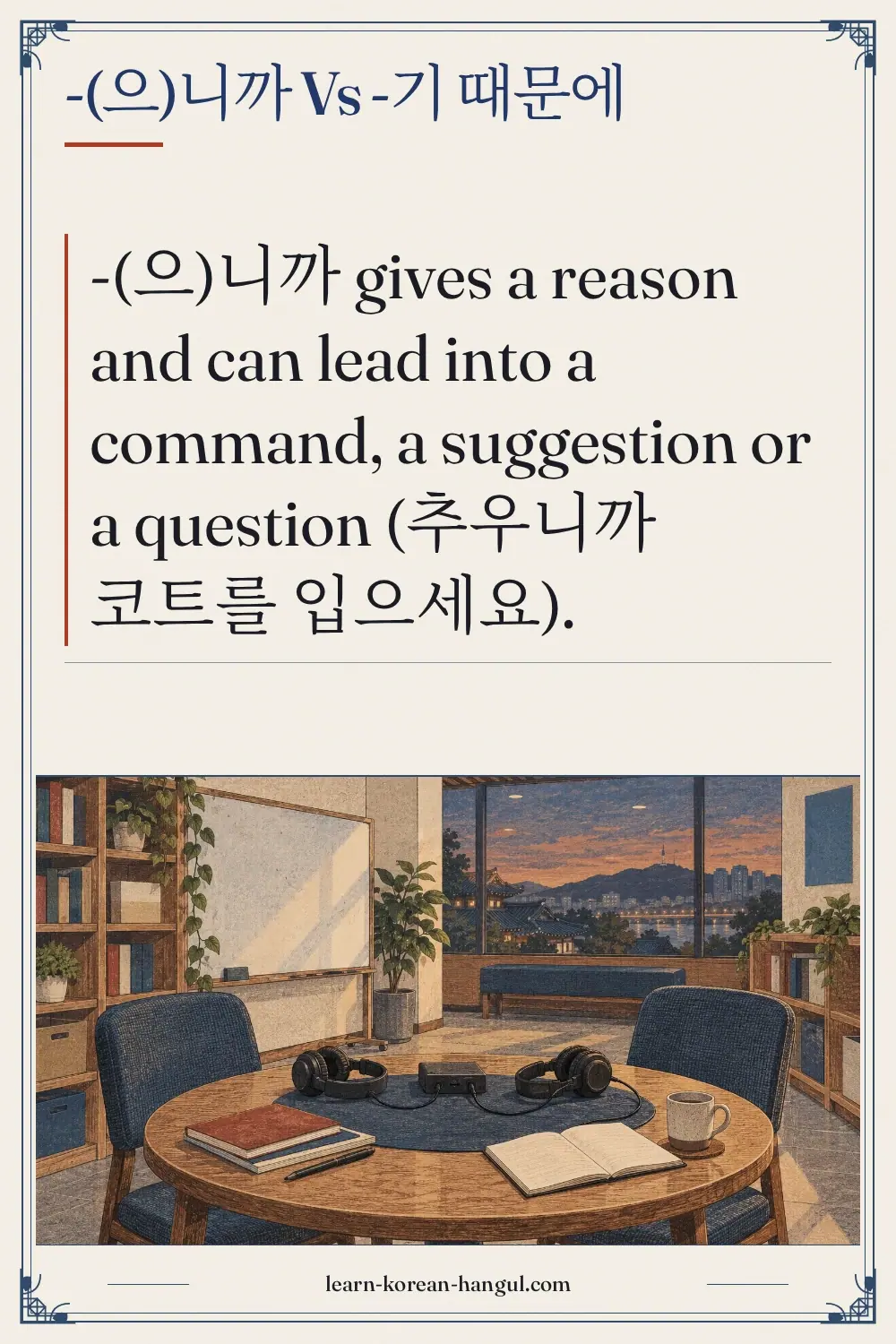
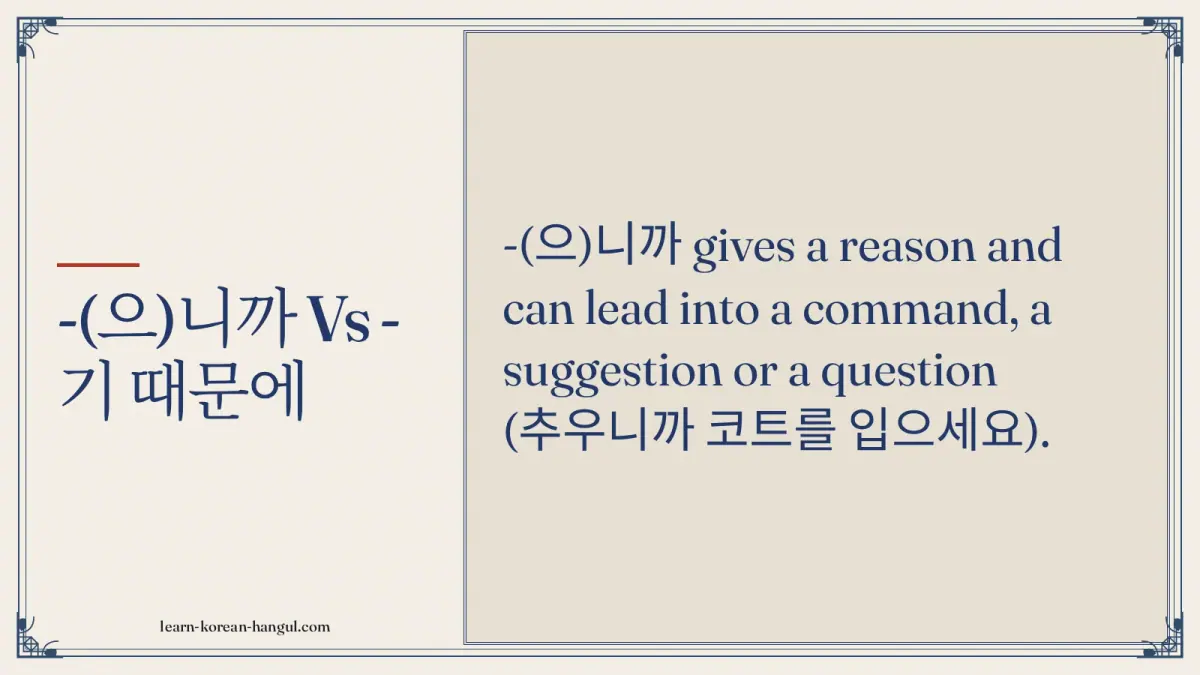
The difference is what the reason is allowed to do. -(으)니까 can support a request: the reason justifies what you ask the listener to do. -기 때문에 explains a result: the reason causes something that happened or happens. The first is for persuading, and the second is for reporting.
Two sentences built on the same weather show the contrast:
- 추우니까 코트를 입으세요. (chuunikka koteureul ibeuseyo.) [이브세요] = "It's cold, so wear a coat." The reason supports a command.
- 추웠기 때문에 코트를 입었어요. (chuwotgi ttaemune koteureul ibeosseoyo.) [추웓끼 때무네] = "Because it was cold, I wore a coat." The reason explains what happened.
Both sentences contain the reason "cold" and a coat. The change is in what comes next: an order in the first, a result in the second. The next sections turn this into a rule you can apply in a few seconds.
The One-Line Rule
Look at the second clause. If it is a command, a suggestion or an invitation, use -(으)니까. If it is a plain statement of what happened, in a formal or written setting, use -기 때문에. In ordinary conversation, -(으)니까 fits both jobs, and the neutral -아/어서 often fits the second.
-(으)니까 vs -기 때문에: Side-by-Side Table
The table compares the two patterns on the points learners need most. Each row has one specific answer for each pattern.
| Point | -(으)니까 | -기 때문에 |
|---|---|---|
| Core meaning | since, because (a reason you offer to the listener) | because (a cause that leads to a result) |
| English cue | "since", "so" | "because", "due to the fact that" |
| Main clause: command or suggestion | yes: 추우니까 입으세요 | no |
| Main clause: statement or question | yes | yes |
| Register | spoken, neutral | formal, written, explanatory |
| Past marker | yes: 추웠으니까 | yes: 추웠기 때문에 |
| After a noun | 학생이니까 | 학생이기 때문에 (but 학생 때문에 means "because of the student") |
| Sentence-final use | yes: 바쁘니까요 | yes: -기 때문이다 / -기 때문이에요 |
| Other meaning | "when I did X, I found Y" | none |
| Spacing | attached: 오니까 | 때문에 is a separate word: 오기 때문에 |
| Example | 시간이 없으니까 택시를 탑시다. | 비가 오기 때문에 경기가 취소됐어요. |
The table shows that -(으)니까 is the wider tool: it works in more sentence types and has a second meaning. -기 때문에 is narrower, but it fits formal explanations. Each has typical situations.
When Do You Use -(으)니까?
Use -(으)니까 when the reason is meant to persuade or to be accepted. Four situations cover most uses:
- A command. 비가 오니까 우산을 가져가세요. (biga onikka usaneul gajeogaseyo.) = "It's raining, so take an umbrella."
- A suggestion. 시간이 없으니까 택시를 탑시다. (sigani eopseunikka taeksireul tapsida.) [업쓰니까 택씨를 탑씨다] = "There's no time, so let's take a taxi."
- A short answer. 바쁘니까요. (bappeunikkayo.) = "Because I'm busy." The polite 요 turns the clause into an answer to 왜요? ("Why?").
- A discovery. 문을 열어 보니까 아무도 없었어요. (muneul yeoreo bonikka amudo eopseosseoyo.) = "When I opened the door, nobody was there." Here -(으)니까 means "when I did it, I found".
To build the pattern, take the stem and add 니까 after a vowel (가니까, 오니까), 으니까 after a consonant (먹으니까, 없으니까) and 니까 after ㄹ with the ㄹ dropped (만들다 becomes 만드니까). For ㅂ-irregular stems the ending is 우니까: 춥다 becomes 추우니까. The past tense goes first: 추웠으니까.
The reason in a -(으)니까 sentence is often something both people can see or know, such as the weather or the time. That shared quality is why speakers use it before orders and suggestions. It is not a rule that the listener must know the reason, but the pattern signals that the reason should be enough.
When Do You Use -기 때문에?
Use -기 때문에 when you explain a cause. Three situations cover most uses:
- A cause in a report. 비가 오기 때문에 경기가 취소됐어요. (biga ogi ttaemune gyeonggiga chwisodwaesseoyo.) = "Because it is raining, the match was cancelled."
- A reason with a noun. 비 때문에 늦었어요. (bi ttaemune neujeosseoyo.) = "I was late because of the rain." With a noun, 때문에 alone means "because of".
- An explanation that ends the sentence. 늦은 이유는 길이 막히기 때문이에요. (neujeun iyuneun giri makigi ttaemunieyo.) = "The reason I was late is that the road was jammed." The ending -기 때문이다 means "it is because...".
To build the pattern, take the stem and add 기 때문에, with no 으 and no vowel change: 오기 때문에, 춥기 때문에, 막히기 때문에. The ending 기 attaches to the plain stem, and 때문에 is a separate word. For the past, say 추웠기 때문에.
The ending -기 때문에 also fits a negative or neutral result that matters: noun + 때문에 often explains a problem, as in 비 때문에 늦었어요. For a positive result, Korean uses a different noun, 덕분에, which this page does not cover.
Worked Example: Choosing the Reason
Follow the steps with the weather reason "it is raining".
- Write the two parts. The reason is 비가 오다 ("it rains"). The result is 우산을 가져가세요 ("take an umbrella").
- Look at the result clause. 가져가세요 is a command (the honorific -(으)세요 form).
- Choose the pattern. A command needs -(으)니까. The stem 오 ends in a vowel, so add 니까: 비가 오니까 우산을 가져가세요.
- Test the other pattern. Change the result into a statement of fact: 경기가 취소됐어요. Now -기 때문에 fits: 비가 오기 때문에 경기가 취소됐어요.
You will know it worked when each sentence has the pattern that matches its second clause. The usual slip at this stage is to use -기 때문에 because it feels more advanced. A sentence such as 비가 오기 때문에 우산을 가져가세요 sounds wrong, because the command needs a reason that supports it.
Can You Use Both in the Same Sentence?
Yes, when the second clause is a plain statement, either pattern is grammatical. 추웠으니까 코트를 입었어요 and 추웠기 때문에 코트를 입었어요 are both correct. The first sounds like a spoken explanation. The second sounds like a written explanation or a firm statement.
Some limits are firm. Only -(으)니까 can lead into a command or a suggestion. Only -(으)니까 can mean "when I did X, I found Y". Only -기 때문에 has the noun form 때문에 for "because of" and the ending -기 때문이다. An honest limit: textbooks present a third option, the neutral -아/어서, as the default reason pattern. This page compares only the two patterns, so see -아/어서 vs -(으)니까 for the other contrast.
Which Should You Pick? a Simple Rule of Thumb
Follow these four steps in order. The first step that applies gives the answer.
- Is the second clause a command, a suggestion or an invitation? Use -(으)니까: 늦었으니까 빨리 가세요.
- Do you mean "when I did it, I found..."? Use -(으)니까: 열어 보니까.
- Are you writing a report, an essay or a formal explanation? Use -기 때문에: 비가 오기 때문에.
- Is the cause a noun, as in "because of the rain"? Use noun + 때문에: 비 때문에.
Checkpoint: add a command after your reason clause. If the sentence still sounds natural, -(으)니까 is right. If it sounds odd, choose -기 때문에, which is for statements only.
What Mistakes Do Learners Make with These Two?
Learners most often use -기 때문에 where a command is coming. Five mistakes appear again and again, and each has a quick repair.
- Using -기 때문에 before a command. Learners often assume that the two patterns are interchangeable. Actually, 비가 오기 때문에 우산을 가져가세요 sounds wrong. Say 비가 오니까 우산을 가져가세요.
- Using 때문에 straight after a verb stem. 비가 오 때문에 is wrong. Add 기 first: 비가 오기 때문에.
- Mixing up "because of" and "because it is". 학생 때문에 할인을 받아요 means "I get a discount because of the student". For "because I am a student", say 학생이기 때문에 할인을 받아요 or 학생이니까.
- Writing 때문에 without a space. 기때문에 breaks the spelling rule. Write 기 때문에, with 때문에 as its own word.
- Using -(으)니까 in a formal written essay. Reports, news and academic writing prefer -기 때문에. Conversation prefers -(으)니까 or -아/어서.
An honest limit: the "listener should accept the reason" feeling of -(으)니까 is a tendency, not a rule. Speakers also use -(으)니까 for reasons the listener does not yet know, as in 바쁘니까요. Check the second clause first, and use the feeling as a second clue.
Practice: Choose the Right Pattern
Try the five items before you read the answer key. Cover the answers with your hand.
- Choose. You give a command. Complete: 비가 ___ 우산을 가져가세요. (오니까 / 오기 때문에)
- Choose. You report the cause of a cancellation. Complete: 경기는 비 ___ 취소됐어요. (때문에 / 니까)
- Choose. You suggest taking a taxi. Complete: 시간이 없___ 택시를 탑시다. (으니까 / 기 때문에)
- Fix the error. Correct 학생 때문에 할인을 받아요, meaning "I get a discount because I am a student."
- Choose. You describe a discovery. Complete: 문을 열어 보___ 아무도 없었어요. (니까 / 기 때문에)
Practice · 5
You give a command. 비가 ___ 우산을 가져가세요.
Show answer
오니까
A command after the reason needs -(으)니까.
You report the cause of a cancellation. 경기는 비 ___ 취소됐어요.
Show answer
때문에
With the noun 비, 때문에 alone means "because of".
You suggest taking a taxi. 시간이 없___ 택시를 탑시다.
Show answer
으니까
A suggestion needs -(으)니까, and the consonant stem 없 takes 으니까.
Which sentence means "I get a discount because I am a student"?
Show answer
학생이기 때문에 할인을 받아요.
A noun used as the predicate needs 이기 때문에. 학생 때문에 means "because of the student".
You describe a discovery. 문을 열어 보___ 아무도 없었어요.
Show answer
니까
The meaning "when I did X, I found Y" belongs to -(으)니까.
Answer key
- 오니까. A command after the reason needs -(으)니까.
- 때문에. With the noun 비, 때문에 means "because of".
- 으니까. The stem 없 ends in a consonant, so the ending is 으니까, and a suggestion needs -(으)니까.
- 학생이기 때문에 할인을 받아요. The noun is the predicate, so it needs 이기 때문에 (학생이니까 is also correct).
- 니까. The meaning "when I did X, I found Y" belongs to -(으)니까.
If you got four or five right, you can handle most real sentences. If you missed item 4, reread the table row on nouns.
What Should You Learn Next?
After -(으)니까 vs -기 때문에, study each pattern on its own, then the neighbouring contrasts. This page compares the two patterns but does not teach every use of either one.
- Read the full lessons: -(으)니까 and -기 때문에.
- Compare the neutral reason pattern in -아/어서 vs -(으)니까.
- Compare the written reason pattern in -기 때문에 vs -아/어서.
- See every pair on Confusing Grammar Compared, or browse Beginner Grammar for the patterns around level A2.
With these steps, the choice in -(으)니까 vs -기 때문에 becomes automatic: check the second clause, then add the pattern to the stem.
Frequently Asked Questions
Can I always replace -(으)니까 with -기 때문에?
No. -기 때문에 cannot lead into a command or a suggestion, so 비가 오기 때문에 우산을 가져가세요 sounds wrong. It also cannot express the "I found out" meaning of -(으)니까. For a statement of cause and result, the replacement works: 추웠으니까 코트를 입었어요 and 추웠기 때문에 코트를 입었어요 are both fine.
Which one sounds more natural in speech?
-(으)니까 is far more common in conversation, because it works for requests, advice and short answers such as 바쁘니까요. -기 때문에 sounds formal and appears in reports, news, essays, speeches and in explanations such as 이유는 ~기 때문이에요. In plain conversation, -아/어서 is the neutral choice for most reasons.
How do I write 때문에 with a noun or a verb?
After a noun, write the noun and 때문에 with a space: 비 때문에. After a verb or adjective stem, add 기 first and then 때문에: 오기 때문에, 춥기 때문에. After a noun used as a predicate, write 이기 때문에: 학생이기 때문에. 때문에 is always spaced from the word before it.
Can both take a past tense marker?
Yes. Both attach after the past stem: 추웠으니까 and 추웠기 때문에. The past marker shows that the reason lies in the past. This differs from -아/어서, which usually takes no past marker. Choose the tense of the reason clause to match when the reason was true, not when the result happened.
What is the quickest rule to remember?
Look at the second clause. If it is a command, a suggestion or an invitation, use -(으)니까. If it is a statement of result in a formal or written context, use -기 때문에. For ordinary speech with a statement, -(으)니까 or the neutral -아/어서 usually sounds more natural.