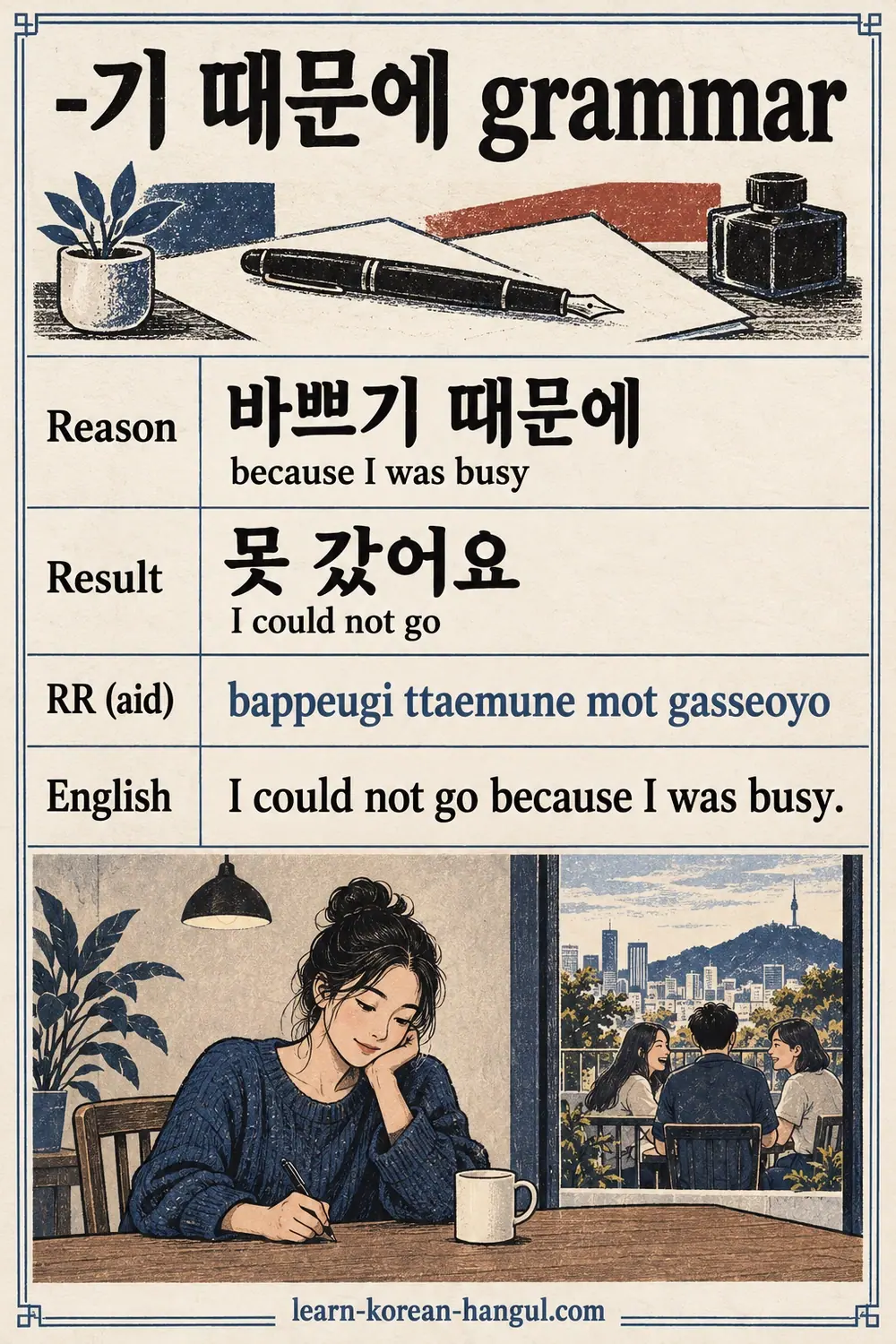
What you'll learn
- Attach -기 때문에 to any verb or adjective, and 때문에 to a noun.
- Put tense inside the clause and end a sentence with -기 때문이다.
- Know why a command can never follow it.
- Choose between -기 때문에, -아/어서 and -(으)니까.
Prerequisites: the polite ending -아요/어요 and the past tense -았/었-. Time: about 15 minutes.
Listen to two model sentences.
The next section defines the pattern.
What Does -기 때문에 Grammar Mean?

-기 때문에 means "because". It states a reason clearly and gives it weight. In the sentence, the reason is not a side comment. It is the main explanation for what follows.
The pattern has two parts. The ending -기 turns a verb or adjective into a noun-like phrase. A nominalizer is an ending that makes a phrase work like a noun. The word 때문 is a dependent noun meaning "cause" or "sake", and 에 marks it as "because of". So 바쁘기 때문에 literally says "because of the fact that I am busy".
Here are two glossed examples.
| Part | 바쁘기 때문에 못 갔어요. | 일이 많았기 때문에 늦게 왔어요. |
|---|---|---|
| Reason | 바쁘기 때문에 (because I was busy) | 일이 많았기 때문에 (because I had a lot of work) |
| Result | 못 갔어요 (I could not go) | 늦게 왔어요 (I came late) |
| Spoken | [바쁘기 때무네 몯 까써요] | [이리 마낟끼 때무네 늗께 와써요] |
| RR (aid) | bappeugi ttaemune mot gasseoyo | iri manatgi ttaemune neutge wasseoyo |
| English | I could not go because I was busy. | I came late because I had a lot of work. |
In both sentences, 때문에 is said [때무네]. The ㄴ links to the next syllable, as in most Korean words that end in a consonant before a vowel.
The next section shows how to build the form.
How Do You Form -기 때문에?
There are two shapes: one for verbs and adjectives, and one for nouns.
Verbs and adjectives. Remove 다 from the dictionary form to get the stem. Then add 기 때문에. The stem is the verb or adjective without its dictionary ending -다. For 먹다 the stem is 먹.
Nouns. Put 때문에 directly after the noun. Do not add 기. 감기 때문에 means "because of a cold".
Because 기 starts with a consonant, the stem never needs a helping vowel. That is why this pattern is simpler than -(으)니까.
| Dictionary form | Stem | Stem + 기 때문에 | Spoken | RR (aid) |
|---|---|---|---|---|
| 가다 (go) | 가 | 가기 때문에 | [가기 때무네] | gagi ttaemune |
| 하다 (do) | 하 | 하기 때문에 | [하기 때무네] | hagi ttaemune |
| 먹다 (eat) | 먹 | 먹기 때문에 | [먹끼 때무네] | meokgi ttaemune |
| 읽다 (read) | 읽 | 읽기 때문에 | [일끼 때무네] | ilgi ttaemune |
| 좋다 (be good) | 좋 | 좋기 때문에 | [조키 때무네] | joki ttaemune |
| 많다 (be many) | 많 | 많기 때문에 | [만키 때무네] | manki ttaemune |
| 있다 (exist, have) | 있 | 있기 때문에 | [읻끼 때무네] | itgi ttaemune |
| 없다 (not exist) | 없 | 없기 때문에 | [업끼 때무네] | eopgi ttaemune |
Two sound changes appear. After a final consonant such as ㄱ, ㅂ or ㄷ-sounds, the ㄱ of 기 is said as a tense ㄲ, so 먹기 sounds like [먹끼]. This tensing happens in speech only, and Revised Romanization (RR) does not mark tensing that comes from a neighbouring sound, so it writes meokgi. The second change is aspiration. The ㅎ of 좋 and 많 joins the next ㄱ and makes ㅋ. RR writes this aspiration in predicates, so it is joki and manki.
Stems Ending in a Vowel
A vowel stem takes 기 때문에 directly: 가기 때문에, 비싸기 때문에, 바쁘기 때문에. No contraction takes place. For 하다 verbs, write 하기: 피곤하기 때문에, 정직하기 때문에.
Stems Ending in a Consonant
A consonant stem also takes 기 때문에 directly: 먹기 때문에, 읽기 때문에, 많기 때문에. There is no 으 to insert. This is the biggest difference from -(으)니까, which adds 으 after a consonant.
Irregular Stems and Nouns
Irregular stems do not change before 기. An irregular stem is one that changes its shape before an ending that begins with a vowel. 기 begins with a consonant, so the change never happens.
| Type | Dictionary form | With 기 때문에 | Note |
|---|---|---|---|
| ㅂ-irregular | 춥다 (be cold) | 춥기 때문에 | ㅂ stays; compare 추워요 |
| ㄷ-irregular | 듣다 (listen) | 듣기 때문에 | ㄷ stays; compare 들어요 |
| 르-irregular | 모르다 (not know) | 모르기 때문에 | 르 stays; compare 몰라요 |
| ㅡ stem | 아프다 (be sick) | 아프기 때문에 | ㅡ stays; compare 아파요 |
| ㄹ stem | 살다 (live) | 살기 때문에 | ㄹ stays; it drops only before ㄴ, ㅂ and ㅅ |
For nouns, you have two choices. To say "because of X", use 때문에 alone. To say "because it is X", use 이다 plus 기 때문에.
| Noun | Meaning | Form |
|---|---|---|
| 감기 (a cold) | because of a cold | 감기 때문에 |
| 학생 (student) | because I am a student | 학생이기 때문에 [학쌩이기 때무네] |
| 의사 (doctor) | because I am a doctor | 의사이기 때문에 |
| 아니다 (is not) | because it is not | 아니기 때문에 |
The next section builds a full sentence.
Worked Example: Building 바쁘기 때문에 못 갔어요

Say "I could not go because I was busy." Follow five steps.
- Write the reason. The word is 바쁘다, "be busy".
- Find the stem. Remove 다 to get 바쁘.
- Add 기 때문에. Nothing changes in the stem, so the result is 바쁘기 때문에.
- Write the result. 못 갔어요 means "could not go". The past tense and the polite ending are both in this last verb.
- Join the two parts. 바쁘기 때문에 못 갔어요.
You'll know it worked when the reason part ends in 때문에 and the speech-level ending 요 appears only once, on the last verb. Try the same steps with "I stayed home because of a cold": the noun 감기 takes 때문에 directly, and 집에 있었어요 follows.
Sentence
I could not go because I was busy.
Show answer
바쁘기 때문에 못 갔어요
The next section covers tense and sentence types.
Which Tenses and Sentence Types Work with -기 때문에?

The tense marker goes between the stem and 기. The final verb then carries the speech level.
| Slot | Form | Example | English |
|---|---|---|---|
| Past before 기 | stem + 았/었 + 기 때문에 | 바빴기 때문에 | because I was busy |
| Past with 하다 | 했 + 기 때문에 | 피곤했기 때문에 | because I was tired |
| Future reason | stem + (으)ㄹ 것이기 때문에 | 비가 올 것이기 때문에 | because it will rain |
| Statement after | any style | 길이 막혔기 때문에 늦었어요. | I was late because the road was blocked. |
| Question after | rising for yes/no | 일이 많기 때문에 늦어요? | Will you be late because of work? |
| Command after | not allowed | (use -(으)니까) | |
| Suggestion after | not allowed | (use -(으)니까) | |
| Sentence ending | -기 때문이다 | 길이 막혔기 때문이에요. | It is because the road was blocked. |
Look at the past form. The marker 았/었 comes first and 기 follows, with no helping vowel: 먹었기 때문에, 갔기 때문에, 많았기 때문에. The past tense has its own page: past tense -았/었-.
The form -기 때문이에요 ends a sentence, so it makes a natural answer to a why-question: 왜 늦었어요? 길이 막혔기 때문이에요. The word 왜냐하면 ("the reason is that...") often opens such an answer: 왜냐하면 길이 막혔기 때문이에요. This frame is common in essays and speeches.
The sentence 길이 막혔기 때문입니다 is said [기리 마켣끼 때무님니다]. The ㄴ of 문 joins the vowel of 입, and the ㅂ becomes ㅁ before ㄴ.
Yes/no questions end with a rise. A wh-question puts the stress on the question word and often ends with a fall or a rise-fall, rather than a sharp rise: 왜 늦었어요? asks "Why were you late?"
The big rule is the one at the bottom of the grid. -기 때문에 gives a reason, so it cannot be followed by a command or a suggestion. You cannot say "Because it is raining, take an umbrella!" with this ending. Use -(으)니까 there.
The next section compares -기 때문에 with its neighbours.
How Is -기 때문에 Different from -아/어서?

All three endings can be translated as "because". They differ in tone, flexibility and sentence type.
| Feature | -아/어서 | -(으)니까 | -기 때문에 |
|---|---|---|---|
| Tone | light, neutral | personal, shared reason | firm, explanatory |
| Tense marker inside | not allowed | allowed | allowed |
| Command or suggestion after | not allowed | allowed | not allowed |
| Ends a sentence | with 요 only (막혀서요) | with 요 only (오니까요) | yes: -기 때문이다 |
| Thanks and apology | natural | not natural | not natural |
| Typical place | everyday talk | advice and requests | reports, answers, essays |
| Example | 바빠서 못 갔어요. | 바쁘니까 나중에 가요. | 바쁘기 때문에 못 갔어요. |
Compare these two sentences with the same meaning.
- 바빠서 못 갔어요. ("I was busy, so I couldn't go.") A natural, light explanation.
- 바쁘기 때문에 못 갔어요. ("I could not go because I was busy.") The reason is stressed, as when someone asks you to explain.
A useful test is to ask who needs the reason. If you are chatting, -아/어서 is enough. If you are defending a decision or writing a report, -기 때문에 gives the reason weight. Do not use it when you only want to thank someone. 도와주셔서 감사합니다 is natural, but 도와주기 때문에 감사합니다 is not.
For longer comparisons with practice, see -기 때문에 vs -아/어서 and -(으)니까 vs -기 때문에. The neighbouring lessons are -아/어서 and -(으)니까.
The next section covers set phrases and edge cases.
Variations and Edge Cases of -기 때문에

때문에 after a Noun Leans Negative
When 때문에 follows a noun, it often points to a cause that the speaker blames or regrets. 비 때문에 경기가 취소됐어요 ("The game was cancelled because of the rain") is neutral, but 너 때문에 망했어 ("It is your fault that it went wrong") blames someone. For a good result, Korean uses 덕분에, which means "thanks to".
Spoken, 덕분에 is [덕뿌네]. The sentence 선생님 덕분에 합격했어요 means "Thanks to my teacher, I passed."
The Casual 땜에
In chat messages and casual talk, 때문에 is often shortened to 땜에: 감기 땜에 못 갔어. This is a casual spelling of the spoken form. Use 때문에 in writing and in class.
The Future Reason
For a reason that has not happened yet, writers use -(으)ㄹ 것이기 때문에: 내일 비가 올 것이기 때문에 준비해야 합니다 ("Because it will rain tomorrow, we must prepare"). In speech, -(으)ㄹ 테니까 or -(으)니까 is more common.
Spacing
Write 때문에 as a separate word: 기 때문에 and 감기 때문에. The pattern is not a single ending, so a space follows the stem part or the noun.
The next section lists the mistakes that appear most often.
What Mistakes Do Learners Make with -기 때문에?
Learners make six predictable mistakes. Each has a reason and a fix.
Learners often attach 때문에 directly to a verb stem. Wrong: 바쁘 때문에 못 갔어요. Right: 바쁘기 때문에 못 갔어요. Fix: a verb or adjective needs 기 first. Only a noun can take 때문에 alone.
Learners often add 기 to a noun. Wrong: 감기기 때문에 학교에 못 갔어요. Right: 감기 때문에 학교에 못 갔어요. Fix: nouns take 때문에 alone. If you really mean "because it is X", use 이기 때문에.
Learners often follow it with a command. Wrong: 비가 오기 때문에 우산을 가져가세요. Right: 비가 오니까 우산을 가져가세요. Fix: for advice or invitations, use -(으)니까.
Learners often use it for thanks. Wrong: 도와주기 때문에 감사합니다. Right: 도와주셔서 감사합니다. Fix: -아/어서 expresses thanks and apologies.
Learners often use it for a good result after a noun. 선생님 때문에 합격했어요 sounds like blame or surprise. Fix: use 덕분에.
Learners often put the polite ending inside. Wrong: 바빠요기 때문에 못 갔어요. Right: 바쁘기 때문에 못 갔어요. Fix: attach 기 to the bare stem. A tense marker such as 았/었 is fine inside (바빴기 때문에), but 요 belongs only at the end.
The next section gives you practice.
Practice and Answers
Do the four tasks, then compare with the key.
Task 1: join the sentences with -기 때문에 or 때문에. Write one sentence for each pair.
- 비가 오다 / 경기가 취소됐어요.
- 눈이 많이 오다 / 길이 미끄러워요.
- 감기 / 학교에 못 갔어요.
- 학생이다 / 할인을 받아요.
Task 2: fix the error. Each sentence has one mistake. Rewrite it correctly.
- 바쁘 때문에 못 갔어요.
- 비 때문에 우산을 가져가세요.
- 감기기 때문에 학교에 못 갔어요.
Task 3: translate. Write in Korean: "I am late because the road is blocked." and "Thanks to my teacher, I passed."
Task 4: write your own. Write one sentence that explains why you were late, and one that uses 덕분에.
Practice · 5
How do you say "because of the snow" with the noun 눈?
Show answer
눈 때문에
A noun takes 때문에 directly, with no 기. 눈이기 때문에 would mean "because it is snow".
Which sentence is correct?
Show answer
비가 오니까 우산을 가져가세요.
-기 때문에 cannot be followed by a command or a suggestion. Advice needs -(으)니까.
Which form of 바쁘다 means "because I was busy"?
Show answer
바빴기 때문에
The past form of 바쁘다 is 바빴. Then add 기 때문에.
Finish the answer: "Why were you late?" "The reason is that I was sick." (왜 늦었어요? 아팠기 ___)
Show answer
때문이에요
-기 때문이에요 ends a sentence and means "it is because". The ending 이에요 is the copula.
Which word fits a good result: "I passed ___ my teacher."
Show answer
선생님 덕분에
때문에 often leans negative when it follows a noun. 덕분에 means "thanks to" and is used for good results.
Answer key
- (1) 비가 오기 때문에 경기가 취소됐어요. (2) 눈이 많이 오기 때문에 길이 미끄러워요. (3) 감기 때문에 학교에 못 갔어요. (4) 학생이기 때문에 할인을 받아요.
- (1) 바쁘기 때문에 못 갔어요. (2) 비가 오니까 우산을 가져가세요. (3) 감기 때문에 학교에 못 갔어요. Another correct version is 감기에 걸렸기 때문에 학교에 못 갔어요.
- 길이 막히기 때문에 늦었어요. 선생님 덕분에 합격했어요. Other correct versions exist, for example 길이 막혔기 때문에 늦었어요.
- Sample answers: 일이 많았기 때문에 늦었어요. 친구 덕분에 한국어를 잘하게 됐어요. Any pair is correct if the verb stem carries 기 때문에 and the noun carries 때문에 or 덕분에.
If task 1 was correct, you have the formation rule. If task 2 was hard, check whether the word before 때문에 is a verb or a noun. The next section points you to what comes after this lesson.
What Should You Learn after -기 때문에 Grammar?
After -기 때문에, learn -(으)ㄹ까 봐, a reason based on a worry, and the lesson on -(으)니까 if you have not yet read it.
For a wider view, the parent page Cause and Reason lists every connector in this group. To plan by level, use Beginner Grammar.
This lesson covers -기 때문에 in the polite and formal styles. It does not cover every written variation. About this page. Last updated 2026-10-09. Revised Romanization follows the national rules and is shown only as a learning aid.
Frequently Asked Questions
What Does -기 때문에 Mean?
-기 때문에 means "because". It states a reason in a clear, slightly firm way, and the reason is the point of the sentence. 바쁘기 때문에 못 갔어요 means "I could not go because I was busy." With a noun, 때문에 means "because of": 감기 때문에 학교에 못 갔어요.
How Do I Attach -기 때문에 to a Verb or Adjective?
Take the stem, which is the dictionary form without 다, and add 기 때문에. 가다 becomes 가기 때문에, 먹다 becomes 먹기 때문에, and 춥다 becomes 춥기 때문에. There is no vowel rule and no irregular change. With a noun, skip 기: 눈 때문에. For 이다, say 이기 때문에.
Can -기 때문에 Be Used in the past Tense?
Yes. Put 았/었 before 기: 바빴기 때문에, 먹었기 때문에, 많았기 때문에. Use this when the reason happened earlier than the speaking moment or is complete. For a future reason, formal writing often uses -(으)ㄹ 것이기 때문에. The speech level goes only on the last verb.
Is -기 때문에 Used in Speech or Only in Writing?
Both, but it sounds firm and explanatory. It fits answers to "why", reports, presentations, news and essays. Between friends, learners hear -아/어서, -(으)니까 or the casual 땜에 more often. If you use -기 때문에 in a chat, it can sound stiff or defensive.
What Is the Most Common Mistake with -기 때문에?
The most common mistake is joining 때문에 straight to a verb stem, as in 바쁘 때문에. The second is following -기 때문에 with a command or a suggestion, as in 비가 오기 때문에 우산을 가져가세요. For advice, use -(으)니까: 비가 오니까 우산을 가져가세요.
What Is the Difference between -기 때문에 and -아/어서?
-아/어서 links a cause and its result in a light, neutral way and takes no tense marker. -기 때문에 states the reason more firmly, takes tense markers, and can end a sentence as -기 때문이다. Neither allows a command. Use -아/어서 for thanks and apologies, such as 늦어서 죄송합니다.