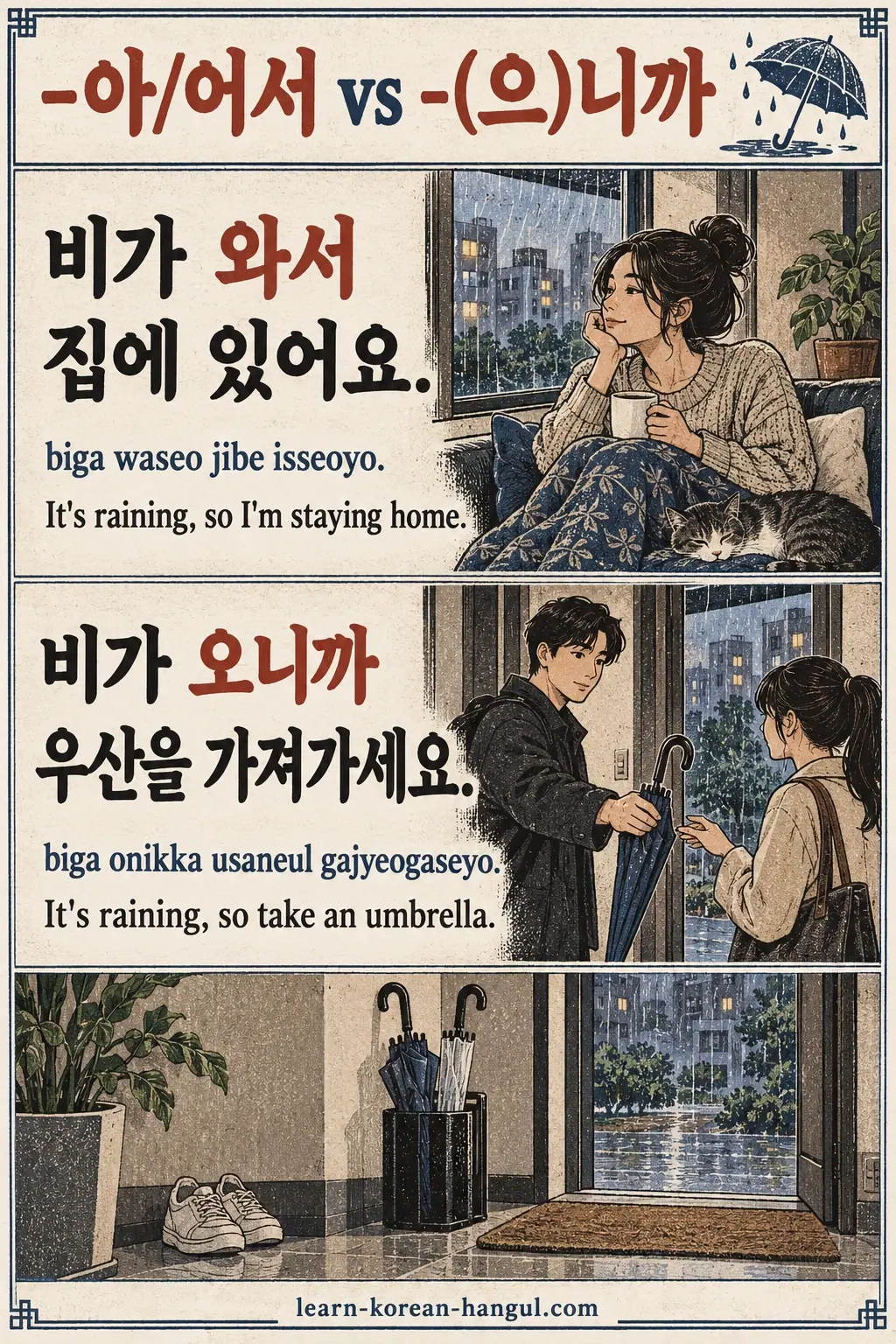
-아/어서 vs -(으)니까 is the choice between two Korean endings that both mean "because" or "so". The first, -아/어서, gives a natural cause-and-effect link. The second, -(으)니까, gives a reason the listener can accept and act on, so it can lead into a command or a suggestion.
Key facts
- Both endings attach to a verb or adjective stem and join two clauses: reason first, result second.
- Level: A2. This is an editorial estimate based on common textbook order, not an official list.
What you'll learn
- Say in one sentence how the two endings differ.
- Pick the right ending by looking at how the sentence ends.
- Avoid the three errors that learners make most often.
- Explain your choice in five short test sentences.
Before you start, it helps to know how to build each ending. The full rules are in the lessons on -아/어서 and -(으)니까. Estimated time: 15 minutes.
What Is the Difference between -아/어서 and -(으)니까?
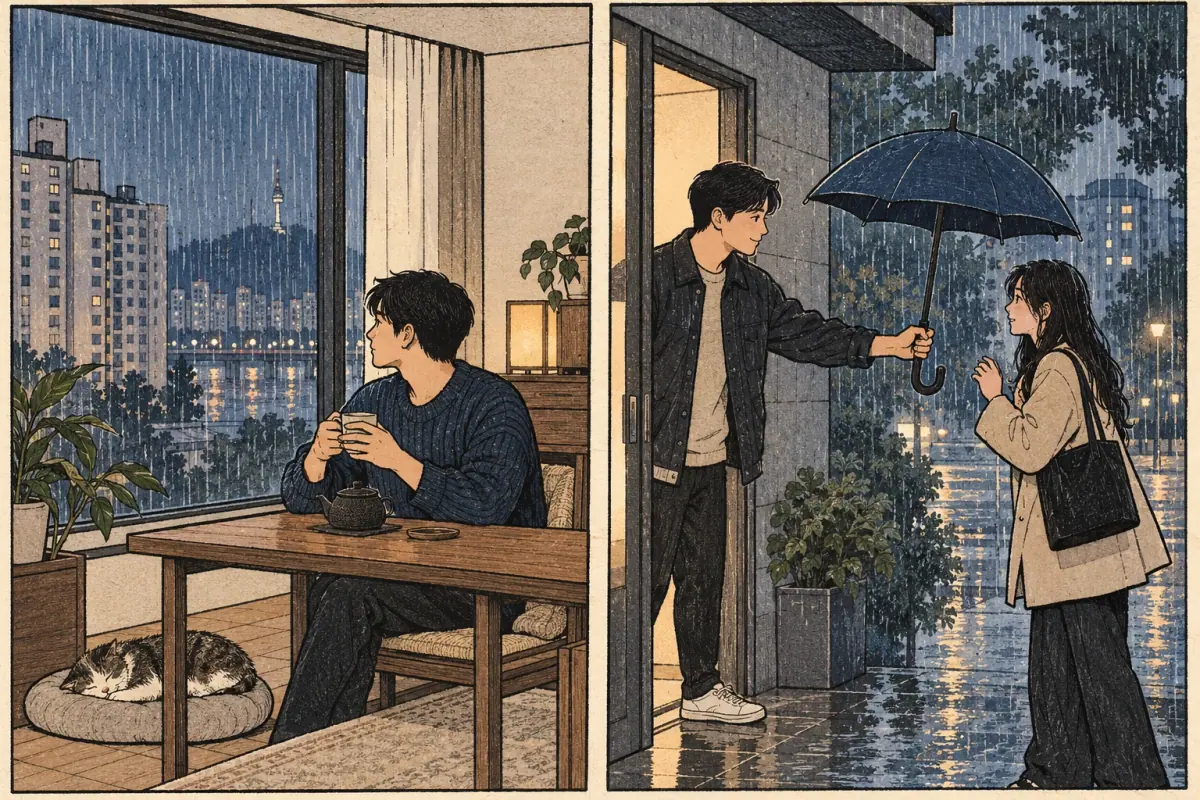
The difference is about what the reason is allowed to do. With -아/어서, the reason is simply the cause of the result. With -(으)니까, the reason is a point you offer to the listener, and then you ask them to do something about it.
Here is the smallest pair that shows it. Both sentences are about rain, and both are correct.
-아/어서: 비가 와서 집에 있어요. (biga waseo jibe isseoyo.) means "It's raining, so I'm staying home." The rain caused the staying home. Nothing is asked of the listener.
-(으)니까: 비가 오니까 우산을 가져가세요. (biga onikka usaneul gajyeogaseyo.) means "It's raining, so take an umbrella." The rain is a reason the listener can see for themselves, and the sentence turns it into advice. Say 가져가세요 as [가저가세요].
The key point: the first sentence reports a result, and the second one directs someone. That is why the sentence type at the end decides which ending you need.
-아/어서 vs -(으)니까: Side-by-Side Table
The table compares the two endings on the points that decide most choices. Each row is a test you can run on your own sentence.
-아/어서
cause and effect: because, so; also and then
-(으)니까
a reason to act on: since, because; also a discovery marker
Use -(으)니까 before commands and suggestions or when the clause needs a past tense; use -아/어서 for ordinary causes, thanks and apologies.
| Test | -아/어서 | -(으)니까 |
|---|---|---|
| Core meaning | natural cause and effect | a reason the listener can accept |
| Followed by a command? | no | yes: 추우니까 입으세요 |
| Followed by a suggestion? | no | yes: 좋으니까 갈까요? |
| Past tense inside the clause? | no | yes: 잤으니까 |
| Thanks and apologies | yes: 늦어서 죄송합니다 | not used |
| Meaning "and then" | yes: 만나서 보다 | no |
| Discovery meaning ("when I did X, I found Y") | no | yes: 오니까 있었어요 |
| After a noun | (이)라서 | (이)니까 |
| Short answer to "why?" | not used alone | yes: -(으)니까요 |
Most of these rows come down to one fact. A -아/어서 clause is a closed cause, so it cannot carry its own tense or point toward an action. A -(으)니까 clause is a full statement in its own right, so it can.
When Do You Use -아/어서?

You use -아/어서 when the first clause is the plain cause of the second clause, and when the sentence ends in a statement or a question about a fact. It has four main jobs.
- Ordinary cause and effect. 배가 아파서 병원에 갔어요. (baega apaseo byeongwone gasseoyo.) means "My stomach hurt, so I went to the hospital." The pain caused the visit. The tense sits on the last verb only.
- Thanks and apologies. The reason for a feeling is always -아/어서: 도와줘서 고마워요 ("Thank you for helping") and 늦어서 죄송합니다 ("I am sorry I am late"). Say 늦어서 as [느저서].
- Sequence, "and then". 친구를 만나서 영화를 봤어요. (chingureul mannaseo yeonghwareul bwasseoyo.) means "I met a friend and saw a movie." The first action leads straight into the second.
- Nouns with (이)라서. After a noun, the form is 이라서 after a final consonant and 라서 after a vowel: 학생이라서 할인을 받아요 ("I get a discount because I'm a student"). Say 학생이라서 as [학쌩이라서].
How the form is built: take the stem and add 아서 if the last vowel is ㅏ or ㅗ, and 어서 for every other vowel. 오다 gives 와서, 늦다 gives 늦어서, 도와주다 gives 도와줘서, and 하다 gives 해서. The vowel-harmony rule and the irregular verbs are covered in the full -아/어서 lesson.
When Do You Use -(으)니까?

You use -(으)니까 when you give a reason that the listener can see or accept and then say what to do about it, and also when the reason clause needs its own tense. It has four main jobs.
- Before a command. 추우니까 외투를 입으세요. (chuunikka oetureul ibeuseyo.) means "It's cold, so put on a coat." The reason is shared, and the command follows from it. 춥다 is a ㅂ irregular adjective, so the stem 춥 becomes 추우 before -(으)니까.
- Before a suggestion. 날씨가 좋으니까 산책할까요? (nalssiga joeunikka sanchaekalkkayo?) means "The weather is nice, so shall we take a walk?" The question is a yes/no question, so it rises at the end. Say 좋으니까 as [조으니까].
- With a past tense inside the clause. 어제 늦게 잤으니까 오늘 피곤해요. (eoje neutge jasseunikka oneul pigonhaeyo.) means "I went to bed late yesterday, so I'm tired today." The past marker -았/었 sits inside the clause, before -(으)니까. Say 잤으니까 as [자쓰니까].
- As a discovery marker. 집에 오니까 편지가 있었어요. (jibe onikka pyeonjiga isseosseoyo.) means "When I came home, there was a letter." Here -(으)니까 does not give a reason at all. It means "I did X, and then I found Y".
How the form is built: add 니까 to a stem that ends in a vowel, and 으니까 to a stem that ends in a consonant. 오다 gives 오니까, 좋다 gives 좋으니까, and 하다 gives 하니까. Verbs with ㄹ at the end of the stem drop it, so 살다 gives 사니까. Notice that no vowel harmony applies here.
Can You Use Both in the Same Sentence?

Yes, in plain statements, you often can. When the second clause is a statement and not a command, both endings are grammatical, and the difference is a matter of tone.
- 배가 아파서 병원에 갔어요. This reports what happened.
- 배가 아프니까 병원에 갔어요. This sounds like the speaker is explaining or justifying the visit.
So the swap is safe only when the sentence is a statement. It stops working in three places: after a command or a suggestion (only -(으)니까 works), in thanks and apologies (only -아/어서 works), and in "and then" sequences (only -아/어서 works).
The two endings can also appear in one sentence when there are two reasons. 비가 와서 길이 막히니까 지하철을 타세요 means "It rained and the roads are jammed, so take the subway." The first reason is a plain cause, and the second reason leads into the command. The limit of this example is that it is a long sentence, and most learners should build such chains slowly.
Which One Should You Pick? a Simple Rule of Thumb
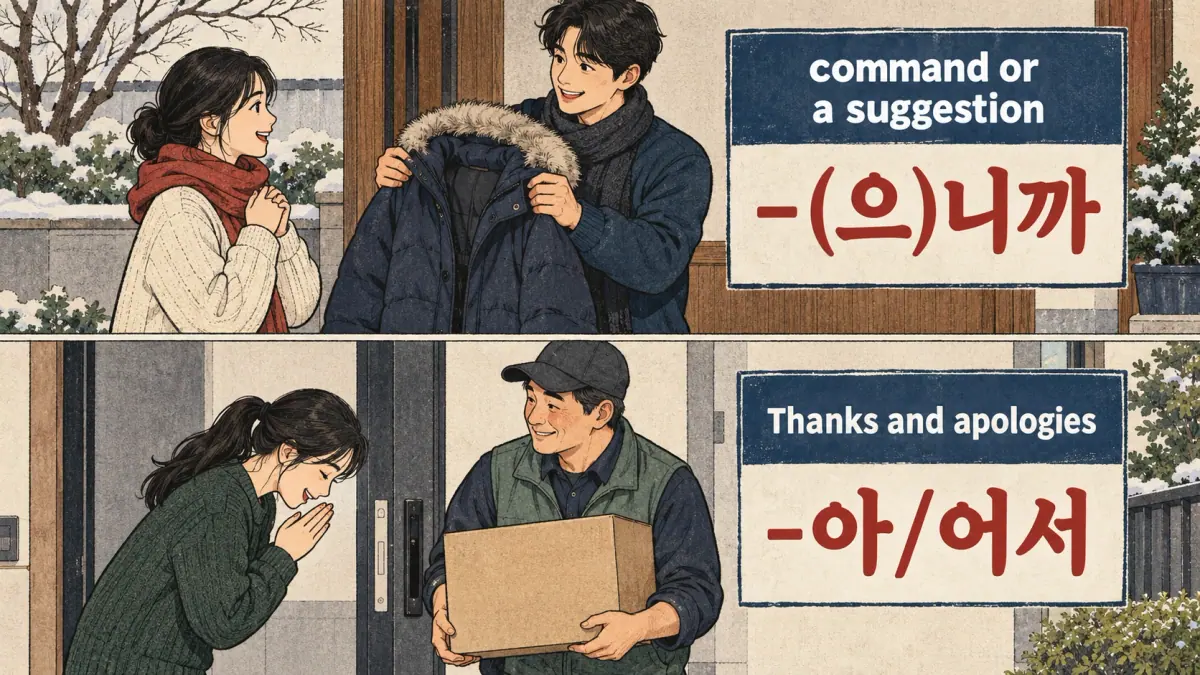
Pick the ending by reading the end of your sentence and following this short chain of questions in order.
- Does the sentence end in a command or a suggestion? Commands end in -(으)세요 or -(으)십시오, and suggestions end in -(으)ㄹ까요?, -ㅂ시다 or -자. If yes, use -(으)니까.
- Does the reason clause need a past tense? If yes, use -(으)니까 with -았/었으니까.
- Is it thanks, an apology or "and then"? If yes, use -아/어서.
- Is it a plain statement of cause and effect? Use -아/어서, which is the neutral choice.
You'll know the rule works when you can say why 비가 와서 우산을 가져가세요 breaks it: step 1 says the command needs -(으)니까.
The rule is a teaching tool, and it is not a law of Korean. Native speakers sometimes use -(으)니까 in plain statements to give an explanation, and the thank-you and apology patterns are fixed. If a sentence does not fit, follow step 4 and check the result with a Korean teacher or tutor.
What Mistakes Do Learners Make with These Two?
Learners make three mistakes with this pair, and each has a one-line fix.
- A command after -아/어서. Learners often write 비가 와서 우산을 가져가세요. Actually this is ungrammatical, because -아/어서 cannot be followed by a command. Use 비가 오니까 우산을 가져가세요.
- A tense marker before -아/어서. Learners often write 어제 비가 왔어서 집에 있었어요. Actually the clause before -아/어서 never takes -았/었. Write 어제 비가 와서 집에 있었어요, and put the past tense on the last verb.
- -(으)니까 in thanks and apologies. Learners often write 늦었으니까 죄송합니다 to mean "I'm sorry I'm late". Actually it sounds like an excuse. The fixed form is 늦어서 죄송합니다.
A fourth, smaller mistake is to use -(으)니까 for every reason because it feels safer. It is grammatical in statements, but it adds a tone of explanation. Use -아/어서 when you only want to report the cause.
Practice: Choose the Right Pattern
These exercises check the outcome of this page: choosing the right ending for a new sentence and explaining the rule. Try each one before reading the answers.
Practice · 5
Choose the ending: 시간이 없___ 택시를 타세요. (There is no time, so take a taxi.)
Show answer
없으니까
The sentence ends in a command (타세요), so the reason clause needs -(으)니까.
Choose the ending: 늦___ 죄송합니다. (I am sorry I am late.)
Show answer
어서
Apologies and thanks use -아/어서: 늦어서 죄송합니다.
Which sentence is correct?
Show answer
어제 비가 와서 집에 있었어요.
-아/어서 takes no tense marker. The past tense goes on the last verb, 있었어요.
Which pattern gives the "and then" meaning in 친구를 만나___ 영화를 봤어요?
Show answer
서
Only -아/어서 can mean "and then" in a sequence of actions.
Choose the ending: 날씨가 좋___ 같이 걸을까요? (The weather is nice, shall we walk together?)
Show answer
으니까
A suggestion (-(으)ㄹ까요?) follows, so use -(으)니까: 날씨가 좋으니까.
Exercise 1: Choose the ending. 시간이 없__ 택시를 타세요. (There is no time, so take a taxi.)
Exercise 2: Fix the error. 어제 비가 왔어서 집에 있었어요.
Exercise 3: Choose the ending. 늦__ 죄송합니다.
Exercise 4: Choose the ending. 배가 아프__ 병원에 가세요. (Your stomach hurts, so go to the hospital.)
Exercise 5: Explain. In one sentence, say why you cannot write 날씨가 좋아서 산책할까요?
Answer Key
- Exercise 1: 시간이 없으니까 택시를 타세요. A command follows, so use -(으)니까. 없다 ends in a consonant, so the form is 으니까.
- Exercise 2: 어제 비가 와서 집에 있었어요. Remove -았/었 from the first clause. The past tense goes on 있었어요.
- Exercise 3: 늦어서 죄송합니다. Apologies take -아/어서.
- Exercise 4: 배가 아프니까 병원에 가세요. The sentence ends in a command, so use -(으)니까. 아프다 ends in ㅡ, and the stem 아프 plus 니까 gives 아프니까.
- Exercise 5: A suggestion (-(으)ㄹ까요?) cannot follow -아/어서, so the clause must be 좋으니까.
If you missed Exercise 1 or 4, reread the rule of thumb. The next section shows where to go from here.
What Should You Learn Next?
The fastest way to firm up this pair is to read the two lessons it compares: -아/어서 and -(으)니까. Then practise the sentence types that decide the choice in the lessons on -(으)세요, -(으)ㄹ까요? and -(으)ㅂ시다.
Three nearby pairs cause the same kind of confusion. -고 vs -아/어서 separates "and" from "so". -(으)니까 vs -기 때문에 compares two ways of giving a reason. -기 때문에 vs -아/어서 covers a third reason ending. All of them sit around level A2 on the beginner grammar list, and this pair is one of many in the confusing grammar compared hub.
What this page does not cover. It does not cover the ending -기 때문에, the written-style reason endings, or the full conjugation rules for irregular verbs. Each of those has its own lesson.
In short, -아/어서 vs -(으)니까 comes down to the end of the sentence: commands and suggestions need -(으)니까, and thanks, apologies and plain cause and effect use -아/어서.
Frequently Asked Questions
What is the difference between -아/어서 and -(으)니까? Both mean "because", but they behave differently. -아/어서 links a cause to a result and cannot be followed by a command or a suggestion. -(으)니까 gives a reason the listener can accept, so it can lead into commands, suggestions and past-tense clauses. Check the end of the sentence first.
Can I always replace -아/어서 with -(으)니까? No. In plain statements the swap usually works: 배가 아파서 병원에 갔어요 and 배가 아프니까 병원에 갔어요 are both possible, though the second sounds more like an explanation. In thanks and apologies, such as 늦어서 죄송합니다, and in the "and then" meaning (만나서 보다), -아/어서 is the only choice.
Which one sounds more natural in speech? Both are everyday spoken forms. Statements about cause and effect usually use -아/어서, while advice, requests and invitations use -(으)니까, because the clause that follows is a command or a suggestion. Spoken Korean also uses -(으)니까요 as a short answer to "why": 비가 오니까요. (Because it is raining.)
Which one appears more often on TOPIK? This site has no official frequency count to cite. Both endings are beginner-level grammar of the kind TOPIK I tests, and a common test style is a sentence that ends in a command or a suggestion, where only -(으)니까 fits. Learn the sentence-type rule on this page and you can answer that style of question.
What is the quickest rule to remember? Look at the end of the sentence. If it is a command (-(으)세요, -(으)십시오) or a suggestion (-(으)ㄹ까요, -ㅂ시다, -자), or if the reason clause needs a past tense, use -(으)니까. If it is a plain statement or a thank-you or apology, use -아/어서.