Quick verdict by situation
- One person doing two things at the same time: -(으)면서 (걸으면서 전화해요).
- One action, then the next: -고 (밥을 먹고 숙제를 해요).
- Two different subjects: -고, or -는 동안 (제가 요리하고 동생이 청소해요).
- Two qualities at once, with a feeling of "both": -(으)면서 (가벼우면서 빨라요).
- A plain list of facts: -고 (크고 가벼워요).
Before you start: you know the connector -고, or at least that it means "and". You can also read the lesson on -(으)면서 for the full rules. Estimated time: 15 minutes.
What Is the Difference between -(으)면서 and -고?
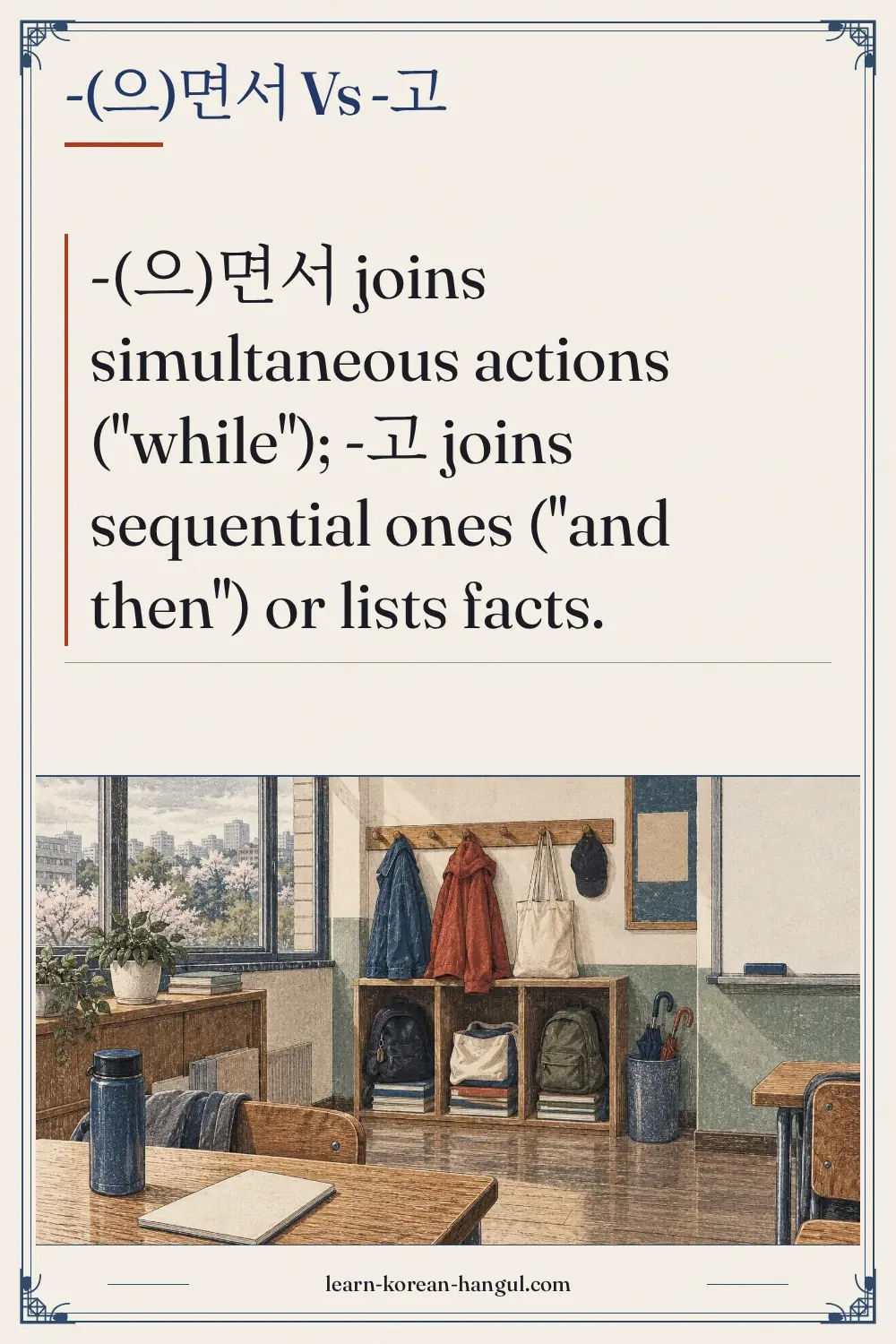
-(으)면서 joins actions that happen at the same time, and -고 joins actions that happen one after the other. Both are connective endings (연결 어미): endings that link one clause to the next. A clause is a group of words built around one verb or adjective. English "and" hides the difference, so learners often pick the wrong ending.
- 음악을 들으면서 공부해요. = "I study while listening to music." The two actions overlap.
- 음악을 듣고 공부해요. = "I listen to music, and then I study." The first action finishes first.
The One-Line Rule
If one person does both actions at the same time, use -(으)면서. If one action comes before the other, or if you list facts, use -고.
That rule covers most beginner sentences. The rest of this page breaks it into five criteria, each with an example, so you can check harder cases one at a time.
Side-by-Side Comparison Table
The table compares the two endings across the criteria that decide most choices. The bold cell in each row marks the ending that the criterion favours.
| Criterion | -(으)면서 | -고 |
|---|---|---|
| Time relation | simultaneous: "while" | sequential: "and then"; or a list |
| Subjects | same subject in both clauses | same or different subjects |
| Form | -면서 after a vowel or ㄹ; -으면서 after a consonant | never changes |
| Sound after a consonant stem | [머그면서] (the final consonant moves on) | [먹꼬] (the ㄱ is tense) |
| With adjectives and 이다 | "and also" | "and" |
| Tense marker before the ending | not used in the "while" meaning | possible when listing facts |
| Sentence types after it | all (statement, question, command, suggestion) | all |
| Formal written partner | -(으)며 | -(으)며 |
The criteria are explained one by one below. The next section shows the first two rows in one worked exchange.
A Worked Example: the Same Two Actions, Three Ways
Check the time relation first, and the subject second. This worked example follows one speaker who talks about the same two actions in three ways.
-(으)면서
while: the actions overlap
-고
and then: one action after the other
| Comparison | -(으)면서 | -고 |
|---|---|---|
| Time relation | simultaneous | sequential or a list |
| Subjects | same | same or different |
| Form | -면서 / -으면서 | -고 |
Use -(으)면서 for "while" with the same subject; use -고 for "and then".
Step 1: The actions overlap. The speaker keeps the music on while studying. 음악을 들으면서 공부해요 (eumageul deureumyeonseo gongbuhaeyo) [으마글 드르면서 공부해요] = "I study while listening to music."
Step 2: The actions follow each other. The speaker listens first and then studies in silence. 음악을 듣고 공부해요 (eumageul deutgo gongbuhaeyo) [으마글 듣꼬 공부해요] = "I listen to music, and then I study."
Step 3: A warning with a command. A speaker tells someone not to do two things at once. 걸으면서 전화하지 마세요 (georeumyeonseo jeonhwahaji maseyo) [거르면서 전화하지 마세요] = "Please don't phone while walking." The verb 걷다 changes its stem to 걸- before a vowel, and 걸으면서 is said [거르면서].
Checkpoint. You'll know you have it when you can explain why 음악을 듣고 공부해요 cannot mean "while". The ending -고 says nothing about overlap, and the plain reading is "and then". The five criteria below test the same idea in other situations.
Criterion 1: Do the Actions Overlap in Time?
Use -(으)면서 when the actions overlap, and use -고 when one ends before the next begins. The time relation is the main reason to choose one over the other.
- 먹으면서 이야기해요. (meogeumyeonseo iyagihaeyo.) [머그면서 이야기해요] = "We talk while eating." The eating and the talking happen together.
- 먹고 이야기해요. (meokgo iyagihaeyo.) [먹꼬 이야기해요] = "We eat, and then we talk." The talk starts after the meal.
Winner for overlap: -(으)면서. Winner for order: -고.
Criterion 2: Is the Subject the Same in Both Clauses?
Use -(으)면서 only when one subject does both actions. The subject is the person or thing that does the action, and Korean often leaves it out. With -(으)면서, the two actions belong to the same person.
- ✗ 제가 요리하면서 동생이 청소해요. This sentence has two subjects, 제가 and 동생이. It is not natural with -(으)면서.
- 제가 요리하는 동안 동생이 청소해요. (jega yorihaneun dongan dongsaengi cheongsohaeyo.) = "While I cook, my younger sibling cleans." The pattern -는 동안 allows different subjects. See the lesson on -는 동안(에).
- 제가 요리하고 동생이 청소해요. (jega yorihago dongsaengi cheongsohaeyo.) = "I cook, and my younger sibling cleans." The ending -고 simply lists two facts.
Winner for one subject doing both: -(으)면서. Winner for two subjects: -고 or -는 동안.
Criterion 3: Which Form Does Each Ending Take?
-고 has one form, while -(으)면서 changes with the stem. This is the biggest practical difference in how the endings are built.
| Stem type | -(으)면서 | -고 |
|---|---|---|
| Vowel: 가다 | 가면서 | 가고 |
| Consonant: 먹다 | 먹으면서 [머그면서] | 먹고 [먹꼬] |
| ㄹ stem: 살다 | 살면서 | 살고 |
| ㄷ-irregular: 듣다 | 들으면서 [드르면서] | 듣고 [듣꼬] |
| ㅂ-irregular: 춥다 | 추우면서 | 춥고 [춥꼬] |
| 하다 verb: 공부하다 | 공부하면서 | 공부하고 |
| 이다 | 학생이면서 [학쌩이면서] | 학생이고 [학쌩이고] |
Two points sit behind the table. First, -(으)면서 is a vowel-initial ending, so it triggers the irregular stem changes of ㅂ and ㄷ verbs: 추우면서 and 들으면서. The ending -고 starts with a consonant, so the stems stay whole. Second, ㄹ stems keep their ㄹ before -면서 (살면서, 놀면서), the same as for the conditional -(으)면.
Pronunciation: 먹으면서 is said [머그면서], because the final ㄱ moves onto the vowel 으 (liaison, Standard Pronunciation Rules Article 13). 먹고 is said [먹꼬], with a tense ㄱ (Article 23).
Winner for easy formation: -고. Winner for a clear "while" meaning: -(으)면서. The lesson on -(으)면서 lists all the forms.
Criterion 4: What Happens with Adjectives and Nouns?
With an adjective or 이다, -(으)면서 means "and also", and -고 means a plain "and". The "also" reading is stronger: it often joins two qualities that you would not expect together.
- 이 노트북은 가벼우면서 빨라요. (i noteubugeun gabyeoumyeonseo ppallayo.) = "This laptop is light and also fast."
- 이 노트북은 가볍고 빨라요. (i noteubugeun gabyeopgo ppallayo.) [이 노트부근 가볍꼬 빨라요] = "This laptop is light and fast." A plain list.
- 그 사람은 학생이면서 가수예요. (geu sarameun haksaengimyeonseo gasuyeyo.) [그 사라믄 학쌩이면서 가수예요] = "That person is a student and also a singer."
For a state that conflicts with another ("light yet strong"), Korean has the separate pattern -(으)면서도. Winner for "both at once": -(으)면서. Winner for a plain list: -고.
Criterion 5: How Do They Behave with Tense and Sentence Type?
Both endings take their tense and sentence type from the final verb. In the "while" and "and then" meanings, put -았/었- on the last verb only.
- 어제 음악을 들으면서 공부했어요. (eoje eumageul deureumyeonseo gongbuhaesseoyo.) [어제 으마글 드르면서 공부해써요] = "Yesterday I studied while listening to music."
- 먹으면서 이야기할까요? (meogeumyeonseo iyagihalkkayo?) [머그면서 이야기할까요] = "Shall we talk while eating?"
Both sentences keep the tense and the question on the last verb. The same holds for -고. The difference is that -고 sometimes carries a past marker when it lists separate facts (밥도 먹었고 커피도 마셨어요), and -(으)면서 does not do that in its "while" meaning.
Winner for a clean "while" in the past: -(으)면서 with the tense on the last verb. Winner for a list of separate past facts: -고. The criteria are complete, so the next section turns them into situation-by-situation advice.
Which Should You Choose in Each Situation?
Choose by the picture in your head. Four common situations each get a firm recommendation.
Two Actions at the Same Time
Use -(으)면서. 커피를 마시면서 책을 읽어요 means "I read while drinking coffee", and the overlap is the point.
One Action after the Other
Use -고. 손을 씻고 밥을 먹어요 means "I wash my hands and then eat", and the order is the point.
Two Different Subjects
Use -고 or -는 동안. 제가 요리하는 동안 동생이 청소해요 shows the second option.
Two Qualities in One Description
Use -(으)면서 for "both at once" and -고 for a plain list: 가벼우면서 빨라요 versus 가볍고 빨라요.
Can You Use Both in the Same Sentence?
Yes, they fit together when the sentence has both a sequence and an overlap. 샤워를 하고 아침을 먹으면서 뉴스를 봐요 (syaworeul hago achimeul meogeumyeonseo nyuseureul bwayo) [샤워를 하고 아치믈 머그면서 뉴스를 봐요] means "I take a shower, and then I watch the news while eating breakfast". The -고 clause marks the first step, and the -(으)면서 clause marks the overlap in the second step.
This pattern also shows why the two are not rivals: one orders actions and the other overlaps them. The next section lists the mistakes that come from mixing them up.
What Mistakes Do Learners Make with These Two?

Learners make five common mistakes with -(으)면서 vs -고. Each one follows the pattern "learners often assume X; actually Y, because Z".
- Using -(으)면서 with two subjects. Learners write 제가 공부하면서 동생이 게임해요. Actually -(으)면서 needs one subject for both actions. Use -는 동안 or -고.
- Using -고 for "at the same time". Learners write 걷고 전화해요 for "I phone while walking". Actually -고 reads as "and then", so it means "I walk, and then I phone". Use 걸으면서 전화해요.
- Using -으면서 after a vowel stem or ㄹ stem. Learners write 가으면서 or 살으면서. Actually vowel stems and ㄹ stems take -면서: 가면서, 살면서.
- Putting the tense before -(으)면서. Learners write 들었으면서 공부해요 for "I studied while listening". Actually the past goes on the last verb: 들으면서 공부했어요.
- Saying 먹으면서 as [먹으면서]. Learners pause after the ㄱ. Actually the final consonant moves onto the next vowel, so say [머그면서].
A practical rule of thumb: picture the two actions on a timeline. If the lines overlap, use -(으)면서. The next section explains where even this rule is not simple.
Edge Cases and Exceptions
The rule "overlap means -(으)면서, order means -고" is a teaching simplification, and it has honest limits. Native speakers make some choices for style or emphasis.
- Loose overlap. If one action is a background habit ("I study these days, listening to music"), -(으)면서 still fits, because the actions share a period of time.
- A longer "while". For a long period or two subjects, use -는 동안: 학교에 다니는 동안 (while attending school).
- The formal written partner. -(으)며 does the job of both endings in news and essays. See the lesson on -(으)며.
- -았/었으면서 is a different meaning. With a past marker, -(으)면서 means "even though" and often sounds like a reproach: 알았으면서 왜 말 안 했어요? ("Why didn't you say anything, when you knew?"). It is not the past of "while".
- Switching mid-action. If one action stops and another starts, the pattern is -다가, not -(으)면서. The page -다가 vs -(으)면서 covers that pair.
If a sentence does not fit any criterion, picture the timeline and move on. The practice below checks the core cases.
Practice and Answers
These four exercises check the core outcome: choosing -(으)면서 or -고 in a new sentence and explaining why. Try each one before you read the answers.
Practice · 5
Which ending fits? 샤워하__ 노래해요. (I sing while I take a shower.)
Show answer
샤워하면서
One person does both actions at the same time, so -(으)면서 fits. A 하다 verb ends in a vowel and takes -면서.
Which sentence correctly says "While I study, my younger sibling plays games"?
Show answer
제가 공부하는 동안 동생이 게임해요.
The two clauses have different subjects, so -(으)면서 does not fit. -는 동안 allows different subjects.
How do you say "I wash my hands and then eat"?
Show answer
손을 씻고 밥을 먹어요.
The washing comes first and ends before eating, so -고 fits.
Which is the correct -(으)면서 form of 듣다?
Show answer
들으면서
-(으)면서 starts with a vowel after a consonant stem, so the ㄷ-irregular stem 듣- becomes 들-.
Which sentence correctly says "I studied while listening to music"?
Show answer
음악을 들으면서 공부했어요.
In the "while" meaning the past tense goes on the last verb only. 듣고 would mean "listened, and then studied".
Exercise 1: Choose the ending. Fill in the blank with -(으)면서 or -고: 샤워하__ 노래해요. (I sing while I take a shower.)
Exercise 2: Fix the error. A learner writes 제가 공부하면서 동생이 게임해요. Give a correct version.
Exercise 3: Choose the ending. Say "I wash my hands and then eat" with 씻다 and 먹다.
Exercise 4: Translate. "I read a book while drinking coffee." (coffee = 커피, read = 읽다, drink = 마시다)
Answer Key
- Exercise 1: 샤워하면서 노래해요. One person does both at once, so -(으)면서 fits. A 하다 verb takes -면서.
- Exercise 2: 제가 공부하는 동안 동생이 게임해요. Two subjects need -는 동안 (or -고: 제가 공부하고 동생이 게임해요).
- Exercise 3: 손을 씻고 밥을 먹어요. [소늘 씯꼬 바블 머거요] The washing comes first, so -고 fits.
- Exercise 4: 커피를 마시면서 책을 읽어요. [커피를 마시면서 채글 일거요] Both actions overlap, so -(으)면서 fits.
If you missed Exercise 1, 3 or 4, reread Criterion 1. If you missed Exercise 2, reread Criterion 2. The next section shows where to go from here.
What Should You Learn Next?
The next step is the full lesson on whichever ending felt weaker: -(으)면서 or -고. Then read -다가 vs -(으)면서 to separate "while" from "switching mid-action". Both endings are listed with their neighbours on the Beginner Grammar list.
What this lesson does not cover. It does not cover -(으)면서도 ("even while"), -는 동안 in depth or the formal written -(으)며. Other confusable pairs are collected under Confusing Grammar Compared. The level given here, A2, is an editorial estimate, not an official grading.
In short, -(으)면서 vs -고 comes down to one question: do the two actions overlap? If one person does both at once, use -(으)면서. If one action follows the other, use -고.
Frequently Asked Questions
Can I always replace -(으)면서 with -고? No. The two endings give different pictures. 음악을 들으면서 공부해요 means "I study while listening to music", and 음악을 듣고 공부해요 means "I listen to music and then study". When the actions overlap in time, -고 changes the meaning. When the subjects differ, -(으)면서 does not work; use -고 or -는 동안.
Which one sounds more natural in speech? Both are everyday speech, and the choice depends on meaning. Native speakers use -(으)면서 constantly for "while doing", as in 걸으면서 전화하다 ("phone while walking"). They use -고 for sequences and lists. Neither is formal or casual. The written, formal partner of both is -(으)며, taught at a higher level.
Which one appears more often on the TOPIK? No official pattern-by-pattern frequency list is published, so no honest ranking exists. This site places both endings at A2, which matches the beginner level of TOPIK I as an editorial estimate. Learn both: -고 appears in nearly every text, and -(으)면서 is the standard way to say "while".
What is the quickest rule to remember? Ask whether the two actions overlap. If one person does both at the same time, use -(으)면서. If one action ends before the next begins, or if you are listing facts, use -고. Then check the subjects: -(으)면서 needs the same subject in both clauses, while -고 can join different subjects.
Can -(으)면서 be used with adjectives and nouns? Yes. With an adjective or with 이다 it means "and also", describing two qualities at once: 이 노트북은 가벼우면서 빨라요 means "This laptop is light and also fast". 그 사람은 학생이면서 가수예요 means "That person is a student and also a singer". The two qualities are usually surprising or impressive together.