Before you start: you should be able to make a simple polite sentence such as 학교에 가요, and you should recognise a verb stem (the dictionary form without its final 다, such as 먹 in 먹다). Estimated time: 15 minutes.
What Does -고 Grammar Mean?
-고 grammar means "and": the ending joins two actions or two descriptions into one sentence. When the two actions happen one after the other, it also reads as "and then". Grammar books call -고 a connective ending (연결 어미, yeongyeol eomi): an ending that does not finish the sentence but links it to the next clause. A clause is a group of words built around one verb or adjective.
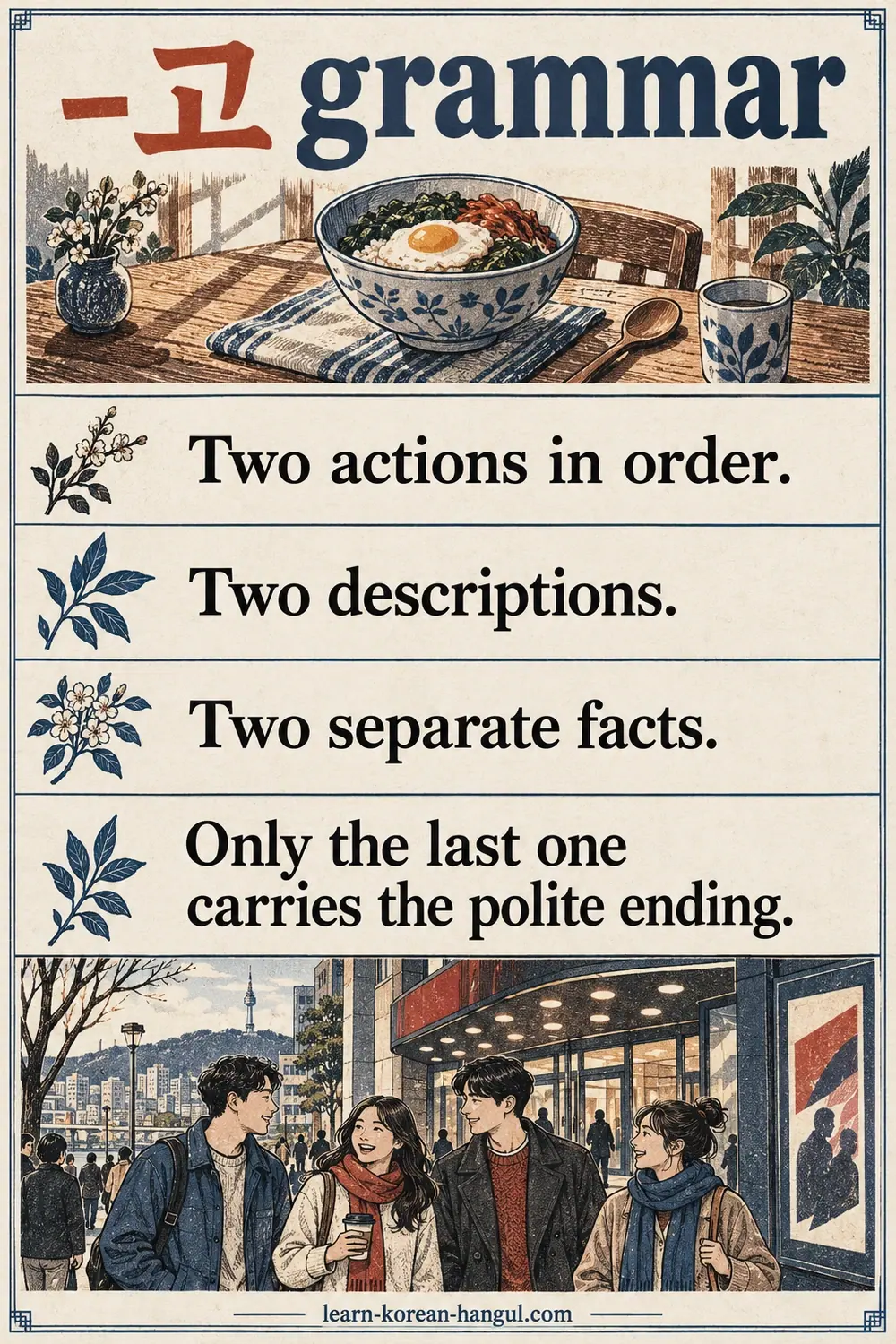
The ending has three everyday jobs:
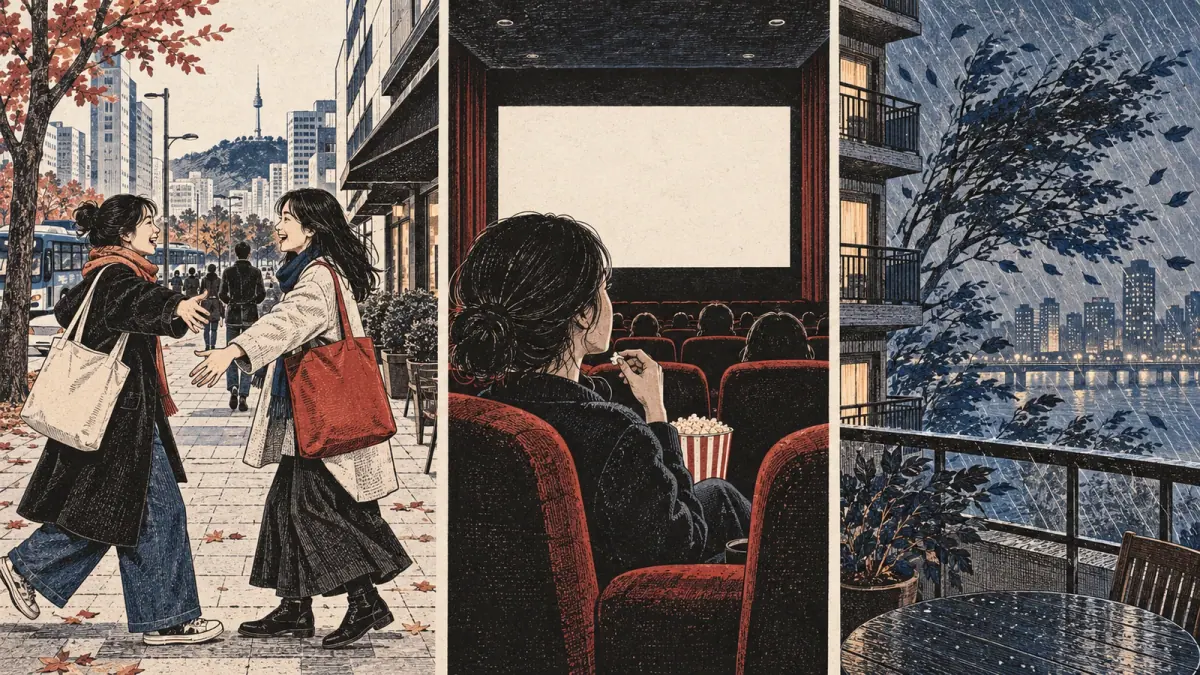
- Two actions in order. 친구를 만나고 영화를 봤어요. = "I met a friend and then watched a movie."
- Two descriptions. 이 가방은 크고 가벼워요. = "This bag is big and light."
- Two separate facts. 비가 오고 바람이 불어요. = "It rains, and the wind blows."
친구를 만나고 영화를 봤어요.
chingureul mannago yeonghwareul bwasseoyo.
I met a friend and then watched a movie.
이 가방은 크고 가벼워요.
i gabangeun keugo gabyeowoyo.
This bag is big and light.
비가 오고 바람이 불어요.
biga ogo barami bureoyo.
It rains, and the wind blows.
The ending says "and", but it does not say why the two clauses belong together. That meaning comes from the words around it. The next section shows how to build the form.
A First Example
Take 저는 아침을 먹고 학교에 가요. Read it from left to right. 저는 is "I" as the topic, 아침을 is "breakfast" as the object, 먹고 is "eat and", 학교에 is "to school", and 가요 is the polite "go". The first verb carries -고, and the last verb carries the polite ending. In speech it sounds like [저는 아치믈 먹꼬 학꾜에 가요], with a tense sound in 먹고 and in 학교.
저는 아침을 먹고 학교에 가요.
jeoneun achimeul meokgo hakgyoe gayo.
I eat breakfast and go to school.
How Do You Form -고?
You form -고 by adding it to the stem, with nothing in between and no change to the stem. Most Korean endings have two or three versions, such as -아요 and -어요, or -면 and -으면. The ending -고 has only one, so it is the easiest connector to learn.
| Stem type | Dictionary form | With -고 | Revised Romanization |
|---|---|---|---|
| Vowel | 가다 | 가고 | gago |
| Vowel | 마시다 | 마시고 | masigo |
| Consonant | 먹다 | 먹고 [먹꼬] | meokgo |
| Consonant | 읽다 | 읽고 [일꼬] | ilgo |
| Consonant | 좋다 | 좋고 [조코] | joko |
| ㄹ stem | 살다 | 살고 | salgo |
| ㅂ stem | 춥다 | 춥고 [춥꼬] | chupgo |
| ㄷ stem | 듣다 | 듣고 [듣꼬] | deutgo |
| 르 stem | 모르다 | 모르고 | moreugo |
| ㅡ stem | 크다 | 크고 | keugo |
| 하다 verb | 공부하다 | 공부하고 | gongbuhago |
| 이다 | 학생이다 | 학생이고 [학쌩이고] | haksaengigo |
Revised Romanization (RR, the official Latin spelling) is only an aid here. It shows the spelling, not the tense sound, so 먹고 is written meokgo even though it is said [먹꼬].
Stems Ending in a Vowel
Add -고 after the vowel and say it as written: 가고, 보고, 마시고, 자고. There is no tense sound, because the ㄱ comes right after a vowel. 보고 is "see and", and 자고 is "sleep and".
Stems Ending in a Consonant
Add -고 after the final consonant. The spelling stays -고, but the ㄱ is said as a tense sound in most cases. A tense consonant is a sharper, tighter sound, written ㄲ, ㄸ, ㅃ, ㅆ or ㅉ when it has its own letter. The Standard Pronunciation Rules (표준 발음법, issued by the National Institute of Korean Language) set the pattern in Articles 11, 12, 23 and 24:
- After the final sounds ㄱ, ㄷ and ㅂ, the ㄱ of -고 becomes tense: 먹고 [먹꼬], 입고 [입꼬], 씻고 [씯꼬].
- After a stem ending in ㄴ or ㅁ, it also becomes tense: 신고 [신꼬], 앉고 [안꼬], 감고 [감꼬].
- After ㄺ, the ㄱ becomes tense and the ㄱ of the cluster is silent: 읽고 [일꼬].
- After ㅎ, the two sounds merge into an aspirated ㅋ: 좋고 [조코], 많고 [만코].
- After ㄹ, nothing changes: 놀고 [놀고], 살고 [살고].
Learners who say [먹고] with a plain ㄱ are still understood, but the tense sound is what Korean listeners expect. The next part covers stems that change in other endings but not here.
Irregular Stems and Nouns
Irregular stems do not change before -고. Korean irregular verbs change their stem only before endings that start with a vowel (and, for ㄹ stems, before ㄴ, ㅂ or ㅅ). The ending -고 starts with the consonant ㄱ, so the stem stays whole. Compare the same stems with the polite ending -아요/어요:
| Irregular class | With -고 | With -아요/어요 |
|---|---|---|
| ㅂ-irregular | 춥고 | 추워요 |
| ㄷ-irregular | 듣고 | 들어요 |
| 르-irregular | 모르고 | 몰라요 |
| ㅅ-irregular | 낫고 [낟꼬] | 나아요 |
| ㅎ-irregular | 그렇고 [그러코] | 그래요 |
| ㅡ-drop | 크고 | 커요 |
| ㄹ-irregular | 살고 | 살아요 (but 사세요) |
Here is one irregular stem in a full sentence: 춥고 바람이 불어요 means "It is cold, and the wind blows." The ㅂ of 춥다 stays, and it is said [춥꼬].
For the copula 이다 ("to be"), use 이고 after a noun with a final consonant: 학생이고 [학쌩이고]. After a noun that ends in a vowel, 이고 is correct, and speakers often shorten it to 고: 의사이고 or 의사고. For the negative copula 아니다, use 아니고: 학생이 아니고 의사예요 means "I am not a student, and I am a doctor." The lesson on 이에요/예요 to be explains 이다 in full.
Nouns cannot take -고 directly to mean "and" between two nouns. That job belongs to particles, covered in the mistakes section below. The next section builds one sentence from start to finish.
Building a Sentence with -고, Step by Step
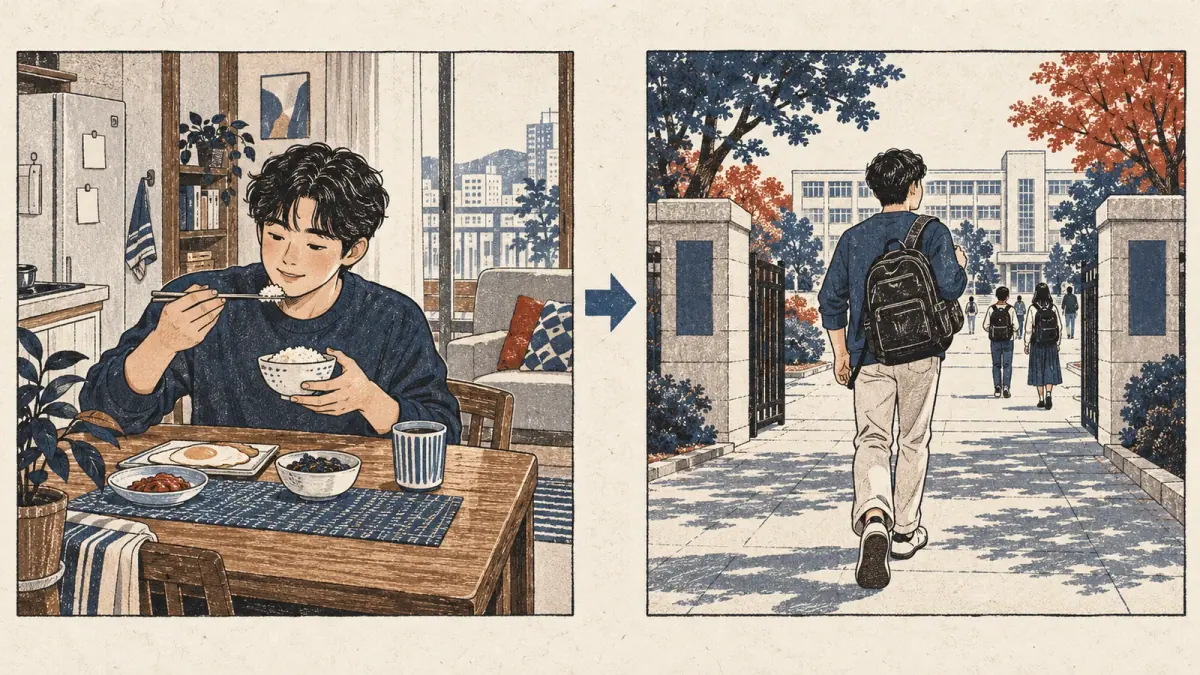
You build it in five steps, working from the two clauses you want to join. This example makes "I eat breakfast and go to school".
- Write each clause with its dictionary verb. 아침을 먹다 and 학교에 가다.
- Find the stem of the first verb. Remove 다 from 먹다. The stem is 먹.
- Add -고. 먹 + 고 = 먹고.
- Give the last verb its tense and politeness. 가다 becomes the polite present 가요. Only this verb carries them.
- Join the clauses and add the topic. 저는 아침을 먹고 학교에 가요.
Sentence
I eat breakfast and go to school.
Show answer
저는 아침을 먹고 학교에 가요
Checkpoint. You have it when you can change the sentence to the past without touching 먹고. The answer is 저는 아침을 먹고 학교에 갔어요 [저는 아치믈 먹꼬 학꾜에 가써요], with 갔어요 as the only past form. If you changed 먹고 to 먹었고, go back to step 4.
The sentence built here is a statement. The next section shows which other tenses and sentence types can follow -고.
Which Tenses and Sentence Types Work with -고?

All of them work, because -고 takes its tense and sentence type from the final verb. The connector itself is neutral. This is why a speaker can turn the same clause into a statement, a question, a command or a suggestion without changing 먹고.
| Feature | Where it goes | Example |
|---|---|---|
| Past tense | final verb | 먹고 갔어요. = "I ate and went." |
| Future tense | final verb | 먹고 갈 거예요. = "I will eat and go." |
| Negation | the verb it negates | 아침을 안 먹고 학교에 가요. = "I go to school without eating breakfast." |
| Statement | final verb | 먹고 가요. |
| Question | final verb | 먹고 가요? = "Will you eat and go?" |
| Command | final verb | 먹고 가세요. = "Please eat and then go." |
| Suggestion | final verb | 밥을 먹고 갈까요? = "Shall we eat and go?" |
Pronunciation: 먹고 갈 거예요 is said [먹꼬 갈꺼예요], and 먹고 갈까요 is said [먹꼬 갈까요]. The honorific -(으)시- (the ending that shows respect for the subject) is a special case. It is usually repeated on both verbs when the same respected person does both actions: 할머니는 신문을 읽으시고 차를 드세요 ("Grandmother reads the newspaper and has tea"). The lesson on the honorific -(으)시- covers that ending.
A past marker on the first clause is possible when you list two separate facts and not two steps. 밥도 먹었고 커피도 마셨어요 means "I ate, and I also had coffee", and 도 ("also") shows that the clauses are a list. The past tense is explained in the lesson on past tense -았/었-.
For ordered actions, the simpler 먹고 갔어요 is the normal choice. Next comes the pattern learners confuse with -고 most often.
How Is -고 Different from -아/어서?

-고 links steps that stand on their own, while -아/어서 links steps where the second builds on the first or follows from it. Both can translate as "and then", which is why learners mix them up. The lesson on -아/어서 gives the full rules for the second pattern.
-고
and, and then: independent steps
-아/어서
and then (linked) or because
| Comparison | -고 | -아/어서 |
|---|---|---|
| Link between clauses | none required | the second builds on or follows from the first |
| Tense before the ending | possible | not possible |
| Command or suggestion after it | possible | not possible in the 'because' meaning |
| Meaning of 'because' | no | yes |
Use -고 for independent steps and lists; use -아/어서 when the second step builds on the first or when you mean because.
Look at the pair:
- 친구를 만나고 영화를 봤어요. = "I met a friend, and (then) I watched a movie." The two steps are separate. The friend may not have been at the movie.
- 친구를 만나서 영화를 봤어요. = "I met a friend and watched a movie with them." The second step grows out of the first.
The second difference is "because". -아/어서 can mean "because", and -고 never does. 비가 와서 집에 있어요 means "Because it rains, I stay home", and 비가 오고 집에 있어요 only lists two facts.
A side-by-side rule is on the page -고 vs -아/어서. Two other neighbours are worth knowing. -지만 means "but" (-지만 is the next lesson in this set), and -(으)며 is a more formal, written "and" (-(으)며). The pair -고 and -(으)면서 ("while") is compared on -(으)면서 vs -고. The next section lists the ways -고 stretches beyond a plain "and".
What Variations and Edge Cases Does -고 Have?

-고 has four useful variations: chains, side-by-side subjects, the 도 echo and spoken shortening. Each one still uses the same ending.
- Chains. You can link three or more clauses with -고 on each: 크고 무겁고 비싸요 means "It is big, heavy and expensive" (said [크고 무겁꼬 비싸요]). Only the last one carries the polite ending.
- Side-by-side subjects. The two clauses can have different subjects, even opposite ones: 형은 키가 크고 동생은 키가 작아요 means "My older brother is tall, and my younger sibling is short". The sentence reads as a comparison, like "while" in English. In speech it sounds like [형은 키가 크고 동생은 키가 자가요].
- The 도 echo. Adding 도 ("also") to both clauses makes the list obvious: 밥도 먹고 커피도 마셔요 means "I eat, and I drink coffee too".
- Spoken shortening. After a noun that ends in a vowel, 이고 often becomes 고 in speech: 의사고. Use the full 이고 when you write.
Many set patterns also contain -고, but each one is a separate grammar point. -고 있다 ("be doing") is taught in progressive -고 있다, -고 싶다 ("want to") in -고 싶다 and -고 나서 ("after finishing") in -고 나서. Do not read their meaning from -고 alone. The next section covers the errors that appear most often.
What Mistakes Do Learners Make with -고?
Learners make five common mistakes with -고. Each one follows the pattern "learners often assume X; actually Y, because Z".
- Using -고 to mean "because". Learners often assume that "rain and I stay home" explains the reason. Actually -고 only lists two facts. Use -아/어서 or -(으)니까 when the first clause is the reason.
- Marking tense on every clause in a sequence. Learners often copy English "ate and went". Actually the tense normally sits on the final verb, so 먹고 갔어요 is the clean form for ordered steps. A past marker on the first clause suits separate facts, as shown above.
- Attaching -고 to a noun without 이. Learners write 학생고. Actually a noun needs the copula first: 학생이고. After a vowel-final noun you may shorten it to 고 in speech.
- Joining two nouns with -고. Learners write 사과고 바나나를 먹어요. Actually nouns are joined with the particles 와/과 or (이)랑: 사과와 바나나를 먹어요. See the lessons on 와/과 and with particle and (이)나 or particle for "and" and "or" between nouns.
- Saying 먹고 with a plain ㄱ. Learners follow the spelling. Actually the ㄱ is tense after a consonant, so say [먹꼬].
If your sentence still feels wrong, check what you are joining: two clauses take -고, and two nouns take a particle. Now test yourself.
Practice and Answers
These four exercises check the main skills: forming -고, joining clauses and choosing the right pattern. Try each one before you read the answers.
Practice · 5
Which form joins 마시다 to the next clause as "drink and"?
Show answer
마시고
Add -고 straight to the stem 마시. The ending never changes.
Which is the -고 form of the ㅂ-irregular adjective 춥다?
Show answer
춥고
-고 starts with a consonant, so the irregular change does not happen.
How do you say "I ate and went" for two steps in order?
Show answer
먹고 갔어요
The tense normally goes on the final verb only.
Which sentence says that the rain is the reason you stay home?
Show answer
비가 와서 집에 있어요.
-고 only lists facts. Use -아/어서 for "because".
Which is correct for "I am a student, and my sister is an office worker"?
Show answer
저는 학생이고 언니는 회사원이에요.
A noun needs the copula 이 before -고: 학생이고.
Exercise 1: Join the clauses. Make one sentence with -고: 커피를 마셔요 + 신문을 읽어요. ("I drink coffee" + "I read the newspaper".)
Exercise 2: Fix the error. A learner writes 저는 학생고 언니는 회사원이에요. Correct it.
Exercise 3: Translate. "The room is small and clean." (room = 방, small = 작다, clean = 깨끗하다)
Exercise 4: Write your own. Say that you did your homework and then slept. (homework = 숙제, do = 하다, sleep = 자다)
Answer Key
- Exercise 1: 커피를 마시고 신문을 읽어요. [커피를 마시고 신무늘 일거요] The stem of 마시다 is 마시, and the polite ending sits on the last verb only.
- Exercise 2: 저는 학생이고 언니는 회사원이에요. [저는 학쌩이고 언니는 회사워니에요] A noun needs 이 before -고.
- Exercise 3: 방이 작고 깨끗해요. [방이 작꼬 깨끄태요] Both are adjectives, so -고 joins two descriptions. The ㄱ after 작 is tense.
- Exercise 4: 저는 숙제를 하고 잤어요. [저는 숙쩨를 하고 자써요] The past tense appears only on 잤어요.
If you missed Exercise 1, return to the five building steps. If you missed Exercise 2 or 4, reread the mistakes section. Next, plan where to go from here.
What Should You Learn Next after -고 Grammar?
The best next lesson is -아/어서, because it covers the cases where -고 does not fit: reasons and linked steps. After that, study -지만 for "but" and -(으)며 for the written "and". The full set of patterns for listing and contrasting clauses is on And / But Connectors. To see where -고 sits in a study plan, use the Beginner Grammar list.
What this lesson does not cover. It does not cover -고 inside set phrases (-고 있다, -고 싶다, -고 나서, -고 해서), the written style -(으)며, or sentence-final uses of -고 in speech. The level given here, A1, is an editorial estimate based on common textbook order and TOPIK I, not an official grading.
In short, -고 grammar joins two verbs or adjectives with one unchanging ending, puts tense and politeness on the last verb, and keeps its meaning to "and" and "and then".
Frequently Asked Questions
What does -고 mean? -고 means "and" and, when two actions happen in order, "and then". It joins two actions (밥을 먹고 가요, "I eat and go") or two descriptions (크고 가벼워요, "big and light") into one sentence. It does not say that one clause causes the other.
How do I attach -고 to a verb or adjective? Remove 다 from the dictionary form and add -고 to the stem: 가다 becomes 가고, 먹다 becomes 먹고, 크다 becomes 크고. Nothing else changes, even for irregular stems such as 춥다 (춥고) or 듣다 (듣고), because -고 begins with a consonant.
Can -고 be used in the past tense? The tense normally goes on the final verb only: 먹고 갔어요 means "ate and went". The ending itself does not change. When you list two separate past facts, a past marker on the first clause is also possible, as in 밥도 먹었고 커피도 마셨어요, but ordered actions do not need it.
Is -고 used in speech or only in writing? -고 is used everywhere: casual speech, polite speech and writing. It is one of the most frequent endings in Korean. The more formal, written partner is -(으)며, which is taught at a higher level and usually appears in news, essays and speeches.
What is the most common mistake with -고? Learners often use -고 where they need "because". 비가 오고 집에 있어요 only lists two facts, "it rains and I stay home". To say that the rain is the reason, use -아/어서 (비가 와서 집에 있어요) or -(으)니까. A second common mistake is attaching -고 to a noun without 이.
What is the difference between -고 and -아/어서? -고 links two steps that stand on their own, while -아/어서 links steps where the second builds on the first or follows from it. -아/어서 also means "because", takes no tense marker, and cannot be followed by a command or suggestion in that meaning. -고 has none of these limits.