Quick verdict by situation
- Seeing, hearing or tasting something right now: -네요 (눈이 오네요).
- Taking in news that someone just told you: -군요 (아, 그렇군요).
- Complimenting what you can see or hear: -네요 (한국어를 잘하시네요).
- Showing that you understood after an explanation: -군요 (아, 매일 운동하는군요).
- Agreeing with something you can both see: -네요 (그렇네요).
Before you start: you know the polite -요 endings and you have seen the two lessons on -네요 and -군요/-는군요, or you are happy to learn the forms here. Estimated time: 15 minutes.
What Is the Difference between -네요 and -군요?
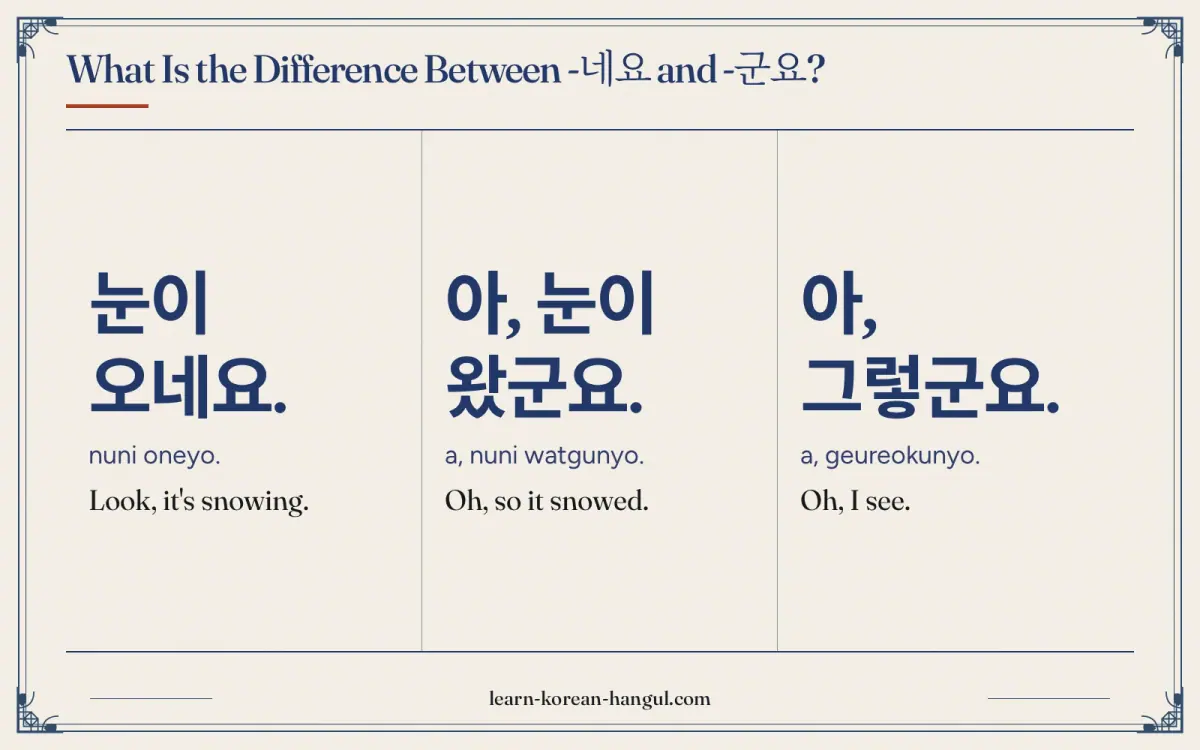
-네요 reacts to what the speaker perceives now, and -군요 reacts to a fact the speaker has just understood. Both are sentence-final endings (종결 어미): endings that close a sentence and add the speaker's attitude. Both turn a plain statement into a small exclamation, and both go before the polite -요. The difference is where the speaker's knowledge comes from.
- 눈이 오네요. = "Look, it's snowing." The speaker is watching the snow fall.
- 아, 눈이 왔군요. = "Oh, so it snowed." The speaker sees white ground and works out what happened.
- 아, 그렇군요. = "Oh, I see." The speaker has just heard an explanation.
눈이 오네요.
nuni oneyo.
Look, it's snowing.
아, 눈이 왔군요.
a, nuni watgunyo.
Oh, so it snowed.
아, 그렇군요.
a, geureokunyo.
Oh, I see.
Revised Romanization (RR, the official Latin spelling) is only an aid here. The little word 아 is a sound of realization, like "oh", and it often comes before -군요.
The One-Line Rule
If you see, hear or feel the fact now, use -네요. If you have just realized or learned it, use -군요.
That rule covers most sentences. The rest of this page breaks it into five criteria, each with an example, so you can check harder cases one at a time.
Side-by-Side Comparison Table
The table compares the two endings across the criteria that decide most choices. The bold cell in each row marks the ending that the criterion favours.
| Criterion | -네요 | -군요/-는군요 |
|---|---|---|
| Where the knowledge comes from | what you perceive now | what you newly understand |
| Typical use | exclamations and compliments: 좋네요 | replies to news: 그렇군요 |
| Verb | stem + 네요: 오네요 | stem + 는군요: 오는군요 |
| Adjective | stem + 네요: 예쁘네요 | stem + 군요: 예쁘군요 |
| 이다 | 학생이네요 | 학생이군요 |
| Past | 왔네요 | 왔군요 |
| Sound of ㅎ | 좋네요 is [존네요] | 좋군요 is [조쿤뇨] |
| Casual form | -네 | -구나 / -는구나 |
The criteria are explained one by one below. The next section shows the first row in one worked exchange.
A Worked Example: One Winter Morning
Ask where the knowledge comes from, and the ending follows. This worked example follows one speaker on a winter morning.
-네요
I see or notice it now
-군요/-는군요
I just realized or learned it
| Comparison | -네요 | -군요/-는군요 |
|---|---|---|
| Source of knowledge | perception now | realization |
| Verb form | stem + 네요 | stem + 는군요 |
| Typical reply to news | 그렇네요 (you are right) | 그렇군요 (I see) |
Use -네요 for perception and -군요 for realization.
Step 1: Perception. The speaker looks out of the window and sees snow falling. 눈이 오네요 (nuni oneyo) [누니 오네요] = "Look, it's snowing."
Step 2: Realization. Later the speaker walks outside and sees white ground. The snow has stopped, but the speaker works out what happened. 아, 눈이 왔군요 (a, nuni watgunyo) [아 누니 왇꾼뇨] = "Oh, so it snowed." The past form 왔 is said with a final ㄷ sound before the tense ㄱ, giving [왇꾼뇨].
Step 3: A reply to news. A friend says that the café closes on Mondays, and the speaker had not known it. 아, 그렇군요 (a, geureokunyo) [아 그러쿤뇨] = "Oh, I see."
Checkpoint. You'll know you have it when you can explain why a polite listener replies 아, 그렇군요 and not 그렇네요 to news. The reply 그렇네요 [그런네요] means "It is so, isn't it", and it agrees with something you can both see. The reply 그렇군요 means "I understand now". The five criteria below test the same idea in other situations.
Criterion 1: What Is the Speaker Reacting To?
Use -네요 for what you perceive with your senses now, and -군요 for what you have learned or worked out. The source of the knowledge is the main reason to choose one over the other.
- 한국어를 잘하시네요. (hangugeoreul jalhasineyo.) [한구거를 잘하시네요] = "You speak Korean well!" The speaker hears the Korean right now. The honorific 시 shows respect for the subject, who here is the listener; see honorific -(으)시-.
- 한국 분이시군요. (hanguk bunisigunyo.) [한국 뿌니시군뇨] = "Oh, you're Korean." The speaker has just learned this, perhaps from the listener's name or from something said.
Winner for a direct perception: -네요. Winner for a newly learned fact: -군요.
Criterion 2: Is the Tone a Quick Reaction or a Reflective One?
-네요 is a quick reaction with mild surprise, while -군요 is more reflective, like "so that's how it is". The tone is the second reason to choose one over the other when both are grammatical.
- 이 김치찌개 맛있네요. (i gimchijjigae masinneyo.) [이 김치찌개 마신네요] = "This kimchi stew is tasty!" The speaker has just tasted it.
- 아, 매일 운동하는군요. (a, maeil undonghaneungunyo.) [아 매일 운동하는군뇨] = "Oh, you exercise every day." The speaker is absorbing what the listener said.
The first sentence is an exclamation about a taste, and the second is a thought that follows a statement. Winner for a quick reaction: -네요. Winner for a reflective one: -군요.
Criterion 3: Which Form Does Each Ending Take?
-네요 attaches to any stem, while -군요 changes shape with the word type. This is the biggest practical difference in how the endings are built.
| Word type | -네요 | -군요/-는군요 |
|---|---|---|
| Verb 오다 | 오네요 | 오는군요 |
| Verb 먹다 | 먹네요 [멍네요] | 먹는군요 [멍는군뇨] |
| Verb 살다 (ㄹ drops) | 사네요 | 사는군요 |
| Adjective 예쁘다 | 예쁘네요 | 예쁘군요 |
| Adjective 좋다 | 좋네요 [존네요] | 좋군요 [조쿤뇨] |
| Noun + 이다 | 학생이네요 [학쌩이네요] | 학생이군요 [학쌩이군뇨] |
| After a vowel noun | 의사네요 | 의사군요 |
| Past 먹었다 | 먹었네요 [머건네요] | 먹었군요 [머걷꾼뇨] |
Three points sit behind the table. First, verbs need the extra 는 before -군요. 오군요 and 먹군요 are wrong, and 운동하군요 is wrong for the same reason. Second, a past marker (-았/었-) lets any word take -군요 with no 는, so 왔군요 and 먹었군요 are correct. Third, 이다 drops its 이 after a vowel noun: 의사네요 and 의사군요 are the usual forms.
Pronunciation: 좋네요 is said [존네요], because ㅎ before ㄴ sounds like ㄴ. 좋군요 is said [조쿤뇨], because ㅎ and ㄱ merge into an aspirated ㅋ (Standard Pronunciation Rules, Article 12). The 요 of -군요 is often said with an added n sound, [쿤뇨], in everyday speech. The lessons on -네요 and -군요/-는군요 list all the forms.
Winner for easy formation: -네요. Winner for a stable "I realize" meaning: -군요.
Criterion 4: How Do They Behave in the past Tense?
Both endings take the past marker -았/었-, and the past changes the picture only slightly. The past form still follows the same source rule: perception for -네요, realization for -군요.
- 눈이 왔네요. (nuni wanneyo.) [누니 완네요] = "It has snowed." The speaker can see that the ground is white.
- 어제 눈이 많이 왔군요. (eoje nuni mani watgunyo.) [어제 누니 마니 왇꾼뇨] = "So it snowed a lot yesterday." The speaker has just put it together, perhaps after hearing the weather report.
The minimal pair from the worked example shows the same contrast: 눈이 오네요 (look, it's snowing) and 아, 눈이 왔군요 (oh, so it snowed). The two endings answer different questions: "What do I notice?" and "What do I now understand?"
Winner for a visible result: -네요. Winner for a newly connected fact: -군요.
Criterion 5: What Sentence Types and Registers Do They Allow?
Both endings make statements with a feeling, and neither gives a command or a suggestion. They are exclamations, not questions: to ask something, use a question ending such as -나요, taught in the lesson on -나요/-(으)ㄴ가요 soft questions.
Register is the other difference. In casual speech, drop the 요 and use the casual forms:
- 눈이 오네. (nuni one.) = "Look, it's snowing." The casual -네.
- 아, 그렇구나. (a, geureokuna.) [아 그러쿠나] = "Oh, I see." The casual -구나.
Use the casual forms with friends and younger people, and keep -요 with elders and in polite speech. Winner for a polite exclamation: both, with 요. Winner for casual speech: -네 and -구나. The criteria are complete, so the next section turns them into situation-by-situation advice.
Which Should You Choose in Each Situation?
Choose by what you did to learn the fact. Four common situations each get a firm recommendation.
Reacting to the Weather, Food or Sights
Use -네요. 날씨가 좋네요 and 이 김치찌개 맛있네요 are the natural reactions to what you sense.
Complimenting Someone
Use -네요. 한국어를 잘하시네요 praises what you are hearing now.
Replying to News
Use -군요. 아, 그렇군요 shows that you understood what you were told.
Understanding a Person or a Situation
Use -군요. 한국 분이시군요 and 아, 매일 운동하는군요 show that a fact has just clicked. The next section shows how the two endings can appear in one conversation.
Can You Use Both in the Same Conversation?
Yes, and a natural conversation often uses both in a few seconds. A speaker tastes the food and says 맛있네요, and then the host explains the recipe and the speaker answers 아, 그렇군요. The first ending marks what the speaker tastes, and the second ending marks what the speaker learns.
This is why the two endings are not rivals. They answer different questions, and a listener who uses both sounds attentive. The next section lists the mistakes that come from mixing them up.
What Mistakes Do Learners Make with These Two?
Learners make five common mistakes with -네요 vs -군요. Each one follows the pattern "learners often assume X; actually Y, because Z".
- Dropping 는 on a verb. Learners write 매일 운동하군요. Actually -군요 on a present-tense verb needs 는: 매일 운동하는군요.
- Replying 그렇네요 to news. Learners use 그렇네요 to mean "I see". Actually 그렇네요 means "It is so" and agrees with something you can both see. The reply for new information is 그렇군요.
- Using -군요 for something you are tasting or seeing at that moment. Learners say 맛있군요 after the first bite. Actually 맛있네요 is the quick reaction. The -군요 version is possible, but it sounds like a thought, not a reaction.
- Saying 좋네요 as [좋네요]. Learners follow the spelling. Actually the ㅎ sounds like ㄴ before ㄴ, so say [존네요].
- Expecting a question. Learners add a question meaning to -네요. Actually it is an exclamation. Use -나요 to ask.
A practical rule of thumb: if you could add "oh, I see" in English, use -군요. If you could add "look!", use -네요. The next section explains where even this rule is not simple.
Edge Cases and Exceptions
The rule "perception means -네요, realization means -군요" is a teaching simplification, and it has honest limits. Native speakers make some choices for tone.
- The two overlap. In many sentences either ending is grammatical, and the speaker picks the one that matches the moment. 눈이 오는군요 can be said when you suddenly notice snow, and the meaning stays close to 눈이 오네요.
- -는데요 is a different ending. 눈이 오는데요 means "Well, it's snowing...", a hint that leaves the rest unsaid. See the lesson on -(으)ㄴ/는데.
- 있다 and 없다. These two words follow their own pattern with -군요, and the lesson on -군요/-는군요 covers them.
- Honorific -시-. The honorific goes before both endings: 잘하시네요, 이시군요.
If a sentence does not fit any criterion, ask "look!" or "oh, I see" and move on. The practice below checks the core cases.
Practice and Answers
These four exercises check the core outcome: choosing -네요 or -군요 in a new sentence and explaining why. Try each one before you read the answers.
Practice · 5
You look out of the window and see snow falling. What do you say?
Show answer
눈이 오네요.
You perceive it now, so -네요 fits.
A friend tells you the café closes on Mondays. You did not know. Which reply fits?
Show answer
아, 그렇군요.
그렇군요 shows you have just understood new information. 그렇네요 agrees with something you can both see.
Which form is correct for the verb 운동하다?
Show answer
운동하는군요
Present-tense verbs take 는 before -군요.
How is 좋네요 pronounced?
Show answer
[존네요]
ㅎ before ㄴ is said as ㄴ.
What is the casual form of 아, 그렇군요?
Show answer
아, 그렇구나.
-군요 becomes -구나 in casual speech.
Exercise 1: Choose the ending. You look out of the window and see snow falling. Say "Look, it's snowing" with -네요.
Exercise 2: Choose the ending. A friend says, "I exercise every day." Reply "Oh, you exercise every day" with -군요.
Exercise 3: Fix the error. A learner writes 아, 매일 운동하군요. Correct it.
Exercise 4: Translate. "Oh, you're a teacher!" (teacher = 선생님, with the honorific 시)
Answer Key
- Exercise 1: 눈이 오네요. [누니 오네요] You perceive the snow now, so -네요 fits.
- Exercise 2: 아, 매일 운동하는군요. [아 매일 운동하는군뇨] You have just learned this, so -군요 fits, and a verb needs 는.
- Exercise 3: 아, 매일 운동하는군요. 운동하다 is a verb, so it needs the 는 before -군요.
- Exercise 4: 아, 선생님이시군요. [아 선생니미시군뇨] The speaker has just learned it, so -군요. The honorific 시 shows respect for the subject, who here is the listener.
If you missed Exercise 1 or 2, reread Criterion 1. If you missed Exercise 3, reread Criterion 3. The next section shows where to go from here.
What Should You Learn Next?
The next step is the full lesson on whichever ending felt weaker: -네요 or -군요/-는군요. Both endings are listed with their neighbours on the Intermediate Grammar list.
What this lesson does not cover. It does not cover related endings of recollection such as -더라고요 and -던데요, the full set of -네요 uses, or intonation. Other confusable pairs are collected under Confusing Grammar Compared. The level given here, B1, is an editorial estimate, not an official grading.
In short, -네요 vs -군요 comes down to one question: did you perceive the fact, or did you just understand it? For a fact you perceive, use -네요. For a fact you have just realized, use -군요.
Frequently Asked Questions
Can I always replace -네요 with -군요/-는군요? No, and often the choice changes the feeling rather than the grammar. 눈이 오네요 says "Look, it is snowing" about something in front of you, while 눈이 오는군요 says "I see, it is snowing". Replies to news prefer -군요: 아, 그렇군요 means "I see", but 그렇네요 means "You are right".
Which one sounds more natural in speech? Both are everyday speech. -네요 is the more frequent exclamation for things you see, hear, taste or feel, such as 좋네요 or 맛있네요. -군요 is the usual way to show that you have taken in new information, so 그렇군요 is one of the most common replies in conversation. Neither is formal or casual.
Which one appears more often on the TOPIK? The official TOPIK site (topik.go.kr) publishes no pattern-by-pattern frequency list, so no honest ranking exists. This site places -네요 at A2 and -군요/-는군요 at B1 as editorial estimates. Learn -네요 first, then -군요, and practise telling the two apart by asking whether you perceived the fact or just learned it.
What is the quickest rule to remember? Ask where the news comes from. If you see, hear or feel it right now, use -네요. If you have just understood something, usually from what someone said or from a clue, use -군요. A good test is the reply 아, 그렇군요 ("I see") versus 그렇네요 ("It is, isn't it").
What are the casual forms of -네요 and -군요? Drop 요 and use the casual forms. -네요 becomes -네, as in 눈이 오네. -군요 becomes -구나 after adjectives and -는구나 after verbs, as in 아, 그렇구나 and 눈이 오는구나. These casual forms are used with friends and younger people. With elders and in polite speech, keep the 요 forms.