What you'll learn
- Choose -는군요 for verbs, -군요 for adjectives and (이)군요 for nouns without hesitation.
- Say the past (-았/었군요), the inference (-겠군요) and the honorific (-시는군요) forms.
- React to a friend's news with 그렇군요 and know when a different ending fits better.
- Distinguish -군요/-는군요 from -네요 and from the casual -구나/-는구나.
- Fix the four most common learner mistakes with the pattern.
Before you start: you should know how to find a verb stem (see verb stem), the difference between action verbs and adjectives, and the polite 요 style. A short reading of -네요 helps, because this lesson keeps comparing the two. Audio plays only when you press a button.
What Does -군요/-는군요 Grammar Mean?

-군요/-는군요 grammar means "oh, I see" or "so that is how it is": the speaker reacts to something newly learned or understood. The information can come from what someone said, from a clue the speaker has worked out, or from something the speaker has just seen. The reaction is quiet and polite, so it fits conversations with teachers, colleagues and new acquaintances.
Here are two first examples. The pattern is the same in both, and only the type of word before the ending changes.
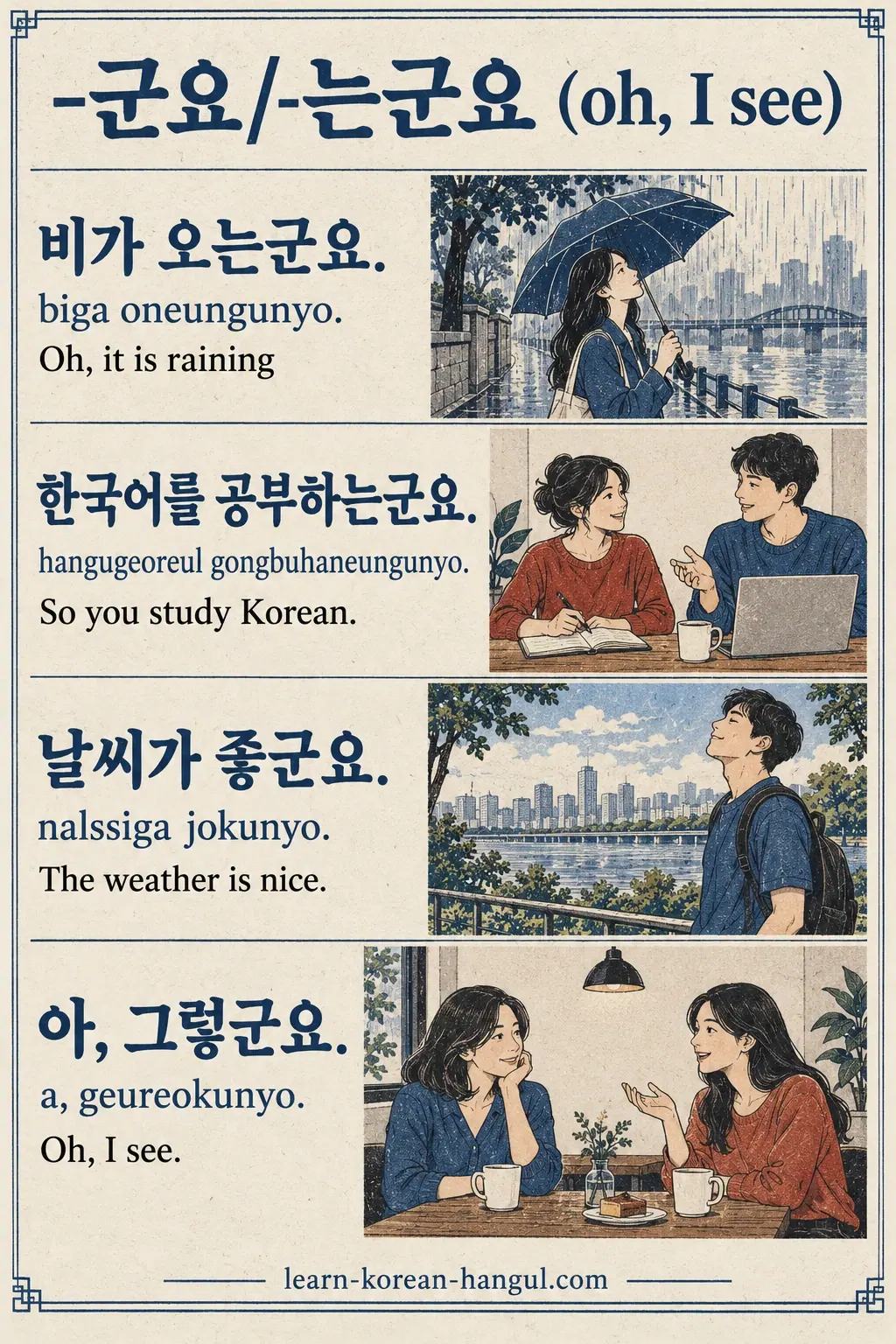
- 비가 오는군요. (biga oneungunyo.) [비가 오는군뇨] = "Oh, it's raining."
- 정말 예쁘군요. (jeongmal yeppeugunyo.) [정말 예쁘군뇨] = "It's really pretty, I see."
In 오는군요, 오 is the stem of 오다 (to come), 는 marks a present action, and 군요 is the ending. In 예쁘군요, 예쁘 is the stem of the adjective 예쁘다 (to be pretty), and the ending 군요 follows it directly. Grammar books call this meaning a "realization" or "mirative" use, because the speaker meets new information. 군요 is the 요 form of the short ending -군, a close partner of the casual 구나. Next comes the rule that builds the pattern.
How Do You Form -군요/-는군요?
-군요/-는군요 is formed by dropping 다 from the dictionary form and adding -는군요 to a verb or -군요 to an adjective. The 는 is the present-tense marker of action verbs, the same 는 you see in 먹는 (eating) and 가는 (going). Adjectives never carry it, which is why the two classes split.
| Word class | Pattern | Example | Spoken | Meaning |
|---|---|---|---|---|
| Action verb | stem + 는군요 | 가는군요 | [가는군뇨] | I see, you go |
| Action verb with final consonant | stem + 는군요 | 먹는군요 | [멍는군뇨] | I see, you eat |
| ㄹ-stem verb | drop ㄹ + 는군요 | 사는군요 | [사는군뇨] | I see, you live |
| Adjective | stem + 군요 | 예쁘군요 | [예쁘군뇨] | I see, it's pretty |
| Noun + 이다 | (이)군요 | 학생이군요 | [학쌩이군뇨] | I see, you're a student |
| Past | stem + 았/었군요 | 갔군요 | [갇꾼뇨] | I see, you went |
To choose between the first and fourth rows, ask whether the word describes an action or a state. 가다 (to go) is an action, so it takes 는. 예쁘다 (to be pretty) is a state, so it does not. The next three parts look at the groups of stems one at a time.
Stems Ending in a Vowel
A vowel stem takes the ending directly. A verb gets 는: 가다 becomes 가는군요, 오다 becomes 오는군요, and 공부하다 becomes 공부하는군요. An adjective gets 군요: 크다 becomes 크군요, and 예쁘다 becomes 예쁘군요.
- 한국어를 공부하는군요. (hangugeoreul gongbuhaneungunyo.) [한구거를 공부하는군뇨] = "So you study Korean."
- 가방이 크군요. (gabangi keugunyo.) [가방이 크군뇨] = "The bag is big, I see."
Vowel stems are the simplest case. A stem with a final consonant looks the same on the page, but it sounds different.
Stems Ending in a Consonant
A consonant stem also takes the ending directly, with no linking vowel. The spelling stays whole, and the sound follows the standard pronunciation rules (표준 발음법) of the 국립국어원 (National Institute of Korean Language). Three rules matter here:
- Nasalization: a final ㄱ, ㄷ or ㅂ becomes a nasal before ㄴ. The 는 in 먹는군요 starts with ㄴ, so 먹 is spoken [멍]: [멍는군뇨]. Likewise 읽는군요 is [잉는군뇨].
- Tensing: a plain ㄱ is spoken tense after a final ㄱ, ㄷ or ㅂ, so 어렵군요 is [어렵꾼뇨] and 춥군요 is [춥꾼뇨].
- Aspiration: ㅎ plus ㄱ makes a [ㅋ] sound, so 좋군요 is [조쿤뇨] and 그렇군요 is [그러쿤뇨].
In everyday speech the ending is usually pronounced with an added ㄴ before 요, as in [군뇨], because the final ㄴ of 군 meets the sound 요. A plain [군요] is also heard. The romanization on this page follows the spelling (-gunyo).
- 책을 많이 읽는군요. (chaegeul mani ingneungunyo.) [채글 마니 잉는군뇨] = "You read a lot of books, I see."
- 이 책은 어렵군요. (i chaegeun eoryeopgunyo.) [이 채근 어렵꾼뇨] = "This book is difficult."
- 날씨가 좋군요. (nalssiga jokunyo.) [날씨가 조쿤뇨] = "The weather is nice."
Write the plain spelling and say the changed sound. Two groups of stems need a short note, because learners expect trouble with them.
Irregular Stems and Nouns
Irregular stems follow the normal rule for the ending, because both 는 and 군 start with a consonant.
- ㄹ-stems: the ㄹ drops before 는 (a ㄴ sound). 살다 becomes 사는군요, 알다 becomes 아는군요, and 만들다 becomes 만드는군요. An adjective ㄹ-stem keeps its ㄹ before 군요, because 군 starts with ㄱ: 멀군요 and 길군요.
- ㅂ, ㄷ and 르 stems: they keep their dictionary stem before a consonant. 춥군요, 돕는군요 [돔는군뇨], 듣는군요 [든는군뇨] and 모르는군요 are all regular in shape.
- 있다 and 없다: in the dictionary these two words (and 맛있다, 멋있다) take the verb form: 있는군요, 없는군요, 맛있는군요. In everyday speech the shorter 있군요 and 맛있군요 are also very common.
- Nouns: 이다 gives (이)군요. After a consonant you say 이군요: 학생이군요. After a vowel, 이 is often dropped: 의사군요. The negative is 아니군요.
With the honorific marker -시-, a verb usually becomes -시는군요 (사시는군요), and the shorter -시군요 is also heard. A teacher is introduced in this way:
- 선생님이시군요. (seonsaengnimisigunyo.) [선생니미시군뇨] = "So you are a teacher."
With the formation clear, one full sentence can be built step by step.
Worked Example: Building a Sentence with -군요/-는군요

-군요/-는군요 grammar turns a plain statement you just heard into a polite reaction. Follow the steps with the sentence "Mina studies Korean."
- Start with the plain sentence. 한국어를 공부해요. (hangugeoreul gongbuhaeyo.) = "She studies Korean." The predicate is 공부해요.
- Find the dictionary form. 공부해요 comes from 공부하다 (to study). It is an action verb.
- Find the stem. Drop 다: 공부하.
- Choose the ending. An action verb takes 는군요, so 공부하 + 는군요 = 공부하는군요.
- Rebuild the sentence. 한국어를 공부하는군요. (hangugeoreul gongbuhaneungunyo.) [한구거를 공부하는군뇨] = "So you study Korean."
Sentence
So you study Korean.
Show answer
한국어를 공부하는군요
You will know it worked when the object (한국어를) stays in place and only the last word changed from 공부해요 to 공부하는군요. The most common slip is dropping 는, which gives the incomplete 공부하군요. Always check that a verb has 는. A reaction can appear in more than one tense and sentence type, and each has limits.
Which Tenses and Sentence Types Work with -군요/-는군요?

-군요/-는군요 works in the present, the past and the inference form, in statements and in rising-tone questions. It does not work in commands or suggestions. The tense markers go before 군요, and in the past and the inference forms the 는 disappears.
| Form | Pattern | Example | Meaning |
|---|---|---|---|
| Present verb | stem + 는군요 | 가는군요. | I see, you go. |
| Present adjective | stem + 군요 | 예쁘군요. | I see, it is pretty. |
| Noun | (이)군요 | 선생님이시군요. | I see, you are a teacher. |
| Past | stem + 았/었군요 | 벌써 밤이 깊었군요. [기펃꾼뇨] | It is already late at night. |
| Inference | stem + 겠군요 | 내일은 비가 오겠군요. [오겓꾼뇨] | It will probably rain tomorrow. |
| Negative | stem + 지 않는군요 / 지 않군요 | 비가 오지 않는군요. | I see, it is not raining. |
| Casual | stem + 는구나 / 구나 | 비가 오는구나. | Oh, it is raining. |
The past form reports something that already happened: 일찍 일어났군요 means "I see you got up early." The inference form -겠군요 is a conclusion from facts, such as 내일은 비가 오겠군요 after you read the forecast.
- 벌써 밤이 깊었군요. (beolsseo bami gipeotgunyo.) [벌써 바미 기펃꾼뇨] = "It's already late at night."
- 내일은 비가 오겠군요. (naeireun biga ogetgunyo.) [내이른 비가 오겓꾼뇨] = "It will probably rain tomorrow."
A statement with -군요 usually ends with a falling or level tone. A rising tone turns it into a gentle check, as in 벌써 가는군요? ("You're leaving already, I see?"). Commands and suggestions never take -군요. These limits make the closest neighbour, -네요, the most useful comparison.
How Is -군요/-는군요 Different from -네요?

-군요/-는군요 reports something you have just learned or understood, while -네요 reports something you perceive directly. Both mean "oh, I see". The difference is the source of the information and the tone: -군요 is calmer and more reflective, and -네요 is lighter and more surprised.
-네요
oh, how ...: a fresh perception
-군요/-는군요
oh, I see: a realization
-구나/-는구나
oh!: the casual realization
| Comparison | -네요 | -군요/-는군요 | -구나/-는구나 |
|---|---|---|---|
| Source of the information | your senses, right now | news, words or a conclusion | news, words or a conclusion |
| Politeness | polite | polite | casual |
| Stem rule | bare stem + 네요 | verb 는군요, adjective 군요 | verb 는구나, adjective 구나 |
| Level | A2 | B1 | B1 |
Use -네요 for what your senses show right now; use -군요/-는군요 for what you just learned or worked out; use -구나/-는구나 for the same meaning with a friend.
Here is the same situation with both endings. A colleague tells you she moved to Daegu. 대구로 이사했군요 ("So you moved to Daegu") reacts to the news she gave you. Later you visit and see a view from her window. 전망이 좋네요 ("What a nice view!") reacts to what your eyes show. The side-by-side lesson is -네요 vs -군요, and the full rules for the other ending are on the page for -네요.
The second neighbour is the casual partner, -구나/-는구나. The meaning is the same, but 구나 is for friends and younger people, and 군요 is for people you speak to politely. These contrasts lead to the smaller variations of the pattern.
Variations and Edge Cases of -군요/-는군요

-군요/-는군요 has three common variations: a set reply, an honorific reaction and a casual partner. Each one is short, and each appears in real conversation.
- The reply 그렇군요. After someone explains something, 아, 그렇군요 means "Oh, I see." The past form 그랬군요 means "So that is how it was." Both are among the most useful replies in a Korean conversation.
- Honorific reaction. To react to a respected person's situation, add -시-: 한국에 사시는군요 ("You live in Korea, I see").
- Casual partner. Close friends use -구나/-는구나: 비가 오는구나. The polite and casual pairs are -네요/-네 and -군요/-구나. See the casual speech pages for more pairs.
아, 그렇군요.
a, geureokunyo.
Oh, I see.
아, 한국에 사시는군요.
a, hanguge sasineungunyo.
Oh, you live in Korea.
A reaction can also give the reason: 아, 그래서 늦었군요 ("Oh, that's why you're late"). The word 그래서 ("so, therefore") links the earlier explanation to the new understanding.
This lesson covers the present, past and inference forms used in daily replies, not the full range of Korean exclamations. Endings such as -더군요 ("I noticed that, as I experienced it") and -군 (the plain written form) belong to other lessons. The mistakes below show where the boundary with other patterns causes real errors.
What Mistakes Do Learners Make with -군요/-는군요?
Learners most often get the stem class, the tense or the source of the information wrong. Four mistakes appear again and again.
- Leaving out 는 after a verb. Learners often assume that 군요 alone is the full ending, because adjectives use it. Actually a present-tense action verb needs 는. 비가 오군요 is wrong; say 비가 오는군요.
- Adding 는 to an adjective. 예쁘는군요 and 바쁘는군요 are wrong, because 는 marks action verbs only. Say 예쁘군요 and 바쁘군요.
- Putting 는 in the past tense. 갔는군요 and 먹었는군요 are wrong. The past marker replaces 는: 갔군요 and 먹었군요.
- Using it for something you have always known. 저는 학생이군요 is odd, because you have not just learned that you are a student. The ending needs a new realization, such as 아, 제가 잘못 알았군요 ("Oh, I got that wrong").
A quick check for any sentence: Is the word before the ending an action verb or an adjective? Is it present or past? Did I just learn this? If you can answer all three, the sentence is sound.
The practice set below tests these four points directly.
Practice and Answers
Try the four items before you read the answer key. Cover the answers with your hand.
- Choose the form. A friend says 저는 부산에 살아요. Reply: 아, 부산에 ___. (사는군요 / 살군요)
- Fix the error. A learner looks at a photo and says 사진이 예쁘는군요. Correct it.
- Translate. "Oh, that's why you're late." Use 늦다 and -았/었군요.
- Write your own. Write one -군요/-는군요 reaction to news from a friend. Then change it to the casual form.
Practice · 6
A friend says they live in Busan. Complete your reply: 아, 부산에 ___.
Show answer
사는군요
살다 is a ㄹ-stem verb. The ㄹ drops before 는, so 살 + 는군요 becomes 사는군요.
Choose the correct form: 이 가방이 정말 ___. (예쁘다)
Show answer
예쁘군요
Adjectives take -군요 without 는.
Someone explains why they are late. Which reply fits best?
Show answer
그렇군요.
그렇다 is an adjective, so it takes -군요. 그렇군요 is the standard polite "I see".
What is the casual (banmal) form of 비가 오는군요?
Show answer
비가 오는구나
The casual partner of -는군요 is -는구나.
Which past form is correct? 아, 그래서 ___. ("Oh, that's why you're late.")
Show answer
늦었군요
In the past tense the past marker replaces 는, so 늦었 + 군요 = 늦었군요.
How is 좋군요 usually pronounced in everyday speech?
Show answer
[조쿤뇨]
ㅎ plus ㄱ makes [ㅋ], and in everyday speech an ㄴ is usually added before 요.
Answer key
- 사는군요. 살다 is a ㄹ-stem verb, so the ㄹ drops before 는: 아, 부산에 사는군요.
- 사진이 예쁘군요. 예쁘다 is an adjective, so it takes -군요 with no 는.
- 아, 그래서 늦었군요. (a, geuraeseo neujeotgunyo.) [아, 그래서 느젇꾼뇨] = "Oh, that's why you're late." The past marker -었- replaces 는.
- Answers vary. Check that verbs have 는 and adjectives do not. An example: 새 직장을 구했군요 becomes 새 직장을 구했구나 ("You found a new job").
If you can complete items 1 to 3 without the key, you can use the pattern in conversation. The lesson now hands off to related patterns.
What Should You Learn Next after -군요/-는군요 Grammar?
After -군요/-는군요 grammar, learn the casual partner, then the ending for shared knowledge. This lesson teaches the polite realization ending and does not cover the casual partner's full rules, retrospective endings or reminders in depth. Those live on their own pages.
- Start with -구나/-는구나, which carries the same meaning for friends and younger people.
- Continue with -네요 if you have not read it, and compare the pair in -네요 vs -군요.
- Return to Exclamations and Realization to see every lesson in this set, or to the Intermediate Grammar list for other B1 patterns.
With these steps, -군요/-는군요 becomes automatic: ask whether the word is an action or a description, add 는군요 or 군요, and keep it for what you have just learned.
Frequently Asked Questions
What does -군요/-는군요 mean in one sentence?
-군요/-는군요 means "oh, I see" or "so that is how it is". The speaker has just learned or worked out something and reacts politely. 비가 오는군요 means "Oh, it is raining," and 그렇군요 means "I see, that is so." It sounds thoughtful and calm, not excited.
How do I attach -군요/-는군요 to a verb or adjective?
Use -는군요 after an action verb stem and -군요 after an adjective stem: 가는군요 but 예쁘군요. A noun takes (이)군요, as in 학생이군요. A ㄹ-stem verb loses its ㄹ before 는, so 살다 becomes 사는군요. Adjectives never take 는, so 예쁘는군요 is wrong.
Can -군요/-는군요 be used in the past tense?
Yes. Put -았/었- before -군요, with no 는: 갔군요 means "I see, they went," and 먹었군요 means "I see, you ate." The past form fits news about something that already happened, such as 일찍 일어났군요 ("So you got up early"). A form like 갔는군요 is not used.
Is -군요/-는군요 polite or casual?
-군요/-는군요 is polite speech, the 요 form of the casual -구나/-는구나. Use it with older people, teachers and new acquaintances. It is common in spoken replies and also appears in interviews and written dialogue. With close friends, drop the 요 and say -구나/-는구나.
What is the most common mistake with -군요/-는군요?
The most common mistake is the wrong class of stem. Verbs need 는, so 비가 오군요 is incomplete; say 비가 오는군요. Adjectives must not take 는, so say 예쁘군요, not 예쁘는군요. A second slip is using it for a fact the speaker has known all along.