What you'll learn
- Attach -네요 to any verb, adjective or noun and say the result aloud, including the nasal sounds in 먹네요 and 좋네요.
- Tell a first-hand discovery (-네요) from a plan (-(으)ㄹ 거예요) and from a stored fact.
- Use -네요 in the past, the negative, the honorific and the inference forms.
- Choose between -네요 and -군요/-는군요 when you react to news.
- Spot and fix the four most common learner mistakes with -네요.
Before you start: you should know how to find a verb stem (drop 다 from the dictionary form, see verb stem) and the polite 요 style (polite 요 style). Audio plays only when you press a button.
What Does -네요 Grammar Mean?

-네요 grammar means "oh, I see" or "oh, how ...": the speaker reports a fresh observation. You see, hear, taste or find something and react in the same moment. The ending turns a plain statement into a small reaction, so it sounds friendlier than a flat 좋아요 or 와요.
Here are two first examples. In the first, the speaker hears someone speak Korean well. In the second, the speaker looks at the calendar or the weather and notices the season.
- 한국어를 잘하시네요. (hangugeoreul jalhasineyo.) [한구거를 잘하시네요] = "Oh, you speak Korean well!"
- 벌써 겨울이네요. (beolsseo gyeourineyo.) [벌써 겨우리네요] = "It's already winter, I see."
In 잘하시네요, 잘하 is the stem of 잘하다 (to be good at), 시 is the honorific marker that respects the subject (here, the listener you are praising), and 네요 is the ending. In 겨울이네요, 겨울 is a noun (winter), 이 is the verb "to be", and 네요 is the same ending. The pattern is the same in both: something is true, and I have just noticed it. Grammar books call this meaning a "realization" or "mirative" use, which means the speaker meets new information. Next comes the rule that builds the pattern.
How Do You Form -네요?
-네요 is formed by dropping 다 from the dictionary form and adding -네요. Nothing else changes for verbs and adjectives. The ending starts with the consonant ㄴ, so it never needs the linking vowel 으 and it never triggers the vowel changes of 아/어 endings.
| Dictionary form | Stem | Add -네요 | Spoken | Meaning |
|---|---|---|---|---|
| 오다 | 오 | 오네요 | [오네요] | Oh, it's coming (snowing, raining) |
| 크다 | 크 | 크네요 | [크네요] | Oh, it's big |
| 먹다 | 먹 | 먹네요 | [멍네요] | Oh, you're eating |
| 좋다 | 좋 | 좋네요 | [존네요] | Oh, it's good |
| 살다 | 살 | 사네요 | [사네요] | Oh, you live (there) |
| 학생 (noun) | 학생 | 학생이네요 | [학쌩이네요] | Oh, you're a student |
The table shows one rule on six words. The next three parts look at each group of stems.
Stems Ending in a Vowel
A vowel stem takes -네요 directly. 오다 becomes 오네요, 크다 becomes 크네요, and 예쁘다 becomes 예쁘네요. Examples:
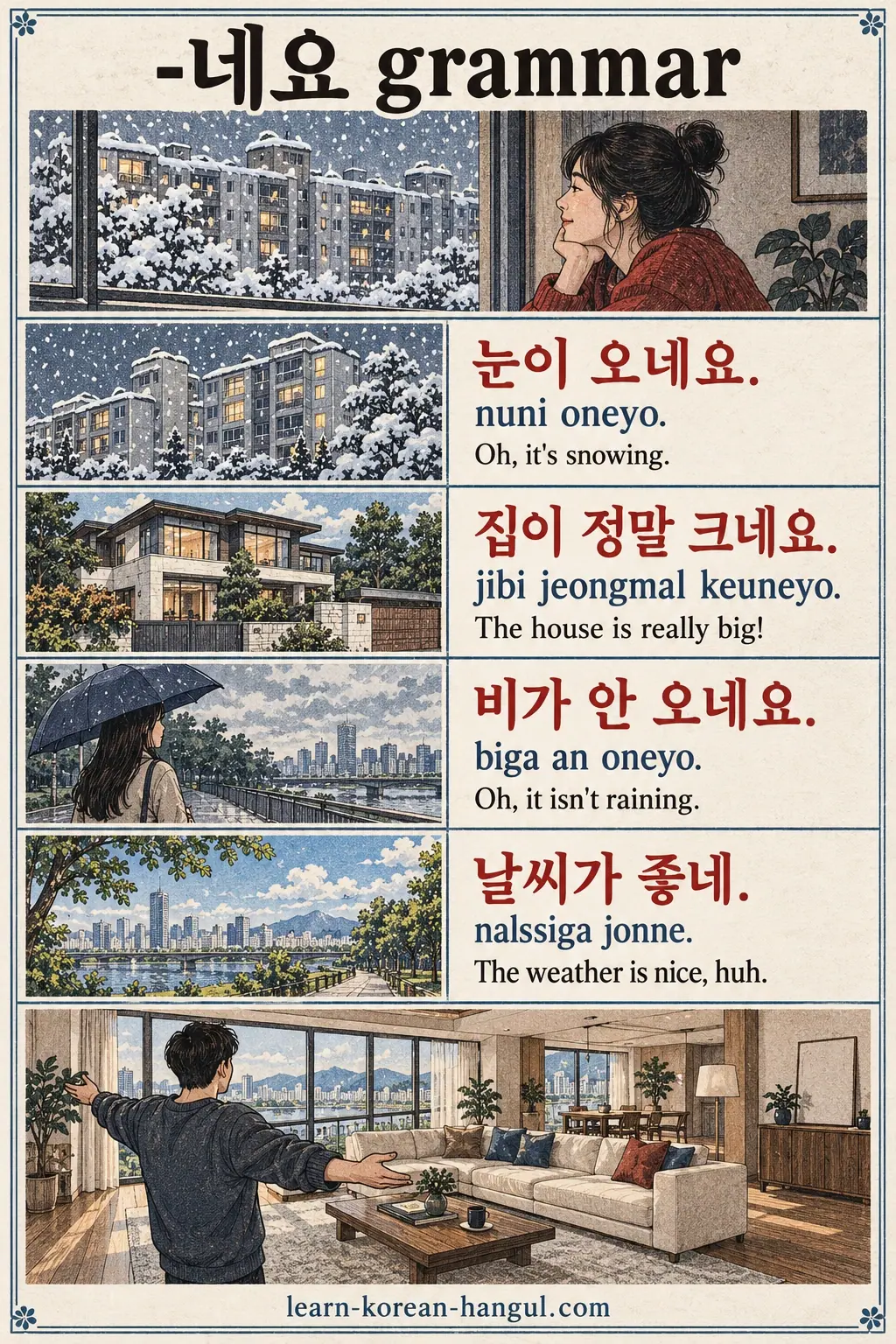
- 눈이 오네요. (nuni oneyo.) [누니 오네요] = "Oh, it's snowing."
- 집이 정말 크네요. (jibi jeongmal keuneyo.) [지비 정말 크네요] = "The house is really big!"
Vowel stems are the simplest case. A stem with a final consonant looks the same on the page, but it sounds different.
Stems Ending in a Consonant
A consonant stem also takes -네요 directly, and the spelling stays whole. The sound changes, because a final consonant meets the nasal ㄴ. The standard pronunciation rules (표준 발음법) of the 국립국어원 (National Institute of Korean Language) turn a final ㄱ, ㄷ or ㅂ into a nasal before ㄴ: ㄱ becomes [ㅇ], ㄷ becomes [ㄴ] and ㅂ becomes [ㅁ]. The final ㅎ of 좋 also becomes [ㄴ].
| Written | Spoken | RR | Rule |
|---|---|---|---|
| 먹네요 | [멍네요] | meongneyo | ㄱ + ㄴ becomes ㅇ + ㄴ |
| 읽네요 | [잉네요] | ingneyo | ㄺ is spoken [ㄱ], then nasalized |
| 듣네요 | [든네요] | deunneyo | ㄷ + ㄴ becomes ㄴ + ㄴ |
| 돕네요 | [돔네요] | domneyo | ㅂ + ㄴ becomes ㅁ + ㄴ |
| 좋네요 | [존네요] | jonneyo | ㅎ + ㄴ becomes ㄴ + ㄴ |
| 많네요 | [만네요] | manneyo | ㄶ is spoken [ㄴ] |
| 있네요 | [인네요] | inneyo | ㅆ is spoken [ㄷ], then becomes ㄴ |
| 없네요 | [엄네요] | eomneyo | ㅄ is spoken [ㅂ], then becomes ㅁ |
Two full sentences show the effect:
- 여기 사람이 많네요. (yeogi sarami manneyo.) [여기 사라미 만네요] = "There are a lot of people here."
- 이 음식 정말 맛있네요. (i eumsik jeongmal masinneyo.) [이 음식 정말 마신네요] = "This food is really tasty."
Write the plain spelling and say the nasal sound. The second sentence has two accepted spoken forms, [마신네요] and [마딘네요]; both follow the standard. Irregular stems and nouns need their own short notes.
Irregular Stems and Nouns
Irregular stems barely change before -네요, because the ending starts with a consonant. The exception is the ㄹ-stem, which loses its ㄹ before ㄴ.
- ㄹ-stems: 살다 becomes 사네요, 알다 becomes 아네요, 길다 becomes 기네요, 멀다 becomes 머네요, and 만들다 becomes 만드네요. The ㄹ drops before ㄴ, ㅂ and ㅅ.
- ㅂ-irregular: 춥다 stays 춥네요 [춤네요], and 돕다 stays 돕네요 [돔네요]. The ㅂ turns into 우 only before a vowel.
- ㄷ-irregular: 듣다 stays 듣네요 [든네요].
- 르 and ㅡ stems: 모르다 stays 모르네요, and 바쁘다 stays 바쁘네요.
- ㅎ adjectives: 그렇다 stays 그렇네요 [그런네요].
Nouns use 이다, which becomes (이)네요. After a consonant you say 이네요: 학생이네요 [학쌩이네요]. After a vowel, 이 is often dropped: 의사네요 ("Oh, you're a doctor") is more common than 의사이네요. The negative noun form is 아니네요: 학생이 아니네요 ("Oh, you're not a student"). With the formation clear, one full sentence can be built step by step.
Worked Example: Building a Sentence with -네요

-네요 grammar turns a plain observation into a reaction. Follow the steps with the sentence "The house is big."
- Start with the plain sentence. 집이 커요. (jibi keoyo.) = "The house is big." The predicate is 커요.
- Find the dictionary form. 커요 comes from 크다 (to be big). The stem is 크.
- Add -네요 to the stem. 크 + 네요 = 크네요. There is no vowel change, because 네요 starts with a consonant.
- Add the words that show your surprise. 정말 ("really") makes the reaction stronger and is optional.
- Rebuild the sentence. 집이 정말 크네요. (jibi jeongmal keuneyo.) [지비 정말 크네요] = "The house is really big!"
Sentence
The house is really big!
Show answer
집이 정말 크네요
You will know it worked when the subject (집이) and the adverb stay in place and only the predicate changes from 커요 to 크네요. The most common slip at this step is keeping the 아/어 form and adding the ending to it (커네요). Always work from the stem. A reaction can appear in more than one tense and sentence type, and each has limits.
Which Tenses and Sentence Types Work with -네요?

-네요 works in the present, the past and the inference form, in statements and in gentle checking questions. It does not work in commands or suggestions. The tense marker goes between the stem and the ending.
| Form | Pattern | Example | Meaning |
|---|---|---|---|
| Present | stem + 네요 | 눈이 오네요. | Oh, it's snowing. |
| Past | stem + 았/었네요 | 벌써 다 먹었네요. [머건네요] | Oh, you've already eaten it all. |
| Inference | stem + 겠네요 | 내일은 비가 오겠네요. [오겐네요] | It looks like it will rain tomorrow. |
| Honorific | stem + 시네요 | 잘하시네요. | Oh, you are good at it. |
| Negative | 안 + verb + 네요 | 비가 안 오네요. | Oh, it isn't raining. |
| Negative (long) | stem + 지 않네요 | 비가 오지 않네요. [오지 안네요] | Oh, it isn't raining. |
| Casual | stem + 네 | 날씨가 좋네. | Oh, nice weather. |
The past form reports a result you can see now. 벌써 다 먹었네요 is what you say when you look at an empty plate. The inference form -겠네요 is a guess from what you can see, such as dark clouds. Neither form works for a plan: the speaker has to be reacting to something.
- 벌써 다 먹었네요. (beolsseo da meogeonneyo.) [벌써 다 머건네요] = "You've already eaten everything."
- 비가 안 오네요. (biga an oneyo.) = "Oh, it isn't raining."
- 내일은 비가 오겠네요. (naeireun biga ogenneyo.) [내이른 비가 오겐네요] = "It looks like it will rain tomorrow."
A statement with -네요 usually ends with a falling tone, like a small sigh of surprise. A rising tone turns it into a checking question: 벌써 가네요? means "You're leaving already?" Commands and suggestions never take -네요, so 가네요 cannot mean "please go" or "let's go". These limits make the closest neighbour, -군요, the most useful comparison.
How Is -네요 Different from -군요/-는군요?
-네요 reports something you perceive directly, while -군요/-는군요 reports something you have just understood or learned. Both mean "oh, I see". The difference is the source: your senses for -네요, and your thinking or someone's words for -군요.
-네요
oh, how ...: a fresh perception
-군요/-는군요
oh, I see: a realization
-잖아요
you know: a reminder of shared knowledge
| Comparison | -네요 | -군요/-는군요 | -잖아요 |
|---|---|---|---|
| Source of the information | your senses, right now | news, words or a conclusion | what both speakers know |
| Typical feeling | mild surprise, a compliment | quiet understanding | gentle reminder, some impatience |
| Fits a reply to someone's story | sometimes | yes: 그렇군요 | no |
| Level | A2 | B1 | B1 |
Use -네요 for what you see, hear or taste right now; use -군요/-는군요 for what you just learned or worked out; use -잖아요 when the listener already knows.
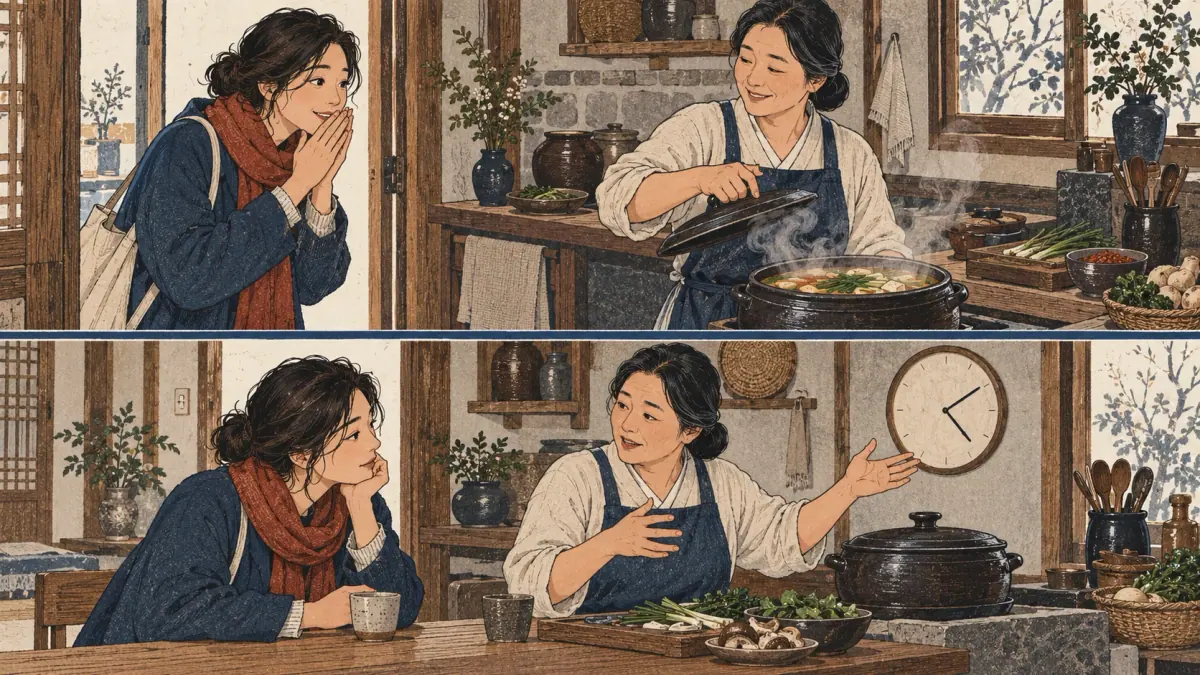
Here is the same situation with each ending. You walk into a friend's kitchen and smell soup. 맛있는 냄새가 나네요 ("It smells good!") reports the smell. Later your friend says the soup took three hours. 오래 걸렸군요 ("So it took a long time, I see") reports what you just learned. A third speaker, who made the soup with you, might say 오래 걸렸잖아요 ("It took a long time, remember"). The full rules are on the page for -군요/-는군요, and the side-by-side lesson is -네요 vs -군요.
The second neighbour is -잖아요. It does not report a discovery at all: it reminds the listener of something they already know, often with a hint of impatience. A reply such as 그렇네요 ("You're right, I see it too") shows that -네요 is also used to agree when you suddenly notice that something is true. These contrasts lead to the smaller variations of the pattern.
Variations and Edge Cases of -네요

-네요 has four common variations: a casual form, a checking question, a self-discovery use and a softening use. Each one is short, and each appears in real conversation.
- Casual -네. Drop the 요 with a close friend or a younger person: 날씨가 좋네 ("Nice weather, huh"). This is the banmal form, explained on the casual speech pages.
- Rising tone. 벌써 가네요? with a rising tone means "You're leaving already?" The speaker checks what they see.
- Self-discovery. The speaker can be the subject if they just found out: 아, 제가 실수했네요 ("Oh, I made a mistake"). This works only when the speaker has just noticed it, not when they did it on purpose.
- Soft information. Staff and friends use -네요 to point something out gently: 여기 있네요 ("Here it is"), 문이 열려 있네요 ("The door is open").
날씨가 좋네.
nalssiga jonne.
The weather is nice, huh.
아, 제가 실수했네요.
a, jega silsuhaenneyo.
Oh, I made a mistake.
Another useful pairing joins two observations with -는데: 어제는 추웠는데 오늘은 따뜻하네요 ("It was cold yesterday, but today it's warm"). The first clause gives the background, and -네요 ends the sentence with the new observation.
This lesson covers the polite and casual forms used in daily life, not the full range of Korean exclamations. Endings such as -더라고요 ("I noticed that") and -(으)ㄴ/는데요 ("but ...") belong to their own lessons. The mistakes below show where the boundary with other patterns causes real errors.
What Mistakes Do Learners Make with -네요?

Learners most often get the source of the information, the tense or the shape of the stem wrong. Four mistakes appear again and again.
- Using -네요 for a plan. Learners often assume that -네요 is a general softener, like English "I guess". Actually -네요 needs something the speaker notices now. 내일 가네요 sounds as if you are watching yourself leave tomorrow. Say 내일 갈 거예요 ("I will go tomorrow").
- Using -네요 for something you have known for years. 서울은 한국의 수도네요 is natural only when you have just read it for the first time. For general knowledge, use the plain 서울은 한국의 수도예요.
- Keeping the 아/어 vowel. 커네요 and 와네요 are wrong. The correct forms are 크네요 and 오네요, because -네요 attaches to the bare stem.
- Forgetting the ㄹ-drop. 살네요 and 만들네요 are wrong. Say 사네요 and 만드네요.
A quick check for any -네요 sentence: Did I just notice this? Is the word before 네요 a bare stem? Is the ending a statement, not a command? If all three answers are yes, the sentence is sound.
The practice set below tests these points directly.
Practice and Answers
Try the four items before you read the answer key. Cover the answers with your hand.
- Choose the form. You walk outside and see snow. Complete: 아, 눈이 ___. (와요 / 오네요)
- Fix the error. A learner says 서울에 살네요 when meeting a friend who lives in Seoul. Correct it.
- Translate. "The weather is really nice!" Use 좋다 and -네요.
- Write your own. Write one -네요 sentence about something you notice in the room right now. Then change it to the casual form.
Practice · 7
You open the window and see snow. Which sentence fits? 아, 눈이 ___.
Show answer
오네요
You are noticing the snow right now, so -네요 fits, and it attaches to the bare stem 오, not to the 아/어 form 와.
Choose the correct form of 살다 (to live) with -네요: 서울에 ___.
Show answer
사네요
The ㄹ of a ㄹ-stem drops before ㄴ, so 살 + 네요 becomes 사네요.
Which sentence correctly expresses a plan, not a discovery?
Show answer
내일 갈 거예요.
A plan uses -(으)ㄹ 거예요. -네요 needs something the speaker notices now.
What is the casual (banmal) form of 날씨가 좋네요?
Show answer
날씨가 좋네
Drop the polite 요 from -네요 to get the casual -네.
How is 좋네요 pronounced?
Show answer
[존네요]
The final ㅎ of 좋 becomes [ㄴ] before the ㄴ of 네요.
Which form of 크다 (to be big) is correct with -네요? 집이 정말 ___.
Show answer
크네요
-네요 attaches to the bare stem 크. 커네요 wrongly keeps the 아/어 form.
You look at an empty plate. Which sentence fits? 벌써 다 ___.
Show answer
먹었네요
The past marker goes before -네요 to report a result you can see now.
Answer key
- 오네요. You are noticing the snow now, so -네요 is the right ending: 아, 눈이 오네요.
- 서울에 사네요. The ㄹ of 살다 drops before ㄴ. (seoure saneyo.) = "Oh, you live in Seoul."
- 날씨가 정말 좋네요. (nalssiga jeongmal jonneyo.) [날씨가 정말 존네요] = "The weather is really nice!"
- Answers vary. Check that the verb or adjective stem is bare before 네요 and that the casual form drops 요. An example: 창문이 열려 있네요 becomes 창문이 열려 있네 ("The window is open").
If you can complete items 1 to 3 without the key, you can use the pattern in conversation. The lesson now hands off to related patterns.
What Should You Learn Next after -네요 Grammar?
After -네요 grammar, learn the ending for realization, then the ending for shared knowledge. This lesson teaches fresh first-hand reactions and does not cover reported news, retrospective endings or reminders in depth. Those live on their own pages.
- Start with -군요/-는군요, which reacts to what you just learned.
- Continue with -잖아요, which reminds a listener of something they already know.
- Compare the first pair side by side in -네요 vs -군요.
- Return to Exclamations and Realization to see every lesson in this set, or to the Beginner Grammar list for other A2 patterns.
With these steps, -네요 becomes automatic: take the bare stem, add 네요, and keep it for what you notice right now.
Frequently Asked Questions
What does -네요 mean in one sentence?
-네요 means "oh, I see" or "oh, how ...". The speaker has just noticed something with their own eyes, ears or taste and says so, often with mild surprise or a small compliment. 한국어를 잘하시네요 means "Oh, you speak Korean well!" The feeling is fresh, not planned.
How do I attach -네요 to a verb or adjective?
Drop 다 and add -네요 with no linking vowel: 가다 becomes 가네요, 좋다 becomes 좋네요, and 이다 becomes (이)네요. A stem ending in ㄹ loses it first, so 살다 becomes 사네요. The same rule works for verbs, adjectives and nouns.
Can -네요 be used in the past tense?
Yes. Put the past marker before it: 먹었네요 means "Oh, you ate it," and 갔네요 means "Oh, they went." The past marker -았/었- attaches to the stem first, and -네요 comes last. -네요 reports that you see a past event now, so the result is usually visible, such as an empty plate.
Is -네요 polite or casual?
-네요 is polite speech: it is the 요 form of the casual ending -네. Use it with strangers, colleagues and older people, and drop the 요 with close friends. It is a spoken ending that also appears in messages and blog posts. In very formal talks, speakers often choose -군요 or a plain polite statement.
What is the most common mistake with -네요?
The most common mistake is using it for facts the speaker already knew or for the speaker's own plans. 내일 가네요 is odd for "I am going tomorrow"; say 내일 갈 거예요. The ending needs a fresh perception, so use it when you notice, see, hear or taste something right now.