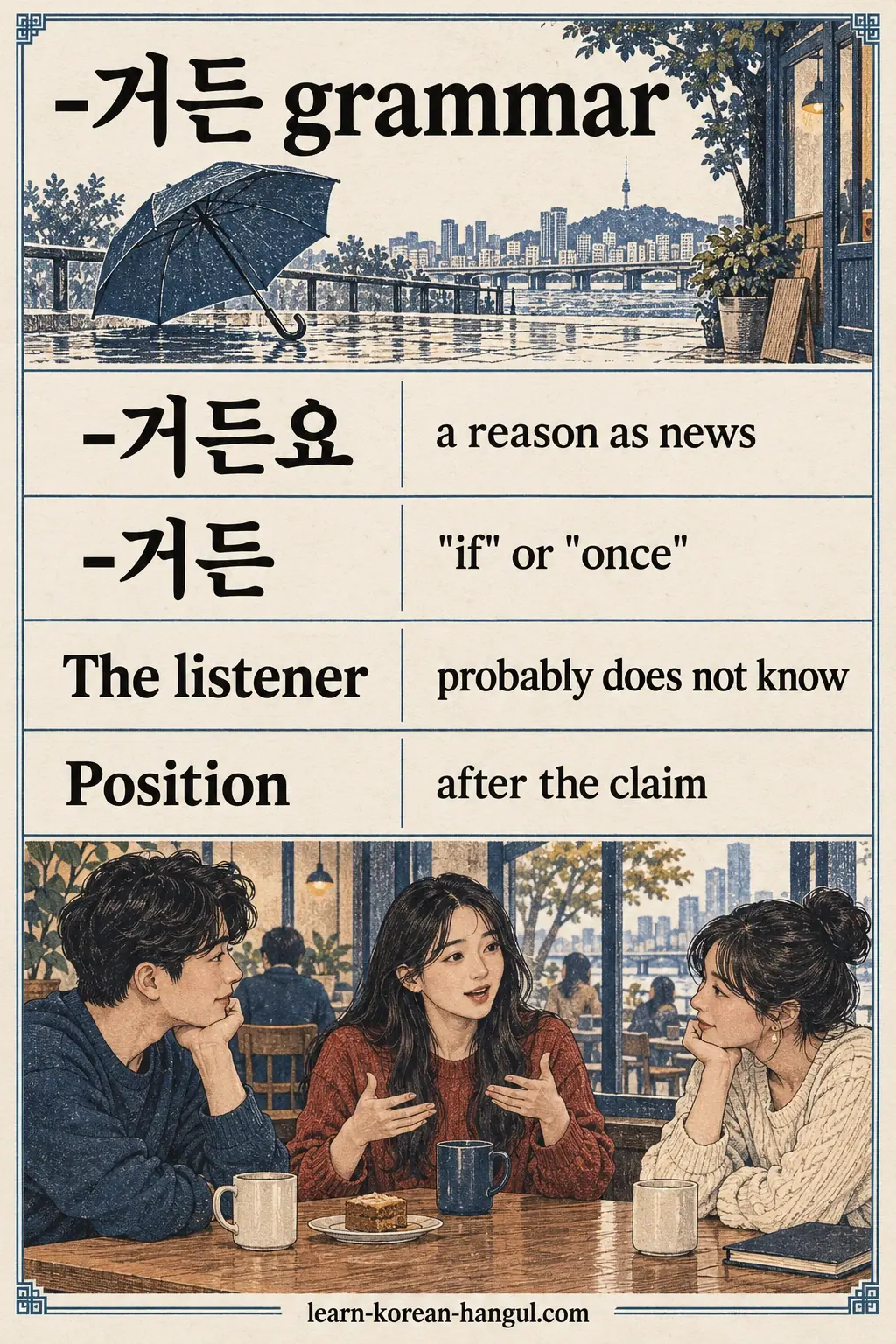
What you'll learn
- Attach -거든요 to verbs, adjectives and 이다.
- Place the reason after the claim it explains.
- Tell the "news" feeling of -거든요 from the "reminder" feeling of -잖아요.
- Recognise the older "if / once" use before a request.
Prerequisites: the polite ending -아요/어요, the past tense -았/었- and -(으)니까. Time: about 15 minutes.
Listen to two model sentences.
The next section defines the pattern.
What Does -거든 Grammar Mean?

-거든 has two uses, and only one of them is common today.
Use 1: a reason as news. At the end of a sentence, -거든요 gives a reason or background. The speaker says it as information the listener may not have. A sentence-final ending is an ending that closes a sentence instead of joining two clauses. -거든요 tells the listener, "Here is something you did not know, and it explains what I said."
Use 2: "if" or "once". In the middle of a sentence, -거든 means "if" or "once", and it leads into a command, a request or a promise. 집에 가거든 전화해 주세요 means "Please call me once you get home." This use is old-fashioned, and it is limited to a few kinds of main clause. Learners meet it in set patterns and in some fixed expressions.
Here are two glossed examples.
| Part | 왜 안 가요? 비가 오거든요. | 집에 가거든 전화해 주세요. |
|---|---|---|
| Question or first part | 왜 안 가요? (Why aren't you going?) | 집에 가거든 (once you get home) |
| Reason or request | 비가 오거든요 (it is raining, you see) | 전화해 주세요 (please call me) |
| Spoken | [왜 안 가요? 비가 오거든뇨] | [지베 가거든 전화해 주세요] |
| RR (aid) | wae an gayo? biga ogeodeunyo | jibe gageodeun jeonhwahae juseyo |
| English | Why aren't you going? Because it's raining. | Please call me once you get home. |
In the first example, the answer comes after a question. That is typical. -거든요 usually answers a question or comes after a claim, because it supplies the missing reason.
The next section shows how to build the form.
How Do You Form -거든?
The rule is simple. Remove 다 from the dictionary form to get the stem. Then add 거든. For polite speech, add 요: 거든요. The stem is the verb or adjective without its dictionary ending -다. For 먹다 the stem is 먹.
Like -지만, -거든 begins with a consonant. It never needs a helping vowel, so the stem stays exactly as it is.
| Dictionary form | Stem | Stem + 거든요 | Spoken | RR (aid) |
|---|---|---|---|---|
| 가다 (go) | 가 | 가거든요 | [가거든뇨] | gageodeunyo |
| 하다 (do) | 하 | 하거든요 | [하거든뇨] | hageodeunyo |
| 먹다 (eat) | 먹 | 먹거든요 | [먹꺼든뇨] | meokgeodeunyo |
| 좋다 (be good) | 좋 | 좋거든요 | [조커든뇨] | jokeodeunyo |
| 많다 (be many) | 많 | 많거든요 | [만커든뇨] | mankeodeunyo |
| 있다 (exist, have) | 있 | 있거든요 | [읻꺼든뇨] | itgeodeunyo |
| 없다 (not exist) | 없 | 없거든요 | [업꺼든뇨] | eopgeodeunyo |
| 춥다 (be cold) | 춥 | 춥거든요 | [춥꺼든뇨] | chupgeodeunyo |
Two sound changes appear. After a stop sound such as ㄱ, ㄷ or ㅂ, the ㄱ of 거 is said as a tense ㄲ, so 먹거든요 sounds like [먹꺼든뇨]. This tensing happens in speech only. Revised Romanization (RR) does not mark tensing that comes from a neighbouring sound, so it writes meokgeodeunyo. In everyday speech, 요 after the final ㄴ of 든 usually picks up an extra ㄴ sound, so 가거든요 sounds like [가거든뇨]. The spelling and the RR do not change. The second change is aspiration. The ㅎ of 좋 and 많 joins the next ㄱ and makes ㅋ. RR writes this aspiration in predicates, so it is jokeodeunyo and mankeodeunyo.
Stems Ending in a Vowel
A vowel stem takes 거든 directly: 가거든, 오거든, 비싸거든, 바쁘거든. No contraction takes place. For 하다 words, write 하거든: 피곤하거든요 ("I'm tired, you see").
Stems Ending in a Consonant
A consonant stem also takes 거든 directly: 먹거든, 읽거든, 많거든. There is no 으, which is a difference from -(으)니까.
Irregular Stems and Nouns
Irregular stems do not change before 거든. An irregular stem is one that changes its shape before an ending that begins with a vowel. 거든 begins with a consonant, so no change takes place.
| Type | Dictionary form | With 거든요 | Note |
|---|---|---|---|
| ㅂ-irregular | 춥다 (be cold) | 춥거든요 | ㅂ stays; compare 추워요 |
| ㄷ-irregular | 듣다 (listen) | 듣거든요 [듣꺼든뇨] | ㄷ stays; compare 들어요 |
| 르-irregular | 모르다 (not know) | 모르거든요 | 르 stays; compare 몰라요 |
| ㅡ stem | 아프다 (be sick) | 아프거든요 | ㅡ stays; compare 아파요 |
| ㄹ stem | 살다 (live) | 살거든요 | ㄹ stays |
For nouns, use 이다, which means "to be". After a consonant, use 이거든요. After a vowel, speakers use 이거든요 or the shortened 거든요.
| Noun | With (이)거든요 | Meaning |
|---|---|---|
| 학생 (student) | 학생이거든요 [학쌩이거든뇨] | I'm a student, you see |
| 의사 (doctor) | 의사거든요 or 의사이거든요 | I'm a doctor, you see |
| 아니다 (is not) | 아니거든요 | it is not, you see |
The next section builds a full sentence.
Worked Example: Building 못 가요. 일이 많거든요.

Say "I can't go. I have a lot of work." Follow five steps.
- Write the claim first. "I can't go" is 못 가요.
- Pick the reason. "I have a lot of work" is 일이 많다.
- Find the stem. The stem of 많다 is 많.
- Add 거든요. 많 + 거든요 = 많거든요. Nothing changes in the stem.
- Place the reason after the claim. 못 가요. 일이 많거든요.
You'll know it worked when the reason sits in its own sentence after the claim and ends in 거든요. The reason first and the claim second would be the pattern of -아/어서 or -(으)니까, not -거든요. Try the same steps with "I'm not eating. I'm not hungry": 안 먹어요. 배가 안 고프거든요.
Sentence
I cannot go. I have a lot of work, you see.
Show answer
못 가요. 일이 많거든요.
The next section covers tense and sentence types.
Which Tenses and Sentence Types Work with -거든?

The two uses behave differently, so the grid has two parts.
| Slot | Form | Example | English |
|---|---|---|---|
| Past before 거든요 | stem + 았/었 + 거든요 | 몸이 아팠거든요. | I was sick, you see. |
| Past with 하다 | 했 + 거든요 | 피곤했거든요. | I was tired, you see. |
| Honorific | stem + (으)시 + 거든요 | 선생님이 바쁘시거든요. | Our teacher is busy, you see. |
| Casual ending | -거든 | 일이 많거든. | I have a lot of work, you see. |
| Statement after | the reason ends the sentence | 못 가요. 비가 오거든요. | I can't go. It's raining. |
| "If / once" use | stem + 거든 + request | 도착하거든 전화해 주세요. | Please call me once you arrive. |
| Command or promise after "if" | 세요, ㅂ시다, 을게요 | 끝나거든 같이 먹읍시다. | Once it's over, let's eat together. |
Look at the past form. The marker 았/었 comes before 거든: 아프 + 았 + 거든요 = 아팠거든요. The past tense has its own page: past tense -았/었-.
The "if / once" use is limited. The main clause must be a request, an order, a suggestion or a promise. You can say 모르거든 물어보세요 ("If you don't know, ask"), but you cannot say 모르거든 안 가요 as a plain statement. For ordinary conditions, use -(으)면.
-거든요 itself closes a statement, so it does not turn a sentence into a question. The question that comes before it follows the usual rules. Yes/no questions end with a rise. A wh-question puts the stress on the question word and often ends with a fall or a rise-fall, rather than a sharp rise: 왜 안 가요? asks "Why aren't you going?"
The next section compares -거든 with its neighbours.
How Is -거든 Different from -잖아요?

-거든요 and -잖아요 both end a sentence, both give a reason, and both belong to spoken Korean. The difference is what the speaker thinks the listener knows.
| Feature | -거든요 | -잖아요 | -(으)니까 |
|---|---|---|---|
| The listener | probably does not know | already knows | can see it |
| Feeling | "here is some news" | "you know this" | "look at this fact" |
| Position | after the claim | before or after | before the result |
| Hint of impatience | no | sometimes | no |
| Example | 오늘 휴일이거든요. | 오늘 휴일이잖아요. | 오늘 휴일이니까 쉬세요. |
Compare the first two.
- 오늘 휴일이거든요. ("Today is a holiday, in case you didn't know.") The listener learns something new.
- 오늘 휴일이잖아요. ("Today is a holiday, as you know.") The speaker reminds the listener. If you use this for a fact the listener has just learned, it sounds rude.
The wrong choice changes the mood of the sentence. Use -거든요 to explain yourself politely. Use -잖아요 only when you are sure the listener shares the fact. For the full sentence-ending lessons, see -잖아요 and the side-by-side page -잖아요 vs -거든요. For a reason before a request, see -(으)니까.
The next section covers set phrases and edge cases.
Variations and Edge Cases of -거든

Opening a Topic
Speakers also use -거든요 to prepare the listener for what comes next. 저 내일 시험이 있거든요. 그래서 오늘은 일찍 자야 해요. means "I have a test tomorrow, you see. So I have to sleep early today." The first sentence is not a direct answer. It sets the scene.
Claim First, Reason Second
Unlike -아/어서, the reason comes after the result. In English, "I can't go because I'm busy" has the same order. In Korean, 바빠서 못 가요 puts the reason first, and 못 가요. 바쁘거든요. puts it second. Think of -거든요 as an afterthought that you add to explain.
The Casual and Polite Pair
In casual talk, -거든 without 요 is common between friends: 나 요즘 바쁘거든. To someone older or to a stranger, keep the 요: 요즘 바쁘거든요. There is no formal -ㅂ니다 form of this ending.
The "If / Once" Use
The mid-sentence -거든 survives in a few patterns, usually with a request or a promise: 끝나거든 같이 저녁 먹읍시다 ("Once work is over, let's eat dinner together"). It is rare in everyday speech. Prefer -(으)면 for ordinary "if".
Be Careful with Obvious Reasons
If the reason is clearly visible to both of you, -거든요 can sound slightly odd or defensive. Say 오늘 일요일이잖아요 ("It's Sunday, you know") instead.
The next section lists the mistakes that appear most often.
What Mistakes Do Learners Make with -거든?
Learners make seven predictable mistakes. Each has a reason and a fix.
Learners often use -거든요 for a shared fact. Wrong: 오늘 월요일이거든요, when both of you know it is Monday and you are complaining. Right: 오늘 월요일이잖아요. Fix: use -잖아요 for a reminder.
Learners often put the reason first. Wrong: 비가 오거든요 못 가요. Right: 못 가요. 비가 오거든요. Or: 비가 와서 못 가요. Fix: -거든요 follows the claim.
Learners often read -거든 as "if" everywhere. At the end of a sentence it means "you see", not "if". Fix: if 거든 or 거든요 closes the sentence, read it as a reason.
Learners often use the "if" use with a plain statement. Wrong: 비가 오거든 집에 있어요. Right: 비가 오면 집에 있어요. Fix: use -(으)면, and keep 거든 for requests.
Learners often drop the 이 from a noun after a consonant. Wrong: 학생거든요. Right: 학생이거든요. Fix: after a consonant, keep 이.
Learners often use the present for a past reason. Wrong: 어제 아프거든요, when the illness is over. Right: 어제 아팠거든요. Fix: put 았/었 before 거든.
Learners often drop 요 to someone senior. Wrong: 일이 많거든 (to a teacher). Right: 일이 많거든요. Fix: keep 요 in polite speech.
The next section gives you practice.
Practice and Answers
Do the four tasks, then compare with the key.
Task 1: answer the question with -거든요. Use the reason in brackets.
- 왜 늦었어요? (길이 막히다)
- 왜 안 먹어요? (배가 부르다)
- 왜 못 가요? (약속이 있다)
- 왜 웃어요? (그 영화가 재미있다)
Task 2: fix the error. Each sentence has one mistake. Rewrite it correctly.
- 비가 오거든요 못 가요.
- 저는 학생거든요.
- 비가 오거든 집에 있어요.
Task 3: translate. Write in Korean: "Please call me when you arrive." and "I can't go. I have a test tomorrow."
Task 4: write your own. Write one answer to "Why are you tired?" using -거든요, and one request using the "once" meaning.
Practice · 5
"Why aren't you eating?" Which reply gives a reason the listener does not know?
Show answer
배가 안 고프거든요.
-거든요 offers the reason as new information. -잖아요 would suggest that the listener already knows.
Which sentence uses the "if / once" meaning of -거든 correctly?
Show answer
집에 가거든 전화해 주세요.
The "if" use needs a request, a command or a promise in the main clause. A plain past statement does not fit.
How do you say "because I am a student" at the end of a sentence?
Show answer
학생이거든요
After a consonant, 이다 keeps its 이: 학생이거든요.
Which form means "I was sick, you see"?
Show answer
아팠거든요
The past marker goes before 거든: 아프다 has the past stem 아팠.
Which pair puts the sentences in the natural order?
Show answer
못 가요. 바쁘거든요.
-거든요 usually follows the claim it explains. The claim comes first and the reason second.
Answer key
- (1) 길이 막혔거든요. (2) 배가 부르거든요. (3) 약속이 있거든요. (4) 그 영화가 재미있거든요.
- (1) 못 가요. 비가 오거든요. (2) 저는 학생이거든요. (3) 비가 오면 집에 있어요.
- 도착하거든 전화해 주세요. 못 가요. 내일 시험이 있거든요. Other correct versions exist, for example 도착하면 전화해 주세요.
- Sample answers: 어제 잠을 못 잤거든요. 집에 가거든 연락 주세요. Any pair is correct if the reason ends in 거든요 and the request sits in the main clause.
If task 1 was correct, you have the formation rule. If task 2 was hard, check whether the reason follows the claim. The next section points you to what comes after this lesson.
What Should You Learn after -거든 Grammar?
After -거든, learn -잖아요, the "as you know" ending, and compare the two on -잖아요 vs -거든요. The sentence-ending lesson on -거든요 goes deeper into conversation use.
For a wider view, the parent page Cause and Reason lists every connector in this group. To plan by level, use Intermediate Grammar.
This lesson covers -거든 in the polite and casual styles. It does not cover tone of voice in detail or every written variation. About this page. Last updated 2026-10-09. Revised Romanization follows the national rules and is shown only as a learning aid.
Frequently Asked Questions
What Does -거든 Mean?
At the end of a sentence, -거든요 gives a reason or background as news for the listener: 못 가요. 비가 오거든요, "I can't go. It's raining, you see." In the middle of a sentence, -거든 means "if" or "once" and leads into a request, as in 집에 가거든 전화해 주세요.
How Do I Attach -거든 to a Verb or Adjective?
Take the stem, which is the dictionary form without 다, and add 거든. 가다 becomes 가거든, 먹다 becomes 먹거든, and 춥다 becomes 춥거든. Nothing changes in the stem. Add 요 for polite speech: 먹거든요. For 이다, say 학생이거든요 or, after a vowel, 의사거든요.
Can -거든 Be Used in the past Tense?
Yes, as -았/었거든요. Use it when the reason happened earlier: 몸이 아팠거든요, "I was sick, you see." Put the tense marker before 거든 and add 요 at the end. For the "if" use, the past tense is rare, because the clause needs a future action to ask for.
Is -거든 Used in Speech or Only in Writing?
The sentence-ending -거든요 is a very common spoken form, and it fits polite and casual talk. The casual form is -거든 without 요. It is not used in formal writing. The "if" use of -거든 mid-sentence is old-fashioned and appears in speech only with commands or promises.
What Is the Most Common Mistake with -거든?
The most common mistake is using -거든요 for something the listener already knows. Then it sounds as if you think they are ignorant. Use -잖아요 for shared knowledge. Another frequent mistake is putting the reason first, as in 비가 오거든요 못 가요, instead of saying the claim first.
What Is the Difference between -거든 and -잖아요?
-거든요 gives information that the listener may not have: 오늘 휴일이거든요, "Today is a holiday, in case you didn't know." -잖아요 reminds the listener of something both of you know: 오늘 휴일이잖아요, "Today is a holiday, as you know." It can carry a hint of impatience.