What you'll learn
- Attach -거든요 to any verb, adjective or noun and say the result with the right tense sounds.
- Place the reason after the result, the way Korean speakers do in conversation.
- Choose between -거든요 (new reason), -잖아요 (shared knowledge) and the connector -거든 (if or when).
- Use -거든요 to answer 왜 ("why?") and to set the scene for a story.
- Fix the four most common learner mistakes with -거든요.
Before you start: you should know how to find a verb stem (see verb stem), the past tense marker -았/었- and the polite 요 style. A short reading of -잖아요 helps, because this lesson keeps comparing the two. Audio plays only when you press a button.
What Does -거든요 Grammar Mean?
-거든요 grammar means "you see" or "the thing is": the speaker adds a reason or background that the listener does not yet have. The ending turns a plain explanation into a conversational one. It also invites the listener to connect the explanation with something said before, or with something about to be said.
Here are two first examples. The pattern is the same in both, and the reason follows the result.
- 저는 못 가요. 일이 있거든요. (jeoneun mot gayo. iri itgeodeunyo.) [저는 몯 까요. 이리 읻꺼든뇨] = "I can't go. I have something on, you see."
- 한국어를 배워요. 한국 드라마를 좋아하거든요. (hangugeoreul baewoyo. hanguk deuramareul joahageodeunyo.) [한구거를 배워요. 한국 드라마를 조아하거든뇨] = "I'm learning Korean. I like Korean dramas, you see."
In 있거든요, 있 is the stem of 있다 (to have, to exist) and 거든요 is the ending. In 좋아하거든요, 좋아하 is the stem of 좋아하다 (to like). The listener did not know about the work or the dramas, and the speaker adds the information as a reason. Next comes the rule that builds the pattern.
How Do You Form -거든요?
-거든요 is formed by dropping 다 from the dictionary form and adding -거든요 to the stem. Nothing else changes, because 거 starts with a consonant and needs no linking vowel. The pattern works for verbs, adjectives and 이다 in the same way.
| Dictionary form | Stem | Add -거든요 | Spoken | Meaning |
|---|---|---|---|---|
| 가다 | 가 | 가거든요 | [가거든뇨] | you see, I go |
| 바쁘다 | 바쁘 | 바쁘거든요 | [바쁘거든뇨] | you see, I'm busy |
| 먹다 | 먹 | 먹거든요 | [먹꺼든뇨] | you see, I eat |
| 좋다 | 좋 | 좋거든요 | [조커든뇨] | you see, it's good |
| 알다 | 알 | 알거든요 | [알거든뇨] | you see, I know |
| 학생 (noun) | 학생 | 학생이거든요 | [학쌩이거든뇨] | you see, I'm a student |
The table shows one rule on six words. The next three parts look at the groups of stems.
Stems Ending in a Vowel
A vowel stem takes -거든요 directly. 가다 becomes 가거든요, 오다 becomes 오거든요, and 바쁘다 becomes 바쁘거든요. The ㄱ of 거 stays plain.
- 제가 요즘 많이 바쁘거든요. (jega yojeum mani bappeugeodeunyo.) [제가 요즘 마니 바쁘거든뇨] = "I've been very busy lately, you see."
- 날씨가 추워요. 눈이 오거든요. (nalssiga chuwoyo. nuni ogeodeunyo.) [날씨가 추워요. 누니 오거든뇨] = "It's cold. It's snowing, you see."
Vowel stems are the simplest case. A stem with a final consonant looks the same on the page, but it sounds different.
Stems Ending in a Consonant
A consonant stem also takes -거든요 directly, and the spelling stays whole. The sound follows the standard pronunciation rules (표준 발음법) of the 국립국어원 (National Institute of Korean Language). Three rules matter here:
- Tensing: a plain ㄱ is spoken tense after a final ㄱ, ㄷ or ㅂ, so 먹거든요 is [먹꺼든뇨] and 있거든요 is [읻꺼든뇨].
- Aspiration: ㅎ plus ㄱ makes a [ㅋ] sound, so 좋거든요 is [조커든뇨].
- Past ㅆ: the final ㅆ of -았/었- is spoken [ㄷ], so 있었거든요 is [이썯꺼든뇨] and 봤거든요 is [봗꺼든뇨].
In everyday speech the ending is also often pronounced with an added ㄴ before 요, as in [거든뇨], because the final ㄴ of 든 meets the sound 요. A plain [거든요] is also heard. The romanization on this page follows the spelling (-geodeunyo).
- 이 식당에 자주 와요. 음식이 맛있거든요. (i sikdange jaju wayo. eumsigi masitgeodeunyo.) [이 식땅에 자주 와요. 음시기 마딛꺼든뇨] = "I come to this restaurant often. The food is good, you see."
- 오늘은 일찍 가야 해요. 약속이 있거든요. (oneureun iljjik gaya haeyo. yaksogi itgeodeunyo.) [오느른 일찍 가야 해요. 약쏘기 읻꺼든뇨] = "I have to leave early today. I have an appointment, you see."
Write the plain spelling and say the changed sound. Two groups of stems need a short note, because learners expect trouble with them.
Irregular Stems and Nouns
Irregular stems stay whole before -거든요, because the ending starts with a consonant. Unlike -네요, the ending does not begin with ㄴ, so ㄹ-stems keep their ㄹ.
- ㄹ-stems: 알다 stays 알거든요, 살다 stays 살거든요, 멀다 stays 멀거든요, and 만들다 stays 만들거든요.
- ㅂ-irregular: 춥다 stays 춥거든요 [춥꺼든뇨], and 어렵다 stays 어렵거든요. The ㅂ turns into 우 only before a vowel.
- ㄷ-irregular: 듣다 stays 듣거든요 [듣꺼든뇨].
- 르 and ㅡ stems: 모르다 stays 모르거든요, and 아프다 stays 아프거든요.
- Nouns: 이다 gives (이)거든요. After a consonant you say 이거든요: 학생이거든요. After a vowel, 이 is often dropped: 의사거든요.
A noun reason is common when you ask for a discount or a service: 싸게 주세요. 저는 학생이거든요 ("Please give me a discount. I'm a student, you see").
With the formation clear, one full sentence can be built step by step.
Worked Example: Building a Sentence with -거든요
-거든요 grammar turns a plain reason into a conversational explanation. Follow the steps with the idea "I'm learning Korean because I like Korean dramas."
- Write the result. 한국어를 배워요. (hangugeoreul baewoyo.) = "I'm learning Korean." This sentence is the result, and it comes first.
- Write the reason in the plain polite style. 한국 드라마를 좋아해요. (hanguk deuramareul joahaeyo.) = "I like Korean dramas." The predicate is 좋아해요.
- Find the dictionary form and the stem. 좋아해요 comes from 좋아하다 (to like). The stem is 좋아하.
- Replace the polite ending with -거든요. 좋아하 + 거든요 = 좋아하거든요.
- Put the sentences together. 한국어를 배워요. 한국 드라마를 좋아하거든요. [한구거를 배워요. 한국 드라마를 조아하거든뇨] = "I'm learning Korean. I like Korean dramas, you see."
Sentence
I like Korean dramas, you see.
Show answer
한국 드라마를 좋아하거든요
You will know it worked when the first sentence stands on its own and the second answers the silent question "why?". The most common slip is keeping the polite ending and adding 거든요 to it (좋아해요거든요). Always work from the stem. A reason can appear in more than one tense, and each form has limits.
Which Tenses and Sentence Types Work with -거든요?
-거든요 works in the present and the past, in statements, and a present form can also give a reason that lies in the future. It does not work in commands, suggestions or real questions. The tense marker goes between the stem and the ending.
| Form | Pattern | Example | Meaning |
|---|---|---|---|
| Present | stem + 거든요 | 약속이 있거든요. | I have an appointment, you see. |
| Past | stem + 았/었거든요 | 어제는 못 잤어요. 시험이 있었거든요. | I had an exam, you see. |
| Honorific | stem + 시거든요 | 선생님이 바쁘시거든요. | The teacher is busy, you see. |
| Negative | 안 + verb + 거든요 | 잠이 안 오거든요. | I can't sleep, you see. |
| Noun | (이)거든요 | 저는 학생이거든요. | I'm a student, you see. |
| Casual | stem + 거든 | 약속이 있거든. | I have an appointment. |
The past form gives a past reason for a present result: 피곤해요. 어제 못 잤거든요 ("I'm tired. I couldn't sleep last night"). The reason can also point to the future: 내일 시험이 있거든요 ("I have an exam tomorrow, you see").
- 어제는 못 잤어요. 시험이 있었거든요. (eojeneun mot jasseoyo. siheomi isseotgeodeunyo.) [어제는 몯 짜써요. 시허미 이썯꺼든뇨] = "I couldn't sleep yesterday. I had an exam, you see."
- 커피를 안 마셔요. 잠이 안 오거든요. (keopireul an masyeoyo. jami an ogeodeunyo.) [커피를 안 마셔요. 자미 안 오거든뇨] = "I don't drink coffee. I can't sleep, you see."
A statement with -거든요 usually ends with a falling tone, as the speaker explains. Commands and suggestions never take -거든요. These limits make the closest neighbour, -잖아요, the most useful comparison.
How Is -거든요 Different from -잖아요 and -거든?
-거든요 gives information the listener does not have, while -잖아요 treats the information as shared. A third look-alike, the connector -거든, has a different job: it means "if" or "when" inside a longer sentence. The three share a shape but not a function.
-거든요
you see: new background or a reason
-잖아요
you know: a reminder of shared knowledge
-거든 (connector)
if, when: a condition before a request
| Comparison | -거든요 | -잖아요 | -거든 (connector) |
|---|---|---|---|
| Position in the sentence | ends the sentence | ends the sentence | joins two clauses |
| Does the listener know the fact? | no | yes, or should | not relevant |
| What follows | nothing, or the next sentence | nothing | a request, command or future clause |
| Level | B1 | B1 | B1 |
Use -거든요 for a reason the listener does not know; use -잖아요 for something both people know; use the connector -거든 to mean "if/when" before a request, command or future clause.
Here is the same word 거든 in two jobs. 일이 있거든요 is a sentence ending: it explains why you cannot join. 집에 도착하거든 전화해 주세요 ("Call me when you get home") uses 거든 to connect "arrive home" to a request. The second job is taught in the -거든 connector lesson.
The pattern with -잖아요 differs in who knows. If a colleague asks twice why you are leaving early, the second answer can be 약속이 있다고 했잖아요 ("I told you I have an appointment"). The full lesson is -잖아요, and the side-by-side page is -잖아요 vs -거든요. These contrasts lead to the smaller variations of the pattern.
Variations and Edge Cases of -거든요
-거든요 has four common variations: a word order that puts the result first, a scene-setting use, an answer to 왜 and a casual form. Each one is short, and each appears in real conversation.
- Result first. Korean speakers usually say the result and then the reason: 못 가요. 일이 있거든요. The connector -아서/어서 puts the reason first instead: 일이 있어서 못 가요. Both mean "I can't go because I have work", but the -거든요 version sounds like two short conversational turns.
- Setting the scene. The speaker gives background before the main point: 제가 어제 영화를 봤거든요. 그런데 정말 재미있었어요 ("I watched a movie yesterday, you see. And it was really fun"). The ending prepares the listener for a story.
- Answering 왜. A friend asks 왜 안 먹어요? ("Why aren't you eating?"), and you answer 배가 안 고프거든요 ("I'm not hungry, you see"). The answer is a reason, so -거든요 fits.
- Casual 거든. Drop the 요 with friends: 나 오늘 바빠. 약속이 있거든. The meaning is the same.
제가 어제 영화를 봤거든요.
jega eoje yeonghwareul bwatgeodeunyo.
I watched a movie yesterday, you see.
나 오늘 바빠. 약속이 있거든.
na oneul bappa. yaksogi itgeodeun.
I'm busy today. I have an appointment, you see.
This lesson covers the present and past forms used in daily explanations, not the full range of Korean background endings. Endings such as -(으)ㄴ/는데요 ("but ...") and -더라고요 ("I noticed that") belong to their own lessons. The mistakes below show where the boundary with other patterns causes real errors.
What Mistakes Do Learners Make with -거든요?
Learners most often get the knowledge status, the word order, the frequency or the function wrong. Four mistakes appear again and again.
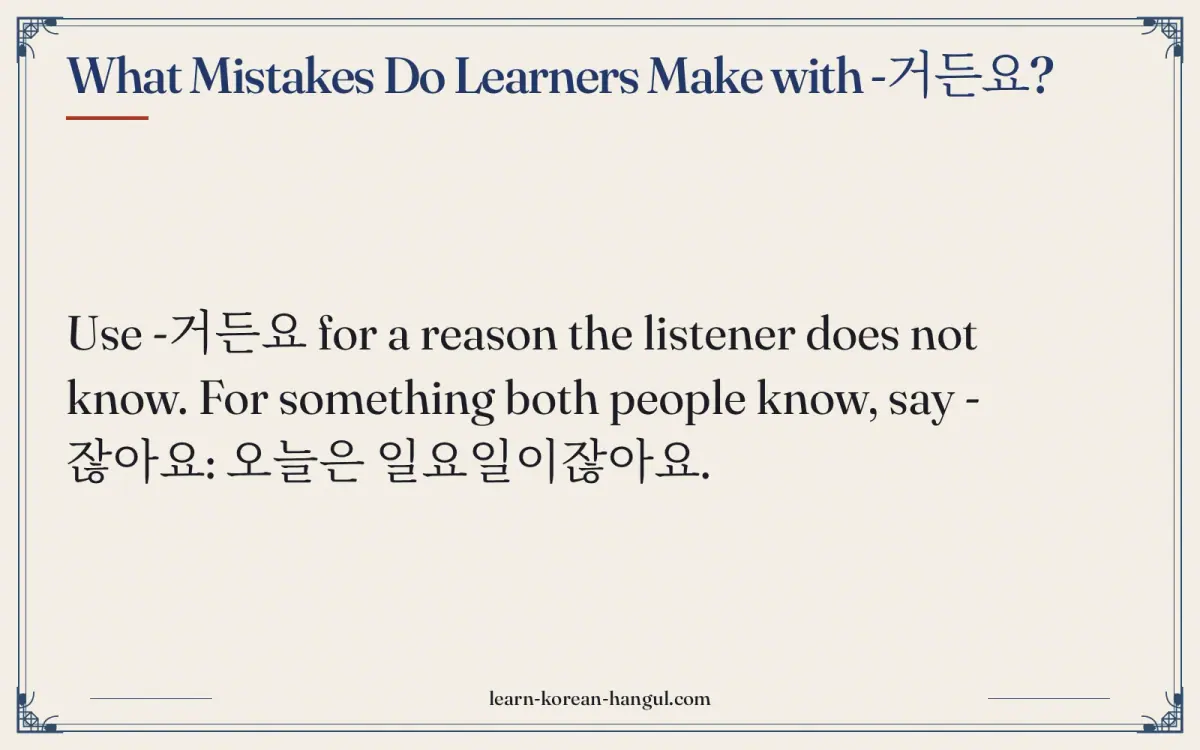
- Using it for something the listener knows. Learners often assume that -거든요 is a universal way to explain. Actually it says the information is new. 오늘은 일요일이거든요 sounds odd when everyone knows the day; the natural sentence is 오늘은 일요일이잖아요.
- Putting the reason first. 일이 있거든요. 못 가요 sounds like a story that is not finished. State the result first, or use -아서/어서: 일이 있어서 못 가요.
- Using it in every sentence. Overuse sounds explanatory and can seem pushy or defensive, as if every action needs an excuse. Use it for real reasons and background.
- Using it to ask for a reason. -거든요 explains; it does not ask. To ask for a reason, say 왜요? or 왜 못 가요?.
A quick check for any -거든요 sentence: Does the listener not know this? Is the result stated first? Is this a statement? If you can answer yes to all three, the sentence is sound.
The practice set below tests these points directly.
Practice and Answers
Try the four items before you read the answer key. Cover the answers with your hand.
- Choose the ending. You explain to a new friend why you cannot come: 저는 못 가요. 일이 ___. (있거든요 / 있잖아요)
- Say it aloud. Write the sound of 먹거든요 in Hangul.
- Translate. "I don't drink coffee. I can't sleep, you see." Use 안 마시다 and -거든요.
- Write your own. Write one result and one reason with -거든요. Then change the reason to the casual form.
Practice · 6
You decline an invitation and give a reason the other person does not know. Complete: 저는 못 가요. 일이 ___.
Show answer
있거든요
-거든요 gives a reason that is new to the listener.
How is 먹거든요 pronounced?
Show answer
[먹꺼든뇨]
After a final ㄱ, the ㄱ of 거 is spoken tense, so 먹거 sounds like [먹꺼]. Nasalization does not apply because 거 does not start with ㄴ or ㅁ.
Which sentence uses -거든 as a conditional "when/if" and not as a sentence ending?
Show answer
집에 도착하거든 전화해 주세요.
Here -거든 connects two clauses and the main clause is a request. The others are sentence endings that give a reason.
What is the casual (banmal) form of 약속이 있거든요?
Show answer
약속이 있거든
Drop the polite 요 from -거든요 to get the casual -거든.
Everyone in the room knows that today is Sunday. Which sentence sounds odd for that reason?
Show answer
오늘은 일요일이거든요.
-거든요 presents the fact as new to the listener. For something everyone knows, use 오늘은 일요일이잖아요.
Which order sounds natural for "I can't go. I have something on, you see"?
Show answer
못 가요. 일이 있거든요.
Korean speakers state the result first and add the reason with -거든요.
Answer key
- 있거든요. The friend does not know about your work, so -거든요 fits.
- [먹꺼든뇨]. The ㄱ of 거 is tense after the final ㄱ of 먹. In everyday speech the ending is also pronounced with an added ㄴ before 요, as [거든뇨].
- 커피를 안 마셔요. 잠이 안 오거든요. (keopireul an masyeoyo. jami an ogeodeunyo.) [커피를 안 마셔요. 자미 안 오거든뇨] = "I don't drink coffee. I can't sleep, you see."
- Answers vary. Check that the result comes first and the reason second, and that the casual form drops 요. An example: 피곤해요. 어제 못 잤거든요 becomes 피곤해. 어제 못 잤거든 ("I'm tired. I couldn't sleep yesterday").
If you can complete items 1 to 3 without the key, you can use the pattern in conversation. The lesson now hands off to related patterns.
What Should You Learn Next after -거든요 Grammar?
After -거든요 grammar, learn the ending for shared knowledge, then the ending for agreement. This lesson teaches the new-reason ending and does not cover the conditional connector, retrospective endings or softened statements in depth. Those live on their own pages.
- Start with -잖아요, which reminds a listener of something they already know.
- Continue with -지요/-죠, which asks for agreement or states a fact softly.
- Compare the first pair side by side in -잖아요 vs -거든요, and read the connector lesson -거든 to see the other job of the same sounds.
- Return to Exclamations and Realization to see every lesson in this set, or to the Intermediate Grammar list for other B1 patterns.
With these steps, -거든요 becomes automatic: state the result, take the bare stem of the reason, add 거든요, and keep it for information the listener does not have.
Frequently Asked Questions
What does -거든요 mean in one sentence?
-거든요 means "you see" or "the thing is". The speaker gives a reason or background that the listener does not know. 저는 못 가요. 일이 있거든요 means "I can't go. I have something on, you see." The ending explains a statement that came before, or sets the scene for what comes next.
How do I attach -거든요 to a verb or adjective?
Drop 다 and add -거든요 with no linking vowel: 가다 becomes 가거든요, 바쁘다 becomes 바쁘거든요, and 이다 becomes (이)거든요. A stem that ends in ㄹ keeps it, so 알다 becomes 알거든요. The same rule works for verbs, adjectives and nouns, with no irregular changes.
Can -거든요 be used in the past tense?
Yes. Put -았/었- before it: 시험이 있었거든요 means "I had an exam, you see," and 영화를 봤거든요 means "I watched a movie, you see." The past form gives a past reason for a present result, such as 피곤해요. 어제 못 잤거든요 ("I am tired. I couldn't sleep yesterday").
Is -거든요 polite or casual?
-거든요 is polite, the 요 form of the casual -거든. It suits colleagues, strangers and teachers when the tone is calm. Overuse sounds explanatory and can seem pushy, because every sentence sounds like a defence. Use it for real reasons, and use plain statements for facts that need no excuse.
What is the most common mistake with -거든요?
The most common mistake is using it for something the listener already knows. 오늘은 일요일이거든요 sounds odd when everyone knows the day. Use -잖아요 for shared knowledge and -거든요 only for new reasons. A second mistake is putting the reason first, as in 일이 있거든요. 못 가요.