Before you start: you should know how to find a verb stem (the dictionary form without its final 다, such as 하 in 하다) and how -(으)려고 states a single intention. The ending in this lesson is the same -(으)ㄹ that you meet in the future modifier, so -(으)ㄹ future modifier is useful background. Estimated time: 15 minutes.
What Does -(으)ㄹ 겸 Grammar Mean?
-(으)ㄹ 겸 grammar means "doing X as well as Y" or "X and at the same time Y". It tells the listener that one action has two aims. In 운동도 할 겸 걸어서 갔어요, the speaker walked. The walk was a way to get there, and it was also a way to get some exercise. The pattern works like a connective ending (연결 어미, yeongyeol eomi), a form that links one clause to the next, although it is built from the -(으)ㄹ modifier plus a noun.
The word 겸 (gyeom) is a dependent noun, a noun that cannot stand alone and needs a describing phrase in front of it. Here the phrase is "the thing I will do", made with the -(으)ㄹ ending. So 운동도 할 겸 literally says "as a matter of also doing exercise". You do not need to translate it word for word. Remember it as "while I am at it".
Two ideas set this pattern apart from other purpose patterns. The first is the double aim. The second is a light, relaxed tone: the second purpose is usually a small bonus, not the main reason. The particle 도 ("also") often sits on the bonus purpose, as in 운동도 할 겸.
운동도 할 겸 걸어서 갔어요.
undongdo hal gyeom georeoseo gasseoyo.
I walked there to get some exercise too.
바람도 쐴 겸 산책을 나갔어요.
baramdo sswoel gyeom sanchaegeul nagasseoyo.
I went out for a walk to get some fresh air too.
친구도 만날 겸 부산에 갔어요.
chingudo mannal gyeom busane gasseoyo.
I went to Busan to meet a friend as well.
In each example the first part names a small extra goal, and the last verb names the action that was actually done. The next section shows how to build the form on every kind of verb.
How Do You Form -(으)ㄹ 겸?
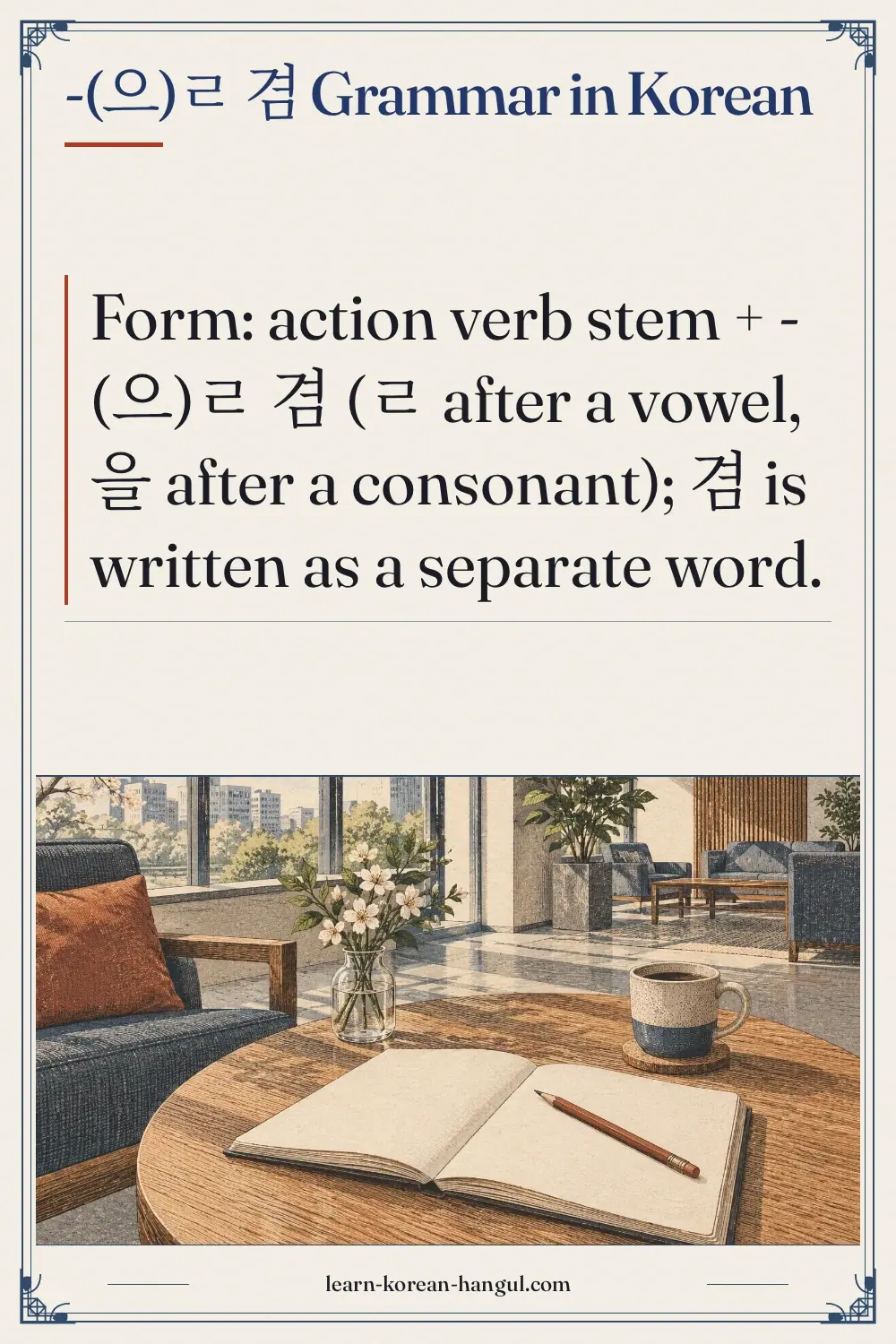
You form -(으)ㄹ 겸 by adding ㄹ to a stem that ends in a vowel and 을 to a stem that ends in a consonant, then writing 겸 as a separate word. The pattern is the same as the future modifier -(으)ㄹ. That is why it has the "(으)" in its name: the 으 appears only after a consonant.
| Stem type | Dictionary form | With -(으)ㄹ 겸 | Sound | Revised Romanization |
|---|---|---|---|---|
| Vowel | 가다 | 갈 겸 | [갈꼄] | gal gyeom |
| Vowel | 하다 | 할 겸 | [할꼄] | hal gyeom |
| Vowel (ㅡ) | 쓰다 | 쓸 겸 | [쓸꼄] | sseul gyeom |
| Consonant | 먹다 | 먹을 겸 | [머글꼄] | meogeul gyeom |
| Consonant | 읽다 | 읽을 겸 | [일글꼄] | ilgeul gyeom |
| ㄹ stem | 놀다 | 놀 겸 | [놀꼄] | nol gyeom |
| ㄹ stem | 풀다 | 풀 겸 | [풀꼄] | pul gyeom |
| ㅂ stem | 돕다 | 도울 겸 | [도울꼄] | doul gyeom |
| ㄷ stem | 듣다 | 들을 겸 | [드를꼄] | deureul gyeom |
| 르 stem | 부르다 | 부를 겸 | [부를꼄] | bureul gyeom |
| ㅅ stem | 짓다 | 지을 겸 | [지을꼄] | jieul gyeom |
Revised Romanization (RR, the official Latin spelling) follows the sounds of the words but does not show tensing caused by a neighbouring sound. So 할 겸 is written hal gyeom even though it is said [할꼄]. Words separated by a space are romanized separately.
Stems Ending in a Vowel
Add ㄹ to the last syllable, so the stem and the ending share one block: 가 + ㄹ = 갈, 하 + ㄹ = 할, 만나 + ㄹ = 만날. Then write 겸 after a space. The consonant ㄱ of 겸 is tense after the -ㄹ ending. The Standard Pronunciation Rules (표준 발음법, Article 27) say that after the modifier ending -(으)ㄹ, the next ㄱ, ㄷ, ㅂ, ㅅ or ㅈ is pronounced tense. A tense consonant is a sharper, tighter sound, written ㄲ, ㄸ, ㅃ, ㅆ or ㅉ when it has its own letter. So 갈 겸 is said [갈꼄]. The bracket here joins the two words because they are said as one phrase.
Stems Ending in a Consonant
Add 을 after the final consonant. The final consonant moves across to start the next syllable when 을 follows: 먹 + 을 = 먹을, said [머글]. A double final consonant keeps only the second sound before a vowel: 읽을 is said [일글], with the ㄹ staying in the first syllable and the ㄱ moving across. Then 겸 follows with a tense ㄲ: [머글꼄], [일글꼄].
- 책도 읽을 겸 도서관에 갔어요. ("I went to the library to read a book too.")
- 점심도 먹을 겸 친구를 만났어요. ("I met a friend to have lunch too.")
책도 읽을 겸 도서관에 갔어요.
chaekdo ilgeul gyeom doseogwane gasseoyo.
I went to the library to read a book too.
Irregular Stems and Nouns
Irregular verbs change their stem before the -(으)ㄹ ending in the same way as before the future modifier. Stems that end in ㄹ keep the ㄹ and add nothing: 놀다 gives 놀 겸, not 놀을 겸. Stems with ㅂ lose the ㅂ and add 울: 돕다 gives 도울 겸. Stems with ㄷ turn it into ㄹ: 듣다 gives 들을 겸. Stems with ㅅ drop the ㅅ: 짓다 gives 지을 겸. Stems with 르 stay regular here, because their change happens only before 아/어 endings: 부르다 gives 부를 겸.
기분도 풀 겸 노래방에 갔어요.
gibundo pul gyeom noraebange gasseoyo.
I went to a singing room to cheer myself up too.
친구도 도울 겸 같이 갔어요.
chingudo doul gyeom gachi gasseoyo.
I went along to help my friend too.
The pattern also joins two nouns, but that is a different use: 아침 겸 점심 means "breakfast and lunch in one meal". The section on variations explains it. Adjectives do not take the verb pattern, because it needs an action that someone chooses to do. Next, here is one full sentence built step by step.
Worked Example: Building a Sentence with -(으)ㄹ 겸
You build the sentence in five steps, working from the one action and the two aims you want to join. This example makes "I went to Busan to meet a friend as well".
- Write the action and the extra aim. The action is 부산에 가다 ("go to Busan"). The extra aim is 친구를 만나다 ("meet a friend").
- Choose which verb goes into the 겸 clause. The extra aim goes first: 친구를 만나다. The action that was really done goes last.
- Find the stem and its last sound. Remove 다 from 만나다. The stem is 만나, and it ends in a vowel.
- Add the ending. 만나 + ㄹ = 만날, then write 겸 after a space: 만날 겸. Add 도 to mark the bonus: 친구도 만날 겸.
- Give the last verb its tense and politeness. 가다 becomes the polite past 갔어요. Put the clause first: 친구도 만날 겸 부산에 갔어요.
Sentence
I went to Busan to meet a friend as well.
Show answer
친구도 만날 겸 부산에 갔어요
Checkpoint. You have it when you can move the sentence into the future without touching 만날 겸. The answer is 친구도 만날 겸 부산에 갈 거예요 [친구도 만날꼄 부사네 갈꺼예요]. Only the last verb changes.
The sentence built here is a statement. The next section shows which tenses and sentence types can follow -(으)ㄹ 겸.
Which Tenses and Sentence Types Work with -(으)ㄹ 겸?
The last verb can have any tense, and the verb in front of 겸 always keeps the same -(으)ㄹ shape. The ending is already a "will do" form, so it describes an aim, not a past event. You read the time from the final verb.
| Feature | Where it goes | Example |
|---|---|---|
| Past | final verb | 운동도 할 겸 걸어서 갔어요. |
| Present or habit | final verb | 주말마다 운동도 할 겸 걸어서 가요. |
| Future | final verb | 내일 책도 읽을 겸 도서관에 갈 거예요. |
| Question or suggestion | final verb | 산책도 할 겸 공원에 갈까요? |
| Request | final verb | 운동도 할 겸 걸어가세요. |
| Tense inside the 겸 clause | not allowed | 갔을 겸 is wrong |
| Adjective in the 겸 clause | not allowed | 예쁠 겸 is wrong |
| Different subjects | not natural | the person with the aims is the person who acts |
The two clauses share one subject: the person who has the two aims is the person who does the action. So you normally leave the subject out. Questions and suggestions work well because the pattern is friendly and relaxed.
Next comes the pattern that learners confuse with -(으)ㄹ 겸 most often.
How Is -(으)ㄹ 겸 Different from -(으)려고?
-(으)ㄹ 겸 joins two aims, while -(으)려고 states one intention. The lesson on -(으)려고 gives the full rules. In 운동하려고 걸어서 갔어요, the only reason for walking is exercise. In 운동도 할 겸 걸어서 갔어요, exercise is one of two reasons, and the other one is getting there.
-(으)ㄹ 겸
X as well as Y: two aims
-(으)려고
in order to: one intention
| Comparison | -(으)ㄹ 겸 | -(으)려고 |
|---|---|---|
| Main idea | double purpose | single intention |
| Example | 운동도 할 겸 걸어서 갔어요. | 운동하려고 걸어서 갔어요. |
| Followed by a request or suggestion | yes | no |
| Level | B2 | B1 |
Use -(으)ㄹ 겸 for two aims in one action; use -(으)려고 for a single clear intention.
The second difference is the final clause. After -(으)려고 the sentence is usually a statement or a question about the past or future, and it does not take a command or a "let's" suggestion. After -(으)ㄹ 겸, you can say 운동도 할 겸 걸어가세요 ("Walk, to get some exercise too"). Both patterns need the same subject in both clauses.
A quick test: if you can say "and while I am at it" in the English, -(으)ㄹ 겸 fits. If you mean only "in order to", use -(으)려고. Next are the useful variations of the pattern.
Variations and Edge Cases of -(으)ㄹ 겸
-(으)ㄹ 겸 has four useful variations: the repeated form, the form with 해서, the noun use and the noun-based way to say a purpose.
- A-(으)ㄹ 겸 B-(으)ㄹ 겸. Two 겸 clauses can be placed one after the other to list both aims: 선물도 살 겸 구경도 할 겸 시장에 갔어요 means "I went to the market to buy a present and to look around".
- -(으)ㄹ 겸 해서. Speakers often add 해서 ("doing so"), as in 운동도 할 겸 해서 걸었어요. It means the same thing and sounds a little softer. In writing, 겸 해서 is also spaced.
- N 겸 N. Placed between two nouns, 겸 means "also serving as". 아침 겸 점심 is "brunch" (breakfast and lunch in one), and 저는 대학생 겸 작가예요 means "I am a university student and also a writer". Here no verb stem is involved.
- A noun-based purpose. For a plain single purpose with a noun, Korean uses a different form. The -기 nominalizer turns a verb into a noun, which is how -기 위해(서) is built. See -기 위해 for that purpose pattern.
선물도 살 겸 구경도 할 겸 시장에 갔어요.
seonmuldo sal gyeom gugyeongdo hal gyeom sijange gasseoyo.
I went to the market to buy a present and to look around.
For more neighbours of this pattern, see Purpose and Intention. Next are the errors that appear most often.
What Mistakes Do Learners Make with -(으)ㄹ 겸?
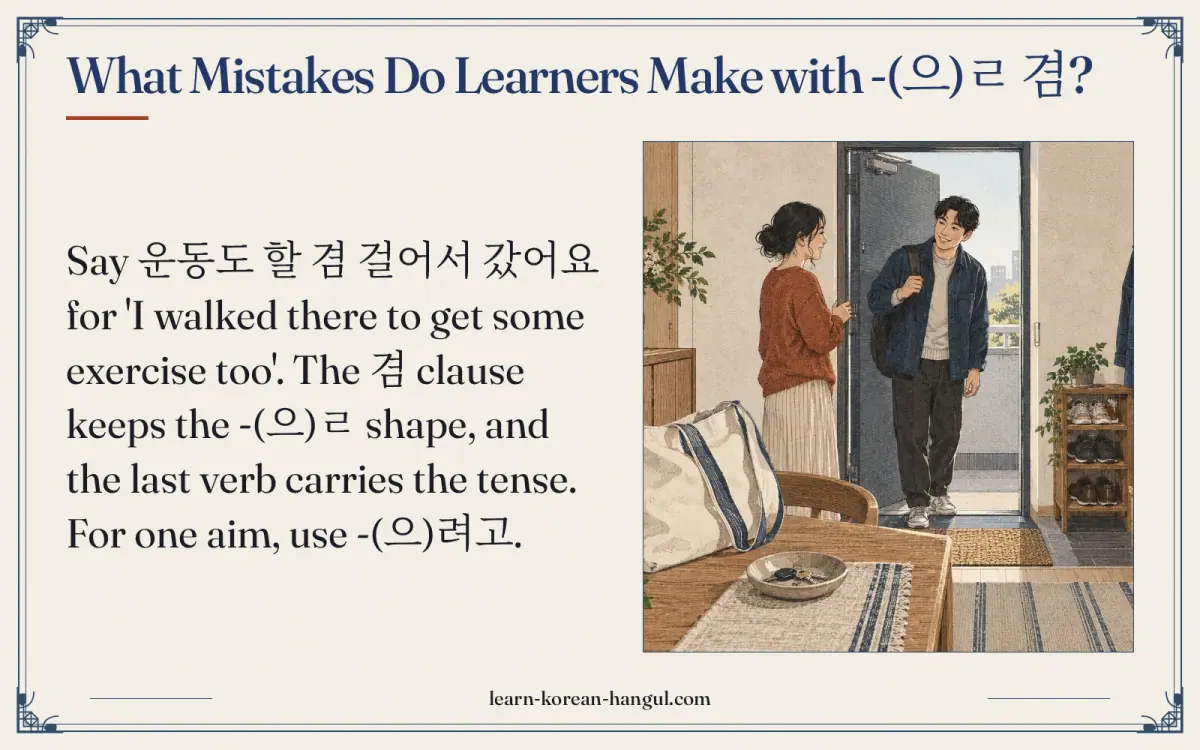
Learners make five common mistakes with -(으)ㄹ 겸.
- Using it when there is only one aim. Learners write 시험에 합격할 겸 공부했어요, but studying here has no other purpose besides passing, so the "while I am at it" feeling does not fit. Use -(으)려고 for a single aim: 시험에 합격하려고 공부했어요. In 운동도 할 겸 걸어갔어요 the second aim (getting there) is the action itself, and 도 marks exercise as the bonus.
- Putting a past ending in the 겸 clause. Learners write 친구를 만났을 겸 갔어요. Actually the clause names an aim and keeps the -(으)ㄹ shape. The final verb carries the tense: 친구도 만날 겸 갔어요.
- Using it with an adjective. Learners write 건강할 겸 먹어요 or 예쁠 겸 입어요. Actually the pattern needs an action that you do on purpose. Say 건강도 챙길 겸 먹어요 ("I eat it to look after my health too").
- Leaving out the space. Learners write 할겸. Actually 겸 is a separate word, so write 할 겸.
- Reading 겸 as "because". Learners translate 운동도 할 겸 as "because I exercise". Actually 겸 states an aim for the future, not a reason from the past. For reasons, use -아/어서 or -(으)니까.
Whenever you reach for 겸, check that you can name both aims. Now test yourself.
Practice and Answers
These four exercises check the main skills: joining aims, repairing a mistake and choosing the right pattern. Try each one before you read the answers.
Practice · 5
Which is the correct -(으)ㄹ 겸 form of 먹다?
Show answer
먹을 겸
먹 ends in a consonant, so it takes 을 before 겸.
Which is the correct form of 놀다 (to play) before 겸?
Show answer
놀 겸
Stems that end in ㄹ keep the ㄹ and add nothing: 놀 겸.
Which sentence is wrong?
Show answer
친구를 만났을 겸 부산에 갔어요.
The 겸 clause names an aim and keeps the -(으)ㄹ shape. The tense goes on the last verb, so the clause should be 친구도 만날 겸.
Fill the gap: 운동도 ___ 걸어서 갔어요.
Show answer
할 겸
하 ends in a vowel, so 하 + ㄹ = 할, and then 겸.
How is 할 겸 usually pronounced?
Show answer
[할꼄]
After the modifier ending -ㄹ, the ㄱ of 겸 becomes tense (ㄲ), so the phrase is said [할꼄].
Exercise 1: Join the aims. Make one sentence with -(으)ㄹ 겸: 책을 읽다 + 도서관에 가다. ("I read a book" as the extra aim, and "I went to the library".) Use the polite past.
Exercise 2: Fix the error. A learner writes 운동도 했을 겸 걸어갔어요. Correct it.
Exercise 3: Choose the right pattern. You want to say "I studied hard in order to pass the exam", with only one aim. Is -(으)ㄹ 겸 right, or -(으)려고?
Exercise 4: Translate. "I went to Myeongdong to meet a friend and also to shop." (meet = 만나다, shop = 쇼핑하다, Myeongdong = 명동)
Answer Key
- Exercise 1: 책도 읽을 겸 도서관에 갔어요. [책또 일글꼄 도서과네 가써요] The extra aim 읽다 takes 을 and then 겸.
- Exercise 2: 운동도 할 겸 걸어갔어요. [운동도 할꼄 거러가써요] The 겸 clause loses its past ending.
- Exercise 3: -(으)려고. The sentence is 시험에 합격하려고 열심히 공부했어요. There is one aim, so there is nothing for 겸 to join.
- Exercise 4: 친구도 만날 겸 쇼핑도 할 겸 명동에 갔어요. [친구도 만날꼄 쇼핑도 할꼄 명동에 가써요] Two 겸 clauses list both aims.
If you missed Exercise 1 or 2, return to the five building steps. If you missed Exercise 3, reread the section on -(으)려고. Next, plan where to go from here.
What Should You Learn Next after -(으)ㄹ 겸 Grammar?
The best next lesson is -(으)려고, which states a single intention and is the pattern to use when there is only one aim. Then try -(으)러, the "go in order to" pattern for movement verbs. The full set of purpose patterns is on Purpose and Intention. To see where -(으)ㄹ 겸 sits in a study plan, use the Advanced Grammar list.
What this lesson does not cover. It does not cover the idiom 겸사겸사, the formal written uses of 겸 in job titles, or exam-style transformations. The level given here, B2, is an editorial estimate based on common textbook order and TOPIK II, not an official grading.
In short, -(으)ㄹ 겸 grammar attaches to an action verb stem, keeps the -(으)ㄹ shape, and says that one action serves two aims.
Frequently Asked Questions
What does -(으)ㄹ 겸 mean? -(으)ㄹ 겸 means "doing X as well as Y" or "X and at the same time Y". It joins two aims in one action. In 운동도 할 겸 걸어서 갔어요, walking served as transport and as exercise: "I walked there to get some exercise too". The second aim is usually a small bonus, and the particle 도 often marks it.
How do I attach -(으)ㄹ 겸 to a verb? Remove 다 from an action verb. Add ㄹ after a vowel stem and 을 after a consonant stem, then write 겸 as a separate word: 가다 becomes 갈 겸, 먹다 becomes 먹을 겸. Stems ending in ㄹ add nothing (놀 겸), and irregular stems follow the future modifier: 돕다 gives 도울 겸 and 듣다 gives 들을 겸.
Can I use -(으)ㄹ 겸 in the past tense? The 겸 clause never takes a tense. It keeps the -(으)ㄹ shape, and the last verb shows the time. Say 친구도 만날 겸 부산에 갔어요 for "I went to Busan to meet a friend too". Writing 만났을 겸 is wrong. The same shape is used for past, present and future sentences.
Is -(으)ㄹ 겸 formal or casual? -(으)ㄹ 겸 is neutral. It is common in everyday talk and in writing, and it has a relaxed, friendly feel because the second aim is a small extra. The politeness comes from the last verb, so 갔어요 is polite and 갔다 is plain. Speakers often add 해서 and say 겸 해서.
What is the most common mistake with -(으)ㄹ 겸? Learners use it for one purpose only, or attach it to an adjective or a past stem. The pattern needs two aims and an action verb in the -(으)ㄹ shape, such as 운동도 할 겸. With a single aim, -(으)려고 is the natural choice. Also remember to write 겸 as a separate word.
What is the difference between -(으)ㄹ 겸 and -(으)려고? -(으)ㄹ 겸 gives two aims, such as 운동도 할 겸 걸어서 갔어요. -(으)려고 states one intention, as in 운동하려고 걸어서 갔어요. The last clause also differs: after -(으)ㄹ 겸 you can use a request like 걸어가세요, but after -(으)려고 a command or a suggestion is not natural.