What you'll learn
- Attach -(으)ㄴ 후에 to verbs, including ㄹ, ㅂ and ㄷ verbs.
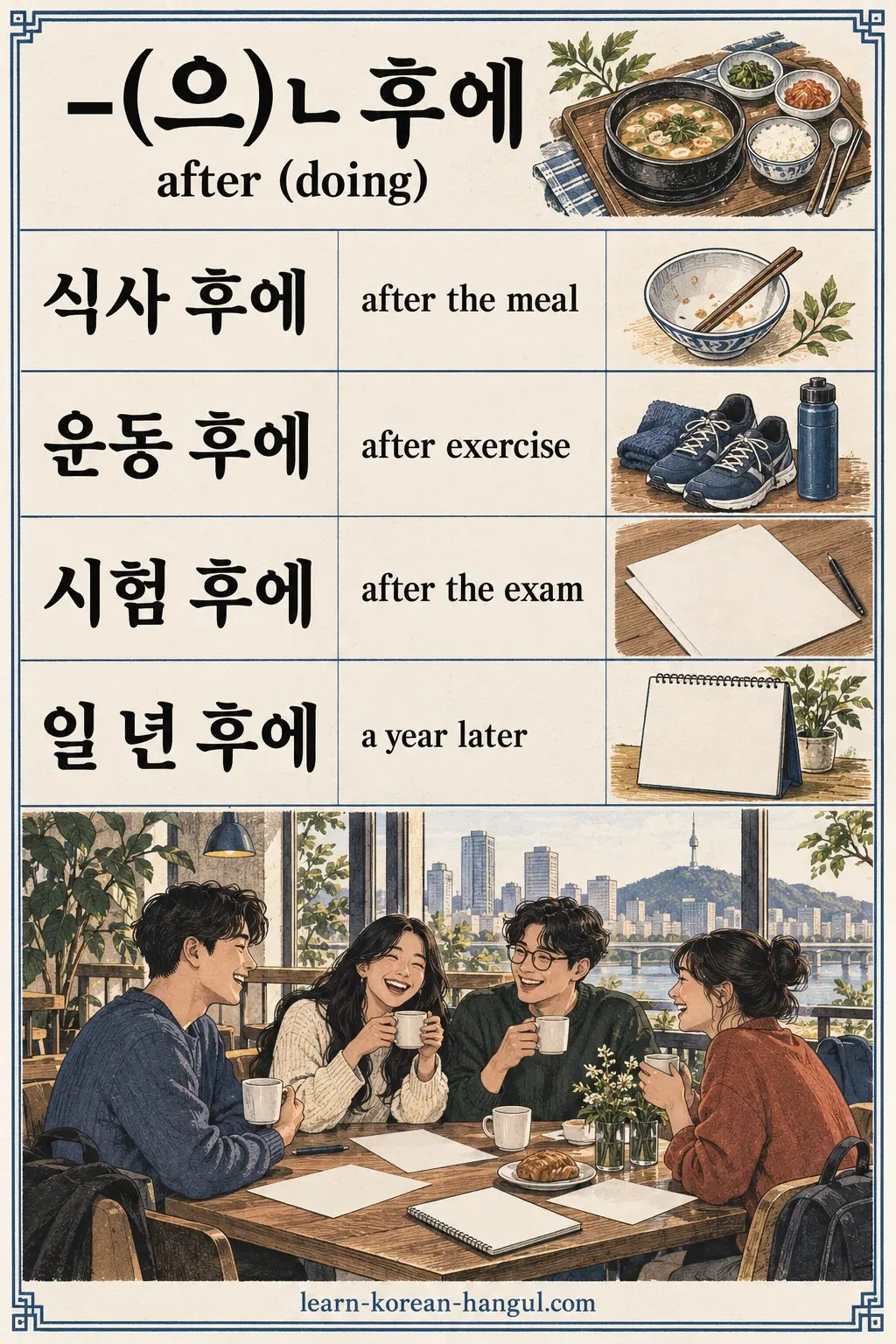
- Use 후에 after a noun, as in 식사 후에.
- Keep the first clause free of tense markers.
- Choose between 후에, 뒤에, 다음에 and 이후에.
Prerequisites: the polite ending -아요/어요 and the past tense -았/었-. Time: about 15 minutes.
Key facts
- -(으)ㄴ 후에 means "after (doing)".
- The form is stem + ㄴ 후에 after a vowel (간 후에) and stem + 은 후에 after a final consonant (먹은 후에).
- It is used with verbs. Adjectives do not take it.
- The first clause never has 았/었 or 겠 inside it.
- The main verb shows the tense of the whole sentence.
Listen to two model sentences.
The next section defines the pattern.
What Does -(으)ㄴ 후에 Grammar Mean?
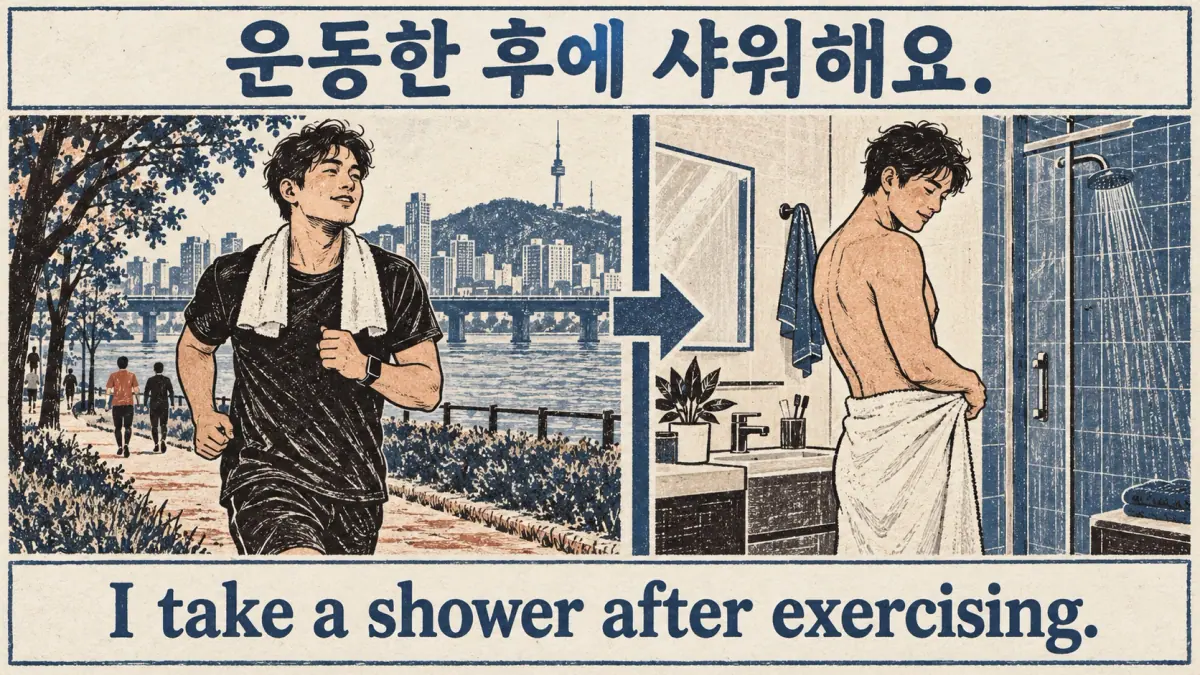
-(으)ㄴ 후에 means "after (doing)". The noun 후 means "the time after", and 에 is the particle that marks a point in time. The part before 후, such as 간, is a modifier ending. A modifier ending changes a verb into a describing word that sits in front of a noun. So 간 후에 literally means "at the time after having gone".
The pattern puts two actions in order. The first clause happens first. The main clause happens after it. Because the -(으)ㄴ ending carries the meaning "finished", the first clause already feels complete without any other marker.
Here are two glossed examples.
| Part | 수업이 끝난 후에 점심을 먹어요. | 운동한 후에 샤워해요. |
|---|---|---|
| First clause | 수업이 끝난 후에 (after class ends) | 운동한 후에 (after exercising) |
| Main clause | 점심을 먹어요 (I eat lunch) | 샤워해요 (I take a shower) |
| Spoken | [수어비 끈난 후에 점시믈 머거요] | [운동한 후에 샤워해요] |
| RR (aid) | sueobi kkeunnan hue jeomsimeul meogeoyo | undonghan hue syawohaeyo |
| English | After class ends, I eat lunch. | I take a shower after exercising. |
Revised Romanization (RR) is the national system for writing Korean in the Latin alphabet. It is shown here only as a learning aid.
The next section shows how to build the form.
How Do You Form -(으)ㄴ 후에?
Take the dictionary form, remove 다 to get the stem, and look at the last sound of the stem. The stem is the verb without its dictionary ending -다. For 먹다 the stem is 먹.
| Stem ends in | Add | Dictionary form | Result | Spoken | RR (aid) |
|---|---|---|---|---|---|
| a vowel | ㄴ 후에 | 가다 (go) | 간 후에 | [간 후에] | gan hue |
| a vowel | ㄴ 후에 | 하다 (do) | 한 후에 | [한 후에] | han hue |
| a vowel | ㄴ 후에 | 끝나다 (end) | 끝난 후에 | [끈난 후에] | kkeunnan hue |
| a final consonant | 은 후에 | 먹다 (eat) | 먹은 후에 | [머근 후에] | meogeun hue |
| a final consonant | 은 후에 | 읽다 (read) | 읽은 후에 | [일근 후에] | ilgeun hue |
| a final consonant | 은 후에 | 씻다 (wash) | 씻은 후에 | [씨슨 후에] | ssiseun hue |
| ㄹ (drops) | ㄴ 후에 | 살다 (live) | 산 후에 | [산 후에] | san hue |
| ㄹ (drops) | ㄴ 후에 | 만들다 (make) | 만든 후에 | [만든 후에] | mandeun hue |
The form is the same as the past modifier ending you meet in 먹은 음식 ("the food I ate"). The full set of modifier endings is on the Noun-Modifying Forms page.
The ㅎ of 후 comes right after a final ㄴ, and the two sounds run together softly in fast speech. You do not need to change anything when you write it.
Stems Ending in a Vowel
Vowel stems take ㄴ directly, and the ㄴ sits under the last syllable: 가 + ㄴ = 간, 하 + ㄴ = 한, 끝나 + ㄴ = 끝난. For verbs made with 하다, the result is 한: 운동하 + ㄴ = 운동한.
Stems Ending in a Consonant
Consonant stems take 은: 먹 + 은 = 먹은. The 은 is a helping syllable that keeps the final consonant and the ㄴ from piling up.
Irregular Stems and Nouns
An irregular stem is one that changes its shape before an ending that begins with a vowel or ㄴ. The usual changes appear here.
| Type | Dictionary form | With -(으)ㄴ 후에 | Note |
|---|---|---|---|
| ㄹ stem | 살다 (live) | 산 후에 | ㄹ drops before ㄴ |
| ㄹ stem | 열다 (open) | 연 후에 | ㄹ drops before ㄴ |
| ㅂ-irregular | 돕다 (help) | 도운 후에 | ㅂ becomes 우; compare 도와요 |
| ㄷ-irregular | 듣다 (listen) | 들은 후에 | ㄷ becomes ㄹ; spoken [드른 후에] |
| 르-irregular | 모르다 (not know) | 모른 후에 | 르 stays, since ㄴ starts the ending |
A noun can take 후에 directly, with no ending: 식사 후에 ("after the meal"), 운동 후에 ("after exercise"), 시험 후에 ("after the exam"). A time span also works: 일 년 후에 means "in a year" or "a year later", spoken [일련 후에].
The next section builds a full sentence.
Worked Example: Building 손을 씻은 후에 밥을 먹어요
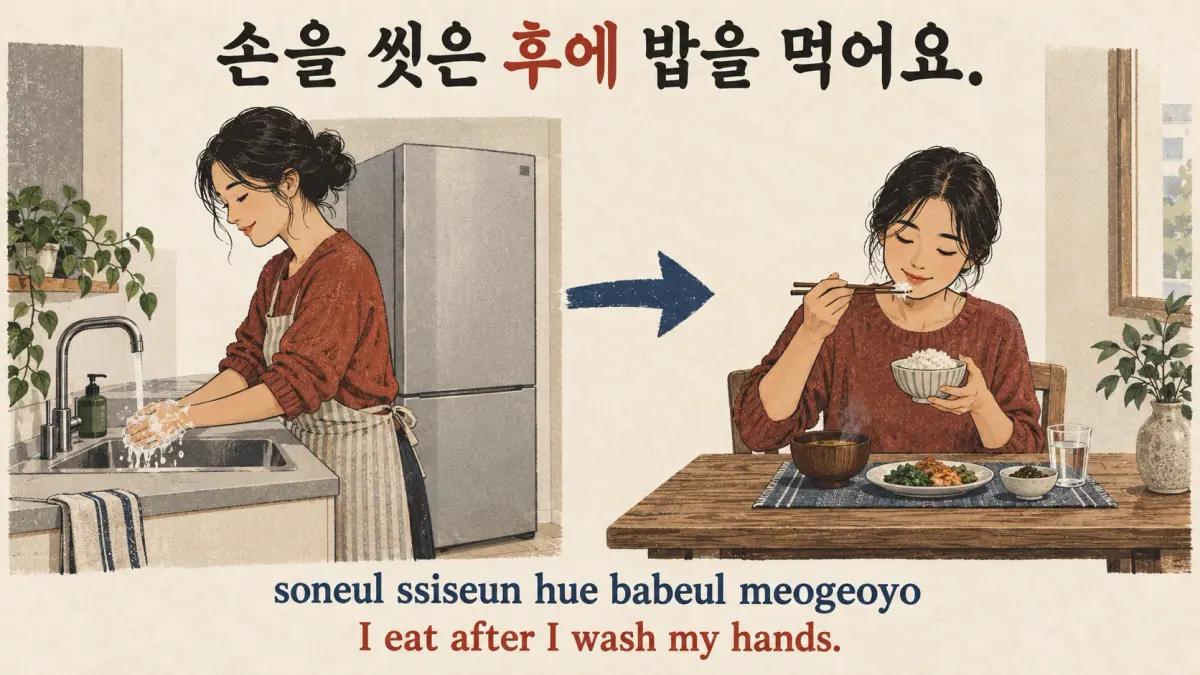
Say that you wash your hands and then eat. Follow five steps.
- Write the first action. "I wash my hands" is 손을 씻어요 in the polite style.
- Find the stem. The dictionary form is 씻다, so the stem is 씻.
- Add 은 후에. The stem ends in a consonant, so 씻 + 은 후에 = 씻은 후에. Take away the polite ending, because the ending belongs to the last verb only.
- Write the main clause. "I eat" is 밥을 먹어요. The noun 밥 means "rice" or "a meal".
- Join the two parts. 손을 씻은 후에 밥을 먹어요.
You'll know it worked when the first verb ends in 은 후에 with nothing after the stem except 은, and the polite ending 요 appears only once, at the end. Spoken, it is [소늘 씨슨 후에 바블 머거요], and in RR it is soneul ssiseun hue babeul meogeoyo.
Try the same steps with "After I finish work, I exercise": 일하다 gives 일한 후에, and 운동해요 follows.
Sentence
I eat after I wash my hands.
Show answer
손을 씻은 후에 밥을 먹어요
The next section covers tense and sentence types.
Which Tenses and Sentence Types Work with -(으)ㄴ 후에?

The first clause is fixed. It does not take 았/었, 겠 or 는. The tense is shown only by the main verb at the end of the sentence.
| Main verb | Example | English |
|---|---|---|
| present or habit | 수업이 끝난 후에 점심을 먹어요. | After class ends, I eat lunch. |
| past | 수업이 끝난 후에 점심을 먹었어요. | After class ended, I ate lunch. |
| future | 수업이 끝난 후에 점심을 먹을 거예요. | After class ends, I will eat lunch. |
The past form is spoken [점시믈 머거써요]. Notice that 끝난 후에 stays the same in all three. A common beginner worry is "but the class ended in the past, so I need 끝났". You do not. The -(으)ㄴ ending already means that the first action is complete, and the final verb carries the time.
After -(으)ㄴ 후에, every sentence type is possible.
| Sentence type | Example | English |
|---|---|---|
| statement | 운동한 후에 샤워해요. | I take a shower after exercising. |
| yes/no question | 밥을 먹은 후에 커피를 마셔요? | Do you drink coffee after you eat? |
| wh-question | 수업이 끝난 후에 뭐 해요? | What do you do after class? |
| command | 밥을 먹은 후에 약을 드세요. | Please take the medicine after you eat. |
| suggestion | 수업이 끝난 후에 같이 가요. | Let's go together after class. |
Yes/no questions usually end with a rise. A wh-question puts the stress on the question word and often ends with a fall or a rise-fall, rather than a sharp final rise. A sharp final rise can turn the question word into "something", so 뭐 해요? with a high rise can mean "Are you doing something?"
The two clauses can have different subjects. 비가 그친 후에 해가 났어요 means "After the rain stopped, the sun came out."
The next section compares -(으)ㄴ 후에 with similar patterns.
How Is -(으)ㄴ 후에 Different from -기 전에 and -고 나서?
The three patterns all link two actions in time, but they look in different directions.
| Pattern | Core idea | Example | Feeling |
|---|---|---|---|
| -(으)ㄴ 후에 | after the first action | 밥을 먹은 후에 약을 먹어요. | Plain order: first eating, then the medicine. |
| -기 전에 | before the first action | 밥을 먹기 전에 손을 씻어요. | The first clause is the later one in time. |
| -고 나서 | after finishing the first action | 밥을 먹고 나서 약을 먹어요. | The first action is a completed block. |
| -(으)ㄹ 때 | at the same time as | 밥을 먹을 때 물을 마셔요. | The two actions overlap. |
Look at how the same verb changes. For 먹다, "after eating" is 먹은 후에, "before eating" is 먹기 전에, and "when eating" is 먹을 때. The -기 전에 pattern uses the plain stem plus 기, and its first clause never takes a tense marker, even when the main verb is in the past. The -(으)ㄴ 후에 pattern uses the finished ㄴ form.
The mirror pairs are worth learning together.
| After | Before |
|---|---|
| 먹은 후에 | 먹기 전에 |
| 간 후에 | 가기 전에 |
| 운동한 후에 | 운동하기 전에 |
| 수업 후에 | 수업 전에 |
Between -(으)ㄴ 후에 and -고 나서, you can swap them in most sentences with verbs. Choose -고 나서 when you want to stress that the first action is completely finished. Choose -(으)ㄴ 후에 when you want to put an order on a timeline, or when you use a noun or a time span (식사 후에, 일 년 후에), because -고 나서 attaches to verbs only. For a side-by-side with practice, see -고 나서 vs -(으)ㄴ 후에.
The next section covers synonyms and edge cases.
Variations and Edge Cases of -(으)ㄴ 후에

뒤에: the Casual Match
뒤 literally means "back" or "behind", and 뒤에 can mean "after" in time. 수업이 끝난 뒤에 점심을 먹어요 means the same as the 후에 version. In speech, 뒤에 is the more casual choice. 후에 sounds slightly more formal and is common in announcements, instructions and writing.
다음에: Next, Afterwards
다음 means "next". 식사한 다음에 커피를 마셔요 means "After the meal, I drink coffee." 다음에 puts stress on the next step in a sequence, so it is common in recipes and step-by-step directions. By itself, 다음에 can also mean "next time": 다음에 만나요 means "Let's meet next time."
이후에: from That Point On
이후 means "that point and everything after it". 졸업한 이후에 계속 서울에 살아요 means "I have lived in Seoul ever since I graduated." Choose 이후에 when the later state continues from that point and does not just happen once.
그 후에: a Sentence Connector
You can start a new sentence with 그 후에, meaning "after that". 점심을 먹었어요. 그 후에 커피를 마셨어요 means "I ate lunch. After that, I drank coffee."
후 without 에
In titles, lists and written instructions, 에 is often dropped: 식사 후, 사용 후. You will see this on signs and in manuals. In conversation, keep the 에.
The next section lists the mistakes that appear most often.
What Mistakes Do Learners Make with -(으)ㄴ 후에?
Learners make six predictable mistakes. Each has a reason and a fix.
Learners often add a past marker inside the first clause. Wrong: 수업이 끝났은 후에 점심을 먹어요. Right: 수업이 끝난 후에 점심을 먹어요. Fix: the -(으)ㄴ ending already shows that the first action is finished. Tense goes on the last verb only.
Learners often use the present modifier. Wrong: 먹는 후에 약을 먹어요. Right: 먹은 후에 약을 먹어요. Fix: 는 describes an action in progress. For "after", use the finished form 은 or ㄴ.
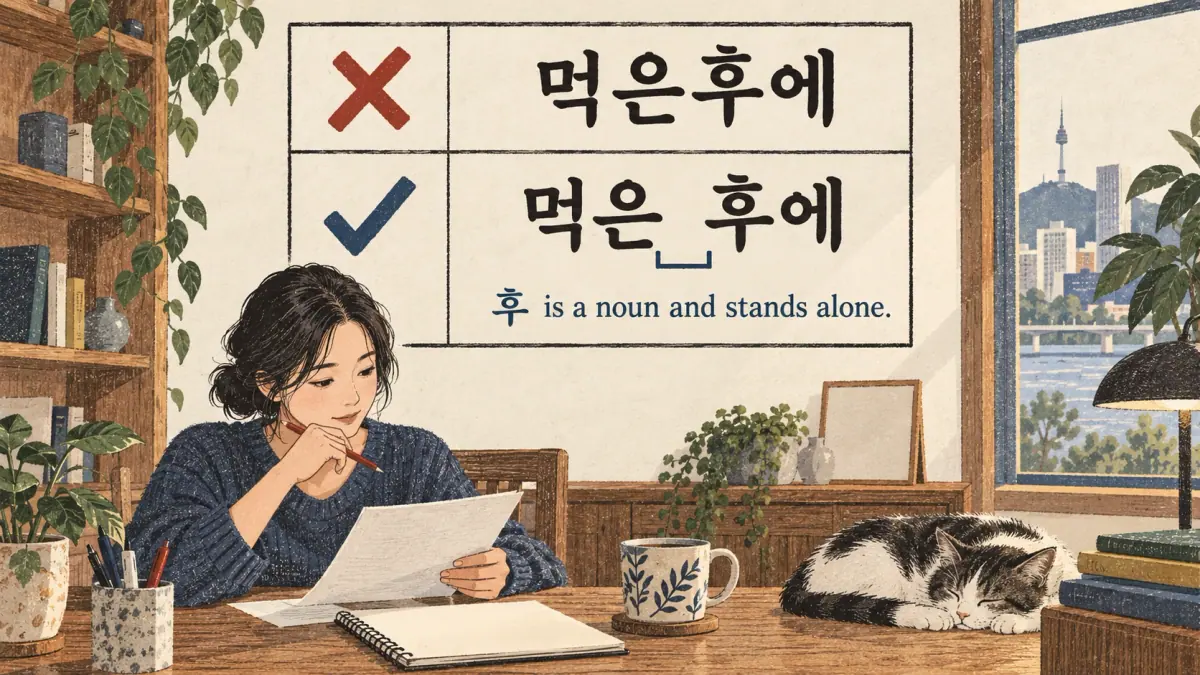
Learners often forget the space. Wrong: 먹은후에, 한후에. Right: 먹은 후에, 한 후에. Fix: 후 is a noun and stands alone.
Learners often use it with adjectives. Wrong: 추운 후에 겨울이 와요. Right: 추워진 후에 옷을 입어요 ("After it got cold, I put on clothes"). Fix: -(으)ㄴ 후에 describes a completed action, so with a state, first change it into an action with 아/어지다, as in 추워지다.
Learners often confuse 후에 and 전에. Wrong: 밥을 먹은 전에 손을 씻어요. Right: 밥을 먹기 전에 손을 씻어요. Fix: after a verb, 전에 always takes -기, never -(으)ㄴ.
Learners often read "in a year" as "a year ago". Wrong: 일 년 후에 한국에 왔어요 when you mean "I came to Korea a year ago". Right: 일 년 전에 한국에 왔어요. Fix: 후에 points forward from a time, and 전에 points back from now.
The next section gives you practice.
Practice and Answers
Do the four tasks, then compare with the key.
Task 1: add -(으)ㄴ 후에. Write the "after" form of each verb.
- 가다 (go)
- 먹다 (eat)
- 만들다 (make)
- 듣다 (listen)
- 돕다 (help)
Task 2: join the sentences with -(으)ㄴ 후에. Write one sentence for each pair.
- 수업이 끝나요. / 점심을 먹어요.
- 샤워해요. / 자요.
- 일해요. / 운동해요.
Task 3: fix the error. Each sentence has one mistake. Rewrite it correctly.
- 밥을 먹었은 후에 가요.
- 공부한후에 놀아요.
- 먹는 후에 커피를 마셔요.
Task 4: write your own. Write one sentence about what you do after class or work, and one about what you will do after dinner.
Practice · 5
Which form of 먹다 means "after eating"?
Show answer
먹은 후에
The stem 먹 ends in a final consonant, so it takes 은 후에. 는 and 었 do not belong here.
How do you say "after living" with 살다?
Show answer
산 후에
살다 is a ㄹ stem. The ㄹ drops before ㄴ, so 살 + ㄴ becomes 산.
Which sentence is correct?
Show answer
수업이 끝난 후에 점심을 먹어요.
The first clause keeps the fixed -(으)ㄴ form. Tense is shown only on the last verb.
Which pattern means "before eating"?
Show answer
먹기 전에
-기 전에 means before. The other three patterns are about after or at the same time.
Which one is a correct noun use of 후에?
Show answer
식사 후에 커피를 마셔요.
A noun takes 후에 directly, with a space: 식사 후에.
Answer key
- (1) 간 후에 (2) 먹은 후에 (3) 만든 후에 (4) 들은 후에 (5) 도운 후에
- (1) 수업이 끝난 후에 점심을 먹어요. (2) 샤워한 후에 자요. (3) 일한 후에 운동해요.
- (1) 밥을 먹은 후에 가요. (2) 공부한 후에 놀아요. (3) 먹은 후에 커피를 마셔요.
- Sample answers: 수업이 끝난 후에 친구를 만나요. 저녁을 먹은 후에 산책할 거예요. Any pair is correct if each first clause ends in a finished form such as 은 or ㄴ with a space before 후에.
If task 1 was correct, you have the formation rule. If task 3 was hard, check for a past marker inside the first clause and for the space before 후에. The next section points you to what comes after this lesson.
What Should You Learn after -(으)ㄴ 후에 Grammar?
After -(으)ㄴ 후에, learn -기 전에 to say "before", and -고 나서 for "after finishing". To see how the two "after" patterns compare, read -고 나서 vs -(으)ㄴ 후에. To say how long it has been since something, continue with -(으)ㄴ 지.
For a wider view, the parent page Time and Sequence lists every time connector in this group. To plan by level, use Beginner Grammar.
This lesson shows -(으)ㄴ 후에 with polite-style endings; the pattern itself is the same in every speech style, because the style comes from the last verb. It does not cover every written variation. About this page. Last updated 2026-10-09. Revised Romanization follows the national rules and is shown only as a learning aid.
Frequently Asked Questions
What Does -(으)ㄴ 후에 Mean?
-(으)ㄴ 후에 means "after (doing)". It attaches to a verb and tells the listener that the action in the main clause comes later than the action in the first clause. 수업이 끝난 후에 점심을 먹어요 means "After class ends, I eat lunch." The noun 후 means "the time after".
How Do I Attach -(으)ㄴ 후에 to a Verb or Adjective?
Use verbs only. Remove 다 to get the stem. After a vowel, add ㄴ: 가다 becomes 간 후에. After a final consonant, add 은: 먹다 becomes 먹은 후에. A stem that ends in ㄹ drops it: 살다 becomes 산 후에. Adjectives do not take this pattern.
Can -(으)ㄴ 후에 Be Used in the past Tense?
The first clause never takes a tense marker, so 끝났은 후에 is wrong. The -(으)ㄴ ending already means the first action is finished. The tense is shown on the main verb, which can be present, past or future. 수업이 끝난 후에 점심을 먹었어요 means "After class ended, I ate lunch."
Is -(으)ㄴ 후에 Used in Speech or Only in Writing?
It is used in both. In speech, 뒤에 is the more casual match, as in 수업이 끝난 뒤에. 후에 sounds slightly more formal and is common in writing, announcements and instructions. In writing you may also see the shortened 후 without 에, as in 식사 후.
What Is the Most Common Mistake with -(으)ㄴ 후에?
Learners add a past marker inside the first clause, as in 끝났은 후에. Write 끝난 후에 instead. The second common slip is the present form, 먹는 후에. Use 먹은 후에, because the first action is complete. A third slip is missing the space before 후에.
What Is the Difference between -(으)ㄴ 후에 and -기 전에?
They are opposites. -(으)ㄴ 후에 means "after" and takes the finished form 먹은 후에. -기 전에 means "before" and takes the plain stem 먹기 전에, which never has a tense marker. 밥을 먹은 후에 약을 먹어요 is "After eating, I take medicine". 밥을 먹기 전에 손을 씻어요 is "Before eating, I wash my hands".