What you'll learn
- Tell sound words (의성어) from manner words (의태어).
- Place a doubled mimetic word before a verb, as in 별이 반짝반짝 빛나요.
- Turn a mimetic word into a verb with 하다 or 거리다.
- Hear how a change of vowel changes the feeling: 졸졸 and 줄줄, 깡충깡충 and 껑충껑충.
- Tell mimetic adverbs apart from -게 adverbs and from degree adverbs such as 아주 and 너무.
Before you start: you should know that an adverb is a word that describes a verb, and that Korean usually puts it just before the verb. If adverbs are new, read Korean Adverbs first. Estimated time: 15 minutes.
What Does the Korean Mimetic Words Adverbs 반짝반짝 Lesson Cover?
Korean mimetic words adverbs are words that copy a sound or a manner and then describe an action. The phrase "mimetic" means "imitating". Korean has two kinds. Sound words, called 의성어 (uiseongeo), copy what you hear, such as 멍멍 (a dog's bark) and 똑똑 (a knock). Manner words, called 의태어 (uitaeeo), copy how something looks, moves or feels, such as 반짝반짝 (twinkling) and 두근두근 (pounding).
English has some of these too: "buzz", "splash" and "twinkle". Korean has many more, and speakers use them all the time. They make a sentence vivid in a way that a plain adverb does not. Saying 비가 와요 means "It rains". Saying 비가 주룩주룩 와요 paints a picture of heavy rain falling in lines.
A word list is on the vocabulary pages for Korean onomatopoeia and Korean mimetic words. This lesson is about the grammar: where the words go, what they attach to and how they differ from other adverbs.
A First Example
Here are two sentences that show the pattern with a manner word and a rain word.
- 별이 반짝반짝 빛나요. (byeori banjjakbanjjak binnayo.) [벼리 반짝빤짝 빈나요] = "The stars twinkle."
- 비가 주룩주룩 와요. (biga jurukjuruk wayo.) [비가 주룩쭈룩 와요] = "The rain pours down."
In each sentence, the doubled word stands right before the verb and says how the verb happens. In the first, 반짝반짝 shows a light that flickers on and off. In the second, 주룩주룩 shows rain falling in thick lines. Notice the sound change: 반짝반짝 is said [반짝빤짝], because the tense ㅃ follows the final ㄱ. The next section shows how these words work.
How Do Korean Mimetic Adverbs Work?
A mimetic adverb is usually a short syllable group that is said twice, and it stands before the verb it describes. It takes no ending. You do not add -게 or -히, and you do not change it for the tense. The verb carries the tense and the politeness, as in any other Korean sentence.
The doubled pattern is the most common one. The same group is repeated, as in 반짝반짝, 두근두근 and 살금살금. Some words are not doubled: 쾅 (a slam), 꿀꺽 (a gulp) and 번쩍 (a single flash) are said once. Some use two related parts, such as 울긋불긋 (colourful, with many mixed colours). The doubling usually means that the action repeats or goes on, while the single word is a short moment. Compare 번개가 번쩍 쳤어요 ("The lightning flashed once") with 별이 반짝반짝 빛나요 ("The stars keep twinkling").
Pattern Table
The table shows the four ways that mimetic words appear in a sentence. Each row has a pattern, an example, a sound and a meaning.
| Pattern | Example | Sound | Revised Romanization | Meaning |
|---|---|---|---|---|
| Mimetic word + verb | 별이 반짝반짝 빛나요 | [벼리 반짝빤짝 빈나요] | byeori banjjakbanjjak binnayo | The stars twinkle. |
| Mimetic word + 하다 | 가슴이 두근두근해요 | [가스미 두근두근해요] | gaseumi dugeundugeunhaeyo | My heart is pounding. |
| Mimetic word + 거리다 | 가슴이 두근거려요 | [가스미 두근거려요] | gaseumi dugeungeoryeoyo | My heart is pounding. |
| Noun-modifier form | 반짝이는 별 | [반짜기는 별] | banjjagineun byeol | a twinkling star |
Revised Romanization (RR, the official Latin spelling) follows the sounds of the words but does not show tensing caused by a neighbouring sound. So 반짝반짝 is written banjjakbanjjak even though it is said [반짝빤짝]. RR does write ㄲ, ㄸ, ㅃ, ㅆ and ㅉ when they appear in Hangul, as in 짝 (jjak). Words separated by a space are romanized separately.
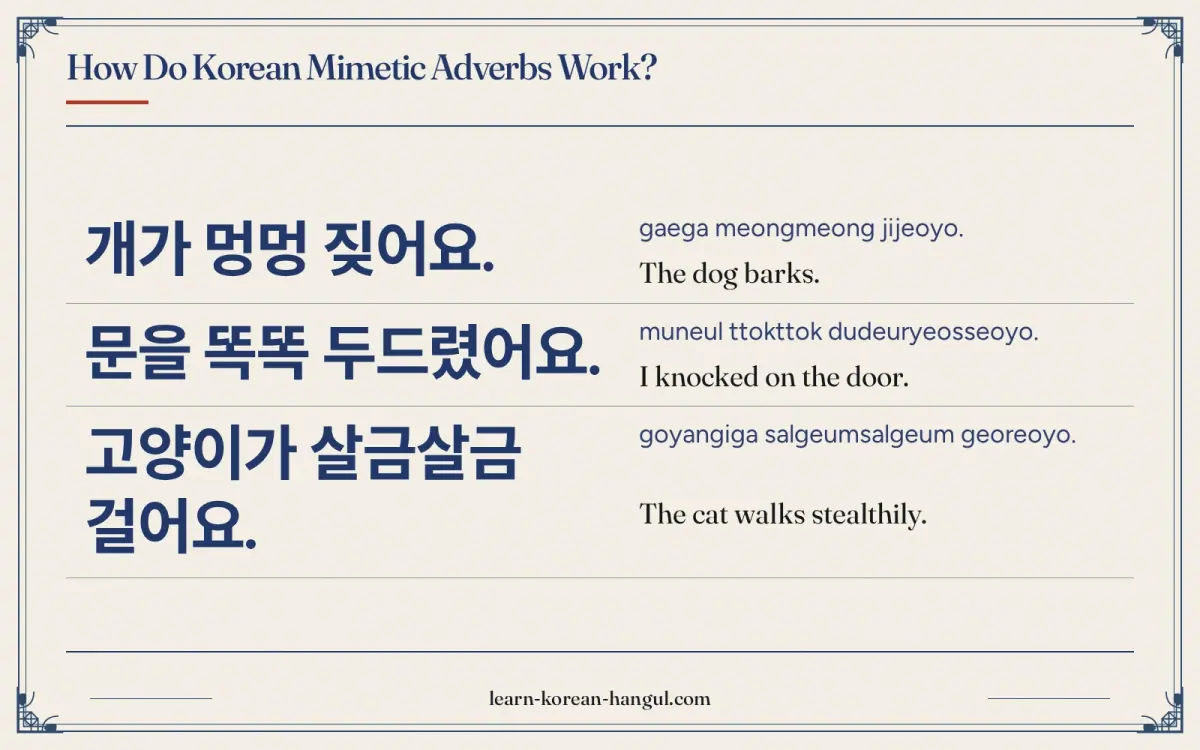
Form 1: the word before a verb. The mimetic word stands on its own, directly before the verb it describes. 개가 멍멍 짖어요 means "The dog barks", and 문을 똑똑 두드렸어요 means "I knocked on the door". This is the form to learn first.
개가 멍멍 짖어요.
gaega meongmeong jijeoyo.
The dog barks.
문을 똑똑 두드렸어요.
muneul ttokttok dudeuryeosseoyo.
I knocked on the door.
Form 2: the word plus 하다. Many manner words can take 하다 and become a verb: 두근두근하다 means "to pound". The verb then conjugates as usual: 가슴이 두근두근해요 ("My heart is pounding"). Not every mimetic word accepts 하다, so learn each one as you meet it.
Form 3: the word plus 거리다. The ending -거리다 also makes a verb from a repeated action: 반짝거리다 (to glitter) and 두근거리다 (to pound). It suggests that the action keeps repeating. You still see the shorter 반짝이다 (to twinkle) in many songs and stories.
Form 4: a modifier before a noun. A mimetic adverb cannot describe a noun directly. To say "a twinkling star", turn it into a verb first and use a noun-modifying ending: 반짝이는 별. Writing 반짝반짝 별 does not work as a noun phrase. The children's song line 반짝반짝 작은 별 is poetic word order: there 반짝반짝 goes with the verb later in the line (비치네, "shines"), not with 별. The ending -는 and the other noun-modifying forms are covered under Noun-Modifying Forms.
Some everyday mimetic words appear again and again, so these are worth learning first.
고양이가 살금살금 걸어요.
goyangiga salgeumsalgeum georeoyo.
The cat walks stealthily.
배에서 꼬르륵 소리가 나요.
baeeseo kkoreureuk soriga nayo.
My stomach rumbles.
눈이 펑펑 내려요.
nuni peongpeong naeryeoyo.
The snow falls heavily.
아이가 깡충깡충 뛰어요.
aiga kkangchungkkangchung ttwieoyo.
The child hops.
In the third example, the word 꼬르륵 is a sound word and it is paired with the noun 소리 ("sound") and the verb 나요 ("comes out"). That is the usual way to use a sound that has no action verb of its own. The next section shows how to build a sentence of your own.
Worked Example, Step by Step
You build a mimetic sentence in five steps, working from a plain sentence and adding a picture. This example makes "The stars twinkle in the night sky".
- Start with the plain sentence. 밤하늘에서 별이 빛나요. = "The stars shine in the night sky."
- Ask what kind of shine. The light is not steady. It comes and goes, bright and small.
- Choose the word. A flickering light is 반짝반짝.
- Place it directly before the verb. 반짝반짝 goes in front of 빛나요, after the subject: 별이 반짝반짝 빛나요.
- Check the sound and the spacing. Say [반짝빤짝] and write the word as one unit. The full sentence is 밤하늘에서 별이 반짝반짝 빛나요.
Sentence
The stars twinkle in the night sky.
Show answer
밤하늘에서 별이 반짝반짝 빛나요
Checkpoint. You have it when the mimetic word sits right before the verb and nothing is added to it. The tense lives in the verb, so the past is 밤하늘에서 별이 반짝반짝 빛났어요 ("The stars twinkled in the night sky").
The sentence built here is a statement. The next section shows how these words differ from similar adverbs.
How Is a Mimetic Adverb Different from Similar Forms?
A mimetic adverb copies a sound or a manner, while a -게 adverb comes from an adjective and a degree adverb shows "how much". They all sit before the verb, but they come from different sources and answer different questions. The lesson on adverb -게 and the lesson on adverbs -히 and -이 cover the others in full.
| Kind | Source | Question it answers | Example |
|---|---|---|---|
| Mimetic adverb | a sound or a manner | what does it sound or look like? | 별이 반짝반짝 빛나요. |
| Adverb -게 | an adjective stem + 게 | in what way? | 예쁘게 웃어요. |
| Adverb -히 / -이 | a root + 히 or 이 | in what way? | 조용히 해 주세요. |
| Degree adverb | a fixed word | how much? | 아주 예뻐요. |
A mimetic word is its own word. You cannot make it from an adjective by adding an ending, and you cannot turn another adverb into one. Another difference is the picture. 예쁘게 웃어요 says "She smiles prettily", a plain description. 방긋방긋 웃어요 says "She smiles with a sweet beaming smile", a picture of the smile itself. For the degree words, see adverbs of degree.
A change of vowel often changes the feeling. Bright vowels such as ㅏ and ㅗ tend to feel small and light, and dark vowels such as ㅓ and ㅜ tend to feel big and heavy.
| Light and small | Heavy and big | Difference |
|---|---|---|
| 졸졸 [졸졸] joljol | 줄줄 [줄줄] juljul | a thin trickle versus a stronger flow |
| 깡충깡충 [깡충깡충] kkangchungkkangchung | 껑충껑충 [껑충껑충] kkeongchungkkeongchung | small hops versus big leaps |
| 반짝반짝 [반짝빤짝] banjjakbanjjak | 번쩍번쩍 [번쩍뻔쩍] beonjjeokbeonjjeok | a light twinkle versus a heavy flash |
A quick test: if the English can use a picture word like "twinkling", "pounding" or "trickling", Korean probably has a mimetic word for it. Next, here is when to use it and when to hold back.
When Do You Use Mimetic Adverbs, and When Not?
Use mimetic adverbs whenever you want a vivid picture, in speech and writing alike. They are common in everyday talk, children's books, webtoons, advertising, song lyrics and news features. Adults use them all the time, for example 배에서 꼬르륵 소리가 나요 when hungry or 친구가 킥킥 웃었어요 when a friend giggles.
They are less common in a formal report, a legal text or a technical manual, where a plain adverb or a precise verb is preferred. In a formal presentation, one well-chosen word is enough. A paragraph full of them can sound like a children's story.
친구가 킥킥 웃었어요.
chinguga kikkik useosseoyo.
A friend giggled.
Choose a word that fits the verb and the thing that moves or sounds. 개가 멍멍 짖어요 works because dogs bark. A cat says 야옹, so 고양이가 멍멍 짖어요 would be funny and wrong. Likewise, 눈이 펑펑 내려요 fits heavy snow, while 주룩주룩 is for rain. Next are the errors that appear most often.
What Mistakes Do Learners Make with Mimetic Adverbs?
Learners make five common mistakes with mimetic adverbs.
- Thinking the words are slang. Learners avoid 반짝반짝 or 두근두근 because they sound childish. Actually they are standard Korean, found in the dictionary and used by adults every day.
- Using the word directly before a noun. Learners write 반짝반짝 별을 봐요 for "I look at the twinkling stars". Actually a mimetic adverb describes a verb, not a noun. Say 반짝이는 별을 봐요.
- Splitting the doubled word. Learners write 반짝 반짝 빛나요 with a space. Actually a repeated word like this is one adverb and is written without a space: 반짝반짝.
- Choosing a word that does not fit. Learners say 고양이가 멍멍 짖어요 or 눈이 주룩주룩 내려요. Actually the sound or the manner must match what is happening: 야옹 for a cat, 펑펑 for heavy snow.
- Mixing up vowel pairs. Learners use 줄줄 where 졸졸 is meant, and a small trickle suddenly sounds like a flood. Check whether you want light or heavy.
Whenever you add a mimetic word, check three things: the verb is right after it, the word matches the scene and a noun is not directly after it. Now test yourself.
Practice and Answers
These four exercises check the main skills: choosing the word, repairing a mistake, translating and writing one of your own. Try each one before you read the answers.
Practice · 5
Which word is a sound word (의성어)?
Show answer
멍멍
멍멍 copies the sound of a dog's bark. The other three describe a manner or a look.
Complete the sentence for heavy snowfall: 눈이 ___ 내려요.
Show answer
펑펑
펑펑 describes snow coming down heavily. The other words are for a bark, a pounding heart and a rumbling stomach.
How is 반짝반짝 usually pronounced?
Show answer
[반짝빤짝]
The ㅂ of the second 반 follows a final ㄱ, so it becomes tense: [반짝빤짝].
Which sentence is wrong?
Show answer
고양이가 멍멍 짖어요.
A cat does not bark. 멍멍 is the sound of a dog, so the sentence does not match the scene.
Which word describes a stronger flow of water?
Show answer
줄줄
줄줄 has the heavier vowel ㅜ and describes a stronger flow than 졸졸, which is a thin trickle.
Exercise 1: Choose the form. A dog is barking. Which fits: 개가 멍멍 짖어요 or 개가 야옹 짖어요?
Exercise 2: Fix the error. A learner writes 반짝반짝 별을 봐요 for "I look at the twinkling stars". Correct it.
Exercise 3: Translate. "My heart is pounding." (heart = 가슴)
Exercise 4: Write your own. Write one sentence with a mimetic adverb about rain, snow or a star.
Answer Key
- Exercise 1: 개가 멍멍 짖어요. [개가 멍멍 지저요] 야옹 is the sound of a cat.
- Exercise 2: 반짝이는 별을 봐요. [반짜기는 벼를 봐요] A mimetic adverb cannot describe a noun, so use the noun-modifier form 반짝이는.
- Exercise 3: 가슴이 두근두근해요. [가스미 두근두근해요] The form 가슴이 두근거려요 is also correct.
- Exercise 4: Answers vary. One correct answer is 비가 주룩주룩 와요. [비가 주룩쭈룩 와요] The mimetic word stands right before the verb.
If you missed Exercise 1 or 2, return to the pattern table. If you missed Exercise 3, reread the section on forms with 하다 and 거리다. Next, plan where to go from here.
Next Lessons and Where to Go from Here
The best next lesson is adverb -게, which shows the adverbs that come from adjectives. Then read adverbs -히 and -이 and adverbs of degree. For word order, see adverb position. To see more sound and manner words, use Korean onomatopoeia. The page on 너무: too or very shows one degree adverb in detail.
What this lesson does not cover. It does not give a full list of mimetic words, the rules of all vowel and consonant changes, or the sound words in comics and chat. The level given here, B1, is an editorial estimate based on common textbook order, not an official grading.
In short, Korean mimetic adverbs are doubled sound or manner words placed right before a verb, with no ending added, and they describe a noun only after they become a verb form.
Frequently Asked Questions
What are Korean mimetic words adverbs? Korean mimetic words adverbs are doubled words that copy a sound or a manner and describe an action, such as 반짝반짝 (twinkling) and 두근두근 (pounding). Sound words are 의성어, like 멍멍. Manner words are 의태어, like 반짝반짝. They stand before a verb, as in 별이 반짝반짝 빛나요, "The stars twinkle".
How do I use a mimetic word in a sentence? Put the word directly before the verb it describes and add no ending: 비가 주룩주룩 와요. The verb carries the tense and politeness. To make a verb from the word, add 하다 or 거리다 (두근두근하다, 반짝거리다). To describe a noun, use the verb in a modifier form, such as 반짝이는 별, not 반짝반짝 별.
Are mimetic words slang? No. They are standard Korean, listed in dictionaries and used by adults in daily talk, news, ads, songs and stories. They suit vivid description. In a very formal report or a legal text, a plain adverb is more usual, and too many of them can sound like a children's story.
What is the difference between 의성어 and 의태어? 의성어 are sound words that copy what you hear, such as 멍멍 (a bark) or 똑똑 (a knock). 의태어 are manner words that copy how something looks, moves or feels, such as 반짝반짝 or 살금살금. The line is not always sharp: 주룩주룩 for pouring rain suggests both the sound and the look.
What is the most common mistake with mimetic adverbs? Learners place a mimetic word directly before a noun, as in 반짝반짝 별을 봐요, or pick a word that does not fit the scene. The word must describe the verb and match the sound or manner. Say 반짝이는 별을 봐요 for "the twinkling stars", and use 야옹 for a cat, not 멍멍.
How do vowel changes alter a mimetic word? Bright vowels such as ㅏ and ㅗ usually feel small and light, and dark vowels such as ㅓ and ㅜ feel big and heavy. So 졸졸 is a thin trickle and 줄줄 a stronger flow, 깡충깡충 is small hops and 껑충껑충 big leaps, and 반짝반짝 is a light twinkle while 번쩍번쩍 is a heavy flash.