
Key facts
- Topic: Korean onomatopoeia, words that imitate sounds. They are called 의성어 (uiseongeo).
Korean Onomatopoeia at a Glance
Every language hears the world a little differently. A Korean dog says 멍멍, a Korean clock says 째깍째깍 and a Korean doorbell says 딩동. These sound words are called 의성어 (uiseongeo, words that imitate sounds). Korean also has 의태어 (uitaeeo, words that imitate manner or shape), such as 반짝반짝 (twinkling). This page covers the sound words. The manner words have their own list on Korean mimetic words.
Sound words are common in children's books, comics, webtoons and daily speech. They sit in the Standard Korean Dictionary (표준국어대사전) as ordinary words, with their own spellings. A few are written in more than one way, so a dictionary from the National Institute of Korean Language (국립국어원) is the place to check a spelling.
| Group | Words | What it covers |
|---|---|---|
| Animal sounds | 10 | Pets, farm animals, birds and a tiger |
| Nature and weather sounds | 10 | Water, rain, wind, thunder and leaves |
| Human sounds | 10 | Coughs, laughs, cries and eating sounds |
| Everyday object sounds | 10 | Doors, clocks, phones, cars and cameras |
| Sound-pattern pairs | 10 | Small-and-big pairs and glass or metal sounds |
The page is part of Korean Word Types. It has three deeper pages: Animal sounds in Korean (25 animal words), Korean mimetic words and Korean sound symbolism and vowel harmony.
Which Sound Words Should You Learn First?
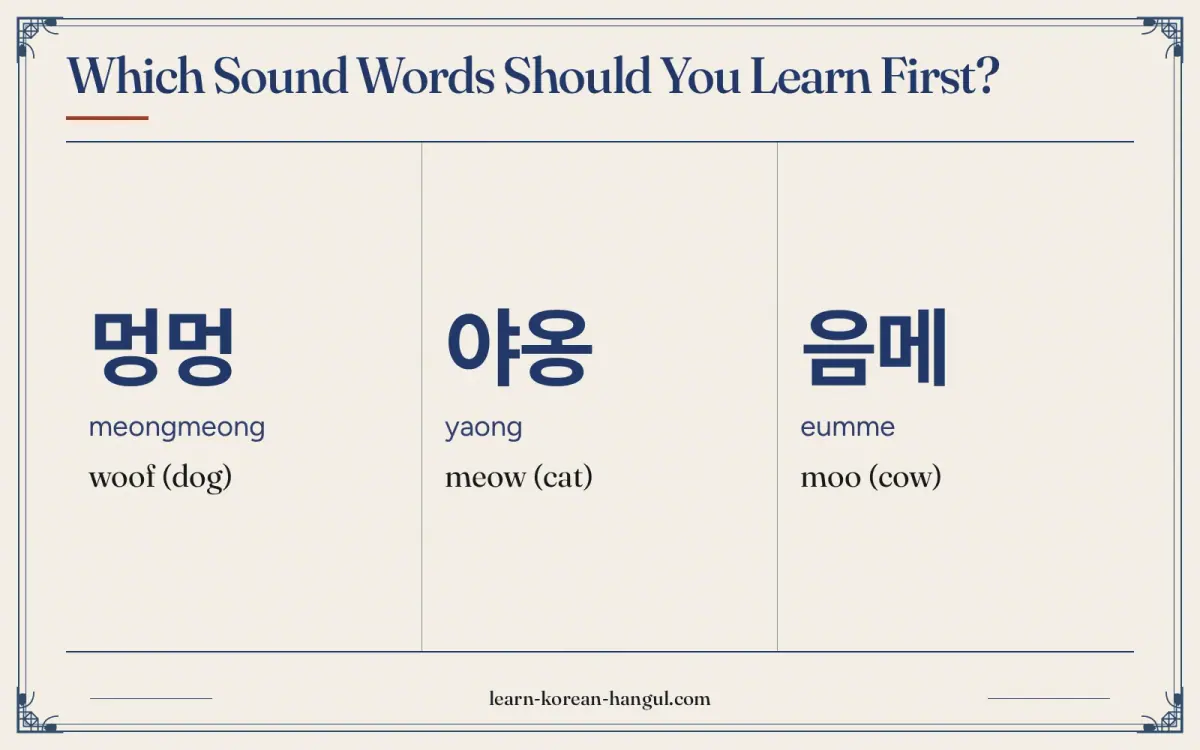
Start with the animal sounds, because they are the most common and the easiest to picture. Then learn the doorbell, phone and clock sounds, which you hear in daily life. Learn the weather and body sounds next. They show up in stories and in speech about your day. Keep the last group for later, since the pairs teach a pattern more than a vocabulary list.
- Say first. 멍멍, 야옹, 꿀꿀, 딩동, 똑똑, 짝짝.
- Use often. 콜록콜록, 쿨쿨, 꿀꺽, 쾅쾅, 주룩주룩.
- Recognise in stories. 와르르, 쨍그랑, 풍덩, 철썩, 바스락.
The scene below is a farmyard with ten numbered animals from the first group. Tap a number to hear the sound.
Word · 10
- 1
멍멍
meongmeong
woof (dog)
- 2
야옹
yaong
meow (cat)
- 3
음메
eumme
moo (cow)
- 4
꿀꿀
kkulkkul
oink (pig)
- 5
꼬꼬댁
kkokkodaek
cluck (hen)
- 6
꼬끼오
kkokkio
cock-a-doodle-doo (rooster)
- 7
꽥꽥
kkwaekkkwaek
quack (duck)
- 8
짹짹
jjaekjjaek
chirp (sparrow)
- 9
개굴개굴
gaegulgaegul
ribbit (frog)
- 10
어흥
eoheung
roar (tiger)
Animal Sounds
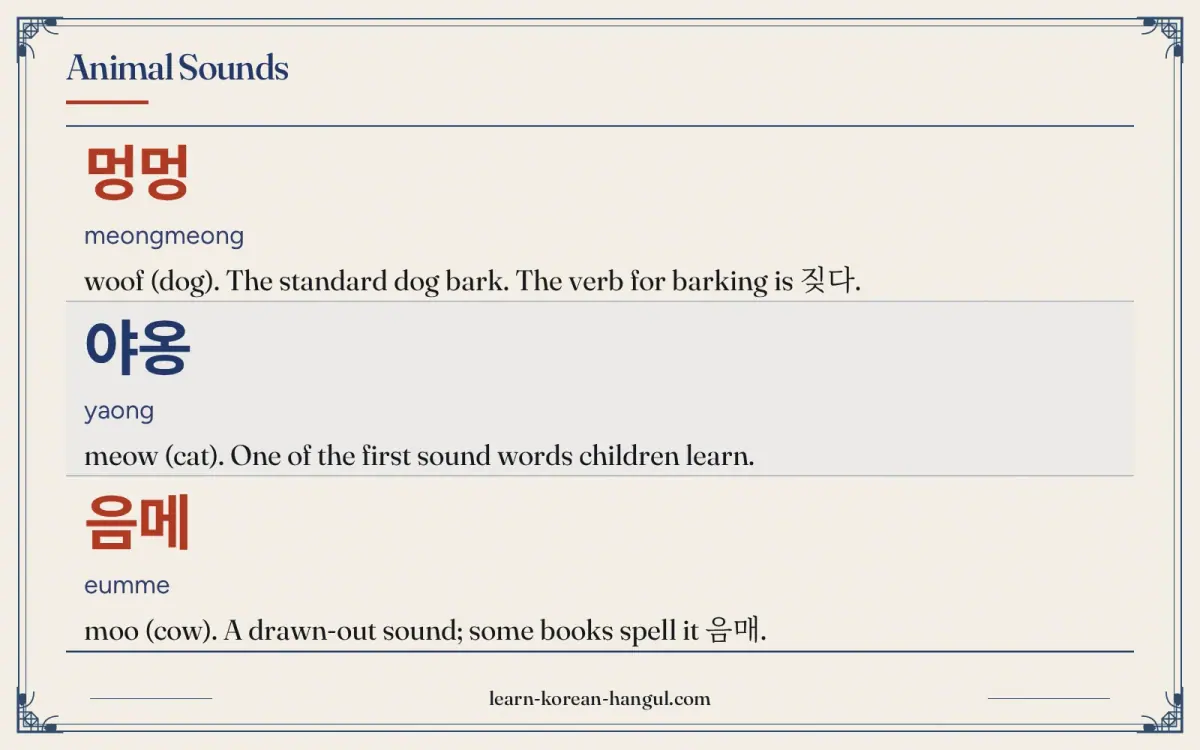
Animal sounds are the heart of Korean onomatopoeia. The animal comes first as the subject, then the sound, then a short verb. Dogs take 짖다 (to bark). Most other animals take 울다 (to cry, to call). This list gives only the ten you need first. The longer list has 25 words, including three kinds of dog bark, in Animal sounds in Korean.
| No. | Hangul | Revised Romanization | Meaning and note | Example sentence | Audio assetId |
|---|---|---|---|---|---|
| 1 | 멍멍 | meongmeong | woof (dog). The standard dog bark. The verb for barking is 짖다. | 개가 멍멍 짖어요. (The dog barks woof woof.) | au-pg-vocabulary-word-types-onomatopoeia-1; example: au-pg-vocabulary-word-types-onomatopoeia-51 |
| 2 | 야옹 | yaong | meow (cat). One of the first sound words children learn. | 고양이가 야옹 울어요. (The cat meows.) | au-pg-vocabulary-word-types-onomatopoeia-2; example: au-pg-vocabulary-word-types-onomatopoeia-52 |
| 3 | 음메 | eumme | moo (cow). A drawn-out sound; some books spell it 음매. | 소가 음메 울어요. (The cow moos.) | au-pg-vocabulary-word-types-onomatopoeia-3; example: au-pg-vocabulary-word-types-onomatopoeia-53 |
| 4 | 꿀꿀 | kkulkkul | oink (pig). Tense ㄲ twice. It is not close to the English 'oink'. | 돼지가 꿀꿀 울어요. (The pig oinks.) | au-pg-vocabulary-word-types-onomatopoeia-4; example: au-pg-vocabulary-word-types-onomatopoeia-54 |
| 5 | 꼬꼬댁 | kkokkodaek | cluck (hen). The hen. The rooster has a different sound, 꼬끼오. | 암탉이 꼬꼬댁 울어요. (The hen clucks.) | au-pg-vocabulary-word-types-onomatopoeia-5; example: au-pg-vocabulary-word-types-onomatopoeia-55 |
| 6 | 꼬끼오 | kkokkio | cock-a-doodle-doo (rooster). The rooster's crow. | 수탉이 꼬끼오 울어요. (The rooster crows.) | au-pg-vocabulary-word-types-onomatopoeia-6; example: au-pg-vocabulary-word-types-onomatopoeia-56 |
| 7 | 꽥꽥 | kkwaekkkwaek | quack (duck). Close to the English sound, with tense ㄲ. | 오리가 꽥꽥 울어요. (The duck quacks.) | au-pg-vocabulary-word-types-onomatopoeia-7; example: au-pg-vocabulary-word-types-onomatopoeia-57 |
| 8 | 짹짹 | jjaekjjaek | chirp (sparrow). Small birds. Tense ㅉ at the start. | 참새가 짹짹 울어요. (The sparrow chirps.) | au-pg-vocabulary-word-types-onomatopoeia-8; example: au-pg-vocabulary-word-types-onomatopoeia-58 |
| 9 | 개굴개굴 | gaegulgaegul | ribbit (frog). Four syllables: the pair 개굴 said twice. | 개구리가 개굴개굴 울어요. (The frog croaks.) | au-pg-vocabulary-word-types-onomatopoeia-9; example: au-pg-vocabulary-word-types-onomatopoeia-59 |
| 10 | 어흥 | eoheung | roar (tiger). The tiger in picture books and folk stories. | 호랑이가 어흥 해요. (The tiger roars.) | au-pg-vocabulary-word-types-onomatopoeia-10; example: au-pg-vocabulary-word-types-onomatopoeia-60 |
Example Sentences
All ten sentences use one frame: animal + 이/가 + sound + verb. The particle is 이 after a consonant and 가 after a vowel: 개가, 고양이가, 소가, 암탉이, 수탉이. Play each sentence, say it aloud, then swap the animal.
Nature and Weather Sounds
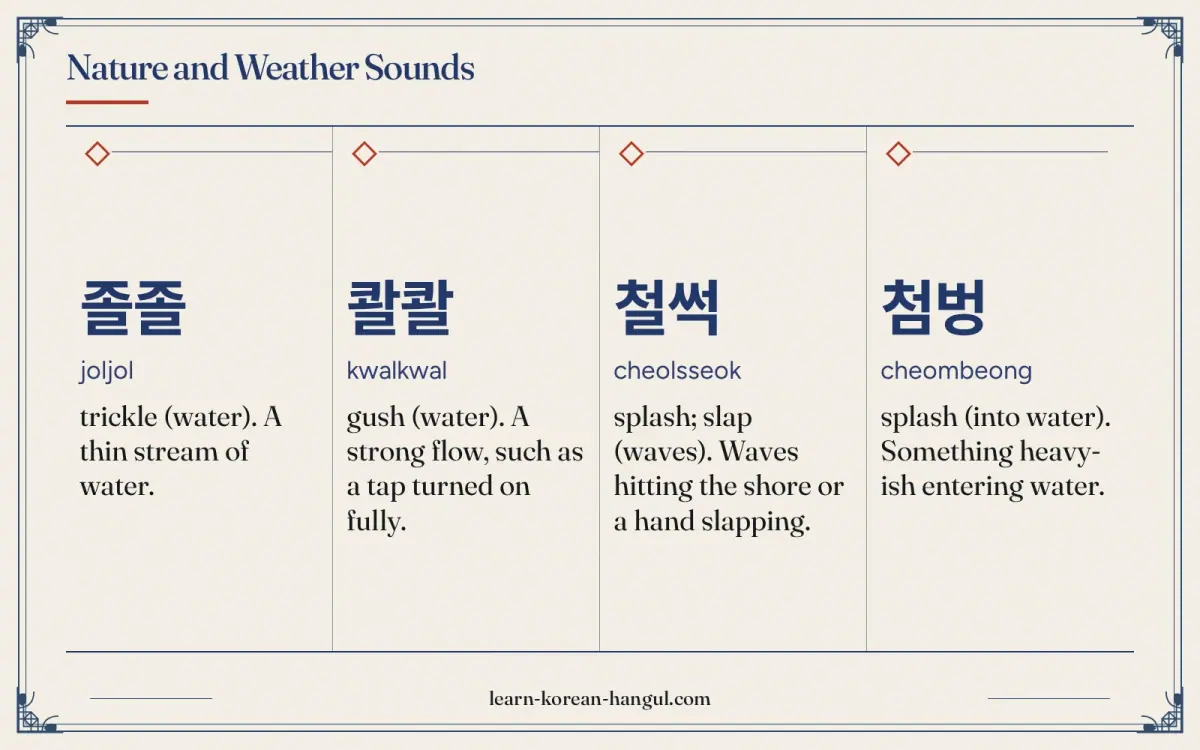
Nature words describe water, weather and the sounds of the open air. Water has the biggest set: 졸졸 is thin, 콸콸 is strong and 철썩 and 첨벙 are splashes. Weather words such as 주룩주룩 and 쾅쾅 appear in forecasts, stories and daily talk about the rain. Several of these words also describe how something looks or moves, so a speaker can use them for both sound and sight.
| No. | Hangul | Revised Romanization | Meaning and note | Example sentence | Audio assetId |
|---|---|---|---|---|---|
| 11 | 졸졸 | joljol | trickle (water). A thin stream of water. | 시냇물이 졸졸 흘러요. (The stream trickles along.) | au-pg-vocabulary-word-types-onomatopoeia-11; example: au-pg-vocabulary-word-types-onomatopoeia-61 |
| 12 | 콸콸 | kwalkwal | gush (water). A strong flow, such as a tap turned on fully. | 수돗물이 콸콸 나와요. (Tap water gushes out.) | au-pg-vocabulary-word-types-onomatopoeia-12; example: au-pg-vocabulary-word-types-onomatopoeia-62 |
| 13 | 철썩 | cheolsseok | splash; slap (waves). Waves hitting the shore or a hand slapping. | 파도가 철썩 쳐요. (The waves slap the shore.) | au-pg-vocabulary-word-types-onomatopoeia-13; example: au-pg-vocabulary-word-types-onomatopoeia-63 |
| 14 | 첨벙 | cheombeong | splash (into water). Something heavy-ish entering water. | 아이가 물에 첨벙 들어가요. (The child plunges into the water with a splash.) | au-pg-vocabulary-word-types-onomatopoeia-14; example: au-pg-vocabulary-word-types-onomatopoeia-64 |
| 15 | 주룩주룩 | jurukjuruk | pouring (rain). Heavy rain falling in lines. It describes sound and look at once. | 비가 주룩주룩 내려요. (The rain pours down.) | au-pg-vocabulary-word-types-onomatopoeia-15; example: au-pg-vocabulary-word-types-onomatopoeia-65 |
| 16 | 후드득 | hudeudeuk | pattering (drops). Raindrops or hail hitting a surface for a moment. | 빗방울이 후드득 떨어져요. (Raindrops patter down.) | au-pg-vocabulary-word-types-onomatopoeia-16; example: au-pg-vocabulary-word-types-onomatopoeia-66 |
| 17 | 쌩쌩 | ssaengssaeng | whoosh (wind; fast traffic). A fast rush of air. | 차가 쌩쌩 달려요. (The cars whoosh by.) | au-pg-vocabulary-word-types-onomatopoeia-17; example: au-pg-vocabulary-word-types-onomatopoeia-67 |
| 18 | 우르릉 | ureureung | rumble (thunder). The long deep rumble. It often comes before 쾅쾅. | 하늘에서 우르릉 소리가 나요. (A rumble comes from the sky.) | au-pg-vocabulary-word-types-onomatopoeia-18; example: au-pg-vocabulary-word-types-onomatopoeia-68 |
| 19 | 쾅쾅 | kwangkwang | boom boom (thunder; slamming). A heavy bang, repeated. | 천둥이 쾅쾅 쳐요. (The thunder booms.) | au-pg-vocabulary-word-types-onomatopoeia-19; example: au-pg-vocabulary-word-types-onomatopoeia-69 |
| 20 | 바스락 | baseurak | rustle (dry leaves). Dry paper or leaves under your feet. | 낙엽에서 바스락 소리가 나요. (The dry leaves make a rustling sound.) | au-pg-vocabulary-word-types-onomatopoeia-20; example: au-pg-vocabulary-word-types-onomatopoeia-70 |
How Do You Say Human Sounds in Korean?
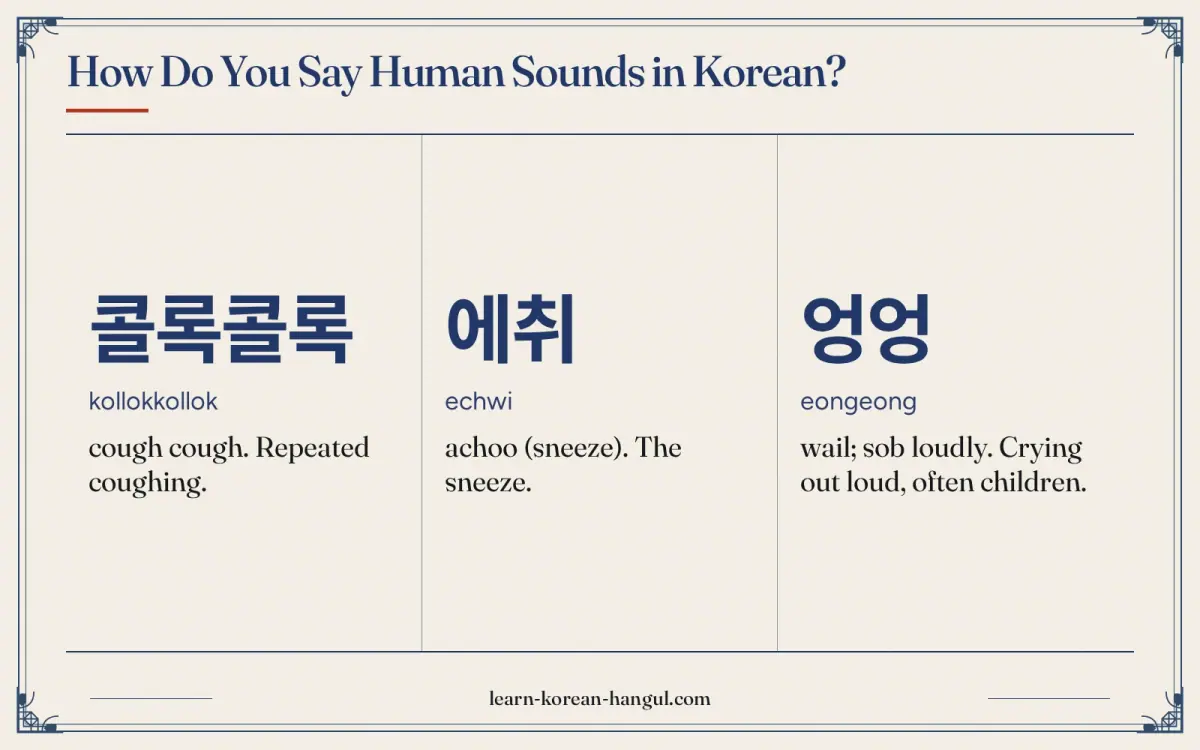
Body sounds are very informal. You hear them in family talk and comic strips and from children. 에취 and 콜록콜록 are written when someone coughs or sneezes, and 꿀꺽, 후루룩 and 냠냠 mark eating. They are rarely used in formal writing or in a polite talk with a stranger. In a restaurant, noodle slurping is a normal sound, and 후루룩 is a friendly word, not a rude one.
| No. | Hangul | Revised Romanization | Meaning and note | Example sentence | Audio assetId |
|---|---|---|---|---|---|
| 21 | 콜록콜록 | kollokkollok | cough cough. Repeated coughing. | 콜록콜록 기침해요. (I cough and cough.) | au-pg-vocabulary-word-types-onomatopoeia-21; example: au-pg-vocabulary-word-types-onomatopoeia-71 |
| 22 | 에취 | echwi | achoo (sneeze). The sneeze. | 에취! 재채기가 나요. (Achoo! I am sneezing.) | au-pg-vocabulary-word-types-onomatopoeia-22; example: au-pg-vocabulary-word-types-onomatopoeia-72 |
| 23 | 엉엉 | eongeong | wail; sob loudly. Crying out loud, often children. | 아기가 엉엉 울어요. (The baby is wailing.) | au-pg-vocabulary-word-types-onomatopoeia-23; example: au-pg-vocabulary-word-types-onomatopoeia-73 |
| 24 | 깔깔 | kkalkkal | hahaha (loud laugh). A bright, loud laugh among friends. | 친구들이 깔깔 웃어요. (My friends laugh out loud.) | au-pg-vocabulary-word-types-onomatopoeia-24; example: au-pg-vocabulary-word-types-onomatopoeia-74 |
| 25 | 쿨쿨 | kulkul | zzz (sleeping soundly). Deep sleep or snoring. | 아기가 쿨쿨 자요. (The baby sleeps soundly.) | au-pg-vocabulary-word-types-onomatopoeia-25; example: au-pg-vocabulary-word-types-onomatopoeia-75 |
| 26 | 꿀꺽 | kkulkkeok | gulp. Swallowing a drink or a bite in one go. | 물을 꿀꺽 마셔요. (I gulp down the water.) | au-pg-vocabulary-word-types-onomatopoeia-26; example: au-pg-vocabulary-word-types-onomatopoeia-76 |
| 27 | 후루룩 | hururuk | slurp (noodles). The sound of slurping noodles or soup. | 국수를 후루룩 먹어요. (I slurp the noodles.) | au-pg-vocabulary-word-types-onomatopoeia-27; example: au-pg-vocabulary-word-types-onomatopoeia-77 |
| 28 | 냠냠 | nyamnyam | yum yum (eating). Children's word for eating happily. | 아이가 냠냠 먹어요. (The child eats yum yum.) | au-pg-vocabulary-word-types-onomatopoeia-28; example: au-pg-vocabulary-word-types-onomatopoeia-78 |
| 29 | 헉헉 | heokheok | pant; gasp. Heavy breathing after running or climbing. | 헉헉 숨을 쉬어요. (I pant for breath.) | au-pg-vocabulary-word-types-onomatopoeia-29; example: au-pg-vocabulary-word-types-onomatopoeia-79 |
| 30 | 쯧쯧 | jjeutjjeut | tut-tut. Clicking the tongue in pity or disapproval. | 할머니가 쯧쯧 혀를 차요. (Grandmother clicks her tongue.) | au-pg-vocabulary-word-types-onomatopoeia-30; example: au-pg-vocabulary-word-types-onomatopoeia-80 |
Everyday Object Sounds
Machines and household objects have their own sound words. They are short and clear: 똑똑 for a knock, 딩동 for a bell and 찰칵 for a camera. With most of them the verb is 소리를 내다 (to make a sound), so the pattern is object + 이/가 + sound word + 소리를 내요. For example, 차가 빵빵 소리를 내요 means the car honks.
| No. | Hangul | Revised Romanization | Meaning and note | Example sentence | Audio assetId |
|---|---|---|---|---|---|
| 31 | 똑똑 | ttokttok | knock knock. Knocking on a door. Also a dripping drop. | 문을 똑똑 두드려요. (I knock on the door.) | au-pg-vocabulary-word-types-onomatopoeia-31; example: au-pg-vocabulary-word-types-onomatopoeia-81 |
| 32 | 딩동 | dingdong | ding-dong (doorbell). A doorbell chime. | 딩동! 누가 왔어요? (Ding-dong! Who has come?) | au-pg-vocabulary-word-types-onomatopoeia-32; example: au-pg-vocabulary-word-types-onomatopoeia-82 |
| 33 | 째깍째깍 | jjaekkakjjaekkak | tick-tock (clock). A clock ticking. | 시계가 째깍째깍 가요. (The clock ticks along.) | au-pg-vocabulary-word-types-onomatopoeia-33; example: au-pg-vocabulary-word-types-onomatopoeia-83 |
| 34 | 따르릉 | ttareureung | ring (phone; bell). An old-style phone or a bicycle bell. | 전화가 따르릉 울려요. (The phone rings.) | au-pg-vocabulary-word-types-onomatopoeia-34; example: au-pg-vocabulary-word-types-onomatopoeia-84 |
| 35 | 빵빵 | ppangppang | beep beep (car horn). A car horn. Not the same as the word 빵 (bread). | 차가 빵빵 소리를 내요. (The car honks.) | au-pg-vocabulary-word-types-onomatopoeia-35; example: au-pg-vocabulary-word-types-onomatopoeia-85 |
| 36 | 쿵 | kung | thud. One heavy fall or bump. | 책이 쿵 떨어졌어요. (The book fell with a thud.) | au-pg-vocabulary-word-types-onomatopoeia-36; example: au-pg-vocabulary-word-types-onomatopoeia-86 |
| 37 | 찰칵 | chalkak | click (camera shutter). A camera shutter or a lock clicking. | 카메라가 찰칵 소리를 내요. (The camera clicks.) | au-pg-vocabulary-word-types-onomatopoeia-37; example: au-pg-vocabulary-word-types-onomatopoeia-87 |
| 38 | 삐삐 | ppippi | beep beep (machine). A machine alarm or a timer. | 기계가 삐삐 소리를 내요. (The machine beeps.) | au-pg-vocabulary-word-types-onomatopoeia-38; example: au-pg-vocabulary-word-types-onomatopoeia-88 |
| 39 | 부릉부릉 | bureungbureung | vroom vroom (engine). An engine starting up. | 오토바이가 부릉부릉 소리를 내요. (The motorcycle goes vroom.) | au-pg-vocabulary-word-types-onomatopoeia-39; example: au-pg-vocabulary-word-types-onomatopoeia-89 |
| 40 | 짝짝 | jjakjjak | clap clap. Clapping hands. | 모두 짝짝 박수를 쳐요. (Everyone claps their hands.) | au-pg-vocabulary-word-types-onomatopoeia-40; example: au-pg-vocabulary-word-types-onomatopoeia-90 |
What Is the Difference between 의성어 and 의태어?
A sound word copies what you hear, and a manner word copies how something looks or moves. 졸졸 (water trickling) is a sound word. 반짝반짝 (twinkling) is a manner word. The line is not always clear. 주룩주룩 for pouring rain describes both the sound and the look of falling lines. Korean speakers use both kinds in the same way: before a verb, as an adverb.
| Kind | Korean | Describes | Example |
|---|---|---|---|
| Sound word | 의성어 (uiseongeo) | what you hear | 졸졸 흘러요 (it trickles) |
| Manner word | 의태어 (uitaeeo) | how it looks or moves | 반짝반짝 빛나요 (it twinkles) |
Both kinds can also turn into verbs with -거리다 or -대다. For example, 두근거리다 (to pound, of a heart) and 반짝거리다 (to twinkle) are verbs made from manner words. The adverb use is explained in Korean mimetic words as adverbs.
Sound-Pattern Pairs
The last group shows how Korean changes a sound word to change its feel. Take 퐁당 and 풍덩. Both mean something dropping into water, but 퐁당 has the light vowel ㅗ and means a small object, while 풍덩 has the dark vowel ㅜ and means a big one. 달그락 and 덜거덕 work the same way. Korean linguists call the effect sound symbolism, and the sound symbolism lesson covers it in full.
| No. | Hangul | Revised Romanization | Meaning and note | Example sentence | Audio assetId |
|---|---|---|---|---|---|
| 41 | 퐁당 | pongdang | plop (small thing into water). Light vowel ㅗ for a small object. Pair: 풍덩. | 돌이 퐁당 떨어져요. (A pebble drops in with a plop.) | au-pg-vocabulary-word-types-onomatopoeia-41; example: au-pg-vocabulary-word-types-onomatopoeia-91 |
| 42 | 풍덩 | pungdeong | splash (big thing into water). Dark vowel ㅜ for a big object. Pair: 퐁당. | 큰 돌이 풍덩 떨어져요. (A big rock drops in with a splash.) | au-pg-vocabulary-word-types-onomatopoeia-42; example: au-pg-vocabulary-word-types-onomatopoeia-92 |
| 43 | 달그락 | dalgeurak | clink (small dishes). Light vowels for small, light things. Pair: 덜거덕. | 그릇이 달그락 소리를 내요. (The dishes clink.) | au-pg-vocabulary-word-types-onomatopoeia-43; example: au-pg-vocabulary-word-types-onomatopoeia-93 |
| 44 | 덜거덕 | deolgeodeok | clatter (heavy things). Dark vowels for heavy things. Pair: 달그락. | 수레가 덜거덕 소리를 내요. (The cart clatters.) | au-pg-vocabulary-word-types-onomatopoeia-44; example: au-pg-vocabulary-word-types-onomatopoeia-94 |
| 45 | 줄줄 | juljul | stream (water). A stronger flow than 졸졸. Pair: 졸졸. | 물이 줄줄 흘러요. (Water streams out.) | au-pg-vocabulary-word-types-onomatopoeia-45; example: au-pg-vocabulary-word-types-onomatopoeia-95 |
| 46 | 딸랑딸랑 | ttallangttallang | jingle (small bell). A small bell. Tense ㄸ, light vowel. | 방울이 딸랑딸랑 울려요. (The little bell jingles.) | au-pg-vocabulary-word-types-onomatopoeia-46; example: au-pg-vocabulary-word-types-onomatopoeia-96 |
| 47 | 땡땡 | ttaengttaeng | ding ding (school bell). A metal bell ringing. | 학교 종이 땡땡 울려요. (The school bell rings ding ding.) | au-pg-vocabulary-word-types-onomatopoeia-47; example: au-pg-vocabulary-word-types-onomatopoeia-97 |
| 48 | 짤랑짤랑 | jjallangjjallang | jingle (coins). Coins or keys knocking together. | 동전이 짤랑짤랑 소리를 내요. (The coins jingle.) | au-pg-vocabulary-word-types-onomatopoeia-48; example: au-pg-vocabulary-word-types-onomatopoeia-98 |
| 49 | 쨍그랑 | jjaenggeurang | crash (glass). Glass or a metal plate shattering. | 유리컵이 쨍그랑 깨졌어요. (The glass broke with a crash.) | au-pg-vocabulary-word-types-onomatopoeia-49; example: au-pg-vocabulary-word-types-onomatopoeia-99 |
| 50 | 와르르 | wareureu | crumble; clatter down. Many things falling or collapsing together. | 블록이 와르르 무너졌어요. (The blocks tumbled down.) | au-pg-vocabulary-word-types-onomatopoeia-50; example: au-pg-vocabulary-word-types-onomatopoeia-100 |
Three patterns are worth knowing. First, many sound words are reduplicated, so the same syllable or pair is said twice, as in 땡땡 and 짝짝. Second, light vowels (ㅏ, ㅗ) feel small, sharp or quick, and dark vowels (ㅓ, ㅜ) feel big, heavy or slow. Third, tense consonants (ㄲ, ㄸ, ㅃ, ㅉ) make the sound sharper than plain ones. Compare 졸졸 (a thin trickle) with 쫄쫄 (a thin, quick trickle).
How Do You Pronounce These Words?
Sound words are a drill in tense consonants and repeated syllables. The Standard Pronunciation Rules (표준 발음법) of the National Institute of Korean Language (국립국어원) are the reference, and the romanization follows the Revised Romanization of Korean, which writes tense letters (kk, tt, pp, ss, jj) but does not show tensing caused by a neighbouring sound.
- Tense consonants. ㄲ, ㄸ, ㅉ are said with a tight throat and no puff of air. Practise 꿀꿀, 딸랑딸랑 and 쨍그랑.
- Final consonants. A final ㄱ closes the syllable without a puff of air, and a final ㅇ is the nasal sound at the end of English 'song': 콜록콜록 (kollokkollok), 쾅쾅 (kwangkwang).
- Repeated syllables. Say both halves with the same weight. Do not rush the second half.
- Light and dark vowels. 퐁당 and 풍덩 differ only by ㅗ and ㅜ, so listen for the lip shape.
Audio and Slow Playback
Each word and sentence has its own clip. The clips below replay five tricky words slowly. Play one, repeat it, then play it again and compare.
What Mistakes Do Learners Make with Sound Words?
Five mistakes come up often.
- Using English sounds. 'Woof', 'oink' and 'ding-dong' are not Korean. Use 멍멍, 꿀꿀 and 딩동.
- Using 짖다 for every animal. Use 짖다 only for dogs. Use 울다 for most other animals.
- Dropping the tense consonant. 꿀꿀 said as [굴굴] sounds like a different word.
- Mixing sound words and manner words. 졸졸 is a sound. 반짝반짝 is a look. Use each with a fitting verb.
- Using body sounds in polite writing. Words like 꿀꺽 and 헉헉 fit stories and casual speech, not business email.
Tense consonants matter most. A word that loses its tension loses its feel, even when the vowel is right.
Practice: Flashcards and Worksheet
Run the deck in recognition mode until each sound matches its source, then switch to listening mode and take the quiz. The deck holds all 50 words with audio, and your progress stays in your browser. The vocabulary flashcard decks page lists the other decks, and the Korean onomatopoeia flashcards deck is a separate 28-card set that shares many of these words.
Practice · 105
- 01멍멍
Show answer
headword 1: woof (dog)
- 02야옹
Show answer
headword 2: meow (cat)
- 03음메
Show answer
headword 3: moo (cow)
- 04꿀꿀
Show answer
headword 4: oink (pig)
- 05꼬꼬댁
Show answer
headword 5: cluck (hen)
- 06꼬끼오
Show answer
headword 6: cock-a-doodle-doo (rooster)
- 07꽥꽥
Show answer
headword 7: quack (duck)
- 08짹짹
Show answer
headword 8: chirp (sparrow)
- 09개굴개굴
Show answer
headword 9: ribbit (frog)
- 10어흥
Show answer
headword 10: roar (tiger)
- 11졸졸
Show answer
headword 11: trickle (water)
- 12콸콸
Show answer
headword 12: gush (water)
- 13철썩
Show answer
headword 13: splash; slap (waves)
- 14첨벙
Show answer
headword 14: splash (into water)
- 15주룩주룩
Show answer
headword 15: pouring (rain)
- 16후드득
Show answer
headword 16: pattering (drops)
- 17쌩쌩
Show answer
headword 17: whoosh (wind; fast traffic)
- 18우르릉
Show answer
headword 18: rumble (thunder)
- 19쾅쾅
Show answer
headword 19: boom boom (thunder; slamming)
- 20바스락
Show answer
headword 20: rustle (dry leaves)
- 21콜록콜록
Show answer
headword 21: cough cough
- 22에취
Show answer
headword 22: achoo (sneeze)
- 23엉엉
Show answer
headword 23: wail; sob loudly
- 24깔깔
Show answer
headword 24: hahaha (loud laugh)
- 25쿨쿨
Show answer
headword 25: zzz (sleeping soundly)
- 26꿀꺽
Show answer
headword 26: gulp
- 27후루룩
Show answer
headword 27: slurp (noodles)
- 28냠냠
Show answer
headword 28: yum yum (eating)
- 29헉헉
Show answer
headword 29: pant; gasp
- 30쯧쯧
Show answer
headword 30: tut-tut
- 31똑똑
Show answer
headword 31: knock knock
- 32딩동
Show answer
headword 32: ding-dong (doorbell)
- 33째깍째깍
Show answer
headword 33: tick-tock (clock)
- 34따르릉
Show answer
headword 34: ring (phone; bell)
- 35빵빵
Show answer
headword 35: beep beep (car horn)
- 36쿵
Show answer
headword 36: thud
- 37찰칵
Show answer
headword 37: click (camera shutter)
- 38삐삐
Show answer
headword 38: beep beep (machine)
- 39부릉부릉
Show answer
headword 39: vroom vroom (engine)
- 40짝짝
Show answer
headword 40: clap clap
- 41퐁당
Show answer
headword 41: plop (small thing into water)
- 42풍덩
Show answer
headword 42: splash (big thing into water)
- 43달그락
Show answer
headword 43: clink (small dishes)
- 44덜거덕
Show answer
headword 44: clatter (heavy things)
- 45줄줄
Show answer
headword 45: stream (water)
- 46딸랑딸랑
Show answer
headword 46: jingle (small bell)
- 47땡땡
Show answer
headword 47: ding ding (school bell)
- 48짤랑짤랑
Show answer
headword 48: jingle (coins)
- 49쨍그랑
Show answer
headword 49: crash (glass)
- 50와르르
Show answer
headword 50: crumble; clatter down
- 51개가 멍멍 짖어요.
Show answer
example sentence for 멍멍
- 52고양이가 야옹 울어요.
Show answer
example sentence for 야옹
- 53소가 음메 울어요.
Show answer
example sentence for 음메
- 54돼지가 꿀꿀 울어요.
Show answer
example sentence for 꿀꿀
- 55암탉이 꼬꼬댁 울어요.
Show answer
example sentence for 꼬꼬댁
- 56수탉이 꼬끼오 울어요.
Show answer
example sentence for 꼬끼오
- 57오리가 꽥꽥 울어요.
Show answer
example sentence for 꽥꽥
- 58참새가 짹짹 울어요.
Show answer
example sentence for 짹짹
- 59개구리가 개굴개굴 울어요.
Show answer
example sentence for 개굴개굴
- 60호랑이가 어흥 해요.
Show answer
example sentence for 어흥
- 61시냇물이 졸졸 흘러요.
Show answer
example sentence for 졸졸
- 62수돗물이 콸콸 나와요.
Show answer
example sentence for 콸콸
- 63파도가 철썩 쳐요.
Show answer
example sentence for 철썩
- 64아이가 물에 첨벙 들어가요.
Show answer
example sentence for 첨벙
- 65비가 주룩주룩 내려요.
Show answer
example sentence for 주룩주룩
- 66빗방울이 후드득 떨어져요.
Show answer
example sentence for 후드득
- 67차가 쌩쌩 달려요.
Show answer
example sentence for 쌩쌩
- 68하늘에서 우르릉 소리가 나요.
Show answer
example sentence for 우르릉
- 69천둥이 쾅쾅 쳐요.
Show answer
example sentence for 쾅쾅
- 70낙엽에서 바스락 소리가 나요.
Show answer
example sentence for 바스락
- 71콜록콜록 기침해요.
Show answer
example sentence for 콜록콜록
- 72에취! 재채기가 나요.
Show answer
example sentence for 에취
- 73아기가 엉엉 울어요.
Show answer
example sentence for 엉엉
- 74친구들이 깔깔 웃어요.
Show answer
example sentence for 깔깔
- 75아기가 쿨쿨 자요.
Show answer
example sentence for 쿨쿨
- 76물을 꿀꺽 마셔요.
Show answer
example sentence for 꿀꺽
- 77국수를 후루룩 먹어요.
Show answer
example sentence for 후루룩
- 78아이가 냠냠 먹어요.
Show answer
example sentence for 냠냠
- 79헉헉 숨을 쉬어요.
Show answer
example sentence for 헉헉
- 80할머니가 쯧쯧 혀를 차요.
Show answer
example sentence for 쯧쯧
- 81문을 똑똑 두드려요.
Show answer
example sentence for 똑똑
- 82딩동! 누가 왔어요?
Show answer
example sentence for 딩동
- 83시계가 째깍째깍 가요.
Show answer
example sentence for 째깍째깍
- 84전화가 따르릉 울려요.
Show answer
example sentence for 따르릉
- 85차가 빵빵 소리를 내요.
Show answer
example sentence for 빵빵
- 86책이 쿵 떨어졌어요.
Show answer
example sentence for 쿵
- 87카메라가 찰칵 소리를 내요.
Show answer
example sentence for 찰칵
- 88기계가 삐삐 소리를 내요.
Show answer
example sentence for 삐삐
- 89오토바이가 부릉부릉 소리를 내요.
Show answer
example sentence for 부릉부릉
- 90모두 짝짝 박수를 쳐요.
Show answer
example sentence for 짝짝
- 91돌이 퐁당 떨어져요.
Show answer
example sentence for 퐁당
- 92큰 돌이 풍덩 떨어져요.
Show answer
example sentence for 풍덩
- 93그릇이 달그락 소리를 내요.
Show answer
example sentence for 달그락
- 94수레가 덜거덕 소리를 내요.
Show answer
example sentence for 덜거덕
- 95물이 줄줄 흘러요.
Show answer
example sentence for 줄줄
- 96방울이 딸랑딸랑 울려요.
Show answer
example sentence for 딸랑딸랑
- 97학교 종이 땡땡 울려요.
Show answer
example sentence for 땡땡
- 98동전이 짤랑짤랑 소리를 내요.
Show answer
example sentence for 짤랑짤랑
- 99유리컵이 쨍그랑 깨졌어요.
Show answer
example sentence for 쨍그랑
- 100블록이 와르르 무너졌어요.
Show answer
example sentence for 와르르
- 101꿀꺽
Show answer
slow playback: 꿀꺽
- 102쯧쯧
Show answer
slow playback: 쯧쯧
- 103콜록콜록
Show answer
slow playback: 콜록콜록
- 104쨍그랑
Show answer
slow playback: 쨍그랑
- 105후드득
Show answer
slow playback: 후드득
Practice · 5
What does 멍멍 (meongmeong) mean?
Show answer
woof (dog)
멍멍 means woof (dog). Example: 개가 멍멍 짖어요. (The dog barks.)
Which word is the doorbell sound?
Show answer
딩동
딩동 is a doorbell. 똑똑 is a knock. Example: 딩동! 누가 왔어요? (Ding-dong! Who has come?)
Which word fits a big thing falling into water?
Show answer
풍덩
풍덩 has the dark vowel ㅜ and is for something big. 퐁당 is for something small.
What does 후루룩 (hururuk) copy?
Show answer
slurping noodles
후루룩 is the slurp of noodles or soup. Example: 국수를 후루룩 먹어요. (I slurp the noodles.)
Which verb goes with dogs barking?
Show answer
짖다
짖다 means to bark and is used for dogs. Most other animals take 울다.
Korean Onomatopoeia Worksheet (PDF)
A printable worksheet for these words (word list, matching, writing practice, fill-in-the-blank exercises and answer key) is available in A4 and US Letter from the download card on this page. For practice, draw five sources of sound, write the Korean sound word beside each and say it aloud.
Where to Go Next
Learn the full animal list in Animal sounds in Korean, then the words for movement and appearance in Korean mimetic words. To go up a level, return to Korean Word Types, or move on to Korean idioms. Animal names are on animal names.
Frequently Asked Questions
What Are Korean Onomatopoeia Called?
Words that imitate sounds are called 의성어 (uiseongeo). Words that imitate manner, shape or movement are 의태어 (uitaeeo). Together they are often called sound-symbolic words. In everyday English, people use the single word onomatopoeia for the first kind.
How Do You Say Woof and Meow in Korean?
A dog says 멍멍 (meongmeong) and a cat says 야옹 (yaong). Say 개가 멍멍 짖어요 for 'The dog barks' and 고양이가 야옹 울어요 for 'The cat meows'. Other animals have their own sound words, and the first ten are in the animal group on this page.
Do Korean Sound Words Come in Pairs?
Many do. A syllable or pair is repeated, as in 땡땡 and 짝짝. Some also come in light and dark versions, such as 퐁당 (a small plop) and 풍덩 (a big splash). The vowel changes the size and feel of the sound.
Can Sound Words Be Used as Verbs?
Some can. Add -거리다 or -대다 to make a verb, as in 두근거리다 (to pound) and 반짝거리다 (to twinkle). A sound word on its own is an adverb that goes before a verb, as in 졸졸 흘러요 (it trickles).
Are the Spellings of Korean Sound Words Fixed?
Not completely. Some words have variant spellings, and books may stretch or repeat a sound for effect. The forms on this page are common ones. The National Institute of Korean Language (국립국어원) dictionary is the place to check a spelling.
Is the Romanization on This Page Official?
It follows the Revised Romanization of Korean, which South Korea adopted on 7 July 2000 and whose rules the National Institute of Korean Language (국립국어원) publishes. It is a learning aid and does not mark every sound change, so rely on the Hangul and the audio.