Key facts
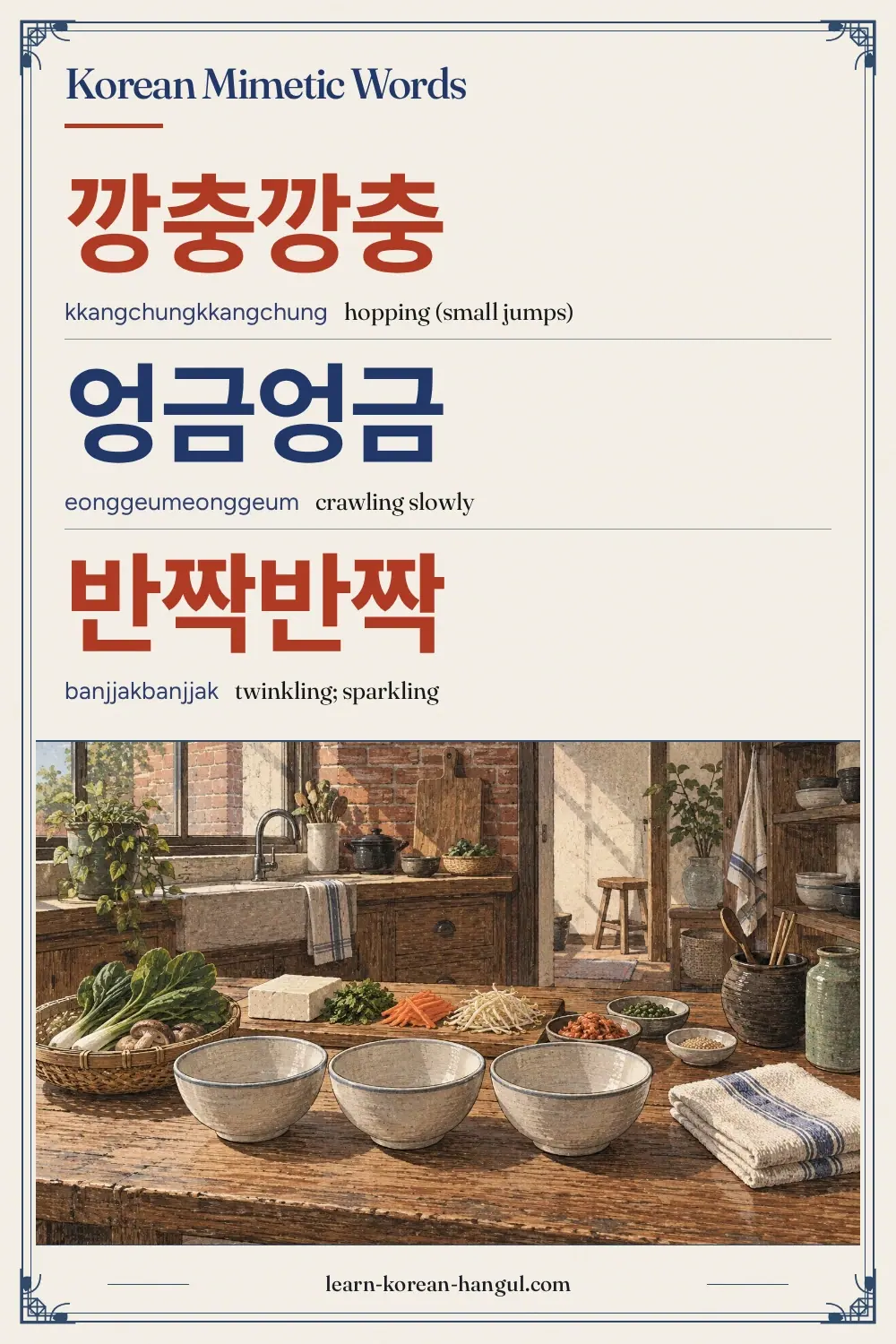
- Topic: Korean mimetic words, which describe manner, shape and feeling. They are called 의태어 (uitaeeo).
- Most are repeated pairs (반짝반짝) and are used before a verb as an adverb.
Korean Mimetic Words at a Glance
English has a few manner words, such as 'zigzag' or 'wobble', and uses many more plain adverbs. Korean has a large and lively set. A mimetic word picks one clear picture and puts it in a repeated syllable pair. 깡충깡충 is a rabbit hopping, 울퉁불퉁 is a lumpy road and 두근두근 is a heart racing. Korean speakers use them in conversation, picture books, comics and songs, so learners meet them early.
Mimetic words belong with the sound words, 의성어 (uiseongeo). The sound words copy what you hear, and the manner words copy how something looks, moves or feels. See Korean onomatopoeia for the sound words. This page sits inside that section, next to Animal sounds in Korean and Korean sound symbolism, which explains the vowel harmony, tense consonants and reduplication behind mimetic words.
| Group | Words | What it covers |
|---|---|---|
| Movement words | 8 | Hopping, crawling, sneaking, striding, spinning |
| Light and shine | 8 | Twinkling, flashing, blinking, glossy, dark |
| Feelings and body states | 8 | Heartbeat, aches, itch, trembling, chills |
| Shape and texture | 8 | Round, spiky, bumpy, smooth, chewy, crispy |
| Pairs that change the feel | 8 | Small and big versions, smiles, colors |
Which Mimetic Words Should You Learn First?
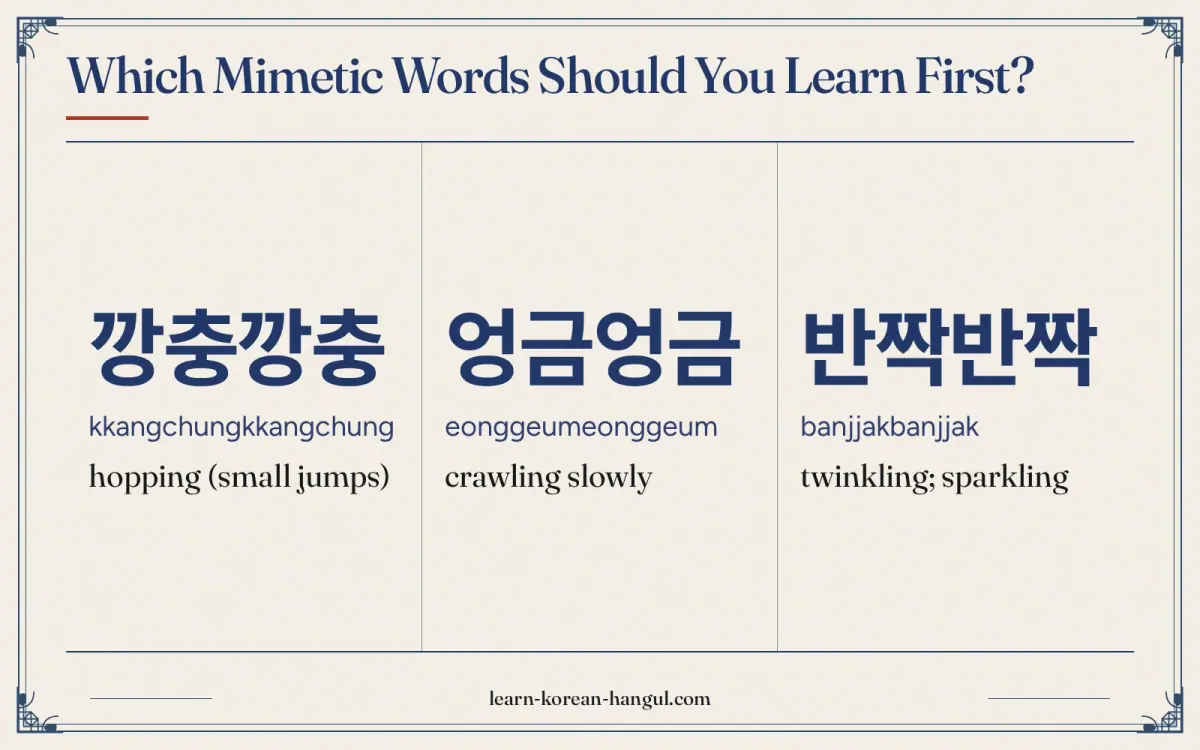
Start with the words you can picture at once: 반짝반짝 for stars, 두근두근 for a nervous heart and 바삭바삭 for crunchy food. Then learn the texture words for food, because they are the ones you will use at a restaurant. Leave the rarer movement words, such as 비틀비틀 and 성큼성큼, until you meet them in a story.
- Say first. 반짝반짝, 두근두근, 바삭바삭, 말랑말랑, 깜깜해요.
- Use often. 울퉁불퉁, 간질간질, 지끈지끈, 쫄깃쫄깃, 깡충깡충.
- Recognise in stories. 엉금엉금, 살금살금, 오싹오싹, 올망졸망, 알록달록.
The scene below is a meadow and a kitchen table, with ten numbered items taken from five groups. Tap a number to hear the word.
Word · 10
- 1
깡충깡충
kkangchungkkangchung
hopping (small jumps)
- 2
엉금엉금
eonggeumeonggeum
crawling slowly
- 3
반짝반짝
banjjakbanjjak
twinkling; sparkling
- 4
번쩍
beonjjeok
a flash (once)
- 5
깜깜
kkamkkam
pitch dark
- 6
간질간질
ganjilganjil
itchy; tickling
- 7
울퉁불퉁
ultungbultung
bumpy; uneven
- 8
말랑말랑
mallangmallang
soft and squishy
- 9
바삭바삭
basakbasak
crispy
- 10
찰랑찰랑
challangchallang
swaying lightly; brimming
Movement Words
Movement words tell you how a body moves, not just that it moves. 걷다 (to walk) is one verb, but 터벅터벅, 성큼성큼 and 살금살금 give three different walks. The words attach to the verb they modify. The verb can be plain, so the mimetic word does the work of an English adverb or a whole phrase.
| No. | Hangul | Revised Romanization | Meaning and note | Example sentence | Audio assetId |
|---|---|---|---|---|---|
| 1 | 깡충깡충 | kkangchungkkangchung | hopping (small jumps). Light vowel ㅏ for a small hop. Bigger partner: 껑충껑충. | 토끼가 깡충깡충 뛰어요. (The rabbit hops along.) | au-pg-vocabulary-word-types-onomatopoeia-mimetic-words-1; example: au-pg-vocabulary-word-types-onomatopoeia-mimetic-words-41 |
| 2 | 엉금엉금 | eonggeumeonggeum | crawling slowly. Slow, heavy movement on all fours, like a turtle. | 거북이가 엉금엉금 기어가요. (The turtle crawls slowly along.) | au-pg-vocabulary-word-types-onomatopoeia-mimetic-words-2; example: au-pg-vocabulary-word-types-onomatopoeia-mimetic-words-42 |
| 3 | 살금살금 | salgeumsalgeum | sneaking; tiptoeing. Moving quietly so nobody notices. | 고양이가 살금살금 걸어요. (The cat walks stealthily.) | au-pg-vocabulary-word-types-onomatopoeia-mimetic-words-3; example: au-pg-vocabulary-word-types-onomatopoeia-mimetic-words-43 |
| 4 | 터벅터벅 | teobeokteobeok | trudging. Heavy, tired steps. | 터벅터벅 걸어서 집에 가요. (I trudge home on foot.) | au-pg-vocabulary-word-types-onomatopoeia-mimetic-words-4; example: au-pg-vocabulary-word-types-onomatopoeia-mimetic-words-44 |
| 5 | 빙글빙글 | binggeulbinggeul | spinning round and round. Turning in circles. | 팽이가 빙글빙글 돌아요. (The top spins round and round.) | au-pg-vocabulary-word-types-onomatopoeia-mimetic-words-5; example: au-pg-vocabulary-word-types-onomatopoeia-mimetic-words-45 |
| 6 | 성큼성큼 | seongkeumseongkeum | striding. Taking long, confident steps. | 아버지가 성큼성큼 걸어요. (My father walks with long strides.) | au-pg-vocabulary-word-types-onomatopoeia-mimetic-words-6; example: au-pg-vocabulary-word-types-onomatopoeia-mimetic-words-46 |
| 7 | 뒤뚱뒤뚱 | dwittungdwittung | waddling. Swaying from side to side, like a penguin or a duck. | 펭귄이 뒤뚱뒤뚱 걸어요. (The penguin waddles.) | au-pg-vocabulary-word-types-onomatopoeia-mimetic-words-7; example: au-pg-vocabulary-word-types-onomatopoeia-mimetic-words-47 |
| 8 | 비틀비틀 | biteulbiteul | staggering. Walking unsteadily. | 피곤해서 비틀비틀 걸어요. (I am tired, so I stagger along.) | au-pg-vocabulary-word-types-onomatopoeia-mimetic-words-8; example: au-pg-vocabulary-word-types-onomatopoeia-mimetic-words-48 |
Example Sentences
All eight sentences follow one frame: subject + 이/가 + mimetic word + verb. The particle is 이 after a consonant and 가 after a vowel (토끼가, 거북이가, 아버지가). The mimetic word sits right before the verb. Play the sentence, say it aloud, then replace the mimetic word with another movement word.
Light and Shine
Light words sort lights by size and strength. 반짝반짝 is a small, clear sparkle. 번쩍번쩍 is bigger and brighter. 깜빡깜빡 is a light going on and off. The single forms 반짝 and 번쩍 describe a flash that happens once. 깜깜 describes the dark, and 깜깜하다 also means to know nothing, as in 소식에 깜깜하다 (to be in the dark about the news).
| No. | Hangul | Revised Romanization | Meaning and note | Example sentence | Audio assetId |
|---|---|---|---|---|---|
| 9 | 반짝반짝 | banjjakbanjjak | twinkling; sparkling. Small, clear lights, like stars. Also a nursery-song word. | 별이 반짝반짝 빛나요. (The stars twinkle.) | au-pg-vocabulary-word-types-onomatopoeia-mimetic-words-9; example: au-pg-vocabulary-word-types-onomatopoeia-mimetic-words-49 |
| 10 | 번쩍번쩍 | beonjjeokbeonjjeok | flashing; gleaming. A bigger, stronger light than 반짝반짝. Dark vowel ㅓ. | 유리창이 번쩍번쩍 빛나요. (The window gleams brightly.) | au-pg-vocabulary-word-types-onomatopoeia-mimetic-words-10; example: au-pg-vocabulary-word-types-onomatopoeia-mimetic-words-50 |
| 11 | 깜빡깜빡 | kkamppakkkamppak | blinking; flickering. On and off, like a signal light or an eye. | 전등이 깜빡깜빡해요. (The light is flickering.) | au-pg-vocabulary-word-types-onomatopoeia-mimetic-words-11; example: au-pg-vocabulary-word-types-onomatopoeia-mimetic-words-51 |
| 12 | 반들반들 | bandeulbandeul | shiny; glossy. A smooth, polished surface. | 구두가 반들반들해요. (The shoes are shiny.) | au-pg-vocabulary-word-types-onomatopoeia-mimetic-words-12; example: au-pg-vocabulary-word-types-onomatopoeia-mimetic-words-52 |
| 13 | 반짝 | banjjak | a glint; a twinkle (once). One flash. Also used for 'bright' eyes. | 눈이 반짝 빛나요. (Her eyes light up.) | au-pg-vocabulary-word-types-onomatopoeia-mimetic-words-13; example: au-pg-vocabulary-word-types-onomatopoeia-mimetic-words-53 |
| 14 | 번쩍 | beonjjeok | a flash (once). One strong flash, such as lightning. | 번개가 번쩍 쳐요. (Lightning flashes.) | au-pg-vocabulary-word-types-onomatopoeia-mimetic-words-14; example: au-pg-vocabulary-word-types-onomatopoeia-mimetic-words-54 |
| 15 | 어른어른 | eoreuneoreun | flickering; shimmering. A faint, wavering light or image. | 불빛이 어른어른해요. (The light is shimmering.) | au-pg-vocabulary-word-types-onomatopoeia-mimetic-words-15; example: au-pg-vocabulary-word-types-onomatopoeia-mimetic-words-55 |
| 16 | 깜깜 | kkamkkam | pitch dark. Used for darkness, and for knowing nothing: 깜깜하다. | 방이 깜깜해요. (The room is pitch dark.) | au-pg-vocabulary-word-types-onomatopoeia-mimetic-words-16; example: au-pg-vocabulary-word-types-onomatopoeia-mimetic-words-56 |
How Do You Say Feelings and Body States in Korean?
Korean uses mimetic words for the body more than English does. You do not say only that your head hurts. You say how: 머리가 지끈지끈 아파요 (a splitting headache), 다리가 욱신욱신 아파요 (a throbbing leg). These words are the first thing to learn for a visit to a pharmacy or a doctor. For the full list of health vocabulary, see health vocabulary.
| No. | Hangul | Revised Romanization | Meaning and note | Example sentence | Audio assetId |
|---|---|---|---|---|---|
| 17 | 두근두근 | dugeundugeun | heart pounding (excited or nervous). Said when your heart beats fast. Verb: 두근거리다. | 가슴이 두근두근해요. (My heart is pounding.) | au-pg-vocabulary-word-types-onomatopoeia-mimetic-words-17; example: au-pg-vocabulary-word-types-onomatopoeia-mimetic-words-57 |
| 18 | 콩닥콩닥 | kongdakkongdak | heart thumping lightly. A lighter, quicker beat than 두근두근. | 가슴이 콩닥콩닥 뛰어요. (My heart thumps.) | au-pg-vocabulary-word-types-onomatopoeia-mimetic-words-18; example: au-pg-vocabulary-word-types-onomatopoeia-mimetic-words-58 |
| 19 | 욱신욱신 | uksinuksin | throbbing ache. A deep, pulsing pain after a bruise or injury. | 다리가 욱신욱신 아파요. (My leg aches and throbs.) | au-pg-vocabulary-word-types-onomatopoeia-mimetic-words-19; example: au-pg-vocabulary-word-types-onomatopoeia-mimetic-words-59 |
| 20 | 지끈지끈 | jikkeunjikkeun | splitting (headache). The usual word for a pounding headache. | 머리가 지끈지끈 아파요. (My head is splitting.) | au-pg-vocabulary-word-types-onomatopoeia-mimetic-words-20; example: au-pg-vocabulary-word-types-onomatopoeia-mimetic-words-60 |
| 21 | 따끔따끔 | ttakkeumttakkeum | stinging; prickling. A sharp small sting, such as a sore throat. | 목이 따끔따끔해요. (My throat stings.) | au-pg-vocabulary-word-types-onomatopoeia-mimetic-words-21; example: au-pg-vocabulary-word-types-onomatopoeia-mimetic-words-61 |
| 22 | 간질간질 | ganjilganjil | itchy; tickling. A light itch or tickle. | 등이 간질간질해요. (My back is itchy.) | au-pg-vocabulary-word-types-onomatopoeia-mimetic-words-22; example: au-pg-vocabulary-word-types-onomatopoeia-mimetic-words-62 |
| 23 | 후들후들 | hudeulhudeul | trembling (legs). Legs shaking from fear or tiredness. | 다리가 후들후들 떨려요. (My legs tremble.) | au-pg-vocabulary-word-types-onomatopoeia-mimetic-words-23; example: au-pg-vocabulary-word-types-onomatopoeia-mimetic-words-63 |
| 24 | 오싹오싹 | ossagossak | shivering (with a chill). A chill down the spine from fear or cold. | 무서워서 오싹오싹해요. (I shiver with fear.) | au-pg-vocabulary-word-types-onomatopoeia-mimetic-words-24; example: au-pg-vocabulary-word-types-onomatopoeia-mimetic-words-64 |
The heartbeat pair needs a note. 두근두근 is a strong beat from excitement or fear. 콩닥콩닥 is lighter and quicker, often from a small thrill. Both can become verbs with -거리다: 두근거리다.
Shape and Texture
Texture words are a favourite of Korean food writers. 바삭바삭 for fried chicken, 쫄깃쫄깃 for rice cake and noodles, 말랑말랑 for jelly and 촉촉 for a moist cake appear on menus, in reviews and in everyday talk. Shape words, such as 둥글둥글 and 뾰족뾰족, describe objects. These words are often used with 하다 to make a descriptive word: 말랑말랑해요 (it is squishy), 바삭바삭해요 (it is crispy).
| No. | Hangul | Revised Romanization | Meaning and note | Example sentence | Audio assetId |
|---|---|---|---|---|---|
| 25 | 둥글둥글 | dunggeuldunggeul | round. Smooth and round in shape. | 돌이 둥글둥글해요. (The stone is round.) | au-pg-vocabulary-word-types-onomatopoeia-mimetic-words-25; example: au-pg-vocabulary-word-types-onomatopoeia-mimetic-words-65 |
| 26 | 뾰족뾰족 | ppyojokppyojok | spiky; pointed. Many sharp points. | 선인장이 뾰족뾰족해요. (The cactus is spiky.) | au-pg-vocabulary-word-types-onomatopoeia-mimetic-words-26; example: au-pg-vocabulary-word-types-onomatopoeia-mimetic-words-66 |
| 27 | 울퉁불퉁 | ultungbultung | bumpy; uneven. A rough surface with lumps and dips. | 길이 울퉁불퉁해요. (The road is bumpy.) | au-pg-vocabulary-word-types-onomatopoeia-mimetic-words-27; example: au-pg-vocabulary-word-types-onomatopoeia-mimetic-words-67 |
| 28 | 매끈매끈 | maekkeunmaekkeun | smooth; sleek. Smooth to touch with no bumps. | 피부가 매끈매끈해요. (The skin is smooth.) | au-pg-vocabulary-word-types-onomatopoeia-mimetic-words-28; example: au-pg-vocabulary-word-types-onomatopoeia-mimetic-words-68 |
| 29 | 보들보들 | bodeulbodeul | soft and silky. Gentle, soft touch, like a baby's skin. | 아기 피부가 보들보들해요. (The baby's skin is soft.) | au-pg-vocabulary-word-types-onomatopoeia-mimetic-words-29; example: au-pg-vocabulary-word-types-onomatopoeia-mimetic-words-69 |
| 30 | 말랑말랑 | mallangmallang | soft and squishy. Springy and soft when you press it. | 젤리가 말랑말랑해요. (The jelly is soft and squishy.) | au-pg-vocabulary-word-types-onomatopoeia-mimetic-words-30; example: au-pg-vocabulary-word-types-onomatopoeia-mimetic-words-70 |
| 31 | 쫄깃쫄깃 | jjolgitjjolgit | chewy. The pleasing chew of rice cake or noodles. | 떡이 쫄깃쫄깃해요. (The rice cake is chewy.) | au-pg-vocabulary-word-types-onomatopoeia-mimetic-words-31; example: au-pg-vocabulary-word-types-onomatopoeia-mimetic-words-71 |
| 32 | 바삭바삭 | basakbasak | crispy. The crunch of fried food or crackers. | 과자가 바삭바삭해요. (The snack is crispy.) | au-pg-vocabulary-word-types-onomatopoeia-mimetic-words-32; example: au-pg-vocabulary-word-types-onomatopoeia-mimetic-words-72 |
Pairs That Change the Feel
Korean can change the feel of a mimetic word by changing its vowels or consonants. A light vowel (ㅏ, ㅗ) makes the picture small, quick or bright, and a dark vowel (ㅓ, ㅜ) makes it big, slow or heavy. Compare 깡충깡충 and 껑충껑충: both are hopping, but the first is a rabbit and the second is a deer. 방글방글 is a baby's sweet smile, and 벙글벙글 is a man's wide grin.
| No. | Hangul | Revised Romanization | Meaning and note | Example sentence | Audio assetId |
|---|---|---|---|---|---|
| 33 | 껑충껑충 | kkeongchungkkeongchung | bounding (big jumps). Dark vowel ㅓ for a big leap. Partner: 깡충깡충. | 사슴이 껑충껑충 뛰어요. (The deer bounds along.) | au-pg-vocabulary-word-types-onomatopoeia-mimetic-words-33; example: au-pg-vocabulary-word-types-onomatopoeia-mimetic-words-73 |
| 34 | 찰랑찰랑 | challangchallang | swaying lightly; brimming. Light movement of hair or water to the rim. | 머리카락이 찰랑찰랑해요. (Her hair sways softly.) | au-pg-vocabulary-word-types-onomatopoeia-mimetic-words-34; example: au-pg-vocabulary-word-types-onomatopoeia-mimetic-words-74 |
| 35 | 출렁출렁 | chulleongchulleong | sloshing; rolling. A bigger, heavier swing than 찰랑찰랑. | 파도가 출렁출렁해요. (The waves roll and slosh.) | au-pg-vocabulary-word-types-onomatopoeia-mimetic-words-35; example: au-pg-vocabulary-word-types-onomatopoeia-mimetic-words-75 |
| 36 | 철렁 | cheolleong | a lurch (heart sinking). One sudden drop, usually in the chest. | 가슴이 철렁해요. (My heart sinks.) | au-pg-vocabulary-word-types-onomatopoeia-mimetic-words-36; example: au-pg-vocabulary-word-types-onomatopoeia-mimetic-words-76 |
| 37 | 방글방글 | banggeulbanggeul | smiling sweetly. A soft, happy smile. Light vowels. | 아기가 방글방글 웃어요. (The baby smiles sweetly.) | au-pg-vocabulary-word-types-onomatopoeia-mimetic-words-37; example: au-pg-vocabulary-word-types-onomatopoeia-mimetic-words-77 |
| 38 | 벙글벙글 | beonggeulbeonggeul | grinning broadly. A wide grin. Dark vowels; partner of 방글방글. | 아저씨가 벙글벙글 웃어요. (The man grins broadly.) | au-pg-vocabulary-word-types-onomatopoeia-mimetic-words-38; example: au-pg-vocabulary-word-types-onomatopoeia-mimetic-words-78 |
| 39 | 알록달록 | allokdallok | colorful; multicolored. Lots of bright colors in small patches. | 알록달록한 옷을 입어요. (I wear colorful clothes.) | au-pg-vocabulary-word-types-onomatopoeia-mimetic-words-39; example: au-pg-vocabulary-word-types-onomatopoeia-mimetic-words-79 |
| 40 | 올망졸망 | olmangjolmang | small ones together. Many small things of different sizes close together. | 아이들이 올망졸망 모여요. (The little children gather together.) | au-pg-vocabulary-word-types-onomatopoeia-mimetic-words-40; example: au-pg-vocabulary-word-types-onomatopoeia-mimetic-words-80 |
| Light, small, quick | Dark, big, heavy | The difference |
|---|---|---|
| 깡충깡충 (kkangchungkkangchung) | 껑충껑충 (kkeongchungkkeongchung) | small hop / big leap |
| 반짝반짝 (banjjakbanjjak) | 번쩍번쩍 (beonjjeokbeonjjeok) | gentle sparkle / strong flash |
| 방글방글 (banggeulbanggeul) | 벙글벙글 (beonggeulbeonggeul) | sweet smile / broad grin |
| 찰랑찰랑 (challangchallang) | 출렁출렁 (chulleongchulleong) | light sway / heavy roll |
| 말랑말랑 (mallangmallang) | 물렁물렁 (mulleongmulleong) | springy soft / mushy soft |
This pattern is called vowel harmony in sound words. Plain, tense and aspirated consonants add a second layer. A tense or aspirated start makes the picture stronger than a plain one: 빙빙, 삥삥 and 핑핑 all describe spinning, from plain to strongest.
How Do You Use Mimetic Words in a Sentence?
Use a mimetic word the same way you use an adverb: put it before the verb. 별이 반짝반짝 빛나요 means the stars twinkle. To describe a noun, add 하다 and use a modifier form: 알록달록한 옷 (colorful clothes), 말랑말랑한 젤리 (squishy jelly). To make a verb that repeats an action, add -거리다 or -대다: 반짝거리다 (to twinkle), 두근거리다 (to pound), 깜빡거리다 (to blink). More adverb patterns are in Korean mimetic words as adverbs.
| Pattern | Example | Meaning |
|---|---|---|
| Mimetic word + verb | 반짝반짝 빛나요 | it twinkles |
| Mimetic word + 하다 | 말랑말랑해요 | it is squishy |
| Mimetic word + 한 + noun | 알록달록한 옷 | colorful clothes |
| Mimetic stem + 거리다 | 두근거리다 | to pound (heart) |
Use mimetic words freely in speech and stories. In formal reports and exams, speakers choose plainer words, such as 빛나다 (to shine) alone or 아프다 (to hurt) alone.
How Do You Pronounce These Words?
Mimetic words are a drill in tense consonants and repeated syllables. The Standard Pronunciation Rules (표준 발음법) of the National Institute of Korean Language (국립국어원) are the reference, and the romanization follows the Revised Romanization of Korean.
- Tense consonants. Say ㄲ, ㄸ, ㅃ, ㅉ with a tight throat and no puff of air: 깜빡깜빡, 따끔따끔, 쫄깃쫄깃.
- Tensing after a final stop. A plain consonant after a final ㄱ becomes tense (Article 23): 바삭바삭 is said [바삭빠삭] and 욱신욱신 is said [욱씨눅씬]. Romanization does not show tensing caused by a neighbouring sound, so you see basakbasak.
- Final ㅅ. At the end of a syllable ㅅ sounds like ㄷ: 쫄깃쫄깃 is [쫄긷쫄긷].
- Moving forward. A final consonant moves to a silent ㅇ in the next syllable: 오싹오싹 is [오싸고싹], and in RR it is ossagossak.
Audio and Slow Playback
Each word and sentence has its own clip. The clips below replay five tricky words slowly. Play one, repeat it, then play it again and compare.
What Mistakes Do Learners Make with Mimetic Words?
Five mistakes come up often.
- Using a mimetic word as a noun. 반짝반짝 is not 'a star'. Say 별이 반짝반짝 빛나요, not 반짝반짝이 있어요.
- Forgetting 하다 or a modifier. Write 알록달록한 옷, not 알록달록 옷, when the word describes a noun.
- Mixing up the light and dark partners. 깡충깡충 and 껑충껑충 are not interchangeable. The vowel tells the size.
- Dropping the doubled half. 반짝 is one flash, and 반짝반짝 is a repeated sparkle. The meaning changes.
- Overusing them in formal writing. Choose a plain verb in reports and exams.
The vowel pair is the hardest. If you are unsure, use the lighter form for small, quick, sweet things and the darker form for big, slow, heavy ones.
Practice: Flashcards and Worksheet
Run the deck in recognition mode until each word gives its picture, then switch to listening mode and take the quiz. The deck holds all 40 words with audio, and your progress stays in your browser. The vocabulary flashcard decks page lists the other decks.
Practice · 85
- 01깡충깡충
Show answer
headword 1: hopping (small jumps)
- 02엉금엉금
Show answer
headword 2: crawling slowly
- 03살금살금
Show answer
headword 3: sneaking; tiptoeing
- 04터벅터벅
Show answer
headword 4: trudging
- 05빙글빙글
Show answer
headword 5: spinning round and round
- 06성큼성큼
Show answer
headword 6: striding
- 07뒤뚱뒤뚱
Show answer
headword 7: waddling
- 08비틀비틀
Show answer
headword 8: staggering
- 09반짝반짝
Show answer
headword 9: twinkling; sparkling
- 10번쩍번쩍
Show answer
headword 10: flashing; gleaming
- 11깜빡깜빡
Show answer
headword 11: blinking; flickering
- 12반들반들
Show answer
headword 12: shiny; glossy
- 13반짝
Show answer
headword 13: a glint; a twinkle (once)
- 14번쩍
Show answer
headword 14: a flash (once)
- 15어른어른
Show answer
headword 15: flickering; shimmering
- 16깜깜
Show answer
headword 16: pitch dark
- 17두근두근
Show answer
headword 17: heart pounding (excited or nervous)
- 18콩닥콩닥
Show answer
headword 18: heart thumping lightly
- 19욱신욱신
Show answer
headword 19: throbbing ache
- 20지끈지끈
Show answer
headword 20: splitting (headache)
- 21따끔따끔
Show answer
headword 21: stinging; prickling
- 22간질간질
Show answer
headword 22: itchy; tickling
- 23후들후들
Show answer
headword 23: trembling (legs)
- 24오싹오싹
Show answer
headword 24: shivering (with a chill)
- 25둥글둥글
Show answer
headword 25: round
- 26뾰족뾰족
Show answer
headword 26: spiky; pointed
- 27울퉁불퉁
Show answer
headword 27: bumpy; uneven
- 28매끈매끈
Show answer
headword 28: smooth; sleek
- 29보들보들
Show answer
headword 29: soft and silky
- 30말랑말랑
Show answer
headword 30: soft and squishy
- 31쫄깃쫄깃
Show answer
headword 31: chewy
- 32바삭바삭
Show answer
headword 32: crispy
- 33껑충껑충
Show answer
headword 33: bounding (big jumps)
- 34찰랑찰랑
Show answer
headword 34: swaying lightly; brimming
- 35출렁출렁
Show answer
headword 35: sloshing; rolling
- 36철렁
Show answer
headword 36: a lurch (heart sinking)
- 37방글방글
Show answer
headword 37: smiling sweetly
- 38벙글벙글
Show answer
headword 38: grinning broadly
- 39알록달록
Show answer
headword 39: colorful; multicolored
- 40올망졸망
Show answer
headword 40: small ones together
- 41토끼가 깡충깡충 뛰어요.
Show answer
example sentence for 깡충깡충
- 42거북이가 엉금엉금 기어가요.
Show answer
example sentence for 엉금엉금
- 43고양이가 살금살금 걸어요.
Show answer
example sentence for 살금살금
- 44터벅터벅 걸어서 집에 가요.
Show answer
example sentence for 터벅터벅
- 45팽이가 빙글빙글 돌아요.
Show answer
example sentence for 빙글빙글
- 46아버지가 성큼성큼 걸어요.
Show answer
example sentence for 성큼성큼
- 47펭귄이 뒤뚱뒤뚱 걸어요.
Show answer
example sentence for 뒤뚱뒤뚱
- 48피곤해서 비틀비틀 걸어요.
Show answer
example sentence for 비틀비틀
- 49별이 반짝반짝 빛나요.
Show answer
example sentence for 반짝반짝
- 50유리창이 번쩍번쩍 빛나요.
Show answer
example sentence for 번쩍번쩍
- 51전등이 깜빡깜빡해요.
Show answer
example sentence for 깜빡깜빡
- 52구두가 반들반들해요.
Show answer
example sentence for 반들반들
- 53눈이 반짝 빛나요.
Show answer
example sentence for 반짝
- 54번개가 번쩍 쳐요.
Show answer
example sentence for 번쩍
- 55불빛이 어른어른해요.
Show answer
example sentence for 어른어른
- 56방이 깜깜해요.
Show answer
example sentence for 깜깜
- 57가슴이 두근두근해요.
Show answer
example sentence for 두근두근
- 58가슴이 콩닥콩닥 뛰어요.
Show answer
example sentence for 콩닥콩닥
- 59다리가 욱신욱신 아파요.
Show answer
example sentence for 욱신욱신
- 60머리가 지끈지끈 아파요.
Show answer
example sentence for 지끈지끈
- 61목이 따끔따끔해요.
Show answer
example sentence for 따끔따끔
- 62등이 간질간질해요.
Show answer
example sentence for 간질간질
- 63다리가 후들후들 떨려요.
Show answer
example sentence for 후들후들
- 64무서워서 오싹오싹해요.
Show answer
example sentence for 오싹오싹
- 65돌이 둥글둥글해요.
Show answer
example sentence for 둥글둥글
- 66선인장이 뾰족뾰족해요.
Show answer
example sentence for 뾰족뾰족
- 67길이 울퉁불퉁해요.
Show answer
example sentence for 울퉁불퉁
- 68피부가 매끈매끈해요.
Show answer
example sentence for 매끈매끈
- 69아기 피부가 보들보들해요.
Show answer
example sentence for 보들보들
- 70젤리가 말랑말랑해요.
Show answer
example sentence for 말랑말랑
- 71떡이 쫄깃쫄깃해요.
Show answer
example sentence for 쫄깃쫄깃
- 72과자가 바삭바삭해요.
Show answer
example sentence for 바삭바삭
- 73사슴이 껑충껑충 뛰어요.
Show answer
example sentence for 껑충껑충
- 74머리카락이 찰랑찰랑해요.
Show answer
example sentence for 찰랑찰랑
- 75파도가 출렁출렁해요.
Show answer
example sentence for 출렁출렁
- 76가슴이 철렁해요.
Show answer
example sentence for 철렁
- 77아기가 방글방글 웃어요.
Show answer
example sentence for 방글방글
- 78아저씨가 벙글벙글 웃어요.
Show answer
example sentence for 벙글벙글
- 79알록달록한 옷을 입어요.
Show answer
example sentence for 알록달록
- 80아이들이 올망졸망 모여요.
Show answer
example sentence for 올망졸망
- 81쫄깃쫄깃
Show answer
slow playback: 쫄깃쫄깃
- 82바삭바삭
Show answer
slow playback: 바삭바삭
- 83울퉁불퉁
Show answer
slow playback: 울퉁불퉁
- 84오싹오싹
Show answer
slow playback: 오싹오싹
- 85욱신욱신
Show answer
slow playback: 욱신욱신
Practice · 5
What does 반짝반짝 (banjjakbanjjak) mean?
Show answer
twinkling
반짝반짝 means twinkling. Example: 별이 반짝반짝 빛나요. (The stars twinkle.)
Which word describes a heart pounding?
Show answer
두근두근
두근두근 is a pounding heart. Example: 가슴이 두근두근해요. (My heart is pounding.)
Which word is the bigger, heavier version of 깡충깡충?
Show answer
껑충껑충
껑충껑충 has the dark vowel ㅓ and means bounding with big leaps.
Which word means 'crispy'?
Show answer
바삭바삭
바삭바삭 is crispy. 쫄깃쫄깃 is chewy. Example: 과자가 바삭바삭해요. (The snack is crispy.)
How do you make 알록달록 describe a noun?
Show answer
알록달록한 옷
Add 하다 in its modifier form: 알록달록한 옷 (colorful clothes).
Korean Mimetic Words Worksheet (PDF)
A printable worksheet for these words (word list, matching, writing practice, fill-in-the-blank exercises and answer key) is available in A4 and US Letter from the download card on this page. For practice, draw a rabbit, a star, a rice cake and a road, then write the matching mimetic word beside each.
Where to Go Next
Practise the adverb patterns on Korean mimetic words as adverbs. For the sound words, return to Korean onomatopoeia, and for animal calls go to Animal sounds in Korean.
Frequently Asked Questions
What Are Korean Mimetic Words?
Mimetic words, called 의태어 (uitaeeo), describe how something looks, moves or feels, such as 반짝반짝 (twinkling) and 두근두근 (heart pounding). They differ from sound words, 의성어, which copy a sound, such as 멍멍 (woof). Both kinds are used as adverbs before a verb.
How Do You Say Twinkling and Heart Pounding in Korean?
Twinkling is 반짝반짝 (banjjakbanjjak): 별이 반짝반짝 빛나요 means 'The stars twinkle'. A pounding heart is 두근두근 (dugeundugeun): 가슴이 두근두근해요 means 'My heart is pounding'. Both words repeat a two-syllable unit.
What Is the Difference between 깡충깡충 and 껑충껑충?
Both mean hopping. 깡충깡충 uses the light vowel ㅏ and shows small, quick hops, like a rabbit. 껑충껑충 uses the dark vowel ㅓ and shows big, long leaps, like a deer. Korean changes the vowel to change the size and feel.
How Do I Use a Mimetic Word with a Noun?
Add 하다 in its modifier form. 알록달록한 옷 means 'colorful clothes' and 말랑말랑한 젤리 means 'squishy jelly'. Without 한 the word is only an adverb and goes before a verb.
Do I Need to Learn Mimetic Words to Speak Korean?
You can make yourself understood without them, but you will sound plainer. Native speakers use them constantly for food, pain, weather and feelings. Learn the 10 most common first, then add more as you meet them.
Is the Romanization on This Page Official?
It follows the Revised Romanization of Korean, which South Korea adopted on 7 July 2000 and whose rules the National Institute of Korean Language (국립국어원) publishes. It is a learning aid and does not mark every sound change, so rely on the Hangul and the audio.