
The Korean negative copula 아니에요 not to be means "is not" or "am not". It is the polite present form of 아니다 and the negative partner of 이다. It follows a noun marked with 이 or 가: 저는 학생이 아니에요 means "I am not a student."
What you'll learn
- Say that someone or something is not a noun, using noun + 이/가 + 아니에요.
- Choose between 이 and 가 by checking the last sound of the noun.
- Tell 아니에요, 아니요 and 안 + verb apart.
- Use 아니에요 as a polite reply to thanks.
Prerequisites: you know the positive pattern in 이에요/예요 and the existence words in 있어요/없어요. Estimated time: 25 minutes.
What Does 아니에요 Not to Be Mean?

아니에요 means "it is not" and it is the everyday polite way to say that something is not a certain noun. Korean has two partner words for "to be": 이다 for "is" and 아니다 for "is not". Both follow a noun, and both change their ending by politeness. In the polite style, 이다 becomes 이에요 or 예요, and 아니다 becomes 아니에요.
The words differ in one visible way. The positive word attaches to the noun without a space (학생이에요), while the negative word is a separate word that follows the noun and its particle (학생이 아니에요).
| Meaning | Positive | Negative |
|---|---|---|
| I am a student. | 저는 학생이에요. | 저는 학생이 아니에요. |
| This is a book. | 이것은 책이에요. | 이것은 책이 아니에요. |
A First Look: Two Annotated Examples
Example 1. 저는 학생이 아니에요. (jeoneun haksaengi anieyo.) means "I am not a student." The parts are 저는 (as for me), 학생 (student), 이 (complement particle), and 아니에요 (am not). Say it as [저는 학쌩이 아니에요]: the ㅅ in 생 becomes tense after the ㄱ in 학.
Example 2. 이것은 제 책이 아니에요. (igeoseun je chaegi anieyo.) means "This is not my book." The parts are 이것은 (as for this), 제 (my), 책 (book), 이 (complement particle) and 아니에요 (is not). Say 책이 as [채기].
Both sentences have the frame topic + noun + 이/가 + 아니에요. The next section explains how to choose 이 or 가.
How Does 아니에요 Work?

아니에요 works by taking a noun marked with 이 or 가 in front of it. The noun is the complement (보어), the thing that completes the meaning of "is not". After a consonant use 이, and after a vowel use 가. These are the same particles that mark a subject, but here they mark the complement.
| Last sound of the noun | Particle | Example | Meaning |
|---|---|---|---|
| Consonant | 이 | 학생이 아니에요 | am not a student |
| Consonant | 이 | 책이 아니에요 [채기] | is not a book |
| Vowel | 가 | 의사가 아니에요 | am not a doctor |
| Vowel | 가 | 친구가 아니에요 | is not a friend |
Add the topic particle to the person or thing you are talking about, then the frame is complete: 저는 의사가 아니에요 means "I am not a doctor."
Compare the positive version, 저는 학생이에요, to see the difference in structure. The positive version attaches 이에요 to the noun, and the negative version separates 아니에요 with a space and puts 이 on the noun.
Korean builds three positive and negative pairs for the three basic predicates, and 아니에요 is the pair of the first:
| Predicate type | Positive | Negative |
|---|---|---|
| Noun ("is a ...") | 학생이에요 | 학생이 아니에요 |
| Existence | 있어요 (there is) | 없어요 (there is not) |
| Verb or descriptive verb | 가요 (go) | 안 가요 (do not go) |
The word ends the sentence, like any Korean predicate. This ordering matches the pattern in the Korean basic sentence patterns lesson. For the particle choice itself, see the lesson on the subject particle 이/가.
What Are the Casual and Formal Forms?
아니에요 has a casual form, 아니야, and a formal form, 아닙니다. Use the polite 아니에요 with strangers and in daily talk, 아니야 with close friends, and 아닙니다 in announcements and formal speech.
| Style | Form | Example |
|---|---|---|
| Casual | 아니야 | 나는 학생이 아니야. |
| Polite | 아니에요 | 저는 학생이 아니에요. |
| Formal | 아닙니다 | 저는 학생이 아닙니다. |
The three styles use the same stem 아니, and only the ending changes. The casual sentence also swaps the humble 저 for plain 나, because 저 sounds odd with 반말. With the form clear, one worked example walks through building a sentence.
Worked Example: Building 저는 학생이 아니에요
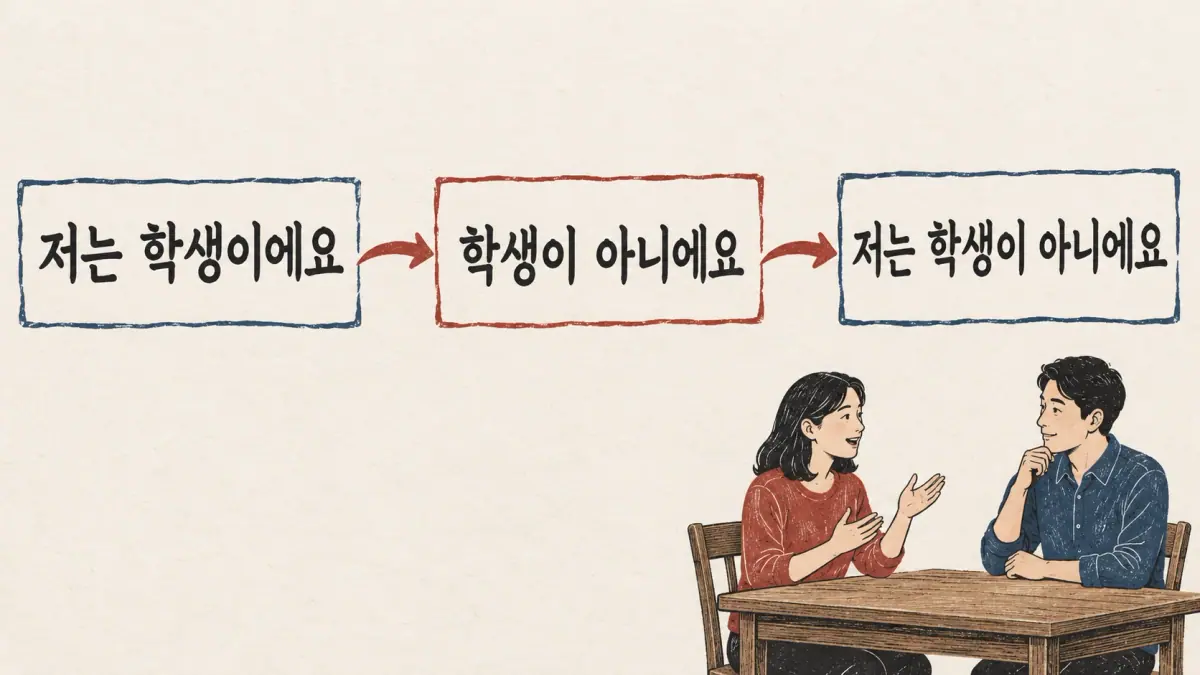
Building 저는 학생이 아니에요 from the positive sentence takes five steps, and each step ends with a check.
- Start with the positive sentence. 저는 학생이에요 (I am a student). Check: it ends in 이에요.
- Detach the noun. Take out 학생. Check: the noun stands alone.
- Pick 이 or 가. 학생 ends in the consonant ㅇ, so use 이: 학생이. Check: a consonant means 이.
- Add 아니에요 after a space. 학생이 아니에요. Check: a space separates the particle and the verb.
- Add the topic. 저는 학생이 아니에요. Check: the topic comes first and the predicate last.
You will know it worked when you can change the noun and keep the frame: 저는 의사가 아니에요 (I am not a doctor), because 의사 ends in a vowel and takes 가.
The sentence says what you are not. It does not say what you are, so a follow-up often adds the true answer: 저는 학생이 아니에요. 선생님이에요 (I am not a student. I am a teacher). Next we compare 아니에요 with two words it is often confused with.
How Is 아니에요 Different from 아니요 and 안?

아니에요, 아니요 and 안 all express a negative, but each has a separate job. 아니에요 says "is not" for a noun, 아니요 says "no" as an answer, and 안 negates a verb or a descriptive verb.
| Word | Meaning | Used with | Example |
|---|---|---|---|
| 아니에요 | is not | a noun + 이/가 | 학생이 아니에요 |
| 아니요 | no | stands alone as a reply | 아니요, 학생이 아니에요. |
| 안 | not | before a verb or descriptive verb | 안 가요, 안 예뻐요 |
The rule of thumb has two parts. If the thing you want to negate is a noun ("I am not a student"), use 아니에요. If it is an action or quality ("I am not going", "it is not pretty"), put 안 in front of the verb or descriptive verb. The two cannot combine, so 학생 안이에요 does not exist.
Answering a yes-or-no question uses both. When someone asks 학생이에요? (Are you a student?), the full negative answer is 아니요, 학생이 아니에요. The short answer 아니요 alone is also fine. The lesson on 안 negation in Korean covers the verb pattern, and the lesson on answering yes or no questions in Korean covers replies.
When Does 아니에요 Mean More than "Is Not"?

아니에요 also works as a polite "not at all" in reply to thanks, apologies and compliments. The sentence is short and fixed, and the literal meaning is "it is not (a thing to thank me for)".
- After thanks: 감사합니다. 아니에요. means "Thank you." "Not at all."
- After an apology: 죄송합니다. 아니에요. means "I am sorry." "No, it is fine."
- After a compliment: a modest 아니에요 means "No, not really."
Four more variations are worth knowing:
- Contrast with 은/는. The complement can take the topic particle for contrast: 저는 학생은 아니에요 means "I am not a student (but I am something else, or something close)". Use it to correct an assumption.
- Dropping 이/가 in speech. In casual speech Koreans often drop the particle: 저는 학생 아니에요. Both forms are acceptable, but learners should write the full form first.
- Not X but Y. Use the connecting form 아니라 to correct: 학생이 아니라 선생님이에요 means "I am not a student but a teacher". The stem 아니 stays the same and only the ending changes.
- Asking with 아니에요. Raise your voice at the end to ask: 학생이 아니에요? means "Aren't you a student?" The answer follows the fact, not the English habit. If you are not a student, you say 네, 학생이 아니에요 (yes, I am not a student), where 네 agrees with the negative statement.
A fair limit: this lesson covers the present polite form. The past form 아니었어요 (was not) and the negative of other forms (아닐 거예요, probably is not) are taught with tenses. The lesson on the Korean past tense of 이다 is a good next stop once you are comfortable here.
Common Mistakes with 아니에요

Most mistakes come from copying English or from mixing up the three negative words. Each mistake below shows what learners assume, what is true and why.
Adding 안 to 이에요. Learners often assume 안 is the general "not" and write 학생 안이에요; actually 안 only precedes verbs and descriptive verbs, and the negative of a noun statement is 아니에요, so write 학생이 아니에요.
Using 을/를 for the complement. Learners often assume the noun before 아니에요 is an object and write 학생을 아니에요; actually it is a complement, so it takes 이/가: 학생이 아니에요.
Mixing up 아니요 and 아니에요. Learners often use 아니에요 where only the answer "no" fits, or write 아니요 where "is not" is needed; actually 아니요 is a stand-alone "no" and 아니에요 needs a noun before it.
Attaching 아니에요 to the noun. Learners often copy the positive pattern and write 학생아니에요 with no space; actually 아니에요 is a separate word, so leave a space after the particle.
Dropping the complement entirely. Learners often say 아니에요 alone in a statement about identity and leave the listener guessing; actually the noun is needed unless the context supplies it. Say 저는 학생이 아니에요 at first.
All five errors have one cause: the learner treats 아니에요 as a free-floating "not". It is a predicate that needs a noun partner.
Practice: Choose, Fix, Translate and Write

Try these before reading the answers.
Exercise 1. Choose 이 or 가.
- 저는 선생님___ 아니에요. (I am not a teacher.)
- 이것은 가방___ 아니에요. (This is not a bag.)
- 저는 의사___ 아니에요. (I am not a doctor.)
Exercise 2. Fix the error.
저는 학생을 아니에요. (Meaning: I am not a student.)
Exercise 3. Translate into Korean. "This is not my bag." Use 제 for "my".
Exercise 4. Write your own. Use the frame noun + 이/가 + 아니에요 with a job or a thing you know.
Sentence
I am not a student.
Show answer
저는 학생이 아니에요
Practice · 3
Which particle goes before 아니에요 after 의사?
Show answer
가
Which word means 'no' as a reply?
Show answer
아니요
Which sentence is correct?
Show answer
학생이 아니에요
Answers.
- Exercise 1: item 1 is 선생님이 (the word ends in ㅁ, a consonant); item 2 is 가방이 (ends in ㅇ); item 3 is 의사가 (ends in a vowel).
- Exercise 2: 저는 학생이 아니에요. The complement takes 이/가, never 을/를.
- Exercise 3: 이것은 제 가방이 아니에요.
- Exercise 4: answers vary. A correct model is 저는 요리사가 아니에요 (I am not a cook).
Where to Go after 아니에요 Not to Be
After 아니에요 not to be, learn how a Korean speaker can leave out the subject in the lesson on dropping the subject in Korean, because 학생이에요 can mean "I am", "you are" or "she is". Then see the verb negative in 안 negation in Korean. For the positive partner, return to 이에요/예요, and for reply patterns read answering yes or no questions in Korean. The other sentence patterns are in Korean sentence structure.
This lesson does not cover the past and future forms or the negative of verbs in full. Those topics have their own lessons.
In short, 아니에요 not to be says "is not" for a noun, with the noun marked by 이 after a consonant or 가 after a vowel, and it never combines with 안.
Frequently Asked Questions
What does 아니에요 mean? 아니에요 means 'it is not', 'I am not' or 'that is not', depending on the context. It is the polite present form of 아니다, the negative of 이다. In conversation it also works as a polite 'no' answer, or as 'not at all' when someone thanks you or compliments you.
What is the difference between 아니에요 and 아니요? 아니요 means 'no' and stands alone as an answer to a question. 아니에요 means 'is not' and negates a noun, so it takes a complement: 학생이 아니에요 (I am not a student). Learners often mix up the spellings because the two words sound close and both start 아니.
When do I use 안 instead of 아니에요? Use 안 before verbs and descriptive verbs: 안 가요 (I do not go), 안 예뻐요 (it is not pretty). Use 아니에요 after a noun to say the noun is not something: 학생이 아니에요. The two never combine, so 학생 안이에요 is wrong.
Why does 아니에요 take 이 or 가 and not 을 or 를? The word before 아니에요 is a complement, not an object. Korean marks the complement with 이/가, the same particles as a subject, because 아니다 describes what something is not instead of acting on it. Writing 학생을 아니에요 is a mistake. Write 학생이 아니에요.
Is 아니에요 polite? Yes. The ending 에요 makes it the polite informal style, suitable for strangers, coworkers and elders in everyday talk. For the casual style with friends use 아니야. For formal speech, such as announcements, use 아닙니다. The lesson on speech levels explains when to choose each.