What you'll learn
- Recognise the seven causative suffixes and the verb pairs they build.
- Mark the causer and the causee with the right particles.
- Turn a plain sentence into a causative sentence in four steps.
- Separate suffix causatives from -게 하다 and -시키다.
- Fix the five most common mistakes.
Before you start: you should know the polite ending -아요/어요, the particles 이/가, 을/를 and 에게, and the idea of a passive verb. If the passive is new, skim the passive suffixes 이 히 리 기 lesson first. Audio plays only when you press a button.
What Do the Causative Suffixes 이 히 리 기 우 구 추 Mean?
A causative sentence says that one person makes or lets another person (or thing) do something. In English, "Mom feeds the baby" is a causative idea: Mom causes the baby to eat. Korean can build this idea into the verb itself with a suffix, so 먹다 ("eat") turns into a different verb, 먹이다 ("feed").
Two new roles appear in a causative sentence:
- The causer is the one who makes it happen. The causer is the subject and takes 이/가.
- The causee is the one who is made to act. The causee takes 에게 or 을/를, as the next sections show.
The new verb is a normal dictionary verb, and it is conjugated like any other regular verb: 먹이다 gives 먹여요 (present) and 먹였어요 (past).
A First Example
- 엄마가 아기에게 밥을 먹여요. (eommaga agiege babeul meogyeoyo.) [엄마가 아기에게 바블 머겨요] = "Mom feeds the baby."
- 아이를 재워요. (aireul jaewoyo.) [아이를 재워요] = "I put the child to sleep."
In the first sentence, 엄마가 is the causer, 아기에게 is the causee, 밥을 is the object and 먹여요 is 먹이다 in the polite present. The baby does the eating, but Mom causes it. In the second sentence, the speaker is the causer and is not named. 아이를 is the causee, and 재워요 is 재우다 in the polite present. The next section shows how the pairs are built.
How Do the Causative Suffixes 이 히 리 기 우 구 추 Work?
The causative suffixes 이 히 리 기 우 구 추 work by replacing the base verb with a related causative verb. No rule predicts which of the seven suffixes a verb takes, so learn each pair as a unit. The table lists sixteen common pairs.
| Suffix | Base verb | Causative verb | Polite present | Meaning |
|---|---|---|---|---|
| 이 | 먹다 (eat) | 먹이다 | 먹여요 | feed |
| 히 | 입다 (wear) | 입히다 | 입혀요 | dress someone |
| 히 | 앉다 (sit) | 앉히다 | 앉혀요 | seat someone |
| 히 | 눕다 (lie down) | 눕히다 | 눕혀요 | lay someone down |
| 리 | 울다 (cry) | 울리다 | 울려요 | make cry |
| 리 | 살다 (live) | 살리다 | 살려요 | save, bring to life |
| 리 | 알다 (know) | 알리다 | 알려요 | let know, inform |
| 기 | 웃다 (laugh) | 웃기다 | 웃겨요 | make laugh |
| 기 | 남다 (remain) | 남기다 | 남겨요 | leave behind |
| 기 | 벗다 (take off) | 벗기다 | 벗겨요 | undress someone |
| 우 | 자다 (sleep) | 재우다 | 재워요 | put to sleep |
| 우 | 깨다 (wake up) | 깨우다 | 깨워요 | wake someone |
| 우 | 타다 (ride) | 태우다 | 태워요 | give a ride |
| 우 | 비다 (be empty) | 비우다 | 비워요 | empty |
| 추 | 낮다 (be low) | 낮추다 | 낮춰요 | lower |
| 추 | 늦다 (be late) | 늦추다 | 늦춰요 | delay, put off |
The table shows two points beyond the suffix list. First, 우 often shows a vowel change in the stem, as in 자다 to 재우다 and 타다 to 태우다. Second, some base words are adjectives: 낮다 ("be low") gives 낮추다 ("lower"). The suffix 구 is rare (달다 "get hot" gives 달구다 "heat up"), so this lesson concentrates on the common pairs.
The Causee Particle
A causative sentence has up to three noun phrases, and the particle on the causee depends on the base verb.
- The base verb takes an object. The causee takes 에게 (or 한테 in casual speech), and the object keeps 을/를: 엄마가 아이에게 옷을 입혀요 (eommaga aiege oseul ipyeoyo) [엄마가 아이에게 오슬 이펴요], "Mom dresses the child."
- The base verb has no object. The causee takes 을/를: 엄마가 아기를 재워요, "Mom puts the baby to sleep." Here 자다 ("sleep") has no object, so the causee takes the object slot.
The second clip follows the second pattern: 택시 기사가 손님을 태워요 (taeksi gisaga sonnimeul taewoyo) [택씨 기사가 손니믈 태워요] means "The taxi driver gives the customer a ride." The base verb 타다 ("ride") is used here without a place object, so 손님 takes 을/를. This is a simplified rule, but it covers most sentences you will meet. The next section builds one full sentence.
Worked Example: from a Plain Sentence to a Causative
The causative suffixes 이 히 리 기 우 구 추 turn a plain sentence into a causative one in four steps. Follow the sentence "Mom feeds the baby."
- Start with the plain sentence. 아기가 밥을 먹어요. (agiga babeul meogeoyo.) [아기가 바블 머거요] = "The baby eats rice."
- Add the causer. Someone new makes it happen: 엄마. The causer is the new subject and takes 이/가: 엄마가.
- Move the old subject to the causee slot. The baby had 이/가. The sentence already has an object (밥을), so the baby takes 에게: 아기에게.
- Swap in the causative verb. 먹다 becomes 먹이다, and the polite present is 먹여요.
Result: 엄마가 아기에게 밥을 먹여요.
Sentence
You know it worked when the sentence has a new subject, the old subject is marked with 에게 or 을/를, and the verb is a real causative. For a verb with no object, step 3 uses 을/를: 아기가 자요 ("The baby sleeps") becomes 엄마가 아기를 재워요 ("Mom puts the baby to sleep"). The next section shows how this differs from the other causative patterns.
How Do the Suffix Causatives Differ from -게 하다 and -시키다?
Korean has three common ways to build a causative. The suffix pairs are a closed list, -게 하다 works on almost any verb or adjective, and -시키다 attaches to nouns.
| Point | Suffix causative | -게 하다 | -시키다 |
|---|---|---|---|
| Attaches to | specific verbs and adjectives | any verb or adjective stem | nouns |
| Example | 엄마가 아기에게 밥을 먹여요. | 엄마가 아기에게 밥을 먹게 해요. | 부모님이 아이에게 공부를 시켜요. |
| Meaning of example | Mom feeds the baby. | Mom makes or lets the baby eat. | The parents make the child study. |
| Typical feel | direct, hands-on | indirect, the causee acts by themselves | a request or order given to someone |
The line between 먹여요 and 먹게 해요 is a tendency that grammar books describe, not a strict rule. With 먹여요, the causer usually does the feeding. With 먹게 해요, the causee does the eating. The page on causative -게 하다 teaches the productive pattern, and the page on -시키다 causative teaches the noun pattern.
- 코미디언이 사람들을 웃겨요. (komidieoni saramdeureul utgyeoyo.) [코미디어니 사람드를 욷껴요] = "The comedian makes people laugh."
- 선생님이 학생에게 책을 읽혀요. (seonsaengnimi haksaengege chaegeul ilkyeoyo.) [선생니미 학쌩에게 채글 일켜요] = "The teacher has the student read a book."
The next section looks at limits and special cases.
When Do You Use a Suffix Causative, and When Not?
A suffix causative is the best choice when a pair exists and the idea is direct: feeding, dressing, putting to sleep, giving a ride. It does not fit every verb, and some pairs have more than one meaning.
- Pairs are a closed list. If you cannot find a pair in the dictionary, use -게 하다. For 가다, say 가게 하다, or use another verb such as 보내다 ("send").
- Adjectives have causatives too. 높다 ("be high") gives 높이다 ("raise"), and 낮다 gives 낮추다. 소리를 낮춰 주세요 (sorireul natchwo juseyo) [소리를 낟춰 주세요] means "Please lower the volume."
- One shape, two jobs. Some forms can be passive or causative. 먹이다 is causative ("feed"), while 먹히다 is passive ("be eaten"). The verb 읽히다 can mean "have someone read", as above, and also "be read". The page causative vs passive in korean sorts these out.
- Everyday meanings. 웃기다 is also the ordinary word for "funny": 이 영화 웃겨요 (i yeonghwa utgyeoyo) [이 영화 욷껴요] means "This movie is funny."
- Waking someone. 깨우다 means to wake someone else. For yourself, use 깨다: 아이를 깨워요 (aireul kkaewoyo) means "I wake the child."
This lesson covers the common pairs, the particles on the causee and the contrast with the other causatives. It does not list every pair in the dictionary. The mistakes below show where learners go wrong.
What Mistakes Do Learners Make with the Causative Suffixes?
Learners most often put the wrong person in the subject slot or invent a suffix pair. Five mistakes appear again and again.
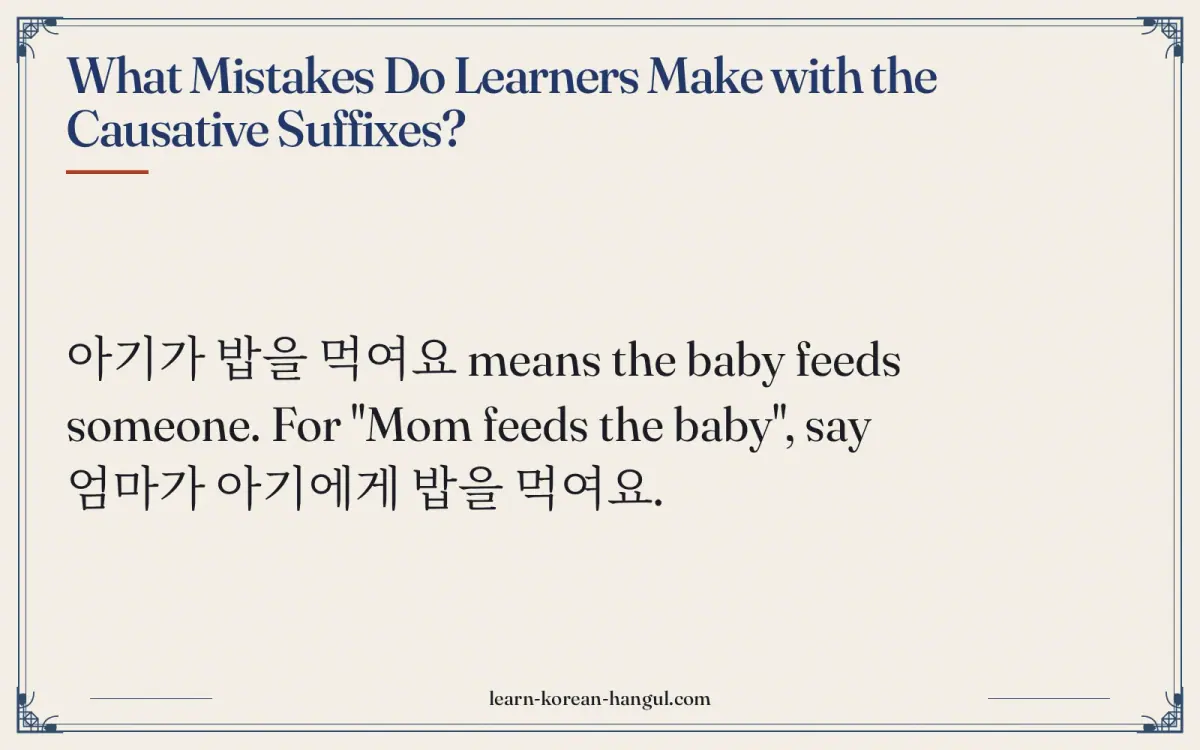
- Making the causee the subject. 아기가 밥을 먹여요 is wrong if you mean "Mom feeds the baby". It says that the baby feeds someone. The causer, 엄마, must be the subject.
- Guessing the suffix. 자이다 and 재히다 are wrong. The pair is 자다 and 재우다. Learn the pair, not the rule.
- Mixing up the passive and the causative. 아기에게 밥을 먹혀요 is wrong. 먹히다 is passive ("be eaten"). For "feed", use 먹이다: 아기에게 밥을 먹여요.
- Assuming every verb has a causative suffix. 가이다 is not a word. Use 가게 하다 or a different verb.
- Using 에게 for the causee of a verb with no object. 아이에게 재워요 is not natural. Use 을/를: 아이를 재워요.
A quick check helps: Is the causer the subject? Does the causee have 에게 (if there is an object) or 을/를 (if there is none)? Is the verb a real dictionary pair? If all three answers are yes, the sentence is sound.
The practice set tests these points.
Practice and Answers
Try the four items before you read the answers.
- Choose the form. Complete: 엄마가 아기를 ___. (재워요 / 자요)
- Fix the error. A learner says 아기에게 밥을 먹혀요 for "I feed the baby". Correct it.
- Translate. "Please lower the volume." Use 소리 and 낮추다.
- Write your own. Write one causative sentence about a child, using 이, 히, 리, 기, 우 or 추.
Practice · 6
Which is the causative of 먹다 meaning "feed"?
Show answer
먹이다
먹이다 is the causative (feed). 먹히다 is the passive (be eaten), and 먹기다 does not exist.
Which sentence means "Mom puts the baby to sleep"?
Show answer
엄마가 아기를 재워요.
자다 has no object, so the person who sleeps takes 을/를, and the verb becomes 재우다.
In 엄마가 아이에게 옷을 입혀요, who is dressed?
Show answer
The child (아이)
에게 marks the causee, the person who is made to wear the clothes.
Which verb is passive, not causative?
Show answer
먹히다
먹히다 means "be eaten". 재우다 and 입히다 are causatives.
Which verb has no suffix causative, so Korean uses -게 하다 instead?
Show answer
가다
가다 has no suffix causative: say 가게 하다. 먹다 has 먹이다 and 자다 has 재우다.
Which sentence is wrong if you mean "Mom feeds the baby"?
Show answer
아기가 밥을 먹여요.
With 아기가 as the subject, the sentence says the baby feeds someone. The causer, Mom, must be the subject.
Answer key
- 재워요. The causer is 엄마, and 자다 has no object, so the causee 아기 takes 를: 엄마가 아기를 재워요.
- 아기에게 밥을 먹여요. 먹히다 is passive. The causative is 먹이다.
- 소리를 낮춰 주세요. (sorireul natchwo juseyo.) [소리를 낟춰 주세요]
- Answers vary. Check that the causer is the subject, that the causee has 에게 or 을/를 and that the verb is a real pair. An example: 아이에게 옷을 입혀요 ("I dress the child").
If you can complete items 1 to 3 without the key, you can use the causative suffixes in conversation. The next section points to related lessons.
What Should You Learn Next after the Causative Suffixes 이 히 리 기 우 구 추?
After the suffix causatives, learn the productive causative and the noun causative. This lesson teaches the closed list of pairs. It does not teach how to build a causative from any verb, and it does not compare the causative with the passive in depth.
- Read causative -게 하다 for the pattern that works on any verb.
- Read -시키다 causative for words like 소개시키다.
- Read causative vs passive in korean to separate 먹이다 from 먹히다.
- Browse korean transitive and intransitive verb pairs for related verb pairs such as 열다 and 열리다.
- Review the passive suffixes 이 히 리 기 and the -아/어지다 become passive lessons.
- Return to the full set of korean passive verbs.
With these steps, the pattern becomes automatic: find the pair, make the causer the subject, and mark the causee with 에게 or 을/를.
Frequently Asked Questions
What are the causative suffixes in Korean?
The causative suffixes are 이, 히, 리, 기, 우, 구 and 추. They attach to a verb or adjective stem and make a new verb meaning "make or let someone do it", as in 먹다 to 먹이다 (feed) and 자다 to 재우다 (put to sleep).
How do I mark the person who is made to do the action?
The person who is made to act is called the causee. If the verb also has an object, mark the causee with 에게 or 한테: 엄마가 아기에게 밥을 먹여요. If the verb has no object, mark the causee with 을/를: 엄마가 아기를 재워요.
Do all verbs have a causative suffix?
No. Only some verbs have a suffix pair, and you must learn them one by one. Verbs such as 가다 and 오다 have none, so Korean uses -게 하다 (가게 하다) or a different verb (보내다, "send").
How do I tell a causative from a passive when the suffix is the same?
Check the particles and the meaning. A causative has a causer as subject and a made-to-act person with 에게 or 을/를: 엄마가 아기에게 밥을 먹여요. A passive has the receiver as subject: 닭이 여우에게 먹혔어요. Learn each verb as a pair so that you know which meaning it carries.
What is the difference between 먹이다 and 먹게 하다?
먹이다 usually means that you feed someone directly, for example with a spoon. 먹게 하다 means that you make or let someone eat, so the person eats by themselves. Grammar books often draw this line, but the two can overlap in everyday use.