What you'll learn
- Tell a transitive verb from an intransitive verb by the particle before it.
- Match 20 common verb pairs, such as 열다/열리다 and 켜다/켜지다.
- Turn an object (을/를) into a subject (이/가) when you switch verbs.
- Say "the door is open" with 열려 있어요 and "the door opened" with 열렸어요.
- Spot the five most common mistakes with pairs.
Before you start: you should know the subject particle 이/가 and the object particle 을/를. If the object particle is new, read object particle 을/를 first. Audio plays only when you press a button.
What Are Korean Transitive and Intransitive Verb Pairs?
Korean transitive and intransitive verb pairs are two related verbs, one with an actor who does something to an object and one without. A transitive verb (타동사) needs an object: "I open the door." An intransitive verb (자동사) does not take an object: "The door opens." English often uses the same verb for both, but Korean uses two different verbs.
The pairs matter because the choice of verb changes the particles. The object of the transitive verb, marked by 을/를, becomes the subject of the intransitive verb, marked by 이/가. The partner is also often a passive verb, which means that the subject receives the action.
A First Example
- 문을 열어요. (muneul yeoreoyo.) [무늘 여러요] = "I open the door."
- 문이 열려요. (muni yeollyeoyo.) [무니 열려요] = "The door opens."
In the first sentence, an actor (I) acts on 문 ("door"), which takes 을. In the second, 문 is the only participant, so it takes 이, and the verb changes from 열다 to 열리다. Nothing else in the sentence changed. The next section shows how many pairs follow the same swap.
How Do the Pairs Work, and Which Pairs Are Common?
Transitive and intransitive pairs work by a simple swap: change the verb and change 을/를 to 이/가. The partners are built in several ways. Some add a suffix (이, 히, 리, 기), some use 지다 or 되다, and in some the transitive verb is the derived one (줄다 → 줄이다) or the two differ in their endings (떨어뜨리다/떨어지다). Because the way of building varies, learn each pair as a unit.
| Pair (transitive → intransitive) | Meaning | How built | Sound |
|---|---|---|---|
| 열다 → 열리다 | open | suffix 리 | — |
| 닫다 → 닫히다 | close | suffix 히 | [닫따] → [다치다] |
| 켜다 → 켜지다 | turn on → come on | 지다 | — |
| 끄다 → 꺼지다 | turn off → go off | 지다 | — |
| 바꾸다 → 바뀌다 | change | suffix 이 (contracted) | — |
| 보다 → 보이다 | see → be visible | suffix 이 | — |
| 듣다 → 들리다 | listen → be audible | suffix 리 | [듣따] → [들리다] |
| 막다 → 막히다 | block → be blocked | suffix 히 | [막따] → [마키다] |
| 풀다 → 풀리다 | untie, solve → come undone | suffix 리 | — |
| 섞다 → 섞이다 | mix → be mixed | suffix 이 | [석따] → [서끼다] |
| 모으다 → 모이다 | gather → come together | suffix 이 | — |
| 끊다 → 끊기다 | cut off → be cut off | suffix 기 | [끈타] → [끈키다] |
| 쌓다 → 쌓이다 | pile up → be piled up | suffix 이 | [싸타] → [싸이다] |
| 만들다 → 만들어지다 | make → be made | 어지다 | [만들다] → [만드러지다] |
| 시작하다 → 시작되다 | start → begin | 하다 → 되다 | [시자카다] → [시작뙤다] |
| 떨어뜨리다 → 떨어지다 | drop → fall | different ending | [떠러뜨리다] → [떠러지다] |
| 끝내다 → 끝나다 | finish → end | different ending | [끈내다] → [끈나다] |
| 늘리다 → 늘다 | increase | 늘다 + causative 리 | — |
| 줄이다 → 줄다 | reduce → decrease | 줄다 + causative 이 | — |
| 세우다 → 서다 | stand up, stop → stand, stop | 서다 + causative 우 (irregular) | — |
The table shows twenty pairs. The next three parts show how each group behaves in a sentence.
Pairs Built with a Suffix
The largest group adds 이, 히, 리 or 기 to the stem of the transitive verb to make the partner. These suffixes are taught in full in passive suffixes 이 히 리 기. The suffix cannot be predicted from the stem, so memorise the pair.
- 창문을 닫았어요. (changmuneul dadasseoyo.) [창무늘 다다써요] = "I closed the window."
- 창문이 닫혔어요. (changmuni dachyeosseoyo.) [창무니 다처써요] = "The window closed" or "The window was closed."
- 이름을 바꿨어요. (ireumeul bakkwosseoyo.) [이르믈 바꿔써요] = "I changed my name."
- 이름이 바뀌었어요. (ireumi bakkwieosseoyo.) [이르미 바뀌어써요] = "My name changed."
Notice the sound of 닫혔어요. The ㄷ and ㅎ join into [ㅊ], so the word is said [다처써요].
Pairs Built with 지다 or 되다
Some pairs use -아/어지다, which makes a verb that happens without a named doer. The pair 끄다/꺼지다 and the pair 켜다/켜지다 are the most common. Verbs made from a noun plus 하다 swap 하다 for 되다.
- 불을 켜요. (bureul kyeoyo.) [부를 켜요] = "I turn on the light."
- 불이 켜져요. (buri kyeojyeoyo.) [부리 켜저요] = "The light comes on."
- 선생님이 수업을 시작해요. (seonsaengnimi sueobeul sijakaeyo.) [선생니미 수어블 시자캐요] = "The teacher starts the class."
- 수업이 시작돼요. (sueobi sijakdwaeyo.) [수어비 시작뙈요] = "The class begins."
The full rule is on -아/어지다 become passive, and the 하다 verbs are on -되다 passive 하다 verbs. The third group has no single pattern.
Pairs with Other Endings
A few pairs share a root but differ in their endings, and in some the transitive verb is the longer, derived one. 끝내다 means "finish something" and 끝나다 means "end", while 세우다 means "stand something up, stop it" and 서다 means "stand, stop". These pairs follow no single rule, so they simply have to be learned.
- 지갑을 떨어뜨렸어요. (jigabeul tteoreotteuryeosseoyo.) [지가블 떠러뜨려써요] = "I dropped my wallet."
- 지갑이 떨어졌어요. (jigabi tteoreojyeosseoyo.) [지가비 떠러저써요] = "The wallet fell."
With the pairs in view, the next step is a method for picking the right verb.
Worked Example: Choosing the Right Verb in a Pair
Transitive and intransitive verb pairs can be chosen with a short test. Follow the steps with the sentence "The light turns on."
- Find the noun. The thing involved is 불 ("light").
- Decide whether someone acts on it. In "The light turns on", no one is named, so the noun is the subject. In "I turn on the light", the speaker acts on it, so the noun is the object.
- Pick the verb of the pair. The subject version uses the intransitive verb 켜지다. The object version uses the transitive verb 켜다.
- Mark the noun to match. The subject takes 이/가: 불이 켜져요. The object takes 을/를: 불을 켜요.
Sentence
You know it worked when the particle and the verb agree: 이/가 with the intransitive and 을/를 with the transitive. The usual slip is to change the verb but keep the old particle, as in 불이 켜요.
For the state after the event, use -아/어 있다 with the intransitive partner. 문이 열렸어요 (muni yeollyeosseoyo) [무니 열려써요] says that the door opened. 문이 열려 있어요 (muni yeollyeo isseoyo) [무니 열려 이써요] says that the door is open now. The page on -아/어 있다 state explains this contrast. The same pattern can also show a reason: 바람 때문에 문이 열렸어요 means "The door opened because of the wind."
How Are Transitive and Intransitive Pairs Different from Similar Forms?
Transitive and intransitive pairs differ from causative and passive suffix forms in what they describe. A pair is a set of two verbs that exist in the dictionary. A causative or passive is a way of making a new verb from a verb, and the two overlap because they use the same suffixes.
| Point | Verb pair | Passive suffix | Causative suffix |
|---|---|---|---|
| What it does | names two matching verbs | makes the subject the receiver | makes the subject cause an action |
| Example | 열다 / 열리다 | 잡다 → 잡히다 | 먹다 → 먹이다 |
| Meaning | open / be open | catch → be caught | eat → feed |
| Doer shown | no | yes, with 에게 | yes, as the subject |
The same suffix can serve several jobs. 보이다 can mean "be seen" (산이 보여요, "The mountain is visible") or "show" (사진을 보여 주세요, "Please show me the photo"). The first is the intransitive partner of 보다. The second is a causative. Which one it is depends on the particles around it. The lessons passive suffixes 이 히 리 기 and causative suffixes 이 히 리 기 우 구 추 cover the two jobs, and causative vs passive in Korean compares them. These contrasts lead to a few special cases.
When Do You Use Verb Pairs, and When Not?
Verb pairs work for events with or without an actor, but a few verbs work in both ways and a few pairs overlap in meaning.
- Verbs that work both ways. 움직이다 ("move") and 멈추다 ("stop") need no partner. 차가 움직여요 [차가 움지겨요] means "The car moves", and 차를 움직여요 [차를 움지겨요] means "I move the car." The same is true for 멈추다: 차가 멈췄어요 and 차를 멈췄어요.
- Two English meanings in one pair. 걸다 ("hang") and 걸리다 ("hang; be caught; take time") cover several meanings, so a dictionary check helps.
- No partner at all. Some verbs, such as 가다 and 오다, have no transitive partner. You cannot "go" something.
- Causes without an actor. When the cause is a thing, not a person, use 때문에: 바람 때문에 문이 열렸어요.
This lesson covers the common pairs, not every pair in the dictionary. The mistakes below show where the particles go wrong.
What Mistakes Do Learners Make with Verb Pairs?
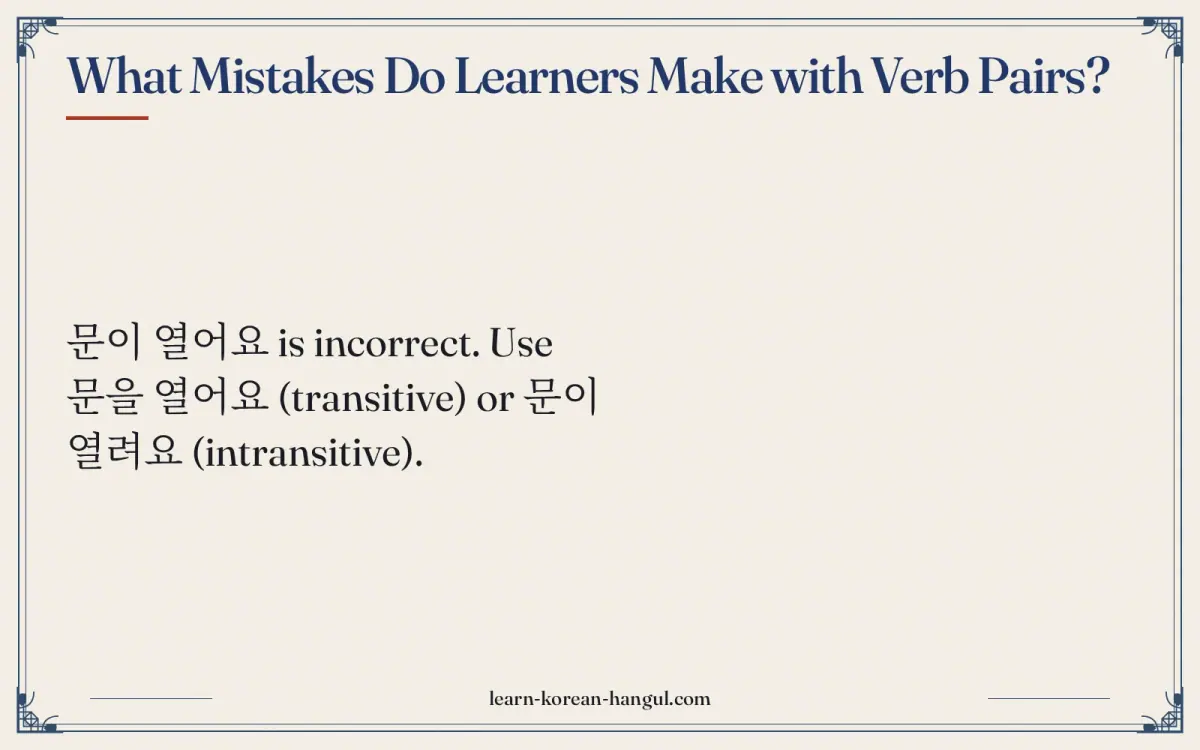
Learners most often keep the wrong particle after they swap the verb. Five mistakes appear again and again.
- Using the transitive verb with 이/가. 문이 열어요 is wrong, because 열다 needs an object. Say 문이 열려요 or 문을 열어요.
- Using the intransitive verb with 을/를. 문을 열려요 is wrong. Say 문을 열어요.
- Using the transitive verb with the light as the subject. 불이 켜요 is wrong. Say 불이 켜져요 or 불을 켜요.
- Inventing the suffix. 닫이다 and 열이다 are not words. The suffix belongs to each pair, so check the pair in the dictionary.
- Using the intransitive for a deliberate act. 문이 열렸어요 does not say who opened it. If you did it, say 제가 문을 열었어요.
A quick check: Does the noun have 이/가 or 을/를? Is the verb the matching partner? If both answers are yes, the sentence is sound.
The practice set tests these points.
Practice and Answers
Try the four items before you read the answers.
- Choose the form. Complete: 바람 때문에 창문___ ___. (이 열렸어요 / 을 열었어요)
- Fix the error. A learner says 불이 켜요. Correct it, in two ways.
- Translate. "I closed the window." Use 닫다.
- Write your own. Write one sentence with a transitive verb from the table, then rewrite it with its intransitive partner.
Practice · 8
Complete: 문___ 열려요.
Show answer
이
열리다 is intransitive, so 문 is its subject and takes 이/가.
Which sentence means "I open the door"?
Show answer
문을 열어요.
The transitive verb 열다 takes an object with 을/를.
A learner says 불이 켜요. Which correction is right?
Show answer
불이 켜져요.
With 이/가 you need the intransitive partner 켜지다. With 을/를 you would use 켜다.
What is the intransitive partner of 닫다?
Show answer
닫히다
닫다 pairs with 닫히다. 닫이다 is not a word, and 열리다 is the partner of 열다.
Which sentence says that the door is open now?
Show answer
문이 열려 있어요.
-아/어 있다 on the intransitive verb describes the state after the event.
Which verb works both ways, with 이/가 or with 을/를?
Show answer
움직이다
움직이다 needs no partner: 차가 움직여요 and 차를 움직여요 are both correct.
How is 닫혔어요 pronounced?
Show answer
[다처써요]
ㄷ and ㅎ join into [ㅊ] before the vowel ㅕ.
The wind opened the window, and no person did it. Which sentence fits?
Show answer
바람 때문에 창문이 열렸어요.
With no actor, use the intransitive verb with 이/가.
Answer key
- 이 열렸어요. The wind caused it, and no actor is named, so the intransitive verb takes 이: 바람 때문에 창문이 열렸어요.
- 불이 켜져요 ("The light comes on") or 불을 켜요 ("I turn on the light"). Change either the verb or the particle, but keep the two matched.
- 창문을 닫았어요. (changmuneul dadasseoyo.) [창무늘 다다써요]. The actor is "I", so the object takes 을.
- Answers vary. Check that the object particle turns into 이/가. An example: 길을 막아요 ("I block the road") → 길이 막혀요 ("The road is blocked").
If you can complete items 1 to 3 without the key, you can pick the right verb in conversation. The next section points to lessons that build on this one.
What Should You Learn Next after Verb Pairs?
After verb pairs, learn how the same suffixes work as passives and causatives. This lesson teaches the pairing and the particle swap, and it does not cover the passive with a named doer, the causative with 게 하다 or the comparison of the two. Those have their own pages.
- Read passive suffixes 이 히 리 기 for the suffixes behind many pairs.
- Read causative suffixes 이 히 리 기 우 구 추 for the other job of the same suffixes.
- Read -아/어지다 become passive for the 지다 pairs.
- Read -시키다 causative for 하다 verbs and causative vs passive in Korean for the final comparison.
- Return to the full set of Korean passive verbs.
With these steps, the pairs become automatic: ask whether anyone acts on the noun, pick the matching verb and mark the noun with 을/를 or 이/가.
Frequently Asked Questions
What is a transitive verb in Korean?
A transitive verb (타동사) takes an object marked with 을/를, such as 열다 in 문을 열어요 ("I open the door"). An intransitive verb (자동사) takes no object, such as 열리다 in 문이 열려요 ("The door opens"). Many Korean verbs have one of each, and the pair changes the particles.
How do I form a transitive and intransitive pair?
Most pairs cannot be formed by a rule, because the suffix varies: 열다/열리다, 닫다/닫히다, 바꾸다/바뀌다, 보다/보이다. Some use 지다 (켜다/켜지다), some use 되다 (시작하다/시작되다), and some differ in their endings (끝내다/끝나다, 떨어뜨리다/떨어지다). Learn each pair together with its particles.
Why is 문이 열어요 wrong?
열다 is a transitive verb, so it needs an object with 을/를. 문이 열어요 gives it a subject only, and the sentence has no actor. Say 문을 열어요 for "I open the door" or 문이 열려요 for "The door opens". The verb and the particle must agree.
Is every intransitive partner a passive?
Not every one. 열리다 and 닫히다 are passives in form, but they work as ordinary intransitive verbs and rarely name a doer. 끝나다 and 서다 are not passives at all: they are the base verbs, and 끝내다 and 세우다 are their transitive partners. In practice, you can treat them all as the intransitive partner and use 이/가.
Do I use verb pairs in speech, writing or both?
Both. 문이 열려요, 불이 켜져요 and 길이 막혀요 are everyday speech, and the same pairs appear in news and instructions with other endings, such as 열립니다.