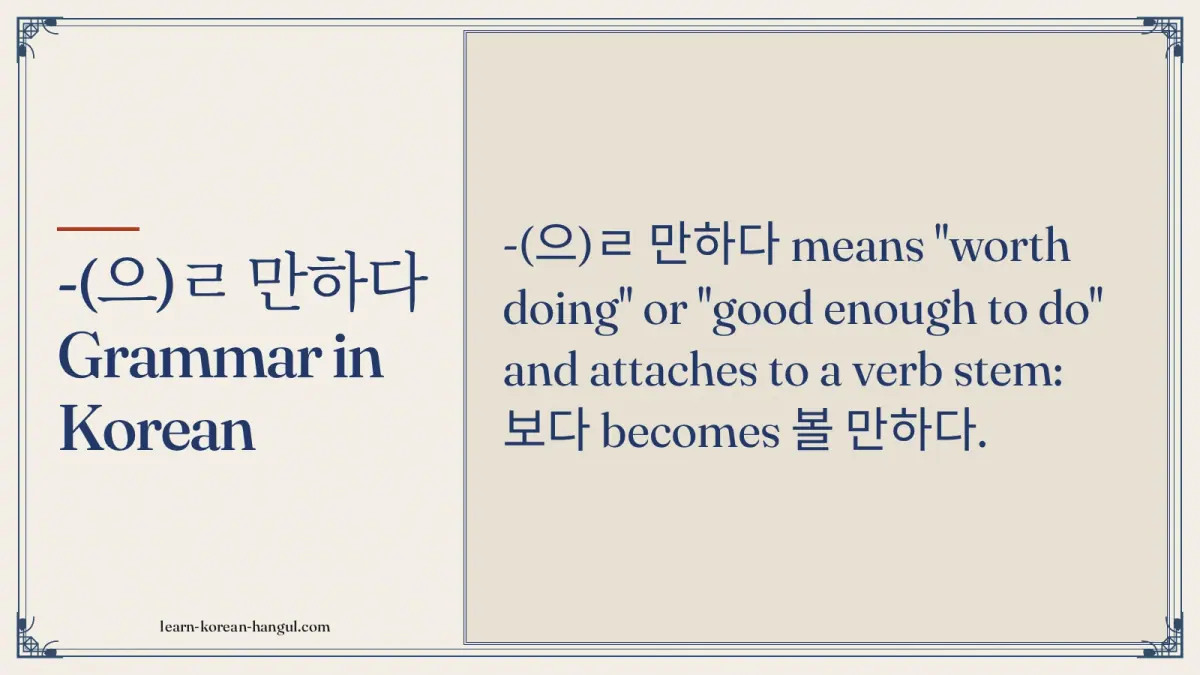
Key facts
- 만하다 is an adjective, so the noun-modifying form is 만한 (볼 만한 영화), never 만하는.
What you'll learn
- Attach -(으)ㄹ 만하다 to any verb stem and say the polite form (-(으)ㄹ 만해요) from memory.
- Tell a friend that a film, a restaurant or a book is worth the time.
- Use the noun-modifying form 만한 for phrases such as 가 볼 만한 곳 ("a place worth visiting").
- Explain why -(으)ㄹ 만하다 and -(으)ㄹ 수 있다 are different patterns.
- Spot the mild meaning "good enough" in sentences such as 먹을 만해요.
Before you start: you should know how to find a verb stem (drop 다 from the dictionary form) and the polite ending -아요/어요. You will also meet the future-modifier ending -(으)ㄹ, which this page explains from scratch. Audio plays only when you press a button.
What Does -(으)ㄹ 만하다 Grammar Mean?
-(으)ㄹ 만하다 grammar means that an action is worth doing, or at least good enough to do. The verb says which action you mean, and 만하다 says that the action deserves the time, the money or the effort. The result is one opinion about something you have seen, tried or heard about.
Here are the first two examples. The pattern is the same in both, and only the verb changes.
- 이 영화는 볼 만해요. (i yeonghwaneun bol manhaeyo.) = "This film is worth watching."
- 그 식당은 가 볼 만해요. (geu sikdangeun ga bol manhaeyo.) [그 식땅은 가 볼 만해요] = "That restaurant is worth a visit."
Look at how 볼 만해요 is built. 보 is the stem of 보다 (to see, to watch), ㄹ is an ending that turns the verb into a modifier, 만 is a dependent noun, and 하다 closes the phrase. A dependent noun (의존 명사) is a noun that cannot stand alone and always needs a modifier in front of it. Here 만 means roughly "worth" or "the measure of." Grammar books call 만하다 an auxiliary adjective (보조 형용사): it follows another verb and behaves like an adjective. That explains two later rules, the modifier form 만한 and the way the thing worth doing becomes the topic. First, the formation.
How Do You Form -(으)ㄹ 만하다?
-(으)ㄹ 만하다 is formed by dropping 다 from the dictionary form of a verb, adding the modifier ending -(으)ㄹ, and then adding 만하다. The ending is -ㄹ after a vowel or after a ㄹ stem, and -을 after any other consonant. The letters in parentheses show which part appears only in one case.
| Dictionary form | Stem | Add -(으)ㄹ 만하다 | Polite form | Meaning |
|---|---|---|---|---|
| 보다 | 보 | 볼 만하다 | 볼 만해요 | worth watching |
| 가다 | 가 | 갈 만하다 | 갈 만해요 | worth going |
| 먹다 | 먹 | 먹을 만하다 | 먹을 만해요 | worth eating, decent |
| 읽다 | 읽 | 읽을 만하다 | 읽을 만해요 | worth reading |
| 믿다 | 믿 | 믿을 만하다 | 믿을 만해요 | trustworthy |
| 살다 | 살 | 살 만하다 | 살 만해요 | livable, decent to live in |
The table shows one rule applied to six verbs. The next three parts look at the groups of stems one at a time.
Stems Ending in a Vowel
A vowel stem takes -ㄹ directly on the last syllable. 보다 becomes 볼, 가다 becomes 갈, and 사다 becomes 살. Then you add 만하다. Speakers often put the helper 보다 ("try and see") in front, which gives 가 보다 (to go and see) and 해 보다 (to try doing). The pattern then reads 가 볼 만하다 or 해 볼 만하다, "worth going to see" or "worth trying."
- 해 볼 만한 일이에요. (hae bol manhan irieyo.) [해 볼 만한 이리에요] = "It is a job worth trying."
- 서울에는 볼 만한 곳이 많아요. (seoureneun bol manhan gosi manayo.) [서우레는 볼 만한 고시 마나요] = "There are many places worth seeing in Seoul."
Vowel stems are the simplest case. A stem with a final consonant needs one extra syllable.
Stems Ending in a Consonant
A consonant stem takes -을 before 만하다. 먹다 becomes 먹을 만하다, 읽다 becomes 읽을 만하다, and 믿다 becomes 믿을 만하다. This is the same link vowel that appears in -으세요 and -으면, so the choice between ㄹ and 을 follows the familiar "consonant or vowel" rule.
- 이 음식은 먹을 만해요. (i eumsigeun meogeul manhaeyo.) [이 음시근 머글 만해요] = "This food is decent."
- 믿을 만한 사람이에요. (mideul manhan saramieyo.) [미들 만한 사라미에요] = "He or she is a person worth trusting."
The final consonant moves to the next syllable in speech, so 먹을 sounds like [머글] and 믿을 like [미들]. The spelling stays 먹을 and 믿을. Two more groups need a short note, because learners expect trouble with them.
Irregular Stems and Nouns
Irregular verbs follow the same changes that they show before any ending starting with -(으)ㄹ.
- ㄷ-irregular: 듣다 becomes 들을 만하다. 들을 만한 노래 (deureul manhan norae) means "a song worth listening to."
- ㅂ-irregular: 돕다 becomes 도울 만하다 ("worth helping").
- ㄹ-stems: 만들다 and 살다 keep their ㄹ and add no second one. 만들 만하다 means "worth making," and 살 만하다 means "livable." The reason is that the ending -ㄹ would only repeat the ㄹ already there.
- 르-verbs: 부르다 becomes 부를 만하다 ("worth singing"), and 모르다 becomes 모를 만하다.
- 하다 verbs: 하다 becomes 할 만하다, and 공부하다 becomes 공부할 만하다 ("worth studying").
Nouns do not take the pattern directly. To say that a noun is worth something, use a verb that belongs to it. A film is worth watching (볼 만하다), and a person is worth trusting (믿을 만하다). Adjectives do not take -(으)ㄹ 만하다 either, because the pattern evaluates an action. With the formation clear, one full sentence can be built step by step.
Worked Example: Building a Sentence with -(으)ㄹ 만하다
-(으)ㄹ 만하다 grammar turns an action into an opinion about the thing involved. Follow the steps with the plain sentence "I watch this film."
- Start with the plain sentence. 이 영화를 봐요. (i yeonghwareul bwayo.) = "I watch this film." The verb is 봐요, and the object is 이 영화를.
- Find the dictionary form and stem. 봐요 comes from 보다. The stem is 보.
- Add the modifier ending. 보 ends in a vowel, so add -ㄹ: 볼.
- Add 만하다 and move to the polite style. 볼 + 만해요 = 볼 만해요.
- Move the thing to the front as the topic. The film is no longer something you do something to. It is the thing being judged. So 을/를 changes to 은/는: 이 영화는 볼 만해요. (i yeonghwaneun bol manhaeyo.) = "This film is worth watching."
Sentence
You will know it worked when the thing worth watching stands at the front with 은/는 and the verb is in the modifier form 볼. The common slip at step 5 is keeping 을/를: 이 영화를 볼 만해요 is understandable, but it is less natural. Ordinary speech puts the judged thing first as the topic. Each sentence can also appear in several tenses and sentence types, and each has limits.
Which Tenses and Sentence Types Work with -(으)ㄹ 만하다?
-(으)ㄹ 만하다 works in the present, past, future and negative, in statements and questions. Because 만하다 is an adjective, every change happens on 만하다, and the verb in front never changes. The table shows the forms for 보다 in the polite style.
| Sentence type | Form | Meaning |
|---|---|---|
| Present statement | 볼 만해요 | It is worth watching. |
| Past statement | 볼 만했어요 | It was worth watching. |
| Probable future | 볼 만할 거예요 | It will probably be worth watching. |
| Negative | 볼 만하지 않아요 | It is not worth watching. |
| Question | 볼 만해요? | Is it worth watching? |
| Formal | 볼 만합니다 | It is worth watching (formal). |
| Casual (banmal) | 볼 만해 | It's worth watching (to a friend). |
| Written plain style | 볼 만하다 | It is worth watching (review, essay). |
| Before a noun | 볼 만한 영화 | a film worth watching |
The present statement and the question have the same shape, and rising tone marks the question. Commands and suggestions are not possible, because adjectives do not form them. You cannot say 볼 만하세요 to mean "please watch it." For that, use a different pattern.
The negative needs a note. In speech, 볼 만하지 않아요 sounds like [볼 만하지 아나요], because the ㅎ of 않 is silent before a vowel. Learners usually add a softener: 별로 볼 만하지 않아요 ("It is not really worth watching").
- 이 책은 읽을 만했어요. (i chaegeun ilgeul manhaesseoyo.) [이 채근 일글 만해써요] = "This book was worth reading."
- 별로 볼 만하지 않아요. (byeollo bol manhaji anayo.) [별로 볼 만하지 아나요] = "It is not really worth watching."
The tense rule is simple: the opinion changes tense and the activity does not. Moving the past tense onto the verb (읽었을 만해요) does not say "it was worth reading." It is not used for this meaning, so keep the verb as 읽을 and put the past tense on 만하다. The most useful contrast is with the pattern that learners confuse with this one.
How Is -(으)ㄹ 만하다 Different from -(으)ㄹ 수 있다/없다?
-(으)ㄹ 만하다 gives a judgement of value, while -(으)ㄹ 수 있다/없다 says that something is possible. Both put a modifier ending in front of a short word, and both translate with "can" or "able" in some English sentences. Their meanings are different.
| Point | -(으)ㄹ 만하다 | -(으)ㄹ 수 있다/없다 |
|---|---|---|
| Core idea | worth doing, good enough | able to do, possible |
| Question it answers | Is it worth it? | Is it possible? |
| Word class of the helper | adjective (만하다) | adjective pair (있다/없다) |
| Usual topic | the thing judged (이 영화는) | often the person who can (저는) |
| Example | 이 영화는 볼 만해요. | 이 영화는 볼 수 있어요. |
| Meaning of example | This film is worth watching. | You can watch this film (it is available). |
The two example sentences differ in one small word, yet only the second one is about permission or access. 볼 수 있어요 tells you that the film is available and that you are free to watch it. 볼 만해요 tells you that watching it is a good idea. A film can be very much worth watching but unavailable (볼 만하지만 볼 수 없어요), and a film can be available and a waste of time (볼 수 있지만 볼 만하지 않아요).
A second neighbour is the negation of ability. 못 and -지 못하다 describe things you cannot do. They never talk about worth. If you want that side of the story, see 못 can't in Korean and -지 못하다 cannot. A third neighbour is -(으)ㄹ 수도 있다, which says that something might happen. These contrasts lead to the smaller variations of the pattern itself.
Variations and Edge Cases of -(으)ㄹ 만하다
-(으)ㄹ 만하다 has four common variations: a mild "good enough" tone, a noun-modifying form, set phrases and a spacing choice. Each one is short, and each appears in real conversation.
- A mild tone. 만하다 often praises with restraint. 이 음식은 먹을 만해요 usually means "This food is decent," not "This food is wonderful." To make the praise stronger, add 정말 or 꼭 (정말 볼 만해요, "It is really worth watching"). To make the lukewarm meaning clear, add 그런대로 ("more or less"): 그런대로 먹을 만해요, "It is edible enough."
- Modifying a noun. Change 만하다 to 만한 to describe a noun: 볼 만한 영화 (bol manhan yeonghwa), "a film worth watching." The past form is 만했던, as in 볼 만했던 영화, "a film that was worth watching." Do not use 만하는, because 하는 is the form for action verbs, and 만하다 is an adjective.
- Set phrases. Four phrases appear again and again. 가 볼 만한 곳 means "a place worth visiting," and it heads many travel guides. 살 만하다 means "livable," as in 서울은 살 만해요. 믿을 만한 사람 means "a trustworthy person." 할 만하다 means "doable," as in 요즘 일이 할 만해요, "The work is manageable these days."
- Spacing. This site writes 볼 만하다 with a space, the standard way to write a helper word such as 만하다. The Korean spelling rules also allow 볼만하다 as one word for this kind of helper. You will see both in print.
This lesson covers the common forms used in daily life. It does not cover related patterns such as -(으)ㄹ 만큼 ("to the extent that"), which uses the same 만 but has a different job. The mistakes below show where the boundaries cause real errors.
Common Mistakes with -(으)ㄹ 만하다
Learners most often get the meaning, the modifier form or the word 만 wrong. Four mistakes appear again and again.
- Using it for a duty. 갈 만해요 does not mean "I have to go." 만하다 never expresses necessity. A duty uses -아/어야 하다. -(으)ㄹ 만하다 only says that going is worth it.
- Using it for ability. 수영할 만해요 does not mean "I can swim." It means "swimming is worth doing." For ability, use 수영할 수 있어요.
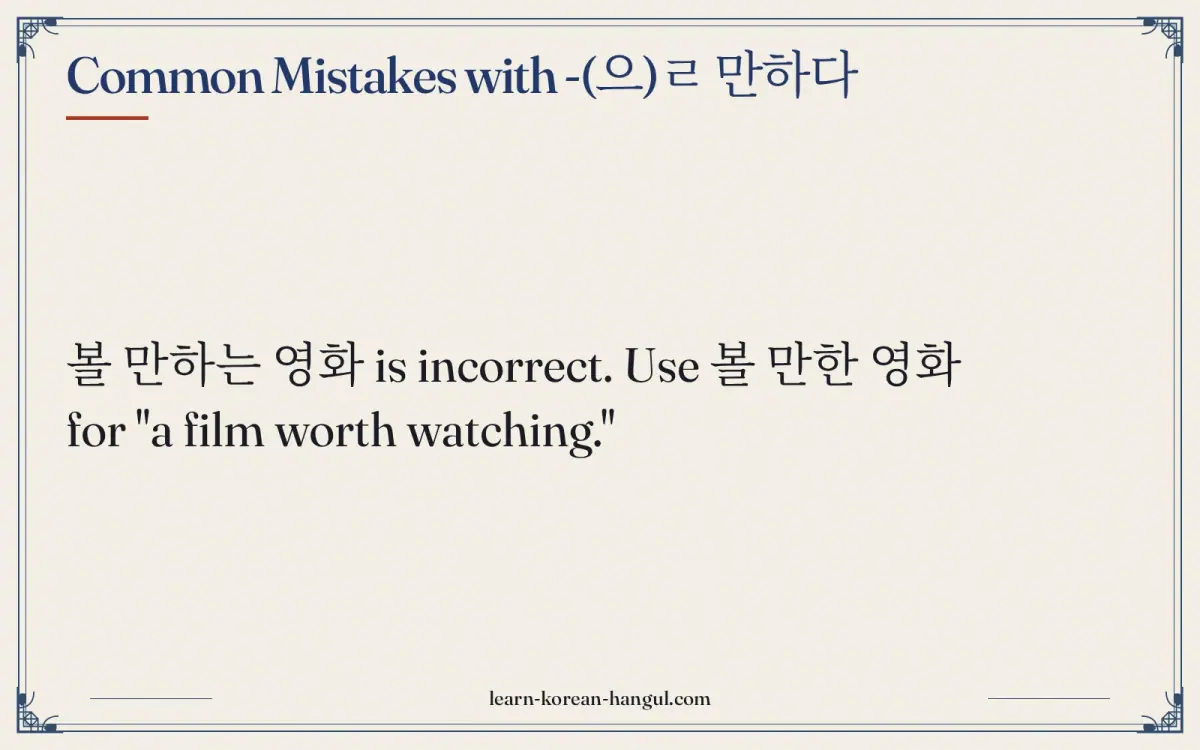
- Using 만하는 before a noun. 볼 만하는 영화 is wrong. The correct form is 볼 만한 영화, because 만하다 follows adjective rules.
- Mixing it up with 만 ("only"). The particle 만 means "only," as in 나만 가요 ("Only I am going"). It has nothing to do with the dependent noun in 볼 만하다. The easy test: if the word 만 sits right before 하다 and follows a form ending in -ㄹ or -을, it is the pattern.
A quick check for any "worth doing" sentence: Is the word before 만 a verb in the -(으)ㄹ form? Is the thing judged the topic? Is the tense on 만하다? If all three answers are yes, the sentence is sound.
The practice set below tests these four points directly.
Practice and Answers
Try the four items before you read the answer key. Cover the answers with your hand.
- Choose the form. Complete: 이 책은 ___. ("This book is worth reading.") (읽을 만해요 / 읽을 수 있어요)
- Build the phrase. Say "a restaurant worth visiting" with 가 보다.
- Fix the error. A learner writes 볼 만하는 영화예요. Correct the phrase.
- Write your own. Use 믿다 to say "He is a friend worth trusting."
Practice · 8
Which sentence says "This book is worth reading"?
Show answer
이 책은 읽을 만해요.
Worth is expressed by -(으)ㄹ 만하다. 수 있다 is about possibility, and the past tense goes on 만하다, not on the verb.
Which phrase means "a film worth watching"?
Show answer
볼 만한 영화
만하다 is an adjective, so its noun-modifying form is 만한. 볼 수 있는 영화 means a film you can watch.
What does 수영할 만해요 mean?
Show answer
Swimming is worth doing.
만하다 judges worth. Ability uses 수영할 수 있어요.
Add -(으)ㄹ 만하다 to 먹다. Which form is correct?
Show answer
먹을 만해요
A consonant stem takes -을 before 만하다.
What does 이 음식은 먹을 만해요 usually mean?
Show answer
This food is decent.
만하다 often praises with restraint: "good enough", not "wonderful".
Which sentence says "This book was worth reading"?
Show answer
이 책은 읽을 만했어요.
The opinion takes the tense, so the past goes on 만하다: 만했어요.
만하다 is an adjective. Which use is not possible?
Show answer
A command such as 볼 만하세요 meaning "please watch it"
Adjectives do not form commands or suggestions, so 볼 만하세요 cannot mean "please watch it".
In 나만 가요 ("Only I am going"), what is 만?
Show answer
The particle "only"
The particle 만 means "only". The pattern needs a verb in the -(으)ㄹ form before 만하다.
Answer key
- 읽을 만해요. The meaning is "worth reading," so the value pattern is right: 이 책은 읽을 만해요.
- 가 볼 만한 식당. (ga bol manhan sikdang.) The modifier form of 만하다 is 만한. 갈 만한 식당 is also acceptable.
- 볼 만한 영화예요. 만하다 is an adjective, so the modifier form is 만한.
- 그는 믿을 만한 친구예요. (geuneun mideul manhan chinguyeyo.) Answers vary slightly. Check that the stem 믿 takes 을 before 만한.
If you can complete items 1 to 3 without the key, you can use the pattern in conversation. Next, the lesson hands off to related patterns.
What Should You Learn Next after -(으)ㄹ 만하다 Grammar?
After -(으)ㄹ 만하다 grammar, learn the pattern for ability and permission, then the pattern for possibility. This lesson teaches the judgement of worth and does not cover ability, probability or necessity in depth. Those live on their own pages.
- Start with -(으)ㄹ 수 있다/없다, the pattern for "can" and "cannot."
- Continue with -(으)ㄹ 수도 있다, which says that something might happen.
- Return to Ability and Possibility to see every lesson in this set, or to the Intermediate Grammar list for other B1 patterns.
With these steps, -(으)ㄹ 만하다 becomes automatic: take the verb stem, add -(으)ㄹ 만해요, and keep the judged thing as the topic.
Frequently Asked Questions
What does -(으)ㄹ 만하다 mean?
-(으)ㄹ 만하다 means "worth doing" or "good enough to do." 이 영화는 볼 만해요 means "This film is worth watching," and 이 음식은 먹을 만해요 means "This food is decent." It judges an activity or a thing, and the strength of the praise depends on the words around it.
How do I attach -(으)ㄹ 만하다 to a verb or adjective?
Take the verb stem and add -ㄹ 만하다 after a vowel or ㄹ (보다 becomes 볼 만하다) and -을 만하다 after another consonant (먹다 becomes 먹을 만하다). It attaches to action verbs only. Irregular stems change as they do before -(으)ㄹ: 듣다 becomes 들을 만하다.
Can -(으)ㄹ 만하다 be used in the past tense?
Yes. Put the past tense on 만하다, not on the verb: 이 책은 읽을 만했어요 means "This book was worth reading." Do not put the past on the verb (읽었을 만해요), because that is a different, less common pattern. To give your opinion about a past experience, change only 만하다.
Is -(으)ㄹ 만하다 used in speech or only in writing?
Both. People say 볼 만해요 in conversation and 볼 만합니다 in formal talk. In writing, 볼 만하다 appears in reviews and travel guides, and 가 볼 만한 곳 ("places worth visiting") is a very common heading. The pattern does not belong to one register.
What is the most common mistake with -(으)ㄹ 만하다?
Learners use it for duties or for ability. 가야 만해요 is wrong for "I have to go," and 수영할 만해요 does not mean "I can swim." The pattern gives a judgement of worth. It also confuses people because 만 alone means "only," as in 나만 가요.
Can I say 만하다 about something I must do?
No. 만하다 praises or accepts an activity, but it never says that someone is required to do it. For a duty, use -아/어야 하다. For "I can do it," use -(으)ㄹ 수 있다. A thing you must do can still be described as worth doing, but the sentence then reports your opinion.