
What you'll learn
- Attach -(으)ㄹ 수도 있다 to verbs, adjectives and 이다, and say the polite form from memory.
- Make a polite prediction or a warning about the weather, the schedule or a person.
- Guess about the past with -았/었을 수도 있다.
- Say that something might not happen, and avoid the trap of 수도 없다.
- Explain why -(으)ㄹ 수도 있다 does not mean "can."
Before you start: you should know how to find a stem (drop 다 from the dictionary form) and the polite ending -아요/어요. The lesson on -(으)ㄹ 수 있다/없다 comes first, because this pattern grows out of it. Audio plays only when you press a button.
What Does -(으)ㄹ 수도 있다 Grammar Mean?
-(으)ㄹ 수도 있다 grammar means "there is also a chance that" and, in practice, "it might be that." It says that a situation is possible, but it leaves room for the opposite. The speaker is not sure, and says so.
Here are the first two examples. The pattern is the same in both.
- 내일은 비가 올 수도 있어요. (naeireun biga ol sudo isseoyo.) [내이른 비가 올쑤도 이써요] = "It might rain tomorrow."
- 그 사람이 틀릴 수도 있어요. (geu sarami teullil sudo isseoyo.) [그 사라미 틀릴쑤도 이써요] = "That person could be wrong."
The pieces are the same as in the "can" pattern. 수 is a dependent noun (의존 명사) meaning "way" or "possibility," 올 is the verb in its modifier form, and 있어요 says that the possibility exists. The new piece is the particle 도. In most sentences, 도 means "also" or "even" and attaches to a person or thing. Here it attaches to 수, the possibility itself. Literally, 올 수도 있어요 is "there is also a possibility of coming." That "also" turns a plain possibility into one among several, which is why the sentence sounds like a hedge. The pattern says "this could happen too," and it leaves open that something else might happen instead. First, the formation.
How Do You Form -(으)ㄹ 수도 있다?
-(으)ㄹ 수도 있다 is formed by dropping 다 from the dictionary form, adding the modifier ending -(으)ㄹ, and then adding 수도 있다. The ending is -ㄹ after a vowel or a ㄹ stem, and -을 after any other consonant. The same rule works for verbs and adjectives.
| Dictionary form | Stem | Add -(으)ㄹ 수도 있다 | Polite form | Meaning |
|---|---|---|---|---|
| 오다 | 오 | 올 수도 있다 | 올 수도 있어요 | might come, might rain |
| 늦다 | 늦 | 늦을 수도 있다 | 늦을 수도 있어요 | might be late |
| 어렵다 | 어렵 | 어려울 수도 있다 | 어려울 수도 있어요 | might be difficult |
| 비싸다 | 비싸 | 비쌀 수도 있다 | 비쌀 수도 있어요 | might be expensive |
| 틀리다 | 틀리 | 틀릴 수도 있다 | 틀릴 수도 있어요 | might be wrong |
| 선생님이다 | 선생님이 | 선생님일 수도 있다 | 선생님일 수도 있어요 | might be a teacher |
The table shows one rule applied to six words, including a noun with 이다. The next three parts look at the groups of stems one at a time.
Stems Ending in a Vowel
A vowel stem takes -ㄹ on the last syllable. 오다 becomes 올, 가다 becomes 갈, and 비싸다 becomes 비쌀. Then add 수도 있다.
- 그 가게는 비쌀 수도 있어요. (geu gageneun bissal sudo isseoyo.) [그 가게는 비쌀쑤도 이써요] = "That shop might be expensive."
- 어쩌면 비가 올 수도 있어요. (eojjeomyeon biga ol sudo isseoyo.) = "Perhaps it might rain."
After the -ㄹ ending, the ㅅ of 수 is tense, so 올 수도 sounds like [올쑤도]. This follows Article 27 of the standard pronunciation rules (표준 발음법) of the 국립국어원 (National Institute of Korean Language). Write the plain spelling and say the tense sound. Vowel stems are the simplest case. A stem with a final consonant needs one extra syllable.
Stems Ending in a Consonant
A consonant stem takes -을 before 수도. 늦다 becomes 늦을, and 잃다 would become 잃을. The ending 을 is the same link vowel that appears in -으세요 and -으면.
- 우리가 늦을 수도 있어요. (uriga neujeul sudo isseoyo.) [우리가 느즐쑤도 이써요] = "We might be late."
- 지갑을 잃어버렸을 수도 있어요. (jigabeul ireobeoryeosseul sudo isseoyo.) [지가블 이러버려쓸쑤도 이써요] = "I might have lost my wallet."
The final consonant moves to the next syllable in speech, so 늦을 sounds like [느즐]. The second sentence shows the past guess, which gets its own section below. Two more groups need a short note, because learners expect trouble with them.
Irregular Stems and Nouns
Irregular stems change as they do before any ending that begins with -(으)ㄹ.
- ㅂ-irregular: 어렵다 becomes 어려울 수도 있다, and 춥다 becomes 추울 수도 있다. 시험이 어려울 수도 있어요 = "The exam might be difficult." [시허미 어려울쑤도 이써요]
- ㄷ-irregular: 듣다 becomes 들을 수도 있다.
- ㄹ-stems: 살다 becomes 살 수도 있다, with no second ㄹ.
- 르-verbs: 모르다 becomes 모를 수도 있다.
- 하다 verbs: 하다 becomes 할 수도 있다, and 포기하다 becomes 포기할 수도 있다.
Nouns use the verb 이다 ("to be"). The stem of 이다 is 이, so -ㄹ makes 일, after any noun: 선생님일 수도 있어요 (seonsaengnimil sudo isseoyo) [선생니밀쑤도 이써요], "He or she might be a teacher." 의사일 수도 있어요 means "might be a doctor."
Both verbs and adjectives take this pattern. That is a difference from many other endings, which prefer one or the other. With the formation clear, one full sentence can be built step by step.
Worked Example: Building a Sentence with -(으)ㄹ 수도 있다
-(으)ㄹ 수도 있다 grammar turns a firm statement into a careful prediction. Follow the steps with the firm sentence "The exam is difficult."
- Start with the plain sentence. 시험이 어려워요. (siheomi eoryeowoyo.) = "The exam is difficult." The predicate is the adjective 어려워요.
- Find the dictionary form and stem. 어려워요 comes from 어렵다, a ㅂ-irregular adjective. The stem is 어렵.
- Make the modifier form. Before -(으)ㄹ, ㅂ becomes 우: 어려울.
- Add 수도 있다 and move to the polite style. 어려울 + 수도 있어요 = 어려울 수도 있어요.
- Rebuild the sentence. Keep everything before the predicate: 시험이 어려울 수도 있어요. (siheomi eoryeoul sudo isseoyo.) = "The exam might be difficult."
Sentence
You will know it worked when the subject (시험이) did not change and only the last part became 어려울 수도 있어요. The most common slip at step 3 is forgetting that ㅂ-irregular adjectives change: 어렵을 수도 is wrong. Each sentence can also appear in several tenses and sentence types, and each has limits.
Which Tenses and Sentence Types Work with -(으)ㄹ 수도 있다?
-(으)ㄹ 수도 있다 works for present and future possibility, and for past possibility, in statements and in questions. It does not combine with commands or suggestions. The table shows the forms for 오다 in the polite style.
| Sentence type | Form | Meaning |
|---|---|---|
| Possibility now or later | 올 수도 있어요 | It might come. |
| Past guess | 왔을 수도 있어요 | It might have come. |
| Past possibility | 올 수도 있었어요 | It could have come. |
| Negative possibility | 안 올 수도 있어요 | It might not come. |
| Negative (long form) | 오지 않을 수도 있어요 | It might not come. |
| Question | 올 수도 있어요? | Could it come? |
| Formal | 올 수도 있습니다 | It may come (formal). |
| Casual (banmal) | 올 수도 있어 | It might come (to a friend). |
| Written plain style | 올 수도 있다 | It may come (report, essay). |
The present and future share one form, and context tells you which is meant. A negative possibility puts 안 or -지 않- inside the pattern. Compare 안 올 수도 있어요 ("He might not come") with 올 수도 없어요. The second sentence ends in 없다, and it says that coming is not even possible, which is a very different claim.
- 안 올 수도 있어요. (an ol sudo isseoyo.) [안 올쑤도 이써요] = "He might not come."
- 지금은 갈 수도 없어요. (jigeumeun gal sudo eopseoyo.) [지그믄 갈쑤도 업써요] = "I can't even go now."
The past guess uses the past marker -았/었 before 을: 왔을 수도 있어요. It is a guess about something that has probably already happened, such as a lost wallet or a missed message. A question with the pattern, such as 비가 올 수도 있어요?, asks whether rain is possible, and it is gentler than a direct question. The most useful contrast for a learner is with the "can" pattern.
How Is -(으)ㄹ 수도 있다 Different from -(으)ㄹ 수 있다/없다?
-(으)ㄹ 수도 있다 gives a possibility the speaker is unsure about, while -(으)ㄹ 수 있다/없다 states ability, permission or a plain possibility. The difference is the tiny particle 도, and it changes the whole sentence.
| Point | -(으)ㄹ 수 있다 | -(으)ㄹ 수도 있다 |
|---|---|---|
| Core idea | can, be able to | might, may |
| Expresses ability | yes | no |
| Speaker's certainty | high (a fact or a skill) | low (one of several outcomes) |
| Example | 저도 갈 수 있어요. | 저는 갈 수도 있어요. |
| Meaning of example | I can go too. | I might go. |
The two examples differ in two places. In the first, 도 sits on 저 and means "too." In the second, 도 sits on 수 and hedges. 수영할 수 있어요 says that you can swim, and 수영할 수도 있어요 says that you might swim, for example if the weather is nice. Ability is not part of the second sentence. A learner who wants to say "I can swim, too" should write 저도 수영할 수 있어요.
A second neighbour is the negation of ability. 못 and -지 못하다 describe things you cannot do and never hedge. See 못 can't in Korean and -지 못하다 cannot for those forms. A third neighbour is -(으)ㄹ 수밖에 없다, which goes the other way and says that only one outcome is possible. These contrasts lead to the variations of the pattern itself.
Variations and Edge Cases of -(으)ㄹ 수도 있다
-(으)ㄹ 수도 있다 has three common variations: a place on the certainty scale, an adverb that sharpens the guess and a way of softening advice. Each one is short, and each appears in real conversation.
- Where it sits on the certainty scale. Korean has several ways to talk about what is likely. -(으)ㄹ 것 같다 ("I think it will") shows that you believe it. -(으)ㄹ 수도 있다 says that it is possible. -(으)ㄹ지도 모르다 ("maybe, I don't know") shows slightly more doubt. Compare 비가 올 것 같아요 (I think it will rain), 비가 올 수도 있어요 (it could rain) and 비가 올지도 몰라요 (it may rain, who knows).
- Adverbs. Adverbs such as 어쩌면 ("perhaps") and 혹시 ("by any chance") often come before the pattern: 어쩌면 비가 올 수도 있어요. They make the hedge clearer. 아마 ("probably") expresses more certainty, so it more often goes with a stronger pattern such as 것 같다.
- Softening advice. Speakers use the pattern to warn politely. 길이 막힐 수도 있으니까 일찍 나가세요 means "The road might be jammed, so please leave early." The warning is gentle because it names a possibility, not a fact.
This lesson covers the common forms used in daily life. It does not cover related patterns such as -(으)ㄹ 수도 없다 ("cannot even") or the fixed phrase 그럴 수도 있다 ("that might be so") in depth. The mistakes below show where the boundaries cause real errors.
Common Mistakes with -(으)ㄹ 수도 있다
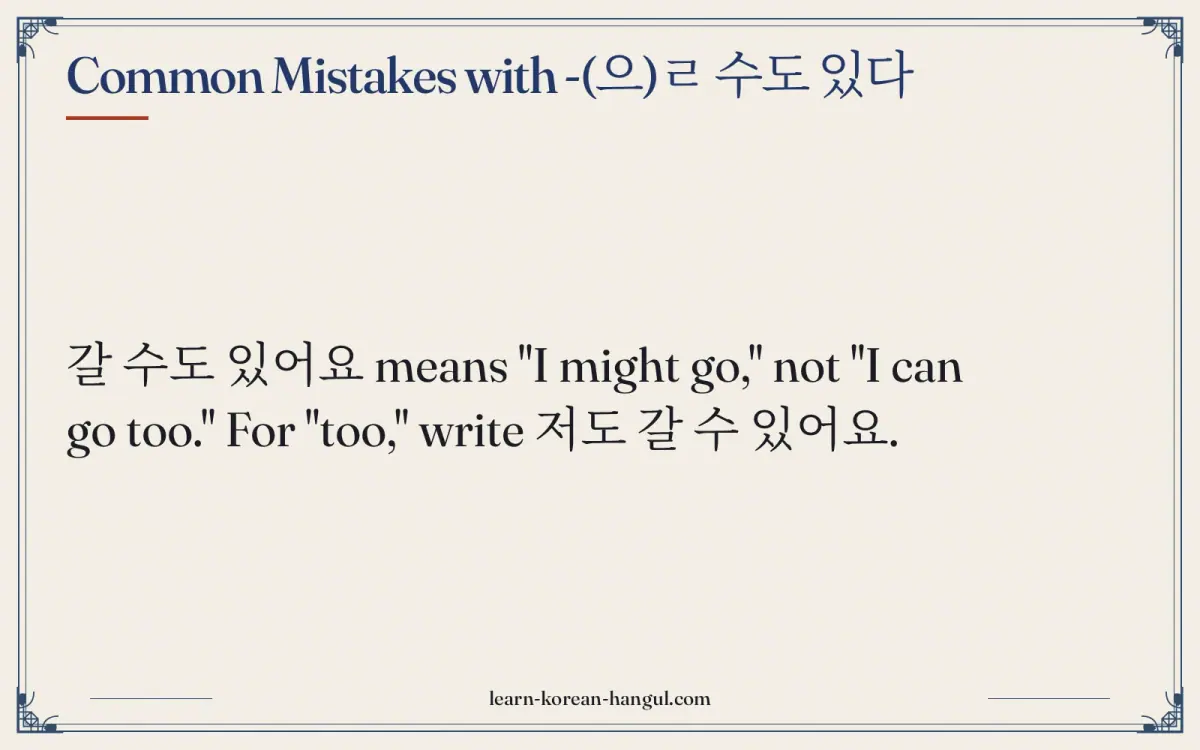
Learners most often get the meaning of 도, the negative or the certainty wrong. Four mistakes appear again and again.
- Reading 도 as "also." Learners translate 갈 수도 있어요 as "I can go too." The sentence means "I might go." To say "too," put 도 on the person or thing: 저도 갈 수 있어요.
- Using it for ability. 한국어를 읽을 수도 있어요 means "I might read Korean," not "I can read Korean." For a skill, use 읽을 수 있어요.
- Using it when the speaker is sure. If the exam is on Friday, say 금요일에 시험이 있어요. Hedging a known fact sounds strange. Use 수도 있다 only when the outcome is open.
- Forming the negative with 없다. 올 수도 없어요 does not mean "He might not come." For that, write 안 올 수도 있어요 or 오지 않을 수도 있어요.
A quick check for any "might" sentence: Is the speaker unsure? Is the word before 수도 a stem in the -(으)ㄹ form (or 일 for a noun)? Does the sentence end in 있다, not 없다? If all three answers are yes, the sentence is sound.
The practice set below tests these four points directly.
Practice and Answers
Try the four items before you read the answer key. Cover the answers with your hand.
- Choose the form. Complete: 내일은 ___. ("It might be cold tomorrow.") (춥다)
- Make it negative. Say "She might not come" in two ways.
- Fix the error. A learner says 수영할 수도 있어요 for "I can swim." Correct the sentence.
- Translate. "I might have lost my wallet." Use 잃어버리다.
Practice · 7
What does 내일은 비가 올 수도 있어요 mean?
Show answer
It might rain tomorrow.
-(으)ㄹ 수도 있다 states a possibility the speaker is not sure about: "it might be that."
Which form completes 시험이 ___ 수도 있어요 ("The exam might be difficult")?
Show answer
어려울
어렵다 is a ㅂ-irregular adjective, so ㅂ becomes 우 before -ㄹ: 어려울.
How do you say "That person might be a teacher"?
Show answer
그 사람은 선생님일 수도 있어요.
Nouns use 이다, and 이 + -ㄹ makes 일: 선생님일 수도 있어요.
Which sentence means "He might not come"?
Show answer
안 올 수도 있어요.
Put the negative inside the pattern: 안 올 수도 있어요. 올 수도 없어요 says that coming is not even possible.
A learner wants to say "I can swim." Which sentence is right?
Show answer
수영할 수 있어요.
Ability uses -(으)ㄹ 수 있다 without 도. 수영할 수도 있어요 means "I might swim."
How do you say "I might have lost my wallet"?
Show answer
지갑을 잃어버렸을 수도 있어요.
A guess about the past puts -았/었 before 을: 잃어버렸을 수도 있어요.
In 저는 갈 수도 있어요, what does 도 do?
Show answer
It hedges the possibility, so the sentence means "I might go."
Here 도 sits on 수 and hedges. To say "I can go too," put 도 on the person: 저도 갈 수 있어요.
Answer key
- 내일은 추울 수도 있어요. 춥다 is a ㅂ-irregular adjective, so ㅂ becomes 우 before -ㄹ: 추울.
- 그 사람은 안 올 수도 있어요. / 그 사람은 오지 않을 수도 있어요.
- 수영할 수 있어요. Ability uses the plain pattern without 도.
- 지갑을 잃어버렸을 수도 있어요. (jigabeul ireobeoryeosseul sudo isseoyo.) The past guess puts -았/었 before 을.
If you can complete items 1 to 3 without the key, you can use the pattern in conversation. Next, the lesson hands off to related patterns.
What Should You Learn Next after -(으)ㄹ 수도 있다 Grammar?
After -(으)ㄹ 수도 있다 grammar, learn the pattern with more doubt, then the pattern with more certainty. This lesson teaches the "might" pattern and does not cover other guessing forms in depth. Those live on their own pages.
- Start with -(으)ㄹ지도 모르다, a close relative that shows more doubt.
- Continue with -(으)ㄹ 것 같다, which shows more certainty.
- Compare the opposite idea in -(으)ㄹ 수밖에 없다, where only one outcome is possible.
- Return to Ability and Possibility to see every lesson in this set, or to the Intermediate Grammar list for other B1 patterns.
With these steps, -(으)ㄹ 수도 있다 becomes automatic: take the stem, add -(으)ㄹ 수도 있어요, and use it only when the outcome is open.
Frequently Asked Questions
What does -(으)ㄹ 수도 있다 mean?
-(으)ㄹ 수도 있다 means "it might be that" or "may." 내일은 비가 올 수도 있어요 means "It might rain tomorrow," and 그 사람이 틀릴 수도 있어요 means "That person could be wrong." The speaker names a real possibility but does not claim it is certain or even likely.
How do I attach -(으)ㄹ 수도 있다 to a verb or adjective?
Take the stem and add -ㄹ 수도 있다 after a vowel or ㄹ (오다 becomes 올 수도 있다) and -을 수도 있다 after another consonant (늦다 becomes 늦을 수도 있다). It works with verbs and adjectives alike. With 이다, use 일 수도 있다. The 수 is always a separate word.
Can -(으)ㄹ 수도 있다 be used in the past tense?
Yes, in two ways. To guess about the past, put -았/었 before 을: 지갑을 잃어버렸을 수도 있어요 means "I might have lost my wallet." To describe a past possibility, change 있다 to 있었다: 늦을 수도 있었어요 means "I could have been late."
Is -(으)ㄹ 수도 있다 used in speech or only in writing?
Both. In conversation, people say 올 수도 있어요 or, to friends, 올 수도 있어. In formal speech, 올 수도 있습니다 is common. In writing, the plain form 올 수도 있다 appears in reports and essays. It is a general hedge, so it fits every speech level.
What is the most common mistake with -(으)ㄹ 수도 있다?
The most common mistake is to treat 도 as "also" and to expect the pattern to say "can." 수영할 수도 있어요 means "I might swim," not "I can swim." For ability, use 수영할 수 있어요. To say "I can go too," put 도 on the person: 저도 갈 수 있어요.
How do I say that something might not happen?
Put the negative inside the pattern: 안 올 수도 있어요 or 오지 않을 수도 있어요, both meaning "He might not come." Do not write 올 수도 없어요. That sentence uses 없다, and it says that coming is not even possible, which is a much stronger claim.