What you'll learn
- Attach -더라 to verbs, adjectives and nouns, in the plain and the past form.
- Tell a friend what you noticed, saw or experienced.
- Use the recall phrases 뭐더라? and 언제였더라?.
- Choose between -더라 and -더라고요, and avoid the common errors.
Before you start: you should know how to find a verb or adjective stem and what casual speech (banmal) is. If banmal is new, read the lesson on casual speech first. It also helps to have met -더라고요, the polite twin of this ending. Audio plays only when you press a button.
What Does -더라 Grammar Mean?
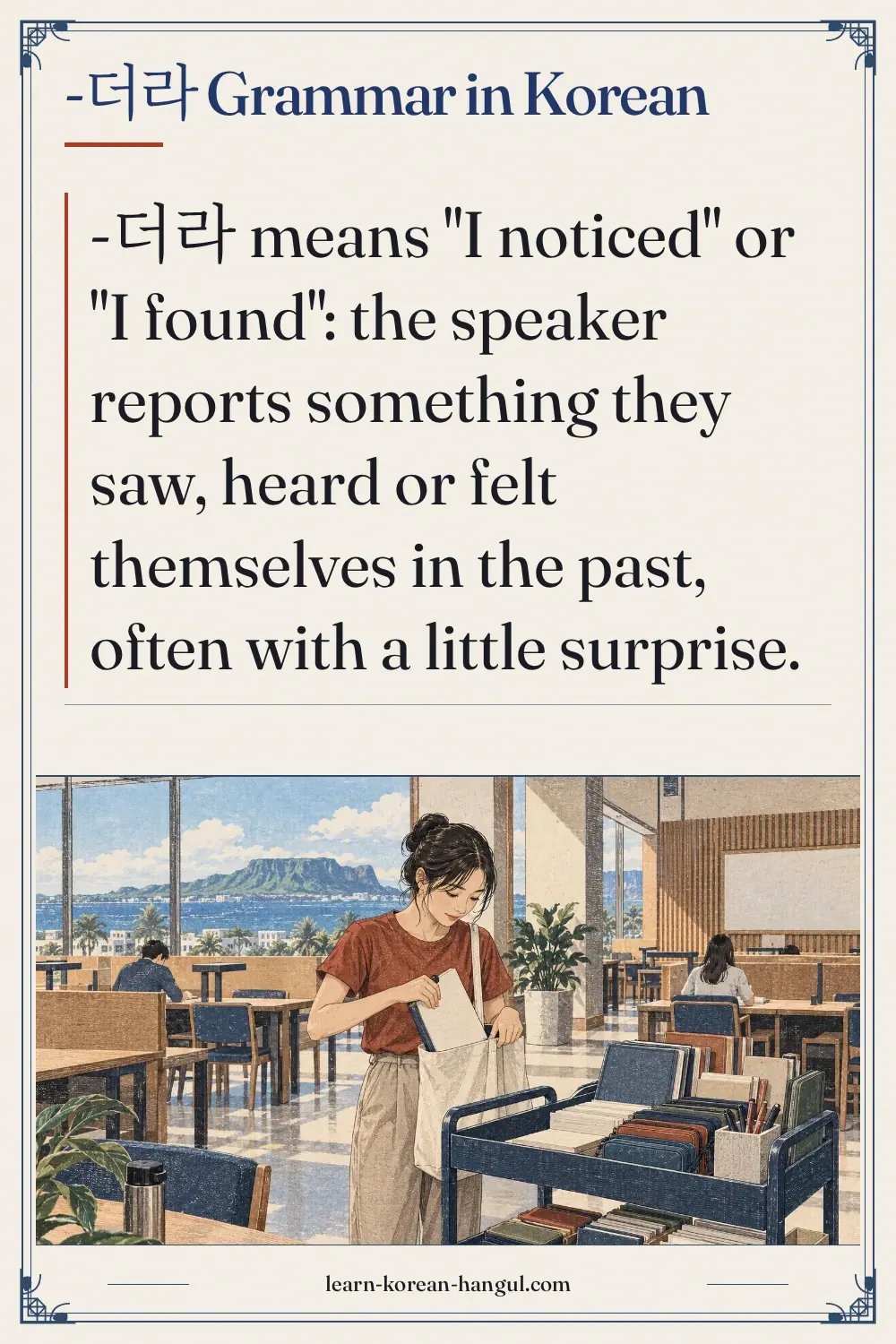
-더라 grammar means "I noticed" and "I found that." It reports something that the speaker experienced directly in the past: seen, heard, tasted or felt. The listener usually did not share the experience, so the sentence carries news. The ending often has a hint of surprise, as if the speaker is still thinking about what they found.
Here are the first two examples. The pattern is the same in both.
- 어제 그 영화 진짜 재미있더라. (eoje geu yeonghwa jinjja jaemiitdeora.) [어제 그 영화 진짜 재미읻떠라] = "That movie yesterday was really fun."
- 걔 키가 크더라. (gyae kiga keudeora.) [걔 키가 크더라] = "He was tall (I noticed)."
Look at the pieces. 재미있 is the stem of 재미있다, and 크 is the stem of 크다. -더라 comes straight after the stem. Inside it, -더- is a marker that means "looking back at what I experienced," and -라 is the casual sentence ending. The first sentence tells the listener that the speaker watched the movie and found it fun. It is not a general statement about the movie. It is a report of one person's experience, and that is why it sounds personal and a little emotional. The sound is worth noticing too. After 있, the ㅆ sounds like ㄷ and the next sound is tensed, so 재미있더라 is spoken [재미읻떠라]. First, the formation.
How Do You Form -더라?
-더라 is formed in two steps: take the plain stem, and add -더라. There is no change at all, and there is no difference between a vowel stem and a consonant stem. For a finished event, put -았/었 between the stem and -더라.
| Dictionary form | Stem | Add -더라 | Past (finished) | Meaning |
|---|---|---|---|---|
| 오다 | 오 | 오더라 | 왔더라 | (He) was coming / had come |
| 먹다 | 먹 | 먹더라 | 먹었더라 | (He) was eating / had eaten |
| 크다 | 크 | 크더라 | 컸더라 | (He) was big / had grown |
| 춥다 | 춥 | 춥더라 | 추웠더라 | It was cold / had been cold |
| 살다 | 살 | 살더라 | 살았더라 | (He) was living / had lived |
| 이다 (시험) | 이 | 시험이더라 | 시험이었더라 | It was an exam |
The table shows one rule applied to six words. Write the ending joined to the stem: 재미있더라. The next three parts look at the groups of stems one at a time.
Stems Ending in a Vowel
A vowel stem takes -더라 directly, and the stem does not change. 오다 becomes 오더라, 크다 becomes 크더라, and 보이다 becomes 보이더라.
- 걔 키가 크더라. = "He was tall (I noticed)."
- 너 어제 피곤해 보이더라. (neo eoje pigonhae boideora.) [너 어제 피곤해 보이더라] = "You looked tired yesterday."
The second sentence shows that -더라 can also describe the listener, when the speaker is reporting what they saw. Vowel stems are the simplest case. A stem with a final consonant works the same way.
Stems Ending in a Consonant
A consonant stem takes -더라 directly as well. 먹다 becomes 먹더라, 춥다 becomes 춥더라, and 맛있다 becomes 맛있더라. The only changes are in the sound.
- 그 식당 음식이 진짜 맛있더라. (geu sikdang eumsigi jinjja masitdeora.) [그 식땅 음시기 진짜 마딛떠라] = "The food at that restaurant was really good."
- 오늘 날씨가 엄청 춥더라. (oneul nalssiga eomcheong chupdeora.) [오늘 날씨가 엄청 춥떠라] = "It was really cold today."
- 그 책 읽어 보니까 생각보다 어렵더라. (geu chaek ilgeo bonikka saenggakboda eoryeopdeora.) [그 책 일거 보니까 생각뽀다 어렵떠라] = "Reading that book, it was harder than I thought."
After a final ㅂ, ㄱ or ㅅ-type sound, the ㄷ of -더라 is tensed, so 춥더라 is [춥떠라] and 어렵더라 is [어렵떠라]. Write the plain spelling and say the sound. Two more groups need a short note, because learners expect trouble with them.
Irregular Stems and Nouns
Here is a pleasant surprise: -더라 starts with a consonant (ㄷ), so irregular stems do not change.
- ㅂ-irregular stems keep the ㅂ: 춥다 becomes 춥더라, not 추워더라. (The ㅂ changes only before a vowel.)
- ㄹ-stems keep the ㄹ: 살다 becomes 살더라, and 만들다 becomes 만들더라.
- ㅡ-stems keep the ㅡ: 바쁘다 becomes 바쁘더라.
- ㄷ-irregular stems keep the ㄷ: 듣다 becomes 듣더라.
- With -았/었, irregular stems change as usual: 춥다 becomes 추웠더라.
Nouns use 이다: 시험이더라 means "It was an exam," as in 달력을 보니까 내일이 시험이더라 (dallyeogeul bonikka naeiri siheomideora) [달려글 보니까 내이리 시허미더라], "Looking at the calendar, the exam is tomorrow." After a vowel, 이 can be dropped in speech: 의사더라 or 의사이더라, "He was a doctor." The past of 이다 is 이었더라 (after a consonant) or 였더라 (after a vowel).
With the formation clear, one full sentence can be built step by step.
Worked Example: Building a Sentence with -더라
-더라 grammar turns a plain statement into "I noticed it." Follow the steps with the statement "The movie I saw yesterday was scary."
- Start with the plain sentence. 어제 본 영화가 무서워요. (eoje bon yeonghwaga museowoyo.) = "The movie I saw yesterday is scary." The predicate is the adjective 무서워요.
- Find the dictionary form and stem. 무서워요 comes from 무섭다. The stem is 무섭.
- Add -더라. The ending does not change the stem, so 무섭 + 더라 = 무섭더라. (Do not use 무서워더라.)
- Add a casual intensifier if you like. 정말 ("really") makes it sound natural.
- Rebuild the sentence. 어제 본 영화가 정말 무섭더라. (eoje bon yeonghwaga jeongmal museopdeora.) [어제 본 영화가 정말 무섭떠라] = "The movie I saw yesterday was really scary."
Sentence
You will know it worked when the subject and the time word stayed in place and the predicate gained 더라. The most common slip at step 3 is changing the stem before -더라, which is only needed before a vowel ending. Each sentence can also appear in several tenses and sentence types, and each has limits.
Which Tenses and Sentence Types Work with -더라?
-더라 works for things you noticed in the past, in the negative, with -았/었 for finished events, as a self-question, and with an honorific subject. It does not express a guess about the future. The table shows the forms for 가다 and 춥다.
| Sentence type | Form | Meaning |
|---|---|---|
| Noticed (ongoing or state) | 춥더라 | It was cold (I felt it). |
| Noticed (finished event) | 갔더라 | (He) had already gone (when I looked). |
| Negative | 안 춥더라 / 춥지 않더라 | It was not cold. |
| Honorific subject | 선생님이 웃으시더라 | The teacher was smiling. |
| Self-question (recall) | 뭐더라? / 언제였더라? | What was it again? / When was it again? |
| Polite form | 춥더라고요 | It was cold (polite). |
| Casual middle form | 춥더라고 | It was cold, you know. |
| Future guess (no evidence) | not used | Use 내일 추울 것 같아. |
The most useful forms in everyday talk are the finished-event form and the recall question. The finished-event form tells a story with a twist:
- 가 보니까 벌써 다 팔렸더라. (ga bonikka beolsseo da pallyeotdeora.) [가 보니까 벌써 다 팔렫떠라] = "When I went, it was already sold out."
- 가 보니 그가 벌써 도착했더라. (ga boni geuga beolsseo dochakaetdeora.) [가 보니 그가 벌써 도차캗떠라] = "When I got there, he had already arrived."
- 가 보니까 문이 닫혀 있더라. (ga bonikka muni dachyeo itdeora.) [가 보니까 무니 다처 읻떠라] = "When I got there, the door was closed."
The recall question uses -더라 as a question to yourself, when you cannot remember a fact: 그 사람 이름이 뭐더라? (geu saram ireumi mwodeora?) [그 사람 이르미 뭐더라] means "What was his name again?" and 언제였더라? (eonjeyeotdeora?) [언제엳떠라] means "When was it again?"
Notice that a sentence with 가 보니까 ("when I went and saw") is a typical frame for -더라, because it names the moment of discovery. The next section compares this ending with the polite one.
How Is -더라 Different from -더라고요?
-더라 and -더라고요 mean the same thing, "I noticed that." They differ in politeness. -더라 is casual, and -더라고요 adds -고요 to make it polite.
| Point | -더라 | -더라고요 |
|---|---|---|
| Speech style | casual (banmal) | polite (haeyo style) |
| Talking to | friends, siblings, younger people | seniors, strangers, colleagues |
| Example | 그 영화 진짜 재미있더라. | 그 영화 진짜 재미있더라고요. |
| Meaning of example | That movie was really fun. | That movie was really fun. |
You cannot make -더라 polite by adding 요 alone: 재미있더라요 is wrong. You need the full -더라고요, or the casual -더라고 for friends. A second neighbour is -던데요, which also reports what you found but leaves the sentence open for a reaction. The ending -더라 is also close to -군요 and -네요, which show surprise at something you notice right now. The difference is time: -네요 and -군요 react to the present moment, and -더라 recalls the past. These contrasts lead to the variations of the pattern itself.
Variations and Edge Cases of -더라
-더라 has four common variations: the polite -더라고요, the casual -더라고, the recall question and the quoted use in stories. Each one is short, and each appears in real conversation.
- Polite -더라고요. For seniors, strangers and colleagues, add -고요: 재미있더라고요.
- Casual -더라고. Between friends, -더라고 sounds softer and a little trailing: 그 영화 진짜 재미있더라고.
- Recall question. 뭐더라? and 언제였더라? work like "What was it again?" when you talk to yourself or to a friend.
- A story frame. Speakers often chain several -더라 clauses in a story: 가 보니까 사람이 진짜 많더라. 그래서 줄을 섰는데 한 시간 걸리더라. ("When I got there, there were so many people. So I stood in line, and it took an hour.")
This lesson covers the common forms used in daily life. It does not cover how -더라 combines with quotation endings, which is a separate topic. The mistakes below show where the boundaries cause real errors.
What Mistakes Do Learners Make with -더라?

Learners most often get the politeness, the subject or the time wrong. Four mistakes appear again and again.
- Adding 요. 재미있더라요 is wrong. The polite form is 재미있더라고요.
- Using it for your own deliberate action. 나는 어제 도서관에 가더라 is wrong, because you cannot "notice" a choice you made. Say 나는 어제 도서관에 갔어. (Feelings and sensations are fine: 나도 먹어 보니까 맛있더라, "I tried it too, and it was good.")
- Using it for a guess about the future. 내일 비가 오더라, said with no source, sounds as if you had already experienced tomorrow. For a guess, say 내일 비가 올 것 같아. If you saw the forecast, name the source: 일기 예보를 보니까 내일 비가 오더라 works, just like 달력을 보니까 내일이 시험이더라.
- Using it with elders. 선생님, 그 영화 재미있더라 sounds rude, because it is casual. Say 선생님, 그 영화 재미있더라고요.
A fifth slip is spelling. Some learners write 재미있드라 because they hear [더라] as [드라]. The standard spelling is -더라, with the vowel ㅓ. A quick check for any sentence with this ending: Did you experience it yourself? Is it in the past? Is the listener someone you speak casually to? If all three answers are yes, the sentence is sound.
The practice set below tests these points directly.
Practice and Answers
Try the four items before you read the answer key. Cover the answers with your hand.
- Translate. "It was really cold today." Use 춥다 and 엄청.
- Choose the form. "When I got there, he had already left." (벌써 가더라 / 벌써 갔더라)
- Make it polite. Change 재미있더라 into a polite sentence for your teacher.
- Write your own. Tell a friend something you noticed yesterday, using -더라.
Practice · 7
What does 어제 그 영화 진짜 재미있더라 mean?
Show answer
I watched it and found it really fun.
-더라 reports something the speaker experienced directly in the past.
Which is the polite form of 재미있더라?
Show answer
재미있더라고요
The polite form is -더라고요. Adding 요 directly to -더라 is wrong.
Which sentence is natural?
Show answer
어제 가 보니 문이 닫혀 있더라.
-더라 reports what you found. It does not suit your own deliberate action, and 요 cannot be added to -더라.
"When I looked, Minsu had already left." 민수가 벌써 ___.
Show answer
갔더라
A finished event takes -았/었 before -더라: 갔더라.
What does 그 사람 이름이 뭐더라? mean?
Show answer
What was his name again?
뭐더라? is a recall question that you ask yourself when you cannot remember something.
With whom can you use 재미있더라 (casual, without 요)?
Show answer
A close friend your age
-더라 is banmal (casual), so it suits close friends and younger people.
How is 맛있더라 pronounced?
Show answer
[마딛떠라]
The ㅆ of 있 sounds like ㄷ, and the ㄷ of 더라 is tensed: [마딛떠라].
Answer key
- 오늘 날씨가 엄청 춥더라. The stem 춥 keeps its ㅂ before -더라.
- 벌써 갔더라. A finished event takes -았/었 before -더라.
- 재미있더라고요. Add -고요, not just 요.
- 어제 본 영화가 정말 무섭더라. (eoje bon yeonghwaga jeongmal museopdeora.) = "The movie I saw yesterday was really scary." Answers vary. Check that the sentence is about something you noticed yourself.
If you can complete items 1 to 3 without the key, you can use the pattern in conversation. Next, the lesson hands off to related patterns.
What Should You Learn Next after -더라 Grammar?
After -더라 grammar, learn the polite version, then the open-ended version that invites a reaction. This lesson teaches the casual ending for what you noticed, and it does not cover reported speech built on -더라. Those live on their own pages.
- Start with -더라고요, the polite version.
- Compare it with -던데요, the open-ended "I noticed, and..."
- Continue with -군요 and -네요, the endings for surprise in the present moment.
- Return to Exclamations and Realization to see every lesson in this set, or to the Advanced Grammar list for other B2 patterns.
With these steps, -더라 becomes automatic: take the plain stem, add 더라, and keep the report about what you noticed.
Frequently Asked Questions
What does -더라 mean?
-더라 means "I noticed that" or "I found that." 어제 그 영화 진짜 재미있더라 means "I watched that movie yesterday, and it was really fun," and 걔 키가 크더라 means "He was tall (I noticed)." The speaker reports something they experienced themselves, often with a little surprise.
How do I attach -더라 to a verb or adjective?
Take the stem and add -더라 with no change: 오다 becomes 오더라, 재미있다 becomes 재미있더라, and 춥다 becomes 춥더라. Irregular stems keep their base form, including ㄹ-stems (살더라). For a finished event, add -았/었: 가다 becomes 갔더라. A noun takes 이더라: 시험이더라.
Can -더라 be used in the past tense?
The ending itself looks back at the time you noticed something. To say that something had already happened when you looked, add -았/었: 벌써 갔더라 means "He had already left (when I got there)." It cannot state a guess about the future: for that, say 내일 비가 올 것 같아. It can report a future fact you saw evidence of, as in 달력을 보니까 내일이 시험이더라.
Is -더라 used in speech or only in writing?
-더라 is mostly spoken. It is casual (banmal), so use it with friends, siblings and younger people, and in stories you tell about your own day. With seniors or strangers, change it to the polite -더라고요. In novels it also appears in dialogue.
What is the most common mistake with -더라?
The most common mistake is adding 요: 재미있더라요 is wrong. The polite form is 재미있더라고요. A second mistake is using -더라 for your own deliberate action, as in 나는 어제 도서관에 가더라. Use 나는 어제 도서관에 갔어 instead.
What is the difference between -더라 and -더라고요?
They mean the same thing, "I noticed that." -더라 is casual and -더라고요 is polite. Use -더라 with friends and -더라고요 with seniors, strangers and colleagues. A casual middle form, -더라고, is also common with friends.