What you'll learn
- Attach -나 싶다 to verbs and -(으)ㄴ가 싶다 to adjectives and nouns.
- Voice a doubt or a worry about the present or the past.
- Explain why the past 싶었어요 is the usual form.
- Pronounce the ending correctly: [나 십따] and [시퍼써요].
- Tell it apart from -지 싶다, -고 싶다 and -나 보다.
Before you start: you should know how to find a verb stem (drop 다 from the dictionary form) and the past endings -았/었-. If stems are new to you, read about verb stems first. Audio plays only when you press a button.
What Does -나 싶다 Grammar Mean?
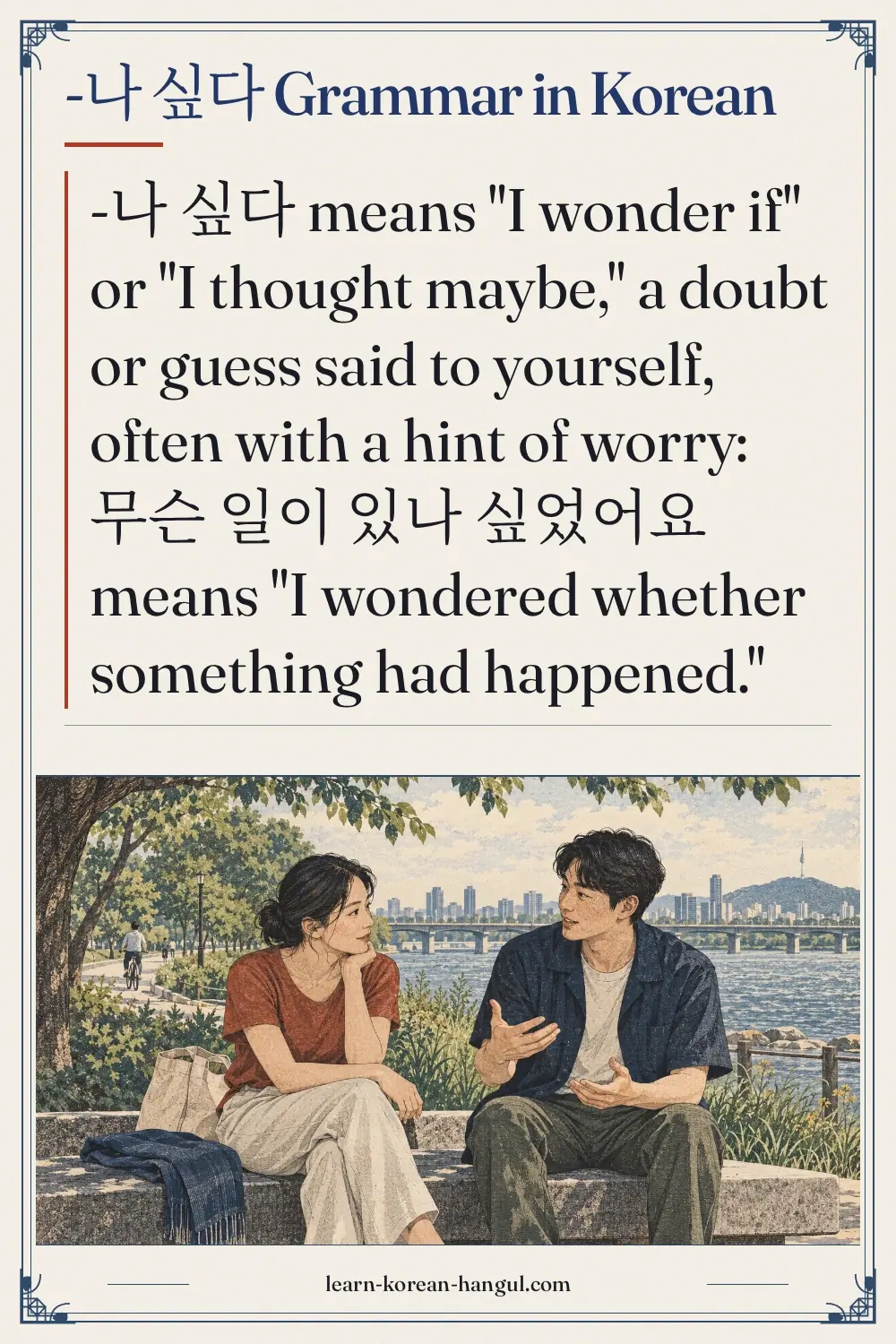
-나 싶다 grammar means "I wonder whether this is so" or "I had a thought that maybe this was so." The ending -나 asks a question to yourself ("is it so?"). The verb 싶다 is not "want" here, but "to feel" or "to think." Together they say: "I wondered, is it so?" The listener hears a private thought, often tinged with concern.
Here are the first two examples. The pattern is the same in both, and only the verb changes.
- 혹시 사고가 났나 싶어서 전화했어요. (hoksi sagoga nanna sipeoseo jeonhwahaesseoyo.) [혹씨 사고가 난나 시퍼서 전화해써요] = "I called because I wondered if there had been an accident."
- 무슨 일이 있나 싶었어요. (museun iri inna sipeosseoyo.) [무슨 니리 인나 시퍼써요] = "I wondered whether something had happened."
In the first sentence, the thought is the reason for an action: the speaker wondered, then phoned. In the second, the thought is simply reported. In both, the speaker does not know the answer and feels a little uneasy. That small worry is what separates -나 싶다 from a neutral guess. The next section shows how to build the pattern.
How Do You Form -나 싶다?
-나 싶다 is formed by dropping 다 from the dictionary form and adding -나 싶다 to a verb, or -(으)ㄴ가 싶다 to an adjective or noun. Add the speech level and time only to the last word, 싶다: 싶어요 (polite), 싶었어요 (polite past), 싶습니다 (formal) or 싶다 (plain).
| Dictionary form | Type | Stem + ending | Polite form | Meaning |
|---|---|---|---|---|
| 오다 | verb | 오나 | 오나 싶어요 | I wonder if he comes |
| 있다 | 있다 word | 있나 | 있나 싶어요 | I wonder if there is |
| 만들다 | ㄹ-verb | 만드나 | 만드나 싶어요 | I wonder if he makes |
| 가다 (past) | verb | 갔나 | 갔나 싶어요 | I wonder if he went |
| 비싸다 | adjective | 비싼가 | 비싼가 싶어요 | I wonder if it is expensive |
| 작다 | adjective | 작은가 | 작은가 싶어요 | I wonder if it is small |
| 학생 | noun | 학생인가 | 학생인가 싶어요 | I wonder if he is a student |
The table shows one rule applied to seven words. The next three parts look at the groups of stems one at a time.
Stems Ending in a Vowel
A verb stem that ends in a vowel takes -나 directly: 오다 becomes 오나, 되다 becomes 되나, and 가다 becomes 가나. For a doubt about something that has happened, add the past ending first: 가 + ㅆ = 갔, so 갔나 싶다.
- 요즘 민수가 왜 안 오나 싶었어요. (yojeum minsuga wae an ona sipeosseoyo.) [요즘 민수가 왜 아노나 시퍼써요] = "I wondered why Minsu is not coming these days."
- 이걸 먹어도 되나 싶어요. (igeol meogeodo doena sipeoyo.) [이걸 머거도 되나 시퍼요] = "I wonder if it is okay to eat this."
The second sentence shows a very common use, 되나 싶다, which asks whether something is allowed or acceptable. Vowel stems are the simplest case. A stem with a final consonant changes the sound, though not the spelling.
Stems Ending in a Consonant
A verb stem that ends in a consonant also takes -나 directly. The final consonant links to ㄴ, and ㅆ and ㅅ change sounds before it: 났나 is spoken [난나], 갔나 is spoken [간나], and 먹었나 is spoken [머건나]. This follows the standard pronunciation rules (표준 발음법) of the 국립국어원 (National Institute of Korean Language) for nasal assimilation, where a final ㄷ-type sound becomes ㄴ before ㄴ.
An adjective that ends in a consonant takes -은가: 작다 becomes 작은가, and 좋다 becomes 좋은가. An adjective that ends in a vowel takes -ㄴ가: 비싸다 becomes 비싼가, and 크다 becomes 큰가.
- 너무 비싼가 싶어요. (neomu bissanga sipeoyo.) [너무 비싼가 시퍼요] = "I wonder if it is too expensive."
- 이 옷이 너무 작은가 싶었어요. (i osi neomu jageunga sipeosseoyo.) [이 오시 너무 자근가 시퍼써요] = "I wondered if this outfit was too small."
Now listen to 싶어요. It is spelled with ㅍ and spoken [시퍼요], and 싶었어요 is spoken [시퍼써요]. Learners who write what they hear, 시퍼요, make a spelling mistake. Two more groups need a short note, because learners expect trouble with them.
Do ㄹ-Stems, Irregular Stems and Nouns Change?
Yes, in a few places. The ending begins with ㄴ, and ㄹ does not stay before ㄴ.
ㄹ-stems drop the ㄹ before -나 and before -ㄴ가: 만들다 gives 만드나 싶다, 살다 gives 사나 싶다, and the adjective 길다 gives 긴가 싶다.
ㅂ-irregular adjectives change before the vowel in -(으)ㄴ가: 춥다 gives 추운가 싶다.
하다 verbs behave like any vowel stem: 연락하다 gives 연락하나 싶다.
있다/없다 words take -나, even when they are used like adjectives: 맛있나 싶다.
이걸 정말 혼자 만드나 싶었어요. (igeol jeongmal honja mandeuna sipeosseoyo.) [이걸 정말 혼자 만드나 시퍼써요] = "I wondered whether he really makes this alone."
방이 너무 추운가 싶어요. (bangi neomu chuunga sipeoyo.) [방이 너무 추운가 시퍼요] = "I wonder if the room is too cold."
For nouns, use the copula 이다 in the form -인가: N + 인가 싶다. After a vowel, the same -인가 is used with the noun: 의사인가 싶다. In the past, use -이었나 (after a consonant) or -였나 (after a vowel).
- 처음에는 학생인가 싶었어요. (cheoeumeneun haksaenginga sipeosseoyo.) [처으메는 학쌩인가 시퍼써요] = "At first I wondered if he was a student."
With the formation clear, one sentence can be built step by step.
Worked Example: Building a Sentence with -나 싶다
-나 싶다 grammar works by turning a worry into a thought. Follow the steps with the idea "I wondered if he had already left."
- Start with the verb. The verb is 가다 (to go). Its dictionary form ends in 다.
- Find the stem. Drop 다. The stem is 가. It ends in the vowel ㅏ.
- Put the guess in the past. The doubt is about something that may have happened, so add -았/었-. 가 + ㅆ = 갔.
- Add -나 싶다. 갔 + 나 싶다 = 갔나 싶다.
- Put the wondering in the past and add a time word. The wondering was earlier, so 싶다 becomes 싶었어요: 벌써 갔나 싶었어요. (beolsseo ganna sipeosseoyo.) [벌써 간나 시퍼써요] = "I wondered if he had already left."
Sentence
I wondered if he had already left.
Show answer
벌써 갔나 싶었어요
You will know it worked when -나 follows the past stem and 싶었어요 comes last as its own word. The most common slip at this step is to write 가고 싶었어요. That sentence means "I wanted to go," because -고 싶다 is the "want" pattern. The sentence is now a thought, but the pattern has limits on tense and sentence type.
Which Tenses and Sentence Types Work with -나 싶다?
-나 싶다 works in the present and the past, in statements and in dependent clauses. There are two places to put tense. The tense of the thing you wonder about goes on the stem (갔나 싶다), and the time of the wondering goes on 싶다 (싶어요, 싶었어요). The table shows forms for 있다.
| Type | Form | Meaning |
|---|---|---|
| Polite present | 있나 싶어요 | I wonder if there is. |
| Polite past | 있나 싶었어요 | I wondered if there was. |
| Past guess | 있었나 싶어요 | I wonder if there was (earlier). |
| Formal | 있나 싶습니다 | I wonder if there is (formal). |
| Casual | 있나 싶어 | I wonder if there is (to a friend). |
| Plain thought | 있나 싶다 | I wonder if there is (to oneself). |
The polite 싶어요 is spoken [시퍼요], the past 싶었어요 is spoken [시퍼써요], and the formal 싶습니다 is spoken [십씀니다].
The past 싶었어요 is more common than the present, because people usually report a doubt they had earlier: "I wondered, then I checked." The present 싶어요 is used for a doubt you hold right now.
- 무슨 일이 있나 싶습니다. (museun iri inna sipseumnida.) [무슨 니리 인나 십씀니다] = "I wonder whether something has happened."
The pattern is not a question to the listener. 있나 싶어요? does not ask "Is there?" The listener hears your private thought. It is also not a command or a suggestion. To ask a listener, use a plain question ending such as 있어요?. The most useful contrast for a learner is next to the pattern it is closest to.
How Is -나 싶다 Different from -지 싶다?
-나 싶다 voices a doubt, while -지 싶다 gives a mild belief. Both use 싶다 for a thought in the speaker's head, and they differ by one syllable.
| Point | -나 싶다 | -지 싶다 |
|---|---|---|
| Meaning | I wonder if | I suspect that |
| Feeling | a doubt, often with worry | a mild belief, leaning to yes |
| Attaches to | verb stem + 나, adjective stem + (으)ㄴ가 | any stem + 지 |
| Example | 그게 맞나 싶어요. | 그게 맞지 싶어요. |
| Meaning of example | I wonder if that is right. | I suspect that is right. |
The first speaker is unsure and may hope the answer is no. The second speaker thinks the answer is probably yes. The full rules are on the page for -지 싶다.
Two other neighbours are worth knowing.
- -나 보다 is a guess based on evidence you can see or hear. 비가 오나 봐요 (biga ona bwayo) [비가 오나 봐요] means "It looks like it is raining" (because you see wet umbrellas). 비가 오나 싶어요 means "I wonder if it will rain." One is an inference from evidence, and the other is a private doubt. See -나 보다 and -(으)ㄴ가 보다.
- -고 싶다 means "want to." It looks similar, but 가고 싶어요 is "I want to go" and 가나 싶어요 is "I wonder if he goes." See -고 싶다.
For a plain future statement, see future tense -(으)ㄹ 거예요 and future guess -겠-. These contrasts lead to the smaller variations of the pattern itself.
Variations and Edge Cases of -나 싶다
-나 싶다 has three common variations: the reason ending 싶어서, the surprise ending 싶었는데 and the plain 싶다 of thought. Each one appears in real conversation.
- The reason ending -나 싶어서. It gives the doubt as the reason for an action, as in the first example on this page: 사고가 났나 싶어서 전화했어요 ("I called because I wondered if there had been an accident"). The doubt came first, and the action followed.
- The surprise ending -나 싶었는데. It sets up a surprise: 갔나 싶었는데 다시 왔어요 (ganna sipeonneunde dasi wasseoyo) [간나 시펀는데 다시 와써요] means "I thought he had left, but he came back." The first part is what you assumed, and the second part breaks it.
- The plain 싶다 of thought. In diaries, posts and subtitles, the plain form shows an inner voice: 내가 너무 늦었나 싶다 ("I wonder if I'm too late").
Also keep in mind two points about use. First, the doubt can be mild, as when 되나 싶다 asks whether something is allowed, or it can be strong, as when someone fears an accident. Second, -나 싶다 is about your own thinking, so it often has "I" as the thinker even when the subject of the clause is someone else. This lesson covers the usual meaning of "I wonder if." The mistakes below show where the boundary causes real errors.
What Mistakes Do Learners Make with -나 싶다?
Learners most often get the form, the spelling or the meaning wrong. Four mistakes appear again and again.
- Attaching -나 to an adjective. Textbooks and careful speech use -(으)ㄴ가 with adjectives and nouns: 비싼가 싶어요, 학생인가 싶어요. You may hear 비싸나 싶어요 in casual talk, but learn the -(으)ㄴ가 form first.
- Keeping ㄹ before -나. 만들나 싶어요 is wrong. The ㄹ drops: 만드나 싶어요.
- Confusing it with -고 싶다. 가고 싶어요 means "I want to go," but 가나 싶어요 means "I wonder if he goes." Look at the syllable before 싶: 나 is a doubt, and 고 is a wish.
- Using the present when the doubt is past. In English, "I wondered" is natural, but learners write 싶어요. Use 싶었어요 for a doubt you had earlier.
A quick check for any "I wonder" sentence: Is the verb followed by -나 (or the adjective by -(으)ㄴ가)? Is 싶다 a separate word? Is the speaker truly unsure? If all three answers are yes, the sentence is sound.
The practice set below tests these points directly.
Practice and Answers
Try the four items before you read the answer key. Cover the answers with your hand.
- Choose the form. Complete: 방이 너무 추운___ 싶어요. (나 / 가 / 고)
- Fix the error. A learner writes 이걸 만들나 싶었어요. Correct it.
- Translate. "I wondered if the roads would be jammed, so I left early." Use 막히다 and 출발하다.
- Write your own. Write one sentence about a worry you had, using -나 싶었어요. Then rewrite it with a belief, using -지 싶었어요.
Practice · 6
What does 무슨 일이 있나 싶었어요 mean?
Show answer
I wondered if something had happened.
-나 싶다 voices a doubt, "I wonder if." The past 싶었어요 means the wondering happened earlier.
Which ending fits the adjective 비싸다 (to be expensive)?
Show answer
비싼가 싶어요
Adjectives take -(으)ㄴ가: 비싼가 싶어요. 비싸고 싶어요 would wrongly use the "want" pattern.
Which form is correct for 만들다 (to make)?
Show answer
만드나 싶어요
ㄹ-stems drop the ㄹ before -나, so 만들다 gives 만드나 싶어요.
Which sentence means "I wonder if it is okay to eat this"?
Show answer
이걸 먹어도 되나 싶어요.
되나 싶다 wonders whether something is allowed. 먹고 싶어요 means "I want to eat this," and 먹을 수 없어요 means "I cannot eat this."
Which sentence means "At first I wondered if he was a student"?
Show answer
처음에는 학생인가 싶었어요.
For nouns, use N인가 싶다. 학생이고 싶었어요 would mean "I wanted to be a student."
How is 갔나 싶어요 spoken?
Show answer
[간나 시퍼요]
The final ㅆ is pronounced [ㄷ] and then becomes [ㄴ] before ㄴ: [간나]. 싶어요 is spoken [시퍼요].
Answer key
- 가. The adjective 춥다 becomes 추운, and -(으)ㄴ가 follows: 추운가 싶어요.
- 이걸 만드나 싶었어요. The ㄹ of 만들다 drops before -나.
- 길이 막히나 싶어서 일찍 출발했어요. (giri makina sipeoseo iljjik chulbalhaesseoyo.) [기리 마키나 시퍼서 일찍 출발해써요] = "I wondered if the roads would be jammed, so I left early."
- Answers vary. Check that -나 is attached to the stem, 싶다 is separate, and the belief version ends in 지 싶었어요. An example: 늦었나 싶었어요 → 늦었지 싶었어요.
If you can complete items 1 to 3 without the key, you can use the pattern in conversation. Next, the lesson hands off to related patterns.
What Should You Learn Next?
You now know how to voice a doubt with "I wonder if." Continue with -지 싶다, which gives a soft belief instead of a doubt. Then learn -나 보다 for a guess based on evidence. All the related lessons are collected under Guessing and Conjecture. The pattern also sits at level B2 on the Advanced Grammar list.
This page covers the meaning, the formation and the common mistakes of -나 싶다. It does not cover every use of 싶다, such as -ㄹ까 싶다. Level placement here is an editorial estimate from textbook syllabi. For official exam information, see topik.go.kr.
Frequently Asked Questions
What does -나 싶다 mean?
-나 싶다 means "I wonder if" or "I thought maybe." It voices a doubt or a guess in the speaker's mind, often with a little worry. 혹시 사고가 났나 싶어서 전화했어요 means "I called because I wondered if there had been an accident." It is not a question for the listener to answer.
How do I attach -나 싶다 to a verb or adjective?
For verbs and for 있다/없다 words, drop 다 and add -나 싶다: 오다 gives 오나 싶다, and 있다 gives 있나 싶다. ㄹ-stems drop ㄹ: 만들다 gives 만드나 싶다. For adjectives, use -(으)ㄴ가 싶다: 비싸다 gives 비싼가 싶다, 작다 gives 작은가 싶다, and 길다 gives 긴가 싶다. For nouns, use N인가 싶다: 학생인가 싶다.
Can -나 싶다 be used in the past tense?
Yes, in two places. The tense of the thing you wonder about goes on the stem (갔나 싶다, 작았나 싶다), and the time of the wondering goes on 싶다 (싶어요 now, 싶었어요 before). The past 싶었어요 is the most common form, because people usually describe a doubt they had earlier.
Is -나 싶다 used in speech or only in writing?
It is mostly spoken, and it also appears in informal writing such as blogs and messages. It sounds like thinking aloud. 싶어서 gives the reason for an action, as in 걱정돼서 전화했어요, and -나 싶었는데 sets up a surprise, as in 갔나 싶었는데 다시 왔어요 ("I thought he had left, but he came back").
What is the most common mistake with -나 싶다?
The most common mistake is keeping the ㄹ of an ㄹ-stem: 만들나 싶어요 is wrong, and 만드나 싶어요 is right. With adjectives and nouns, learn -(으)ㄴ가 first: 비싼가 싶어요. A third mistake is confusing it with -고 싶다: 가고 싶어요 means "I want to go," but 가나 싶어요 means "I wonder if he goes."
What is the difference between -나 싶다 and -지 싶다?
Both use 싶다 for a thought in the speaker's head. -나 싶다 voices a doubt or a worry, as in 맞나 싶어요 ("I wonder if it is right"). -지 싶다 gives a mild belief that leans toward yes, as in 맞지 싶어요 ("I suspect it is right").