
What you'll learn
- Attach -(으)면 to a verb, an adjective or a noun.
- Give short instructions: "Just do this" and "This is enough."
- Ask "What should I do?" with 어떻게 하면 돼요?
- Explain why 되다 means "be enough" here, not "become."
- Tell -(으)면 되다 apart from -아/어도 되다 and the plain connector -(으)면.
Before you start: you should know how to find a verb stem (drop 다 from the dictionary form). If stems are new to you, read about verb stems first. Audio plays only when you press a button.
What Does -(으)면 되다 Grammar Mean?
-(으)면 되다 grammar means "if you do this, that is enough." It is built from -(으)면, which means "if," and 되다, which here means "to be enough" or "to work out." Together they say "it is fine as long as you do this." The speaker points to the single action that matters and leaves everything else out.
Here are the first two examples. The pattern is the same in both, and only the verb changes.
- 이 버튼을 누르면 돼요. (i beoteuneul nureumyeon dwaeyo.) = "You just press this button."
- 내일까지 내면 돼요. (naeilkkaji naemyeon dwaeyo.) = "Handing it in by tomorrow is fine."
The first sentence is an instruction. The second sentence is a reassurance: it tells the listener that the limit is tomorrow and no earlier. Both use the same idea of a minimum that is enough.
Because the meaning is "enough," not "allowed," the pattern is different from permission. It says nothing about what you may or may not do. It says what you must do at least. The next section shows how to build the pattern.
How Do You Form -(으)면 되다?
-(으)면 되다 is formed by dropping 다 from the dictionary form, adding -면 or -으면 to the stem, and then adding 되다. If the stem ends in a vowel or ㄹ, add -면. If it ends in any other consonant, add -으면. The linking 으 only appears after a consonant.
| Dictionary form | Stem | Stem + -(으)면 | Polite form | Meaning |
|---|---|---|---|---|
| 누르다 | 누르 | 누르면 | 누르면 돼요 | just press |
| 쓰다 | 쓰 | 쓰면 | 쓰면 돼요 | just write |
| 오다 | 오 | 오면 | 오면 돼요 | just come |
| 먹다 | 먹 | 먹으면 | 먹으면 돼요 | just eat |
| 열다 | 열 | 열면 | 열면 돼요 | just open |
| 기다리다 | 기다리 | 기다리면 | 기다리면 돼요 | just wait |
| 하다 | 하 | 하면 | 하면 돼요 | just do |
The table shows one rule applied to seven verbs. The next three parts look at the groups of stems one at a time.
Stems Ending in a Vowel
A vowel stem takes -면 directly. 쓰다 becomes 쓰면, 오다 becomes 오면, and 기다리다 becomes 기다리면. Examples:
- 여기에 이름을 쓰면 돼요. (yeogie ireumeul sseumyeon dwaeyo.) [여기에 이르믈 쓰면 돼요] = "You just write your name here."
- 일곱 시까지 오면 돼요. (ilgop sikkaji omyeon dwaeyo.) [일곱 씨까지 오면 돼요] = "Coming by seven is fine."
Vowel stems are the simplest case. A stem with a final consonant needs one small extra sound.
Stems Ending in a Consonant
A consonant stem takes -으면. The 으 helps the consonant link to ㅁ: 먹 + 으면 = 먹으면, 읽 + 으면 = 읽으면, 앉 + 으면 = 앉으면. The only exception is a stem that ends in ㄹ, which takes -면.
- 이 약은 하루에 두 번 먹으면 돼요. (i yageun harue du beon meogeumyeon dwaeyo.) [이 야근 하루에 두 번 머그면 돼요] = "You just take this medicine twice a day."
- 이 문을 열면 돼요. (i muneul yeolmyeon dwaeyo.) [이 무늘 열면 돼요] = "You just open this door."
The spelling keeps the final consonant, but the sound moves to the next syllable: 먹으면 is spoken [머그면]. This follows the standard pronunciation rules (표준 발음법) of the 국립국어원 (National Institute of Korean Language) for linking a final consonant to a following vowel.
Two more groups need a short note, because learners expect trouble with them.
Do Irregular Stems, Adjectives and Nouns Change?
Irregular stems change only before an ending that starts with a vowel. Here the ending starts with -으, so the ㄷ and ㅂ classes change, while 르-verbs and ㄹ-stems do not:
- ㄷ-irregular: 듣다 becomes 들으면 돼요 ("You just listen").
- ㅂ-irregular: 돕다 becomes 도우면 돼요 ("You just help").
- 르-verbs keep 르 before 면: 누르다 becomes 누르면 돼요.
- ㄹ-stems take -면: 만들다 becomes 만들면 돼요.
Adjectives take the same ending, and the meaning becomes "it is enough if it is...": 값이 싸면 돼요 (gapsi ssamyeon dwaeyo) [갑씨 싸면 돼요] = "It is enough if the price is low."
Nouns use the copula 이다 and attach -(이)면: after a vowel, add 면 (커피면 돼요); after a consonant, add 이면 (물이면 돼요). 커피면 돼요 (keopimyeon dwaeyo) = "Coffee will do." This is a very common way to order or accept something without being fussy.
With the formation clear, one sentence can be built step by step.
Worked Example: Building a Sentence with -(으)면 되다
-(으)면 되다 grammar works by turning an action into the only thing needed. Follow the steps with the idea "You just press this button."
- Start with the verb. The verb is 누르다 (to press). Its dictionary form ends in 다.
- Find the stem. Drop 다. The stem is 누르. It ends in the vowel ㅡ.
- Choose -면 or -으면. The stem ends in a vowel, so choose -면. 누르 + 면 = 누르면.
- Add 되다 in the polite style. 되다 becomes 돼요.
- Rebuild the sentence. Put the object first: 이 버튼을 누르면 돼요. (i beoteuneul nureumyeon dwaeyo.) = "You just press this button."
Sentence
You just press this button.
Show answer
이 버튼을 누르면 돼요
You will know it worked when the object (이 버튼을) stays in front and the last two words are the -면 form and 돼요. The most common slip at this step is to use the polite form before 면, as in 눌러요면 돼요. Always work from the stem. The sentence is now an instruction, but the pattern has limits on tense and sentence type.
Which Tenses and Sentence Types Work with -(으)면 되다?
-(으)면 되다 works in the present, the past and the future guess, in statements and in questions. All changes happen on 되다, the last word. The table shows the forms for 하다.
| Sentence type | Form | Meaning |
|---|---|---|
| Polite statement | 하면 돼요 | You just do it. |
| Polite question | 하면 돼요? | Is it enough to do it? |
| Wh-question | 어떻게 하면 돼요? | What should I do? |
| Past | 하면 됐어요 | Doing it was enough. |
| Formal | 하면 됩니다 | It is enough to do it (announcements). |
| Casual | 하면 돼 | You just do it (to a friend). |
| Confirming | 하면 되죠? | I just do it, right? |
In a yes/no question, a rising tone is normal: 하면 돼요? asks "Is that enough?" A wh-question puts the stress on the question word and usually ends with a fall or a rise-fall, not a sharp rise: 어떻게 하면 돼요? asks "What should I do?"
- 어떻게 하면 돼요? (eotteoke hamyeon dwaeyo?) [어떠케 하면 돼요] = "What should I do?"
- 어제는 전화만 하면 됐어요. (eojeneun jeonhwaman hamyeon dwaesseoyo.) = "Yesterday I only had to call."
The past form 됐어요 is spoken [돼써요]. The pattern is not used for commands. For a direct request, use a polite command such as 누르세요. The most useful contrast for a learner is next to the pattern that gives permission.
How Is -(으)면 되다 Different from -아/어도 되다?
-(으)면 되다 says what is enough, while -아/어도 되다 says what is allowed. The two look alike because both end in 돼요, but they answer different questions. One answers "What do I need to do?" and the other answers "Am I allowed to do it?"
| Point | -(으)면 되다 | -아/어도 되다 |
|---|---|---|
| Meaning | all you need to do is | may, it's okay to |
| Function | gives the minimum | gives permission |
| Attaches to | stem + (으)면 | stem + 아/어도 |
| Example | 먹으면 돼요. | 먹어도 돼요. |
| Meaning of example | Just eat. That is enough. | You may eat. |
The pattern 먹으면 돼요 would answer a question such as "How do I take this medicine?" The pattern 먹어도 돼요 would answer "Can I eat this?" The side-by-side lesson is -아/어도 되다 vs -(으)면 되다, and the lesson on -아/어도 되다 has the permission pattern in full.
A second neighbour is the plain connector -(으)면 (if, when). The connector sets up a condition, and the main clause can be any sentence type: 비가 오면 집에 있어요 ("If it rains, I stay home"). In -(으)면 되다, the clause after the condition is always 되다, and it means "is enough." A third neighbour is 안 되다, the prohibition, which flips the meaning: 먹으면 안 돼요 means "You must not eat." See -(으)면 안 되다. These contrasts lead to the smaller variations of the pattern itself.
Variations and Edge Cases of -(으)면 되다
-(으)면 되다 has four common variations: a limiter with 만, a stronger -기만 하면, an honorific form and a set phrase. Each one appears in real conversation.
- With 만 ("only"). Add 만 after the object to say that nothing else is needed: 이름만 쓰면 돼요 means "You only have to write your name." The particle 만 is explained in the particles lessons.
- -기만 하면 되다. Put 기만 before 하면 for "all you have to do is...": 누르기만 하면 돼요 (nureugiman hamyeon dwaeyo) = "You only have to press." The connector is covered by -기만 하면.
- Honorific -(으)시-. Add -(으)시- to speak to a customer or an older person: 이쪽으로 오시면 돼요 (ijjogeuro osimyeon dwaeyo) [이쪼그로 오시면 돼요] = "You just come this way." The full rule is on honorific -(으)시-.
- 됐어요 as a reply. 됐어요 can also mean "That is enough" or "No, thank you." 아니요, 됐어요 (aniyo, dwaesseoyo) is a normal polite refusal of an offer, but a flat tone can sound abrupt. Add 고맙습니다 or 괜찮아요 to soften it.
This lesson covers the instruction and reassurance uses in daily life, not every use of 되다. Obligation ("have to") and the negative ("don't have to") belong to different patterns. The mistakes below show where the boundary causes real errors.
What Mistakes Do Learners Make with -(으)면 되다?
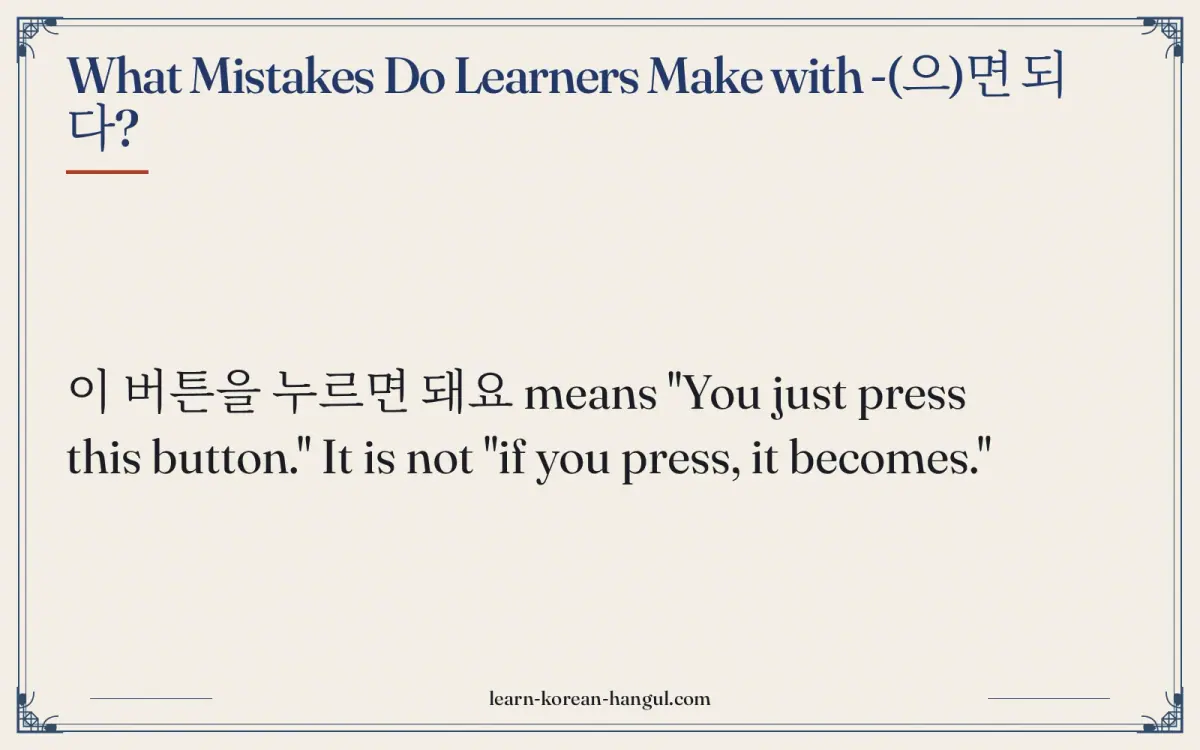
Learners most often get the meaning, the stem or the pattern choice wrong. Four mistakes appear again and again.
- Translating 되다 as "become." 먹으면 돼요 does not mean "if you eat, it becomes." It means "eating is enough." In this pattern, 되다 describes success or sufficiency.
- Using -어요 before 면. 눌러요면 and 와요면 are wrong. Always use the stem: 누르면, 오면.
- Using -으면 after ㄹ. 열으면 is wrong. A stem ending in ㄹ takes -면: 열면.
- Using it for permission. To ask "May I eat?", use 먹어도 돼요?, not 먹으면 돼요?. The question 먹으면 돼요? would mean "Is it enough to eat?"
A quick check for any "all you need" sentence: Is the stem followed by -(으)면? Is 되다 describing what is enough, not what is allowed? Does the sentence answer "What do I need to do?" If all three answers are yes, the sentence is sound.
The practice set below tests these four points directly.
Practice and Answers
Try the four items before you read the answer key. Cover the answers with your hand.
- Choose the form. Complete: 이 약을 하루에 두 번 ___ . (먹으면 돼요 / 먹면 돼요)
- Fix the error. A learner says 눌러요면 돼요. Correct it.
- Translate. "You just sign here." Use 서명하다 and the polite style.
- Write your own. Write one instruction for a phone, a ticket machine or a form using -(으)면 돼요. Then add 만 or -기만 to make it shorter.
Practice · 6
Which sentence means "You just press this button"?
Show answer
이 버튼을 누르면 돼요.
-(으)면 돼요 says what is enough. -아/어도 돼요 gives permission, and -(으)면 안 돼요 forbids.
Add -(으)면 되다 to 먹다. Which form is correct?
Show answer
먹으면 돼요
A stem ending in a consonant other than ㄹ takes -으면.
Which sentence means "Coffee will do"?
Show answer
커피면 돼요.
A noun takes -(이)면 되다. 커피 ends in a vowel, so only 면 is added: 커피면 돼요.
In 이름만 쓰면 돼요, what does 돼요 mean?
Show answer
is enough
Here 되다 means "to be enough." The sentence means "You only have to write your name."
You want to ask "May I eat this?" Which question is right?
Show answer
이거 먹어도 돼요?
Permission uses -아/어도 돼요?. 먹으면 돼요? asks "Is it enough to eat?"
Add -(으)면 되다 to 열다 (to open). Which form is correct?
Show answer
열면 돼요
A stem ending in ㄹ takes -면: 열면 돼요.
Answer key
- 먹으면 돼요. 먹 ends in a consonant other than ㄹ, so it takes -으면.
- 누르면 돼요. Use the stem 누르, not the polite form 눌러요.
- 여기에 서명하면 돼요. (yeogie seomyeonghamyeon dwaeyo.) = "You just sign here."
- Answers vary. Check that -(으)면 is attached to the stem and 돼요 ends the sentence. An example: 이 버튼을 누르면 돼요 → 누르기만 하면 돼요.
If you can complete items 1 to 3 without the key, you can use the pattern in conversation. Next, the lesson hands off to related patterns.
What Should You Learn Next after -(으)면 되다 Grammar?
After -(으)면 되다 grammar, learn the permission pattern, then the prohibition. This lesson teaches the "enough" pattern and does not cover permission, prohibition or obligation in depth. Those live on their own pages.
- Start with -아/어도 되다, which gives permission.
- Continue with -(으)면 안 되다, which forbids.
- Compare the pair side by side in -아/어도 되다 vs -(으)면 되다.
- For the plain "if" connector, read -(으)면. For requests not to do something, see -지 마세요 don't and -지 않다 negation.
- Return to Obligation and Permission to see every lesson in this set, or to the Beginner Grammar list for other A2 patterns.
With these steps, -(으)면 되다 becomes automatic: take the stem, add -(으)면, and finish with 돼요.
Frequently Asked Questions
What does -(으)면 되다 mean?
-(으)면 되다 means "all you need to do is" or "it is enough if." It names the one thing that reaches the goal. 이 버튼을 누르면 돼요 means "You just press this button," and 내일까지 내면 돼요 means "Handing it in by tomorrow is fine." It gives instructions without listing every step.
How do I attach -(으)면 되다 to a verb or adjective?
Drop 다 and add -면 if the stem ends in a vowel or ㄹ, or -으면 if it ends in another consonant. 누르다 gives 누르면 돼요, 열다 gives 열면 돼요, and 먹다 gives 먹으면 돼요. Adjectives work too: 싸면 돼요 means "Cheap is enough." A noun takes -(이)면: 커피면 돼요.
Can -(으)면 되다 be used in the past tense?
Yes. The past marker goes on 되다: 어제는 전화만 하면 됐어요 means "Yesterday I only had to call." The speaker looks back at what was enough. The same word 됐어요 can also be a short reply meaning "That is enough, thank you," which can sound brusque if the tone is flat.
Is -(으)면 되다 used in speech or only in writing?
It is used mostly in speech. Staff, teachers and friends give quick instructions with it: 여기에 이름만 쓰면 돼요. In signs and manuals, writers prefer imperatives or the formal 됩니다. The casual form 하면 돼 is fine with friends, and the polite form 하면 돼요 suits most strangers.
What is the most common mistake with -(으)면 되다?
The most common mistake is translating it as "if it becomes." Here 되다 does not mean "become." It means "be enough" or "be fine." 먹으면 돼요 therefore means "Eating is enough," not "If you eat, it becomes." A second slip is confusing it with -아/어도 되다, which gives permission.