What you'll learn
- Attach -아/어 주시면 감사하겠습니다 to regular and irregular verbs.
- Understand the four parts: 주시- (honorific), -(으)면, 감사하다 and -겠-.
- Choose between this pattern, -아/어 주세요 and -아/어 주시겠어요?.
- Use it in emails and avoid the usual honorific errors.
Before you start: you should know -아/어 주세요, the honorific -(으)시- and the formal ending -습니다. Time: about 30 minutes. This site places the pattern at level B2, which is an editorial estimate. The official TOPIK information is published at topik.go.kr.
What Does -아/어 주시면 감사하겠습니다 Grammar Mean?
-아/어 주시면 감사하겠습니다 means "I would be grateful if you would do this for me." It is a request, but it is phrased as a wish, so it does not push. English has the same idea: "I would appreciate it if you could confirm by Friday."
The pattern has four working parts.
| Part | Form | Job |
|---|---|---|
| Verb + helper | -아/어 주시- | "do it for me", with respect for the listener |
| Conditional | -(으)면 | "if" |
| Gratitude | 감사하- | "be grateful" |
| Formal ending | -겠습니다 | modest wish, in the formal style |
Read together, the sentence says "If you do it for me, I will be grateful." The honorific 시 shows respect for the person who does the favour. The 겠 is not a plain future here. It softens the statement so that it reads as a modest wish.
A First Example
Listen to each sentence at normal speed.
1. 확인해 주시면 감사하겠습니다. (hwaginhae jusimyeon gamsahagetseumnida.) "I would appreciate it if you could check."
Pronunciation: [화긴해 주시면 감사하겓씀니다]. The ㄱ of 확 moves to the next syllable, so 확인 sounds like [화긴]. In fast everyday speech the ㅎ of 해 often weakens after ㄴ, so you may hear [화기내]. The ㅆ of 겠 is said as [ㄷ] before the ㅅ of 습.
2. 회신해 주시면 감사하겠습니다. (hoesinhae jusimyeon gamsahagetseumnida.) "I would be grateful for your reply."
Pronunciation: [회신해 주시면 감사하겓씀니다].
Both sentences end the request politely. The speaker does not say "Please reply." The speaker says "I will be grateful if you reply."
How Do You Form -아/어 주시면 감사하겠습니다?
Take the verb, make its -아/어 form, then add 주시면 감사하겠습니다. This is the same -아/어 form that you use in 해요-style sentences, so you already know it.
- Make the -아/어 form. Use 아 after ㅏ or ㅗ, and 어 after any other vowel. 하다 becomes 해.
- Add 주시면. This is the honorific 주시다 ("give") with -(으)면.
- Add 감사하겠습니다. This part does not change.
| Dictionary form | -아/어 form | With the pattern | RR |
|---|---|---|---|
| 확인하다 (to check) | 확인해 | 확인해 주시면 감사하겠습니다 | hwaginhae jusimyeon gamsahagetseumnida |
| 보내다 (to send) | 보내 | 보내 주시면 감사하겠습니다 | bonae jusimyeon gamsahagetseumnida |
| 닫다 (to close) | 닫아 | 닫아 주시면 감사하겠습니다 | dada jusimyeon gamsahagetseumnida [다다 주시면] |
| 알리다 (to inform) | 알려 | 알려 주시면 감사하겠습니다 | allyeo jusimyeon gamsahagetseumnida |
| 기다리다 (to wait) | 기다려 | 기다려 주시면 감사하겠습니다 | gidaryeo jusimyeon gamsahagetseumnida |
| 돕다 (to help) | 도와 | 도와주시면 감사하겠습니다 | dowajusimyeon gamsahagetseumnida |
| 듣다 (to listen) | 들어 | 들어 주시면 감사하겠습니다 | deureo jusimyeon gamsahagetseumnida |
| 쓰다 (to write) | 써 | 써 주시면 감사하겠습니다 | sseo jusimyeon gamsahagetseumnida |
The irregular verbs behave as they always do before -아/어. 돕다 (ㅂ-irregular) becomes 도와 (and 도와주다 is one dictionary word, so it is written without a space), 듣다 (ㄷ-irregular) becomes 들어, and 쓰다 (ㅡ-verb) becomes 써. The part after the -아/어 form never changes.
Regular and 하다 Verbs
내일까지 서류를 보내 주시면 감사하겠습니다. (naeilkkaji seoryureul bonae jusimyeon gamsahagetseumnida.) "I would appreciate it if you could send the documents by tomorrow."
Pronunciation: [내일까지 서류를 보내 주시면 감사하겓씀니다].
일정을 알려 주시면 감사하겠습니다. (iljjeongeul allyeo jusimyeon gamsahagetseumnida.) "I would be grateful if you could tell me the schedule."
Pronunciation: [일쩡을 알려 주시면 감사하겓씀니다]. In Sino-Korean words such as 일정, the ㅈ after ㄹ becomes tense [ㅉ].
Other Verbs
문을 닫아 주시면 감사하겠습니다. (muneul dada jusimyeon gamsahagetseumnida.) "I would be grateful if you could close the door." Pronunciation: [무늘 다다 주시면 감사하겓씀니다].
기다려 주시면 감사하겠습니다. (gidaryeo jusimyeon gamsahagetseumnida.) "I would appreciate your patience." This one is common in shops and call centres. Pronunciation: [기다려 주시면 감사하겓씀니다].
Worked Example: Building a Sentence with -아/어 주시면 감사하겠습니다
Goal: ask a client, politely, to confirm the meeting time.
- Choose the verb. 확인하다 (to confirm, to check).
- Make the -아/어 form. 확인하 + 여 → 확인해.
- Add the honorific helper. 확인해 + 주시면.
- Add the closing. 감사하겠습니다.
- Add the object and the time. 회의 시간을 확인해 주시면 감사하겠습니다.
Result: 회의 시간을 확인해 주시면 감사하겠습니다. (hoeui siganeul hwaginhae jusimyeon gamsahagetseumnida.) "I would appreciate it if you could confirm the meeting time."
Pronunciation: [회의 시가늘 화긴해 주시면 감사하겓씀니다].
Sentence
Show answer
회의 시간을 확인해 주시면 감사하겠습니다
Where Do You Use -아/어 주시면 감사하겠습니다?
This pattern belongs to written and formal settings. It is polite enough for a boss, a professor, a client or a stranger, and it is too stiff for a friend.
| Situation | Natural? | Example |
|---|---|---|
| Work email | very natural | 첨부 파일을 확인해 주시면 감사하겠습니다. |
| Email to a professor | natural | 추천서를 써 주시면 감사하겠습니다. |
| Notice or announcement | natural | 줄을 서 주시면 감사하겠습니다. |
| Customer service | natural | 잠시 기다려 주시면 감사하겠습니다. |
| Friend or sibling | too stiff | use 해 줘 or 해 줄래? |
A short email shows how it works. The closing line is the request.
안녕하세요, 김 과장님. 지난주 회의 자료를 보내 드립니다. 확인 후 회신해 주시면 감사하겠습니다. 감사합니다.
The third line is 확인 후 회신해 주시면 감사하겠습니다 (hwagin hu hoesinhae jusimyeon gamsahagetseumnida), "I would appreciate your reply after you check it." Pronunciation: [화긴 후 회신해 주시면 감사하겓씀니다]. For the full email format, see the lessons on Korean business email and how to write an email in Korean.
How Is -아/어 주시면 감사하겠습니다 Different from -아/어 주세요 and -아/어 주시겠어요?
All three ask someone to do something. They differ in how directly they ask.
| Pattern | Core meaning | Feel | Example |
|---|---|---|---|
| -아/어 주세요 | please do it | direct, everyday | 확인해 주세요. |
| -아/어 주시겠어요? | would you please do it? | polite question | 확인해 주시겠어요? |
| -아/어 주시면 감사하겠습니다 | I'd be grateful if you did | very formal, written | 확인해 주시면 감사하겠습니다. |
Compare these.
- 확인해 주세요. (hwaginhae juseyo.) = "Please check." Pronunciation: [화긴해 주세요].
- 확인해 주시겠어요? (hwaginhae jusigesseoyo?) = "Would you check?" Pronunciation: [화긴해 주시게써요].
- 확인해 주시면 감사하겠습니다. = "I would appreciate it if you would check."
The first is a plain request. The second is a question and invites an answer. The third states a wish and does not expect a reply. For the shorter forms, see -아/어 주세요 and -아/어 주시겠어요?.
A fourth form looks backward. -아/어 주셔서 감사합니다 means "Thank you for doing it", and you use it after the person has helped: 확인해 주셔서 감사합니다 (hwaginhae jusyeoseo gamsahamnida), "Thank you for checking." Pronunciation: [화긴해 주셔서 감사함니다]. Use -(으)면 before the favour and -아/어서 after it.
Variations and Edge Cases
More humble: 감사드리겠습니다. The verb 드리다 is the humble form of "give", so 확인해 주시면 감사드리겠습니다 (hwaginhae jusimyeon gamsadeurigetseumnida) is more deferential still. Pronunciation: [화긴해 주시면 감사드리겓씀니다]. You will see it in letters to senior people and formal organisations. For the idea of humble forms, see humble forms.
Softer for speech: 고맙겠습니다 or 감사하겠어요. 도와주시면 고맙겠습니다 (dowajusimyeon gomapgetseumnida) uses the plainer word 고맙다. Pronunciation: [도와주시면 고맙껟씀니다]. In conversation with a manager you know well, 도와주시면 감사하겠어요 is a little warmer. The full 습니다 form is the safest in writing.
A different closing: 주셨으면 좋겠습니다. 확인해 주셨으면 좋겠습니다 (hwaginhae jusyeosseumyeon joketseumnida) means "I would like you to check." Pronunciation: [화긴해 주셔쓰면 조켇씀니다]. It has a similar feel but names your wish rather than your gratitude.
Negative requests. Use -지 말아 주시면: 여기에 주차하지 말아 주시면 감사하겠습니다 (yeogie juchahaji mara jusimyeon gamsahagetseumnida), "I would appreciate it if you would not park here." Pronunciation: [여기에 주차하지 마라 주시면 감사하겓씀니다].
Spacing. 주시면 is an auxiliary verb after the -아/어 form. The standard spelling allows a space (확인해 주시면) and also allows joining (확인해주시면). This site uses the spaced form, except where the dictionary lists the whole verb as one word, as with 도와주다 (도와주시면).
What Mistakes Do Learners Make with -아/어 주시면 감사하겠습니다?
- Dropping the honorific 시. 확인해 주면 감사하겠습니다 treats the listener as an equal or a junior. Keep 주시면 for a boss, a client or a teacher.
- Using it for yourself. 제가 확인해 주시면 is wrong, because 시 always respects someone else. To offer help, say 제가 확인해 드리겠습니다.
- Using it with friends. The sentence is too stiff and sounds like a business letter. Use 확인해 줄래? or 확인해 줘.
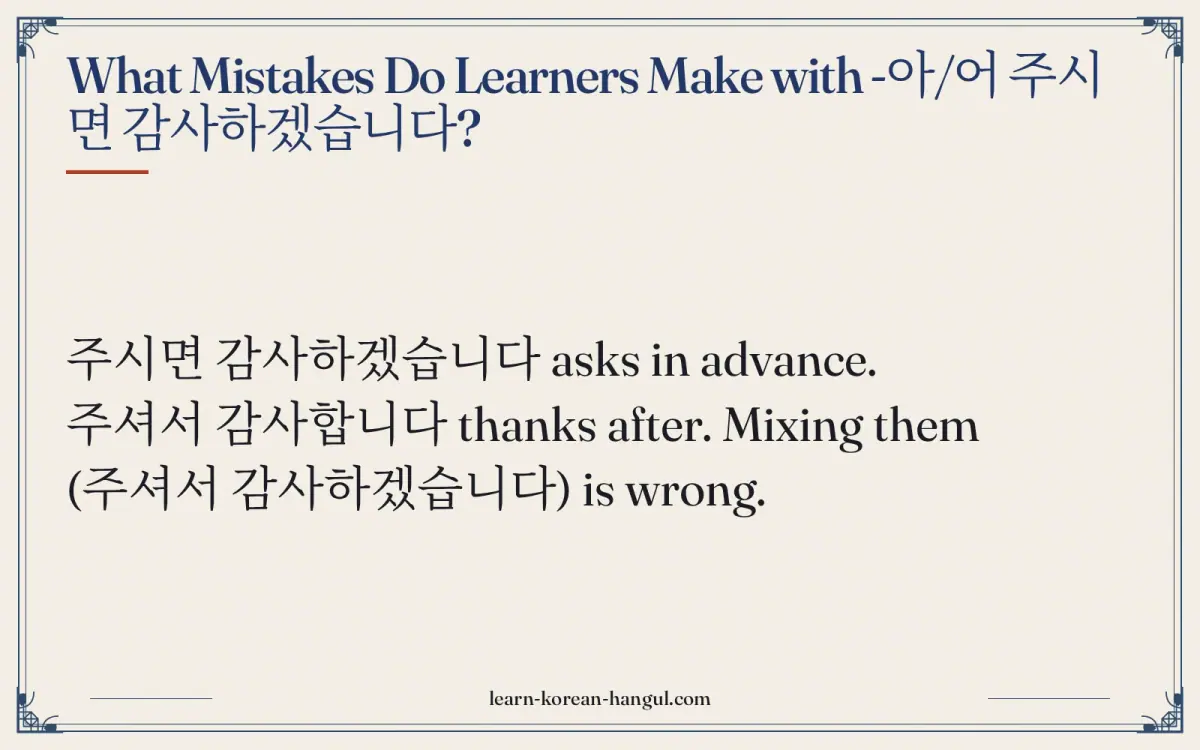
- Mixing thanks for a past favour with 겠. 확인해 주셔서 감사하겠습니다 is wrong. After the favour, say 확인해 주셔서 감사합니다.
- Forgetting the -아/어 form. 확인하 주시면 is wrong. Make the form first: 확인해 주시면.
- Using 감사하겠습니다 alone as "thank you". To thank someone now, say 감사합니다. The 겠 version looks forward to a favour.
Practice and Answers
Try all four items before you read the answers. Each answer has audio.
- Choose the form. "I would appreciate it if you could send the file." 파일을 보내 주시면 감사하겠습니다 or 파일을 보내 주셔서 감사하겠습니다?
- Fix the error. 이 서류를 확인해 주면 감사하겠습니다. (The speaker is writing to a professor.)
- Translate. "I would be grateful if you could tell me the schedule." (Use 일정 and 알리다.)
- Write your own. Write one request that you could put at the end of an email, using 도와주시면, 들어 주시면 or 써 주시면.
Answer Key
- 파일을 보내 주시면 감사하겠습니다. (paireul bonae jusimyeon gamsahagetseumnida.) Pronunciation: [파이를 보내 주시면 감사하겓씀니다]. Use -(으)면 for a favour that has not happened yet.
- 이 서류를 확인해 주시면 감사하겠습니다. (i seoryureul hwaginhae jusimyeon gamsahagetseumnida.) Pronunciation: [이 서류를 화긴해 주시면 감사하겓씀니다]. Add the honorific 시 for a professor.
- 일정을 알려 주시면 감사하겠습니다. (iljjeongeul allyeo jusimyeon gamsahagetseumnida.) Pronunciation: [일쩡을 알려 주시면 감사하겓씀니다]. 알리다 becomes 알려 before 주시면.
- Sample answer: 도와주시면 감사하겠습니다. (dowajusimyeon gamsahagetseumnida.) "I would be grateful for your help." Pronunciation: [도와주시면 감사하겓씀니다]. The ㅂ-irregular verb 돕다 becomes 도와.
Practice · 5
Who is the honorific 시 in 주시면 showing respect to?
Show answer
The person who does the favour
시 shows respect for the person asked to do the favour. It never honours yourself.
Which is the -아/어 form of 돕다 (to help)?
Show answer
도와
돕다 is ㅂ-irregular. The ㅂ becomes 와 before -아/어: 도와.
Where does 주시면 감사하겠습니다 fit best?
Show answer
A work email to a manager
The pattern is formal and polite, so it fits work emails and notices.
Which sentence thanks someone after they have helped?
Show answer
도와주셔서 감사합니다
-아/어 주셔서 감사합니다 thanks for a favour already done.
Which is more humble than 감사하겠습니다?
Show answer
감사드리겠습니다
드리다 is the humble form of "give", so 감사드리겠습니다 is more deferential.
If a sentence went wrong, check three things: the -아/어 form is correct, 주시면 has the honorific 시, and the favour has not happened yet.
What Should You Learn Next?
The natural next step is the shorter requests, -아/어 주세요 and -아/어 주시겠어요?. To offer help instead of asking for it, study -아/어 드릴까요?. All three belong to the set of Suggestions and Requests, and the full list of B2 patterns is on the Advanced Grammar page.
This page uses Revised Romanization only as a learning aid. The Hangul is the reference. To remember the idea in one line: -아/어 + 주시면 + 감사하겠습니다 says "I would be grateful if you did this for me."
Frequently Asked Questions
What Does -아/어 주시면 감사하겠습니다 Mean in Korean?
It means "I would appreciate it if you would..." and is a very polite request used in emails, notices and formal speech. 확인해 주시면 감사하겠습니다 means "I would be grateful if you could check." It states your gratitude in advance and leaves the choice to the other person.
How Do I Form -아/어 주시면 감사하겠습니다?
Make the -아/어 form of the verb, then add 주시면 감사하겠습니다. 확인하다 becomes 확인해, so you say 확인해 주시면 감사하겠습니다. Irregular verbs follow their usual rules: 돕다 becomes 도와, 듣다 becomes 들어, and 쓰다 becomes 써. The part after the verb never changes.
Why Does the Pattern Have Both 시 and 겠?
The 시 in 주시면 respects the person who does the favour. The 겠 in 감사하겠습니다 is not a plain future. It makes the statement a modest wish, which sounds less pushy than 감사합니다.
Can I Use -아/어 주시면 감사하겠습니다 with Friends?
No. It is formal and sounds like a business letter. With friends, say 해 줘 or 해 줄래?. With a manager you know well in speech, 해 주세요 or 해 주시겠어요? is more natural.
What Is the Difference between 주시면 감사하겠습니다 and 주셔서 감사합니다?
주시면 감사하겠습니다 is for a favour that has not happened yet: "I would be grateful if you did it." 주셔서 감사합니다 thanks someone after they have done it. Do not mix them: 주셔서 감사하겠습니다 is wrong.
How Can I Make the Request Even More Humble?
Use 감사드리겠습니다, with the humble verb 드리다: 확인해 주시면 감사드리겠습니다. You can also close an email with 잘 부탁드립니다. These forms are common in letters to senior people and formal organisations.