
What you'll learn
- Build -아/어 드릴까요? from regular, irregular and 하다 verbs.
- Understand why 드리다 replaces 주다 in an offer.
- Offer a noun with 드릴까요, as in 커피 드릴까요?
- Reply when someone offers help to you.
- Avoid the mistake of using 드리다 for yourself or for equals.
Before you start: you should know the question ending -(으)ㄹ까요? and the request -아/어 주세요. This lesson is the mirror image of 주세요. Audio plays only when you press a button.
What Does -아/어 드릴까요? Grammar Mean?
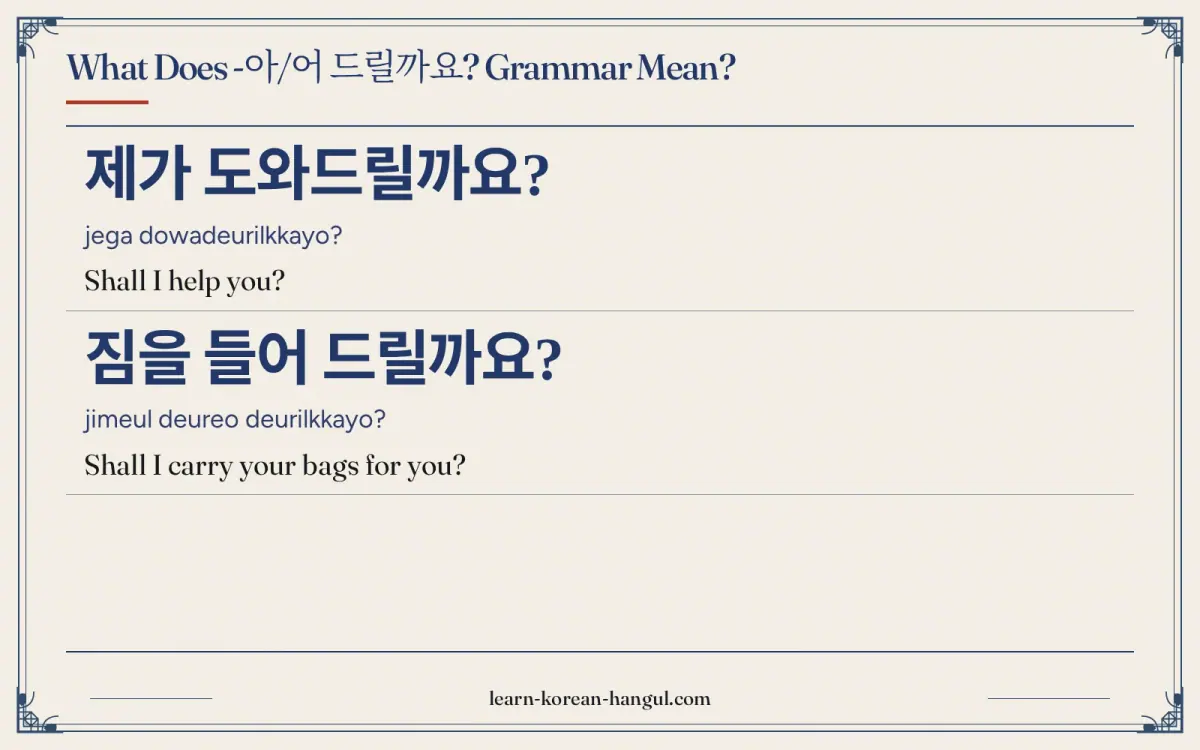
-아/어 드릴까요? grammar means "shall I do (this) for you?" It combines two ideas. The verb 드리다 is the humble form of 주다 ("to give"), and the ending -(으)ㄹ까요? asks the listener whether the speaker should act. The result is a polite offer of service.
Two examples show the idea.
제가 도와드릴까요?
jega dowadeurilkkayo?
Shall I help you?
짐을 들어 드릴까요?
jimeul deureo deurilkkayo?
Shall I carry your bags for you?
The word 제가 is the humble "I" with the subject marker. The word 짐을 [지믈] means "luggage" plus the object marker, and 들어 is the -아/어 form of 들다 ("to carry"). Notice that the speaker is the one who acts in both sentences. Next comes the formation rule.
How Do You Form -아/어 드릴까요?
-아/어 드릴까요? is formed by taking the -아/어 form of the verb and writing 드릴까요 after it. The first part is the same form that you use for 주세요: 열어, 닫아, 해. Then 드릴까요 follows, with a space. The word 드릴까요 itself is 드리다 plus -ㄹ까요?: the stem 드리 ends in a vowel, so it takes -ㄹ까요 directly.
The vowel rule is short. After ㅏ or ㅗ, add -아. After other vowels, add -어. 하다 verbs take 해.
| Dictionary form | -아/어 form | Offer | Meaning |
|---|---|---|---|
| 닫다 | 닫아 | 닫아 드릴까요? | Shall I close it for you? |
| 열다 | 열어 | 열어 드릴까요? | Shall I open it for you? |
| 찍다 | 찍어 | 찍어 드릴까요? | Shall I take a photo for you? |
| 포장하다 | 포장해 | 포장해 드릴까요? | Shall I wrap it to go? |
| 안내하다 | 안내해 | 안내해 드릴까요? | Shall I show you the way? |
| 알리다 | 알려 | 알려 드릴까요? | Shall I let you know? |
| 기다리다 | 기다려 | 기다려 드릴까요? | Shall I wait for you? |
도와드리다 ("to help (someone respected)") is usually written as one word, like 도와주다, so this page writes 도와드릴까요 with no space. The spaced 도와 드릴까요 is also accepted. The next parts take the stem types one at a time.
Stems Ending in a Vowel
Vowel stems often contract. 가져오 + 아 becomes 가져와, 기다리 + 어 becomes 기다려, and 켜 + 어 stays 켜.
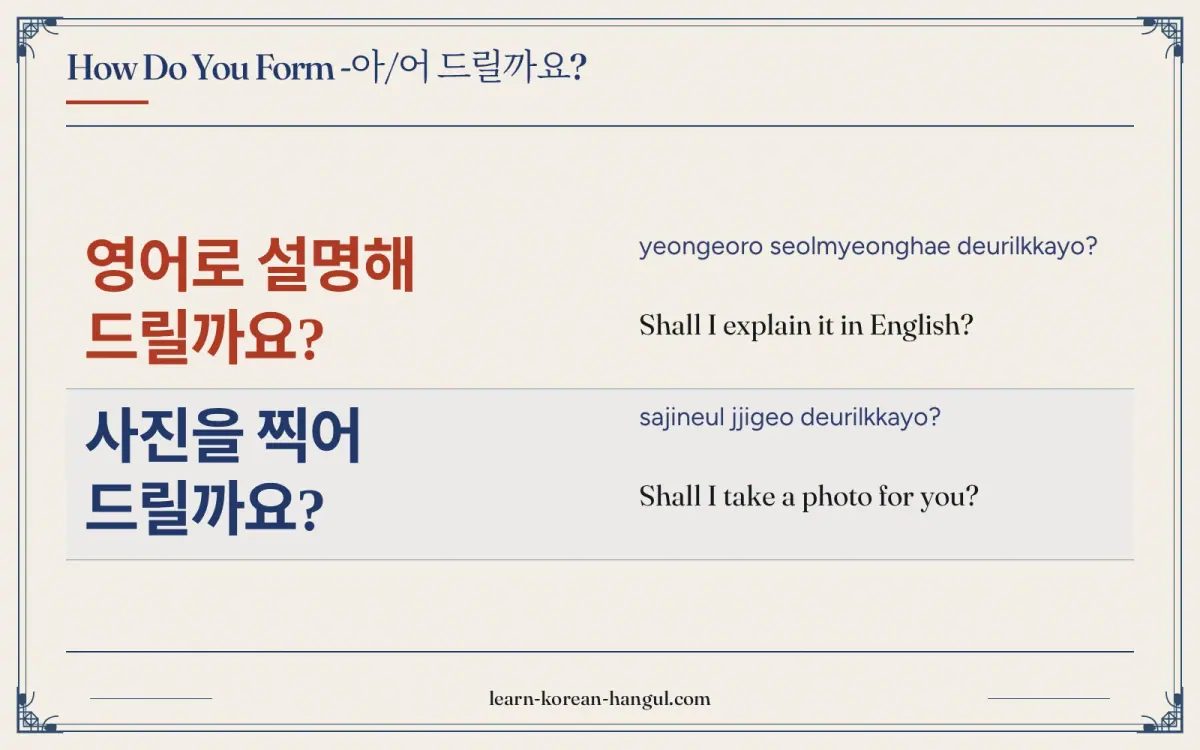
영어로 설명해 드릴까요?
yeongeoro seolmyeonghae deurilkkayo?
Shall I explain it in English?
Stems Ending in a Consonant
Consonant stems add -아 or -어, and the final consonant moves to the next syllable when you speak. 찍어 is written with a final ㄱ but said [찌거], and the object 사진을 is said [사지늘].
사진을 찍어 드릴까요?
sajineul jjigeo deurilkkayo?
Shall I take a photo for you?
The pronunciation follows the 국립국어원 standard pronunciation rules (표준 발음법): a final consonant followed by a vowel moves across. So the sentence is said [사지늘 찌거 드릴까요].
Do Irregular Verbs Change?
The stem changes are the usual ones, applied before -아/어.
- ㅡ-stems drop ㅡ. 끄다 becomes 꺼, so 불을 꺼 드릴까요? means "Shall I turn off the light for you?"
- ㄷ-irregular verbs change ㄷ to ㄹ. 듣다 becomes 들어, so 들어 드릴까요? means "Shall I listen to you?"
- 르-irregular verbs double the ㄹ. 부르다 becomes 불러, so 택시를 불러 드릴까요? means "Shall I call a taxi for you?"
- ㅂ-irregular verbs change ㅂ to 와 or 워. 돕다 becomes 도와, and the common offer is the one word 도와드릴까요?
Noun forms are even simpler. Add 드릴까요 straight after an object: 물 드릴까요? means "Shall I bring you some water?" With the forms clear, you can build a full sentence.
Worked Example: Building a Sentence with -아/어 드릴까요?
-아/어 드릴까요? grammar works the same way every time, so a five-step routine is enough. Follow it with a hotel desk: offering to book a taxi for a guest.
- Start with the dictionary form. The verb is 부르다 (to call).
- Drop 다 to find the stem. The stem is 부르. It is a 르-verb.
- Make the -아/어 form. 르-verbs double the ㄹ: 불러.
- Add 드릴까요. 불러 + 드릴까요 gives 불러 드릴까요.
- Add the object. 택시를 불러 드릴까요? (taeksireul bulleo deurilkkayo?) = "Shall I call a taxi for you?"
Sentence
Shall I call a taxi for you?
Show answer
택시를 불러 드릴까요
You will know it worked if the verb is in its -아/어 form, 드릴까요 follows, and your voice rises at the end. The most common slip is writing the plain 주다: 불러 줄까요 is correct for a friend, but not for a guest. A natural reply from the guest is 네, 부탁드려요 (ne, butakdeuryeoyo), "Yes, please," or 괜찮아요 (gwaenchanayo), "That's all right." The next question is when the pattern can appear.
Which Tenses and Sentence Types Work with -아/어 드릴까요?
-아/어 드릴까요? works as a present or near-future question. It asks about an action that has not happened yet. Other meanings are built by changing the ending.
| Meaning | Form | Example |
|---|---|---|
| Offer as a question | -아/어 드릴까요? | 문을 열어 드릴까요? (Shall I open the door for you?) |
| Offer of a thing | noun + 드릴까요? | 커피 드릴까요? (Shall I get you coffee?) |
| Promise | -아/어 드릴게요 | 제가 해 드릴게요. (I will do it for you.) |
| Formal promise | -아/어 드리겠습니다 | 도와드리겠습니다. (I will help you.) |
| Past, done already | -아/어 드렸어요 | 짐을 들어 드렸어요. (I carried the bags for you.) |
| Friendly offer | -아/어 줄까(요)? | 내가 들어 줄까? (Shall I carry it?) |
The promise 드릴게요 is said [드릴께요], and the formal 드리겠습니다 (deurigetseumnida) is said [드리겓씀니다]. The question and the promise differ in one way: 드릴까요 asks, while 드릴게요 decides. The pattern for tenses is simple: use the question for an offer and the promise for a decision.
How Is -아/어 드릴까요? Different from -(으)ㄹ까요?
-아/어 드릴까요? and -(으)ㄹ까요? both mean "shall I...?", but -(으)ㄹ까요? is general and -아/어 드릴까요? is specific. -(으)ㄹ까요? can suggest an action with "we" ("Shall we go?") or wonder about a third person. -아/어 드릴까요? always offers a service to the listener, and it adds the humble 드리다.
-아/어 드릴까요?
shall I do it for you: an offer to a respected person
-(으)ㄹ까요?
shall we / shall I; I wonder
-아/어 주세요
please do it for me: a request
| Comparison | -아/어 드릴까요? | -(으)ㄹ까요? | -아/어 주세요 |
|---|---|---|---|
| Who acts | the speaker | the speaker or both | the listener |
| Who benefits | the listener | depends on context | the speaker |
| Politeness | humble, very polite | polite, neutral | polite |
| Example | 제가 도와드릴까요? | 같이 도울까요? | 좀 도와주세요. |
Use -아/어 드릴까요? to offer help to someone you respect, -(으)ㄹ까요? to suggest something to do together, and -아/어 주세요 to ask someone else for help.
Compare 같이 갈까요? ("Shall we go together?") with 데려다 드릴까요? ("Shall I take you there?"). The first suggests a shared plan. The second offers a favour. The general question ending is taught in -(으)ㄹ까요?, and the request in the other direction is in -아/어 주세요. These contrasts lead to a few variations.
Variations and Edge Cases of -아/어 드릴까요?
-아/어 드릴까요? has four common variations. Each one helps you sound natural.
- Replies. To accept, say 네, 부탁드려요 or 네, 부탁드립니다 ("Yes, please"). To decline, say 아니에요, 괜찮아요 ("No, it's fine").
- Receiving a favour. When someone does something for you, you say 해 주셨어요. When you do something for someone you respect, you say 해 드렸어요.
- Receiver marker. The person you serve can be named with 께: 선생님께 보여 드릴까요? ("Shall I show it to the teacher?"). 께 is the honorific form of 에게 or 한테.
- Friends and children. Replace 드리다 with 주다: 내가 도와줄까? Among friends, the offer with 드리다 sounds like a joke or like distance.
At a front desk you may hear 전화번호를 알려 드릴까요? ("Shall I give you the phone number?"). Think of it as a ladder of formality: 줄까 (friends) < 드릴까요 (polite) < 드리겠습니다 (formal). The honorific marker that often sits next to these forms is explained in honorific -(으)시-, and the wider picture of politeness is in Korean Speech Levels.
What Mistakes Do Learners Make with -아/어 드릴까요?

Learners usually mix up who acts, who is honoured and which verb to use. Four mistakes appear again and again.
- Using 드리다 for yourself or for equals. 제가 친구한테 책을 드릴까요? sounds odd, because a friend does not need to be honoured. Use 줄까요?
- Using it to ask for help. 제가 도와드릴까요? is an offer, so it asks nothing from the listener. To ask for help, say 이것 좀 도와주세요.
- Adding the honorific. 도와드리시겠어요? is wrong. The honorific -시- honours the actor, and the actor here is you.
- Mixing up 들다 and 듣다. 들다 means "to carry", but 듣다 means "to listen". Their -아/어 forms are the same, 들어. Context decides: 짐을 들어 드릴까요? is carrying, and 이야기를 들어 드릴까요? is listening.
A quick check: Is the speaker the one who acts? Is the receiver someone to respect? Is the verb in the -아/어 form? If all three answers are yes, the offer is sound.
The practice set below tests these four points.
Practice and Answers
Try the four items before you read the answer key. Cover the answers with your hand.
- Choose the form. Complete: 창문을 ___ 드릴까요? (닫 / 닫아 / 닫어)
- Make the offer. Use 포장하다: "Shall I wrap it to go?"
- Offer a thing. How do you ask a guest "Shall I get you some water?"
- Fix the error. A learner offers help to a friend with 짐을 들어 드릴까요? Correct it.
Practice · 5
You work at a cafe. How do you offer to put a customer's order in a take-away bag?
Show answer
포장해 드릴까요?
포장해 드릴까요? offers service to a customer. 포장해 주세요 would ask the customer to pack it.
Which sentence offers to open the door for your grandmother?
Show answer
문을 열어 드릴까요?
열어 드릴까요? uses the humble 드리다, which suits an older person. 열어 줄까? is casual.
What is the correct form for 닫다 (to close)?
Show answer
닫아 드릴까요?
The stem 닫 has the vowel ㅏ, so it takes -아: 닫아 드릴까요?
A learner offers to carry a friend's bag with 짐을 들어 드릴까? What is wrong?
Show answer
드리다 should not be used for equals; 들어 줄까? is better.
드리다 is humble and honours the receiver. With a friend, the natural offer is 들어 줄까?
Which verb is the humble form of 주다 used in this pattern?
Show answer
드리다
드리다 is the humble form of 주다. It lowers the speaker and honours the person who receives the help.
Answer key
- 닫아. The stem 닫 has the vowel ㅏ, so it takes -아: 창문을 닫아 드릴까요?
- 포장해 드릴까요? A 하다 verb takes 해.
- 물 드릴까요? A noun needs only 드릴까요.
- 짐을 들어 줄까? The humble 드리다 is replaced by 주다 for a friend.
If you can complete items 1 to 3 without the key, you can offer help in most daily settings. The final section points to the next lessons.
What Should You Learn Next after -아/어 드릴까요? Grammar?
After -아/어 드릴까요? grammar, learn the sentence endings that sit next to the offer. This lesson teaches the offer of service and does not cover the honorific system in depth. Those live on separate pages.
- Learn the general question in -(으)ㄹ까요?.
- Learn the request in the other direction with -아/어 주세요.
- Read Suggestions and Requests to see every request and suggestion ending in one place.
- Return to the Beginner Grammar list for the other patterns at this level.
With these steps, the choice becomes automatic: use 드릴까요 when you give, and 주세요 when you ask.
Frequently Asked Questions
What does -아/어 드릴까요? mean?
-아/어 드릴까요? means "Shall I do this for you?" It joins the -아/어 form of a verb with 드릴까요, the question form of the humble verb 드리다. 짐을 들어 드릴까요? means "Shall I carry your bag for you?" Shop staff, hosts and polite learners use it to offer help to someone they respect.
How do I attach -아/어 드릴까요? to a verb?
Drop 다, add -아 after ㅏ or ㅗ and -어 after other vowels, then write 드릴까요. 닫다 becomes 닫아 드릴까요?, and 읽다 becomes 읽어 드릴까요? 하다 verbs use 해: 포장하다 becomes 포장해 드릴까요? A noun can take 드릴까요 alone: 커피 드릴까요?
Can -아/어 드릴까요? be used in the past tense?
No. An offer looks forward, so the question stays in this form. To say that you already did something for someone, use 해 드렸어요 ("I did it for you"). To make a firm promise instead of a question, use 해 드릴게요 [해 드릴께요], which means "I will do it for you."
Is -아/어 드릴까요? used in speech or only in writing?
It is mainly spoken. You hear it in restaurants, shops, hotels, offices and homes whenever someone offers help to a person they respect. In formal writing and announcements, the more formal 해 드리겠습니다 is common. With close friends, the plain 해 줄까? is more natural.
What is the most common mistake with -아/어 드릴까요?
The most common mistake is using 드리다 for yourself or for equals. 드리다 only works when the person who receives the action deserves respect. For a friend or a child, say 해 줄까요? or 해 줄까? A second mistake is using it to ask for help, which needs 주세요.