What you'll learn
- Build -아/어 주시겠어요? from regular, irregular and 하다 verbs.
- Understand what 시 and 겠 each add to the request.
- Choose between -아/어 주시겠어요?, -아/어 주세요 and -아/어 줄래요?.
- Reply politely when someone asks you with this pattern.
- Avoid the common mistake of using the honorific for yourself.
Before you start: you should know -아/어 주세요, because this lesson builds on it. Audio plays only when you press a button.
What Does -아/어 주시겠어요? Grammar Mean?
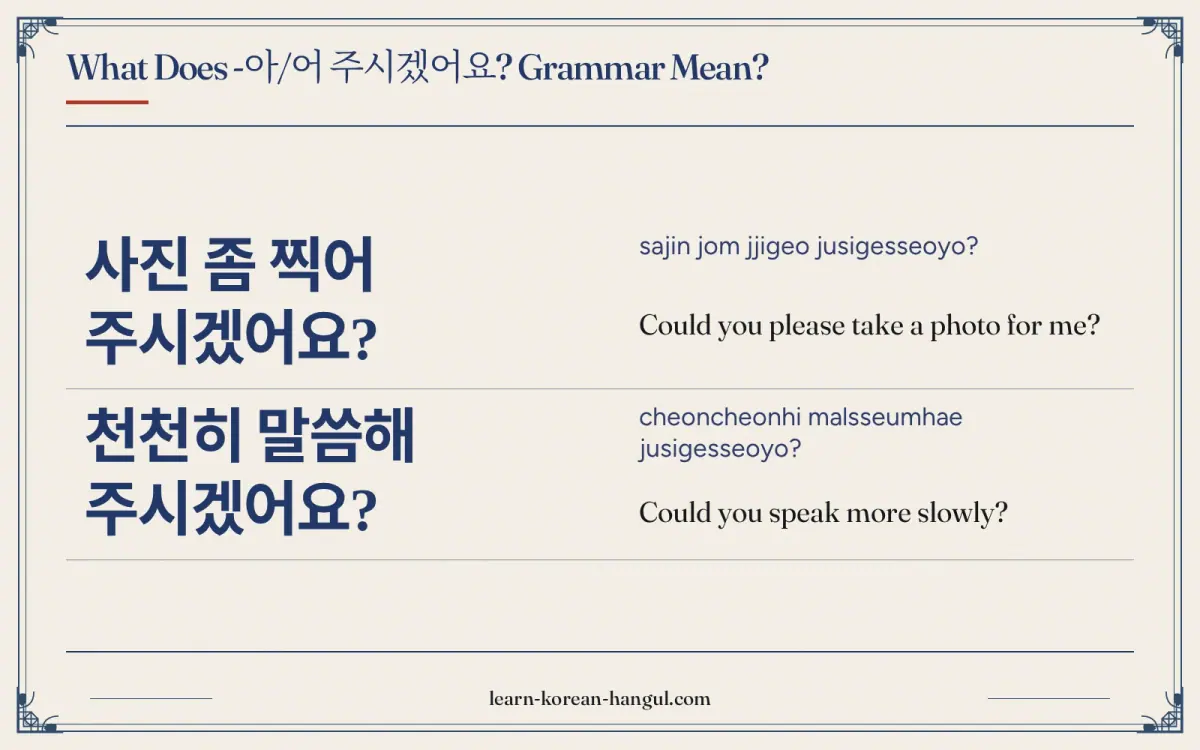
-아/어 주시겠어요? grammar means "could you please do (this) for me?" It is a request dressed as a question. The speaker does not give an order. The speaker asks whether the listener is willing to act, and that gentle shape is why the pattern sounds so polite.
Two examples show the idea.
사진 좀 찍어 주시겠어요?
sajin jom jjigeo jusigesseoyo?
Could you please take a photo for me?
천천히 말씀해 주시겠어요?
cheoncheonhi malsseumhae jusigesseoyo?
Could you speak more slowly?
The word 말씀 is a respectful noun for "words" or "speech", and 말씀하다 is the respectful way to say 말하다 for another person's speech. It fits here, because the person who will speak is the listener. The chunk 주시겠어요 has four parts, and the next section takes them apart.
How Do You Form -아/어 주시겠어요?
-아/어 주시겠어요? is formed by taking the -아/어 form of the verb and writing 주시겠어요 after it. The first part is the same -아/어 form that you used for 주세요. The ending then breaks into four pieces.
| Piece | Form | Job |
|---|---|---|
| Verb | 찍어 | the action you want, in its -아/어 form |
| 주- | 주다 | "to give": the action is a favour |
| -시- | 시 | honorific: respect for the person who acts, the listener |
| -겠- | 겠 | softens the question: "would you be willing?" |
| -어요 | 어요 | polite ending: 주 + 시 + 겠 + 어요 = 주시겠어요 |
The vowel rule is short. After ㅏ or ㅗ, add -아. After other vowels, add -어. 하다 verbs take 해.
| Dictionary form | -아/어 form | Request | Meaning |
|---|---|---|---|
| 닫다 | 닫아 | 닫아 주시겠어요? | Could you close it? |
| 읽다 | 읽어 | 읽어 주시겠어요? | Could you read it? |
| 확인하다 | 확인해 | 확인해 주시겠어요? | Could you check it? |
| 기다리다 | 기다려 | 기다려 주시겠어요? | Could you wait? |
| 보내다 | 보내 | 보내 주시겠어요? | Could you send it? |
| 쓰다 | 써 | 써 주시겠어요? | Could you write it? |
The verb part is the same one used in the other -아/어 patterns. The next parts take stem types one at a time.
Stems Ending in a Vowel
Vowel stems often contract. 기다리 + 어 becomes 기다려, and 보내 + 어 becomes 보내.
잠시 기다려 주시겠어요?
jamsi gidaryeo jusigesseoyo?
Could you wait a moment?
Stems Ending in a Consonant
Consonant stems add -아 or -어, and the final consonant moves to the next syllable when you speak. 닫아 is written with ㄷ but said [다다], and 읽어 is said [일거].
창문 좀 닫아 주시겠어요?
changmun jom dada jusigesseoyo?
Could you close the window?
The pronunciation follows the 국립국어원 standard pronunciation rules (표준 발음법): a final consonant followed by a vowel moves across. The spelling does not show this, so write 닫아 and say [다다].
Do Irregular Verbs Change?
The stem changes are the usual ones, applied before -아/어.
- ㅡ-stems drop ㅡ. 쓰다 becomes 써, so 이름을 써 주시겠어요? means "Could you write your name?"
- ㄷ-irregular verbs change ㄷ to ㄹ. 듣다 becomes 들어, so 들어 주시겠어요? means "Could you listen?"
- 르-irregular verbs double the ㄹ. 부르다 becomes 불러, so 불러 주시겠어요? means "Could you call (him or her)?"
- ㅂ-irregular verbs change ㅂ to 와 or 워. 돕다 becomes 도와, and the usual request is 도와주시겠어요?, written as one word.
길을 알려 주시겠어요?
gireul allyeo jusigesseoyo?
Could you tell me the way?
Notice the spelling of 알려 (from 알리다, "to let know"). It is regular, but the two ㄹ sounds sit side by side. The sentence is said [기를 알려 주시겠어요]. With the forms clear, you can build a full sentence.
Worked Example: Building a Sentence with -아/어 주시겠어요?
-아/어 주시겠어요? grammar is easiest to learn as a five-step routine. Follow it with an office request: "Could you check this document?"
- Start with the dictionary form. The verb is 확인하다 (to check, to confirm).
- Find the -아/어 form. 하다 verbs use 해, so you get 확인해.
- Add 주시겠어요. 확인해 + 주시겠어요 gives 확인해 주시겠어요.
- Add the object. The object is 이 서류를 ("this document"), and it goes first.
- Add a softener and a question rise. 이 서류 좀 확인해 주시겠어요? (i seoryu jom hwaginhae jusigesseoyo?) = "Could you check this document, please?"
Sentence
Could you check this document, please?
Show answer
이 서류 좀 확인해 주시겠어요
You will know it worked if the verb is in its -아/어 form, 주시겠어요 follows it, and your voice rises at the end. The most common slip is writing 주시겠어요 as 줘시겠어요. The form 주 always stays 주. A good reply to this request is 네, 그럼요 ("Yes, of course") or 네, 확인해 드릴게요 [화긴해 드릴께요] ("Yes, I will check it for you"). The reply uses 드리다, the humble verb for giving. The next question is when the pattern can appear.
Which Tenses and Sentence Types Work with -아/어 주시겠어요?
-아/어 주시겠어요? works only as a present-time request in question form. The 겠 inside is not a plain future marker here, so no other tense marker attaches. Other meanings are built by swapping the ending.
| Meaning | Form | Example |
|---|---|---|
| Careful request | -아/어 주시겠어요? | 문을 열어 주시겠어요? (Could you open the door?) |
| Even more indirect | -아/어 주실 수 있어요? | 문을 열어 주실 수 있어요? (Are you able to open the door?) |
| Most indirect | -아/어 주실 수 없을까요? | 문을 열어 주실 수 없을까요? (Is there any chance you could open the door?) |
| Formal question | -아/어 주시겠습니까? | 확인해 주시겠습니까? (Would you please check?) |
| Standard request | -아/어 주세요 | 문을 열어 주세요. (Please open the door.) |
| Friendly request | -아/어 줄래요? | 문을 열어 줄래요? (Will you open the door?) |
Every form keeps 주- and the honorific 시, except the friendly one. The formal form 확인해 주시겠습니까? (hwaginhae jusigetseumnikka?) is used in announcements and polite writing. A statement is not possible, because the pattern is a question. The pattern for tenses is simple: there is none, and the nearest neighbours decide how strong the request sounds.
How Is -아/어 주시겠어요? Different from -아/어 주세요?
-아/어 주시겠어요? is a question that asks if the listener is willing. -아/어 주세요 is a request that states what you want. Both contain the honorific -시-, so both are respectful. The question form leaves room for a "no", so it sounds more careful.
-아/어 주세요
please do it for me: standard polite
-아/어 주시겠어요?
could you please: careful and indirect
-아/어 줄래요?
will you: friendly, for peers and juniors
| Comparison | -아/어 주세요 | -아/어 주시겠어요? | -아/어 줄래요? |
|---|---|---|---|
| Sentence type | request, usually a statement | question | question |
| Feels like | polite and direct | very polite and indirect | warm and casual |
| Best listener | anyone | strangers, seniors, customers | friends, juniors |
| Example | 창문을 닫아 주세요. | 창문을 닫아 주시겠어요? | 창문 좀 닫아 줄래요? |
Use -아/어 주세요 for everyday polite requests, -아/어 주시겠어요? when you want to sound extra careful, and -아/어 줄래요? only with friends and juniors.
The standard request is in -아/어 주세요, and the friendly version is in -아/어 줄래요?. Shop staff, for example, tend to use 주시겠어요 with customers, because the question is gentler. The contrast leads to a few variations.
Variations and Edge Cases of -아/어 주시겠어요?
-아/어 주시겠어요? has four common variations. Each one helps you sound natural.
- Opening softeners. Add 실례지만 (sillyejiman, "excuse me, but") or 죄송하지만 (joesonghajiman, "I am sorry, but") before the request: 죄송하지만 한 번 더 말씀해 주시겠어요? ("I am sorry, but could you say it once more?").
- Replies. Say 네, 그럼요 for "yes, of course", or 네, 해 드릴게요 [해 드릴께요] for "yes, I will do it". A polite refusal is 죄송하지만 지금은 어려워요 ("I am sorry, but it is difficult now").
- Formal and written use. In e-mails, you see 확인해 주시겠습니까? or 회신해 주시겠어요?, and a colleague may write 메일로 보내 주시겠어요? ("Could you send it by e-mail?"). The question form is also common on the phone.
- Stronger politeness. 주실 수 있어요? ("are you able to?") and 주실 수 없을까요? ("would it be possible?") are even more indirect. They add the idea of ability or chance.
Think of the ladder this way: 줘 (casual) < 주세요 (standard) < 주시겠어요? (careful) < 주실 수 없을까요? (most indirect). For the honorific marker itself, see honorific -(으)시-.
What Mistakes Do Learners Make with -아/어 주시겠어요?
Learners usually mix up who the honorific is for, how many pieces the ending has, or which situation fits. Four mistakes appear again and again.
- Using the honorific for yourself. 제가 해 주시겠어요? is wrong, because 시 always honours someone else. To offer help, say 제가 해 드릴까요?, which is taught in -아/어 드릴까요?.
- Dropping the 시. 해 주겠어요? asks "Will you do it for me?" in a blunt way. Keep the 시 for a respectful request.
- Treating it as a future question. 주시겠어요? does not ask "Will you give?" at some later time. The question is a polite request now.
- Using it with close friends. It sounds stiff, like a customer-service script. With a friend, use 해 줄래? or 해 줘.
A quick check: Is the listener the person who acts? Is the verb in the -아/어 form? Is the voice rising at the end? If all three answers are yes, the request is sound.
The practice set below tests these four points.
Practice and Answers
Try the four items before you read the answer key. Cover the answers with your hand.
- Choose the form. Complete: 문 좀 ___ 주시겠어요? (열 / 열어 / 여세)
- Make the request. Use 말씀하다: "Could you speak more slowly?"
- Add a softener. Add 실례지만 to 길을 알려 주시겠어요?
- Fix the error. A learner wants to offer help and says 제가 짐을 들어 주시겠어요? Correct it.
Practice · 5
Which request is the most careful way to ask a stranger to take your photo?
Show answer
사진 좀 찍어 주시겠어요?
주시겠어요? adds 겠 to the honorific, so it sounds the most careful. 찍어 줘 is casual, and 찍어요 is only a statement.
What does the 시 in 주시겠어요 do?
Show answer
It shows respect to the listener.
The 시 is the honorific marker -(으)시-. It shows respect to the person who is asked to act.
Fill in the blank: 이 서류를 ___ 주시겠어요? (확인하다)
Show answer
확인해
하다 verbs combine with -아/어 as 해, so 확인하다 becomes 확인해: 확인해 주시겠어요?
A friend says 제가 가방을 들어 주시겠어요? What is wrong?
Show answer
The honorific 시 cannot describe the speaker's own action.
The honorific 시 always honours someone else. To offer help, say 제가 가방을 들어 드릴까요?
What does 겠 add in 주시겠어요?
Show answer
It softens the question by asking whether the listener is willing.
Here 겠 is not a future marker. It softens the request into a question about the listener's willingness.
Answer key
- 열어. The stem 열 has the vowel ㅕ, so it takes -어: 문 좀 열어 주시겠어요?
- 천천히 말씀해 주시겠어요? The verb 말씀하다 is a 하다 verb, so it uses 해.
- 실례지만 길을 알려 주시겠어요? (sillyejiman gireul allyeo jusigesseoyo?)
- 제가 짐을 들어 드릴까요? The humble 드리다 replaces 주시다 in an offer.
If you can complete items 1 to 3 without the key, you can make most careful requests. The final section points to the next lessons.
What Should You Learn Next after -아/어 주시겠어요? Grammar?
After -아/어 주시겠어요? grammar, learn the casual request and the offer. This lesson teaches the careful request and does not cover the honorific system in depth. Those live on separate pages.
- Learn the friendly request in -아/어 줄래요?.
- Learn how to offer help with -아/어 드릴까요?.
- Read Suggestions and Requests to see every request and suggestion ending in one place.
- Review the Korean Speech Levels for the wider picture.
- Return to the Intermediate Grammar list for the other patterns at this level.
With these steps, the choice becomes automatic: use 주세요 for everyday requests, and 주시겠어요? when the listener deserves extra care.
Frequently Asked Questions
What does -아/어 주시겠어요? mean?
-아/어 주시겠어요? means "Could you please do this for me?" It joins the -아/어 form of a verb with 주시겠어요, a very polite question form of 주다 ("to give"). 사진 좀 찍어 주시겠어요? means "Could you take a photo for me?" It sounds careful and respectful.
How do I attach -아/어 주시겠어요? to a verb?
Drop 다, add -아 after ㅏ or ㅗ and -어 after other vowels, then write 주시겠어요. 닫다 becomes 닫아 주시겠어요?, and 읽다 becomes 읽어 주시겠어요? 하다 verbs use 해: 확인하다 becomes 확인해 주시겠어요? ㅡ-stems drop ㅡ, as in 써 주시겠어요?
Can -아/어 주시겠어요? be used in the past tense?
No. A request is about a future action, so the form stays fixed. The -겠- inside it is not a future marker here; it softens the question. To ask whether someone already did something, use a different pattern, such as 해 주셨어요? ("Did you do it for me?").
Is -아/어 주시겠어요? used in speech or only in writing?
Both. You hear it in shops, hotels, offices and on the phone, and you read it in polite e-mails and messages. In very formal writing the ending becomes 주시겠습니까?. With close friends it sounds stiff, so they say 해 줄래? or 해 줘.
What is the most common mistake with -아/어 주시겠어요?
Learners use it about themselves, such as 제가 해 주시겠어요?, which sounds as if you were honouring yourself. The 시 honours the person who acts, never the speaker, so it cannot describe your own action. To offer help, say 제가 해 드릴까요?