What you'll learn
- Build -아/어 주세요 from any verb, including 하다 verbs and common irregular verbs.
- Ask for objects with noun + 주세요.
- Say the pattern with natural pronunciation, using the audio buttons.
- Choose between -아/어 주세요, -아/어 주시겠어요? and -(으)세요.
- Avoid the mistake of using it to offer help.
Before you start: you should know how to find a verb stem and make the polite -아요/-어요 form. The page on -(으)세요 is a useful companion. Audio plays only when you press a button.
What Does -아/어 주세요 Grammar Mean?
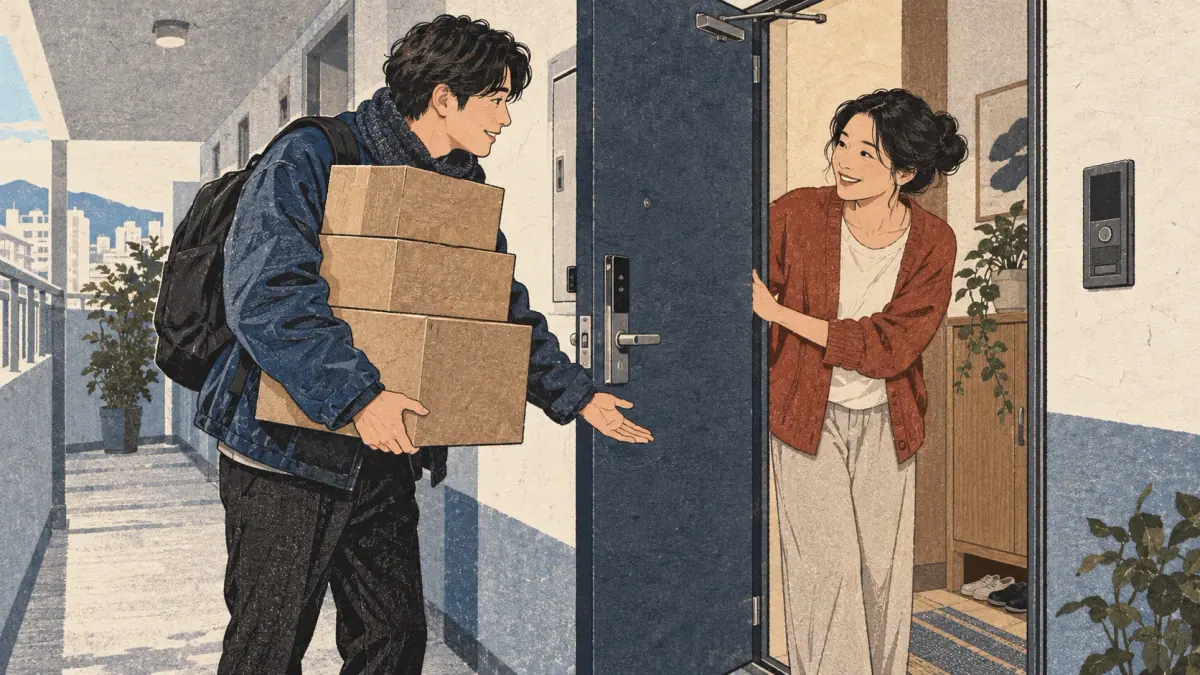
-아/어 주세요 grammar means "please do (this) for me." The verb 주다 means "to give", so the pattern treats an action as something given to you. 주세요 is the polite request form of 주다. It is made from the honorific -(으)시- and the polite ending -어요. The honorific respects the person who does the action, and in a request that person is the listener.
Two examples show the idea.
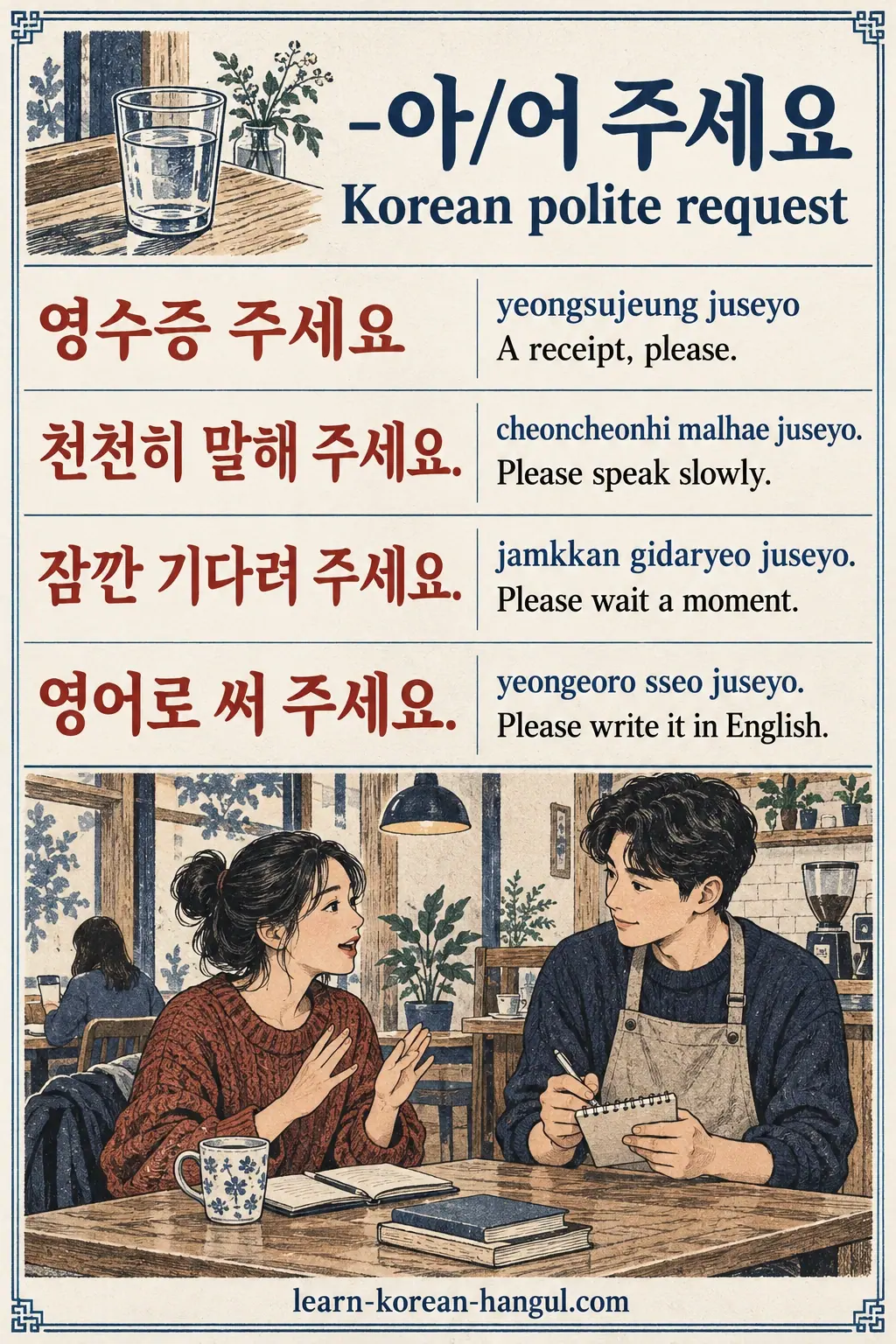
문 좀 열어 주세요.
mun jom yeoreo juseyo.
Please open the door (for me).
천천히 말해 주세요.
cheoncheonhi malhae juseyo.
Please speak slowly.
The word 좀 in the first sentence means "a little" and softens the request. Koreans add it all the time, much as English speakers say "could you just...". It is optional. Next comes the formation rule.
How Do You Form -아/어 주세요?
-아/어 주세요 is formed by taking the verb stem, adding the -아 or -어 ending, and then writing 주세요 after a space. The first part is the same -아/어 form you use to make the polite present. If you know 먹어요, you already know that the -아/어 form is 먹어.
The vowel rule is short. If the last vowel of the stem is ㅏ or ㅗ, add -아. For every other vowel, add -어. Verbs ending in 하다 take 해.
| Dictionary form | -아/어 form | Request | Meaning |
|---|---|---|---|
| 닫다 | 닫아 | 닫아 주세요 | Please close it. |
| 열다 | 열어 | 열어 주세요 | Please open it. |
| 읽다 | 읽어 | 읽어 주세요 | Please read it. |
| 말하다 | 말해 | 말해 주세요 | Please say it. |
| 보다 | 봐 | 봐 주세요 | Please look (at it). |
| 바꾸다 | 바꿔 | 바꿔 주세요 | Please change it. |
| 기다리다 | 기다려 | 기다려 주세요 | Please wait. |
The next parts take the stem types one at a time.
Stems Ending in a Vowel
A vowel stem often contracts with -아/어. 가 + 아 stays 가, 오 + 아 becomes 와, 기다리 + 어 becomes 기다려, and 바꾸 + 어 becomes 바꿔.
잠깐 기다려 주세요.
jamkkan gidaryeo juseyo.
Please wait a moment.
Stems Ending in a Consonant
A consonant stem simply adds -아 or -어, and the final consonant moves to the next syllable when you speak. 닫아 is written with a final ㄷ but said [다다]. 열어 is said [여러].
창문을 닫아 주세요.
changmuneul dada juseyo.
Please close the window.
The pronunciation follows the 국립국어원 standard pronunciation rules (표준 발음법): a final consonant followed by a vowel moves across. So 창문을 닫아 주세요 is said [창무늘 다다 주세요]. The spelling does not show it, so write what you see in the table and say the flowing sound.
Do Irregular Verbs Change?
Yes, but the changes are the usual ones.
- ㅡ-stems drop ㅡ. 쓰다 becomes 써, so 영어로 써 주세요 means "Please write it in English."
- ㄷ-irregular verbs change ㄷ to ㄹ. 듣다 becomes 들어, so 들어 주세요 means "Please listen (to me)."
- ㅂ-irregular verbs change ㅂ to 와 or 워. 돕다 becomes 도와, and the common request is the single verb 도와주세요.
- 르-irregular verbs double the ㄹ. 부르다 becomes 불러, so 이름을 불러 주세요 means "Please call my name."
영어로 써 주세요.
yeongeoro sseo juseyo.
Please write it in English.
이름을 불러 주세요.
ireumeul bulleo juseyo.
Please call my name.
Notice that 돕다 and 주다 combine into one word, 도와주다 ("to help"). Dictionaries write it solid, so 도와주세요 has no space. Most other verbs stay separate from 주세요. With the forms clear, you can build a full sentence.
Worked Example: Building a Sentence with -아/어 주세요

-아/어 주세요 grammar works the same way every time, so a four-step routine is enough. Try it with a common situation: asking someone to take your photo.
- Start with the dictionary form. The verb is 찍다 (to take a photo, to stamp).
- Drop 다 to find the stem. The stem is 찍. Its vowel is ㅣ, so the ending is -어.
- Add -어 and 주세요. 찍어 + 주세요 gives 찍어 주세요.
- Add the object and 좀. 사진 좀 찍어 주세요 (sajin jom jjigeo juseyo) = "Please take a photo (for me)."
Sentence
Please take a photo for me.
Show answer
사진 좀 찍어 주세요
You will know it worked if the verb is in its -아/어 form, 주세요 is separate, and the sentence sounds like a polite request. The most common slip is writing 찍세요, which drops the -어 and the 주. Now to the question of tense and sentence type.
Which Tenses and Sentence Types Work with -아/어 주세요?

-아/어 주세요 works as a present request only. It asks for something to happen next, so no past or future marker belongs inside it. Other meanings are built with different endings.
| Meaning | Form | Example |
|---|---|---|
| Request | -아/어 주세요 | 문을 열어 주세요. (Please open the door.) |
| Request for an object | noun + 주세요 | 물 주세요. (Water, please.) |
| Negative request | -지 말아 주세요 | 말하지 말아 주세요. (Please don't tell anyone.) |
| Softer request | -아/어 주시겠어요? | 문을 열어 주시겠어요? (Could you open the door?) |
| Friendly request | -아/어 줄래요? | 문 좀 열어 줄래요? (Will you open the door?) |
| Casual request | -아/어 줘 | 문 좀 열어 줘. (Open the door for me.) |
The noun pattern is the first one most travellers learn, often with 좀: 물 좀 주세요 ("Some water, please"). 영수증 주세요 (yeongsujeung juseyo) means "A receipt, please." The negative request uses 말다: 말하지 말아 주세요 (malhaji mara juseyo) means "Please don't say it." For a plain "don't", see -지 마세요 don't.
The pattern for tenses is simple: there is none. Past events use a different verb form, which is why the closest neighbours need their own comparison.
How Is -아/어 주세요 Different from -아/어 주시겠어요?
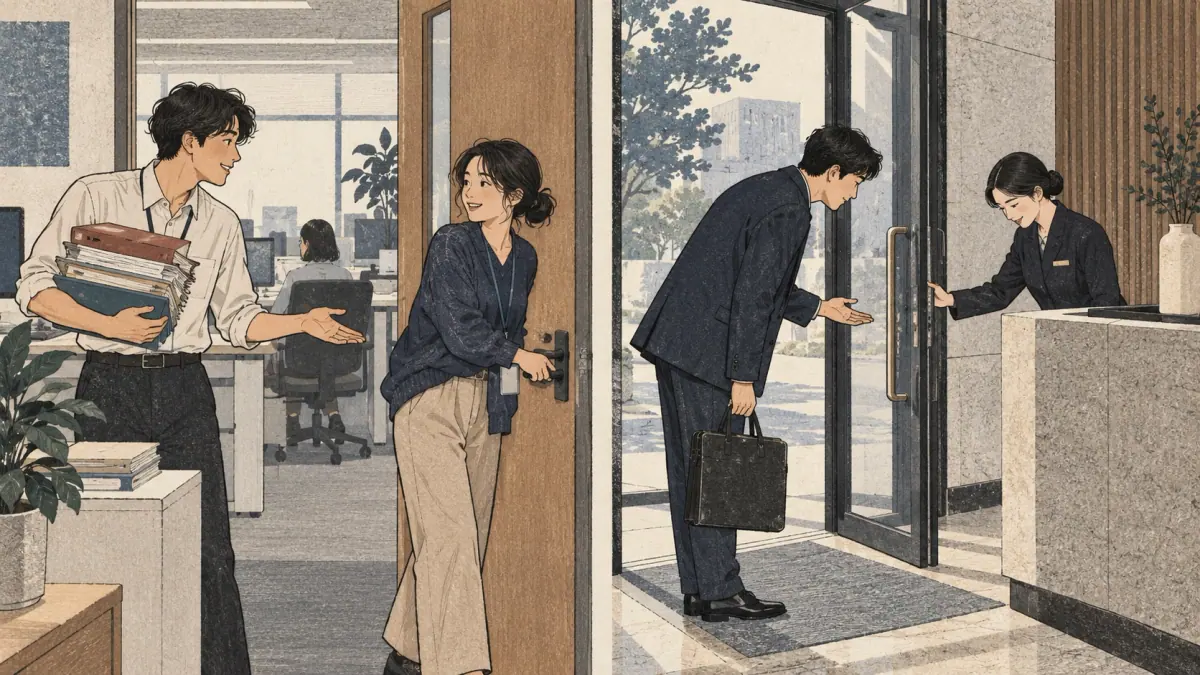
-아/어 주세요 asks directly and politely. -아/어 주시겠어요? asks the same thing as a question and adds -겠-, which makes the request softer and more careful. Both contain the honorific -시-, so both are respectful. The longer one suits strangers, formal service and anything that might trouble the listener.
-아/어 주세요
please do it for me: the standard polite request
-아/어 주시겠어요?
could you please: a softer, more careful request
-(으)세요
please do: an honorific command or invitation
| Comparison | -아/어 주세요 | -아/어 주시겠어요? | -(으)세요 |
|---|---|---|---|
| Meaning | a favour for the speaker | a favour, asked as a question | an instruction or invitation |
| Feels like | polite and direct | extra polite and gentle | polite and neutral |
| Example | 문 좀 열어 주세요. | 문 좀 열어 주시겠어요? | 문을 여세요. |
| Typical level | A1 | B1 | A1 |
Use -아/어 주세요 as your default polite request. Use -아/어 주시겠어요? when you want to sound more careful, and -(으)세요 only when the action is not a favour.
The full lesson is -아/어 주시겠어요?. A third neighbour, -(으)세요, looks almost the same, because 주세요 itself ends in -세요. The difference is that -(으)세요 gives an instruction, while -아/어 주세요 asks a favour. The page on -(으)세요 vs -아/어 주세요 puts them side by side. For more casual speech, see -아/어 줄래요?. These contrasts lead to a few variations.
Variations and Edge Cases of -아/어 주세요
-아/어 주세요 has four common variations. Each one helps you sound natural.
- Softeners. 좀 ("a little") and 한번 ("once, just") make a request feel lighter: 한번 보여 주세요 means "Please show me once."
- Shorter spoken forms. Friends use 해 줘 or 해 줘요. The 주세요 form stays polite, so you can use it with almost anyone.
- Formal version. On signs and in announcements you will see -아/어 주십시오: 잠시 기다려 주십시오 ("Please wait a moment"). It is covered in -(으)십시오.
- Receiving a favour. When someone does something for you, you hear 해 주셨어요, which shows respect to the doer.
Think of 주세요 as a polite "give me." When the object is a thing, 주세요 stands alone. When it is an action, the action comes first. For the honorific marker inside 주세요, see honorific -(으)시-.
What Mistakes Do Learners Make with -아/어 주세요?

Learners usually mix up the direction of the favour, the form of the verb or the spelling. Four mistakes appear again and again.
- Leaving out 주. 문을 열어요 is a statement, and 문을 여세요 is a polite command with no "for me." If you need help, say 열어 주세요.
- Using it to offer help. 제가 짐을 들어 주세요 asks the listener to carry your bag. To offer, use the humble verb 드리다: 제가 짐을 들어 드릴게요 or 들어 드릴까요? The lesson on -아/어 드릴까요? explains it.
- Writing 줘세요. The honorific form of 주다 is 주세요. 줘요 is the plain polite form, and 줘세요 does not exist.
- Copying English word order. English says "Please open the door for me." Korean puts the object first and the verb last: 문을 열어 주세요.
A quick check: Is the verb in the -아/어 form? Is 주세요 after it? Is the favour for the speaker, not for the listener? If all three answers are yes, the request is sound.
The practice set tests these four points.
Practice and Answers
Try the four items before you read the answer key. Cover the answers with your hand.
- Choose the form. Complete: 창문을 ___ 주세요. (닫 / 닫아 / 닫으)
- Make the request. Use 쓰다: "Please write it for me."
- Order a drink. How do you say "A cup of coffee, please"? Use 커피 한 잔.
- Fix the error. A learner wants to offer help and says 제가 문을 열어 주세요. Correct it.
Practice · 5
Which sentence means "Please close the window (for me)"?
Show answer
창문을 닫아 주세요.
닫아 주세요 is the -아 form 닫아 plus 주세요. 창문을 닫아요 is a plain statement, and 닫으세요 is a polite command without the "for me" meaning.
Choose the correct request for 쓰다 (to write): "Please write it for me."
Show answer
써 주세요.
The vowel ㅡ drops before -어, so 쓰다 becomes 써. The request is 써 주세요.
You want a cup of water in a cafe. Which is correct?
Show answer
물 주세요.
With a noun, 주세요 alone means "please give me." 물 주세요 is the normal request.
You want to offer to carry your friend's bag. Which is the best choice?
Show answer
가방을 들어 드릴까요?
들어 주세요 asks the listener to carry the bag. To offer, use the humble 드리다: 들어 드릴까요? ("Shall I carry it for you?").
Which request for 돕다 (to help) is written correctly?
Show answer
도와주세요.
돕다 is ㅂ-irregular (돕 → 도와), and 도와주다 is one dictionary word, so 도와주세요 has no space.
Answer key
- 닫아. The stem 닫 has the vowel ㅏ, so it takes -아: 창문을 닫아 주세요.
- 써 주세요. The vowel ㅡ drops before -어, so 쓰다 becomes 써.
- 커피 한 잔 주세요. (keopi han jan juseyo.) A noun needs only 주세요.
- 제가 문을 열어 드릴게요. The offer uses the humble verb 드리다. An alternative is 제가 열어 드릴까요?
If you can complete items 1 to 3 without the key, you can make most everyday requests. The last section points to the next lessons.
What Should You Learn Next after -아/어 주세요 Grammar?
After -아/어 주세요 grammar, learn the softer version and the offer. This lesson teaches the standard request and does not cover the humble offer or the casual forms in depth. Those live on separate pages.
- Learn the softer request in -아/어 주시겠어요?.
- Learn how to offer help with -아/어 드릴까요?.
- Read Suggestions and Requests to see every request and suggestion ending in one place.
- Review the Korean Speech Levels to understand why 주세요 sounds polite.
- Return to the Beginner Grammar list for the other patterns at this level.
With these steps, the choice becomes automatic: use -아/어 주세요 when you want a favour, and 드릴까요 when you want to give one.
Frequently Asked Questions
What does -아/어 주세요 mean?
-아/어 주세요 means "please do this for me." It joins the -아/어 form of a verb with 주세요, the polite request form of 주다 ("to give"). 문 좀 열어 주세요 means "Please open the door (for me)." It is the everyday polite request in shops, restaurants, taxis and offices.
How do I attach -아/어 주세요 to a verb?
Drop 다, then add -아 if the last vowel is ㅏ or ㅗ and -어 for other vowels, and put 주세요 after it. 닫다 becomes 닫아 주세요, and 읽다 becomes 읽어 주세요. 하다 verbs use 해: 말하다 becomes 말해 주세요. ㅡ-stems drop ㅡ: 쓰다 becomes 써 주세요.
Can -아/어 주세요 be used in the past tense?
No. A request asks for a future action, so 주세요 stays in this form. To say that someone did something for you, change the verb: 도와줬어요 means "He or she helped me," and 도와주셨어요 shows respect. To report a request, use a quotation such as 도와 달라고 했어요.
Is -아/어 주세요 only for formal situations?
No. It is polite but friendly, so it works with strangers, shop staff, teachers and elders, and also with friends you speak politely to. Close friends usually drop the ending to 해 줘. For signs and announcements, the formal version is 해 주십시오.
What is the most common mistake with -아/어 주세요?
Learners leave out 주 and say 열어요 or 여세요, which are a statement or a plain command. Others use it to offer help: 제가 해 주세요 is wrong because it asks the listener to do the job. To offer help, say 제가 해 드릴게요 or 해 드릴까요?