What you'll learn
- Attach -세요 or -으세요 to a verb stem and say the command aloud.
- Handle ㄹ-stems and the ㄷ-, ㅂ- and ㅅ-irregular stems.
- Use the special verbs 드세요, 주무세요, 계세요 and 말씀하세요.
- Tell the command meaning from the honorific present meaning.
- Choose between -(으)세요, -(으)십시오 and -아/어 주세요.
Before you start: you should know how to find a verb stem by dropping 다, and the polite ending -아요/어요. Audio plays only when you press a button.
What Does -(으)세요 Grammar Mean?
-(으)세요 grammar means "please do (this)" when you speak to the person who should act, and it means "he or she does (this)" when you describe a respected person. The ending is made from the honorific marker -(으)시- and the polite ending -어요, so it always shows respect to the person who does the action.
Two examples show the first meaning.
- 여기 앉으세요. (yeogi anjeuseyo.) [여기 안즈세요] = "Please sit here."
- 천천히 드세요. (cheoncheonhi deuseyo.) = "Please eat slowly."
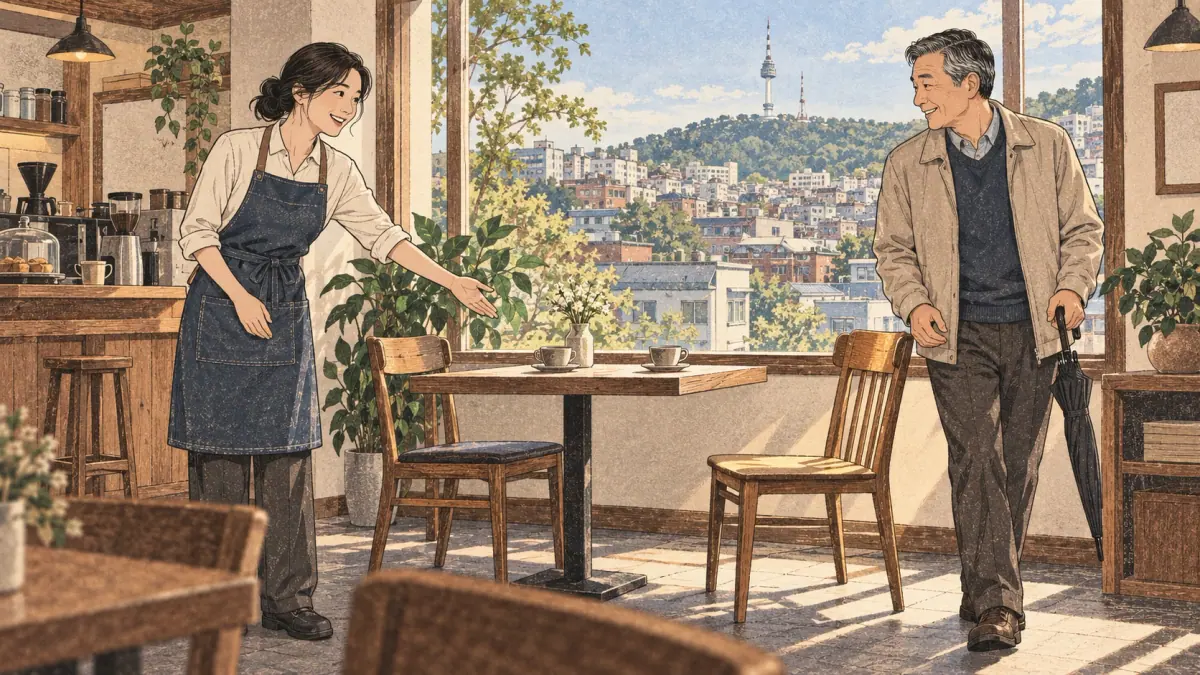
The same form also describes a person. 선생님이 오세요 (seonsaengnimi oseyo) means "The teacher is coming." The speaker is not giving an order; the speaker reports what a respected person does. The sections below show how to build the ending and how to tell the two meanings apart. First comes the formation rule.
How Do You Form -(으)세요?
-(으)세요 is formed by dropping 다 from the dictionary form of a verb and adding -세요 or -으세요, depending on the last sound of the stem. A stem that ends in a vowel takes the short form, and a stem that ends in a consonant takes the form with 으.
| Dictionary form | Stem | Ending added | Result | Romanization | Meaning |
|---|---|---|---|---|---|
| 가다 | 가 | -세요 | 가세요 | gaseyo | Please go. / He or she goes. |
| 오다 | 오 | -세요 | 오세요 | oseyo | Please come. |
| 하다 | 하 | -세요 | 하세요 | haseyo | Please do it. |
| 앉다 | 앉 | -으세요 | 앉으세요 | anjeuseyo | Please sit. |
| 읽다 | 읽 | -으세요 | 읽으세요 | ilgeuseyo | Please read. |
| 만들다 | 만들 | ㄹ dropped, -세요 | 만드세요 | mandeuseyo | Please make it. |
The table shows one pattern with two endings. The honorific 시 is hidden inside 세요, because -(으)시- plus -어요 has merged into 세요. The next parts take each stem type in turn.
Stems Ending in a Vowel
A vowel stem takes -세요 directly: 가다 becomes 가세요, 보다 becomes 보세요, and 쉬다 becomes 쉬세요.
- 어서 오세요. (eoseo oseyo.) = "Welcome." (Literally, "Please come quickly.")
- 안녕히 가세요. (annyeonghi gaseyo.) = "Goodbye." (Said to the person who is leaving.)
The greeting 안녕하세요 comes from the same pattern. It is 안녕하다 ("to be at peace") plus -세요, which originally asked "Are you at peace?" Today it is a fixed greeting, so you do not need to answer the literal question.
Stems Ending in a Consonant
A consonant stem takes -으세요, with 으 as a linking vowel: 앉다 becomes 앉으세요, and 읽다 becomes 읽으세요. The final consonant of the stem moves to the next syllable when you speak: 앉으세요 sounds like [안즈세요], and 먹으세요 sounds like [머그세요]. The pronunciation follows the 국립국어원 standard pronunciation rules (표준 발음법), which move a final consonant onto a following vowel.
- 이 책을 읽으세요. (i chaegeul ilgeuseyo.) [이 채글 일그세요] = "Please read this book."
- 괜찮으세요? (gwaenchaneuseyo?) [괜차느세요] = "Are you all right?"
In 괜찮으세요 the ㅎ of 괜찮 is silent before a vowel, so the Revised Romanization writes gwaenchaneuseyo. The second example is an adjective used as an honorific question, not as a command.
Do ㄹ-Stems and Irregular Verbs Change?
ㄹ-stems drop their ㄹ before -세요, because the ending begins with ㅅ. Verbs with a final ㄹ follow a regular rule in Korean: the ㄹ disappears before an ending that starts with ㄴ, ㅂ or ㅅ. Other irregular verbs change as before any ending that starts with 으.
| Type | Dictionary form | Result | Note |
|---|---|---|---|
| ㄹ-stem | 만들다 | 만드세요 | ㄹ drops before ㅅ |
| ㄹ-stem | 살다 | 사세요 | 사세요 can also mean "Please buy" (from 사다) |
| ㄹ-stem | 열다 | 여세요 | ㄹ drops |
| ㄷ-irregular | 듣다 | 들으세요 | ㄷ becomes ㄹ before 으 |
| ㅂ-irregular | 돕다 | 도우세요 | ㅂ becomes 우 before 으 |
| ㅅ-irregular | 짓다 | 지으세요 | ㅅ drops before 으 |
| 르-verb | 부르다 | 부르세요 | keeps its stem; no change |
These forms come from the site's conjugation engine, which follows the standard rules. With a ㄹ-stem the form can match another verb: 사세요 is both "Please live" (살다) and "Please buy" (사다), and context settles it. With the formation clear, the special verbs come next.
Which Verbs Have Special Honorific Forms?
Some common verbs replace the regular honorific with a separate verb. The special verb then takes -(으)세요 in the normal way.
| Plain verb | Special honorific | Polite form | Meaning |
|---|---|---|---|
| 먹다 / 마시다 | 드시다 | 드세요 | eat / drink |
| 자다 | 주무시다 | 주무세요 | sleep |
| 있다 (be in a place) | 계시다 | 계세요 | be (located) |
| 말하다 | 말씀하시다 | 말씀하세요 | speak |
For possession, 있다 keeps its regular form: 펜 있으세요? (pen isseuseyo?) [펜 이쓰세요] means "Do you have a pen?" For a person's location, use 계세요: 선생님 계세요? means "Is the teacher in?" The negative of 계시다 is 안 계세요, and the negative of possession is 없으세요 ([업쓰세요]). The special form is always more respectful than the plain one: 드세요 is warmer than 먹으세요, although both are correct.
Worked Example: Building a Sentence with -(으)세요
-(으)세요 grammar works by turning a plain verb into a respectful request. Follow the steps for the sentence "Please read this book."
- Start with the dictionary form. The verb is 읽다 (to read).
- Drop 다 to find the stem. The stem is 읽. It ends in a consonant (the cluster ㄺ).
- Choose the ending. A consonant stem takes -으세요, so you get 읽으세요.
- Decide if it is a command or a description. You are speaking to the reader, so it is a command: "Please read."
- Add the object. 이 책을 읽으세요. (i chaegeul ilgeuseyo.) [이 채글 일그세요] = "Please read this book."
Sentence
Please read this book.
Show answer
이 책을 읽으세요
You will know it worked when the ending is -세요 or -으세요 and the sentence sounds like a polite instruction. The most common slip is using -아요/어요 out of habit: 읽어요 is correct Korean, but it does not show respect to the person who acts. The next question is when the ending can appear in different tenses and sentence types.
Which Tenses and Sentence Types Work with -(으)세요?
-(으)세요 works in the present, as a command, a statement or a question. For the past, the honorific moves earlier in the word: -(으)셨어요. The command meaning needs an action verb, but the honorific meaning also works with adjectives and 이다.
| Use | Form | Example |
|---|---|---|
| Command | verb + -(으)세요 | 앉으세요. (Please sit.) |
| Honorific statement | verb or adjective + -(으)세요 | 할아버지는 신문을 읽으세요. (Grandfather reads the newspaper.) |
| Honorific question | verb or adjective + -(으)세요? | 어디 가세요? (Where are you going?) |
| Past honorific | -(으)셨어요 | 어제 오셨어요. (He or she came yesterday.) |
| Prohibition | -지 마세요 | 여기에서 사진을 찍지 마세요. (Please do not take photos here.) |
| Noun | noun + (이)세요 | 선생님이세요. (He or she is a teacher.) |
The prohibition is covered in -지 마세요. The sentence 이름이 어떻게 되세요? (ireumi eotteoke doeseyo?) [이르미 어떠케 되세요] = "What is your name?" is a polite set question built on 되다. Adjectives never give commands: 예쁘세요 can only describe or compliment, and 건강하세요 is a fixed wish ("Please stay healthy").
For intonation, a yes/no question usually rises at the end: 지금 가세요? ↗. A question with a question word, such as 어디 가세요?, puts the stress on 어디 and usually ends with a fall or a rise-fall, not a sharp rise. A sharp final rise can turn 어디 into "somewhere". A command ends with a gentle fall. The pattern has close neighbours that learners confuse with it.
How Is -(으)세요 Different from -(으)십시오 and -아/어 주세요?
-(으)세요 is the everyday polite command, -(으)십시오 is the formal one, and -아/어 주세요 asks for a favour. All three contain the honorific, but each fits a different situation.
| Point | -(으)세요 | -(으)십시오 | -아/어 주세요 |
|---|---|---|---|
| Meaning | please do | please do (formal) | please do it for me |
| Speech level | polite | formal | polite |
| Typical places | daily talk, shops, hosts | signs, announcements | requests to someone |
| Who benefits | the listener or no one | the listener | the speaker |
| Example | 앉으세요. | 앉으십시오. | 앉아 주세요. |
Compare 문을 닫으세요 with 문을 닫아 주세요. The first is an instruction ("Close the door"), often given by someone in charge or as general advice. The second asks the listener to do the speaker a favour ("Please close the door for me"). The word 주다 means "to give", so the action benefits the speaker. The full contrast is covered in -(으)십시오, in -아/어 주세요 and in the comparison -(으)세요 vs -아/어 주세요. A fourth neighbour is the ordinary polite present: -(으)세요 vs -아요/어요 shows when to add the honorific. These contrasts lead to a few variations in how the ending is used.
Variations and Edge Cases of -(으)세요
-(으)세요 has four common variations: set phrases, softeners, offers and a more polite question. Each one shows how real speakers use it.
- Set phrases. 안녕하세요, 어서 오세요, 안녕히 가세요 and 안녕히 계세요 are the ones you hear every day. 안녕히 가세요 is said to the person who leaves, and 안녕히 계세요 to the person who stays.
- Softeners. Adding 좀 ("a little") or 천천히 ("slowly") makes the command gentler: 좀 앉으세요 ("Please, do sit").
- Offers at a table. A host says 많이 드세요 ("Please eat a lot"), and a guest replies 잘 먹겠습니다 (jal meokgetseumnida) [잘 먹겓씀니다] before eating.
- A more polite question. To ask what someone would like, -(으)시겠어요? sounds more careful than -(으)세요?: 뭐 드시겠어요? See -(으)시겠어요?.
This lesson covers the ending itself. The honorific marker -(으)시- has its own page on honorific -(으)시-. For the wider picture, see Korean Speech Levels. The mistakes below are the ones that appear most often.
What Mistakes Do Learners Make with -(으)세요?
Learners most often confuse the subject, the stem and the register. Four mistakes appear again and again.
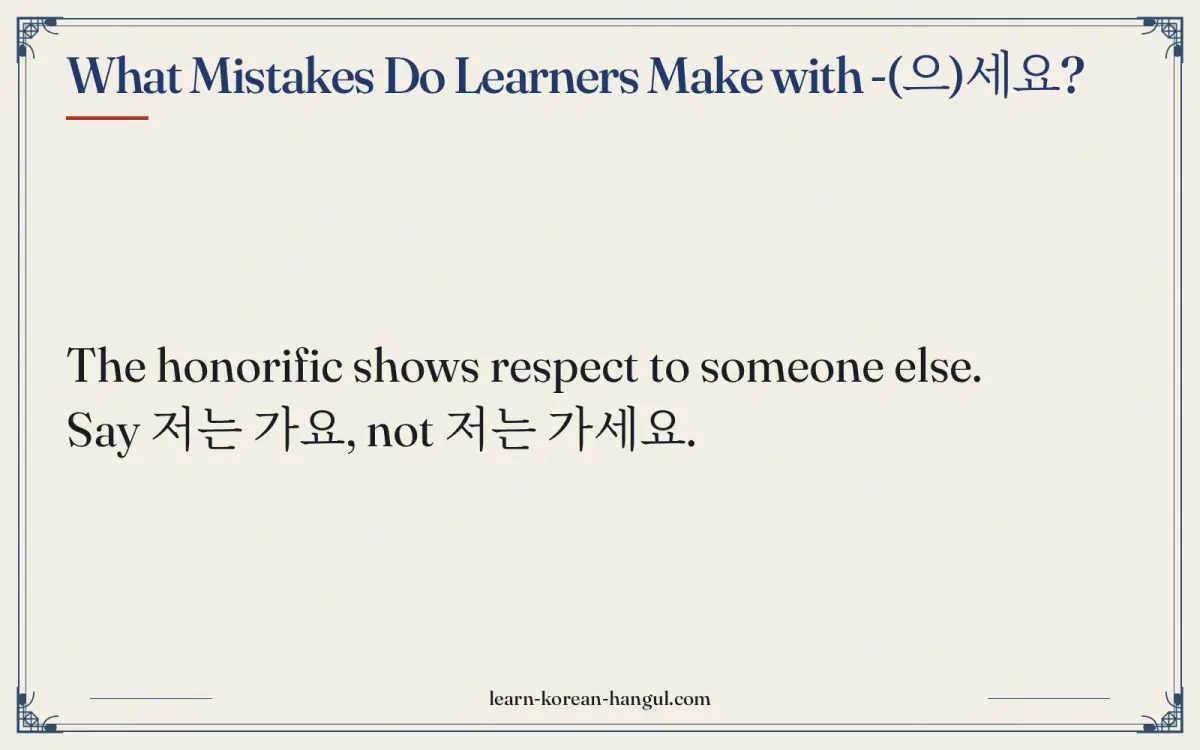
- Using it for yourself. 저는 학교에 가세요 is wrong. The honorific never marks the speaker. Say 저는 학교에 가요.
- Thinking it is rude. Learners sometimes avoid it because English "do this" sounds blunt. The Korean ending is polite. The blunt plain command is -아/어라, which would be rude to an adult you respect.
- Adding 으 to a vowel stem. 가으세요 is wrong. The vowel stem 가 takes 세요 directly.
- Keeping the ㄹ. 만들으세요 and 만들세요 are both wrong. The ㄹ drops, giving 만드세요.
A quick check: Is the person who acts someone you respect or are speaking to? Is the stem handled correctly (vowel, consonant, ㄹ)? Does the verb have a special honorific form? If all three answers are yes, the sentence is sound.
The practice set below tests these points directly.
Practice and Answers
Try the four items before you read the answer key. Cover the answers with your hand.
- Choose the form. Complete: 여기에 ___. (앉세요 / 앉으세요)
- Fix the error. A learner writes 만들으세요 for "Please make it." Correct it.
- Translate. "Please eat slowly." Use the special honorific verb for 먹다.
- Choose the verb. Which asks "Is the teacher in?": 선생님 있으세요? or 선생님 계세요?
Practice · 5
Which form completes 여기 ___. ("Please sit here.")
Show answer
앉으세요
The stem 앉 ends in a consonant, so 으 links the ending: 앉으세요, said [안즈세요].
A host says 많이 드세요. What does it mean?
Show answer
Please eat a lot.
드세요 is the honorific form of 먹다 and 마시다. The plain 먹으세요 is also correct but less respectful.
Which is the correct -(으)세요 form of 만들다?
Show answer
만드세요
The ㄹ of a ㄹ-stem drops before ㅅ, so 만들다 becomes 만드세요.
How do you ask a teacher politely whether he has a pen (possession)?
Show answer
선생님, 펜 있으세요?
있으세요 is used for possession. 계세요 is used for a person's location, such as 선생님 계세요? ("Is the teacher in?").
Which sentence is wrong?
Show answer
저는 학교에 가세요.
The honorific never marks the speaker. Say 저는 학교에 가요.
Answer key
- 앉으세요. The stem 앉 ends in a consonant, so 으 links the ending: 여기에 앉으세요.
- 만드세요. The ㄹ of 만들 drops before the ㅅ of 세요.
- 천천히 드세요. The special honorific of 먹다 is 드시다, which gives 드세요.
- 선생님 계세요? 계세요 describes where a person is. 있으세요 describes possession.
If you can complete items 1 to 3 without the key, you can use -(으)세요 in everyday speech. The final section points to the next lessons.
What Should You Learn Next after -(으)세요 Grammar?
After -(으)세요 grammar, learn the favour request, then the formal command. This lesson teaches the polite command and the honorific present and does not cover the formal level, the past honorific or the favour pattern in depth. Those live on separate pages.
- Learn -아/어 주세요, the standard polite request for a favour.
- Learn -(으)십시오, the formal command for signs and announcements.
- Read Suggestions and Requests for every suggestion and request ending in one place.
- Return to the Beginner Grammar list for the other patterns at this level.
TOPIK is the official Korean proficiency test, and the level shown here is an editorial estimate; the official descriptions are on topik.go.kr. With these steps, the choice becomes automatic: use -(으)세요 for polite commands and respectful descriptions, and add 주다 when you want a favour.
Frequently Asked Questions
What does -(으)세요 mean?
-(으)세요 has two jobs. As a command it means "please do," as in 앉으세요 ("Please sit down"). As an honorific statement or question it describes what a respected person does, as in 선생님이 오세요 ("The teacher is coming"). The speaker uses it to show respect, and the situation tells you which job it has.
How do I attach -(으)세요 to a verb or adjective?
Drop 다 from the verb. After a vowel stem add -세요: 가다 becomes 가세요. After a consonant stem add -으세요: 앉다 becomes 앉으세요. A stem ending in ㄹ drops it: 만들다 becomes 만드세요. Irregular stems follow the usual rules: 듣다 becomes 들으세요, and 돕다 becomes 도우세요.
How can I tell a command from an honorific statement?
Look at the subject and the situation. If you are speaking to the person who should act, it is a command: 여기 앉으세요. If the subject is a respected third person, or the sentence is a question about the listener's habit, it is an honorific present: 할아버지는 신문을 읽으세요. Adjectives never form commands.
Which verbs have special honorific forms?
The common ones are 먹다 and 마시다, which become 드세요 or 잡수세요, 자다, which becomes 주무세요, and 있다, which becomes 계세요 for a person's location. Possession keeps 있으세요. 말하다 becomes 말씀하세요. These forms replace the regular -(으)세요 form, so 먹으세요 is correct but less respectful than 드세요.
Is -(으)세요 a rude order?
No. It is a polite command used with strangers, customers and elders, and it often sounds like a gentle invitation, as in 어서 오세요 ("Welcome"). The blunt plain command is -아/어라, as in 먹어라, used by parents to children or in writing. Adding 좀 or 천천히 makes -(으)세요 sound softer still.