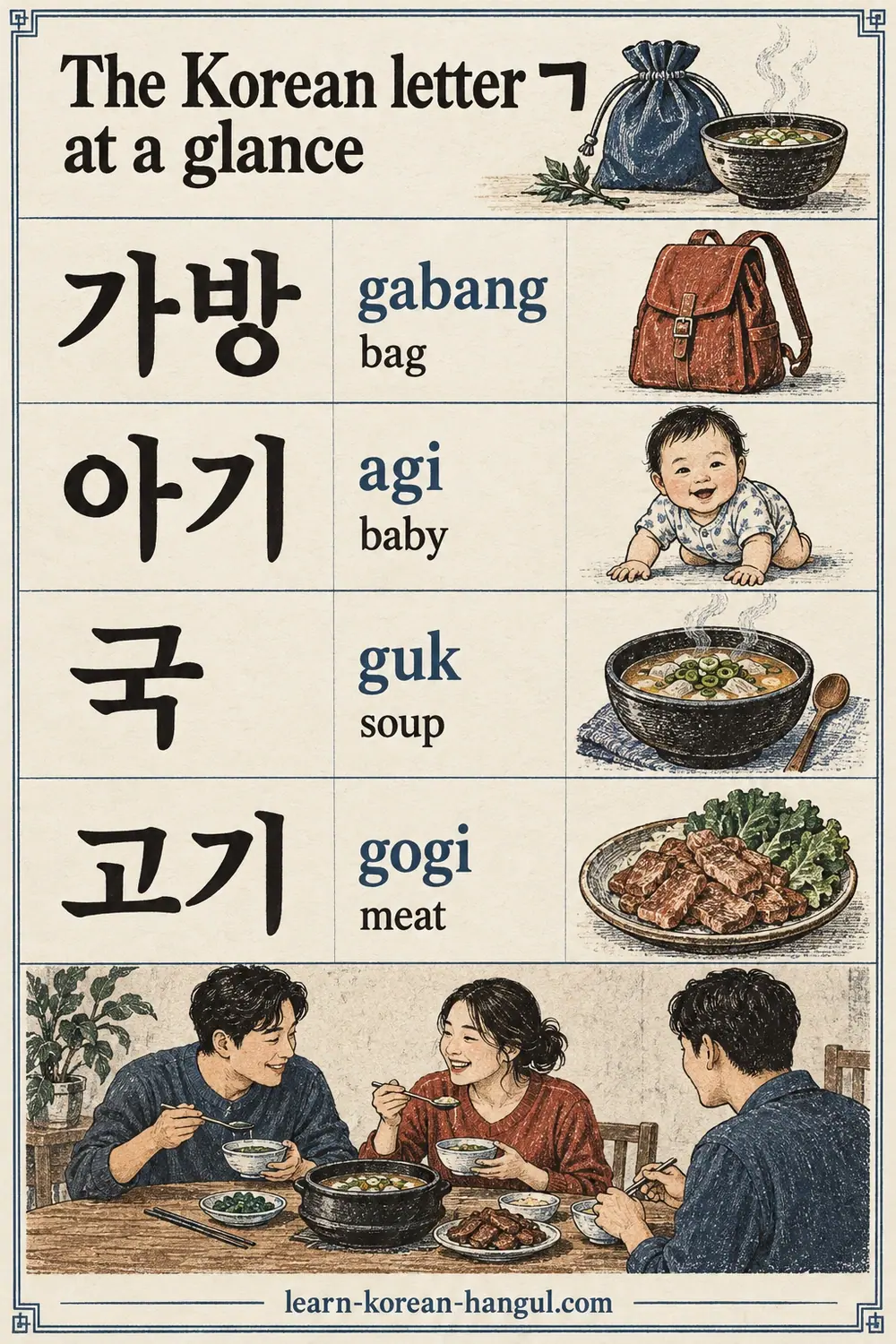
What you'll learn
- Say the letter name 기역 and the three positional sounds of ㄱ, using 가방, 아기 and 국.
- Write ㄱ in one stroke and adjust its corner for 가 and 고.
- Read the syllables 가, 고, 기 and 국 aloud without adding an extra vowel.
- Tell ㄱ apart from ㅋ and ㄲ by ear and with a breath test.
- Prerequisites: the vowel lesson for ㅏ. Estimated time: 15 minutes.
The Korean Letter ㄱ at a Glance
The Korean letter ㄱ is the first consonant in South Korean dictionary order and one of the 14 basic consonants listed in the Hangul Orthography (한글 맞춤법, Article 4) of the National Institute of Korean Language (국립국어원). On this site it is the first of the basic Korean consonants you learn after the six simple vowels.
| Attribute | Value |
|---|---|
| Letter | ㄱ |
| Name | 기역 (giyeok) |
| Revised Romanization | g before a vowel, k at the end of a syllable |
| Sound family | velar stop: the back of the tongue touches the soft palate |
| Strokes | 1 |
| Final sound (batchim) | unreleased [k] |
| Partner letters | ㅋ (aspirated), ㄲ (tense) |
| Keyboard key (Dubeolsik) | R |
The name 기역 is irregular. Most consonant names follow the pattern consonant + 이, consonant + 으 + consonant, for example 니은 for ㄴ. The pattern would give 기윽. The name 기역 comes from Choe Sejin's 1527 textbook Hunmong Jahoe (훈몽자회), which wrote letter names with Chinese characters and had no character read 윽. South Korea kept 기역, while North Korea uses 기윽. The page on the names of the Korean consonants explains the full pattern.
The shape of ㄱ is a picture of the tongue. The 1446 commentary Hunminjeongeum Haerye (훈민정음 해례) says ㄱ shows the root of the tongue blocking the throat. Adding a stroke makes ㅋ, a stronger, breathier version of the same sound. That design logic leads straight into the question of what ㄱ actually sounds like.
What Sound Does ㄱ Make?

ㄱ makes one sound with three positional versions: a light, almost breathless k at the start of a word, a voiced g between vowels, and an unreleased k at the end of a syllable. Linguists call these versions allophones, which means different pronunciations of one sound that never change a word's meaning.
| Position | Example | Pronunciation | What you hear |
|---|---|---|---|
| Start of a word | 가방 (gabang, bag) | [가방] | light k, much less breath than English "k" |
| Between vowels | 아기 (agi, baby) | [아기] | soft g, as in English "again" |
| After ㄴ, ㅁ, ㅇ or ㄹ | 한국 (Hanguk, Korea) | [한국] | soft g |
| End of a syllable | 국 (guk, soup) | [국] | k with the tongue held, no puff of air |
To make the sound, raise the back of your tongue against the soft part of the roof of your mouth, then let it go gently. Keep your throat relaxed and push very little air. If you hold a hand in front of your mouth, you should feel only a small breath on 가.
Why Does ㄱ Sound Like G in 아기 but K in 가방?
ㄱ sounds like g in 아기 because the vocal cords keep vibrating between two vowels, and that vibration turns the light k into a g. At the start of 가방 nothing comes before ㄱ, so the vocal cords are still and you hear a k-like sound. Korean speakers think of both as the same letter, just as English speakers hear the "t" in "top" and "stop" as one letter even though only the first has a puff of air.
The same rule explains 고기 (gogi, meat), [고기]. The first ㄱ sits at the start of the word and sounds close to k. The second sits between ㅗ and ㅣ and sounds like g. Revised Romanization writes both as g because it follows the spelling of the letter before a vowel, not the exact sound.
Once you can hear these versions, the next step is putting the letter on paper.
How Do You Write ㄱ?
ㄱ is written in one stroke: draw a horizontal line from left to right, then turn the corner and pull the line down without lifting your pen. The consonant stroke order lesson shows ㄱ next to the other 18 consonants so you can see the shared rules.
Practise on Paper
- Start at the top left. Draw a short horizontal line to the right.
- Without lifting the pen, turn at the corner and draw down.
Stroke Order: 1 Stroke
- Start at the top left. Draw a short horizontal line to the right.
- Without lifting the pen, turn at the corner and draw down.
The angle of the down stroke depends on the vowel. When ㄱ sits to the left of a tall vowel, as in 가 or 기, the down stroke sweeps slightly down and to the left, so the letter is narrow and tall. When ㄱ sits above a flat vowel, as in 고 or 구, the down stroke drops almost straight, and the letter is wider and shorter. Printed fonts show the same difference: compare the ㄱ in 가 with the ㄱ in 고 on this page.
A common handwriting habit is to curl the end of the down stroke back into a hook, like the bottom of a J. Keep the end straight or only slightly curved. With the shape in hand, you can follow ㄱ as it moves around the syllable block.
How Does ㄱ Change at the Start, Middle and End?
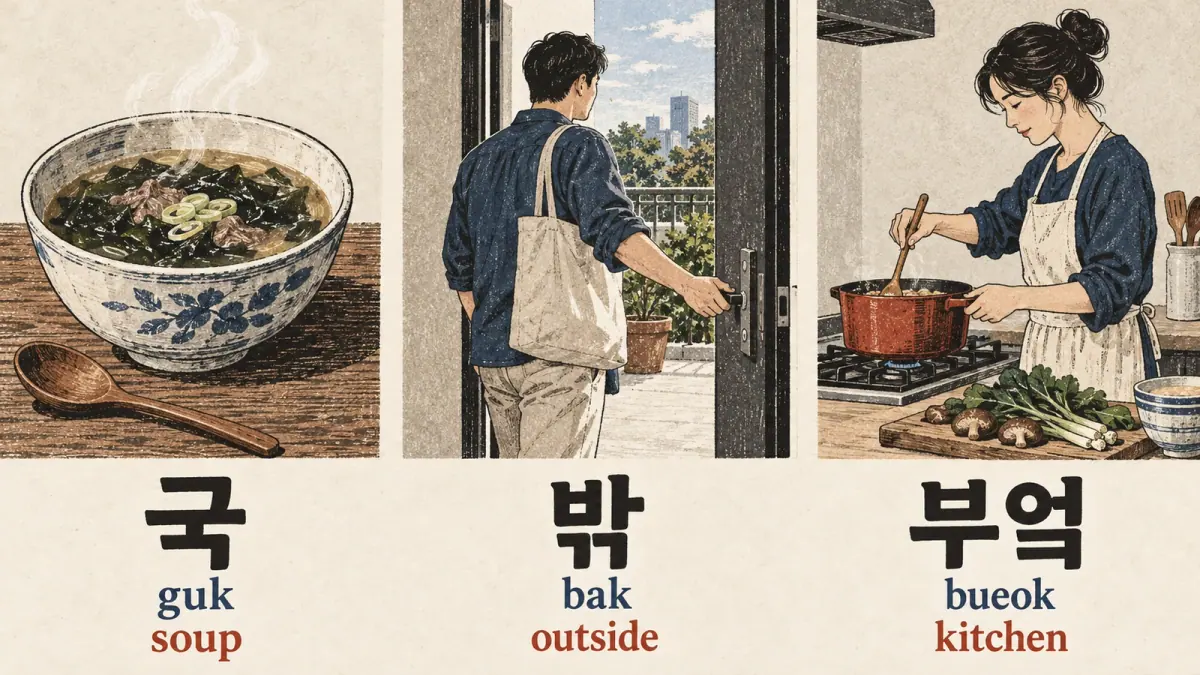
ㄱ changes with its position in the word: it is a light [k] at the start, a voiced [g] between vowels or after ㄴ, ㅁ, ㅇ and ㄹ, and an unreleased [k] when it closes a syllable. The written letter never changes. Only the sound does.
| Position in the block | Example | Written | Said | Romanized |
|---|---|---|---|---|
| Initial, word start | 고기 | 고 | [ko] | go |
| Initial, between vowels | 아기 | 기 | [gi] | gi |
| Final (batchim) | 국 | 국 | [kuk̚] | guk |
| Final, before a vowel | 국이 | 국이 | [구기] | gugi |
The last row shows a useful rule. When a syllable ending in ㄱ is followed by a syllable that starts with the silent ㅇ, the ㄱ slides over and is said at the start of the next syllable. So 국이 (soup + subject particle) is said [구기], with a soft g.
ㄱ as a Final Consonant (batchim)
A consonant written at the bottom of a block, like ㄱ in 국, is called a batchim (받침, "support"). As a batchim, ㄱ is pronounced [k] with the tongue held against the soft palate and no release. Your mouth closes the sound and stops; no "uh" follows.
Three letters share this final [k]: ㄱ, ㄲ and ㅋ. The two clusters ㄳ and ㄺ usually end as [k] too. The Standard Pronunciation Rules (표준 발음법, Article 9) set this rule for ㄲ and ㅋ, as these words show:
- 국 (guk, soup) is said [국].
- 밖 (bak, outside) is spelled with ㄲ but said [박].
- 부엌 (bueok, kitchen) is spelled with ㅋ but said [부억].
This is one of the seven final sounds of Korean: every batchim is pronounced as ㄱ, ㄴ, ㄷ, ㄹ, ㅁ, ㅂ or ㅇ. Final ㄱ also changes before ㄴ or ㅁ. In 국물 (gungmul, broth) the final ㄱ becomes [ㅇ], so the word is said [궁물], and 한국말 (Hangungmal, the Korean language) is said [한궁말]. You will meet this in the nasalization rule (국물 = [궁물]); for now, just notice that the spelling stays 국물.
These position rules come together when you read real syllables, so the next section walks through four of them.
Worked Example: Reading 가, 고, 기, 국

Reading a block with ㄱ takes three steps: find the consonant, find the vowel, then decide whether ㄱ also closes the syllable. Here is the full process for four blocks.
- 가. ㄱ sits on the left, and the tall vowel ㅏ sits on the right. Say a light k, then "ah": [가]. Romanized ga.
- 고. ㄱ sits on top, and the flat vowel ㅗ sits underneath. Round your lips for ㅗ before you release ㄱ: [고]. Romanized go.
- 기. ㄱ sits left of the tall vowel ㅣ. Say a light k, then "ee": [기]. Do not add a puff of air, or it will sound like 키. Romanized gi.
- 국. ㄱ sits on top, ㅜ in the middle, and a second ㄱ at the bottom as the batchim. Say a light k, then "oo", then close the back of your tongue and stop: [국]. Romanized guk.
Check yourself with the audio. If your 국 sounds like "goo-kuh", you released the final ㄱ. Try again and keep the tongue pressed until the sound fades. The trickiest part of these blocks is keeping ㄱ apart from its two partner letters, which the next section covers.
ㄱ Compared with ㅋ and ㄲ
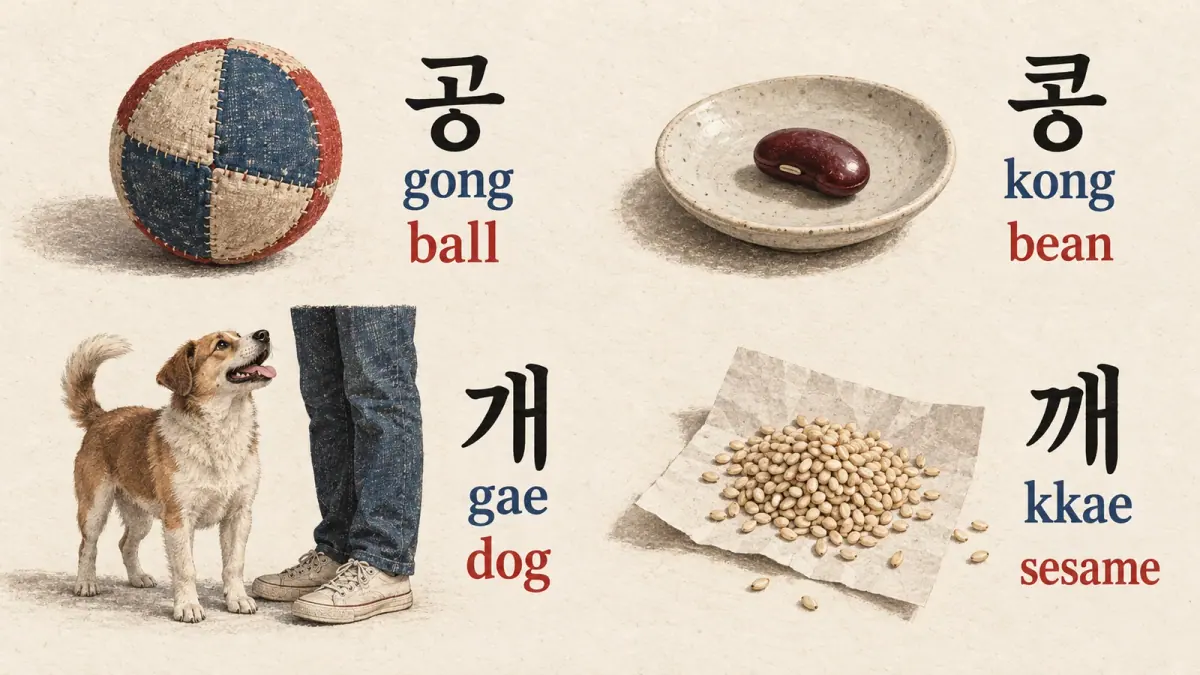
ㄱ, ㅋ and ㄲ are three versions of one tongue position that differ in breath and tension. ㄱ is plain (light breath), ㅋ is aspirated (a strong puff of air), and ㄲ is tense (a tight throat and no puff). Korean uses this three-way contrast to tell words apart, so 공 (ball) and 콩 (bean) are different words.
Paper Test: ㅋ Moves the Paper, ㄱ Barely, ㄲ Not at All
| Korean | Romanization | Meaning | Sound |
|---|---|---|---|
| 가 | ga | syllable ga | |
| 카 | ka | syllable ka | |
| 까 | kka | syllable kka |
| Letter | Type | Breath | Throat | Example word |
|---|---|---|---|---|
| ㄱ | plain (lenis) | small puff | relaxed | 공 (gong, ball), 개 (gae, dog) |
| ㅋ | aspirated | strong puff | relaxed | 콩 (kong, bean) |
| ㄲ | tense | no puff | tight | 깨 (kkae, sesame) |
Try the paper test. Hold a strip of thin paper about 3 cm in front of your lips. Say 카: the paper should jump. Say 가: it should move only a little. Say 까: it should stay still while your throat feels tight. Seoul speakers also tend to say the vowel after ㄱ with a lower pitch than the vowel after ㅋ or ㄲ, so listen for pitch as well as breath.
Compare the full lessons on the letter ㅋ (Kieuk) and the letter ㄲ (Ssanggiyeok) once you finish the basic set. Knowing the contrast also explains most of the mistakes learners make with ㄱ.
Common Mistakes with ㄱ
Four mistakes cause most ㄱ problems, and each has a simple fix.
- Reading ㄱ as a hard English g at the start of 가방. A strongly voiced English g makes Korean listeners hear an accent. Fix: start 가방 almost like "kah", with a relaxed throat and only a small breath.
- Aspirating ㄱ so 기 sounds like 키. 키 means "height", so 기 with a big puff of air can become a different word. Fix: use the paper test and aim for a small movement.
- Releasing final ㄱ in 국 as "gu-kuh". English speakers often add a small vowel after a final k. Fix: hold the back of the tongue up at the end and let the sound stop.
- Writing ㄱ with a curved hook like a 7. A hooked ㄱ is hard to read in small handwriting. Fix: end the down stroke straight, or with a slight leftward sweep when a tall vowel such as ㅏ follows.
Is ㄱ the Same as the English Letter?
No. ㄱ is not the same as either English g or English k. Learners often assume ㄱ has two letters' worth of sounds; actually it is one plain (lenis) sound, /k/, and the neighbouring sounds decide whether you hear it as k or g. English g is voiced at the start of words ("go"), and English k has a strong puff of air ("kite"). Korean ㄱ at the start of a word has neither, which is why it seems to sit between them.
Romanization adds to the confusion. Revised Romanization (국어의 로마자 표기법, 2000) writes ㄱ as g before vowels and k at the end, so 한국 is Hanguk. These are spelling aids for road signs and names, not exact pronunciation guides. Reading the Hangul directly avoids the problem, and the exercises below help you practise exactly that.
Practice: Four Quick Exercises

Try each exercise before you check the answers at the end of this section. You can also run them as an interactive quiz.
Practice · 8
What is the name of the letter ㄱ in South Korea?
Show answer
기역
South Korea keeps the irregular name 기역 from the 1527 Hunmong Jahoe; 기윽 is the North Korean name.
How does ㄱ sound between two vowels, as in 아기?
Show answer
A soft, voiced g
Between vowels the vocal cords keep vibrating, so ㄱ is heard as a soft g.
How is ㄱ pronounced as a final consonant (batchim), as in 국?
Show answer
An unreleased [k] with the tongue held
As a batchim, ㄱ is a [k] with the tongue held against the soft palate and no release.
How many strokes does ㄱ take to write?
Show answer
1
ㄱ is one stroke: a horizontal line to the right that turns and goes down without lifting the pen.
Which word means "ball"?
Show answer
공
공 with plain ㄱ means ball; 콩 with aspirated ㅋ means bean, and 깨 means sesame.
How is 국이 (soup + subject particle) said?
Show answer
[구기]
Before a syllable starting with silent ㅇ, the final ㄱ slides over to the next syllable, so 국이 is said [구기].
In the paper test, which syllable should make the paper jump?
Show answer
카
ㅋ is aspirated with a strong puff, so 카 moves the paper; 가 barely moves it and 까 not at all.
How is 부엌 (kitchen) pronounced?
Show answer
[부억]
ㄱ, ㄲ and ㅋ all end as the same final [k], so 부엌 is said [부억].
- Listen and choose. Which word means "ball": 공 or 콩? Which means "sesame": 개 or 깨?
- Read aloud. Read 고기, 아기, 가구 (gagu, furniture) and 국. For each ㄱ, say whether you hear a k-like or g-like sound.
- Write the block. Build and write these blocks: ㄱ + ㅓ, ㄱ + ㅡ, ㄱ + ㅜ + ㄱ.
- Find the final. In 한국, 학교 and 고기, which ㄱ is a batchim, and how is it pronounced?
Answers
- 공 means "ball" (콩 is "bean"). 깨 means "sesame" (개 is "dog").
- 고기: first ㄱ k-like, second g-like. 아기: g-like. 가구: first k-like, second g-like. 국: first k-like, final ㄱ an unreleased [k].
- ㄱ + ㅓ = 거, ㄱ + ㅡ = 그, ㄱ + ㅜ + ㄱ = 국.
- In 한국, the last ㄱ is a batchim, said [k]. In 학교, the ㄱ under 학 is a batchim, said [k], and it makes the next ㄱ tense: [학꾜]. 고기 has no batchim.
If you got all four right, you are ready to move on.
What Should You Learn after ㄱ?
After the Korean letter ㄱ, learn The Korean Letter ㄴ (Nieun), the next consonant in the course. ㄴ is a nasal sound, and its shape is the starting point for ㄷ and ㅌ, so it builds directly on what you learned about stroke-based families here.
For review, use the Hangul flashcard decks daily for a few minutes, test your recognition in the Hangul quizzes, and play every consonant in the interactive Hangul alphabet. For handwriting, print the Korean consonants writing practice sheet. To see where ㄱ sits among the 19 consonant letters, open all Korean consonants.
What this lesson does not cover: the full rules for tensification (학교 [학꾜]) and nasalization (국물 [궁물]), and final consonant clusters such as ㄺ in 닭. Those rules live in the pronunciation section, linked above, so this page stays focused on reading and writing the single letter ㄱ.
Frequently Asked Questions
Is ㄱ pronounced g or k? ㄱ is one Korean sound that English speakers hear as either g or k. At the start of a word it is a light k with little breath, as in 가방. Between vowels it softens to g, as in 아기. At the end of a syllable it is a k with the tongue held in place, as in 국.
Why is ㄱ called 기역 and not 기윽? Most consonant names follow the pattern consonant + 이, consonant + 으 + consonant, which would give 기윽. The name 기역 comes from Choe Sejin's 1527 textbook Hunmong Jahoe, which spelled the names with Chinese characters and had no character for 윽. South Korea kept 기역; North Korea uses 기윽.
How do you type ㄱ on a Korean keyboard? On the standard Korean keyboard layout (Dubeolsik, the 2-set layout), ㄱ is on the key marked R. Press Shift and R together to type the double letter ㄲ. After you switch your computer or phone to Korean input, typing R then K produces the block 가, because ㅏ sits on the K key.
Why does 학교 sound like hak-kyo? 학교 is spelled with ㄱ twice, but the second ㄱ is said tense, like ㄲ, so the word sounds like [학꾜]. Korean makes a plain consonant tense when it follows a final [k], [t] or [p]. Revised Romanization still writes the spelling, hakgyo, so do not copy the romanization when you speak.
How long does it take to learn the Korean letter ㄱ? Most beginners can recognise, write and pronounce the Korean letter ㄱ in about 15 minutes with this lesson. The final-sound and tense-sound details take longer to hear reliably. A few days of short review with flashcards and the audio rows is a typical time to stop confusing ㄱ with ㅋ.